SUBSCRIBE TO OUR FREE NEWSLETTER
Daily news & progressive opinion—funded by the people, not the corporations—delivered straight to your inbox.
5
#000000
#FFFFFF
To donate by check, phone, or other method, see our More Ways to Give page.
Daily news & progressive opinion—funded by the people, not the corporations—delivered straight to your inbox.
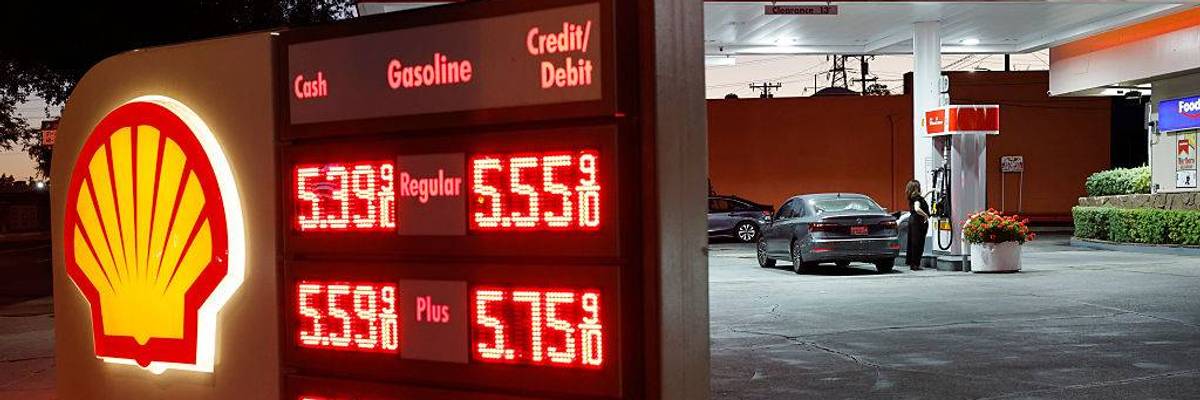
A customer stands near gas prices displayed at a gas station on July 7, 2026 in Pasadena, California.
The latest supply crunch comes at a time when "US gasoline inventories have become critically low," said one analyst.
President Donald Trump's decision to restart his illegal war with Iran has sent the price of oil back up, leading to a corresponding rise in the prices of gasoline and diesel fuel.
Data published by AAA on Thursday showed that the average price of diesel in the US is once again over $5 per gallon, which is 33% higher than the average price of diesel before Trump unlawfully attacked Iran without congressional authorization in February.
Oil industry analyst Patrick De Haan wrote in a Thursday social media post that diesel fuel powers "the trucks that move nearly everything you buy—groceries, goods, supplies," meaning the current spike will lead to "higher prices down the line" for other key goods.
According to a Thursday report in The Wall Street Journal, the rise in diesel prices is unlikely to be short-lived given that there are now multiple factors pushing costs higher.
In addition to the resumption of the Iran war, the Journal writes, Russia has now banned diesel exports after its refineries came under attack by Ukraine. And in the US, domestic stockpiles of the fuel have now fallen to their lowest levels in 20 years.
Given all these factors, analysts told the Journal that diesel prices "could soon climb an additional 20 to 25 cents a gallon."
An analysis published on Thursday by CNN Business senior reporter David Goldman pointed to another factor pushing diesel prices higher: Global refining capacities have taken a significant hit since the start of the Iran war.
Goldman noted that Iran has "damaged or destroyed 30 Middle Eastern refineries" since the start of the conflict, causing global refinery output to fall by "3 million barrels at the peak of the Strait of Hormuz disruption, and 2.1 million barrels of refining capacity remain offline."
Energy analyst John Kemp said on Thursday that the diesel supply crunch will likely spill over to the price of regular gasoline in the coming weeks.
"US gasoline inventories have become critically low," Kemp explained in a social media post, "as domestic refiners prioritize production of jet fuel and diesel to replace global supplies hit by the closure of the Strait of Hormuz and Ukraine's escalating attacks on Russia's refineries."
Kemp added that the US gasoline stocks "have depleted in 13 of the last 16 weeks by a total of 43 million barrels" since the start of the war, making it "by far the largest [depletion] on record for the time of year, and three times faster than average over the last decade."
In an interview with Bloomberg published on Wednesday, International Energy Agency Executive Director Fatih Birol warned that renewed fighting between the US and Iran was again threatening to create a global fuel supply crisis that could come in "not months" but "weeks."
"If the Strait of Hormuz remains closed," Birol said, "we may again have some difficulty for global economies, including those in the region and developing nations and Asia."
Dear Common Dreams reader, It’s been nearly 30 years since I co-founded Common Dreams with my late wife, Lina Newhouser. We had the radical notion that journalism should serve the public good, not corporate profits. It was clear to us from the outset what it would take to build such a project. No paid advertisements. No corporate sponsors. No millionaire publisher telling us what to think or do. Many people said we wouldn't last a year, but we proved those doubters wrong. Together with a tremendous team of journalists and dedicated staff, we built an independent media outlet free from the constraints of profits and corporate control. Our mission has always been simple: To inform. To inspire. To ignite change for the common good. Building Common Dreams was not easy. Our survival was never guaranteed. When you take on the most powerful forces—Wall Street greed, fossil fuel industry destruction, Big Tech lobbyists, and uber-rich oligarchs who have spent billions upon billions rigging the economy and democracy in their favor—the only bulwark you have is supporters who believe in your work. But here’s the urgent message from me today. It's never been this bad out there. And it's never been this hard to keep us going. At the very moment Common Dreams is most needed, the threats we face are intensifying. We need your support now more than ever. We don't accept corporate advertising and never will. We don't have a paywall because we don't think people should be blocked from critical news based on their ability to pay. Everything we do is funded by the donations of readers like you. When everyone does the little they can afford, we are strong. But if that support retreats or dries up, so do we. Will you donate now to make sure Common Dreams not only survives but thrives? —Craig Brown, Co-founder |
President Donald Trump's decision to restart his illegal war with Iran has sent the price of oil back up, leading to a corresponding rise in the prices of gasoline and diesel fuel.
Data published by AAA on Thursday showed that the average price of diesel in the US is once again over $5 per gallon, which is 33% higher than the average price of diesel before Trump unlawfully attacked Iran without congressional authorization in February.
Oil industry analyst Patrick De Haan wrote in a Thursday social media post that diesel fuel powers "the trucks that move nearly everything you buy—groceries, goods, supplies," meaning the current spike will lead to "higher prices down the line" for other key goods.
According to a Thursday report in The Wall Street Journal, the rise in diesel prices is unlikely to be short-lived given that there are now multiple factors pushing costs higher.
In addition to the resumption of the Iran war, the Journal writes, Russia has now banned diesel exports after its refineries came under attack by Ukraine. And in the US, domestic stockpiles of the fuel have now fallen to their lowest levels in 20 years.
Given all these factors, analysts told the Journal that diesel prices "could soon climb an additional 20 to 25 cents a gallon."
An analysis published on Thursday by CNN Business senior reporter David Goldman pointed to another factor pushing diesel prices higher: Global refining capacities have taken a significant hit since the start of the Iran war.
Goldman noted that Iran has "damaged or destroyed 30 Middle Eastern refineries" since the start of the conflict, causing global refinery output to fall by "3 million barrels at the peak of the Strait of Hormuz disruption, and 2.1 million barrels of refining capacity remain offline."
Energy analyst John Kemp said on Thursday that the diesel supply crunch will likely spill over to the price of regular gasoline in the coming weeks.
"US gasoline inventories have become critically low," Kemp explained in a social media post, "as domestic refiners prioritize production of jet fuel and diesel to replace global supplies hit by the closure of the Strait of Hormuz and Ukraine's escalating attacks on Russia's refineries."
Kemp added that the US gasoline stocks "have depleted in 13 of the last 16 weeks by a total of 43 million barrels" since the start of the war, making it "by far the largest [depletion] on record for the time of year, and three times faster than average over the last decade."
In an interview with Bloomberg published on Wednesday, International Energy Agency Executive Director Fatih Birol warned that renewed fighting between the US and Iran was again threatening to create a global fuel supply crisis that could come in "not months" but "weeks."
"If the Strait of Hormuz remains closed," Birol said, "we may again have some difficulty for global economies, including those in the region and developing nations and Asia."
President Donald Trump's decision to restart his illegal war with Iran has sent the price of oil back up, leading to a corresponding rise in the prices of gasoline and diesel fuel.
Data published by AAA on Thursday showed that the average price of diesel in the US is once again over $5 per gallon, which is 33% higher than the average price of diesel before Trump unlawfully attacked Iran without congressional authorization in February.
Oil industry analyst Patrick De Haan wrote in a Thursday social media post that diesel fuel powers "the trucks that move nearly everything you buy—groceries, goods, supplies," meaning the current spike will lead to "higher prices down the line" for other key goods.
According to a Thursday report in The Wall Street Journal, the rise in diesel prices is unlikely to be short-lived given that there are now multiple factors pushing costs higher.
In addition to the resumption of the Iran war, the Journal writes, Russia has now banned diesel exports after its refineries came under attack by Ukraine. And in the US, domestic stockpiles of the fuel have now fallen to their lowest levels in 20 years.
Given all these factors, analysts told the Journal that diesel prices "could soon climb an additional 20 to 25 cents a gallon."
An analysis published on Thursday by CNN Business senior reporter David Goldman pointed to another factor pushing diesel prices higher: Global refining capacities have taken a significant hit since the start of the Iran war.
Goldman noted that Iran has "damaged or destroyed 30 Middle Eastern refineries" since the start of the conflict, causing global refinery output to fall by "3 million barrels at the peak of the Strait of Hormuz disruption, and 2.1 million barrels of refining capacity remain offline."
Energy analyst John Kemp said on Thursday that the diesel supply crunch will likely spill over to the price of regular gasoline in the coming weeks.
"US gasoline inventories have become critically low," Kemp explained in a social media post, "as domestic refiners prioritize production of jet fuel and diesel to replace global supplies hit by the closure of the Strait of Hormuz and Ukraine's escalating attacks on Russia's refineries."
Kemp added that the US gasoline stocks "have depleted in 13 of the last 16 weeks by a total of 43 million barrels" since the start of the war, making it "by far the largest [depletion] on record for the time of year, and three times faster than average over the last decade."
In an interview with Bloomberg published on Wednesday, International Energy Agency Executive Director Fatih Birol warned that renewed fighting between the US and Iran was again threatening to create a global fuel supply crisis that could come in "not months" but "weeks."
"If the Strait of Hormuz remains closed," Birol said, "we may again have some difficulty for global economies, including those in the region and developing nations and Asia."