SUBSCRIBE TO OUR FREE NEWSLETTER
Daily news & progressive opinion—funded by the people, not the corporations—delivered straight to your inbox.
5
#000000
#FFFFFF
To donate by check, phone, or other method, see our More Ways to Give page.
Daily news & progressive opinion—funded by the people, not the corporations—delivered straight to your inbox.
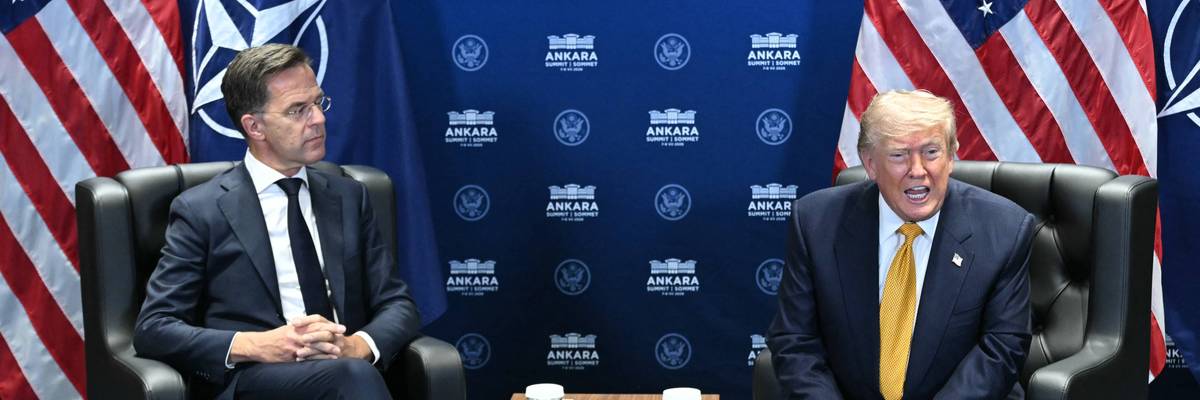
NATO Secretary General Mark Rutte and US President Donald Trump meet on the sidelines of the NATO summit in Ankara, Türkiye on July 8, 2026.
The US president, who launched the illegal and costly war earlier this year, attacked Iranian leaders as "scum" and "sick people."
US President Donald Trump on Wednesday said the interim ceasefire agreement designed to provide space for a lasting peace agreement with Iran was "over," remarks that came just hours after the American military launched a new wave of airstrikes against Iran.
Speaking alongside NATO Secretary General Mark Rutte in Ankara, Türkiye, Trump attacked Iranian leaders as "scum" and "sick people" and dismissed the idea of returning to negotiations as "a waste of time."
"To me, I think it's over," said the US president, referring to the temporary ceasefire established under the memorandum of understanding (MOU) signed last month. "I don't want to deal with them."
Trump's comments, which sent oil prices surging and intensified fears of a resumption of deadly all-out war in the Middle East, came after the US Central Command launched what it characterized as "powerful strikes against Iran to impose heavy costs for targeting and attacking commercial shipping" in the Strait of Hormuz.
Earlier on Tuesday, the Trump administration revoked a waiver allowing Iran to export its oil—a key component of the faltering MOU, which Iran and the US signed less than a month ago. Iran's Foreign Ministry decried the Trump administration's move as a violation of the MOU and "yet another indication of the US administration’s bad faith, inconsistency, and unreliability," according to a statement published by Iran's Fars News Agency.
Iran's Islamic Revolutionary Guard Corps said Wednesday that it hit more than 80 US military targets in the Middle East in response to the Trump administration's latest strikes.
Jamal Abdi, president of the National Iranian American Council, warned in a statement late Tuesday that "it is critical that Iran and the US recommit to the terms of the MOU and get negotiations back on track before it is too late."
"The US has consistently pushed the boundaries of the agreement and put it on uncertain footing, from the failure to rein in Israel’s actions in Lebanon to the establishment of the ‘alternative corridor’ in the Strait outside of Iranian purview," said Abdi. "Iran believes this is an attempt to relitigate the MOU that it says recognized Iran’s authority to manage the waterway. So long as Iran perceives the US as seeking to weaken its position and eventually return to war, negotiations are likely to take a back seat to more fighting."
"As disastrous as this war has been for American interests thus far, President Trump appeared to have found an off-ramp before it triggered uncontrollable economic fallout or escalated to a ground war that could become a generational quagmire," Abdi added. "Now, after having narrowly avoided a worst-case scenario, the president risks being pulled back in and returning us to an unwinnable war."
Dear Common Dreams reader, It’s been nearly 30 years since I co-founded Common Dreams with my late wife, Lina Newhouser. We had the radical notion that journalism should serve the public good, not corporate profits. It was clear to us from the outset what it would take to build such a project. No paid advertisements. No corporate sponsors. No millionaire publisher telling us what to think or do. Many people said we wouldn't last a year, but we proved those doubters wrong. Together with a tremendous team of journalists and dedicated staff, we built an independent media outlet free from the constraints of profits and corporate control. Our mission has always been simple: To inform. To inspire. To ignite change for the common good. Building Common Dreams was not easy. Our survival was never guaranteed. When you take on the most powerful forces—Wall Street greed, fossil fuel industry destruction, Big Tech lobbyists, and uber-rich oligarchs who have spent billions upon billions rigging the economy and democracy in their favor—the only bulwark you have is supporters who believe in your work. But here’s the urgent message from me today. It's never been this bad out there. And it's never been this hard to keep us going. At the very moment Common Dreams is most needed, the threats we face are intensifying. We need your support now more than ever. We don't accept corporate advertising and never will. We don't have a paywall because we don't think people should be blocked from critical news based on their ability to pay. Everything we do is funded by the donations of readers like you. When everyone does the little they can afford, we are strong. But if that support retreats or dries up, so do we. Will you donate now to make sure Common Dreams not only survives but thrives? —Craig Brown, Co-founder |
US President Donald Trump on Wednesday said the interim ceasefire agreement designed to provide space for a lasting peace agreement with Iran was "over," remarks that came just hours after the American military launched a new wave of airstrikes against Iran.
Speaking alongside NATO Secretary General Mark Rutte in Ankara, Türkiye, Trump attacked Iranian leaders as "scum" and "sick people" and dismissed the idea of returning to negotiations as "a waste of time."
"To me, I think it's over," said the US president, referring to the temporary ceasefire established under the memorandum of understanding (MOU) signed last month. "I don't want to deal with them."
Trump's comments, which sent oil prices surging and intensified fears of a resumption of deadly all-out war in the Middle East, came after the US Central Command launched what it characterized as "powerful strikes against Iran to impose heavy costs for targeting and attacking commercial shipping" in the Strait of Hormuz.
Earlier on Tuesday, the Trump administration revoked a waiver allowing Iran to export its oil—a key component of the faltering MOU, which Iran and the US signed less than a month ago. Iran's Foreign Ministry decried the Trump administration's move as a violation of the MOU and "yet another indication of the US administration’s bad faith, inconsistency, and unreliability," according to a statement published by Iran's Fars News Agency.
Iran's Islamic Revolutionary Guard Corps said Wednesday that it hit more than 80 US military targets in the Middle East in response to the Trump administration's latest strikes.
Jamal Abdi, president of the National Iranian American Council, warned in a statement late Tuesday that "it is critical that Iran and the US recommit to the terms of the MOU and get negotiations back on track before it is too late."
"The US has consistently pushed the boundaries of the agreement and put it on uncertain footing, from the failure to rein in Israel’s actions in Lebanon to the establishment of the ‘alternative corridor’ in the Strait outside of Iranian purview," said Abdi. "Iran believes this is an attempt to relitigate the MOU that it says recognized Iran’s authority to manage the waterway. So long as Iran perceives the US as seeking to weaken its position and eventually return to war, negotiations are likely to take a back seat to more fighting."
"As disastrous as this war has been for American interests thus far, President Trump appeared to have found an off-ramp before it triggered uncontrollable economic fallout or escalated to a ground war that could become a generational quagmire," Abdi added. "Now, after having narrowly avoided a worst-case scenario, the president risks being pulled back in and returning us to an unwinnable war."
US President Donald Trump on Wednesday said the interim ceasefire agreement designed to provide space for a lasting peace agreement with Iran was "over," remarks that came just hours after the American military launched a new wave of airstrikes against Iran.
Speaking alongside NATO Secretary General Mark Rutte in Ankara, Türkiye, Trump attacked Iranian leaders as "scum" and "sick people" and dismissed the idea of returning to negotiations as "a waste of time."
"To me, I think it's over," said the US president, referring to the temporary ceasefire established under the memorandum of understanding (MOU) signed last month. "I don't want to deal with them."
Trump's comments, which sent oil prices surging and intensified fears of a resumption of deadly all-out war in the Middle East, came after the US Central Command launched what it characterized as "powerful strikes against Iran to impose heavy costs for targeting and attacking commercial shipping" in the Strait of Hormuz.
Earlier on Tuesday, the Trump administration revoked a waiver allowing Iran to export its oil—a key component of the faltering MOU, which Iran and the US signed less than a month ago. Iran's Foreign Ministry decried the Trump administration's move as a violation of the MOU and "yet another indication of the US administration’s bad faith, inconsistency, and unreliability," according to a statement published by Iran's Fars News Agency.
Iran's Islamic Revolutionary Guard Corps said Wednesday that it hit more than 80 US military targets in the Middle East in response to the Trump administration's latest strikes.
Jamal Abdi, president of the National Iranian American Council, warned in a statement late Tuesday that "it is critical that Iran and the US recommit to the terms of the MOU and get negotiations back on track before it is too late."
"The US has consistently pushed the boundaries of the agreement and put it on uncertain footing, from the failure to rein in Israel’s actions in Lebanon to the establishment of the ‘alternative corridor’ in the Strait outside of Iranian purview," said Abdi. "Iran believes this is an attempt to relitigate the MOU that it says recognized Iran’s authority to manage the waterway. So long as Iran perceives the US as seeking to weaken its position and eventually return to war, negotiations are likely to take a back seat to more fighting."
"As disastrous as this war has been for American interests thus far, President Trump appeared to have found an off-ramp before it triggered uncontrollable economic fallout or escalated to a ground war that could become a generational quagmire," Abdi added. "Now, after having narrowly avoided a worst-case scenario, the president risks being pulled back in and returning us to an unwinnable war."