

SUBSCRIBE TO OUR FREE NEWSLETTER
Daily news & progressive opinion—funded by the people, not the corporations—delivered straight to your inbox.
5
#000000
#FFFFFF
To donate by check, phone, or other method, see our More Ways to Give page.
Daily news & progressive opinion—funded by the people, not the corporations—delivered straight to your inbox.
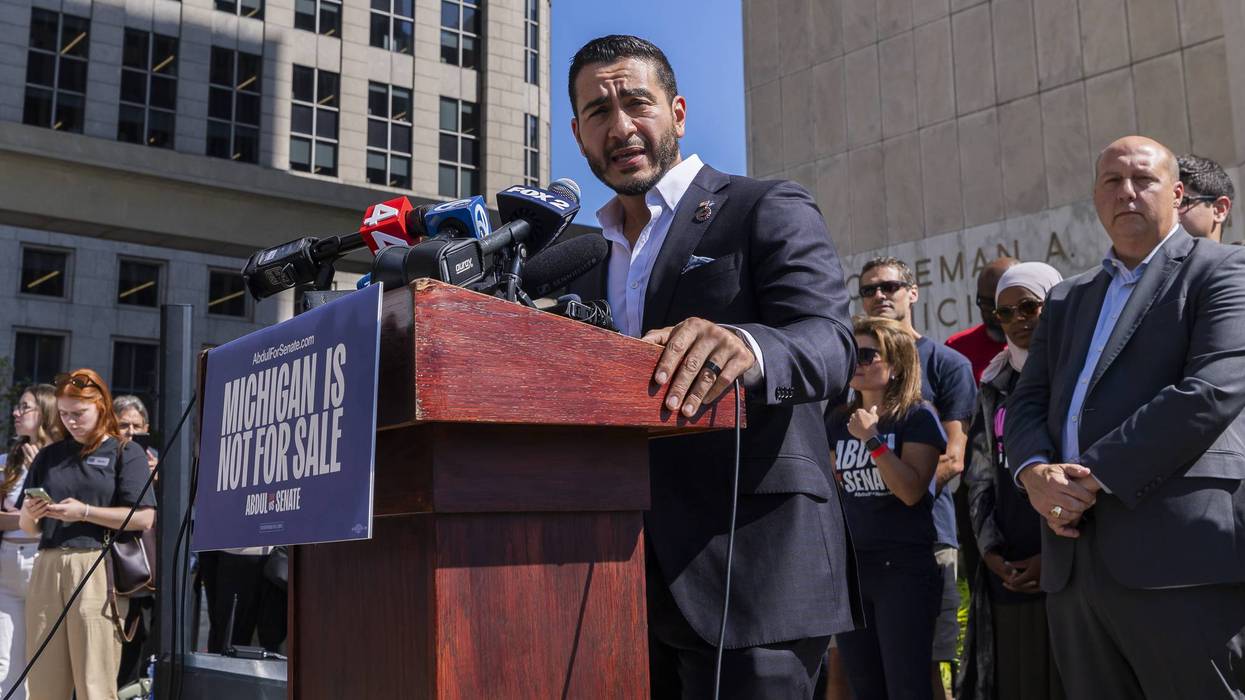
The Michigan Democrat called his Republican opponent "a guy who spent 14 years in Congress with one goal: to figure out how to cash out the day he left," and promised to send him back to Florida in November.
After winning Michigan's Democratic primary contest for US Senate, Abdul El-Sayed wasted no time on Wednesday, challenging the Republican nominee, former Congressman Mike Rogers, to five debates before the November general election.
"Mike," El-Sayed said at a podium while speaking with reporters on Wednesday morning, "I know you're gonna say no 'cause you're a coward: Five debates, all right?"
"If you're willing to stand with me and have a conversation—you and I both know that you will wither in front of your own crimes. But Imma make sure Michiganders know about them," he continued. "By the time we're done, you are not gonna have safe quarter from people holding you accountable to what you've done for them here in Michigan. We will send you back to Florida where you belong."
Ripping Rogers as a "corporate sellout," El-Sayed said that he is "a guy who spent 14 years in Congress with one goal: to figure out how to cash out the day he left. And guess what he did: As soon as he left Congress, after having taken corporate check after corporate check after corporate check, to empower the corporations to pick your pockets, he went and he cashed out."
"Not in Michigan—no, winters are too cold for him," he added, eliciting chuckles from the crowd. "He's got thin skin, after all. He went to Florida. So, Mike, if you wanna be a Florida man, go be a Florida man."
Rogers‚ who was unopposed in Tuesday's GOP primary, worked for the Federal Bureau of Investigation before entering politics, first at the state level and then representing Michigan's 8th District in Congress from 2001-15. In comments to Fox News late Tuesday, the Republican cited his time fighting "terrorism" in the FBI and falsely claimed that El-Sayed believes "America deserved 9/11."
"This is really about the heart and soul of our country," Rogers said of the race just minutes after El-Sayed, a son of Egyptian immigrants, declared victory over Democratic Congresswoman Haley Stevens. "I have never seen someone so radical, so extreme, get nominated by a political party... The Democrat party is lost to this hardcore socialist attitude."
The Democratic Socialists of America did not endorse El-Sayed, but his victory is part of a wave of recent primary wins by progressive congressional candidates, from New York and Pennsylvania to Colorado. The trend continued in other closely watched Michigan races on Tuesday, with William Lawrence winning in the 7th Congressional District and Donavan McKinney in the 13th District.
Like other victorious progressives, El-Sayed ran on a platform prioritizing working-class people; a former public health official, he especially focused on the fight for Medicare for All. Bridge Michigan reported Wednesday that "El-Sayed has said he doesn't consider himself a democratic socialist and rejects the notion that his views are extreme in today’s political climate."
"In an era where our premiums are quickly pricing people out, I think being for Medicare for All is… the moderate position," El-Sayed previously told the outlet. In an era where President Donald Trump "is weaponizing" US immigration and Customs Enforcement "against the Constitution itself," he added, "I think abolishing ICE is a moderate position."
While key party leaders nationwide have often backed establishment candidates over progressives in recent primaries, including El-Sayed v. Stevens, Democrats in Michigan and across the country are already rallying behind the victor, with even the congresswoman he defeated showing her support on Wednesday.
"Mike Rogers represents everything people hate about politics: He sold Michiganders out to the corporate special interests cutting him checks, abandoned Michigan for a Florida mansion, and got rich advising the industries he regulated in Congress," Michigan Democratic Party spokesperson Joey Hannum said in a statement after the primary election.
"As Trump's approval rating plummets to record lows, Rogers is still pledging to rubber stamp his toxic agenda, mocking Michiganders' concerns about rising costs, and saying he would focus on 'shielding' the Trump administration and billionaires like Elon Musk from accountability, rather than stand up for working families," Hannum said. "Michigan Democrats will hold Rogers accountable for his corruption, expose his price-hiking agenda, and defeat him a second time this November."

"We all knew they were going to spend their money," said Abdul El-Sayed. "We didn't know that they were going to outspend us $11 to $1. And yet we're still standing."
Abdul El-Sayed was on track Wednesday to narrowly win the Democratic nomination for US Senate in Michigan, overcoming tens of millions of dollars in outside spending by AIPAC and other special interests that sought to smear the progressive epidemiologist and boost his opponent, US Rep. Haley Stevens.
NBC declared El-Sayed the winner, but The Associated Press said the race was too close to call with over 90% of ballots counted. As of early Wednesday morning, El-Sayed was leading Stevens by roughly 21,000 votes—or just over one percentage point.
In his election night speech, El-Sayed stopped short of declaring victory but celebrated the "movement that we were able to inspire."
"Across that movement that we built, there was an inspiration in the idea that we could take our government back. Government of the people, by the people, and for the people instead of government of the corporations, by the special interests, and for the billionaires," El-Sayed told supporters. "And because you had the audacity to believe in that, you know that the billionaires, the corporations, and the special interests, they weren't going to give up lightly. We all knew they were going to spend their money. We didn't know they were going to spend $70 million of their money. We didn't know that they were going to outspend us $11 to $1. And yet we're still standing."
An El-Sayed victory would be a brutal defeat for AIPAC, the pro-Israel lobbying organization that shelled out over $30 million to defeat him. AIPAC cash accounted for nearly half of all the outside spending in the race, which was the most expensive Democratic primary in US history.
"AIPAC spent over $30 million to stop Dr. Abdul El-Sayed in this race, and that record-high sum wasn’t enough because Democratic voters have had it with the fringe and extremist view that our tax dollars should pay for Israel’s bombs, wars, and genocidal ambitions," said Margaret DeReus, executive director of the IMEU Policy Project. "With Michigan now playing a decisive role in selecting the next Democratic president, potential 2028 contenders should take notes."
The winner of the Senate contest will face Republican Mike Rogers in November.
Progressives also appeared poised to win other closely watched races in Michigan. The Associated Press projected that grassroots organizer and climate activist William Lawrence has won the Democratic primary in Michigan's 7th Congressional District, while progressive state Rep. Donavan McKinney led establishment-backed US Rep. Shri Thanedar—who received AIPAC support—in the 13th District, with more than 70% of the vote counted.
"AIPAC fell on its face in Michigan," the progressive advocacy group RootsAction said in response to the primary results. "Voters showed that they want what progressives have been clamoring for, including Medicare for All, a stop to endless wars, and true economic security."
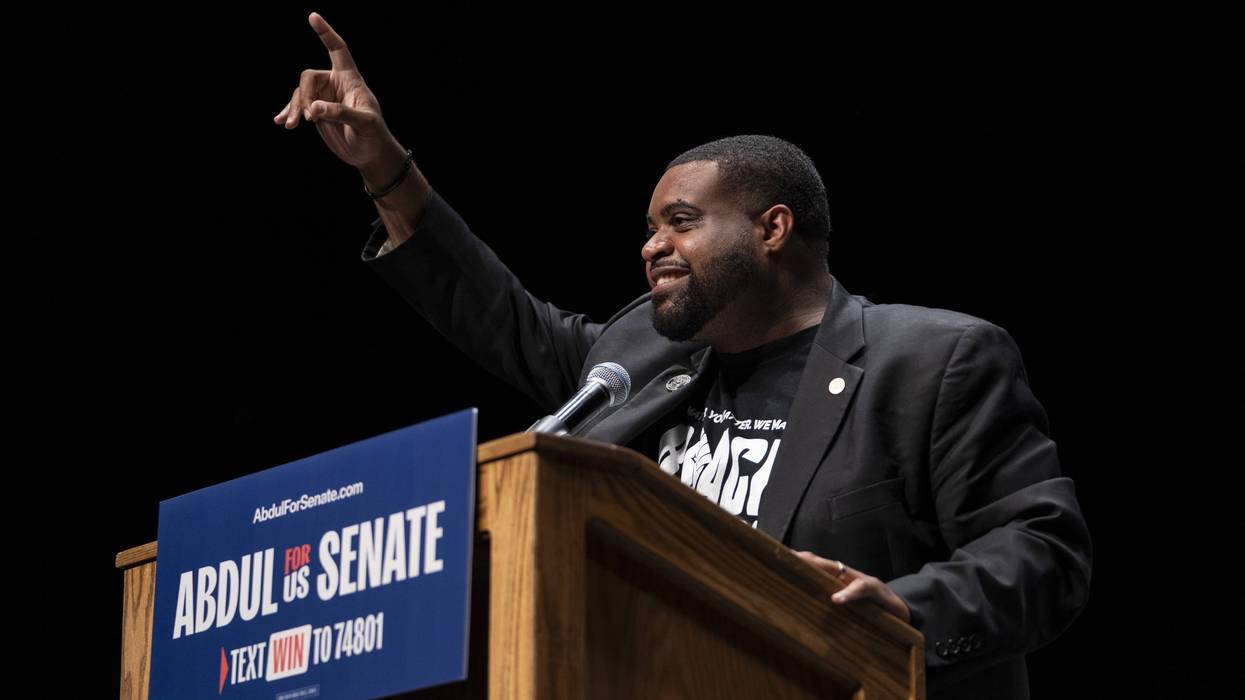
"The Democratic establishment threw everything it had at Abdul El-Sayed," said one podcaster. "If he wins, the reverberations will be felt far outside of Michigan."
Voters in five states are going to the polls Tuesday to cast ballots for US House and Senate candidates, including several who aim to continue a recent streak of progressive victories that—as Colorado democratic socialist Melat Kiros said after she won her own primary race last month—will send a message to "both parties, to Donald Trump, and to the entire country.”
Major races in which progressives are hoping to beat corporate-backed, centrist Democrats are set to be decided in Missouri and Michigan, and observers have pointed to unprecedented outside spending on the primaries—including more than $100 million that's been poured into races by the American Israel Public Affairs Committee (AIPAC) as public support for Israel plummets—as clear evidence that the political establishment views left-wing challengers as formidable opponents.
With AIPAC taking an outsized role in funding a number of centrist primary campaigns this election cycle, the results Tuesday night are expected to reveal whether the lobby group can continue to influence elections and US policy regarding Israel, while a growing number of Americans view Israel negatively following nearly three years of its US-backed assault on Gaza.
Dan Pfeiffer, a former Obama administration staffer who co-hosts the podcast "Pod Save America," said that with the Democratic establishment particularly throwing its weight behind pro-Israel US Rep. Haley Stevens (D-Mich.) in the race between her and progressive former public health official Abdul El-Sayed in Michigan's US Senate race, Tuesday will be "the culmination of one of the most heated and expensive Democratic Senate primaries in history."
"The Democratic establishment threw everything it had at Abdul El-Sayed," said Pfeiffer. "If he wins, the reverberations will be felt far outside of Michigan."
The Michigan Senate race is arguably the most high-profile race taking place Tuesday, but in a number of House districts in the state and elsewhere, progressives are vying for seats in Congress in hopes of increasing the number of Democrats who would use their power to advocate for programs like Medicare for All and universal childcare and against massive Pentagon budgets and US aid to Israel.
Key races include:
McKinney, a former labor organizer, is running to unseat Thanedar in the state's 13th District, and recently notched endorsements from the Democratic Socialists of America and Rep. Summer Lee (D-Pa.). Sen. Bernie Sanders (I-Vt.) and Rep. Rashida Tlaib (D-Mich.) have also thrown their support behind McKinney.
The state lawmaker's website states that he is running "because I’ve lived through the same bull**** as you my whole life, right here at home in Detroit." He calls his city "the poster child for communities in need of the Green New Deal," pointing to lead-polluted water and "some of the most polluted air in the country."
He has also pushed to ban utility monopolies and government contractors, calling Thanedar "our multimillionaire congressman who bought this seat with his own money," and had pledged to defeat "the corporate and right-wing super PACs that will spend millions to support" Thanedar.
According to Punchbowl News, Thanedar is "heavily self-funding" his campaign and, along with the pro-cryptocurrency group Protect Progress, has spent $4.6 million on TV ads.
McKinney has also pointed to Thanedar's campaign funding from Detroit's unpopular energy utility company, DTE, and from AIPAC. According to The Intercept, "two-thirds of the money Thanedar raised in the last quarter came from AIPAC, which collects money from multiple donors and funnels it to the pro-Israel group’s preferred candidates... Less than a quarter of those donors listed Michigan as their state of residence."
Thanedar "was in the minority of House Democrats who voted against cutting $3.3 billion in military aid to Israel from a State Department spending bill" last month, The Intercept added.
In his "closing message" on Tuesday, McKinney told radio show host Dean Obeidallah that he doesn't "have any special interests pulling the strings."
"My special interest is the people of the mighty 13th District, and instead of continuing to send our taxpayer money to fund genocide and send it for bombs and weapons to kill families and children, or to start wars in Iran and spend over $1 billion a day on average, my focus is going to be taking those resources, our taxpayer money, and bringing it back home for people who need it the most," said McKinney.
As Michigan heads to the polls, @DonavanMI13 gave @DeanObeidallah his closing message, that he'll be a fighter for his district. pic.twitter.com/7VofIpa6tz
— SiriusXMProg.bsky.social (@SiriusXMProg) August 4, 2026
Lawrence has also been endorsed by Sanders, Tlaib, and a number of progressive groups in his race in the state's 7th District, where he and the two moderate candidates seek to oust US Rep. Tom Barrett.
Some polls have shown the progressive co-founder of Sunrise Movement in the lead by as many as six percentage points, but other recent surveys have shown Brink in the lead.
Lawrence has touted his energetic grassroots campaign, announcing on Monday that 864 volunteers had knocked on 100,000 doors in the district, which includes Lansing and the surrounding area.
Yesterday we knocked our 100,000th door. We've built a grassroots operation unlike anything Mid-Michigan has seen before.
864 volunteers got us here, and we're just getting started. We will hit even more by November to beat Barrett. pic.twitter.com/WDZJ7gYPDl
— William Lawrence (@WeWill2026) August 4, 2026
Lawrence has focused heavily on the push to build nearly 80 artificial intelligence data centers in communities in Michigan. President Donald Trump has demanded a deregulated approach, and people in towns and cities across the country have rallied against the facilities, arguing the massive water and energy consumption of data centers makes them undesirable additions to their communities.
Lawrence has joined Sanders and US Rep. Alexandria Ocasio-Cortez (D-NY) in calling for a nationwide moratorium on the construction of new data centers. In one campaign ad he was seen at a farm, saying, “Tech billionaires want to turn this field into a massive data center that’ll jack up our energy bills and ruin our home values... I’m running for U.S. Congress because I’ve never been afraid to stand up to corporate power."
Some in the Democratic establishment attacked Lawrence recently over comments he made in 2024 in which he said older Black leaders in the party have worked to defang "the white left." He apologized for the remark.
At a rally ahead of the primary, Lawrence told supporters that the campaign has "continued climbing" despite the attacks.
"And that's because there are real human beings in this campaign who are having real conversations, and that is cutting through the lies and the bullshit," he said.
Our campaign has continued to surge despite the millions of dollars in attacks misrepresenting my record.
We've built real relationships with our neighbors that the dark money outsiders can't buy with lies.
Our movement is ready to weather these smears from the GOP and beat… pic.twitter.com/sNgaoXYMBz
— William Lawrence (@WeWill2026) August 3, 2026
In the state's most closely-watched race, El-Sayed has taken direct aim at Stevens for benefiting from tens of millions of dollars in AIPAC money as he has run on the slogan, "Money out of politics, money in your pocket, and Medicare for all."
Stevens has been endorsed by Senate Minority Leader Chuck Schumer (D-NY), who has come under fire this election cycle for other endorsements including that of Maine Gov. Janet Mills in the New England state's Senate race, with progressives arguing Schumer has backed establishment candidates and ignored the energy around Medicare for All, taxing billionaires, and ending aid for Israel among the party's base.
Ben Rhodes, another former Obama staffer, said Monday that the party leadership "decided to back Haley Stevens in part out of fear of Abdul and the future he represents."
El-Sayed is an outspoken advocate for Medicare for All, but Stevens has appeared eager to center his identity as a Muslim American in the race, joining the centrist think tank Third Way in attacking him for campaigning with commentator Hasan Piker, an outspoken critic of Israel, and claiming last week that El-Sayed wants "to blame all of [his] problems on Jewish Americans."
The latter comment was widely condemned as "race-baiting."
El-Sayed closed his primary campaign out Tuesday with an ad featuring several of his high-profile endorsers as well as grassroots supporters.
"We need to talk about who we are and affirm what we're willing to fight for, and that's exactly why this movement is resonating with so many," said Rep. Ayanna Pressley (D-Mass.).
Time to vote, Michigan! For the many. For money out of politics. For money in your pocket. For Medicare for All. pic.twitter.com/e64Y9A4wuH
— Dr. Abdul El-Sayed (@AbdulElSayed) August 4, 2026
Numerous polls in recent weeks have shown El-Sayed far ahead of Stevens, particularly among younger voters.
Drop Site News highlighted a number of other Michigan races in which progressives are running, including organizer Abbas Alawieh in the 2nd state Senate district and Sanders-endorsed Eboni Taylor in the 3rd state Senate district.
In Missouri's 1st District in St. Louis, former US Rep. Cori Bush is running for a second time against Rep. Wesley Bell, who defeated her in the 2024 primary after nearly two-thirds of his campaign funding came from the United Democracy Project (UDP), a super political action committee affiliated with AIPAC. The group allocated more than $100 million toward defeating candidates that supported Palestinian rights and opposed US military funding for Israel that year.
Bush told Politico recently that this year's election is no different.
“One of us is of the people, by the people, and for the people,” Bush said in a recent interview. “The other one is paid for by AIPAC."
According to AdImpact, UDP has again spent more than $3 million on advertising in the primary.
While Bell has a clear financial advantage, he lacks the "grassroots army" Bush has, The Intercept recently reported, as well as voter engagement. The former county prosecutor has not shown up to several candidate forums.
Polling in the race has been scarce; a survey released in February that was sponsored by Bush's campaign showed Bell ahead by four points, with 17% of respondents undecided.
Jessica Montgomery, co-chair of the St. Louis DSA chapter, told The Intercept that voters in St. Louis are likely to show "buyer's remorse" regarding Bell in Tuesday's election.
He voted along with 74 other Democrats to "thank" US Immigration and Customs Enforcement in June 2025, when Trump was beginning his violent mass deportation campaign
“There’s a lot of very progressive voters in St. Louis who don’t like the fact that he voted to thank ICE,” Montgomery told the outlet. “I think they want someone who will be more adversarial and will fight back against the Trump administration.”
Bush said Monday that her opponent "is backed by billionaires, MAGA money, and AIPAC. But our movement is backed by the people."

AIPAC has spent at least $104.3 million during the 2026 election cycle—a figure that's "likely to swell before the midterms are through," notes a new analysis.
The American Israel Public Affairs Committee, the powerful pro-Israel lobbying organization widely known as AIPAC, has poured more than $100 million into the 2026 midterm elections, with around $30 million dedicated to defeating progressive epidemiologist Abdul El-Sayed in Tuesday's Democratic US Senate primary in Michigan.
The $30.6 million that AIPAC's political action committee and super PAC, the United Democracy Project (UDP), have spent on the Michigan contest is the most money the organization has ever devoted to a single race, according to an analysis published Monday by Sludge. El-Sayed and his supporters have repeatedly called out his opponent, US Rep. Haley Stevens (D-Mich.), for benefiting heavily from AIPAC cash.
"The Michigan Senate primary is a fight as to whether billionaires and their super PACs will continue to control American politics, or whether we can have a government that represents working families," US Sen. Bernie Sanders (I-Vt.), who is supporting El-Sayed, wrote in a social media post on Monday. "Let’s elect Abdul El-Sayed."
More broadly, AIPAC has spent at least $104.3 million during the 2026 election cycle—a figure that's "likely to swell before the midterms are through," Sludge noted. The investigative outlet observed that AIPAC's super PAC—whose ads often include no mention of Israel—had $80 million of cash on hand as of the end of June.
The $104.3 million total does not include spending by super PACs quietly bankrolled by AIPAC. The American Prospect reported earlier this summer that AIPAC has been "routing campaign cash through anodyne-sounding pop-up shell PACs like 'Elect Chicago Women' or 'Affordable Chicago Now,' which received $5.3 million from United Democracy Project back in February for four races in Illinois, which resulted in two wins and two losses."
In addition to spending big to defeat El-Sayed in Michigan, AIPAC is backing incumbent US Rep. Wesley Bell against progressive challenger Cori Bush in Tuesday's Democratic primary race for Missouri's 1st Congressional District. Bell unseated Bush in the district's 2024 Democratic primary with the help of millions of dollars in AIPAC spending.
AIPAC's super PAC pumped more than $3 million into the Missouri primary last month, The Intercept's Akela Lacy reported over the weekend.
"One thing Bell does not have is Bush’s grassroots army," Lacy added. "Though he’s far outraised Bush and has outside spending in his corner, Bush is buoyed by organizers with the St. Louis chapter of Democratic Socialists of America... After being saturated with negative ads and mail from AIPAC and other groups that spent on the 2024 primary, St. Louis residents are slightly more prepared this time around, said organizers backing Bush’s campaign."
US Rep. Shri Thanedar (D-Mich.), who is facing progressive challenger Donavan McKinney on Tuesday, has also received significant campaign funding from AIPAC.

"It can't be overstated how flippant and arrogant Stevens comes off when questioned about $60 million in super PAC spending for her in this race," said one observer.
With just days to go until the Michigan US Senate primary election, Rep. Haley Stevens, the preferred candidate of several Democratic establishment figures, suggested this week that campaign finance—a top issue in her race against former public health official Abdul El-Sayed—is a niche interest held by "educated" people and not working families, and appeared eager for voters and the press to stop asking her about the roughly $60 million outside groups have poured into the race on her behalf.
"It seems like we got the campaign finance zoomies," the Michigan Democrat told reporters at an event with business leaders in Lansing on Wednesday, appearing mystified at the suggestion that ordinary voters would be interested to know her position on super political action committees, which can raise unlimited money from corporations and other groups and individuals to support a candidate's run, and her significant backing from a super PAC affiliated with the increasingly unpopular American Israel Public Affairs Committee (AIPAC).
"My opponent has done a great job talking about campaign finance. It’s an educated issue,” Stevens said, according to a report from Michigan Advance Thursday. “I even had someone who’s got a law degree asking me about some of the campaign finance stuff today. That’s totally fine, but you know what else? These families on paid leave? They need affordable daycare. They need good public schools to go.”
Journalist David Sirota of The Lever said that in what amounts to Steven's "final argument" ahead of the election, the candidate suggested that pro-Israel and other groups' attempt to "buy her a Senate seat—is merely an esoteric 'educated issue' that has nothing to do with corrupt lawmakers creating corrupt policies fueling the affordability crisis."
As Mother Jones reported Friday, about half of the super PAC spending on Stevens' behalf has come from United Democracy Project, which is affiliated with AIPAC, while a large chunk comes from the super PACs A Stronger Michigan and Center Forward.
Those groups have received millions of dollars from PhRHMA, a trade group representing pharmaceutical firms, and UnitedHealth Group—both key players in the for-profit healthcare industry that's raised household costs for families across the country in recent years, with UnitedHealth slashing care expenses for nursing home patients and unlawfully using an artificial intelligence algorithm to deny coverage to people with Medicare Advantage. El-Sayed has notably made Medicare for All a key priority of his campaign.
"The outside spending picture for El-Sayed looks much different," reported Mother Jones. "The biggest individual donor to Fighting for Michigan—El-Sayed’s main outside backer—is the candidate’s father-in-law, a nephrologist at a Detroit hospital who had given $300,000 as of July 15. Overall, the super PAC has expended about $2.8 million—less than one-tenth of what has been spent against El-Sayed by the United Democracy Project alone."
Stevens attempted to shift the focus to her opponent's support from his father-in-law at her meeting with the Lansing Regional Chamber on Wednesday, after she was asked about the record-breaking outside spending in the race by a business leader in the very first question of the event.
But another attendee brought up the issue again later, noting she had not specifically addressed concerns about the groups whose spending her campaign is benefiting from and asking whether she would back a bill proposed by Sen. Bernie Sanders (I-Vt.), an El-Sayed supporter, to abolish super PACs.
Stevens was noncommittal once again, suggesting concerns about super PACs are part of "campaign platform" favored by Sanders.
"He’s in the independent party," she added. "I haven’t talked to him about it. I’m not trying to do any division.”
Stevens did allow that she "would love a constitutional amendment to get rid of money in politics and maybe make our elections shorter" and said she had spoken to Republicans about such a proposal.
But one observer said Stevens' overall message that the financing of her campaign is an issue only voters with "a law degree" are interested in was "flippant and arrogant."
Stevens has benefited from millions in AIPAC-backed super PAC spending as public approval has plummeted regarding the powerful pro-Israel lobby and the United States' funding of Israel's military, after nearly three years of the Israel Defense Forces' assault on Gaza and Prime Minister Benjamin Netanyahu's push for the US to join in attacking Iran—a conflict that has also had a direct impact on working families' household budgets as gas prices have soared.
On Thursday, Stevens took direct aim at El-Sayed, a Muslim, for his focus on AIPAC during the campaign, addressing him in a lengthy post on X in which she said, "Everyone in America understands you want to blame all of your problems on Jewish Americans."
The remark was widely condemned as "race-baiting," and interpreted as one that conflated Jewish Americans with the pro-Israel lobby.
"When someone points out AIPAC is spending $50 million, it’s presented as 'blaming Jewish Americans,'" said podcast host Adam Johnson. "I hate this shit so much, it’s gross, it’s bad faith, it’s sleazy, and it’s more manipulative, crybully smarm."

A Michigan congresswoman called El-Sayed "anti-American" in an interview Thursday in what one progressive lawmaker said was a "racist" attack.
With a number of recent polls finding former public health official Abdul El-Sayed with a strong lead against Rep. Haley Stevens in the Michigan US Senate race, establishment Democrats are resorting this week to attacks that some critics said amounted to racism.
The latest survey, out Thursday from the highly respected, non-partisan Emerson College Polling along with WLNS/WOODTV, found El-Sayed with 54% support, while Stevens had 39%.
Six percent of respondents said they were undecided about the primary election, in which Michigan voters will go to the polls on August 4, and 2% said they backed state Sen. Mallory McMorrow (D-8), who suspended her campaign earlier this summer.
El-Sayed had the support of voters under 50 by 42 percentage points, as well as voters age 50-60 by 12 points.
The poll came on the heels of another survey by Tavern Research, which found El-Sayed—who has built his campaign around the pledge, "Money out of politics, money in your pocket, and Medicare for All"—leading Stevens by 11 points.
Outside groups' spending on behalf of Stevens, including roughly $60 million in funding from a super political action committee affiliated with the increasingly unpopular American Israel Public Affairs Committee (AIPAC), has become a major topic of discussion in the race, with El-Sayed arguing that his opponent's reliance on such outsized spending is proof that she is far less "electable" than her supporters in the Democratic establishment have argued.
Sen. Bernie Sanders (I-Vt.) said Wednesday that billionaires are clearly "panicked" by the possibility of a Democratic Senate candidate whose victory would "make it clearer than ever that the American people are sick and tired of the same-old, same-old establishment politics and policies."
Even with money pouring into Michigan to back Stevens, who has praised US Immigration and Customs Enforcement and said she would not support any conditions on military aid to Israel—further distancing herself from Democratic voters' views—the congresswoman's supporters have resorted to attacks on El-Sayed, with Rep. Hillary Scholten (D-Mich.) recently making numerous media appearances to portray him—without evidence—as "sexist" and "un-American."
Scholten told Semafor Thursday that El-Sayed "has allowed distinctly anti-American sentiment to enter our public dialogue"—an apparent reference to his earlier campaigning with commentator Hasan Piker, an outspoken critic of Israel who once said the US "deserved" the September 11 attacks, a remark he later clarified and apologized for.
Georgia state Rep. Ruwa Romman (D-97) said Scholten's vague comment ignored El-Sayed's own clear statements about his love for and belief in the potential of the United States.
"She’s just racist," Romman said of the remark. "All people have to do is listen to Abdul speak for barely a few minutes, and they’ll hear a deep love for our country."
The United Democracy Project, the super PAC tied to AIPAC, has also attacked El-Sayed for his association with Piker and baselessly claimed in one commercial that the candidate “expressed sympathy for a terrorist." Scholten's comment also echoed the campaign of Republican candidate Mike Rogers, a former US House member who said in a call with supporters, “I don’t think he likes America, candidly.”
AIPAC-funded ads have also claimed El-Sayed's rhetoric is "uniquely sexist."
The commentary from both Democrats and Republicans are "reproducing tropes that have just been around for centuries" about Muslims, Nancy Khalil, an anthropologist at University of Michigan, told The Intercept this week, referring to stereotypes painting Arab and Muslim men as "controlling of women."
“We’re seeing it come from within his own party," said Khalil.
Dr. Adam Hamawy, a surgeon who won the Democratic primary race in New Jersey’s 12th Congressional District in June after also campaigning on Medicare for All and other popular progressive policies, told The Intercept that he faced similar attacks.
"They’re questioning his loyalty, they are not talking about issues,” Hamawy said. “And that was the same thing here as well: They didn’t attack me on issues, they attacked me for who I was.”
While making negative claims about El-Sayed's character, some in the Democratic establishment have refused to say they would vote for the Medicare for All advocate in the general election if he wins the primary. Scholten refused to commit to backing him in an interview with CNN last week, while Michael LaRosa, the former press secretary for First Lady Jill Biden during the Biden administration, said Wednesday that he would "do everything I can to make sure he loses" the general election, due to comments El-Sayed made about supporting primary challenges of Democrats including Sen. John Fetterman (D-Pa.).
Sanders said Wednesday on CNN that he was committed to supporting whichever candidate wins the primary, in the interest of securing a Democratic Senate seat in the crucial election.

"We need him in the Senate to help pass Medicare for All and guarantee health care as a human right," Markey added.
Sen. Ed Markey on Wednesday joined the growing list of senators backing Dr. Abdul El-Sayed in next week's critical Democratic primary in Michigan.
“Abdul El-Sayed is the bold progressive leader Michiganders need fighting for them in the Senate. As a doctor and public health leader in Detroit, Abdul has seen firsthand how our broken health care system leaves working families behind, and we need him in the Senate to help pass Medicare for All and guarantee health care as a human right,” Markey (D-Mass.) said.
“Abdul refuses to take corporate PAC money and has earned the support of organized labor because working people know he will put their interests ahead of the billionaires, private equity, and corporate interests that have rigged the system against them," added the senator. "I am proud to endorse Abdul El-Sayed.”
Markey, who is gearing up for his own competitive primary in Massachusetts against the centrist Democratic Rep. Seth Moulton, is now the fifth US senator to endorse El-Sayed, who already has the backing of Sens. Bernie Sanders (I-Vt.), Elizabeth Warren (D-Mass.), Chris Van Hollen (D-Md.), and Tina Smith (D-Minn.).
Other stars of the progressive movement have also put their support behind El-Sayed, including potential 2028 presidential candidate Rep. Alexandria Ocasio-Cortez (D-NY), who has campaigned with him in Michigan in recent weeks.
“Ed Markey has dedicated his life to making government work for the people of Massachusetts,” El-Sayed said in response to the endorsement. "He’s led on bringing climate justice to the forefront of our politics while rejecting money from corporations who want to stop him. His leadership in Congress is unparalleled, and I look forward to joining him in the Senate to get money out of politics, put money in people’s pockets, and pass Medicare for All."
The Michigan primary has grown increasingly contentious in recent weeks as affiliates of the American Israel Public Affairs Committee (AIPAC) have spent a record of at least $30 million running ads boosting Stevens and bashing El-Sayed.
Another dark money group with undisclosed donors and ties to a well-known corporate lobbyist, A Stronger Michigan, has reported spending over $17 million so far to back Stevens, according to Federal Election Commission filings.
With less than a week before Michiganders head to the polls, there remains little clarity about who is favored to face former Republican Rep. Mike Rogers for the seat in a general election that could determine control of the Senate and—perhaps even more critically—serve as proof of concept for an insurgent progressive movement’s ability to win competitive elections in purple states.
A survey published on Wednesday by the Democratic polling firm Tavern Research showed El-Sayed leading 48%-37% over Stevens. This is consistent with polls commissioned earlier this month by pro-El-Sayed groups, which showed similar double-digit leads.
A Detroit News/WDIV-TV poll earlier this month by the Glengariff Group showed Stevens leading El-Sayed by seven points, though it coincided with a previous Tavern poll that showed Stevens edging out El-Sayed by a point, suggesting there could have been a shift toward El-Sayed in recent weeks.
The Tavern polls show a decline in net favorability for both candidates among Democratic voters, but the decline is dramatically worse for Stevens.
While the poll released on July 8 showed Stevens with a net favorability of +40 among Democratic voters, that had deteriorated to just +18 by July 29. El-Sayed's favorability also shrank during that time, but by much less—from +45 to +40.

In the final debate before Michigan's pivotal Democratic Senate primary, Abdul El-Sayed continued to hammer on the idea that his opponent, Rep. Haley Stevens, is "bought off" by AIPAC and corporate-funded super PACs.
Progressive US Senate hopeful Dr. Abdul El-Sayed spent Monday night's final Democratic primary debate in Michigan continuing to hammer on his centrist opponent Rep. Haley Stevens' backing from big money donors.
With just a week before Michiganders head to the polls, Stevens has emphasized her supposed electability against presumptive Republican nominee former Rep. Mike Rogers for the seat, which could decide the balance of power in the Senate.
While El-Sayed has consistently dominated in fundraising from individual contributors, particularly small-dollar donors, he is still dramatically outgunned by Stevens in terms of overall financial support.
Six aligned super PACs have reserved roughly $60 million to run ads boosting her—more than half of which comes from the American Israel Public Affairs Committee (AIPAC)-affiliated super political action committee (PAC) the United Democracy Project.
This tidal wave of outside funding has appeared to help Stevens remain competitive with El-Sayed after initially trailing him. But on the debate stage Monday, former Detroit public health official El-Sayed—who has made removing big money from politics a central campaign plank—argued that the spending cuts against Stevens' claim that she is more "electable" than him.
Along with the Senate filibuster, which he said would allow Republicans to stymy ambitious agenda items like Medicare for All and labor protection bills like the PRO Act, El-Sayed argued that "money in politics" was among the biggest "risks to our democracy."
He pointed to the super PAC-funded "attack ads that you've seen, probably in the last commercial break itself" that "change our political system." He then called out Stevens directly.
"When you ask $60 million to come into a race for you, and then say that somehow you're electable, I think you don't quite understand what electability means," El-Sayed said. "If you need a $60 million crutch, you probably can't be elected on your own terms."
Both El-Sayed and Stevens are shown to be slightly ahead of Rogers in polls for a hypothetical November matchup.
While Stevens has claimed that Rogers views El-Sayed as an easier opponent, one aggregate of four recent polls by 270ToWin shows El-Sayed leading the Republican by about 2.5 percentage points on average compared to Stevens, who leads by about 1.3 points on average.
El-Sayed, who has made a point of swearing off corporate backers, hit on the idea that Stevens was "bought off" repeatedly throughout the night.
He noted the $45,000 in direct support her campaigns had received since 2019 from the increasingly loathed Michigan energy monopoly DTE, as well as her support from super PACs backed by donors in the health insurance and tech industries.
Responding to Stevens’ message about the need to lower prices for ordinary people, El-Sayed said, “I don’t take money from the corporations who are jacking up your prices in the first place.”
He also pointed to her vote last week to preserve $3.3 billion in military aid for Israel while more than half of her Democratic colleagues voted for an amendment that would have cut off the support.
El-Sayed said it showed that AIPAC, which has grown overwhelmingly unpopular with Democratic voters disgusted by Israel's actions, had dumped at least $30 million behind Stevens because “they know she’ll be a reliable vote."
Stevens largely sidestepped questions about her super PAC support, instead hitting back at El-Sayed for campaigning with "senators who’ve come in here from the coast," like Bernie Sanders (I-Vt.), Elizabeth Warren (D-Mass.) and Chris Van Hollen (D-Md.), who she said lack an understanding of "what makes our state tick."
She emphasized her "experience" over El-Sayed as a four-term congresswoman and as “Michigan’s manufacturing geek” who'd bring a "unique understanding" of the state's issues to Congress.
"I don't think there's much difference between super PACs going in for Abdul or super PACs going in for me," Stevens said, ignoring that outside spending to back Stevens throughout the primary outpaces the amount supporting El-Sayed by about 18-to-1, according to the latest totals from AdImpact.
While polling for next Tuesday's primary has been all over the map, showing leads for both El-Sayed and Stevens in recent weeks, an unscientific online poll from Fox 2 Detroit indicated that El-Sayed was viewed overwhelmingly as the winner of Monday's debate.

"Abdul is the best candidate to win Michigan in November because he is the one who has the capacity to build the grassroots movement that is going to power Democrats to victory," Smith said.
With less than two weeks left before Michigan’s Democratic primary, Senate hopeful Dr. Abdul El-Sayed earned support from another US senator on Thursday, with Sen. Tina Smith praising the progressive as "a fighter."
The endorsement comes as El-Sayed's opponent, Rep. Haley Stevens, rakes in massive support from large super PACs but continues to be massively outraised by him among small donors.
Smith (D-Minn.), who is not seeking reelection in 2026, is nevertheless the fourth member of the chamber to endorse El-Sayed, following Sens. Bernie Sanders (I-Vt.), Chris Van Hollen (D-Md.) and Elizabeth Warren (D-Mass.).
"I've been a United States senator for nearly nine years. And in that time, I have seen there are basically two kinds of senators," Smith said in a video posted to social media. "There are the ones who go along to get along, that hoard their power, and do everything they can to pacify big money. And then there are the fighters—the ones that are ready to challenge the status quo and fight a system that too often seems like it's rigged for the rich and the powerful."
El-Sayed, she said, was one of the latter, crediting his support for Medicare for All, his longtime union membership, and his refusal to accept corporate PAC money.
"Abdul is the best candidate to win Michigan in November," Smith said, "because he is the one who has the capacity to build the grassroots movement that is going to power Democrats to victory."
The endorsement comes as new Federal Election Commission filings released Thursday showed El-Sayed's grassroots fundraising advantage. Between July 1-15, he raised over $2.3 million from individual donors compared to about $921,000 for Stevens during the same period.
The divide is even starker among small donors, where El-Sayed leads Stevens by nearly 9-to-1.
Stevens still has the vast funding advantage thanks to the intervention of powerful outside groups. According to OpenSecrets, the United Democracy Project, the political spending arm of the American Israel Public Affairs Committee (AIPAC), has poured nearly $20 million to push her over the line.
Another super PAC, known as A Stronger Michigan, has spent an additional $14 million on ads promoting Stevens. The dark money group that provides nearly all of its funding, Center Forward, has not disclosed its donors and won't be required to do so until after the August 4 primary.
This wave of outside money has helped Stevens remain competitive against El-Sayed. But her struggles to raise money from voters have raised concerns about her ability to perform in the general election against Republican former Rep. Mike Rogers, who would be expected to suck up the AIPAC funding currently going to Stevens.
While Smith may not have the star power of other Democrats who have backed El-Sayed, journalist Zaid Jilani argued that her endorsement “is a big one” and “a sign [Democrats] think Abdul has a good chance of winning.”
"AIPAC is bailing [Stevens] out right now," he wrote. "But I don’t see why they’d spend on her in a general when Mike Rogers is even friendlier to them."
Journalist Ryan Grim asserted that without AIPAC money for a potential Stevens general election campaign, the Democrats could be forced to pull funding from "Ohio, and Iowa, and Alaska, and so on."
"El-Sayed, meanwhile, has a built-in fundraising base, because he has regular people supporting him, not a super PAC that doesn’t care about Michigan or the Democratic Party," said Grim.
Recent polls show El-Sayed with a slightly larger polling lead over Rogers than the one enjoyed by Stevens. Recent polls for next month's Democratic primary, however, have been more challenging to parse, with some showing El-Sayed far in front and others showing leads for Stevens.
David Dulio, a political science professor at Oakland University, described the race to OpenSecrets as a “battle for the future of the Democratic Party” between powerful donors and the grassroots.
"The story right now… is that Stevens is dominating with outside funding,” Dulio said. “El-Sayed has momentum, and Stevens has money.”
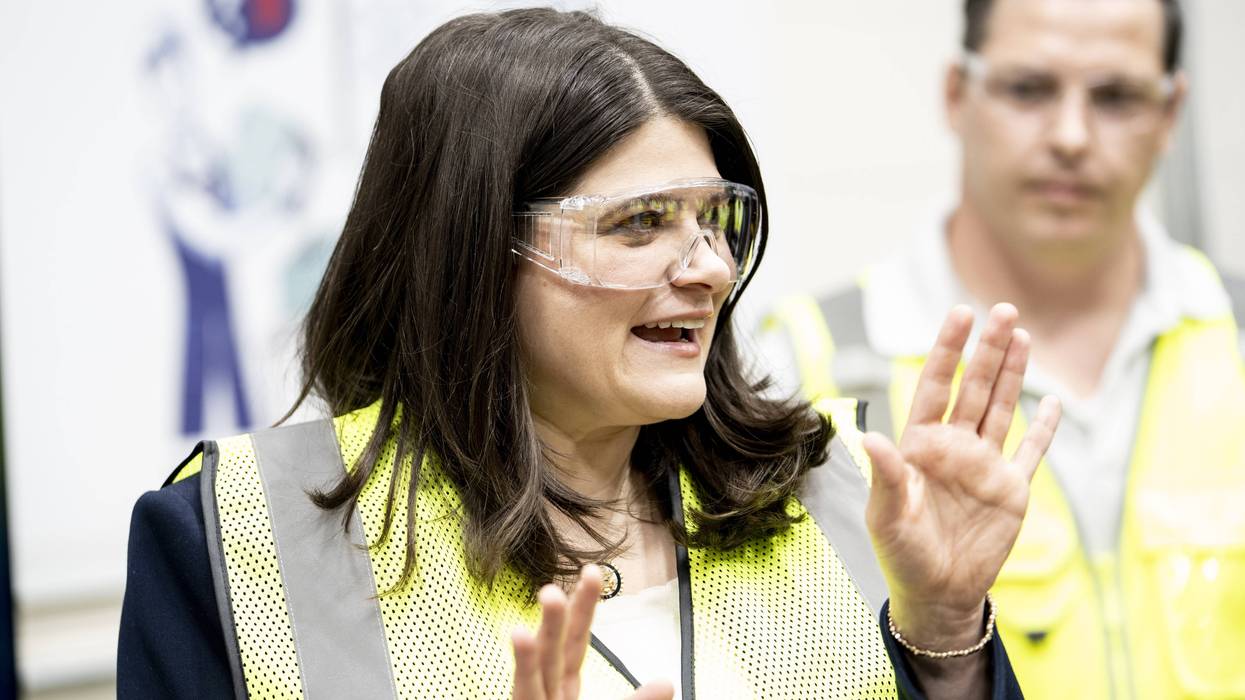
Not only was the press release fake, but Republican Mike Rogers didn't even endorse El-Sayed.
With less than two weeks before the critical Democratic Senate primary in Michigan, Rep. Haley Stevens is reportedly resorting to some underhanded tactics to attack her opponent, Dr. Abdul El-Sayed, by sending out an email making it appear as if he was celebrating an endorsement from their Republican rival.
Remington Hernandez, a political reporter at WWMT-TV, reported on Thursday that the Stevens campaign had sent a fake press release meant to look like it had come from El-Sayed's team.
"ENDORSEMENT ALERT: Mike Rogers Endorses Abdul El-Sayed in the Democratic US Senate Primary," the email says, beneath an "Abdul for Senate" graphic identical to the one used in his campaign communications.
The email quotes Rogers, a former Republican US congressman expected to be the GOP Senate nominee, saying he wants to face El-Sayed in the general election because he'd be easier to beat than Stevens.
“If he wins, I think we’re in good shape,” it quotes Rogers saying. "I think we’ll do well if he in fact is the nominee.”
The quote from Rogers is real. It comes from a CNN report published on Thursday about a call with supporters last month, in which he reportedly called El-Sayed "so radical" and predicted he'd "lose big parts of the west part of the state."
But it is not true, as the email claims, that Rogers had "endorsed" El-Sayed.
Ben Solis, a reporter at Michigan Advance who also received the email, noted that it appeared designed to look authentic, with multiple graphics at the bottom mimicking those El-Sayed's social media team has posted following actual endorsements.
"Is this ethical or legal to make a fake campaign endorsement ad like this?" he asked. "And even if it is, is that playing fair? Seems pretty underhanded at first glance."
Despite the criticism, Stevens has run with the quote herself as part of her pitch against El-Sayed and posted the fake graphics to her own social media accounts, claiming that Rogers was "really wanting Abdul to win this primary."
But it's also not entirely clear whether Rogers was even saying that he'd prefer to take on El-Sayed over Stevens.
The CNN article states that Rogers was "responding to a question about his campaign’s strategy for El-Sayed."
"What is Rogers supposed to say?" asked media critic Adam Johnson. "Of course he's saying they're in good shape, just as he would if he was asked about Stevens."
It's unclear what, if any, response Rogers gave to the prospect of facing Stevens. But Johnson said that on a call full of potential donors, it was probably something similar.
"Was Rogers asked about Stevens? Has anyone seen the full donor call?" he asked. "If he was asked about Stevens, do we think he said, 'Gee, golly, she is gonna be tough to beat'? Or do we think he also projected confidence he would defeat her as well because this is the thing you tell donors?"
He also pointed out that Stevens' largest source of financial backing during the race has been the American Israel Public Affairs Committee (AIPAC) super PAC, the United Democracy Project, whose two largest donors, hedge fund manager Paul Singer and WhatsApp co-founder Jan Koum, are both major supporters of Republicans who spent millions backing President Donald Trump in 2024.
"Yes, Republicans are so excited to take on El-Sayed. Stevens' two biggest backers are Republican megadonors," Johnson quipped.
While Stevens has attempted to portray her progressive opponent as less electable, an average of four recent polls from 270ToWin shows El-Sayed with a slightly larger polling lead over Rogers than she has.
An official account for El-Sayed's campaign noted that it's not the first example of deceptive tactics being used to promote Stevens.
Michigan airwaves have been blanketed by a pro-Stevens super PAC ad heavily implying that she'd been endorsed by former President Barack Obama. Though Stevens did work on the team supporting Obama's efforts to revive the automobile industry during the post-2008 financial recovery, the former president has not endorsed her Senate campaign in 2026.
"Mike Rogers has not endorsed Abdul just like President Obama has not endorsed Haley," said El-Sayed's campaign on Thursday. "But there’s so much disinformation coming out of her campaign it’s hard to tell if this is satire or just another lie unbefitting of a congresswoman."