SUBSCRIBE TO OUR FREE NEWSLETTER
Daily news & progressive opinion—funded by the people, not the corporations—delivered straight to your inbox.
5
#000000
#FFFFFF
To donate by check, phone, or other method, see our More Ways to Give page.


Daily news & progressive opinion—funded by the people, not the corporations—delivered straight to your inbox.
"Investors who voted against these resolutions should expect to have a hard time sleeping at night with the knowledge that their misplaced greed will lead to climate destruction and chaos," said one campaigner
Activists on Tuesday lamented their failure of various climate and Indigenous rights resolutions at the annual shareholder meetings of some of the nation's biggest banks, with one campaigner accusing the financial institutions of prioritizing "profit over people and our planet."
Just 10% of Citigroup shareholders and 7% of those owning Bank of America stock voted for resolutions urging banks to adopt a phaseout of financing for new fossil fuel projects. An unknown percentage of Wells Fargo shareholders voted for the resolution. Similar resolutions proposed last year garnered 13% of the vote at Citi and 11% at Bank of America and Wells Fargo.
Those three banks combined have financed nearly $1 trillion in fossil fuel projects since the Paris climate agreement was implemented in 2016, according to a report published earlier this month by a coalition of green groups.
The resolutions were filed by Trillium Asset Management at Bank of America, Harrington Investments at Citigroup, and Sierra Club Foundation at Wells Fargo.
Nearly 30% of Bank of America shareholders also backed forcing the institution to release a 2030 climate transition plan, while 31% Citi investors endorsed a resolution requiring the company to publish a report on the effects of its policies and actions on Indigenous peoples' human rights.
As Sierra Club noted:
Investor filers made several amendments to the fossil fuel financing proposals at the banks this year, including asking banks to adopt a policy to phase out financing for projects and companies engaging in new fossil fuel exploration and development, which is incompatible with limiting global warming to 1.5°C, and encouraging banks to provide financing for energy sector clients to credibly transition to cleaner technologies, which could safeguard against greenwashing and accelerate the clean energy transition.
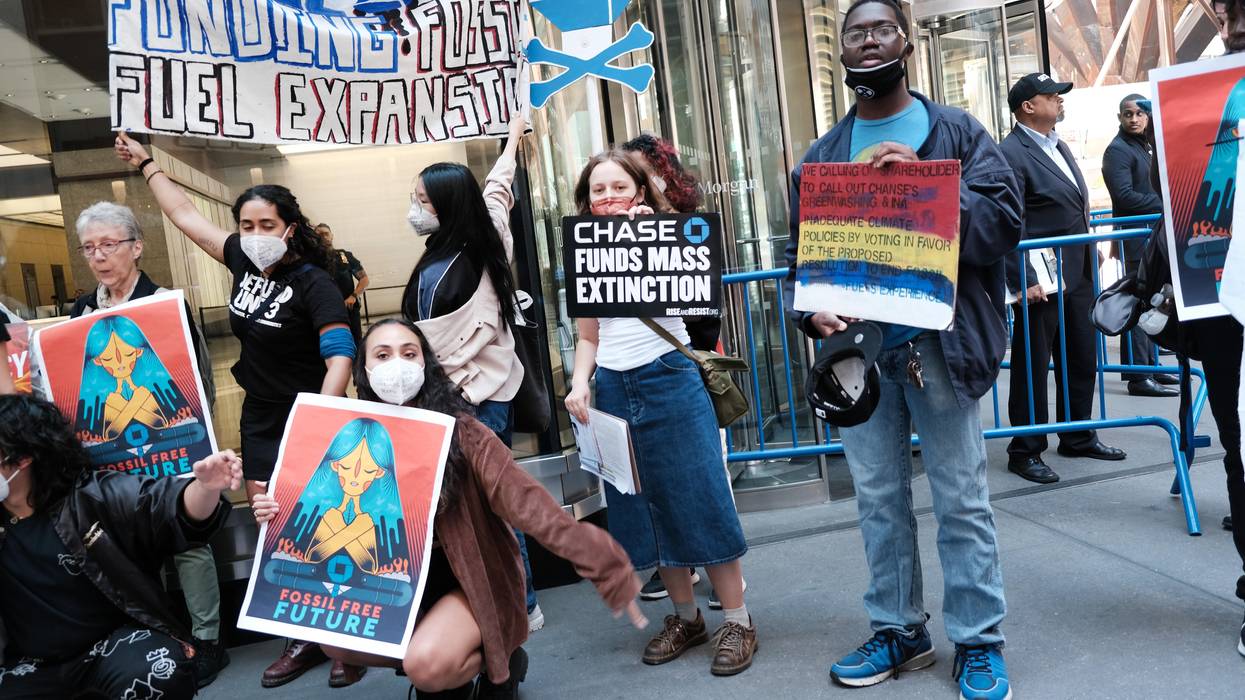
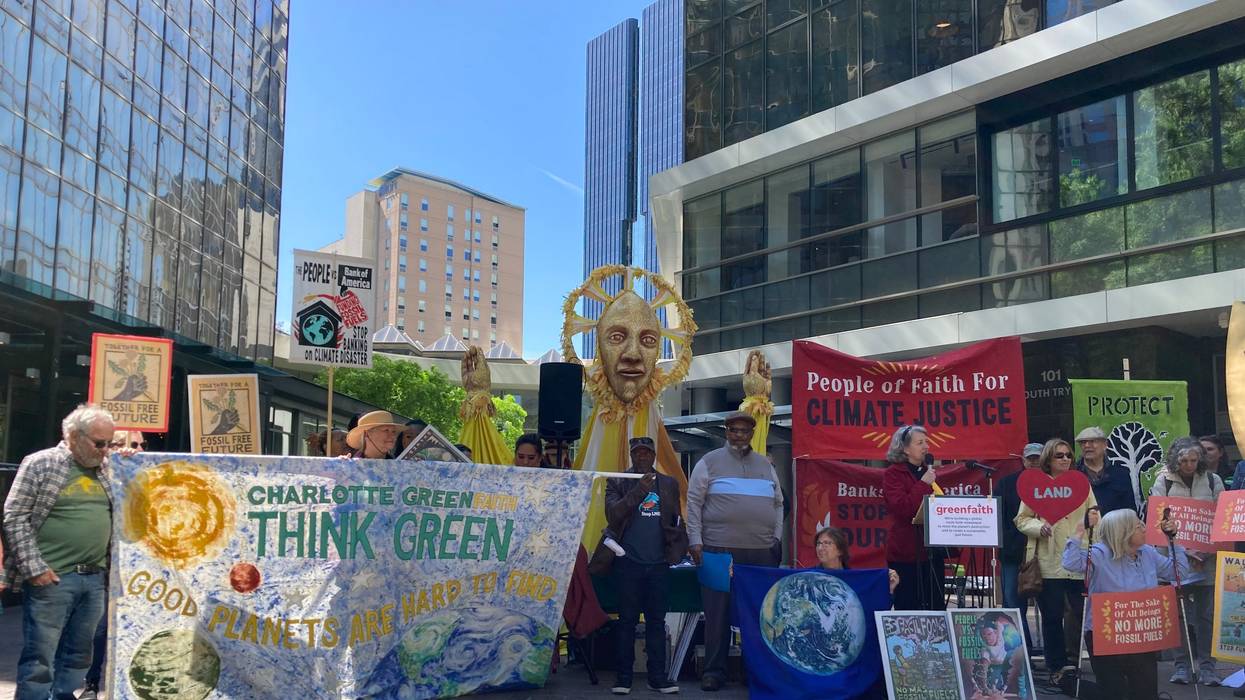
Tuesday's shareholder votes followed protests the previous day outside the headquarters of Bank of America in Charlotte, Citigroup in New York, and Wells Fargo in San Francisco. Dozens of activists slept overnight outside Citi's headquarters.
"While... Citi shareholders continue to support evaluating its policies and impacts on Indigenous peoples, it's saddening and maddening to see the numbers drop a few points as our homelands are destroyed across the globe," said Tara Houska, a member of the Couchiching First Nation and founder of the Giniw Collective.
"These are not uninformed people, they are folks who hold an incredible amount of influence on social discourse and outcomes that impact all life," she added. "Hiding behind jargon and polite rooms are actions they choose as the world's finite freshwater is irreparably harmed."
Stephone M. Coward II, who runs the economic justice and Paid in Full campaigns at the Hip Hop Caucus, argued that "once again, these financial institutions prioritize profit over people and our planet."
" Pollution from fossil fuels worsens the effects of climate change, and together they create a destructive loop that disproportionately impacts the well-being of Black, Brown, and Indigenous people," Coward added. "We must continue to use all the financial levers of power to shift financial capital away from industries causing harm and toward communities that hold the solutions."
Jessye Waxman, the senior campaign representative for Sierra Club's Fossil-Free Finance campaign, said in a statement that "investors have once again failed to align their voting with their stated positions on climate-related financial risk."
"Stewardship is central to many investors' own net-zero commitments, so it's alarming that investors—including the biggest institutional investors like BlackRock and Vanguard—continue to choose a hands-off approach to climate risk mitigation," Waxman added.
Vanguard recently surpassed BlackRock as the world's leading institutional investor in fossil fuels, with the former holding $269 billion in coal, oil, and gas investments and the latter $263 billion.
"Big investors are ignoring science and the needs of frontline communities, protecting the status quo over the changes needed to protect people and planet from climate disaster," Alec Connon, coordinator of the Stop the Money Pipeline, said in a statement. "A transition is coming one way or another: Banks and their investors can help make it orderly and just, or they can pretend they don't see what's coming as they drive the planet off a cliff."
"Investors who voted against these resolutions should expect to have a hard time sleeping at night with the knowledge that their misplaced greed will lead to climate destruction and chaos," Connon added.
Right-wing shareholder proposals that target environmental, social, and governance (ESG) frameworks are up 60% compared to this time last year.
After years of criticizing progressives for shareholder activism focused on social justice and environmental concerns, right-wing groups and ideologues are embracing the same strategy themselves.
At publicly held companies, right-wing shareholder proposals that target environmental, social, and governance (ESG) frameworks are up 60% compared to this time last year, according to the 2023 Proxy Preview report published by the nonprofits As You Sow, the Sustainable Investments Institute, and Proxy Impact.
Of the hundreds of shareholder resolutions that have been filed so far in 2023, the report identifies 43 proposals that decry corporate attempts to redress climate inaction, racial inequity, abortion restrictions, and gun violence. Additional anti-ESG proposals are likely to be filed in advance of annual shareholder meetings, which usually take place in May.
Most of the proposals come from groups that are key players in the Right's war on "woke" capitalism.
The National Center for Public Policy Research (NCPPR), a right-wing advocacy group, has filed at least 17 anti-ESG proposals with various corporations this year, the most of any conservative organization profiled in the report. NCPPR has spearheaded a campaign it calls Stop Corporate Tyranny, which rails against "cancel culture" and accuses corporations of both allowing themselves to be weaponized against "traditional American values" and silencing conservative perspectives in adopting "the progressive Left's extreme and radical agenda."
Quoting Fox News host Tucker Carlson, NCPPR claims that "the biggest threat to liberty is no longer big government, its [sic] big business."
NCPPR claims that "the biggest threat to liberty is no longer big government, its [sic] big business."
The campaign is part of NCPPR's Back to Neutral Coalition, which includes the American Legislative Exchange Council (ALEC), the right-wing corporate bill mill that works with state lawmakers across the country to enact pro-corporate legislation. ALEC chief executive Lisa Nelson is a member of the NCPPR board.
The National Legal and Policy Center (NLPC), another major anti-woke culture warrior, has filed the second most anti-ESG shareholder proposals this year. A former associate member of the State Policy Network (SPN), a right-wing coalition of free market think tanks, the so-called "watchdog" group has received funding from major right-wing donors, including the Sarah Scaife Foundation.
The majority of NLPC's proposals are concerned with "ties to Communist China" and have been filed with large multinational corporations such as Starbucks, McDonald's, Merck, General Motors, Boeing, and Apple. A different resolution targeted at Meta, the parent company of Facebook, demands a report on "government censorship."
Corporate policies that attempt to curb fossil fuel use and address the climate crisis have long raised the ire of right-wing groups—many of which receive major funding from the oil and gas industry.
NLPC filed memos with the Securities and Exchange Commission (SEC) urging shareholders at Bank of America, Citigroup, Goldman Sachs, and Wells Fargo to vote against proposals asking the banks "to take additional actions to reduce greenhouse gas emissions." Shareholder meetings for all four financial institutions are being held next week.
Steven Milloy, a former Fox News columnist and lobbyist for the tobacco and fossil fuel industries who currently sits on the board of the libertarian Heartland Institute, filed a shareholder proposal with Alliant Energy pressing the company to justify its "pure fantasy" of ever achieving net-zero emissions.
Milloy also filed a proposal at Chevron that would require the energy giant to rescind its 2021 emissions reduction pledge. The proposal appears to have been crafted in conjunction with Strive Asset Management, the company founded by anti-woke firebrand and 2024 Republican presidential contender Vivek Ramaswamy.
Investment fund magnate David Bahnsen filed a proposal with Chevron demanding that the company establish a committee to analyze the risks associated with decarbonization goals, and NCPPR filed a similar proposal with Duke Energy.
Six of NCPPR's shareholder proposals raise concerns about racial justice initiatives undertaken by companies, a leitmotif in the Right's attacks on "stakeholder capitalism" and ESG investing, along with alleged reverse racism against white conservatives. Last year, the director's letter in NCPPR's Investor Value Voter Guide 2022 promised that the guide would help proxies vote "against the new racism and sexism of 'equity'" and "other hard-left goals of so-called stakeholder capitalism and ESG." (The organization's 2023 guide has not yet been released.)
Other proposals focus on anti-discrimination and "viewpoint diversity." For instance, NCPPR's proposal for the grocery chain Kroger calls for a report detailing "the potential risks associated with omitting 'viewpoint' and 'ideology' from its written equal employment opportunity (EEO) policy." The SEC ruled that Kroger could omit the proposal.
NCPPR warns against "committing illegal or unconscionable discrimination against employees deemed 'non-diverse'" in the name of "so-called 'equity.'"
At Home Depot, NCPPR hopes to rescind the racial equity audit that shareholders agreed to at the company's 2022 annual meeting. In a proposal with McDonald's, NCPPR warns against "committing illegal or unconscionable discrimination against employees deemed 'non-diverse'" in the name of "so-called 'equity.'"
NCPPR also takes up claims of liberal media bias and "viewpoint discrimination" in its proposal filed with AT&T, which criticizes the company for not renewing DirecTV's contract with the right-wing One America News (OAN) in the wake of its incendiary coverage of the 2020 presidential election and the subsequent insurrection.
For reasons not disclosed, Inspire Investing, a "biblically responsible" investing firm that champions anti-abortion and anti-LGBTQ views, ended up withdrawing its proposal on the "risks" associated with anti-discrimination policies, which it had filed with M&T Bank.
NCPPR filed an anti-abortion proposal with Eli Lilly, the Indianapolis-based pharmaceutical company, in which it calls for a report on the "risks of supporting abortion." NCPPR takes issue with the company's position that its ability to attract "diverse employees" has been hindered since Indiana passed an abortion ban in 2022, and therefore, that it needs to focus its expansion efforts outside the state. NCPPR argues that Eli Lilly's embrace of diversity "ends at diversity of thought, opinion, and religious convictions." The board has recommended voting against the proposal.
Anti-abortion activist and semi-professional shareholder activist Thomas Strobhar also proposed a vote at Disney regarding transparency in charitable contributions. His organization, Life Decisions International, pressures companies to halt donations to Planned Parenthood.
NCPPR submitted a shareholder proposal to American Express that would have required the company to report on how it would "reduce the risk associated with tracking, collecting, or sharing information" regarding payment processing for the "sale or purchase of firearms." In March, the SEC ruled that American Express could omit the proposal from its proxy materials since it appeared to micromanage the company.
Gun control advocates have long urged credit card companies to track gun and ammunition purchases as a way of curtailing rampant gun violence and mass shootings. Lawmakers in states such as New York have pressured Mastercard and American Express—both based in New York—to flag suspicious gun purchases.
By contrast, Florida's Senate Bill 214—which penalizes financial companies for using a separate "merchant category code" for firearms—sailed through the Republican-controlled state senate in March and has crossed over into the house. The bill's lobbyists include Gun Owners of America, the political action arm of the Gun Owners Foundation, which has received funding from the right-wing Ed Uihlein Family Foundation and Shell Oil, according to tax filings.
Bahnsen filed a shareholder proposal with MetLife taking issue with the company's decision "not to offer a bulk discount to NRA members" and to exclude "firearms makers from investment portfolios."
Based on the gun industry's fear that President Biden will reinstate Operation Choke Point—an Obama-era program created to curtail bank fraud and discourage financial institutions from doing business with "high-risk merchants"—NLPC filed three identical proposals with JPMorgan Chase, Mastercard, and Wells Fargo to require the companies to report on any government requests to close accounts, along with their own policies for dealing with those requests. The SEC denied the proposals made to JPMorgan and Wells Fargo, and, in early March, NLPC withdrew a comparable proposal with Mastercard.
In a similar move, Bahnsen filed a shareholder proposal with MetLife taking issue with the company's decision "not to offer a bulk discount to NRA members" and to exclude "firearms makers from investment portfolios" (along with "coal companies and oil sands extractors"), according to Proxy Preview.
Bahnsen sits on the advisory board of the Viewpoint Diversity Score, a right-wing effort to negatively rate companies that take into account social justice concerns such as racial equity. The index, which is a project of the LGBTQ hate-group the Alliance Defending Freedom, received an Innovation Prize from the right-wing Heritage Foundation last year.
Overall, the shareholder activism the Right has undertaken to counter corporate pressure from the Left has met with limited success. Anti-ESG proposals are typically unpopular with shareholders and on average garner 4% support or less. In addition, the volume of right-wing filings still pales in comparison with the number coming from progressive organizations. For example, As You Sow has filed at least 89 proposals this year, mostly related to advancing climate goals, diversity initiatives, and pro-union policies.
Other anti-ESG shareholder strategies—such as the new proxy advisory services launched by Ramaswamy's company Strive—appear to be gaining traction. Indiana's Public Retirement System recently rewarded Strive a $150,000 no-bid contract.
Social and climate risks have real impacts on the bottom line, and investors and customers increasingly expect businesses to take them into consideration.
Yet the overwhelming response from corporate boardrooms has been: ESG policies make financial sense. As Andrew Winston argued in the Harvard Business Review, "The banks pushing back on anti-ESG laws are not seeking medals for philanthropy; they're doing it because it's good business." Social and climate risks have real impacts on the bottom line, and investors and customers increasingly expect businesses to take them into consideration.
An entire generation of talent "won't stay with us if we don't care about ESG or purpose or whatever we call it," Mars CEO Poul Weihrauch told Financial Times last month. "So from my chair, I think it's a nonsense conversation. We don't believe that purpose and profit are enemies."
"It's time for big banks to listen to the science and stop funding climate destruction," said one advocate.
As the fossil fuel-driven climate crisis continues to wreak havoc around the globe, more than 1,300 scientists and researchers on Monday published a letter imploring JPMorgan Chase shareholders to support a resolution that asks the financial giant's board of directors to "adopt a policy for a time-bound phaseout" of bankrolling new coal, oil, and gas projects.
The resolution in question is being proposed at the bank's annual meeting on May 16. If passed, "this resolution would encourage JPMorgan Chase to stop providing financing, including loans, bonds, and underwriting, to companies engaged in fossil fuel expansion," states the letter, which was led by prominent climate experts in partnership with the Union of Concerned Scientists (UCS) and Stop the Money Pipeline (STMP). "By making this commitment, JPMorgan Chase could signal its intention to advance the clean energy transition and help ensure a safer future for people and our planet."
Arielle Swernoff, U.S. Banks Campaign Manager at STMP, said in a statement that "the science is clear: in order to reduce emissions in line with the Paris agreement, fossil fuel expansion must stop now, yet JPMorgan Chase and other big banks like Citi, Wells Fargo, and Bank of America continue to pour money into new oil, gas, and coal."
"Big banks must be held accountable for their role in causing the climate crisis."
Despite pledging to put themselves and their clients on a path to "net-zero" greenhouse gas emissions, the world's 60 largest private banks pumped $4.6 trillion into coal, oil, and gas projects from 2016 to 2021. The four U.S. financial behemoths mentioned by Swernoff are responsible for a quarter of all fossil fuel financing identified since the Paris agreement entered into force. JPMorgan Chase alone provided more than $382 billion to coal, oil, and gas firms during the aforementioned six-year period, including $65.4 billion to the 20 corporations doing the most to ramp up the extraction of planet-heating fossil fuels.
"Over 1,300 scientists have come together to say: enough is enough," said Swernoff. "It's time for big banks to listen to the science and stop funding climate destruction."
Kathy Mulvey, director of the Climate Accountability Campaign at UCS, stressed that "as people around the world face climate-related extreme weather disasters, threats to public health, and systemic economic risk, big banks are choosing to ignore climate science by providing billions of dollars in financing to fossil fuel companies that continue to expand their production of oil and gas."
"JPMorgan Chase and other financial institutions are continuing to mislead shareholders about what is needed to reach global climate goals and instead seeking to maintain a dangerous status quo that prioritizes profit over people and the environment," said Mulvey. "To safeguard communities, investors, and the global economy, shareholders should insist that banks incentivize swift and deep cuts in heat-trapping emissions to limit climate change harms and facilitate a just transition to a clean energy economy."
Mulvey was echoed by Ayana Elizabeth Johnson, co-founder of the Urban Ocean Lab and a lead signatory of the letter.
"To avoid the most dangerous levels of planetary warming, we must rapidly end our reliance on fossil fuels and transition to a clean energy economy that meets the needs of all communities," said Johnson. "Meanwhile, financial institutions like JPMorgan Chase are funding continued expansion of the fossil fuel industry, even as all the warning signs for our planet are flashing red."
Last week, data from the U.S. National Oceanic and Atmospheric Administration showed that annual emissions of carbon dioxide, methane, and nitrous oxide increased again in 2022, pushing atmospheric concentrations of the three main heat-trapping gases to all-time highs.
The Intergovernmental Panel on Climate Change (IPCC) and the International Energy Agency have made clear that increasing fossil fuel supply is incompatible with limiting global warming to 1.5°C above preindustrial levels, beyond which the planetary emergency's consequences will grow worse.
Roughly 1.1°C of warming since the late 1800s is already fueling increasingly frequent and intense extreme weather across the globe. In 2022, the U.S. alone experienced 18 separate billion-dollar disasters turbocharged by climate change, including droughts, wildfires, and hurricanes. Together, these events killed 474 people and cost an estimated $172 billion. Such catastrophes disproportionately hurt low-income populations in the U.S., and the deleterious public health and economic impacts of unmitigated greenhouse gas pollution are even more severe in poor nations that bear the least responsibility for the crisis.
"JPMorgan Chase and other financial institutions are... seeking to maintain a dangerous status quo that prioritizes profit over people and the environment."
After the IPCC released its latest assessment report last month, U.N. Secretary-General António Guterres said that limiting global warming to 1.5°C is possible, "but it will take a quantum leap in climate action," including a prohibition on approving and financing new coal, oil, and gas projects as well as a phaseout of existing fossil fuel production.
Despite ample evidence that burning more coal, oil, and gas will exacerbate the deadly effects of the climate crisis, profit-hungry fossil fuel corporations—supported by trillions of dollars in annual subsidies and industry-friendly public policies—are moving ahead with plans to expand drilling.
A pair of scholars recently introduced the novel legal theory of "climate homicide," which aims to hold fossil fuel corporations criminally liable for deaths caused by the disasters they are knowingly unleashing.
Johnson insisted Monday that like Big Oil, "big banks must be held accountable for their role in causing the climate crisis."
"Shareholders," she added, "should insist that banks accelerate and deepen investment in a just, clean energy future."
According to the letter: "JPMorgan Chase is an internationally known and respected bank. By ending support for fossil fuel expansion, it could help set the global stage for a just transition to a more sustainable and livable future while acting decisively to protect its shareholders and the wider economy from the financial shocks associated with worsening climate change."
"This is no less than what science requires to keep our planet a livable place for current and future generations, including our children and grandchildren," the letter continues. "Please use your vote at this year's shareholder meeting to help protect people and our planet from climate chaos."
"The planet is running out of time and the banks are running out of excuses," said climate leader Bill McKibben.
A coalition of more than 240 advocacy groups on Wednesday launched a "Shareholder Showdown" campaign in support of shareholder resolutions urging climate action and respect for Indigenous rights at major U.S. and Canadian banks and insurance companies.
According to campaign coordinator Stop the Money Pipeline, the resolutions—which were filed by investors including the New York City and state pension funds, Sierra Club Foundation, and others—would require banks and insurance companies to "phase out their financing of companies engaged in fossil fuel expansion, report on projects that could violate Indigenous rights, use absolute emissions rather than emissions intensity targets, disclose 2030 transition plans, and hold directors accountable at banks that are not aligned with 1.5°C pathways."
The resolutions were timed to precede the companies' annual general meetings.
"This campaign is called Shareholder Showdown because we're in for a real fight—we're up against some globally powerful institutions," Arielle Swernoff, Stop the Money Pipeline's U.S. banks campaign manager, explained in an opinion piece published Wednesday by Common Dreams. "But organized people can achieve anything, and together we will stop the flow of money to fossil fuels and climate destruction."
Bill McKibben, co-founder of the climate group 350.org, said in a statement that "the planet is running out of time and the banks are running out of excuses—everyone from the pope to the secretary-general of the [United Nations] have called on them finally to act with clarity and conviction to help with the planet's greatest crisis, and shareholders should demand no less."
Among the resolutions filed are:
" Climate change is an existential crisis that can overwhelm a person in scale and size, impossible to address," said Tara Houska of the Giniw Collective, an Indigenous women and two-spirit-led frontline resistance group fighting fossil fuel projects like Line 3 in Minnesota.
"Big bank shareholders possess an enormous amount of influence on the world's emissions," Houska added. "A roomful of people can impact the disastrous course we are currently on. No more lip service or empty greenwashing—we need action, now."
Without Wall Street cash, the world's most polluting companies wouldn't get the capital they need to finance their toxic expansion.
Today, a coalition of over 240 organizations across North America announced a new campaign on big banks and insurance companies: Shareholder Showdown. This spring, we’re calling for shareholders to step up and push major corporations to start taking the climate crisis seriously.
Every year, shareholder season runs from April to June. It’s the time of year when the country’s biggest corporations hold their annual general meetings, where shareholders vote on all sorts of proposals: how companies should be governed, who should be in charge, and how they should relate to climate, racial, and economic justice.
Shareholder activism has been a tried and true technique of progressive movement organizations for years. Labor unions, environmental activists, and human rights campaigners have won big change by combining filing shareholder resolutions with public pressure and grassroots campaigns.
This year, the climate movement is hoping to turn off the flow of Wall Street money to destructive fossil fuels. Investors have filed shareholder resolutions at the largest North American banks and insurance companies calling on the firms to phase out their financing of fossil fuel expansion, protect Indigenous rights, and stop greenwashing.
This campaign is called shareholder showdown because we’re in for a real fight – we’re up against some globally powerful institutions.
These resolutions are just one part of a multi-faceted campaign to stop the flow of money to oil, gas, and coal. Shareholder season is the time when all eyes are on Wall Street, and an opportunity for activists to call out big banks and insurance companies for their greenwashing, denialism, and continued support of climate destruction.
Wall Street matters in the climate fight because fossil fuel companies simply don’t have the cash on hand to build new coal mines, oil fields, refineries, or pipelines whenever they want. Like other businesses, they need to go to the bank for financing, often in the billions of dollars. Despite pledges to align their business models with the goals of the Paris Agreement, the six largest American banks – JP Morgan Chase, Citigroup, Bank of America, Wells Fargo, Morgan Stanley, and Goldman Sachs – have provided nearly $500 billion in lending and underwriting to the 100 corporations most aggressively expanding fossil fuel operations since 2016.
That’s billions to fossil fuel companies such as ExxonMobil, BP and Gazprom, the Russian state-owned oil company which is helping to finance the murderous invasion of Ukraine. It’s money to companies like Energy Transfer Partners, the operator of the Dakota Access Pipeline, Enbrige, the owner of Line 3 and Line 5, and GeoPark, which is drilling for oil on Indigenous lands in the Amazon.
Fossil fuel expansion isn’t just bad for our carbon budget – although according to the International Energy Agency, in order to have a fifty percent chance of limiting global warming to 1.5°C, we have to stop fossil fuel expansion now – it’s devastating to Black, Indigenous, and communities of color on the frontlines. Polluting fossil fuel infrastructure is disproportionately likely to be sited in communities of color, causing negative impacts such as heart disease, asthma, and cancer, poisoning land, air, and water, and disrupting community cohesion.
Without Wall Street cash, these companies wouldn’t get the capital they need to finance their toxic expansion.
That’s why this spring, climate activists are campaigning hard to get major investors such as pension funds, asset managers, and universities to vote yes on these climate and Indigenous rights resolutions. This vote isn’t like a regular election – they don’t need to pass with more than fifty percent to become policy. Even results in the teens and twenties send a strong signal to companies that people are ready for change. After all, what company would ignore the demands of one in five of its shareholders?
Activists are especially focused on pushing public pension funds, which are large, long-term investors, to vote yes, and it’s already paying off. After coming out publicly in favor of a series “no fossil fuel expansion” resolutions last year, New York City Comptroller Brad Lander filed resolutions at Bank of America, Goldman Sachs, JPMorgan Chase, and Royal Bank of Canada calling on the banks to use absolute targets to track their emissions, rather than the emissions intensity targets that allow them to put out greenwashing statements while insidiously increasing their investment in fossil fuels.
New Yorkers should be proud of their city for this leadership, but those of us in the Big Apple needn’t have all the fun – anyone who lives in a state or city with a public pension can get involved by calling or writing to their Treasurer’s office demanding they support these critical resolutions. People who have public pensions or are public sector employees, including educators, nurses, bus drivers, and administrators can reach out to their pension fund directly and demand that their retirement not be used to uphold Wall Street’s greenwashing and lies.
This campaign is called shareholder showdown because we’re in for a real fight – we’re up against some globally powerful institutions. But organized people can achieve anything, and together we will stop the flow of money to fossil fuels and climate destruction.The climate movement's strategy to end fossil financing needs to evolve—and it already is.
Over the past two years, the State Financial Officers Foundation (SFOF)―a dark money group supported by climate-denying organizations, such as the Heartland Institute and the American Legislative Exchange Council (ALEC)―has organized Republicans to attack climate financial regulation, defeat the nominations of key Biden regulators, and divest state money from BlackRock in retaliation for its climate commitments. This year alone, Republicans have introduced more than 100 bills in 23 states that are designed to punish financial companies for taking action on climate.
This is the latest evolution of the GOP’s decades-long strategy to slow the transition off fossil fuels―an all-out attack on financial institutions they claim are “boycotting” fossil fuels. And it’s working. The world’s largest banks and investors have been falling over themselves to pledge loyalty to the fossil fuel industry.
Given this change of political terrain, the climate movement’s strategy to end fossil financing needs to evolve. Every year since 2017, there have been national days of actions targeting banks funding fossil fuels. During the height of the resistance to Line 3, there were actions at the banks financing the pipeline in over one hundred cities on a single day. Protestors have shut down streets and banking centers in New York, San Francisco, and Seattle time and time again. There is still a need for these kinds of awareness-raising actions—and if you’re not already plugged into Third Act’s national day of action on March 21st, you should find an action near you and get involved.
Shareholders, after all, are literally the people who own the company.
But alone, these kinds of actions aren’t enough. In response to an organized and strategic opposition, we need to refocus our strategy in several key ways. The most pressing of which is right around the corner: shareholder season.
Shareholder season is the time of year when every publicly-traded company in America has their Annual General Meeting (AGM). At AGMs investors vote on a variety of proposals introduced by fellow shareholders. Proposals can be about anything related to the way a company runs its business―executive pay, board diversity, the gender pay gap. In recent years, banks have faced shareholder proposals around their financing of fossil fuels. And 2023 will be no different.
In April and May, investors in Wall Street banks will vote on at least three shareholder proposals related to climate. One will call for a time-bound phase-out of financing for companies engaged in fossil fuel expansion. New York City and New York State have filed a series of anti-greenwashing resolutions that would push banks to use “absolute emissions” metrics when setting their climate targets for the energy sector, rather than the weaker “carbon intensity” metrics they’ve been using. The third resolution will push banks to create a comprehensive plan to achieve the 2030 emissions reduction targets they’ve already set.
These votes are some of the most important climate votes that you’ve never heard of. How they pan out will go a long way to determining how quickly big banks wind down their financing for coal, oil, and gas. Shareholders, after all, are literally the people who own the company.
This spring, it’s the climate movement’s job to organize constituents and pension fund members across the country to make sure that public money casts its vote for climate justice...
Unfortunately, in these elections, it’s not a democratic system where one person gets one vote. But there is one clear way that we can help influence the vote: public pensions.
Public pensions are some of the biggest investors in the country. California’s state pensions alone manage over $740 billion. Last year, the public pensions in many Democratic states, including the trifecta states of California, Washington, Colorado, New Jersey, Maryland, New Mexico, and Maine, voted against a resolution at US banks calling for an end to financing of fossil fuel expansion. Those six pension funds alone represent more than $1.2 trillion in investment capital, a significant percentage of the vote at many companies.
The good news? Public pensions manage public money. They are often overseen by elected officials. That means that they are accountable to their constituents and to everyday members of the pension fund: the teachers, public employees, and firefighters whose interests they are supposed to represent when casting their votes. This spring, it’s the climate movement’s job to organize constituents and pension fund members across the country to make sure that public money casts its vote for climate justice this shareholder season.
Over the past few months, activists around the country and the world have laid the blame for climate disasters at Wall Street's feet. In a wave of escalated actions under the name "Blame Wall Street," dozens of groups have called out the financial industry for their financing of fossil fuels and complicity in the climate crisis.
Around the country, people took on elevated amounts of risk in order to increase pressure on the dirty banks, insurance companies, and asset managers financing the climate crisis.
Activists pummeled the banks with actions and protests for months. Over 40 groups across the country held over 50 actions and protests.
In New York City, a week of action targeting Citigroup began with moms and kids birddogging the bank's chief sustainability officer, Val Smith, over Citi's continued funding of Russian oil and gas interests. Later that week, activists infiltrated Citi's Taste of Tennis gala and interrupted the event with a large banner accusing the bank of funding Russia's war crimes.
Citi, the US's largest funder of coal, faced additional protests at greenwashing PR events and at branches in Phoenix, Brooklyn, and other locations. Activists interrupted the speech of Citi's Chief Sustainability Officer at a sustainable banking conference, and protested Citi, Wells Fargo, and Chase leadership at a Women in Banking event.
Chase emerged from its fall PR events similarly beleaguered. Activists crashed the Chase-sponsored US open, passing out fans to sweaty attendees accusing JPMorgan Chase of funding climate chaos. Later in the month, nine different affinity groups created a circus out of the San Francisco Chase Corporate Challenge, with activists taking over every part of the road race, which hundreds of Chase employees participate in, from the course to the finish line to the after party to protesting in kayaks along the route.
As the world's largest funder of fossil fuels, it's no surprise that Chase was protested again and again: Leavenworth, Washington; Worcester, Watertown, and Boston, Massachusetts; Madison, Wisconsin; Fort Lauderdale, Florida; Chicago, Illinois; Providence, Rhode Island; Silver Spring, Maryland; Sacramento, California; New Orleans, Louisiana; and New York City all saw protests at Chase branches or headquarters.
Another major target was asset manager BlackRock, one of the world's top investors in fossil fuels and climate destruction. BlackRock saw protest after protest at their headquarters, with regular actions from September through November. People sang outside their building, came in costume, held prayer and faith actions, and stormed the headquarters with pitchforks and dumped coal on their escalators. BlackRock is on notice: time to stop financing fossil fuels.
Global climate strike protests also included demands on Wall Street and an end to fossil fuel financing, with activists in Los Angeles, Chicago, New York, and Maryland partnering with youth leaders to demand a safe and livable future. Climate strikers weren't the youngest activists: in Los Angeles and New York, people protested the greed of the fossil fuel industry alongside their infants and toddlers.
Actions were creative, including art, music, and costumes. In Albany, New York, the red rebel brigade joined a protest outside of TD Bank. In Brooklyn, activists dressed up as Mr. Moneybags and brought bagpipes to branch locations of Citi, Chase, and Bank of America. In Sacramento, Denver, and New Orleans, activists staged Halloween actions, dressing up as endangered species or zombie bankers.
Faith leaders exercised their moral authority in calling on banks and asset managers to stop funding climate disaster. Near Philadelphia, Quaker activists held a prayer vigil outside of the Vanguard HQ, calling on the asset manager to stop financing fossil fuels. In Washington, DC, faith leaders called on the IMF and World Bank to do the same. Faith activists also held protests outside of the Bank of America headquarters in Charlotte, and a Bank of America branch in Springfield, Illinois. Leaders from different faith communities protested multiple times outside of BlackRock's corporate headquarters in New York City--at one protest, 27 faith leaders were arrested.
Around the country, people took on elevated amounts of risk in order to increase pressure on the dirty banks, insurance companies, and asset managers financing the climate crisis. Dozens of people were arrested this fall--from San Francisco to New York to Pennsylvania to Rhode Island. These activists went to jail in order to show the world the greed of dirty Wall Street actors.
Activists innovated by taking repeated action at financial targets. Instead of one protest, people showed up week after week, increasing the pressure on banks and asset managers. In Phoenix, Arizona, Sacramento, California, Madison, Wisconsin, and Leavenworth, Washington, local actions happened again and again.
People targeted other financial actors, as well. Insurance companies received their fair share of pressure, with actions on Traveller's, Hartford, and Chubb. One action saw a huge oil derrick parked outside of the home of Chubb CEO, Evan Greenberg. Groups protested the Federal Reserve in Jackson Hole, Wyoming and in Washington, DC, activists protested TIAA's support for deforestation, there was an action outside of the shareholder meeting of Proctor & Gamble, and a noise protest outside of the homes of the CEOs of the private equity firms KKR and Blackstone. In Sierra Leone, youth activists protested the Central Bank's support of fossil fuel expansion.
Activists are not slowing down: it's clear that Wall Street holds an outsized responsibility for the death, destruction, and chaos caused by the climate crisis. With shareholder meetings coming up this spring, banks, insurance companies, asset managers, and pension funds should be ready for increased pressure. Banks are expected to see more shareholder resolutions calling on them to walk the talk on climate than ever before, and the grassroots movement to stop the flow of money to fossil fuels is only growing in energy and momentum.
On December 14, we are hosting a call to share what's next in the fight to stop the money pipeline to climate chaos. We hope you will join us.
A significant percentage of shareholders at three of the biggest U.S. banks voted Tuesday to endorse first-of-their-kind resolutions urging the companies to stop supporting new fossil fuel development amid a worsening climate emergency.
"Big banks have a responsibility to address their massive contribution to the climate crisis and protect their shareholders from climate risk."
Shareholders at Citigoup, Bank of America, and Wells Fargo voted 12.8%, 11%, and 11%, respectively, to support climate resolutions filed by the Sierra Club Foundation and other members of the Interfaith Center on Corporate Responsibility. According to the Sierra Club, any resolution that receives at least 5% of the vote can be refiled the following year, and those that get 10% or more are "considered difficult for a company to ignore."
"Big banks have a responsibility to address their massive contribution to the climate crisis and protect their shareholders from climate risk by aligning their policies with their own net-zero commitments and ending support for fossil fuel expansion," Adele Shraiman of the Sierra Club's Fossil-Free Finance campaign said in a statement. "The pressure on them to do so from shareholders and the public is only growing stronger."
The "groundbreaking" resolutions include a call for each bank to "build upon" its net zero commitments by adopting policies "to help ensure that its financing does not contribute to new fossil fuel supplies that would be inconsistent" with the International Energy Agency's "Net-Zero Emissions by 2050" scenario and other climate frameworks.
While shareholders have previously compelled companies to disclose the emissions impact of their operations and investments and set long-term climate targets, this is the first time they have called on banks to implement plans to achieve those objectives, according to Sierra Club.
"The fact that this first-of-its-kind effort gained as much support as it did should send a clear signal that the effort to push Wall Street to deal with its climate problem isn't going anywhere," said Shraiman.
As Danielle Fugere, president of the shareholder advocacy group As You Sow, told Grist: "Investors are saying we can't conduct business in a world that is on fire, that has heatwaves and insufficient water. And I do think companies are beginning to understand that it's in their interest to take action and that shareholders support that action."
Outlining Tuesday's votes, Sierra Club noted:
The resolutions were publicly supported by New York State Common Retirement Fund, the third-largest pension fund in the country, as well as three of New York City's pensions, and Rhode Island's and Seattle's funds.
However, the vote totals suggest that major asset managers like BlackRock, Vanguard, State Street, and Fidelity--which are by far the largest shareholders of the big banks, and are therefore uniquely positioned to make a huge impact on important votes--failed to support them, despite their own net-zero commitment and pledges to use their shareholder power to advance climate action.
"It's deeply disappointing that, once again, asset managers like BlackRock and Vanguard have failed to put their money where their mouth is and use their immense power to hold banks accountable to their climate pledges," Shraiman lamented.
"The rhetoric coming out of these big investors about climate leadership and engaging with their clients on a clean energy transition is worthless if it's not paired with meaningful accountability for clients that are clearly not interested in making that transition a reality," she added.
Paul Rissman, a Sierra Club board member and former executive vice president of an asset management firm, noted that all the largest U.S. banks have pledged to achieve net-zero financed emissions by 2050.
"Big U.S. banks have utterly failed to protect their shareholders' long-term interests."
"Despite their commitments," he wrote, "all of these banks have continued to fund the top 20 companies that are responsible for most fossil fuel development--to the tune of more than $445 billion combined in the six years since the Paris agreement was signed."
"This is recipe for disaster," warned Rissman. "The scientific consensus is clear that in order to achieve global net-zero emissions by 2050 and avert the worst of the climate crisis, the expansion of new fossil fuel development must stop immediately."
"Big U.S. banks have utterly failed to protect their shareholders' long-term interests as they renege on their net-zero commitments and fumble on adequately managing the risks associated with financing new fossil fuel development," he added.
In addition to denouncing companies for their inadequate climate action, critics have also condemned net-zero pledges that some argue are a dangerous form of greenwashing best avoided in favor of near-term commitments to reducing greenhouse gas emissions.
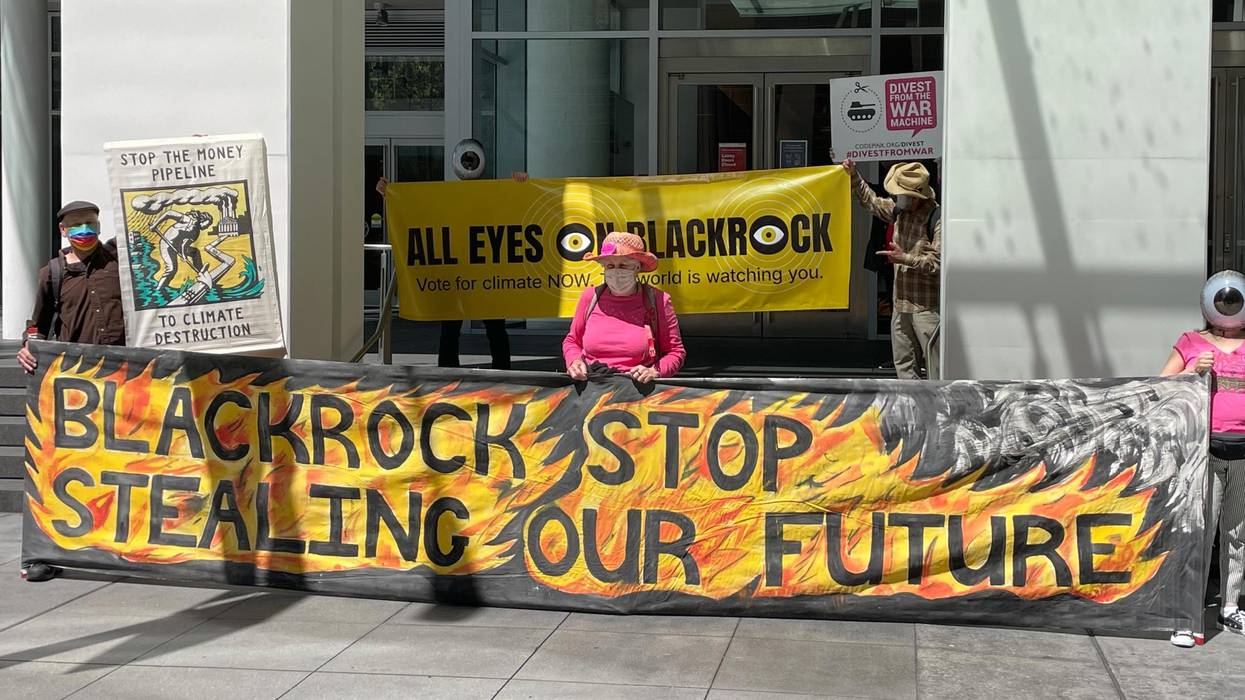
As corporations around the world prepare for annual shareholder meetings, climate activists held a series of actions leading up to and throughout the weekend in cities around the world that aimed to put "all eyes on BlackRock," the world's largest money manager, with nearly $9 trillion in assets under management.
"At the moment, BlackRock is a major part of the problem," said Robin Wells, an English teacher and activist with Fossil Free London who joined the U.K. city's demonstration, in a statement from the global network BlackRock's Big Problem.
"Today we're giving notice that we'll be watching to see if BlackRock will actually pour any water on the flames it has started," Wells said. "We're here because we can't fix our planet with promises, only action can do that."
In addition to London, activists demonstrated at BlackRock offices in Boston, Dallas, Miami, New York City, San Francisco, and Zurich.
"CEO Larry Fink talks a big game on climate, but the company is the top investor in oil, gas, and coal," noted Patrick Houston of New York Communities for Change. "As the season of shareholder annual meetings looms, all eyes are on BlackRock."
As BlackRock's Big Problem details on a webpage about this year's shareholder season:
In BlackRock's 2021 Stewardship Expectations report, the asset manager finally acknowledged that voting against management and supporting shareholder proposals often leads to positive changes at companies. In January 2021, BlackRock expanded its voting criteria and announced that it will hold directors accountable when their companies fail to address climate change in their business plans. In March, both BlackRock and Vanguard joined the Net Zero Asset Managers Initiative, a first move on climate for Vanguard.
While acknowledgments and commitments may mark a change in thinking within BlackRock and Vanguard, it is action that is needed to curb the climate crisis. So this shareholder season, as the world looks toward COP26, their default position must be to vote in favor of pro-climate shareholder resolutions and against corporate boards when a company doesn't have a clear climate transition plan.
The network is focused on eight specific votes. In the oil and gas sector, there will votes on resolutions for BP and Shell to set public targets consistent with the goals of the Paris agreement, and against ExxonMobil chairman and CEO Darren Woods as well as lead independent director Kenneth C. Frazier for failing to implement plans consistent with limiting global temperature rise to 1.5oC, the more ambitious Paris goal.
There are similar plans for financial services--votes on resolutions for Barclays and MUFG to set Paris-related targets and against Wells Fargo chairman Charles H. Noski for failing to implement plans consistent with the 1.5oC goal. There will also be a similar vote against Duke chair and CEO Lynn Good as well as independent lead director Michael G. Browning. Activists are also pushing for a resolution requesting Bunge issue a report about eliminating deforestation in its soy supply chain.
"At this point, voting with corporate management to maintain business as usual is an active choice against climate action," the network says. "If asset managers continue to choose not to vote for climate action this shareholder season, they will be actively working against progress, science, and the interests of their own clients and beneficiaries."
While protesters aimed to raise awareness about the upcoming votes, some also directed attention to the controversial Line 3 pipeline, which opponents have dubbed "a climate time bomb." The Canadian company Enbridge is trying to replace a corroding pipeline with a larger one that would carry oil from Alberta, through North Dakota and Minnesota, to Wisconsin. Construction on the project has been repeatedly halted in recent months by water protectors' direct actions in Minnesota.
"My heritage is of a people whose rights were violently violated. My future is of a planet whose climate is being devastatingly altered. BlackRock should wield its vast financial power to mitigate the climate crisis," declared 19-year-old climate justice activist Xiye Bastida of the Otomi-Toltec Nation. "It can start by divesting from Enbridge, the owner of the Line 3 pipeline, before moving to divest from all tar sands."
Last month, Sen. Elizabeth Warren (D-Mass.) questioned Treasury Secretary Janet Yellen on why the federal government hasn't deemed BlackRock "too big to fail" and subjected the firm to stricter oversight. The senator said during a hearing that "it isn't just banks that pose a risk to the economy. In 2008, two investment companies, Bear Stearns and Lehman Brothers, failed, triggering the 2008 crash."
The Biden administration faces mounting pressure to protect U.S. financial institutions and the economy from risks posed by the climate emergency as well as demands that the administration help end the flow of private finance from Wall Street to major polluters. Polling results released Monday show that a majority of U.S. voters support federal government action to prevent future climate-related economic crises.
Activist and shareholder frustrations with JPMorgan Chase's funding of global climate catastrophe were on full display Tuesday during the multinational investment bank's virtual Annual General Meeting.
"The pressure Chase faced on climate at today's meeting and the votes showing unprecedented support for climate accountability are proof that the movement to push Chase and other big banks to clean up their act on climate is only gaining momentum and power."
--Ben Cushing, Sierra Club
In a clear signal of support for reforming the lending practices of the world's largest private bank to ensure a habitable future planet, 49.6% of shareholders voted in favor of a resolution that asked JPMorgan to craft a plan to better align its operations with the Paris climate agreement's goal of limiting global temperature rise to 1.5degC.
Welcoming that vote in a statement Tuesday, Sierra Club campaigner Ben Cushing declared that "the days when Chase could quietly funnel money into the fossil fuel industry without the public taking notice are over."
"The pressure Chase faced on climate at today's meeting and the votes showing unprecedented support for climate accountability are proof that the movement to push Chase and other big banks to clean up their act on climate is only gaining momentum and power," Cushing said. "This is only the beginning, and we'll continue to demand meaningful changes to align Chase's investments with a climate-safe future."
The development was also celebrated by Danielle Fugere, president of the nonprofit shareholder advocacy group As You Sow. "Shareholders today sent the message that it is past time for Chase to catch up with its peers, implement a strategy to decarbonize and de-risk its lending portfolio, and help build a more secure future for all," she said.
Since the landmark Paris accord was adopted in late 2015, JPMorgan has provided over a quarter of a trillion dollars in fossil fuel financing. That has made the bank a top target of climate activists--including Stop the Money Pipeline, a campaign launched in January by a coalition of advocacy groups to pressure banks, insurers, and asset managers to cut ties with planet-wrecking companies.
"As the world's largest funder of fossil fuels, JPMorgan Chase has a decision to make--either recognize growing global climate risk and dramatically reduce its fossil fuel funding or continue irresponsibly driving global temperature rise to greater and more devastating impacts," said Fugere. She noted that As You Sow withdrew similar proposals at Wells Fargo, Morgan Stanley, Bank of America, and Goldman Sachs after the banks made climate commitments.
"It is critical that financial heavyweight JPMorgan Chase accelerate ambition to clean up its fossil fuel financing," Fugere added. "JPMorgan's inaction in the face of the staggering risks of climate change is noteworthy and unacceptable. Investors can no longer tolerate business as usual in these unprecedented times."
JPMorgan announced in February that it would stop financing extraction projects in the Arctic and phase out loans for coal by 2024 but continue funding oil and gas developments. At the time, activists called the moves "small concessions" but also evidence that "citizen power can work."
Eli Kasargod-Staub, executive director of nonprofit shareholder advocacy group Majority Action, said Tuesday that "instead of vague professions of support of the Paris agreement, JPMorgan must commit to the goal of achieving net-zero CO2 financed emissions by 2050 and disclose their plans for how they will realign their lending and underwriting strategies to achieve this goal."
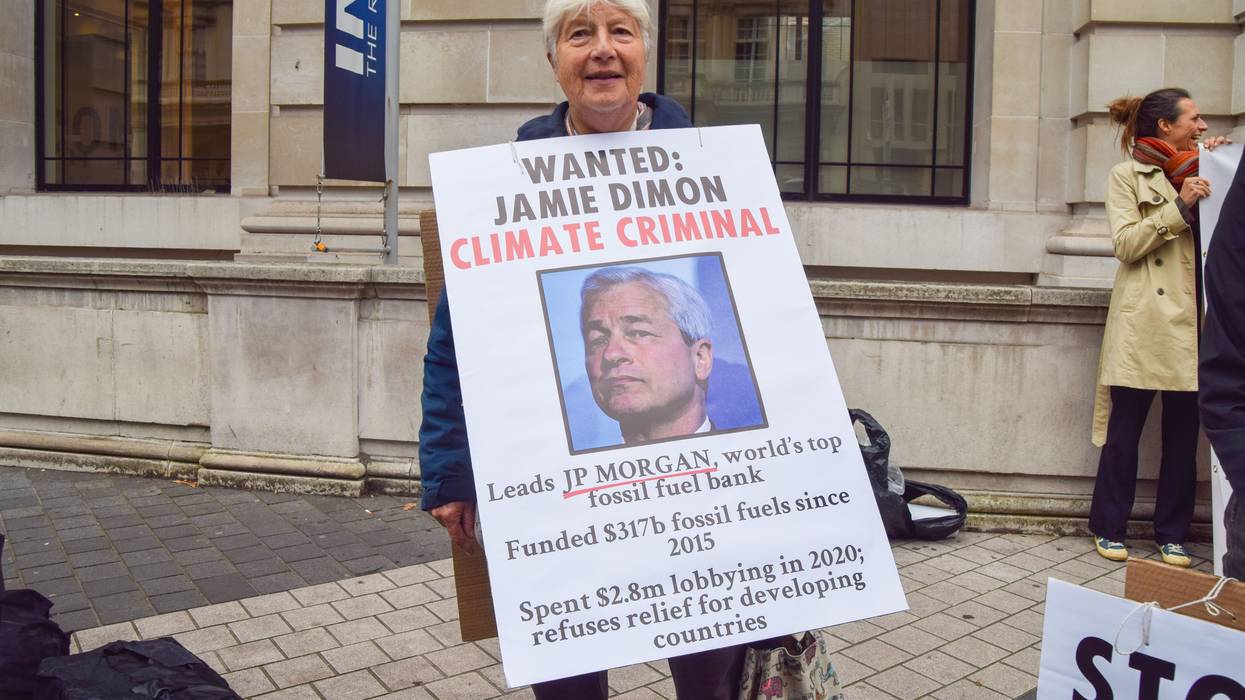
During the annual meeting, JP Morgan also faced pressure to oust from its board of directors Lee Raymond, an ex-CEO of oil giant ExxonMobil who was quietly demoted from his longtime leadership role at the bank earlier this month due to activist and investor demands. Additionally, 41.96% of shareholder voted to split the roles of board chair and CEO, which activists lauded as a rebuke to Jamie Dimon, who holds both positions.
"This shareholders' revolt against Jamie Dimon's failed record on climate change shows that JPMorgan Chase's days of acting as the house bank of the fossil fuel industry will have to end," Patrick McCully, Climate & Energy Program director at Rainforest Action Network, said in a statement.
"The unprecedented share of the votes against management," he said, "and the fact that JPMorgan had to demote climate denier Lee Raymond from his board leadership role, shows that investors agree with activists that business as usual in financing fossil fuels is no longer acceptable."
Although Raymond's demotion pleased activists, 350.org senior strategist Richard Brooks urged the bank to go further. As he put it: "While demoting climate-denying Lee Raymond as lead independent director after 19 years is a start, this is just the tip of the melting iceberg of what needs to happen at JPMorgan Chase."
"The future is not in financing risky, bankrupt prone fossil fuel companies wrecking our climate," Brooks added. "It is in investing in community driven climate solutions. The climate related shareholder votes signal it's time for an overhaul at JPMorgan and we aren't going to stop until we achieve that."
Brooks also took to Twitter Tuesday to share a Daily News op-ed called for Raymond's removal:
The op-ed was co-authored by Boston University fellow Neva Goodwin, Rockefeller Family Fund president Miranda Kaiser, and New York City Comptroller Scott Stringer; Goodwin and Kaiser are the daughter and granddaughter of former Chase chairman David Rockefeller. In the article, they also took aim at the bank's lending practices.
"In contrast, a coalition of 130 banks and competitors to JPMorgan, including Citigroup and Barclays, have committed to aligning their investment actions with the goals of the Paris climate agreement," the trio wrote. "Rather than trying to capitalize on a global energy transition, JPMorgan's financing of fossil fuels today locks in emissions for decades to come. This places JPMorgan at the back of the pack and drastically behind the curve."