

SUBSCRIBE TO OUR FREE NEWSLETTER
Daily news & progressive opinion—funded by the people, not the corporations—delivered straight to your inbox.
5
#000000
#FFFFFF
To donate by check, phone, or other method, see our More Ways to Give page.
Daily news & progressive opinion—funded by the people, not the corporations—delivered straight to your inbox.
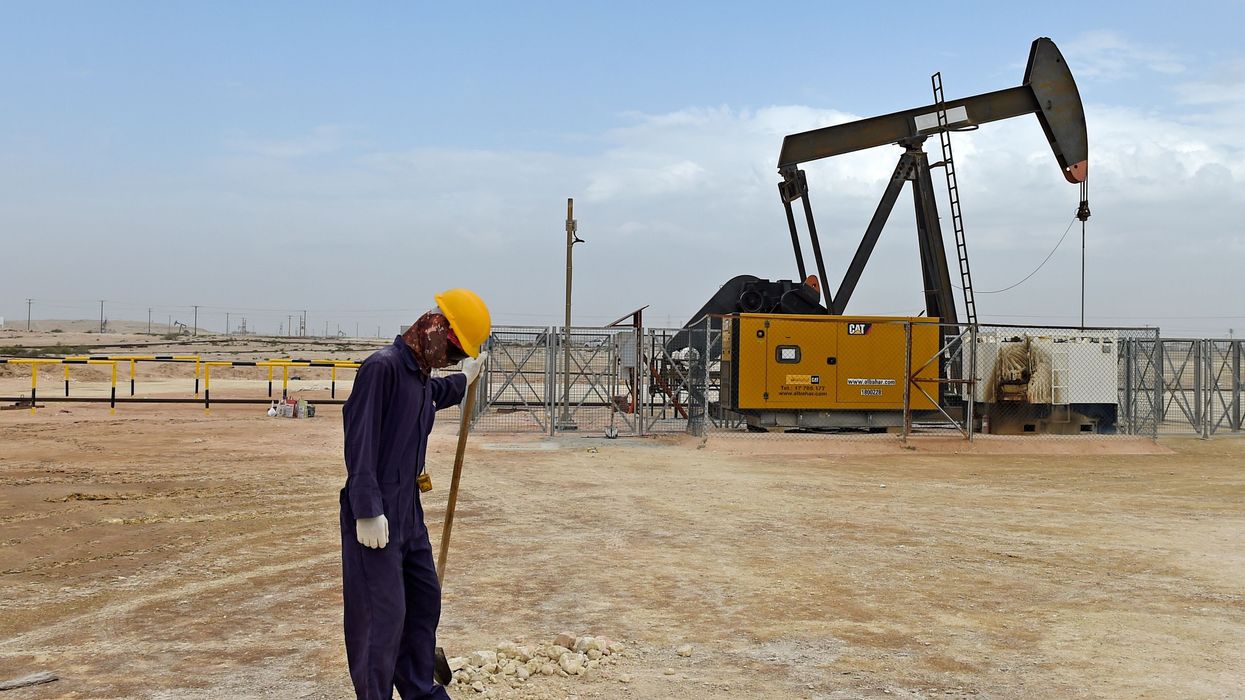
"This approval signals another setback for Biden's climate commitments, and cements the United States yet again as the worst of the laggard countries in violation of the promise to end international public finance for fossil fuels," one campaigner said.
Despite a Biden administration pledge to stop backing international fossil fuel projects by 2022, the U.S. Export-Import Bank announced Thursday that it would provide a $500 million loan for oil and gas expansion in Bahrain.
The funding marks the fifth time that EXIM has chosen to back a fossil fuel project abroad since President Joe Biden joined the Clean Energy Transition Partnership (CETP) at the United Nations COP26 climate conference in Glasgow in 2021.
"EXIM's decision to approve the Bahrain oil and gas project is another alarming step in the wrong direction for climate action, as the bank goes rogue and continues to defy President Biden's promises," Nina Pušic, an export finance climate strategist at Oil Change International, said in a statement, adding that the project was a "huge climate bomb paid for by the American taxpayer."
"This is the wrong decision. Our health, planet, and future are at stake—the U.S. must stop financing oil and gas expansion."
Signatories to CETP vowed to "end new direct public support for the international unabated fossil fuel energy sector by the end of 2022" and instead shift financing toward renewable energy projects. Yet an Oil Change analysis published in September found that countries including the U.S. continued to back fossil fuel projects after signing.
According to that analysis, the U.S. had approved the largest number of projects after the CETP's 2022 deadline to stop funding oil, gas, and coal. What's more, counting Thursday's $500 million, the EXIM has funded fossil fuel projects to the tune of $1.3 billion since the cut-off date.
"This approval signals another setback for Biden's climate commitments, and cements the United States yet again as the worst of the laggard countries in violation of the promise to end international public finance for fossil fuels," Pušic said.
In its announcement, EXIM said that the money, lent to Bahrain's semi-independent Bapco Energies, would support around 2,100 jobs in Texas and other U.S. states and "was not expected to result in a meaningful increase in oil and gas production." The bank pointed out that Bapco Energies had signed the COP28 Oil and Gas Decarbonization Charter, promising net-zero operations by 2050 and an end to flaring by 2030.
"This transaction will support thousands of U.S. jobs and play a crucial role in ensuring Bapco Energies is able to achieve its climate goals of enhanced grid interconnectivity, more efficiency, decarbonization, and investments in large-scale solar projects," EXIM President and Chair Reta Jo Lewis said in a statement.
However, EXIM told Congress when it first announced the potential funding that the project would create more than 400 new oil wells and 30 new gas wells, Reuters reported.
The announcement came two days after Democratic and Independent lawmakers led by Sen. Jeff Merkley (D-Ore.) sent a letter to the bank urging it not to fund the project "because of its negative impacts on the climate."
In the letter, the legislators pointed to the International Energy Agency's assessment that any new oil, gas, and coal investment was incompatible with the Paris agreement goal of limiting global heating to 1.5°C. Further, they noted that Congress had stipulated that EXIM should review the environmental and climate impact of projects when it reauthorized its charter in 2019.
"The world is in the midst of a climate crisis that is already having devastating impacts on millions of people across the globe," the letter concluded. "We cannot afford to have EXIM undermine domestic and international climate progress by financing projects that worsen this crisis. We urge you to take EXIM's mandate to consider the environmental impacts of projects seriously, and to start by disapproving new funding for oil and gas drilling in Bahrain."
"The United States has lost any credibility it had as a climate leader, and instead has proven to be led by forces like EXIM to prop up a dying industry while simultaneously killing its own people."
Instead of heeding the lawmakers' request, EXIM approved five times the amount of funds it had initially told Congress is was considering.
"We can't tackle climate chaos and lead the globe to a renewable energy economy if we keep greenlighting fossil energy of the past," Merkley said on social media in response to the news. "This is the wrong decision. Our health, planet, and future are at stake—the U.S. must stop financing oil and gas expansion."
The move comes as younger voters have warned Biden that he should double-down on climate friendly policies to encourage youth turnout in the 2024 presidential election. Writing in Common Dreams on Thursday, Noa Greene-Houvras, a 17-year-old climate activist with Fridays for Future NYC, encouraged the president to stand up to EXIM and back an OECD proposal to end the support of export credit agencies for oil and gas projects.
In a separate statement, Greene-Houvras said: "We are horrified at the decision to send $500 million to new oil projects in Bahrain. The United States has lost any credibility it had as a climate leader, and instead has proven to be led by forces like EXIM to prop up a dying industry while simultaneously killing its own people."
"As youth we are watching our future slip away, engulfed by fire and flood," Greene-Houvras continued, adding "We are both terrified and baffled at this decision making process, and we will not let this stand."
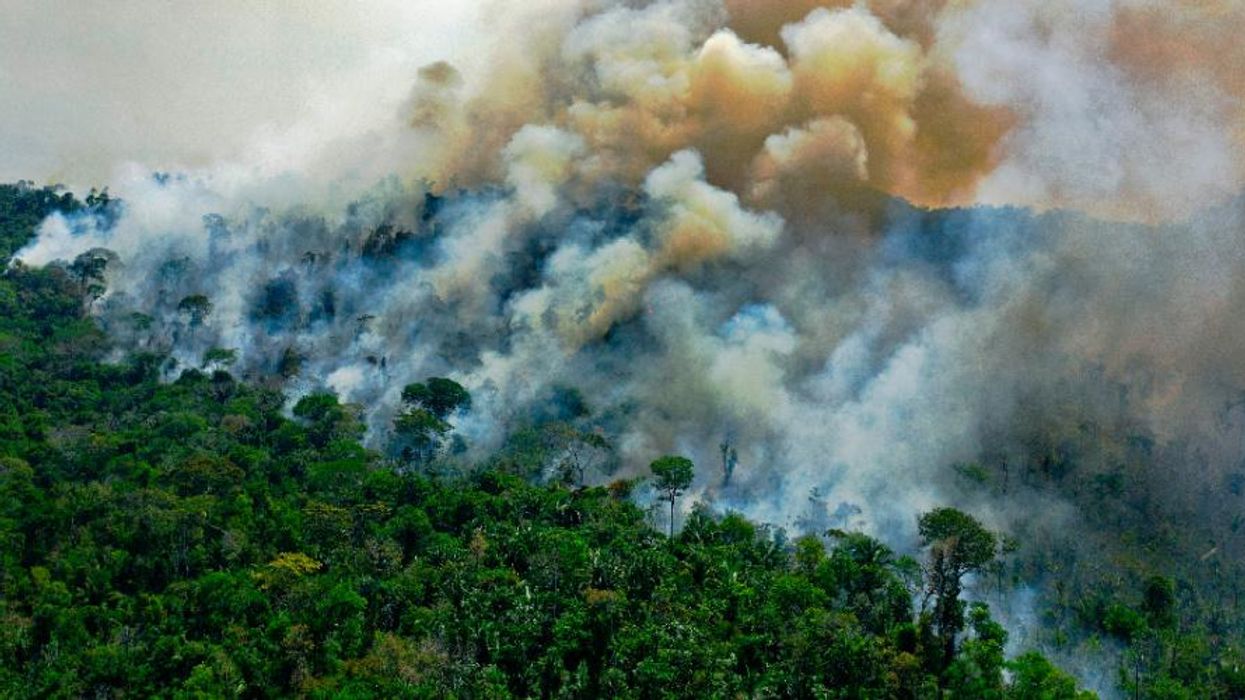
"We are investing in activities that are harmful for forests at far higher rates than we are investing in activities that are beneficial for forests," the assessment coordinator said.
Despite promising to halt global deforestation by 2030, world leaders have not done enough to protect forests, a new report has found.
The 2023 Forest Declaration Assessment, released late Monday, calculated that human activities destroyed 6.6 million hectares of forest in 2022, which means the world is 21% off track from meeting the 2030 deadline. In addition, 4.1 million hectares of especially vital primary tropical forests were cleared, 33% off where they need to be to stay on schedule.
"The world is failing forests with devastating consequences on a global scale," WWF Global Forests Lead Fran Price said in a statement. "It is impossible to reverse nature loss, address the climate crisis, and develop sustainable economies without forests."
The Forest Declaration Assessment has been published by a group of civil society organizations every year since 2015. Beginning last year, it started tracking the progress of governments towards the 2021 Glasgow Leaders' Declaration on Forests and Land Use, under which more than 100 nations attending the COP26 U.N. climate conference promised to "halt and reverse forest loss and land degradation by 2030."
"That 2030 goal is not just nice to have; it's essential for maintaining a livable climate for humanity," Erin Matson, senior consultant at Climate Focus and coordinator for the Forest Declaration Assessment, said during a press briefing ahead of the report's release.
Last year's report showed that deforestation had actually decreased by 6% compared to the baseline, which "was not enough, but it was progress," Matson said. "And it gave us hope that we could see continued progress in 2022."
"We really need to remember that every hectare of forest we lose pushes us further away from being able to keep global temperature rise to within 1.5°C, avoid irreversible tipping points, and restore nature."
Why wasn't that hope realized? The answer, Matson said, came down to money.
"We are investing in activities that are harmful for forests at far higher rates than we are investing in activities that are beneficial for forests," Matson explained.
Agriculture, including cattle ranching and the production of commodities like soy and palm oil, remains the leading cause of tropical deforestation. Yet Global Canopy found that, in 2022, 150 private financial institutions continued to channel $6.1 trillion to companies whose activities were likely to contribute to deforestation through commodity production, and two-thirds of the institutions did not have any policies in place to avoid investing in forest clearing. When it comes to public finance, between 2013 and 2018 governments invested $378 to $635 per year in "gray" finance—funding activities that could hurt forests—and only $26.5 billion total in "green" finance programs to protect them. That means that green finance flows were just $2.2 billion a year, or less than 1% of gray finance flows. Existing green finance also falls far short of the $460 billion a year that is needed to meet forest goals.
"We're financing deforestation through the products we buy and the activities that governments and businesses support through subsidies and investments," Mary Gagen, chief advisor on forests at WWF-UK, said during the briefing. "We really need to remember that every hectare of forest we lose pushes us further away from being able to keep global temperature rise to within 1.5°C, avoid irreversible tipping points, and restore nature."
There was some good news in the report. More than 50 countries are making enough progress to halt deforestation internally by the end of the decade, including Indonesia and Malaysia. Their success offers a potential road map for others.
"Much of their success is attributable to strong laws and enforcement, collaboration with the private sector and civil society, and strong support for and recognition for the rights of Indigenous peoples and local communities, as well as just sheer political will," Matson said.
The report also does not include data that reflects Brazilian President Luiz Inácio Lula da Silva's success at reducing Amazon deforestation in 2023 by enforcing environmental laws and respecting Indigenous rights after former right-wing President Jair Bolsonaro worked to erode them.
The report offered several recommendations for governments, private institutions, and civil society, including protecting and securing Indigenous land rights, boosting finance, and channeling subsidies away from industries and activities that harm forests and towards those that help. Overall, the report authors argued that the definition of "business as usual" had to change.
"Global economic models must be re-structured to value forests for the benefits that they provide over the long term, rather than for the superficial and short-term gain that comes with clearing them," the report authors wrote.
Alongside the assessment report, WWF released its Forest Pathways report, "the first ever comprehensive global blueprint on how to stop failing our forests," as Gagen put it.
The report outlines four pathways to protecting forests:
The conservation group also debuted a graphic of "forest stripes." Based on the famous "climate stripes" visualizing the warming of average temperatures, it shows in green to red the 79% decline of forest-dependent species from 1970 to 2018.
"We're at a critical juncture," Price said during the briefing. "We don't need new forest goals. We need uncompromising ambition, speed, and accountability by both governments and businesses to fulfill their existing goals."
Yet governments and corporations may not act on their own, especially as Matson does not expect forests to be a priority at the upcoming COP28 climate talks in United Arab Emirates this November and December.
"It's so much more important that citizens and the media and civil society keep our attention and pressure on world leaders to meet their shared responsibility on forests," Matson said. "Every country has to get on track or else we have little hope of meeting the 2030 goal."
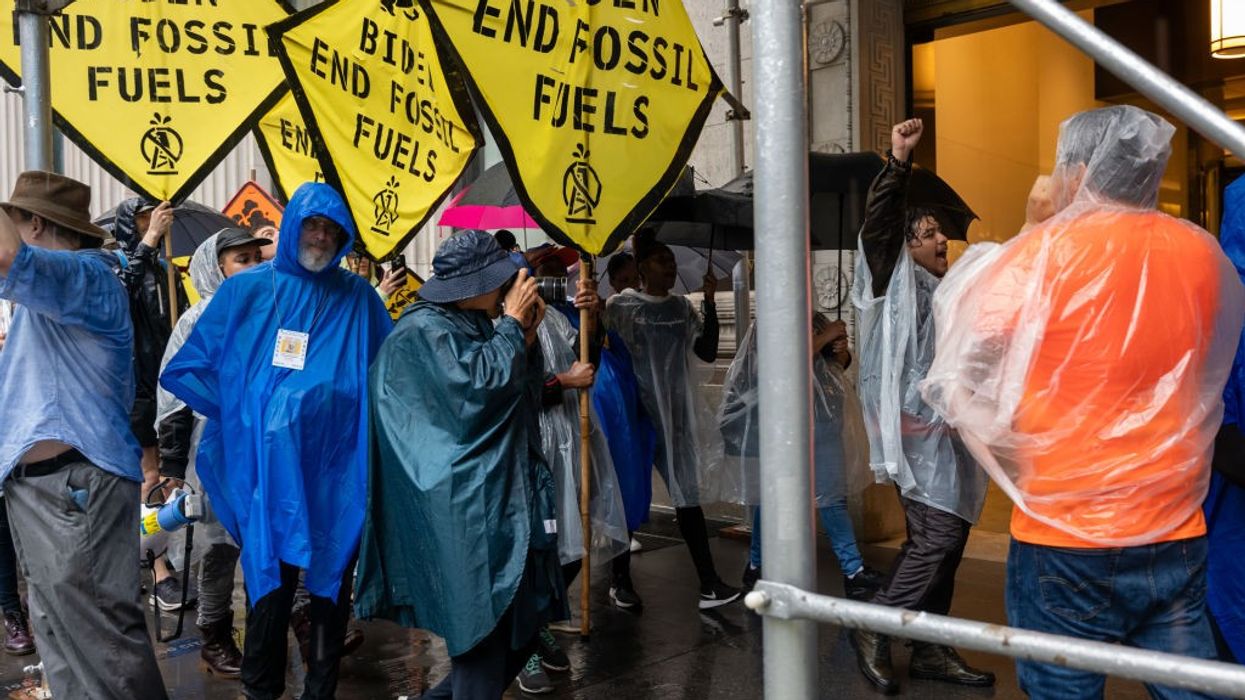
The approval comes as the nation has signed off on $1.5 billion for overseas oil and gas projects so far this year, even though it pledged to stop doing so by the end of 2022.
Despite President Joe Biden's commitment to end investments in overseas fossil fuel projects, the U.S. Export-Import Bank on Thursday agreed to fund the Liwathon oil tank project in Estonia.
The decision comes on top of the $1.5 billion that the U.S. has already promised to overseas oil and gas developments in 2023, in violation of a 2022 deadline to end international fossil finance.
"President Biden cannot claim climate wins while his U.S. Export-Import Bank is propping up a pollutive industry," Kate DeAngelis, senior international finance program manager for Friends of the Earth U.S., said in a statement. "EXIM spent the hottest months in history approving four major fossil fuel projects, demonstrating its disregard for the planet and all living beings. An institution that chooses polluters over people should not be trusted to follow President Biden's climate commitments."
"Biden and the United States risk becoming an international embarrassment with these retrograde approvals."
Biden signed an executive order in 2021 in which he promised to develop a climate finance plan that would promote "the flow of capital toward climate-aligned investments and away from high-carbon investments." Then, at the COP26 U.N. climate conference in Glasgow, Scotland, the U.S. joined 24 other countries and five financial institutions in pledging to stop funding "unabated fossil fuel energy" overseas by 2022.
Despite this, Oil Change International found in a September report that the U.S. had approved more money for international fossil fuel projects in 2023 than any other nation that agreed to stop.
"EXIM's decision to approve the Liwathon oil project is yet another concerning step in the wrong direction for climate action," Collin Rees, U.S. program manager at Oil Change International, said in a statement, calling the approval "yet another setback for President Joe Biden's climate commitments."
"Despite lofty promises and international agreements, Biden continues to approve projects that exacerbate our climate crisis and threaten communities," Rees continued. "As many other G-20 countries implement their commitment to end public finance for fossil fuels, Biden and the United States risk becoming an international embarrassment with these retrograde approvals."
In addition to the Liwathon approval, the EXIM specifically has already signed off on almost $100 million for an oil refinery in Indonesia, $240 million for an Iraqi gas development, and $400 million for Trafigura to support U.S. exports of liquefied natural gas (LNG), Friends of the Earth said. The bank is also weighing whether to fund Papua LNG in Papua New Guinea and oil and gas projects in Bahrain and Guyana.
Both the International Energy Agency and the Intergovernmental Panel on Climate Change have concluded that no new oil, gas, and coal developments are compatible with limiting global heating to 1.5°C above preindustrial levels. At the same time, Nina Pusic, export finance climate strategist at Oil Change International, argued that fossil finance goes against economic as well as scientific sense.
"Ultimately, using American taxpayer dollars to finance oil and gas infrastructure is not only an irresponsible use of public money from a climate perspective, but also risks creating stranded assets, as many regions of the world quickly transition to cleaner energy sources," Pusic said in a statement.
However, it's not too late to reverse course.
"The U.S. can help lead a shift of billions of dollars from last century's dirty energy into the clean, renewable energy of the future," Rees said, "but approvals like Liwathon are a huge step backward."
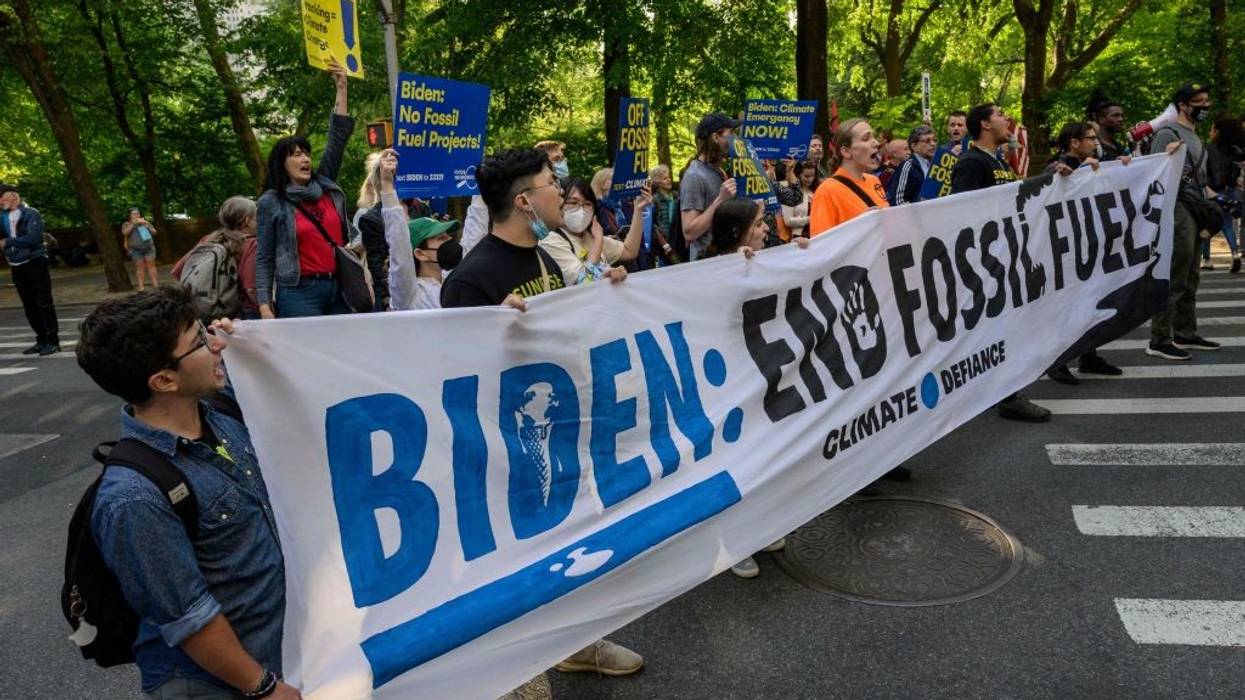
President Biden’s approach to the climate crisis is nothing short of hypocritical. While the president’s rhetoric aligns with global climate promises, his administration has approved massive fossil fuel projects.
Ahead of its Climate Ambition Summit in September, the United Nations is calling on global leaders to phase out fossil fuels. U.S. President Joe Biden is painfully falling behind on this agenda and must urgently get back on track to maintain any credibility in these climate discussions.
As we suffer through extreme heat in the U.S. and across the globe, President Biden has been protecting fossil fuel profits instead of people. From the Willow Project in Alaska to Gulf LNG exports, Biden props up dangerous oil and gas projects and the corporations that value their bottom line over our future. It has to stop.
The latest reports from the International Energy Agency (IEA) and the Intergovernmental Panel on Climate Change (IPCC) show that maintaining a 50% chance of limiting global warming to 1.5°C (2.7°F) requires an immediate end to investments in new coal, oil, and gas production and hazardous liquified fossil gas (LNG) infrastructure.
Of all countries in the world, the United States is the world’s top oil and gas producer and exporter, and is planning the largest expansion in oil and gas production over the next decade.
These findings remain unchanged in the context of the war in Ukraine and its impact on global energy markets, and as last year’s World Energy Outlook said: “No one should imagine that Russia’s invasion can justify a wave of new oil and gas infrastructure in a world that wants to reach net zero emissions by 2050.”
President Biden’s approach to the climate crisis is nothing short of hypocritical. While the president’s rhetoric aligns with global climate promises, his administration has approved massive fossil fuel projects.
Of all countries in the world, the United States is the world’s top oil and gas producer and exporter, and is planning the largest expansion in oil and gas production over the next decade. This year alone, Biden approved the Willow oil project in Alaska and multiple LNG export facilities, and his administration put its support behind the Mountain Valley fracked gas pipeline, skipping important permitting processes meant to protect people and the environment, betraying communities and his voters.
President Biden has even backed policies that gut bedrock environmental laws that protect communities from fossil fuel pollution.
At the United Nations COP26 climate summit in Glasgow, President Biden joined 38 other countries and financial institutions in promising to end international public finance for fossil fuels by the end of 2022 and to instead prioritize public finance for clean energy. At the G7 leader’s summit in 2021, a near-identical commitment was adopted, bringing Japan, one of the world’s largest fossil financiers, onboard, and this year the G7 committed to report on progress by the end of 2023. If the United States followed through on its promise, they could shift $3.7 billion annually out of fossil fuels on average, increasing their international renewable energy public finance by five times.
But instead of keeping its commitment, the Biden administration continues to approve new public funding for fossil fuel expansion abroad. While Canada, the United Kingdom, and France have published policies keeping their promises to stop international funding for fossil fuels, the United States has refused to publish a policy.
In May, the Biden administration approved almost $100 million in export finance for expanding an Indonesian oil refinery, neglecting the agreed end of 2022 deadline for ending such support. Just a month ago, the U.S. development finance corporation (DFC) pledged half a billion dollars to support LNG imports in Poland and gas infrastructure in South Africa. Most recently in July, the Export-Import Bank of the United States (EXIM)—the official export credit agency of the U.S.—insured $400 million in revolving credit facilities for global commodities trader Trafigura, allowing them to purchase LNG from U.S. exporters to sell primarily to European buyers. And more is on the docket—the United States is currently considering export finance for a controversial LNG project in Papua New Guinea.
Voters will not ignore Biden’s disastrous climate track record unless he starts keeping his climate promises and paves the way for a cleaner, safer, and more equitable future with cheaper energy bills and good jobs.
The U.S. breaking its promise is particularly unhelpful now that a huge diplomatic opportunity is opening up to advance oil and gas export finance restrictions at the Organisation for Economic Co-operation and Development (OECD).
More than half of OECD countries, including the United States, signed onto the COP26 commitment to end international public finance for fossil fuels, creating strong foundations for a progressive member to table a proposal for oil and gas restrictions and kick off negotiations on the topic. This is an urgent matter. OECD members still provide $41 billion annually in export support to fossil fuel projects, five times their clean energy support.
Ironically, the United States was the country championing efforts to secure OECD coal finance restrictions back in 2015. Now it risks being an obstacle rather than a leader at the OECD.
At a time when we must rapidly and equitably phase out fossil fuels, it is alarming to see Biden consistently breaking their climate commitments and pushing for the global expansion of LNG and oil, as well as holding back progress at the UNSG Climate Ambition Summit and the OECD. Every new fossil fuel project is incompatible with a liveable future.
As the world’s biggest historic polluter, the United States has a responsibility to lead a global just transition away from fossil fuels. Biden can make the choice to lead this moment and succeed. Voters will not ignore Biden’s disastrous climate track record unless he starts keeping his climate promises and paves the way for a cleaner, safer, and more equitable future with cheaper energy bills and good jobs.
We call on President Biden to fulfill his duty to the American people, the international community, and communities whose lives and well-being are impacted by the dirty fossil fuel projects he has been backing. On Sunday, September 17 people will be marching through New York City with these demands at the UNSG Climate Ambition Summit. It’s time for Biden to listen to our voices and end the era of fossil fuels.

"While the Glasgow Statement is a success story that's having a real-world impact in shifting finance away from fossil fuels, some countries like the U.S., Germany, and Italy have broken their promise," said a lead author.
A report released Wednesday by Oil Change International reveals that while the Glasgow Statement is already shifting billions of dollars from fossil fuels to clean energy around the world, some rich nations are still failing to live up to promises made under the 2021 agreement.
During COP26—the United Nations climate summit in Glasgow, Scotland—34 countries and five public finance institutions vowed to cut off financing for new international fossil fuel projects by the end of 2022 and instead invest that money in clean power.
"Our research shows that while the Glasgow Statement is a success story that's having a real-world impact in shifting finance away from fossil fuels, some countries like the U.S., Germany, and Italy have broken their promise," said Oil Change International (OCI) public finance strategist Adam McGibbon, a lead author of the report.
The report—entitled Promise Breakers: Assessing the impact of compliance with the Glasgow Statement commitment to end international public finance for fossil fuels—states that "out of 16 signatories that provide significant international public finance for energy, eight have new or existing policies that broadly meet the promise they made in Glasgow (Canada, the European Investment Bank, the United Kingdom, France, Finland, Sweden, Denmark, and New Zealand)."
"True leaders do not blink when faced with a global climate crisis."
While those actions are expected to shift $5.7 billion from fossil fuels to clean energy annually, the report suggests that another $13.7 billion could be added if the countries who have failed to enact such policies and those "with below-Glasgow policies" did more to cut fossil fuel funding.
The nations with policies that are updated but still not in line with the Glasgow statement are Belgium, Spain, Switzerland, and the Netherlands. Those identified by OCI as in breach of the 2021 deal are Germany, Italy, Portugal, and the United States.
"During the 2020 presidential election, Joe Biden promised to end U.S. support for dirty energy projects abroad," the report highlights. "The Biden administration has taken the unusual step of developing a policy in response to the Glasgow Statement for its bilateral financing agencies but not making it public, even at the request of members of Congress."
After noting a diplomatic cable revealed in December 2021, the report calls on the administration to "release a public interagency guidelines that (a) bars new public fossil fuel support with no exemptions for gas projects and (b) closes the potential widely defined loophole for projects with 'national security' implications that appeared in the leaked memo."
Kate DeAngelis, international finance program manager at Friends of the Earth U.S., echoed that demand for transparency.
"The United States has long claimed to be a world leader in climate action, yet fails to back this up with meaningful action or policy," she said. "U.S. agencies like the U.S. Export-Import Bank and U.S. International Development Finance Corporation continue to be piggy banks for fossil fuel projects from Mexico to South Africa to Indonesia, as these nations suffer from climate change."
"President Biden must make his administration's policy public, which would catalyze other countries to stop providing billions of dollars to polluting projects all over the world," DeAngelis added. "True leaders do not blink when faced with a global climate crisis."
Meanwhile, the report details that not only has Italy declined to publish any Glasgow Statement policies but also the government recently "attempted to weaken a ministerial statement by 10 European governments to stop export credit support for fossil fuel projects" and its export credit agency SACE—which financed €13.7 billion ($14.45 billion) in fossil fuels from 2016-21—is continuing to consider major international projects.
Simone Ogno, climate and finance campaigner at ReCommon, pointed to some specific projects, saying Wednesday that "through its export credit agency SACE, Italy has become the first European fossil fuel financier, enabling the development of strategic oil and gas projects for the Russian Federation, not to mention LNG projects in Mozambique and oil refineries in Egypt."
Germany also has not only failed to put out a policy, but also "is engaged in a 'dash for gas,' including pursuing controversial gas development in Senegal and exploring gas deals with Qatar, the United States, and Iraq," the report says.
"Instead of providing gigantic sums of public funds for fossil fuel projects that are incompatible with the Paris agreement, we urge German Chancellor Olaf Scholz to ensure that the Kreditanstalt für Wiederaufbau adheres to the Glasgow Statement," declared Constantin Zerger, head of energy and climate protection at the Deutsche Umwelthilfe, referring to the nation's public bank.
"The government-owned development bank needs to officially commit that it will end its support for financial fossil fuel projects abroad and in Germany," Zerger charged. "Chancellor Scholz, it is time to become a real climate leader!"
Rather than featuring a section on Portugal like the other "promise breakers," the report calls out the country for "particularly low data transparency" and says its process for developing a policy related to the Glasgow Statement is "unclear."
While the new report takes aim at the "promise breakers," it also stresses that "all signatories must still do more to meet the parallel commitment to 'prioritize support fully towards the clean energy transition' whilst 'do[ing] no significant harm' to the goals of the Paris agreement, local communities, and local environments."

U.S. Sen Ed Markey on Wednesday led a group of upper chamber lawmakers who urged the Biden administration "to fulfill its commitment in the Glasgow Statement by publicly releasing a plan for ending public financing of unabated international fossil fuel projects by the end of 2022."
"To date, the United States has not made public its plan for meeting these pledges by the end of the year."
Last year, dozens of countries and institutions including the United States pledged at COP26 in Glasgow, Scotland to end public financing of the overseas unabated fossil fuel sector by the end of this year and fully prioritize a shift to clean energy investment.
"To date, the United States has not made public its plan for meeting these pledges by the end of the year," wrote Markey (D-Mass.)--who chairs the Senate Environment and Public Works Subcommittee on Clean Air, Climate, and Nuclear Safety--along with Sens. Elizabeth Warren (D-Mass.), Jeff Merkley (D-Ore.), and Bernie Sanders (I-Vt.).
"In order to assess whether the United States will succeed in meeting them, we must understand the steps the country is planning to take to achieve them," the senators explained. "That is why we are asking you to release your plan for how the United States will fulfill its Glasgow Statement commitments."
"To strengthen our position as a global leader on climate change, enable effective oversight of U.S. public finance, and catalyze similar efforts from multilateral banks and other countries, the United States must demonstrate in transparent and concrete terms how it intends to fulfill this crucial climate pledge," the lawmakers asserted.
The letter continues:
The public release of our plan to implement the Glasgow Statement commitments will help the United States encourage other governments and their institutions, as well as public finance institutions, to hold themselves accountable to their pledge. A clear indication of our move away from public finance for international fossil fuel projects can also spur more climate-friendly financing decisions in other international bodies such as multilateral development banks.
A transparent, open plan will also enable the United States to apply pressure to fossil fuel-financing countries such as China and Russia, which are glaringly absent from the list of Glasgow Statement signatories.
Markey's request--which is not his first such ask of Biden--came weeks after a report published by Oil Change International and Friends of the Earth U.S. revealing that Group of 20 member governments and multilateral development banks spent nearly twice as much financing international fossil fuel projects as they did on clean energy alternatives during a recent two-year period.
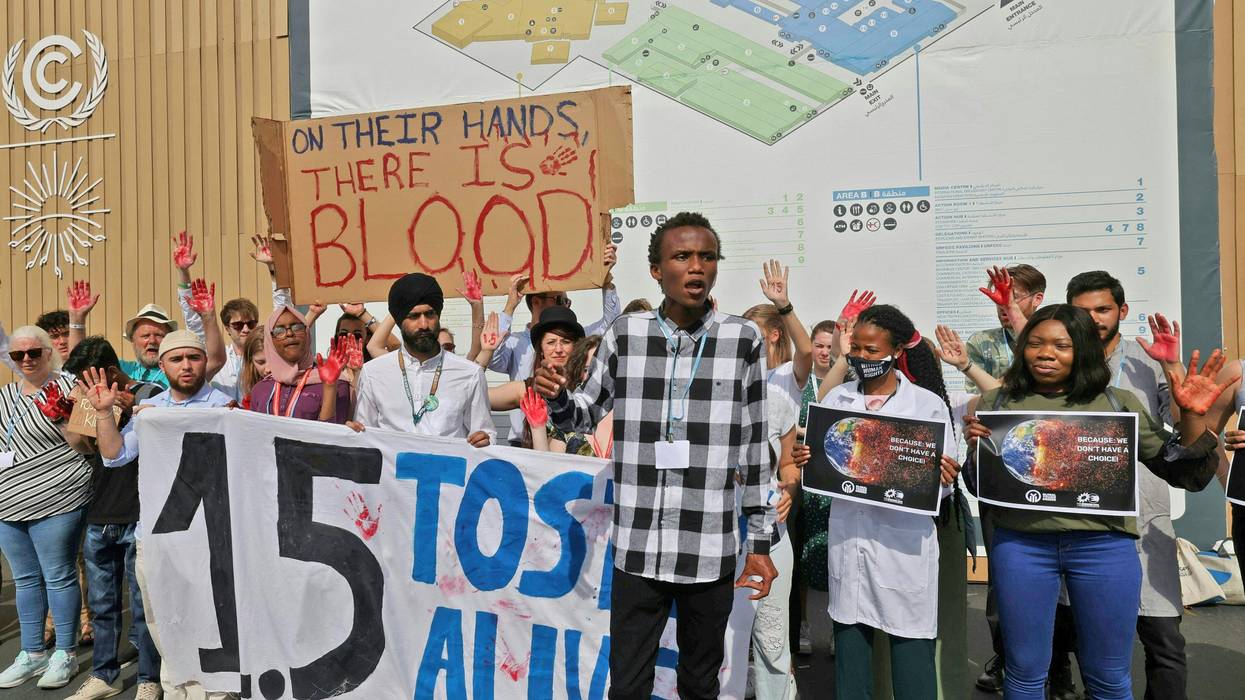
As the United Nations Climate Change Conference winds down in Egypt, and with little progress apparent on key issues from loss and damage compensation to a clean energy transition, activists on Wednesday underscored the imperative to include a fossil fuel phaseout in the summit's final text and keep oil, gas, and coal in the ground.
"By 2030, we need to reduce emissions by between 30% to 45%, but since COP26 we've shaved off 1%."
"Those who've traveled across the [world] to fight for 1.5degC at COP27, and their communities at home, are sick of waiting as delegates avoid, delay, and greenwash," the climate action group 350.org tweeted, referring to the Paris agreement's preferential global heating target. "We need ALL fossil fuels phased out, gas included--keep it in the ground, and keep 1.5 alive!"
As rich nations ignore pleas from campaigners and Global South stakeholders to pursue loss and damage payments to the countries that have contributed the least to--but suffer the most from--the climate emergency, and as fossil fuel interests and the governments they influence work to ensure fossil fuels are included in COP27's final decision text, activists are growing more strident in their calls to action.
"This is our rallying cry--from actions, press conferences, to side events, today is the day where we, the civil society movement, are holding governments to account and demanding that an equitable, managed, and just phaseout of all fossil fuels must be in the cover decision of COP27," 350.org executive director May Boeve said in a statement.
Climate Action Network head of global political strategy Harjeet Singh said that "we came here to demand climate justice, but we know what's happening. There are more than 630 fossil fuel lobbyists who have turned this COP into an expo, and they are making the climate crisis worse. The fossil fuel industry is directly responsible for the death and destruction we are seeing around the world and this same industry is profiting from the crisis, making obscene profits."
Inger Andersen, who heads the United Nations Environment Program, lamented that "we've barely scratched the surface" of what needs to be done to salvage 1.5degC.
"The one year since Glasgow, frankly, has been a year of climate procrastination," she added, referring to last year's COP26 conference in Scotland. "By 2030, we need to reduce emissions by between 30% to 45%, but since COP26 we've shaved off 1%. So, we have a long way to go."
According to the International Renewable Agency, just 29% of global electricity generation currently comes from renewables, while carbon emissions continue an upward trend and new fossil fuel projects are ramped up in the face of fuel shortages caused by factors including Russia's invasion of Ukraine and production decisions by the Organization of Petroleum Exporting Countries.
Omar Elmawi, coordinator of the Stop the East African Crude Oil Pipeline (EACOP) campaign, argued that it's "unacceptable to even consider huge projects" like EACOP "when rapid and deep emission cuts are needed to avoid catastrophic climate impacts."
"We do not accept that the need to address the energy crisis can be used to greenlight fossil fuel projects, including risky gas developments," Elmawi added. "This message needs to be heard, acted on, and commitments made to halt such projects. Finances should be channeled into a just transition to community-led renewable energy. We need true and real solutions for the African continent."
Fridays for Future Germany organizer Luisa Nebauer said that "this COP has turned into a fossil fuel energy theater. I can't believe that I am here, with two days left till the end of these climate talks, fighting for fossil fuel inclusion in the final text, when we know that the climate crisis is being caused by fossil fuels."
"Just because some industry leaders might be hurt when we tell them the era of fossil fuels has ended, their model does not work," she insisted. "This COP must be the one where fossil fuels come to an end."
Some countries are earnestly working toward a fossil fuel-free future. On Wednesday, Fiji, Tuvalu, Kenya, and Chile joined Italy, Finland, and Luxembourg as "friends" of the Beyond Oil and Gas (BOGA) Alliance. Launched last year by Costa Rica and Denmark at COP26 in Glasgow, BOGA--which counts 11 countries and territories as members or associate members, and now seven others as "friends"--is working "to facilitate the managed phaseout of oil and gas production."
Joseph Sikulu, 350.org's Pacific managing director, said in a statement that "the expansion of oil and gas is a threat to the existence of many small island developing states."
"The leadership shown from Tuvalu and Fiji as friends of the Beyond Oil and Gas Alliance comes just as our Pacific leaders fight to have the phaseout of fossil fuels included in the final text of the COP27 climate talks in Egypt," Sikulu added. "This is a David vs. Goliath fight for many of our islands, but this announcement is a resounding call that the Pacific is not standing down in the fight against oil and gas expansion."
There was a glimmer of hope Wednesday as U.S. climate envoy John Kerry said his country would support a proposal to phase down all fossil fuels, if it focused on projects with "unchecked emissions."
"It's a step in the right direction to see John Kerry state U.S. support for a fossil fuel phasedown," 350's North America director Aube Giroux said. "The nuance however is in the details and the loopholes. The U.S. delegation is making a distinction between 'abated' and 'unabated' fossil fuel projects and ramping up their desire to use carbon capture and sequestration and carbon tax credits as means to mitigate the climate crisis."
"Fundamentally that is an insufficient approach that continues to provide cover for the fossil fuel industry to continue to drill for and burn fossil fuels that are destroying our planet," Giroux continued. "If the U.S. wants to be a real leader on climate, we need to see them push real solutions including investing in solar and wind."
"The U.S. needs to incorporate a windfall tax on fossil fuel companies with no caveats," she added, "and create a mechanism for these companies to pay for the damage they've caused, reinvesting the finances into a renewable energy economy."

Following a year of horrific and deadly heat waves, floods, droughts and storms, global leaders will converge this week on Sharm el Sheikh, Egypt, for the 27th Conference of the Parties to the U.N. Framework Convention on Climate Change. The looming question for COP27 is whether nations will strengthen their pledges enough to get us on a path that averts catastrophic climate disruption.
These things are all doable. The obstacles are not technological. They're not physical. They are entirely political.
It's worth a reminder that the goal of the original convention, first signed in 1992 and ratified by enough nations to hold the first COP in 1995, was to prevent "dangerous human interference with the climate system"--an aim that has clearly not been met. As billions of people worldwide can attest, human-caused climate disruption has passed the "dangerous" threshold. What was a serious problem in the 1990s has snowballed into a full-blown crisis of extreme weather, displacement and destruction. What we must now strive to avoid is climate catastrophe.
While there is no precise warming level that defines "catastrophe," climate scientists have reasonably concluded that warming beyond 1.5 degrees Celsius (2.7 degrees Fahrenheit) would lock in devastating and irreversible climate impacts. The Paris agreement incorporated that threshold in 2015, and time is running out to avoid crossing it.
The good news? There has been substantial progress this year. The bad news? It's not nearly enough.
The United States, the world's largest cumulative greenhouse gas emitter, finally passed major federal climate legislation in the Inflation Reduction Act. While far from perfect, it is a $370-billion national investment designed to move markets away from fossil fuels and toward clean electrification across the economy. It is projected to cut U.S. emissions by about 40% from 2005 levels by 2030--close to but still falling short of our national commitment to a 50% reduction.
A more ambitious U.S. climate policy would require a larger congressional majority that supports appropriately aggressive action--a scenario that depends in part on whether voters turn out in the midterm elections to vote for climate champions and against deniers and delayers. Some international elections this year bring promise, including the replacement of Australia's fossil-fuel-coddling conservative government with a climate-friendly coalition of moderates and Labor Party members, and the toppling of the Amazon-paving Jair Bolsonaro regime in Brazil.
The recently released U.N. Emissions Gap report, however, finds that the international community is falling short of the Paris goals, with no credible pathway yet in place to limit warming to 1.5 degrees Celsius. It estimates that current policies point to a 2.8-degree Celsius rise by the end of the century (or at lowest a 2.4-degree rise if all pledges are met). More encouraging, a recent study in Nature shows that warming could be held below 2.0 degrees Celsius if all pledges--unconditional and conditional--were implemented in full and on time. But the pledges are still just promises at this point, not actions supported with policies, and even if kept, they won't fulfill the 1.5-degree Celsius goal.
That means there is both an ambition gap--current pledges are not nearly ambitious enough--and an implementation gap--countries do not have sufficient policies in place to make good even on those promises.
In that context, perhaps the most urgent goal for COP27 is to reckon with the lunacy of continued fossil fuel expansion. The International Energy Agency and other researchers have concluded that no new oil and gas development can take place if we hope to meet the 1.5-degree target. Meanwhile, several major coal producers are planning on continuing or increasing production, and most major oil and gas producing countries are on track to increase production through 2030 or beyond. In fact, energy plans indicate that governments around the world are planning for more than twice the amount of fossil fuels in 2030 than would be compatible with the Paris agreement.
These plans violate the first rule of holes: When you're in one, stop digging. Despite these realities, countries have never come close to committing to phase out new fossil fuel development. At last year's COP26 in Glasgow, Scotland, a hard-fought agreement to phase out coal was watered down to "phase down coal" because of a last-minute intervention led by India and China. COP27 provides an opportunity for nations to try again to reach an agreement to end all new fossil fuel development.
Another major issue on the COP27 agenda is reckoning with the global north's emissions having disproportionate impact on the global south, which is experiencing more climate destruction despite causing less of it. Developed countries should answer demands from vulnerable nations for funds to recover from climate-change-fueled unnatural disasters that are already wreaking billions of dollars' worth of havoc on those who can least afford it. They should also step up to offer global south countries more financial and technical support for clean energy development and adaptation to improve resilience.
These things are all doable. The obstacles are not technological. They're not physical. They are entirely political. The false belief that we are making no progress at all can be too easily exploited by polluters and their apologists to support inaction and business as usual. What we need instead is more ambition, as well as near-term plans and deadlines to keep us on track.
We must wrap our minds around two seemingly opposing realities: We are making substantial progress, and yet it's wholly insufficient to the scale of the challenge. At COP27, we must seek to change that.

At this month's annual United Nations conference on climate change in Egypt, delegates from around the globe will encounter something new: a Climate Justice Pavilion in the official "Blue Zone," where diplomats and policymakers gather. Finally, at this 27th Conference of the Parties--aka COP 27--environmental justice advocates will be in the zone where it happens, centering justice, focusing on equity, and highlighting the communities hit worst and first by the effects of climate change and our dirty-energy economy.
In this all-hands-on-deck moment, it is essential to recognize and advance the dignity of all those hands. Only with climate justice can climate action succeed.
At the COP, we U.S. climate justice activists will join our voices with Indigenous communities, people from across the Global South, and climate justice groups from around the world. We may be far-flung, but we face parallel problems. In the forests of the American South, we are fighting the wood-pellet industry; our counterparts in Indonesia are fighting the palm oil industry. Oil companies that pollute the air and contaminate the water in the U.S. are also busy polluting other countries. And just as U.S. communities find ourselves battling corporations based in faraway states, communities throughout the Global South find themselves battling corporations based in faraway countries.
Our solutions, too, are similar: community-controlled solar energy independent of the grid. Forest protection efforts that curb climate change while blunting flooding and erosion. Agricultural practices that produce healthy food without depleting the land or furthering climate change.
The movement for justice for Black, Indigenous, and other People of Color is not an American thing; it's a global thing. We are all reaching out to learn from each other, support each other, and advocate for a more just and sustainable world, and we are relentless.
At a U.N. COP, you don't run into a lot of climate deniers anymore, but climate delayers are still common. They argue for pumping the brakes on climate action. They don't want to commit to the ambitious goals and timetables our climate crisis requires. Their real goal is winning the next election or hitting the next quarter's profit projections, instead of building a more sustainable, prosperous, and equitable world for the long term and for every person.
Climate justice voices are united in knowing this foot-dragging has to stop. It's time for a new chapter, focused on implementing the solutions we already know will work--many of which have been developed in the very communities that have been most impacted by climate change. I call it a new era of IRON will--of implementation, resolve, opportunity, and new approaches.
Here's what I mean:
Implementation: We cannot wait until utilities and oil companies decide it is sufficiently profitable to put solutions in place. We cannot wait until politicians are sure it is advantageous to act. Climate justice communities need to keep implementing our own solutions in our own communities, even as we keep pushing for broader policies that protect people and the planet. Solutions must be scaled up and rapidly replicated around the world, starting now.
Resolve: We must keep marching relentlessly toward a just, clean-energy future while protecting communities from the effects of climate change--no matter what threatens to distract us, divide us, or turn us around.
Opportunity: Climate justice communities must leverage opportunities inherent in climate action. In the U.S., for example, funding initiatives such as Justice40 and the Inflation Reduction Act might not be perfect, but they can still be leveraged to open doors for skills training, job creation and community wealth-building; address needs such as clean air, healthy food, and safe water; and build resilience in the face of climate-related threats such as increased flooding, heat waves, and wildfires.
New approaches: From young people in Liberia and Sierra Leone making their livings by charging people's smart phones with solar panels, to diverse U.S. neighborhoods developing community-controlled solar energy systems, communities are creating sustainable solutions that break free from outdated business models that don't serve us well.
I've been working on environmental justice since the movement was born in the 1990s. The cause has taken me to Appalachia, New Orleans' Lower Ninth Ward, and to African villages; and to the White House, the United Nations, and annual COPs held in Poland and Spain. Closer to home in South Carolina, we've won affordable weatherization and solar-power access for low-income families; installed solar-powered hydropanels that make clean, healthy water from sunlight and air; and assembled and deployed climate disaster relief kits equipped with dozens of items, from boats and solar-powered electric chargers to electric bikes, tents, and solar-powered grills.
I've been at this long enough to know that in order to address climate change, everybody must be involved. It must be as simple as a family swapping out lightbulbs or weatherizing a home, and as complex as global negotiations held at official U.N. COPs. Whether we're focusing on modest initiatives or ambitious paradigm shifts, and whether we're working in a small town or on the international stage, we must always center justice.
In this all-hands-on-deck moment, it is essential to recognize and advance the dignity of all those hands. Only with climate justice can climate action succeed.

Every year, the intensifying climate crisis brings more pain and suffering to hundreds of millions of people across the globe. The only way we can exit this climate crisis, and avoid an accelerating disaster, is by launching an urgent system-wide transformation of our economies and societies. But still, as the 2022 edition of the United Nations Environment Programme's (UNEP) "Emissions Gap Report" shows, countries are not stepping up.
To get on track to limiting global warming to 1.5 degrees Celsius, we need to cut 45 percent off the greenhouse gas emissions that we can expect in 2030 based on policies currently in place.
At the Glasgow climate summit last year, known as COP26, nations signed up to a statement calling for climate pledges that would bring deeper and faster cuts to greenhouse gas emissions. Did this happen? The answer is a resounding "no." Collectively, updated pledges since COP26 shave less than 1 percent off projected emissions for 2030. The gap between where emissions need to be in 2030 to meet the Paris Agreement goals and where they are predicted to be in that year remains huge.
This leaves us heading for a 2.4 to 2.8 degrees Celsius increase in temperatures by 2100, depending on whether we analyze unconditional national climate commitments, conditional national climate commitments or current policies. Right now, we are in a world at 1.1 degrees Celsius above pre-industrial temperatures. Just look at what this brought to Pakistan recently: an apocalyptic flood and over 30 million people impacted. Temperature rises in the range this report predicts won't give us once-in-a-century floods in Pakistan. They will give us annual floods, storms and heatwaves across the globe. They will give us dying ecosystems and species. They will give us more hunger, more thirst, more migration, more pain.
To avoid this future, we need to meet the goals of the Paris Agreement. To get on track to limiting global warming to 1.5 degrees Celsius, we need to cut 45 percent off the greenhouse gas emissions that we can expect in 2030 based on policies currently in place. To hold global warming well below 2 degrees Celsius, the challenge is still significant: 30 percent by 2030. Beyond 2030, emissions must continue to decline rapidly to avoid exhausting the remaining atmospheric carbon budget.
If we are serious about getting this done, we need to kick start a system-wide transformation, right now.
In the electricity supply, industry, transport and buildings sectors, we need to avoid locking in new fossil fuel-intensive infrastructure. We need to advance zero-carbon technologies, market structures and planning for a just transformation. We need to apply zero-emission technology and behavioural changes to sustain reductions to eventually reach zero emissions.
In food systems, we must act on the protection of natural ecosystems, dietary changes, improvements in food production and the decarbonization of food supply chains, while securing food security for all. Action in these four areas can reduce predicted 2050 food systems emissions to around one-third of current levels.
The financial system must become an enabler, rather than a barrier, to the transformation to a low-carbon economy, which requires annual investments of at least $4 trillion to $6 trillion USD per year. This is a relatively small (1.5 to 2 percent) share of total financial assets managed, but significant (20 to 28 percent) in terms of additional annual resources needed. Delivering such funding will require making financial markets more efficient, introducing carbon pricing, creating markets for low-carbon technology through shifting financial flows, mobilizing central banks and much more.
Many people will say this can't be done over the next eight years. I say we must try. Even if we don't get there by 2030, every fraction of a degree matters to vulnerable communities, endangered species and ecosystems--and eventually to our own livelihoods. We will be setting up a carbon-neutral future: one that will allow us to bring down temperature overshoots and deliver many other social and environmental benefits, like clean air, green jobs and universal energy access.
Many people will also say that we are too busy dealing with other crises to transform our economies. I say these other crises are opportunities to reform our economies. We have missed the chance to invest significantly in a low-carbon recovery from the COVID-19 pandemic. Now, we are in danger of missing the closing window to boost clean and efficient energy as a response to the energy crisis. Instead of missing such opportunities, we must capitalize on them with confidence.
I urge every nation, every government, to pore over the solutions in this report and build them into their climate commitments. I urge the private sector to start reworking their practices. I urge every investor, public and private, to put their capital toward a net-zero world. This is the only way to kick-start a system-wide transformation across the globe. And it is the only way to shed the shroud of greenhouse gases that is slowly baking our planet and putting humanity's future in jeopardy.