

SUBSCRIBE TO OUR FREE NEWSLETTER
Daily news & progressive opinion—funded by the people, not the corporations—delivered straight to your inbox.
5
#000000
#FFFFFF
To donate by check, phone, or other method, see our More Ways to Give page.
Daily news & progressive opinion—funded by the people, not the corporations—delivered straight to your inbox.
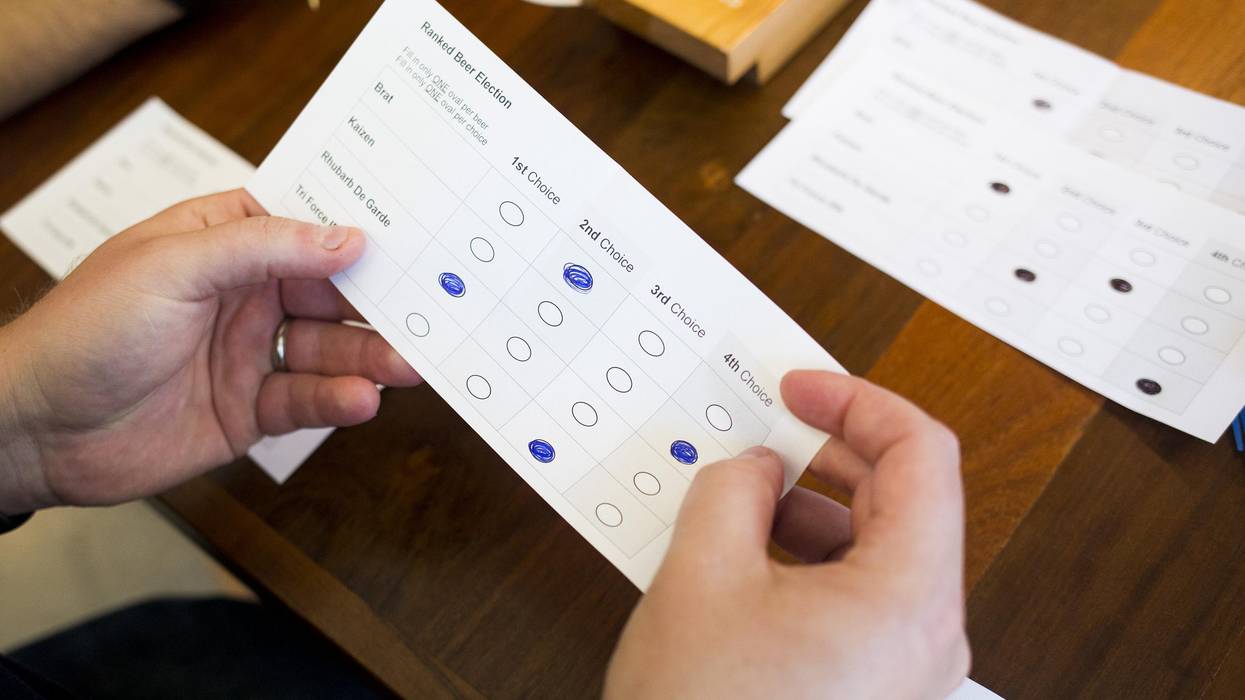
Six states have banned the practice and voters rejected referendums in four states; however, Democratic strategists and funders behind this year’s push for RCV may be able to learn from the losses.
It’s been a bad year for advocates of ranked-choice voting reforms.
Legislatures in five states banned the reform outright, as did voters in Missouri. And voters in four states—Colorado, Idaho, Nevada, and Oregon—rejected referendums on adopting the new system. Only in the District of Columbia did a majority vote in favor of adopting the reform, and Alaskans chose to keep ranked-choice voting by a remarkably close 0.25% margin.
However, Democratic strategists and funders behind this year’s push for RCV may be able to learn from the losses. In three of the four ballot measure states, RCV initiatives were combined with a proposal for open primaries, flipping typical supporters to opponents. In Colorado and Nevada, where RCV was combined with open primaries, progressive groups joined the opposition, and business interests flooded the coffers of the PACs supporting the measures.
Despite recent setbacks, the coalition advocating in favor of ranked-choice voting appears to be changing.
The pushback against ranked-choice voting (RCV)—which allows voters to rank candidates according to their preference instead of choosing just one—is typically part of a larger Republican-aligned effort to restrict voting rights by limiting voting by mail, banning ballot drop boxes, and raising the threshold for passage of popular ballot initiatives.
MAGA groups oppose the practice as likely to favor Democrats and moderate Republicans over their candidates. Indeed, “election integrity” groups associated with Leonard Leo and Cleta Mitchell have been attacking ranked-choice voting options in their larger sweep to restrict voting rights, and the American Legislative Exchange Council (ALEC), the right-wing bill mill, has developed and circulated model legislation to prohibit it.
“Special interests are pushing a novel and complicated election process called ranked-choice voting,” ALEC’s model bill states. The group contends that the alternative voting system creates “a conflict between local and state election processes,” a claim legal scholars rebut. ALEC also highlights ranked-choice voting as systematically undermining the nation’s election systems in its annual “essential policy solutions” report for 2025.
At ALEC’s annual meeting in 2023, the custom hotel room keys featured anti-RCV branding. Key card sponsors gain access to lawmakers and VIP events at the conference, according to sponsorship materials obtained and reviewed by the Center for Media and Democracy (CMD).
Republicans, with some exceptions, have historically opposed ranked-choice voting. After former Alaska Gov. Sarah Palin (R) lost a special House election in 2022—which was decided through ranked-choice voting—Republicans railed against it, with party leaders denouncing it as a “scam.” The Republican National Committee called for banning RCV “in every locality and level of government.”
Since then there has been a surge of interest in banning RCV for local, state, and federal elections. This year alone, bans passed in Louisiana (SB 101), Alabama (SB 186), Mississippi (SB 2144), Oklahoma (HB 3156), and Kentucky (HB 44), where the legislature overrode the governor’s veto of the bill. Previously, bans have been passed in Florida (SB 524, 2022), Idaho (HB 179, 2023), Montana (HB 598, 2023), South Dakota (SB 55, 2023), and Tennessee (SB 1820, 2022). Anti-RCV bills were introduced but never made it out of committee in Ohio and South Carolina.
In Missouri, the legislature paired RCV with a redundant measure to outlaw voting by noncitizens—which is already illegal in all federal elections—and sent it out to voters in what critics dismissed as partisan “ballot candy.”
In South Carolina (HB 4591, 2024), one of the bill’s two primary sponsors, Bill Taylor, is an ALEC member, as was the primary sponsor of the South Dakota bill (SB 55, 2023) that banned RCV.
In Colorado, the failed effort to adopt ranked-choice voting—Proposition 131, which also would have eliminated single-party primaries—was primarily backed by Colorado Voters First, which received significant funding from industry and business interests.
Colorado Voters First received $2 million from Ben Walton, heir to the Walmart fortune; $600,000 from the Colorado Chamber of Commerce; $500,000 from Chevron; $100,000 from Kimbal Musk, Elon Musk’s brother; $496,000 from Voters for the American Center; and nearly $550,000 from private equity executives.
The largest donations came from Kent Thiry, a former healthcare executive who is board co-chair of Unite America, a large nonprofit that has spent significantly on ranked-choice voting ballot measures across the country. He donated a total of nearly $6 million to Colorado Voters First, while Unite America donated a total of $5.8 million.
Thiry has become a major player in Colorado politics, and has successfully fought for election reform ballot measures since 2016.
The main group opposing the proposition, Voters Rights Colorado, raised approximately $380,000, with its largest contributions coming from labor groups such as AFSCME and the National Education Association (NEA), as well as civic groups.
The coalition behind the no vote argued that the measure would disproportionately hurt progressive and pro-labor candidates, and most opposing groups were primarily concerned with the implementation of “jungle” primaries, not RCV.
The Colorado Working Families Party called the proposition “snake oil of the highest order” and expressed concern that it would “increase the role of big money in Colorado politics.”
The proposition risks “giving an even greater advantage to wealthy candidates and a bigger voice to special interests,” said Aly Belknap, Executive Director of Colorado Common Cause.
Some, however, worry about RCV more generally.
“There’s this feeling among progressives that ranked-choice voting is good for us, but here in Colorado, we fundamentally disagreed that Proposition 131 would help progressives, at least at the state level,” said Sean Hinga, deputy director of AFSCME Colorado. He believes the measure would “harm our ability to get labor candidates elected.”
AFSCME and Common Cause supported the RCV measure in Oregon.
Colorado voters rejected the RCV proposition 53.5% to 46.5%.
Idaho’s Proposition 1 would have both instituted ranked-choice voting and ended closed primaries. The GOP-controlled legislature had tried to preemptively ban the measure from ever coming up for a vote, and the legislature had banned RCV the previous year. If it had passed, the ballot measure would have repealed the state law.
The initiative was supported by the Idaho Education Association and Idahoans for Open Primaries, which received $3 million from national PACs such as Unite America and a related group ($1.8 million), Article IV ($2.2 million), and Way Back PAC ($250,000), according to campaign finance disclosures.
Article IV, a 501(c)(4) nonprofit based in Virginia, is led by George Wellde III, a former Goldman Sachs investor. Working alongside Democratic operatives is the group’s treasurer, Cabell Hobbs, who has been the subject of a Federal Elections Commission complaint for helping a pro-Trump super PAC make illegal campaign contributions. Article IV is not required to publicly disclose its donors.
Way Back PAC, a hybrid PAC (also known as a Carey Committee), is based in Wyoming and mostly focuses on supporting independent and Democratic candidates in Western states.
The state GOP and many Republican representatives opposed the measure. Idaho Rising, the main opposition group, spent $321,000 on media advertising against the measure, according to its disclosures, and a constellation of smaller groups, including Secure Idaho Elections and Idaho Fair Elections, also worked to oppose it. One Person One Vote—a PAC that raised $250,000 in the four months it existed before the election—raised half of its funds from local Idahoan Larry Williams, the subject of a campaign finance complaint.
Nearly 70% of voters in Idaho voted against the measure.
This year Nevada voters reversed their position on ranked-choice voting. In 2022, a majority of voters supported RCV, whereas this year, 53% voted against the proposition, known as Question 3, which was paired with a proposal for open primaries. Since the Nevada constitution requires voters to approve a ballot question twice before it is enacted, its failure to pass this year prevents it from becoming law.
Both state parties opposed the measure. The Nevada ACLU took no position on it.
Vote Yes on 3, the main group supporting the measure, received $13 million from Article IV, $6.4 million from Unite America, and $250,000 from Wynn Resorts, according to the group’s financial disclosures.
The opposition campaign, spearheaded by Protect Your Vote Nevada, raised approximately $2 million from a single group called Nevada Alliance, a progressive-leaning organization that is not required to disclose its donors.
Nearly 57% of Oregon voters rejected Measure 117, which would have established statewide ranked-choice voting.
Yes on 117 PAC, the main group supporting the measure, spent nearly $9.4 million on the campaign, and received over $5.8 million from the 501(c)(4) nonprofit Oregon Ranked Choice Voting, by far the largest contributor to the PAC. It also received $2.8 million from Article IV, as well as funding from labor organizations and the Sierra Club.
The major group opposing the measure—Concerned Election Officials—raised a total of $1,380.
Alaskans voted to retain ranked-choice voting—voting no on Ballot Measure 2—by only 743 votes.
Yes On 2, the primary PAC advocating for repeal of RCV, raised approximately $117,000 between July and October, with the largest donations being $10,000.
The anti-repeal effort, led by No On 2, raised nearly $14 million between June and late October, including $5.5 million from Unite America PAC, $4.4 million from Article IV, and $2 million from Action Now Initiative, the action arm of the philanthropic organization Arnold Ventures.
Despite recent setbacks, the coalition advocating in favor of ranked-choice voting appears to be changing. Even where efforts to implement RCV failed, the donors backing various ballot measures illustrate just how varied the groups interested in pushing for this election reform are.
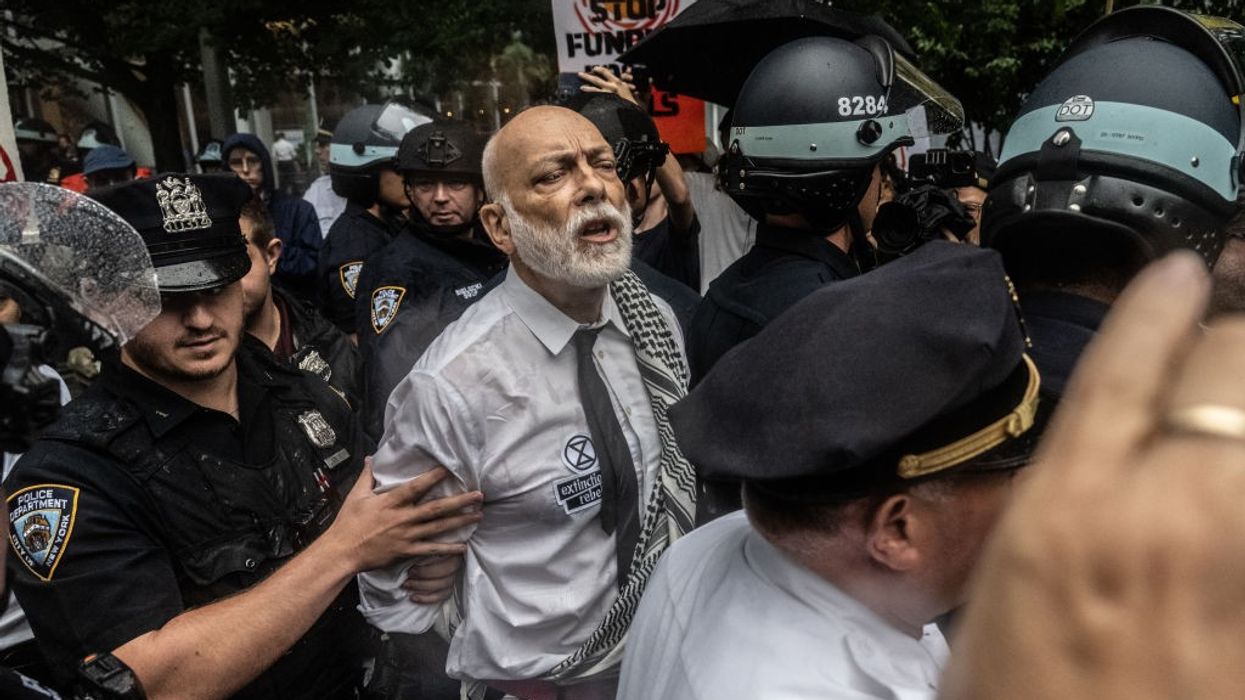
On both sides of the Atlantic, volleys of laws threatening long-term imprisonment for nonviolent dissent are being put on the books to cow the climate movement into silence. Trump promises to go further.
In August, climate activist and cellist John Mark Rozendaal was arrested and charged with criminal contempt for playing a few minutes of Bach outside Citibank’s headquarters in New York City. Rozendaal, 63, was prominent in the “Summer of Heat on Wall Street” campaign that targeted Citibank for its prolific financing of fossil-fuel projects. He and a co-defendant now face up to seven years imprisonment if convicted.
Meanwhile in Atlanta, more than 50 justice and environmental activists are awaiting trial on domestic terrorism and other charges arising from their years-long defense of the city’s South River Forest against the construction of an 85-acre police training center there. They are being prosecuted under Georgia’s Racketeer Influenced and Corrupt Organization (RICO) law. Any of them found guilty of “racketeering” would have five to 20 years of imprisonment added to their sentences for the alleged underlying crimes.
Such situations are symptomatic of a grim trend in both the United States and Europe. Nonviolent, nondestructive climate protest is increasingly being subjected to criminal prosecution, while punishments are being ratcheted up to levels befitting violent and far more serious crimes.
The state abuses described in this article should be considered a preview of what is almost guaranteed to be even worse to come if Donald Trump does indeed retake the White House and the Republicans win majorities in the House and Senate.
Across the Global South, such environmental protests are all too often being met by corporate and state forces with extreme extrajudicial violence, especially in Indigenous communities. Here in the Global North, however, the clampdown on protest has largely been through legal action, at least so far. But that might—especially in an America with Donald Trump as its president again—only be a prelude to more violent kinds of suppression as global warming accelerates.
For embattled American climate activists, this trend further raises the stakes of the November 5 election. The crackdowns on climate protest are so far being carried out by state and local governments. But the state abuses described in this article should be considered a preview of what is almost guaranteed to be even worse to come if Donald Trump does indeed retake the White House and the Republicans win majorities in the House and Senate. As recently as October 13, in fact, Trump insisted that, once back in the White House, he’d call in the military to quash domestic dissent of any sort.
In addition, a Trumpian Congress would be likely to pass laws gutting federal climate policies and imposing extreme penalties on future climate protesters. Both prospects also feature prominently in the Heritage Foundation’s Project 2025, produced in part by a gaggle of former Trump officials. That now-infamous blueprint for his possible second administration calls explicitly for—as the Center for American Progress describes it—“suppressing dissent and fomenting political violence.” Among other things, Project 2025 suggests that a future President Trump could invoke the Insurrection Act of 1807, which would indeed allow him to use the military to punish lawful nonviolent protest. And count on it, he’s almost certain to exploit that act if he does indeed become president again.
Since 2016, 21 states have passed a total of 56 laws criminalizing protest or dramatically increasing the penalties for engaging in it. To be sure, John Mark Rozendaal was arrested in New York, a city located in a blue state, but all the states that have adopted new anti-protest laws are governed by Republican-majority legislatures. And the specific activity most frequently targeted for prosecution is protesting the construction or existence of oil and gas pipelines. (Note that all state laws mentioned below are described in detail in a recent report by the International Center for Not-For-Profit Law, or ICNL.)
The state of Alabama, for example, can now punish a person who simply enters an area containing “critical infrastructure,” including such pipelines, with up to a year in jail and a fine of up to $6,000. If you go near a pipeline in Arkansas, you’re at significantly higher risk: imprisonment of up to six years and a $10,000 fine. Impeding access to a pipeline or a pipeline construction site in Mississippi carries a sentence of up to seven years. Do that in North Carolina as a member of a group and you’ve got even bigger problems. As the ICNL reports, “[A] group of people protesting the construction of a fossil fuel pipeline could face more than 15 years in prison and a mandatory $250,000 fine if they impede or impair the construction of a pipeline.”
Even as protest is being criminalized, assaulting protesters by car is, in effect, being decriminalized.
Many such sentences for protesting are wildly disproportionate to the severity of the act committed. In Florida, trespassing on property that contains pipelines can result in up to five years imprisonment, compared to only 60 days for trespassing just about anywhere else. Enter a pipeline facility in Ohio with the intention of tampering with it in any way and face a potential ten-year sentence. Simply spraying graffiti on an Ohio pipeline installation can carry a six-year sentence, while anyone who “conspires” with the person creating such graffiti could be fined an eye-popping $100,000.
Many climate marches or demonstrations involve walking or standing in roadways. Politicians have been exploiting the fact that “automobile supremacy is inscribed in law by every branch of government and at every level of authority” (in the words of law professor Gregory Shill) to pass highly punitive measures against street protests with little fear of having them overturned. In effect, the laws privilege fossil-fueled vehicles over the human beings who speak out against them.
In May, the Tennessee legislature passed a law that mandates a prison sentence of 2 to 12 years for protesters convicted of knowingly obstructing roadways. In Florida, groups of 25 or more protesters impeding traffic can be charged with “rioting” and face up to 15 years imprisonment. Anyone in Louisiana who does no more than help plan a protest that would impede traffic can be charged with conspiracy or with “aiding and abetting,” even if the protest ends up not hindering traffic or not occurring at all.
In Iowa, being on the street or sidewalk during a vociferous but nonviolent protest can cost you five years in prison, yet (believe it or not) a driver who runs into you during a protest, causing injury, is immune from civil liability if that driver can convince authorities that he or she had taken “due care.”
Laws that permit drivers to run into or over pedestrians engaged in protest have been passed in four states. Three of those laws hit the books in 2021 in the midst of a 16-month period during which American drivers deliberately rammed into groups of protesters a whopping 139 times, according to a Boston Globe analysis. Three victims were killed and at least 100 injured. Drivers were criminally charged in fewer than half of the ramming incidents and in only four was a driver actually convicted of a felony. In other words, even as protest is being criminalized, assaulting protesters by car is, in effect, being decriminalized.
Finally, Louisiana can file RICO charges against people who, as part of a “tumultuous” demonstration, block roads or damage oil or gas pipelines. And protesters beware, since that state’s RICO law carries the possibility of 50 years in prison at hard labor and a $1 million fine. (And yes, you read that right!)
Many laws that impose severe penalties for protest were passed in the wake of the Indigenous-led campaign against the Dakota Access oil pipeline in 2016-2017. Hundreds of people were arrested in that struggle. More than 700 protesters with the Indigenous Environment Network have been criminalized for their untiring efforts to impede or halt pipeline projects across North America.
If the dozens of state anti-protest laws display many suspicious similarities, that’s no coincidence. In response to pipeline protests, oil and gas companies teamed up with the American Legislative Exchange Council, which draws up “model legislation” for Republicans in statehouses across the country to use as templates for bills that push various corporate and hard-right priorities. Once this genre of legislation was directed toward on-site pipeline protests and passed in state after state, it was also seized upon to criminalize street marches and demonstrations, including those against racist violence, fossil fuels, and other ills—all with “traffic safety” as a pretext.
Following the lead of their kindred state legislators, Republicans in Congress have proposed their own raft of bills criminalizing protest. Fortunately, they haven’t succeeded in getting any of them passed—yet. Many of the bills were prompted by campus protests against U.S.-supported genocide in Gaza or over climate policy and against the fossil-fuel industry.
Some of the congressional bills amounted to less-than-serious grandstanding. One, for instance, would have required a person convicted of “unlawful activity” on a university campus at any time since last October 7 to perform six months of “community service” in Gaza. But there were also dead-serious bills like the one prescribing a prison sentence of up to 15 years for inhibiting traffic on an interstate highway. Other proposed bills would have withheld federal funding (in one case, even pandemic aid) from states that refused to prosecute people who took part in protests on public roadways.
Punitive measures against climate protest are reaching new extremes in Europe, too. Since the British Parliament passed harsh new anti-protest laws in 2022, more than 3,000 activists associated with the Just Stop Oil movement have been arrested. According to CNN, “Most of those arrests have been for planning or carrying out direct actions, including slow marching,” which impedes traffic.
In response to such repression, Michel Forst, the United Nations Special Rapporteur on Environmental Defenders, wrote that under the Aarhus Convention (a 1998 agreement most European countries have signed but not the United States), “Whether intended or not, any disruptions that [environmental] actions may cause, such as traffic jams or disturbances to normal economic activity, does not remove the protection for the exercise of fundamental rights during such action under international human rights law.”
In defiance of that principle, the new British laws prescribe a sentence of up to 10 years imprisonment for those convicted of planning protests judged to be a “public nuisance” (which often means disrupting traffic). Such prison terms, noted CNN, are comparable to those for aggravated robbery or rape under British law.
When the climate change group Extinction Rebellion announced an action near The Hague in September 2023, more than 10,000 people of all ages showed up. They’d come to protest the more than $40 billion in subsidies that the Netherlands government gives fossil fuel companies annually. The police blasted the crowd with water cannons, then arrested and hauled away 2,400 protesters, including children.
The group Climate Rights International (CRI) reports that “some democratic countries are even taking measures designed to stop peaceful climate protests before they start.” In June 2023, for instance, German police detained an activist before he could even leave his home to join a climate protest. Five months earlier, a Dutch activist was held in custody for two days to keep him from an action by Extinction Rebellion. He ended up being convicted of sedition (yes, sedition!) for encouraging others to attend the protest. None of that sounds like something “democratic countries,” as CRI called them, should be doing.
People charged with nonviolent protest often invoke the “necessity defense,” declaring that they committed a minor law violation to stop a far greater crime. Unfortunately, that defense almost never succeeds and judges often forbid defendants from even explaining their motives during a trial.
That’s what happened to members of the group Insulate Britain who stood trial this year for a climate protest that disrupted traffic by nonviolently occupying streets and climbing onto overpasses along a major London ring road in 2022. The judge presiding over their trials ordered the defendants not to mention climate change in court. Several of the activists defied that order, citing the climate emergency as their motivation, so the judge promptly held them in contempt of court and sent two of them to jail for seven weeks.
One of the protesters cited for contempt, Nick Till, told CRI that, while trying to bar him and the others from explaining the purpose of their actions, the judge allowed the prosecutors to depict the defendants as threats to society. “There’s an attempt to insinuate we’re a ‘cell,’” Till said, “which is language that implies some kind of revolutionary group. They had an expert in counterterrorism testify. They tried to portray us as dangerous extremists.”
Though also being threatened with increasing penalties under state laws, Americans have somewhat stronger protections under the First Amendment.
In July, four people who planned the London protests were convicted and sentenced to a draconian four years in prison. A fifth defendant, Roger Hallam, one of the most prominent British climate activists, was sentenced to five years even though, bizarrely enough, he was neither a planner of the protest nor a participant. He was charged instead for a speech he gave regarding civil disobedience as an effective form of climate action in a Zoom call with that protest’s planners.
In their trial, the five defendants represented themselves. Over the course of four days, with the judge repeatedly trying and failing to silence them, they presented what could be the most extensive and compelling version of the necessity defense ever heard in a courtroom. (Later, in his prison cell, Hallam wrote up an account of the trial. It’s well worth reading.)
On both sides of the Atlantic, volleys of laws threatening long-term imprisonment for nonviolent dissent are being put on the books to cow the climate movement into silence. So far, European protesters who dare to resist are getting hit hardest with convictions and sentences. Though also being threatened with increasing penalties under state laws, Americans have somewhat stronger protections under the First Amendment. But how long will dissent continue to enjoy such protections in this country? That largely depends on how we all vote between now and November 5.
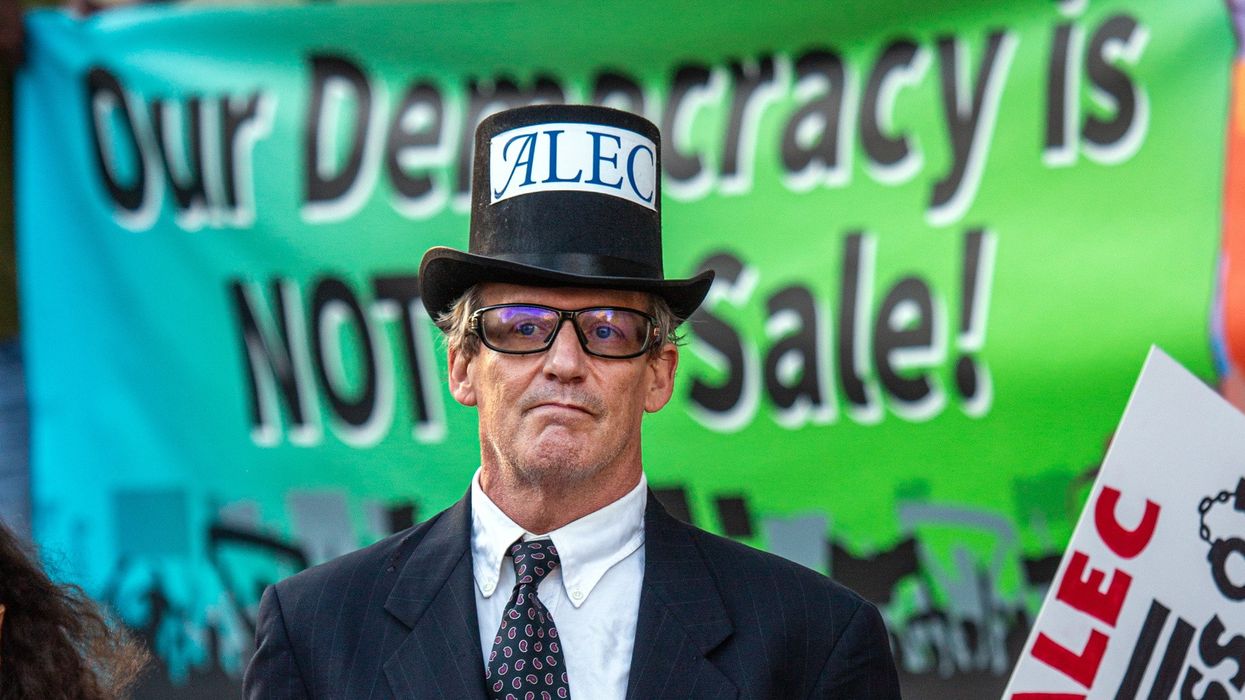
State lawmakers, right-wing operatives, and corporate lobbyists are descending on the Rocky Mountain state to vote on model policies and resolutions that impact the environment, education, elections, fundamental human rights, and more.
The American Legislative Exchange Council, or ALEC, is holding its 51st Annual Meeting in Denver this week at the four-star Hyatt Regency Denver at Colorado Convention Center. ALEC state lawmakers, right-wing operatives, and corporate lobbyists are descending on the Rocky Mountain state to hear presentations and vote on model policies and resolutions that impact the environment, education, elections, fundamental human rights, and more.
Colorado Gov. Jared Polis (D), Iowa Gov. Kim Reynolds (R), Oklahoma Gov. Kevin Stitt (R), Liberty Energy CEO Chris Wright, and GOP pollster Scott Rasmussen are slated to speak at the conference. Polis is the first high-profile Democrat to speak to the ALEC faithful in recent years.
The annual meeting officially kicked off Tuesday night with an anti-abortion “late night dessert and coffee reception” with national abortion ban proponent Marjorie Dannenfelser, president of Susan B. Anthony Pro-Life America, and “pre-recorded remarks” from pollster Kellyanne Conway, former U.S. President Donald Trump’s former senior counselor, to coach legislators on “how to communicate” about abortion during this fall’s campaign season. ALEC plotted its post-Dobbs strategy at its annual meeting last summer, and at least 684 state lawmakers affiliated with the group have voted to prohibit abortion access, a Center for Media and Democracy (CMD) analysis found.
Tuesday morning, the “Christian ALEC” (officially the National Association of Christian Lawmakers)—which circulates anti-abortion model legislation among its members—hosted a prayer breakfast for attendees.
In June 2021, ALEC CEO Lisa Nelson wrote in Real Clear Politics, “ALEC doesn’t have ‘template legislation’ on voting because ALEC doesn’t work on voting issues.” CMD exposed that claim as a lie, revealing a Council for National Policy meeting video where she described the work ALEC was doing on the issue in targeted states and admitted to outsourcing model voting legislation to the Honest Elections Project (HEP).
ALEC has held at least three voter suppression summits with HEP, a voter suppression project of Leonard Leo’s 85 Fund, and last summer passed a model bill pushed by HEP banning ranked choice voting, the process by which voters rank candidates in order of preference on their ballots rather than simply voting in favor of a single candidate.
This week, ALEC members will consider model policies that align with HEP priorities laid out in its 2024 “Safeguarding Our Elections” report: the Citizen Only Voting Amendment and Only Citizens Vote Model Policy. While the voting amendment is targeted at prohibiting municipalities from allowing noncitizens to vote in local elections, the model policy covers state and federal elections—even though it is already illegal for noncitizens to vote in either. That push is part of what The New York Times describes as a wider GOP campaign designed to promote Trump’s baseless claims of widespread voter fraud and “echoes the racist ‘great replacement’ conspiracy theory.”
In January, the ostensibly “nonpartisan” ALEC announced that it is joining forces with Run GenZ to try to draw young voters to the GOP.
“In recent months, the specter of immigrants voting illegally in the U.S. has erupted into a leading election-year talking point for Republicans,” Politico reported. Republican-controlled legislatures in Iowa, Kentucky, Missouri, North Carolina, Oklahoma, South Carolina, and Wisconsin have placed constitutional amendments to ban noncitizen voting on the ballot this November as a way of driving GOP turnout.
ALEC is also offering a workshop on the nonissue of noncitizens voting, called “States Must Do: Protecting the Vote.” The description of the training claims “the threat of noncitizen participation in our U.S. elections is real.”
ALEC may claim this, but the facts prove otherwise. “Every legitimate study ever done on the question shows that voting by noncitizens in state and federal elections is vanishingly rare,” the Brennan Center reported. As the Brennan Center points out, even the Charles Koch-founded and funded Cato Institute determined that “noncitizens don’t illegally vote in detectable numbers.”
Meeting attendees will also debate on whether to approve The School Board Election Date Act, which would politicize school board elections across the country by requiring candidates to indicate a “political party designation” beginning in 2026 and mandating that they coincide with November elections every four years. In its Safeguarding Our Elections report, HEP recommends consolidating school board election dates with general elections in November.
Another workshop, called “Foreign Influence in American Campaigns,” will consider “options” state lawmakers have to “prevent foreign influence on state campaigns.” In the same report, HEP advises lawmakers to “ban foreign influence in ballot measure campaigns.”
In January, the ostensibly “nonpartisan” ALEC announced that it is joining forces with Run GenZ to try to draw young voters to the GOP. At the meeting, ALEC members can attend a “Boomer to Zoomer: Run GenZ Informational Meeting” to learn more about the right-wing youth candidate training partnership.
Meeting attendees will once again consider a number of pro-fossil fuel and climate-harming policies at the meeting this week.
Since the summer of 2021, CMD has repeatedly documented ALEC’s consideration and promotion of multiple model bills punishing companies and public entities that embrace environmental, social, and governance factors (ESG) in their business and investing practices.
Consumers’ Research Executive Director Will Hild, an anti-ESG zealot, has become a regular speaker at ALEC meetings since it became a major sponsor, and ALEC has, in turn, promoted his attacks. Hild is again scheduled to speak at this week’s meeting and is likely the sponsor of the workshop, “America Runs on Energy: ESG and Grid Sustainability.” The description of the training claims that “activism in investing is far from new, but the push to give outsized importance to ESG scores has a deleterious effect on our nation’s power grid.” Of course, it mentions nothing about the unfolding climate crisis and its impact on the grid.
One bill, the Act to Define Clean Energy, would replace references to “renewable energy” with “clean energy,” so that “power generation supplied by nuclear fuel” can be promoted in green energy policies.
Model legislation up for a vote at the conference relates to the power grid. The Equitable Escalation of Electricity Demand Act, for example, blames rising electrical costs on electric vehicles (EVs) and Big Tech, and seeks to pass the increased costs on to EV owners and technology companies that manage large data centers.
Another model bill, the Electric Ratepayers Affordability and Reliability Advocacy Act, claims that consumer utility boards have been co-opted by “green energy” advocates and proposes the creation of a new statewide position, a “Ratepayer Affordability and Reliability Advocate” with the “singular mission” of advocating for “the most reliable, [lowest] cost form of electricity in a service area.”
ALEC members will also vote on a related bill, the Electricity Trajectory Management Act, which would stop the decommissioning of power plants that use coal, natural gas, water, or nuclear for energy generation and require building new ones in order to meet the increasing power demands EVs and data centers place on the grid.
Under ALEC’s draft Resolution Urging States to Not Allow the Use of IRIS Assessments to Inform its Rulemakings, state regulators would not be allowed to use the Environmental Protection Agency’s Integrated Risk Information System (IRIS) “as the basis of hazard assessment or risk assessment decisions or as the basis to establish air, water or waste rulemaking.”
The Natural Asset Company Prohibition Act would ban this type of corporation. In 2023, the Securities and Exchange Commission (SEC) floated the idea of including “Natural Asset Companies” (NACs) on the New York Stock Exchange, but then backtracked. NACs are a new type of corporation that put a market value on ecosystems and natural resources and are organized to “actively manage, maintain, restore (as applicable), and grow the value of natural assets and their production.”
The State Financial Officers Foundation (SFOF), the ALEC-tied group of Republican state treasurers, auditors, CFOs, and others weaponized to fight “woke capitalism” and ESG, and American Stewards of Liberty, the group tasked with upending Biden’s 30×30 executive order to help tackle the climate crisis, worked together to drum up opposition to NACs.
ALEC is also seeking to redefine terms used to promote sustainable energy to include traditional methods. One bill, the Act to Define Clean Energy, would replace references to “renewable energy” with “clean energy,” so that “power generation supplied by nuclear fuel” can be promoted in green energy policies. A related model up for consideration, The Affordable, Reliable and Clean Energy Security Act, would include natural gas and nuclear in the definition of “green energy.”
Last month, the Supreme Court rejected 40 years of precedent and overturned the 1984 decision in Chevron v. Natural Resources Defense Council, summarily curtailing the power of federal agencies to interpret laws they administer and giving that power to the courts. The monumental decision provides an opening for lawyers to overturn regulations that address everything from the ongoing climate emergency to the healthcare crisis and workplace safety.
ALEC meeting attendees will hear a presentation titled, “After Relentless: What Will Chevron’s Revised Status Mean for State Officials?” and vote on model legislation to Establish the Office of Regulatory Management in the states. “This Office aims to enhance and utilize transparency to reduce unnecessary regulatory burdens and ensure that new regulations are evidence-based and cost-effective,” the ALEC description reads.
Once an office is up and running, it is clear that the regulatory “transparency” created will be used by anti-regulation zealots and corporations to challenge regulations that conflict with their ideology or impact their profit models.
Partisan legislative attacks on diversity, equity, and inclusion (DEI) efforts from the right ramped up in 2023 and 2024, so it isn’t surprising that ALEC would provide model bills related to this to aid their members.
The Freedom from Indoctrination Act introduced this week prohibits universities and colleges from requiring DEI courses and prevents them from requiring first-year students to participate in DEI orientation activities. The model policy was first circulated by the right-wing Goldwater Institute and Speech First in April of 2023.
“During the 2023 legislative session alone, anti-diversity, equity, and inclusion bills were introduced in various states 40 separate times, and all of them addressed a combination of the same four objectives: ending mandatory DEI training, preventing the use of diversity statements in job applications and promotion materials, prohibiting hiring practices designed to increase diversity, and/or ending state funding for DEI offices and personnel altogether,” as CMD reported earlier this month.
Following the Supreme Court’s decision in Students for Fair Admissions, Inc. v. President and Fellows of Harvard College, ALEC is circulating the SCOTUS Anti-Discrimination Implementation Act to officially ban affirmative action programs designed to increase diversity on campuses or make places of higher education reflective of local demographics.
ALEC is also asking its members to vote on the First Amendment Preservation Act, which would prevent any state agency—including universities—from contracting with “media monitoring organizations” or advertisers or marketing companies that work with these organizations.
The bill defines media monitoring organizations as groups that “rate or rank news and information sources for the factual accuracy of their content,” or “provide ratings or rankings of news sources based on misinformation, bias, adherence to journalistic standards, or ethics, including, but not limited to, organizations that claim to engage in fact checking or determining overall news accuracy.”
In other words, this bill seeks to protect those engaged in hate speech or the peddling of mis/disinformation by making it harder for state governments to assess the accuracy of information and by punishing private companies that work with fact checkers to prevent the spread of disinformation.
On January 30, ALEC launched the Education Freedom Alliance in partnership with the Committee to Unleash Prosperity and the Job Creators Network to further privatize K–12 education through Education Savings Accounts (ESA), or universal, tax-funded school vouchers.
The ALEC-led coalition set “its goal of expanding universal education freedom to 25 states by 2025,” but will struggle to reach that target after only passing three ESA bills—in Alabama, Louisiana, and Missouri—so far this year, bringing the total to 12. ALEC and Charles Koch’s yes. every kid advocacy group will promote ESAs to ALEC attendees in a two-part workshop titled “The New Frontier: ESAs and Beyond.”
ALEC is also asking members to vote on the Microschool Education Act, which would give home-based or micro-school entities of 100 or fewer students the same rights as private and charter schools. Koch and the Walton Family Foundation are major backers of this latest school privatization effort.
Opponents fear that since this definition includes any criticism of Israel, relying on it will expose anti-war and pro-Palestinian activists to prosecution or hate crime charges for simply speaking out against Israel’s war in Gaza or occupation of Palestine.
ALEC’s American City County Exchange project will vote on the ACCE Model County Code Ordinance, which would streamline zoning for microschools.
In direct attacks on the First Amendment rights of students, ALEC meeting attendees will consider an Act to Prohibit Antisemitism in State K–20 Educational Institutions and an Act to Adopt the International Holocaust Remembrance Alliance (IHRA) Working Definition of Antisemitism.
The first bill appears to be positive on the surface, but within the text it states that, “The Working Definition of Antisemitism adopted by the International Holocaust Alliance (IHRA) that contains contemporary examples of antisemitism may also be used to identify antisemitism.”
Opponents fear that since this definition includes any criticism of Israel, relying on it will expose anti-war and pro-Palestinian activists to prosecution or hate crime charges for simply speaking out against Israel’s war in Gaza or occupation of Palestine, as Truthout reported in an article tying ALEC to the effort to codify the weaponized definition of antisemitism.
The second model bill would officially adopt the IHRA definition. ALEC, along with representatives from the Israeli government and the Heritage Foundation, has been pushing state lawmakers to adopt the IHRA definition since as early as 2021.
Lastly, in a bizarre attempt to address the public health crisis of gun violence in our nation’s schools, ALEC is promoting the Use of AI Firearm Detection Software in Schools. The model bill would allow state departments of education to use taxpayer money to buy AI gun detection software.
For many years, ALEC worked with the National Rifle Association (NRA) and Gun Owners of America to develop legislation to loosen gun regulations, promote stand-your-ground laws, allow concealed handguns on college campuses, and prevent cities from suing gun manufacturers, and many others.
ALEC may be spoiling for a fight in the U.S. Supreme Court to radically curtail federal powers. Up for consideration at this week’s annual meeting are two bills that would do just that.
The Presumption of State Jurisdiction Amendments, based on legislation in Utah according to the text, declares state sovereignty and jurisdiction over “natural resources; water resources and water rights; agriculture; education; and energy resources,” unless the federal government can show that “jurisdiction over the subject matter in question is specifically enumerated to the federal government under the Constitution.”
Earlier this year, Utah passed the Utah Constitutional Sovereignty Act, which empowers its legislature to “prohibit a government officer from enforcing or assisting in the enforcement of a federal directive within the state if the Legislature determines the federal directive violates the principles of state sovereignty.”
Now ALEC members are asking to vote on the same model. University of Utah Law Professor Robert Keiter told CNN after the bill passed there that “if the legislature actually passes a concurrent resolution and overrules a federal regulation, then it will likely be overturned due to the Supremacy Clause.”
ALEC members will have the opportunity to debate and vote on a couple of models related to squatting, or the occupying of property by anyone who doesn’t own it or have permission to live in it.
The Stop Squatters Act prohibits anyone from the unauthorized entry or occupation of residential or commercial properties, creates a process for having law enforcement remove squatters, and enacts penalties of a misdemeanor if damages are less than $1,000 or a felony if they exceed $1,000. The bill mirrors a model circulated by the right-wing litigation center Pacific Legal Foundation. ALEC is also circulating a Statement of Principles on Illegal Possession of Private Property on the issue.
Squatting data is sparse, and Juan Pablo Garnham, a researcher and communications manager at Princeton University’s Eviction Lab, told The Washington Post in April that “squatting is ‘an extremely rare issue’” in the U.S.
ALEC has long loathed public sector unions and circulated model policies weakening their power. The new so-called Public Employees’ Bill of Rights in front of its membership this week seeks to do the same by mandating that non-dues-paying members be given “equal rights” within a union.
The model bill also allows public employees to sue their unions and obtain a “full accounting” of union activities and dues.
ALEC publishes an anti-union playbook that was recently updated to include bills that target independent contractors and occupational licensing, CMD reported.
"Restricting the operations of charitable bail organizations is like closing down a food pantry and claiming you’re curing hunger."
The American Legislative Exchange Council (ALEC) is helping the for-profit bail industry push legislation in four states to restrict or outright eliminate charitable bail funds, which provide those unable to afford bail with enough cash to avoid being imprisoned while awaiting their day in court.
Led by the American Bail Coalition (ABC), the commercial bail industry sees the growth of charitable bail funds as a threat. The national trade group, which opposes bail reform efforts across the country, is also one of ALEC’s key corporate members. Last fall, ABC provided platinum-level sponsorship of ALEC’s ritzy 50th anniversary gala; its chairman, Bill Carmichael, is the vice chair of ALEC’s private sector board of directors; and an ABC representative sits on ALEC’s Criminal Justice Task Force. Since joining the pay-to-play legislative bill mill in the early 1990s, “ABC has written 12 model bills fortifying the commercial bail industry,” the group claimed in a 2010 newsletter.
Charitable bail funds post bail to secure pretrial release for people who couldn’t otherwise afford it. Many groups, such as the Atlanta Solidarity Fund, also operate with the specific purpose of assisting activists who often face arrest for public protests and end up in jail when unable to pay steep cash bail amounts.
Model policy developed by the ABC cautions that “in the past few years, the [charitable bail] funds have nationalized, and are now operating in [a] fashion to destabilize the bail system.”
The bills targeting charitable bail funds — which are currently being considered by lawmakers in Georgia, Kentucky, Washington, and Virginia — call for imposing general reporting and registration requirements, setting a maximum amount of bail that a fund can cover, and/or limiting the number of times a charity can post bail to just three per year, which would effectively shutter its operations.
“Restricting the operations of charitable bail organizations is like closing down a food pantry and claiming you’re curing hunger,” says Jeremy Cherson of the Bail Project, a national nonprofit that advocates for the elimination of cash bail while also providing bail and support services.
Instead of investing in support services, “lawmakers in these states have pursued shortsighted solutions that stick with the status quo of cash bail,” he points out. That, in turn, “leads to unnecessary incarceration and all its attendant consequences like job loss, family separation, and housing instability, which only makes cities and states less safe.”
Critics of the cash bail system repeatedly warn that curtailing the operations of bail funds disproportionately impacts poor and working-class Black and brown people.
The for-profit bail bond industry generates as much as $2.4 billion in annual revenue, according to U.S. industry estimates, with more than 2 million people entering into contracts with private bail bondsmen every year. The top six bail insurers control 76% of the market, according to reporting by Reuters.
The U.S. and the Philippines are the only countries in the world with commercial bail industries. Bail bond agents charge people who can’t afford bail a non-refundable fee — usually 10% of the set amount — to ensure that bail will be paid in full if the defendant doesn’t show up in court. Defendants frequently borrow money from bail bondsmen at predatory interest rates to cover their fees. The profits from these exorbitant rates are split between the bail bondsman and the insurers that provide the financial backing.
The heightened focus on charitable bail organizations comes amidst other corporate-funded assaults on the right to protest and ongoing threats from 2024 presidential candidate Donald Trump to deploy the military against civilian protesters.
A Center for Media and Democracy (CMD) analysis of current and recent bills that seek to curtail the operations of charitable bail funds found that the ABC has likely used its ALEC connections with state lawmakers to advance these pieces of legislation.
The number of bills seeking to regulate or restrict the operations of charitable bail organizations skyrocketed in 2020 after nationwide protests in the wake of George Floyd’s murder in June of that year. When donations poured in to bail funds across the country, some of the accompanying media attention focused on certain funds that had bailed out individuals accused of committing violent crimes.
By the end of the year, the ABC had published a briefing document calling for the regulation of charitable bail funds. “During 2020, these funds grew in popularity due in large part to celebrity and political endorsements aimed at posting bail for those arrested during the violent protests across the country which began after the George Floyd incident,” the document states. “With a warchest perhaps as high as $200 million nationally, these funds are now a major issue in bail and pretrial release,” and are being used “to destabilize the bail and criminal justice system.”
Critics of the commercial bail industry counter that the for-profit business is far more detrimental.
“The payment plans, the 10% fees, the collateral bail bonds agents extract — those are the types of disruptions that take people years to recover from,” the Bail Project’s Cherson told CMD.
The ABC, which has an annual revenue of $2.3 million according to its most recent tax filings, consists of five surety insurance companies that pay steep membership dues.
In late 2021, the coalition published a model policy on how to regulate the charitable bail industry. The aim of the model bill was to hamstring charitable bail funds by putting into place preliminary reporting and regulatory requirements. It was based on a bill that passed in New York — the first state to enact restrictive legislation — along with legislation introduced in Texas and Indiana.
ABC has gone so far as to suggest that charitable bail funds may not be legal because they leave “the defendant [with] zero financial incentive to show up in court.”
The coalition spent more than $1 million on lobbying in 2022, according to its most recent tax filings, nearly double what it spent in 2020. A Reuters investigation found that in 2020 insurance companies spent $17 million “to defeat proposals to weaken or abolish the for-profit bail industry in the United States” — an industry that “brings insurers $15 billion in business a year.”
Georgia’s SB 63, which has been passed in both legislative chambers, would prevent charitable funds from posting more than three cash bonds per year and require them to have their application approved by a local sheriff’s department. It would also dramatically expand the number of bail-restricted violations — including unlawful assembly, which is often used as a dragnet to include peaceful protest. A previous, less expansive version of the bill was proposed in 2022, but failed to pass.
A spokesman for Governor Kemp’s office said that the legislation is “undergoing a thorough review process.”
In a recent statement about the bill, Tiffany Williams Roberts, public policy director of the Southern Center for Human Rights, notes that “given the history of bail funds in many civil and human rights movements in Atlanta, SB 63 represents another violent attack on the right to political dissent, which, unfortunately aligns with Atlanta’s current repression of social movements that challenge the criminal legal system.”
Two of the bill sponsors, Republican senators Frank Ginn and Stephen Gooch, are members of ALEC, with Gooch serving as an ALEC state chair. Its House co-sponsor, Rep. Houston Gaines (R), is also an ALEC member who has delivered on other ALEC priorities such as preempting local democratic control over law enforcement budgets.
Speaking on the House floor earlier this month, Gaines repeatedly referred to defendants — regardless of what they were charged with — as criminals who are “not showing back up for court, and staying on the streets,” framing his attack with rhetoric that echoes the industry’s talking points.
According to a recent ABC statement, “Georgia has come up with what is really a very simple floor for these dangerous criminals — they aren’t getting out of jail free without some assurance that they will show up for court and answer for the charges.”
Charitable bail funds are “unaccountable,” Gaines said in claiming that these organizations are responsible for releasing “violent criminals on our streets.”
The ACLU of Georgia has said that it will sue the state if Kemp signs the bill.
Kentucky
In Kentucky, a sweeping piece of legislation called the Safer Kentucky Act, which rewrites and expands much of the state’s criminal code, has widespread support among Republican lawmakers. It would limit bail payments by charitable bail organizations to a maximum of $5,000 and prevent those organizations from posting bail for people accused of certain violent crimes. The component targeting charitable bail organizations has been recycled from a previous bill first proposed in 2022.
Washington
In Washington, state Senator Mike Padden (R) reintroduced SB 5116, which would impose registration and reporting requirements on charitable bail funds. Padden, who is also a founding member of the state’s conservative Freedom Caucus, has served as a member of ALEC’s Criminal Justice Task Force. When he was a state representative in the 1990s, he served on ALEC’s board of directors.
In the early 2000s, Padden used his influence to secure $7.5 million in fees and interest payments via favorable county contracts and special interest legislation for his former employer, a debt collection agency. This session, the senator has also sponsored bills to repeal a state ban on contracting with private prison companies and authorize the use of chokeholds by police.
Virginia
Virginia’s HB 846, introduced by conservative delegate Wren Williams, would similarly regulate charitable bail funds by implementing steep registration fees and other requirements. The bill also prevents bail funds from assisting anyone previously convicted of a violent crime.
Beyond New York, Indiana is the only state to have put in place significant restrictions on charitable bail organizations with the passage of HB 1300 in 2022. The law requires charitable bail organizations to be certified by the state, prevents them from receiving state funding, and prohibits them from bailing out any defendant who has been charged with a violent crime or a felony, or has a prior conviction for a crime of violence. The Indy Star reported how a misinformation campaign that misrepresented the number of reoffenders bailed out by bail funds helped propel the proposed legislation into law.
In the wake of its passage, the Bail Project teamed up with the Indiana ACLU to sue the state over what it argued was unjust targeting of its organization. The Bail Project came under intense media scrutiny in Indiana after three of the individuals it bailed out committed violent crimes on pretrial release, making it the industry’s strawman for arguing in favor of maintaining the status quo.
Although neither the bill’s author, Rep. Peggy Mayfield (R), nor its coauthor, Rep. Donna Schaibley (R), are known to be ALEC members, reporting by CNN found that Mayfield had contact with the ABC while drafting the legislation. In addition, the three Senate sponsors of the bill are all affiliated with ALEC.
“Unlike licensed bail agents, bail funds do not have the ability to recover defendants who skip court, and their involvement should be limited to cases that don’t impose a significant risk to the public’s health and safety,” ABC Executive Director Jeffrey J. Clayton wrote in an op-ed when a previous version of the legislation was under consideration.
Cherson disagrees, telling CMD that “charitable bail organizations make a small but meaningful impact on the incredible devastation wrought by this system. And the more legislatures pursue these types of restrictions, the more broken these systems become.”
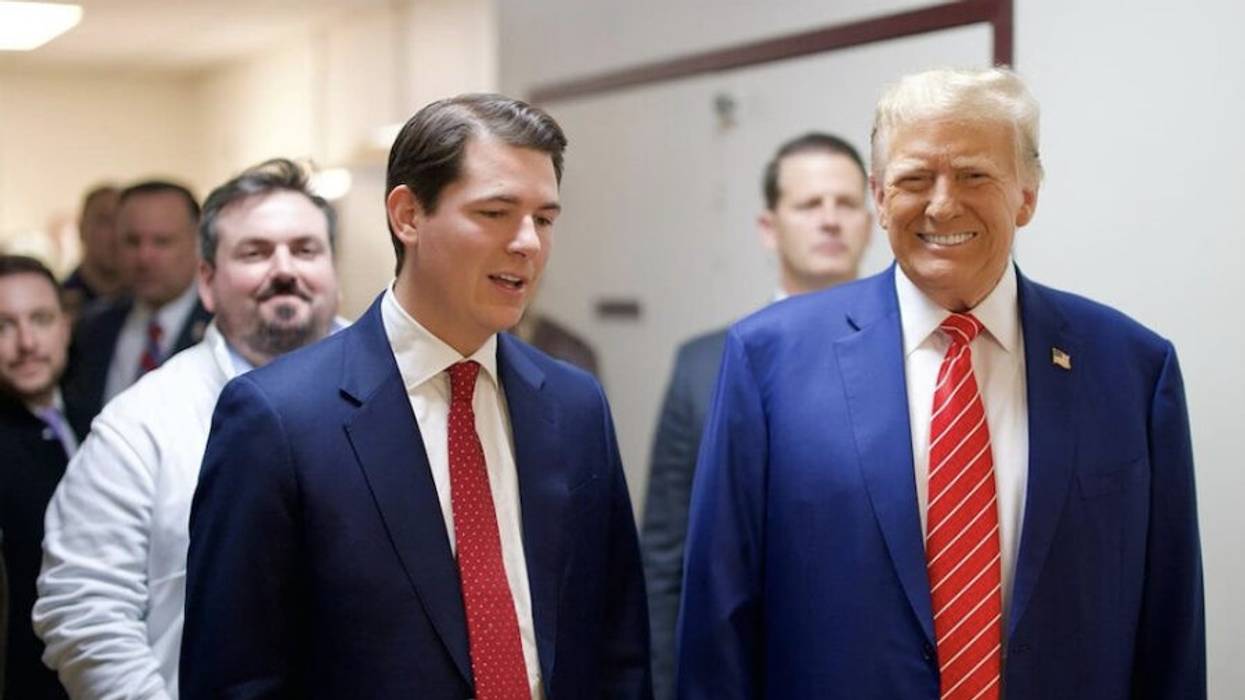
A new “strategic partnership” with ALEC Action is aimed not just at expanding ALEC’s bench of state legislators, but also at grooming young conservatives to win local elections nationwide.
In the last presidential election, Gen Z voters — those between the ages of 18 and 29 — supported Joe Biden over Donald Trump by a margin of 24 points (59–35%). And people in the Gen Z age range identify more with Democrats and less with Republicans than all other generations — except for millennials, who are just one percentage point behind in favoring Democrats.
Now the ostensibly “nonpartisan” American Legislative Exchange Council (ALEC) has teamed up with a new Gen Z political group to try to shift the balance among young voters in favor of the GOP.
The right-wing and corporate bill mill’s advocacy arm, ALEC Action, has joined forces with Iowa-based Run GenZ to recruit and train young “conservatives” to run for state and local office.
While it also presents itself as nonpartisan, Run GenZ was founded by a Republican legislator, is exclusively led by Republicans, and all of the “rising stars” and politicians in its promotional videos are Republicans. The group’s annual conference, held in Iowa shortly before the Republican caucus, was attended by Donald Trump and Nikki Haley.
“Run GenZ is going to help grow the next generation of conservative leaders in America by recruiting more young people that believe in free markets, capitalism, and individual liberty to run for office,” said U.S. Rep. Ashley Hinson (R-IA) in an endorsement video.
The Internal Revenue Service (IRS) has long recognized “conservative” as a code word for partisan political activity.
“By partnering ALEC Action with Run GenZ, we will equip next-generation leaders who share our principles and vision for America,” said Lisa Nelson, CEO of both ALEC and ALEC Action, in announcing the new partnership on Jan. 5, 2024. The press release describes the relationship between the two groups as a “merger.”
ALEC’s announcement makes the electoral objectives of the groups crystal clear. “The RGZ mission to ‘Empower, Recruit, and Mentor’ the next generation of elected officials has produced more than 95 state and local elected leaders across this country,” the press release claims. Boasting a “win rate” of more than 70%, ALEC says Run GenZ will provide the conservative movement with “a strong bench of policy-savvy candidates for decades to come.”
“I like to say we’ve kind of cornered the market on getting young conservatives in their twenties elected to office,” Mason Morgan, Run GenZ’s then 26-year-old executive director, told Texas Monthly in 2022.
ALEC is a tax-exempt 501(c)(3) charitable organization that is prohibited by law from engaging in any electoral activity. Entering into the Run GenZ partnership through its advocacy arm, ALEC Action, does nothing to insulate ALEC from that prohibition since ALEC exclusively controls and largely funds it. ALEC Action (legally registered with the IRS as the Jeffersonian Project) is run by ALEC’s executive team, ALEC handpicks its board, and all decisions are subject to ALEC’s approval, according to the group’s 2022 tax return.
This is not ALEC’s first foray into electoral politics. For years, it has provided its legislative members with free access to ALEC CARE, sophisticated voter management software linked to the Republican National Committee’s voter database. The software, which would normally cost a legislator $3,000, was developed by VoterGravity, a partisan spin-off of GOP operative Ned Ryun’s American Majority.
Former Iowa State Rep. Joe Mitchell (R) — who was elected in 2018 when he was 21 and served until 2022 when he was defeated in the Republican primary — founded Run Gen Z in 2020 and serves as its president. Former Iowa Speaker of the House Linda Upmeyer, a former ALEC board member, serves as secretary of the group’s board, and Barry Jackson, a Republican political strategist who was chief of staff for former U.S. Speaker of the House John Boehner (R-OH), serves as treasurer. Boehner is an ALEC alumnus from when he was an Ohio state lawmaker.
Run GenZ raised $289,086 in contributions and grants in 2022 and had $346,360 in expenses.
Its new “strategic partnership” with ALEC Action is aimed not just at expanding ALEC’s bench of state legislators, but also at grooming young conservatives to win local elections.
Run GenZ’s “Municipal Council” of six Republican politicians could potentially boost the American City County Exchange (ACCE), ALEC’s organization of city and county public officials. ACCE’s mission is “to engage local elected officials and leaders from business and industry for the advancement of limited government and free market principles.”
Like ALEC, ACCE provides local officials with a host of model bills aimed at limiting taxes, privatizing services, busting unions, blocking local minimum wage increases, and achieving other right-wing objectives.
David Armiak contributed research to this report.
Time to wake up, people. It's no longer just a dream—but a nightmare one step closer to happening.
One of the right’s favorite fever dreams over the years has been to gut the US Constitution of many of its checks and balances and officially turn America into a legal oligarchy with a strongman presidency, nearly bulletproof legal immunity for the morbidly rich, and full personhood for corporations.
As of this month, it’s no longer just a dream.
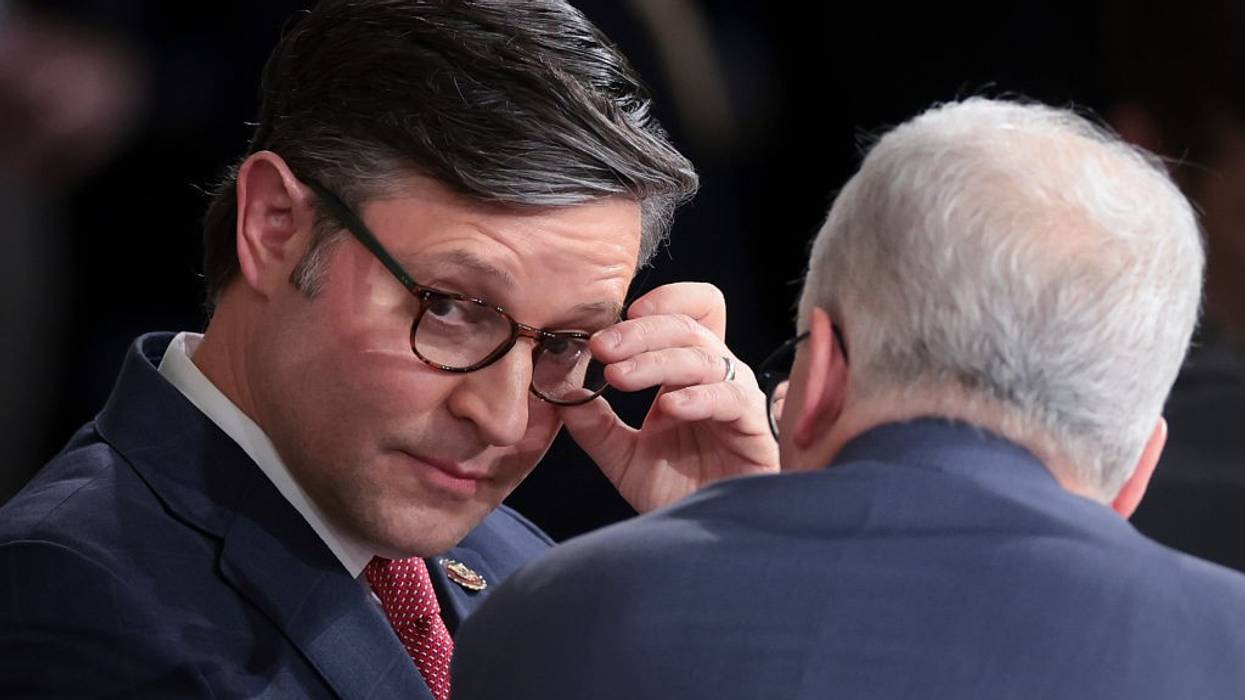
The American Legislative Exchange Council (ALEC) completed their winter “National Policy Summit” get-together in Scottsdale, Arizona last week with Speaker Mike Johnson as its keynote speaker. This is the group that’s brought “Stand Your Ground” and voter suppression “model legislation” to Red states across America and, for fifty years now, has been bringing together corporate lobbyists and Republican state-level politicians to make state after state more corporate- and billionaire-friendly.
If their plan works, these Republican toadies of the billionaires who fund and own them will rewrite our Constitution and state governors, the US Congress, and the President will have no say whatsoever in the process.
At this recent meeting they rolled out a new strategy to convene a Constitutional Convention, so they can finally remake America in their own image: they’re going to try to get the six corrupt Republicans on the Supreme Court — who all have direct or indirect ties back to ALEC, its related/affiliated organizations, and/or its funders — to go along with it.
Former Wisconsin Senator Russ Feingold (now a professor of law and president of the American Constitution Society) is not prone to hyperbole; he’s always been a thoughtful and measured speaker and writer. So, it’s worth taking him seriously when he recently said of MAGA Mike Johnson:
“It is alarming to have a speaker of the House who supports the extremist Convention of States movement, which is striving to radically rewrite the U.S. Constitution.”
Please consider the horrifying possibilities.
Morbidly rich billionaires and the groups they fund are working to rewrite our Constitution to do all this and more.
They want to provide corporations and the rich with more and more protections and benefits while chopping away at anything smelling of “socialism” like Social Security, child labor laws, or inheritance, income, and wealth taxes.
The Constitution provides for three ways to change or amend itself. The first is that Congress can propose a constitutional amendment, pass it with a supermajority in both houses, and have three-quarters of the states ratify it. This is the way it’s been done for every one of the existing 27 amendments.
The second strategy is done by using Article V of the Constitution and driving the process up from the states. The easiest way to do this is for three-quarters of the states to legislatively approve (with simple majority votes in the legislatures of each state) an amendment, in which case Congress is unnecessary and upon ratification by the 38th state, it becomes a permanent amendment to the Constitution.
While this strategy has never been used, it’s one process many of the good-government groups like Move To Amend and Public Citizen are pushing for a “Corporations are not people, and money is not speech” amendment to reverse Citizens United.
The third — and incredibly dangerous — strategy to amend the Constitution is to simply call a “Convention of the States,” again using Article V, and open the entire document itself up to rewriting and tinkering.
This third strategy is the one ALEC was pushing this month. If they can pull it off in the states (where it’s cheaper to buy politicians), then Congress, state governors, the president, and even the courts would have no say over it. And ALEC has spent the past 50 years becoming a major — some would say controlling — factor in Republican-controlled state legislatures.
Their barrier has been that it takes 34 states to call for a convention, and there have never been that many states calling call for one at the same time since the founding of our republic. However, as was pointed out at ALEC last week, every state except Hawaii has — at one time or another, starting with Virginia in 1788 — passed a resolution proposing a constitutional convention (there have been 400 such resolutions since the founding of our nation).
While most of history’s resolutions for a convention have been specific to one issue or another (New York’s 1789 resolution called for a Bill of Rights to be added to the Constitution, for example, something that Congress and the states did in 1791), a half-dozen were simply calls for a convention without specifics. These are sometimes referred to as “generic” convention resolutions.
The theory pushed at ALEC, first rolled out three years ago at an ALEC workshop by conservative activist David Biddulph but now apparently fully endorsed, is to combine the existing 28 Red state resolutions along with the six “generic” ones (going all the way back to 1789) to hit the magic number of 34 states to open the convention.
The key to the strategy is to get it before the Supreme Court and let the billionaire-owned Republican justices do ALEC’s work for it by ruling that those old resolutions are still valid, even though the people who proposed and passed them are all long dead.
Utah Republican State Rep. Ken Ivory told ALEC lawmakers it was imperative to get the issue before the Supreme Court:
“Please join us in the state of Utah as we look into the legal mechanisms that we have under the Constitution… to [get the Court to] declare that Congress must count the [old] applications. … And if, as we believe, we’ve already achieved 34 applications to Congress for a fiscal responsibility convention, call [it]… and hold a Convention of States.”
If their plan works, these Republican toadies of the billionaires who fund and own them will rewrite our Constitution and state governors, the US Congress, and the President will have no say whatsoever in the process. Only state legislatures are necessary for rewriting the Constitution and then ratifying their own work, according to Article V of the Constitution, and governors can’t veto their actions.
Much like the many cases that have suddenly burst onto the scene and then been used by the six corrupt Republicans on the Court to alter American law and take away citizens’ rights, this one could move quickly. Now that the ALEC meeting is over, expect to see states begin putting together the lawsuits or other legal actions necessary to get this proposal before the Court.
Alexander Hamilton was prescient: in the last sentence of Federalist 85, he warns us of efforts to re-write or replace our Constitution:
“I dread the more the consequences of new attempts, because I know that powerful individuals, in this and in other States, are enemies to a general national government in every possible shape.”
Common Cause and the Center for Media and Democracy have been at the forefront of sounding the alarm and I’ve hot-linked their names to their most recent articles about the work they’re doing to try to stop the billionaire machine devoted to rewriting our Constitution.
Please check them out, get on their mailing lists, and spread the word. This is one of those things that Republicans on the Court could use to seemingly spring out of nowhere and bring down our democracy once and for all.

ALEC politicians considered model policies and resolutions related to an Article V constitutional convention, so-called “woke” capitalism, school curricula, the environment, gutting regulations, and more.
State lawmakers, corporate lobbyists, and right-wing operatives got together in Scottsdale, Arizona, last week for the 2023 States and Nation Policy Summit hosted by the American Legislative Exchange Council, or ALEC. The summit—one of the largest annual gatherings of the ALEC faithful, along with the summer meeting—caps off ALEC’s 50th anniversary year.
Following its 50th Annual Meeting in July, ALEC held a formal gala on October 4 at the National Portrait Gallery in Washington, D.C., where attendees were met with protests highlighting the pay-to-play group’s “50 Years of Harm.” ALEC also organized a “50th Anniversary Policy Day” at the U.S. Capitol that featured discussions on artificial intelligence; environmental, social, and corporate governance (ESG) investment strategies; school privatization; and the “state tax cut revolution,” as an agenda obtained by the Center for Media and Democracy (CMD) details.
Meeting at the four-star Westin Kierland Resort & Spa in Scottsdale, ALEC politicians considered model policies and resolutions related to an Article V constitutional convention, so-called “woke” capitalism, school curricula, the environment, gutting regulations, and more.
Among the slate of Republican politicians and other right-wing speakers were former Arizona Governor Doug Ducey, U.S. Speaker of the House Mike Johnson (via video), former U.S. Speaker of the House Newt Gingrich, Arizona State Supreme Court Justice Clint Bolick, and many others.
ALEC prioritized its push for an Article V constitutional convention early in the opening session with multiple speakers who advocated for the radical move to rewrite our nation’s founding document.
In his address, the new House speaker (and ALEC alumnus) called the size of the federal debt “the greatest present threat to our national security” and announced “plans for a bipartisan debt commission to study and propose solutions to begin reducing our debt and putting America back on a path to fiscal responsibility.”
Johnson has long supported the Convention of States, one of the right-wing groups lobbying for state resolutions to hold a constitutional convention. The group relies on ALEC as a tool to reach state legislators to back its extreme plan to rewrite the U.S. Constitution in order to drastically curtail federal powers and lock in minority rule.
He noted that several states are considering whether to file a case against Congress with the goal being “to get a case before the Supreme Court to force the Congress to discharge its constitutional responsibilities.”
ALEC used this most recent policy summit to double down on a strategy first presented in 2020 claiming that unrelated and outdated state resolutions should be counted to meet the threshold of the 34 state calls needed to hold a constitutional convention. Using this rationale, the threshold was reached in 1979, making Congress legally required to convene a constitutional convention immediately.
U.S. Rep. Jodey Arrington (R-Texas) presented the bill he has introduced (HCR 24) to do just that, claiming Congress has “failed in its constitutional duty to count applications and call a ‘Convention for proposing Amendments.’”
“Working with my friend and our fearless leader in the House, Speaker Mike Johnson, I’m going to continue to push to pass this important legislation to stave off a sovereign debt crisis, to rein in the reckless and wasteful spending in Washington, and to return power back to the sovereign states,” Arrington said.
David Walker, former comptroller general of the U.S., discussed steps being taken to force the issue in the courts. “The Federal Fiscal Sustainability Foundation (of which I’m a board member) has financed the drafting of a declaratory judgment filing by a prominent D.C. firm with significant Supreme Court experience,” Walker explained. He noted that several states are considering whether to file a case against Congress with the goal being “to get a case before the Supreme Court to force the Congress to discharge its constitutional responsibilities. We need more states to join this effort.”
Utah State Rep. Ken Ivory (R) also called on ALEC lawmakers to urge the Supreme Court to act. “Please join us in the state of Utah as we look into the legal mechanisms that we have under the Constitution… to declare that Congress must count the applications,” Ivory implored. “And if, as we believe, we’ve already achieved 34 applications to Congress for a fiscal responsibility convention, call [it]… and hold a Convention of States.”
In a workshop titled “Article V: The People’s Voice and State’s Empowerment Tool,” ALEC lawmakers heard from “legal experts” who delved “into the merits of a Declaratory Judgment suit against Congress, specifically addressing its negligence since 1979 in calling a Convention for an inflation-fighting Fiscal Responsibility Amendment.”
Members of ALEC’s Federalism and International Relations Task Force heard a similar presentation called “Article V—Next Steps If the 34-State Threshold Was Met in 1979.”
Task force members then took a secret vote on a Resolution Demanding Congress Call the Fiscally Responsible Amendment Convention as Article V Mandated in 1979 Stipulating Ratification by State Convention, where “We the People Rule.” This resolution not only calls on Congress to hold a constitutional convention, it requires the states’ governors, attorneys general, and legislative councils “to seek judicial enforcement” if they fail to do so.
Attacks on so-called woke capitalism and sustainable investing were featured prominently throughout the summit.
ALEC’s Tax and Fiscal Policy Task Force held a discussion on “States Keeping Politics Out of Pensions” and reconsidered the Proxy Voting Integrity and Transparency Act that failed to pass at the annual meeting in July. Now that this model bill—which seeks to prevent government entities managing public pension plans from considering ESG factors when engaging in the proxy voting process—didn’t pass this time either, it’s likely dead.
At their meeting, members of the Energy, Environment, and Agriculture Task Force voted on making adjustments to the Model Policy Amending the Prudent Management of Institutional Funds Act, but it didn’t move. The changes would have prohibited the consideration of ESG factors in the management of public institutional funds.
This model is also hosted on the Heritage Foundation website, as are most anti-ESG model policies introduced at ALEC meetings over the past few years.
At the closing session, Andy Puzder, former CEO of CKE Restaurants, the parent company of the popular fast-food chains Carl’s Jr. and Hardee’s and a visiting fellow at Heritage, once again drummed up fears about ESG as a lens for investing, calling it a “Neo-Marxist investment strategy.”
Puzder has spoken at multiple ALEC meetings and drafted many of the anti-ESG bills the corporate bill mill has circulated since the summer of 2021, when it held its annual meeting in conjunction with the State Financial Officers Foundation, an association of right-wing state treasurers and other fiscal managers that is staunchly opposed to making decisions about public policy and funds based on factors such as climate change, equity and inclusion, and social justice.
At last year’s ALEC policy summit, Puzder compared the fight against ESG to his father’s generation’s fight against Nazism.
In addition to demonizing sustainable investing in his remarks last week, Puzder promoted the only anti-ESG model bill that has been approved by ALEC’s board of directors: the State Government Employee Retirement Protection Act. The bill, which he helped draft, prohibits anyone managing state, local, or university public pensions from considering the climate emergency or other social or political factors when investing pension funds.
Puzder also promoted anti-boycott bills that he refers to as “contracting legislation.” Originally called the Eliminate Political Boycotts Act but renamed at the December 2022 summit, this model bill bars companies with 10 or more employees from receiving state contracts if they take into account any “social, political, or ideological interests” to limit their commercial relations with fossil fuel, logging, mining, or agricultural businesses—and instructs legislatures to “insert additional industries if needed,” as CMD first reported.
ALEC’s board rejected the anti-boycott model due to opposition from the American Bankers Association, state bankers associations, and others.
ALEC lawmakers also considered passing The Science of Reading Act. This model bill would require all schools to adopt the “science of reading” method of instruction in place of older approaches to teaching students how to read, prohibit the use of any other reading curricula, and require all new teachers to take 80 hours of additional training “aligned with the science of reading.” The training must be “provided by an organization accredited by the International Dyslexia Association”—which offers a clue as to which special interests likely drafted the model bill, something ALEC keeps secret. This is totally at odds with the National Center on Improving Literacy, which maintains that the “science of reading” is a body of research and not “a program, an intervention, or a product you can buy.” The bill does not include language on funding.
The unfunded “science of reading” curriculum has proven to be difficult to roll out and expensive to implement for school districts in states where this new reading program is mandated by law. Education scholar Diane Ravitch argues that there is no such thing as “the science” of reading. “There are better and worse ways of teaching, but none is given the mantle of ‘science,’” Ravitch points out. “Calling something ‘science’ is a way of saying ‘my approach is right and yours is wrong.’”
ALEC politicians in the Energy, Environment, and Agriculture Task Force meeting debated An Act to Prevent Lawsuit Abuse Regarding Ethylene Oxide Emissions, which would protect medical device manufacturers and distributors from potential lawsuits that may stem from a new rule from the Environmental Protection Agency regulating emissions of the cancer-causing chemical.
ALEC lawmakers serving on the Federalism and International Relations Task Force also heard a presentation titled “Protecting State Critical Infrastructure—A National and Homeland Security Imperative” and voted on the Statement of Principles on Securing and Protecting Public Utility Infrastructure. The model legislation makes the case that protecting public utility infrastructure is a matter of both “homeland security” and “environmental protection.”
This may also suggest a renewed interest from ALEC in pushing its 2018 model policy designed to criminalize and quell environmental protests in and around fossil fuel infrastructure.
ALEC’s sister organization, the American City County Exchange (ACCE) also introduced a couple of model bills to attendees.
The Homelessness Crisis Mitigation Act would prevent cities or towns within a given county from addressing the critical needs of the unhoused “without first entering into a shared services agreement with [COUNTY] to provide said services.” This would create a significant hurdle for social service agencies and possibly prevent shelters or other temporary housing options from being offered to those in need.
The Local Taxpayer Protection Act would require the vote of two-thirds of a county legislature in order to increase property taxes, raising the threshold needed and making it more difficult for counties trying to finance policies and programs unfunded by state legislatures.
In the Commerce, Insurance, and Economic Development Task Force, members considered the Regulatory Sunset Act, which calls for any rule or regulation enacted or amended after the model’s passage to be terminated after five years and gives the legislature power to control any renewals. Regulatory agencies would have to notify the legislature a year in advance and provide a cost-benefit analysis for each regulation they wish to renew. This would create an extensive amount of additional work for state agencies and state legislatures, many of which operate part-time, and put health, environmental, workplace, and other regulations that keep Americans safe at risk of lapsing.
Other new model policies considered at the ALEC summit include:

This promotion of vigilantism has resulted in a shoot-first-ask-questions-later culture that has made us all less safe, not more.
In early October, a Florida state senator introduced legislation to repeal the state’s controversial “Stand Your Ground” law allowing individuals to use deadly force in self-defense outside their homes. Florida was the first state to enact such a measure, and in the 18 years since its passage, studies have shown that more Floridians are dying because of it.
“The data is clear: homicide rates and gun deaths are higher where these discriminatory, dangerous policies are on the books,” Sen. Shevrin Jones (D-34), the bill’s sponsor, told the Center for Media and Democracy (CMD).
What’s less widely known is the pivotal role the American Legislative Exchange Council (ALEC) has played in ensuring the widespread adoption of such laws.
Since its founding 50 years ago, ALEC has brought together Republican state legislators and corporate donors to draft model legislation repealing labor protections, rolling back environmental regulations, and encouraging the privatization of education. Yet one of ALEC’s ugliest efforts has been its collaboration with the National Rifle Association (NRA) to legalize an individual’s right to shoot to kill in public — the bloody legacy of its Stand Your Ground model legislation.
Stand Your Ground laws are an expansion of what’s known as the “Castle Doctrine,” the common law principle that people are entitled to defend their own homes, even with lethal force. While the Castle Doctrine is legally upheld in most jurisdictions, applying that same principle to public spaces is more controversial. Individuals in states that have not passed Stand Your Ground laws are generally obligated to retreat from a public danger or threat — real or perceived — as long as they’re able to do so, whereas in states with these laws people are allowed to use force to meet the threat.
“A person who uses or threatens to use deadly force,” the 2005 Florida statute reads, “does not have a duty to retreat and has the right to stand his or her ground” as long as that person is in a public place and is not engaged in any criminal activity.
Applauded by the NRA and ALEC, the law has proven to be a game changer, enabling people to use deadly force in public with impunity.
Former NRA president and lobbyist Marion Hammer conceived of that first bill and worked with two Florida legislators who were members of ALEC at the time, State Sen. Durell Peaden and Rep. Dennis Baxley, to get it passed. Baxley, a far-right legislator who is a member of a neo-Confederate organization, had won the NRA’s Defender of Freedom award the year before. “Disorder and chaos are always held in check by the law-abiding citizen,” he said when the bill passed.
The NRA considered the legislation as the “first step of a multi-state strategy,” NRA Executive Vice President Wayne LaPierre told a reporter for The Washington Post. And ALEC was the perfect front group to execute that strategy.
Shortly after Stand Your Ground was signed into law in Florida, Hammer proposed that ALEC’s Criminal Justice Task Force adopt it as a model bill. A month later, ALEC’s board approved it. Since then, the language of ALEC’s model legislation — misleadingly dubbed the “Castle Doctrine Act” — has been incorporated into law in 29 more states, with some adopting especially broad versions of the legislation.
Stand Your Ground proponents like the NRA and Rep. Baxley claimed that these bills would reduce violent crime and make citizens feel safer. Yet countless lives have been lost due to the lethal force they permit. A study published last year in JAMA, the Journal of the American Medical Association found a significant increase in homicides in states with Stand Your Ground laws. An earlier study found that in Florida alone, the rates of homicide increased 24% and gun-related homicide increased 32% between 2005 and 2014. A meta review of 16 previous studies on the impact of Stand Your Ground also concluded that these laws lead to increased rates of homicide, especially due to deadly gun violence.
The American Bar Association called for the repeal of Stand Your Ground laws in a 2015 report, noting that they are racially biased and provide “a low-cost license to kill.”
In the wake of George Zimmerman’s murder of Black teenager Trayvon Martin in 2012, the tides appeared to turn against ALEC and its legislation supporting gun violence. Given the state’s Stand Your Ground law, Florida police had refused to make an arrest, spurring national outrage. At the time, research by CMD traced the bills back to ALEC and the NRA. When the civil rights group Color of Change called for a corporate boycott of ALEC, multiple corporations — including Kraft Foods, Coca-Cola, and PepsiCo — pulled out from the organization. In a statement, ALEC called Martin’s death a “tragedy,” and attempted to distance itself from the Florida legislation.
Yet when ALEC announced that it would disband its Public Safety and Elections Task Force in 2012 (formerly the Criminal Justice Task Force) — which had shaped Florida’s law into a cookie-cutter Stand Your Ground model bill — the chair of the task force made quiet assurances that the work would continue through other channels. “ALEC’s decision won’t impact the important issues we’ve worked on,” former Texas State Rep. Jerry Madden told The Christian Post. Since 2012, Stand Your Ground laws have continued to surface across the country.
ALEC has never repudiated its support for Stand Your Ground laws or pushed to undo any of the legislation. And as recently as 2021, ALEC CEO Lisa Nelson assured concerned members that although the organization no longer explicitly pursues social policies, it’s able to push its agenda through other means.
Just 80 miles north of the luxury hotel in Orlando where ALEC held its 50th annual meeting, Florida’s Stand Your Ground law came into national focus again in June when Susan Lorincz, a 58-year-old white woman, shot and killed her 35-year-old Black neighbor, A.J. Owens, through Lorincz’s closed front door. She later admitted to having used racial slurs in verbally harassing Owens’ four children.
Although Lorincz was inside her home when she killed Owens, the local sheriff cited the state’s Stand Your Ground law as a reason to hesitate making an immediate arrest. “We have to rule out…whether this deadly force was justified or not before we can even make the arrest,” Marion County Sheriff Billy Woods told the press on June 5.
What makes Stand Your Ground laws especially insidious is that they flip the burden of proof. “Now police and prosecutors must prove a negative — that a shooter was not in fear for their life — to even bring a case,” Reveal reported. “According to legal experts, that’s an almost impossible standard to meet, meaning that many shooters won’t face charges for crimes as serious as murder.”
“‘Stand Your Ground’ laws threaten public safety, encourage armed vigilantism, and promote a culture of ‘shoot first, ask questions later,’” Sen. Jones told CMD.
“The National Rifle Association and the American Legislative Exchange Council have a stranglehold on Republican lawmakers here in Florida and across the country,” he continued. “These entities have traded campaign checks in exchange for fealty from legislators, and as a result, our communities are less safe.”
Lisa Graves and Arn Pearson contributed to this article.
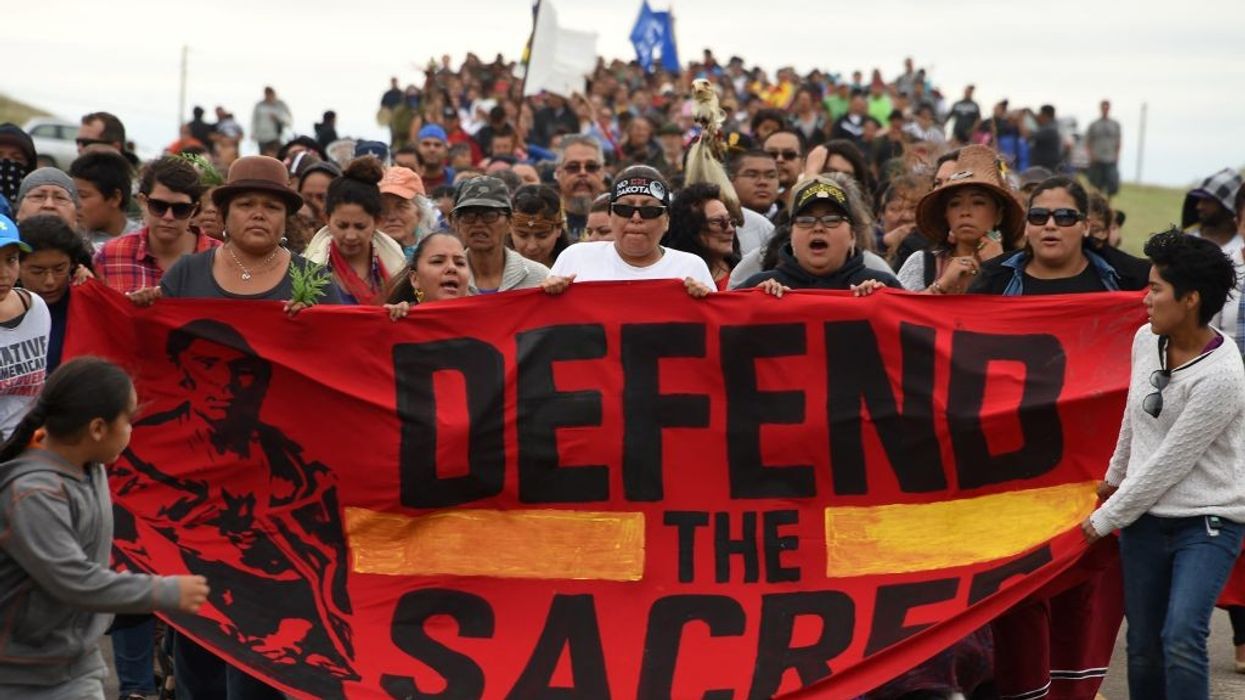
Fossil fuel companies have contributed millions of dollars to legislators who sponsored such laws, according to a new report.
In the seven years since the massive protests against the Dakota Access pipeline at Standing Rock, the fossil fuel industry and their allies in politics and law enforcement have been hard at work to prevent a repeat: Around 60% of oil and gas infrastructure in the U.S. is now shielded by anti-protest laws that make direct action much riskier for activists and frontline communities who want to protect their local and global home from dangerous pollution, a new Greenpeace report has found.
The report, Dollars vs. Democracy 2023: Inside the Fossil Fuel Industry's Playbook to Suppress Protest and Dissent in the United States, reveals that fossil fuel companies made up nine of the 10 most determined lobbyists for anti-protest measures since 2017 and that 25 oil, gas, coal, and energy companies contributed more than $5 million to legislators who sponsored these laws.
"Our current climate emergency is a direct result of the oil and gas industry’s operations," Greenpeace USA executive director Ebony Twilley Martin said in a statement. "Frontline activists should not face extreme, life-altering legal risks for putting their bodies on the line to keep our planet habitable. Oil and gas companies are finding new and dangerous ways to delay the transition to clean energy and protect their own profits."
The oil and gas industry has played an outsize role in the spread of so-called "critical infrastructure" laws. These laws impose extra penalties for campaigners who trespass on the property of pipelines and other fossil fuel infrastructure, despite the fact that states already have anti-trespass laws on the books. In 2017, Marathon Petroleum and the American Fuel and Petrochemical Manufacturers pushed the American Legislative Exchange Council (ALEC) to adopt an anti-fossil fuel protest measure as one of its "model bills." ALEC is a shadowy network of corporations and lawmakers that prepares bill templates aligned with business interests that can be easily spread from state to state.
Since 2017, 18 states have passed critical infrastructure laws that now protect around 60% of oil and gas infrastructure, and four other states have passed slightly watered-down versions of these laws. In 2023 alone, lawmakers have introduced 23 anti-protest bills in 15 states, and four states have passed anti-fossil fuel protest laws. North Carolina passed the most draconian of the year. It classifies trespassing on an energy facility as a felony punishable with up to two years in prison and attempting to “obstruct, impede, or impair the services of transmissions of an energy facility" as felonies that carry up to 19 years in prison and $250,000 in fines. Oregon, Utah, and Georgia also passed more limited anti-protest laws.
The oil, gas, and coal industry has financed the spread of these laws: Nine of the top 10 lobbyists for these bills from 2017 to 2023 were Marathon, ExxonMobil, Enbridge, TC Energy, Koch Industries, Chevron, Energy Transfer, Williams Companies, and Valero. In addition, 25 fossil fuel companies gave $5 million to lawmakers pushing these laws, with the top five donors being Duke Energy, Dominion Energy, Marathon Petroleum, BNSF Railway Co., and Koch Industries.
"It is time to stop pretending that the fossil fuel industry is so vital to our national interest that it needs to be protected from any and all criticism; nothing could be further from the truth."
"The fossil fuel industry has lobbied for these extreme anti-protest laws to shut down criticism of them," Nicholas Robinson, senior legal advisor at the International Center for Not-for-Profit Law, said in a statement. "Climate change is an urgent challenge and all Americans, including the communities most impacted by these fossil fuel projects, have a right to have their voice heard, not silenced, at this critical moment for the planet."
Pushing anti-protest laws isn't the only way that the fossil fuel industry has tried to stifle protest. It also relies on a tactic known as strategic lawsuits against public participation (SLAPP). Almost three-quarters of the 116 SLAPP lawsuits filed since 2010 came from companies that also supported anti-protest laws, among them Energy Transfer, ExxonMobil, Murray Energy Corporation, Chevron, and TransCanada.
"We at Greenpeace USA are all too familiar with these tactics," Twilley Martin explained in a statement. "We are facing a $300 million lawsuit from Energy Transfer, the company behind the Dakota Access Pipeline. Energy Transfer alleges that we organized the massive Indigenous resistance at Standing Rock. They targeted Greenpeace as a proxy for the movement as a whole. Now, the industry is watching our lawsuit—and others—to see how effective this tactic will be in silencing protest."
Other ways that the fossil fuel industry quashes protest include having their private security collaborate with law enforcement—sometimes using physically harmful tactics against demonstrators—and by working to depict land defenders and environmental activists as radicals or terrorists.
To push back against the oil-and-gas-funded attack on protest and free speech, Greenpeace offers four policy recommendations:
"It is time to stop pretending that the fossil fuel industry is so vital to our national interest that it needs to be protected from any and all criticism; nothing could be further from the truth," Greenpeace USA senior researcher Andres Chang, who wrote the report, said in a statement. "Black, Brown, Indigenous, and low-income communities are getting hit by climate change and polluting oil and gas projects first and hardest, and their voices need to be heard, not silenced."
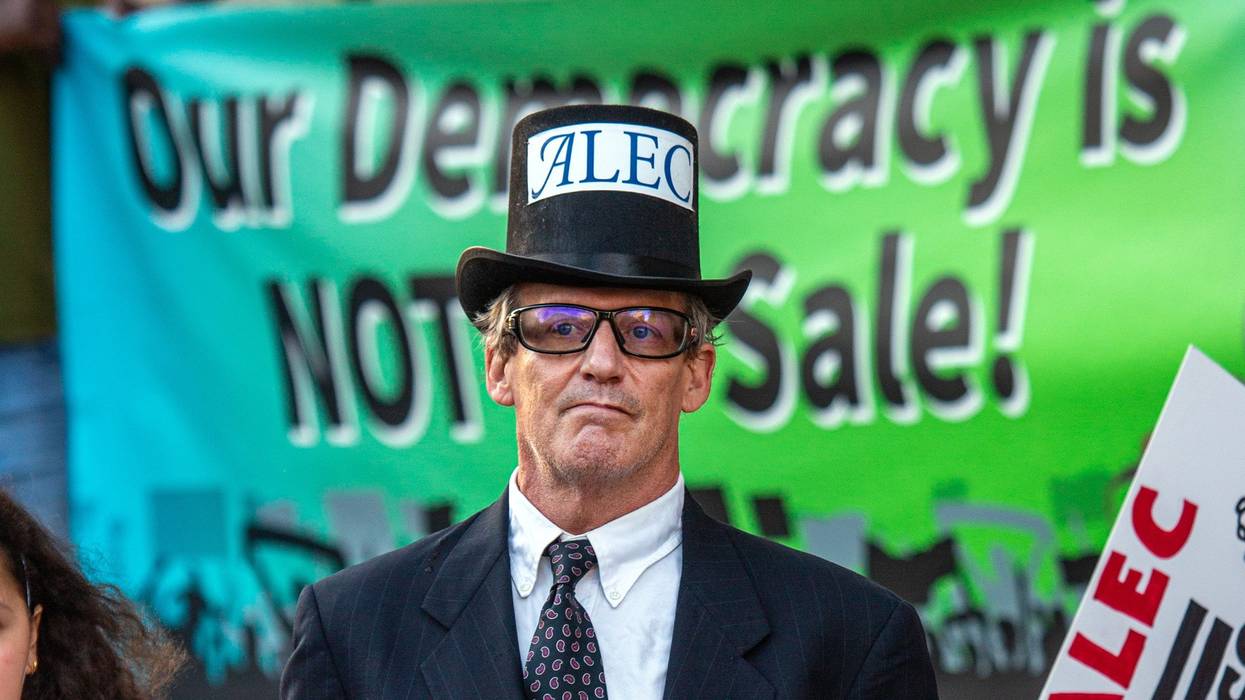
The American Legislative Exchange Council, which funnels right-wing model legislation to state houses, has "a really regressive agenda for our nation," one campaigner said.
As the American Legislative Exchange Council celebrated its 50th anniversary Wednesday night, a coalition of public interest groups gathered to wish them "a happy unbirthday," in the words of one critic opposed to the shadowy right-wing organization.
ALEC is a pay-to-play network of legislators and private sector operators who have spent the last half a century drafting pro-corporate legislation that members then push to state houses across the country. The advocacy organizations opposed to ALEC—including Common Cause, Greenpeace, the Union of Concerned Scientists, and True North Research—gathered to say that 50 years is "more than enough."
"ALEC's anniversary is nothing to celebrate because it has played such a fundamental role in undermining the American dream," Lisa Graves, executive director of True North Research and an expert on the group's activities, told Common Dreams.
"Fifty years of harm is absolutely enough."
ALEC has been the driving force behind a plethora of state laws that demonstrate "a really regressive agenda for our nation," Graves said. These include right-to-work laws, voter ID laws, laws criminalizing climate protests, and, in recent years, laws barring the use of environmental, social, and governance (ESG) criteria in investing.
The groups are hoping to use ALEC's 50th anniversary to draw attention to its past activities as well as solidify as well as solidify opposition to its anti-democratic operations going forward.
"We want to make sure that every American knows that, if Americans are behind bars in your state, in a private prison, you can thank ALEC for that," Svante Myrick, president and CEO of People for the American Way, said in a press briefing ahead of Wednesday's rally. "If there are laws in your state that make it harder for Black people and brown people to vote, you can thank ALEC for that. If there are laws that make it a crime to protest against polluters and climate change in your state, you can thank ALEC for that."
Looking ahead, the coalition aims to pressure the corporations and even nonprofits that associate with ALEC to disengage, with a new petition launching Thursday.
Outside the National Portrait Gallery in Washington, D.C., on Wednesday evening, the groups held a rally to coincide with the ALEC gala event and confronted the attendees.
"It was a good action with a lot of the core groups represented there to make sure that these ALEC legislators and their sponsors arriving in their tuxedos and their formal gowns were greeted by representatives of a lot of people across the country who object to the type of corruption that ALEC represents," Graves said.
In 2011, when Graves received a trove of ALEC draft legislation from a whistleblower while she was executive director of the Center for Media and Democracy (CMD), a coalition of groups launched a pressure campaign that persuaded more than 120 corporations to drop their ALEC memberships, including ExxonMobil, Dow, and Coca-Cola.
Since then, however, "they've gotten a little sneakier about it," Viki Harrison, the director of Common Cause's Constitutional Convention and Protecting Dissent programs, said during the press briefing.
Instead of joining ALEC as a member outright, corporations will sponsor a cigar bar or whiskey night at an ALEC gathering, for example. The new petition, therefore, will be sent to the presidents, CEOs, and members of the board of any corporation who is still attending conferences or hosted events.
"Anybody who is still involved, we say dump ALEC," Harrison said. "Fifty years of harm is absolutely enough."
The new round of targets will include the hosts and host committee members of Wednesday's gala, who include usual suspects like Newt Gingrich, Mike Pence, and Philip Morris; major companies like Guarantee Trust Life Insurance and the United Parcel Service; but also, surprisingly, the Humane Society of the United States, according to a list obtained by CMD.
The Humane Society's participation was particularly shocking, Graves said, because one of the model ALEC bills she covered in 2011 made it harder for pet owners to sue if their pets died because of corporate wrongdoing.
Another notable name on Wednesday's list, Graves said, was Leonard Leo right-hand man William Hild, who leads Consumers' Research, Consumers' Research, a right-wing front group that promotes itself as a consumer advocacy group while promoting corporate interests. This reflects the strengthening relationship between ALEC and Leo, the Federalist Society co-chair and architect of the current far-right Supreme Court. When Leo received a $1.6 billion donation from billionaire Barre Seid in 2021, he funneled $200,000 of it to ALEC, and in exchange ALEC pushed voter suppression legislation nationwide.
"Because ALEC is a pay-to-play operation, it goes where the money is, and the money is with Leo," Graves said.
ALEC has also taken up Leo's so-called "anti-woke agenda" and opposition to ESG investment guidelines in particular, Graves said. Both Texas and Arkansas have passed ALEC-drafted legislation barring their state governments from doing business with companies that have guidelines against investing in fossil fuels or firearms, Alan Leveritt, founder and publisher of the Arkansas Times, explained during Wednesday's press briefing. Leveritt said this had cost Arkansas an additional $30 million and Texas $300 to $500 million as the states had to move pension funds from larger firms like BlackRock to smaller companies with higher management fees.
"They have essentially raised taxes on the consumers and the retirees in the state of Arkansas and all these other states," Leveritt said.
Harrison said the anti-ESG push was especially alarming because it went against the conservative principle of allowing financial actors to make their own decisions without government interference.
"It's the antithesis of what the republican party has always said they are," she told Common Dreams.
In addition, Graves noted, ALEC bills tend to single out restrictions on fossil fuel investments and even limit investments in renewable energy "at a time when our climate is demonstrably growing worse due to the burning of fossil fuels."
In response, groups like Common Cause, CMD, People for the American Way, and Greenpeace are increasing their collaboration to shine the light on ALEC's activities. Because ALEC pushes legislation covering almost every major issue, "they feel we can't keep an eye on everything," Harrison said.
She and her coalition partners want to make sure that "activists in each state don't feel like they're seeing that bill by themselves."
Concerned citizens can help by researching the issues they care about, seeing if there is ALEC-backed legislation in place that targets them, and speaking to their state legislators about where the bills came from and how to challenge them.
‘We have to ask ourselves," Myrick said during the briefing, "will the next 50 years belong to ALEC, or will it belong to us?"