SUBSCRIBE TO OUR FREE NEWSLETTER
Daily news & progressive opinion—funded by the people, not the corporations—delivered straight to your inbox.
5
#000000
#FFFFFF
To donate by check, phone, or other method, see our More Ways to Give page.
Daily news & progressive opinion—funded by the people, not the corporations—delivered straight to your inbox.
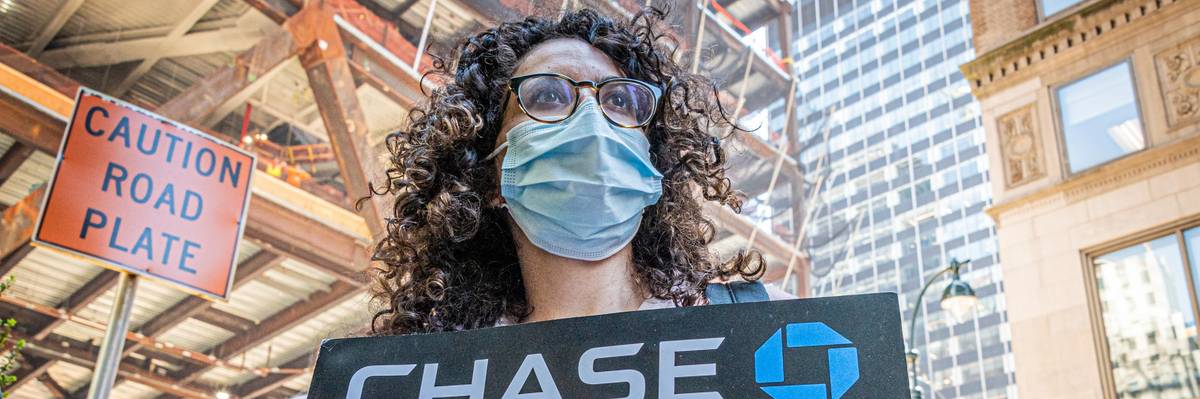
Protester seen holding a sign at the rally outside JP Morgan Headquarters on May 17, 2022.
Over the past few months, activists around the country and the world have laid the blame for climate disasters at Wall Street's feet. In a wave of escalated actions under the name "Blame Wall Street," dozens of groups have called out the financial industry for their financing of fossil fuels and complicity in the climate crisis.
Around the country, people took on elevated amounts of risk in order to increase pressure on the dirty banks, insurance companies, and asset managers financing the climate crisis.
Activists pummeled the banks with actions and protests for months. Over 40 groups across the country held over 50 actions and protests.
In New York City, a week of action targeting Citigroup began with moms and kids birddogging the bank's chief sustainability officer, Val Smith, over Citi's continued funding of Russian oil and gas interests. Later that week, activists infiltrated Citi's Taste of Tennis gala and interrupted the event with a large banner accusing the bank of funding Russia's war crimes.
Citi, the US's largest funder of coal, faced additional protests at greenwashing PR events and at branches in Phoenix, Brooklyn, and other locations. Activists interrupted the speech of Citi's Chief Sustainability Officer at a sustainable banking conference, and protested Citi, Wells Fargo, and Chase leadership at a Women in Banking event.
Chase emerged from its fall PR events similarly beleaguered. Activists crashed the Chase-sponsored US open, passing out fans to sweaty attendees accusing JPMorgan Chase of funding climate chaos. Later in the month, nine different affinity groups created a circus out of the San Francisco Chase Corporate Challenge, with activists taking over every part of the road race, which hundreds of Chase employees participate in, from the course to the finish line to the after party to protesting in kayaks along the route.
As the world's largest funder of fossil fuels, it's no surprise that Chase was protested again and again: Leavenworth, Washington; Worcester, Watertown, and Boston, Massachusetts; Madison, Wisconsin; Fort Lauderdale, Florida; Chicago, Illinois; Providence, Rhode Island; Silver Spring, Maryland; Sacramento, California; New Orleans, Louisiana; and New York City all saw protests at Chase branches or headquarters.
Another major target was asset manager BlackRock, one of the world's top investors in fossil fuels and climate destruction. BlackRock saw protest after protest at their headquarters, with regular actions from September through November. People sang outside their building, came in costume, held prayer and faith actions, and stormed the headquarters with pitchforks and dumped coal on their escalators. BlackRock is on notice: time to stop financing fossil fuels.
Global climate strike protests also included demands on Wall Street and an end to fossil fuel financing, with activists in Los Angeles, Chicago, New York, and Maryland partnering with youth leaders to demand a safe and livable future. Climate strikers weren't the youngest activists: in Los Angeles and New York, people protested the greed of the fossil fuel industry alongside their infants and toddlers.
Actions were creative, including art, music, and costumes. In Albany, New York, the red rebel brigade joined a protest outside of TD Bank. In Brooklyn, activists dressed up as Mr. Moneybags and brought bagpipes to branch locations of Citi, Chase, and Bank of America. In Sacramento, Denver, and New Orleans, activists staged Halloween actions, dressing up as endangered species or zombie bankers.
Faith leaders exercised their moral authority in calling on banks and asset managers to stop funding climate disaster. Near Philadelphia, Quaker activists held a prayer vigil outside of the Vanguard HQ, calling on the asset manager to stop financing fossil fuels. In Washington, DC, faith leaders called on the IMF and World Bank to do the same. Faith activists also held protests outside of the Bank of America headquarters in Charlotte, and a Bank of America branch in Springfield, Illinois. Leaders from different faith communities protested multiple times outside of BlackRock's corporate headquarters in New York City--at one protest, 27 faith leaders were arrested.
Around the country, people took on elevated amounts of risk in order to increase pressure on the dirty banks, insurance companies, and asset managers financing the climate crisis. Dozens of people were arrested this fall--from San Francisco to New York to Pennsylvania to Rhode Island. These activists went to jail in order to show the world the greed of dirty Wall Street actors.
Activists innovated by taking repeated action at financial targets. Instead of one protest, people showed up week after week, increasing the pressure on banks and asset managers. In Phoenix, Arizona, Sacramento, California, Madison, Wisconsin, and Leavenworth, Washington, local actions happened again and again.
People targeted other financial actors, as well. Insurance companies received their fair share of pressure, with actions on Traveller's, Hartford, and Chubb. One action saw a huge oil derrick parked outside of the home of Chubb CEO, Evan Greenberg. Groups protested the Federal Reserve in Jackson Hole, Wyoming and in Washington, DC, activists protested TIAA's support for deforestation, there was an action outside of the shareholder meeting of Proctor & Gamble, and a noise protest outside of the homes of the CEOs of the private equity firms KKR and Blackstone. In Sierra Leone, youth activists protested the Central Bank's support of fossil fuel expansion.
Activists are not slowing down: it's clear that Wall Street holds an outsized responsibility for the death, destruction, and chaos caused by the climate crisis. With shareholder meetings coming up this spring, banks, insurance companies, asset managers, and pension funds should be ready for increased pressure. Banks are expected to see more shareholder resolutions calling on them to walk the talk on climate than ever before, and the grassroots movement to stop the flow of money to fossil fuels is only growing in energy and momentum.
On December 14, we are hosting a call to share what's next in the fight to stop the money pipeline to climate chaos. We hope you will join us.
Dear Common Dreams reader, It’s been nearly 30 years since I co-founded Common Dreams with my late wife, Lina Newhouser. We had the radical notion that journalism should serve the public good, not corporate profits. It was clear to us from the outset what it would take to build such a project. No paid advertisements. No corporate sponsors. No millionaire publisher telling us what to think or do. Many people said we wouldn't last a year, but we proved those doubters wrong. Together with a tremendous team of journalists and dedicated staff, we built an independent media outlet free from the constraints of profits and corporate control. Our mission has always been simple: To inform. To inspire. To ignite change for the common good. Building Common Dreams was not easy. Our survival was never guaranteed. When you take on the most powerful forces—Wall Street greed, fossil fuel industry destruction, Big Tech lobbyists, and uber-rich oligarchs who have spent billions upon billions rigging the economy and democracy in their favor—the only bulwark you have is supporters who believe in your work. But here’s the urgent message from me today. It's never been this bad out there. And it's never been this hard to keep us going. At the very moment Common Dreams is most needed, the threats we face are intensifying. We need your support now more than ever. We don't accept corporate advertising and never will. We don't have a paywall because we don't think people should be blocked from critical news based on their ability to pay. Everything we do is funded by the donations of readers like you. When everyone does the little they can afford, we are strong. But if that support retreats or dries up, so do we. Will you donate now to make sure Common Dreams not only survives but thrives? —Craig Brown, Co-founder |
Over the past few months, activists around the country and the world have laid the blame for climate disasters at Wall Street's feet. In a wave of escalated actions under the name "Blame Wall Street," dozens of groups have called out the financial industry for their financing of fossil fuels and complicity in the climate crisis.
Around the country, people took on elevated amounts of risk in order to increase pressure on the dirty banks, insurance companies, and asset managers financing the climate crisis.
Activists pummeled the banks with actions and protests for months. Over 40 groups across the country held over 50 actions and protests.
In New York City, a week of action targeting Citigroup began with moms and kids birddogging the bank's chief sustainability officer, Val Smith, over Citi's continued funding of Russian oil and gas interests. Later that week, activists infiltrated Citi's Taste of Tennis gala and interrupted the event with a large banner accusing the bank of funding Russia's war crimes.
Citi, the US's largest funder of coal, faced additional protests at greenwashing PR events and at branches in Phoenix, Brooklyn, and other locations. Activists interrupted the speech of Citi's Chief Sustainability Officer at a sustainable banking conference, and protested Citi, Wells Fargo, and Chase leadership at a Women in Banking event.
Chase emerged from its fall PR events similarly beleaguered. Activists crashed the Chase-sponsored US open, passing out fans to sweaty attendees accusing JPMorgan Chase of funding climate chaos. Later in the month, nine different affinity groups created a circus out of the San Francisco Chase Corporate Challenge, with activists taking over every part of the road race, which hundreds of Chase employees participate in, from the course to the finish line to the after party to protesting in kayaks along the route.
As the world's largest funder of fossil fuels, it's no surprise that Chase was protested again and again: Leavenworth, Washington; Worcester, Watertown, and Boston, Massachusetts; Madison, Wisconsin; Fort Lauderdale, Florida; Chicago, Illinois; Providence, Rhode Island; Silver Spring, Maryland; Sacramento, California; New Orleans, Louisiana; and New York City all saw protests at Chase branches or headquarters.
Another major target was asset manager BlackRock, one of the world's top investors in fossil fuels and climate destruction. BlackRock saw protest after protest at their headquarters, with regular actions from September through November. People sang outside their building, came in costume, held prayer and faith actions, and stormed the headquarters with pitchforks and dumped coal on their escalators. BlackRock is on notice: time to stop financing fossil fuels.
Global climate strike protests also included demands on Wall Street and an end to fossil fuel financing, with activists in Los Angeles, Chicago, New York, and Maryland partnering with youth leaders to demand a safe and livable future. Climate strikers weren't the youngest activists: in Los Angeles and New York, people protested the greed of the fossil fuel industry alongside their infants and toddlers.
Actions were creative, including art, music, and costumes. In Albany, New York, the red rebel brigade joined a protest outside of TD Bank. In Brooklyn, activists dressed up as Mr. Moneybags and brought bagpipes to branch locations of Citi, Chase, and Bank of America. In Sacramento, Denver, and New Orleans, activists staged Halloween actions, dressing up as endangered species or zombie bankers.
Faith leaders exercised their moral authority in calling on banks and asset managers to stop funding climate disaster. Near Philadelphia, Quaker activists held a prayer vigil outside of the Vanguard HQ, calling on the asset manager to stop financing fossil fuels. In Washington, DC, faith leaders called on the IMF and World Bank to do the same. Faith activists also held protests outside of the Bank of America headquarters in Charlotte, and a Bank of America branch in Springfield, Illinois. Leaders from different faith communities protested multiple times outside of BlackRock's corporate headquarters in New York City--at one protest, 27 faith leaders were arrested.
Around the country, people took on elevated amounts of risk in order to increase pressure on the dirty banks, insurance companies, and asset managers financing the climate crisis. Dozens of people were arrested this fall--from San Francisco to New York to Pennsylvania to Rhode Island. These activists went to jail in order to show the world the greed of dirty Wall Street actors.
Activists innovated by taking repeated action at financial targets. Instead of one protest, people showed up week after week, increasing the pressure on banks and asset managers. In Phoenix, Arizona, Sacramento, California, Madison, Wisconsin, and Leavenworth, Washington, local actions happened again and again.
People targeted other financial actors, as well. Insurance companies received their fair share of pressure, with actions on Traveller's, Hartford, and Chubb. One action saw a huge oil derrick parked outside of the home of Chubb CEO, Evan Greenberg. Groups protested the Federal Reserve in Jackson Hole, Wyoming and in Washington, DC, activists protested TIAA's support for deforestation, there was an action outside of the shareholder meeting of Proctor & Gamble, and a noise protest outside of the homes of the CEOs of the private equity firms KKR and Blackstone. In Sierra Leone, youth activists protested the Central Bank's support of fossil fuel expansion.
Activists are not slowing down: it's clear that Wall Street holds an outsized responsibility for the death, destruction, and chaos caused by the climate crisis. With shareholder meetings coming up this spring, banks, insurance companies, asset managers, and pension funds should be ready for increased pressure. Banks are expected to see more shareholder resolutions calling on them to walk the talk on climate than ever before, and the grassroots movement to stop the flow of money to fossil fuels is only growing in energy and momentum.
On December 14, we are hosting a call to share what's next in the fight to stop the money pipeline to climate chaos. We hope you will join us.
Over the past few months, activists around the country and the world have laid the blame for climate disasters at Wall Street's feet. In a wave of escalated actions under the name "Blame Wall Street," dozens of groups have called out the financial industry for their financing of fossil fuels and complicity in the climate crisis.
Around the country, people took on elevated amounts of risk in order to increase pressure on the dirty banks, insurance companies, and asset managers financing the climate crisis.
Activists pummeled the banks with actions and protests for months. Over 40 groups across the country held over 50 actions and protests.
In New York City, a week of action targeting Citigroup began with moms and kids birddogging the bank's chief sustainability officer, Val Smith, over Citi's continued funding of Russian oil and gas interests. Later that week, activists infiltrated Citi's Taste of Tennis gala and interrupted the event with a large banner accusing the bank of funding Russia's war crimes.
Citi, the US's largest funder of coal, faced additional protests at greenwashing PR events and at branches in Phoenix, Brooklyn, and other locations. Activists interrupted the speech of Citi's Chief Sustainability Officer at a sustainable banking conference, and protested Citi, Wells Fargo, and Chase leadership at a Women in Banking event.
Chase emerged from its fall PR events similarly beleaguered. Activists crashed the Chase-sponsored US open, passing out fans to sweaty attendees accusing JPMorgan Chase of funding climate chaos. Later in the month, nine different affinity groups created a circus out of the San Francisco Chase Corporate Challenge, with activists taking over every part of the road race, which hundreds of Chase employees participate in, from the course to the finish line to the after party to protesting in kayaks along the route.
As the world's largest funder of fossil fuels, it's no surprise that Chase was protested again and again: Leavenworth, Washington; Worcester, Watertown, and Boston, Massachusetts; Madison, Wisconsin; Fort Lauderdale, Florida; Chicago, Illinois; Providence, Rhode Island; Silver Spring, Maryland; Sacramento, California; New Orleans, Louisiana; and New York City all saw protests at Chase branches or headquarters.
Another major target was asset manager BlackRock, one of the world's top investors in fossil fuels and climate destruction. BlackRock saw protest after protest at their headquarters, with regular actions from September through November. People sang outside their building, came in costume, held prayer and faith actions, and stormed the headquarters with pitchforks and dumped coal on their escalators. BlackRock is on notice: time to stop financing fossil fuels.
Global climate strike protests also included demands on Wall Street and an end to fossil fuel financing, with activists in Los Angeles, Chicago, New York, and Maryland partnering with youth leaders to demand a safe and livable future. Climate strikers weren't the youngest activists: in Los Angeles and New York, people protested the greed of the fossil fuel industry alongside their infants and toddlers.
Actions were creative, including art, music, and costumes. In Albany, New York, the red rebel brigade joined a protest outside of TD Bank. In Brooklyn, activists dressed up as Mr. Moneybags and brought bagpipes to branch locations of Citi, Chase, and Bank of America. In Sacramento, Denver, and New Orleans, activists staged Halloween actions, dressing up as endangered species or zombie bankers.
Faith leaders exercised their moral authority in calling on banks and asset managers to stop funding climate disaster. Near Philadelphia, Quaker activists held a prayer vigil outside of the Vanguard HQ, calling on the asset manager to stop financing fossil fuels. In Washington, DC, faith leaders called on the IMF and World Bank to do the same. Faith activists also held protests outside of the Bank of America headquarters in Charlotte, and a Bank of America branch in Springfield, Illinois. Leaders from different faith communities protested multiple times outside of BlackRock's corporate headquarters in New York City--at one protest, 27 faith leaders were arrested.
Around the country, people took on elevated amounts of risk in order to increase pressure on the dirty banks, insurance companies, and asset managers financing the climate crisis. Dozens of people were arrested this fall--from San Francisco to New York to Pennsylvania to Rhode Island. These activists went to jail in order to show the world the greed of dirty Wall Street actors.
Activists innovated by taking repeated action at financial targets. Instead of one protest, people showed up week after week, increasing the pressure on banks and asset managers. In Phoenix, Arizona, Sacramento, California, Madison, Wisconsin, and Leavenworth, Washington, local actions happened again and again.
People targeted other financial actors, as well. Insurance companies received their fair share of pressure, with actions on Traveller's, Hartford, and Chubb. One action saw a huge oil derrick parked outside of the home of Chubb CEO, Evan Greenberg. Groups protested the Federal Reserve in Jackson Hole, Wyoming and in Washington, DC, activists protested TIAA's support for deforestation, there was an action outside of the shareholder meeting of Proctor & Gamble, and a noise protest outside of the homes of the CEOs of the private equity firms KKR and Blackstone. In Sierra Leone, youth activists protested the Central Bank's support of fossil fuel expansion.
Activists are not slowing down: it's clear that Wall Street holds an outsized responsibility for the death, destruction, and chaos caused by the climate crisis. With shareholder meetings coming up this spring, banks, insurance companies, asset managers, and pension funds should be ready for increased pressure. Banks are expected to see more shareholder resolutions calling on them to walk the talk on climate than ever before, and the grassroots movement to stop the flow of money to fossil fuels is only growing in energy and momentum.
On December 14, we are hosting a call to share what's next in the fight to stop the money pipeline to climate chaos. We hope you will join us.