SUBSCRIBE TO OUR FREE NEWSLETTER
Daily news & progressive opinion—funded by the people, not the corporations—delivered straight to your inbox.
5
#000000
#FFFFFF
To donate by check, phone, or other method, see our More Ways to Give page.
Daily news & progressive opinion—funded by the people, not the corporations—delivered straight to your inbox.
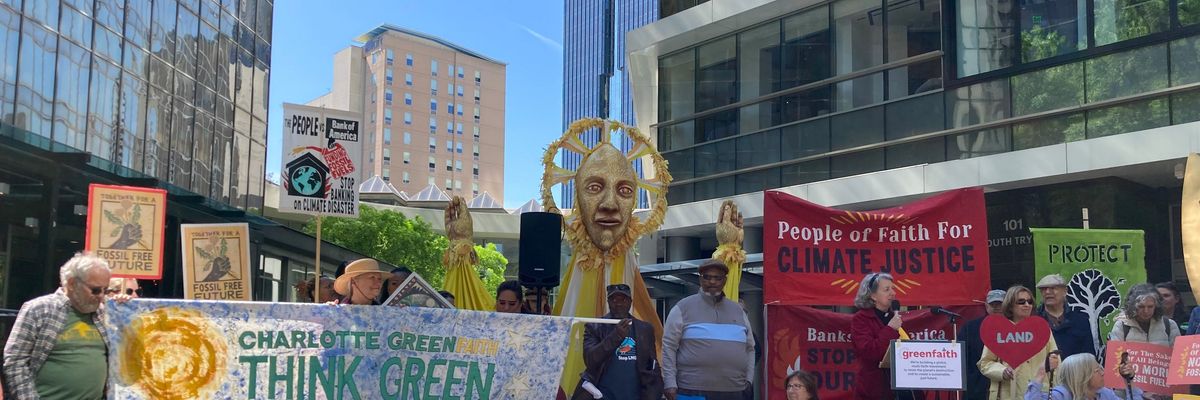
Climate activists demonstrate outside Bank of America headquarters in Charlotte, North Carolina on April 24, 2023.
"Investors who voted against these resolutions should expect to have a hard time sleeping at night with the knowledge that their misplaced greed will lead to climate destruction and chaos," said one campaigner
Activists on Tuesday lamented their failure of various climate and Indigenous rights resolutions at the annual shareholder meetings of some of the nation's biggest banks, with one campaigner accusing the financial institutions of prioritizing "profit over people and our planet."
Just 10% of Citigroup shareholders and 7% of those owning Bank of America stock voted for resolutions urging banks to adopt a phaseout of financing for new fossil fuel projects. An unknown percentage of Wells Fargo shareholders voted for the resolution. Similar resolutions proposed last year garnered 13% of the vote at Citi and 11% at Bank of America and Wells Fargo.
Those three banks combined have financed nearly $1 trillion in fossil fuel projects since the Paris climate agreement was implemented in 2016, according to a report published earlier this month by a coalition of green groups.
The resolutions were filed by Trillium Asset Management at Bank of America, Harrington Investments at Citigroup, and Sierra Club Foundation at Wells Fargo.
Nearly 30% of Bank of America shareholders also backed forcing the institution to release a 2030 climate transition plan, while 31% Citi investors endorsed a resolution requiring the company to publish a report on the effects of its policies and actions on Indigenous peoples' human rights.
As Sierra Club noted:
Investor filers made several amendments to the fossil fuel financing proposals at the banks this year, including asking banks to adopt a policy to phase out financing for projects and companies engaging in new fossil fuel exploration and development, which is incompatible with limiting global warming to 1.5°C, and encouraging banks to provide financing for energy sector clients to credibly transition to cleaner technologies, which could safeguard against greenwashing and accelerate the clean energy transition.
Tuesday's shareholder votes followed protests the previous day outside the headquarters of Bank of America in Charlotte, Citigroup in New York, and Wells Fargo in San Francisco. Dozens of activists slept overnight outside Citi's headquarters.
"While... Citi shareholders continue to support evaluating its policies and impacts on Indigenous peoples, it's saddening and maddening to see the numbers drop a few points as our homelands are destroyed across the globe," said Tara Houska, a member of the Couchiching First Nation and founder of the Giniw Collective.
"These are not uninformed people, they are folks who hold an incredible amount of influence on social discourse and outcomes that impact all life," she added. "Hiding behind jargon and polite rooms are actions they choose as the world's finite freshwater is irreparably harmed."
Stephone M. Coward II, who runs the economic justice and Paid in Full campaigns at the Hip Hop Caucus, argued that "once again, these financial institutions prioritize profit over people and our planet."
" Pollution from fossil fuels worsens the effects of climate change, and together they create a destructive loop that disproportionately impacts the well-being of Black, Brown, and Indigenous people," Coward added. "We must continue to use all the financial levers of power to shift financial capital away from industries causing harm and toward communities that hold the solutions."
Jessye Waxman, the senior campaign representative for Sierra Club's Fossil-Free Finance campaign, said in a statement that "investors have once again failed to align their voting with their stated positions on climate-related financial risk."
"Stewardship is central to many investors' own net-zero commitments, so it's alarming that investors—including the biggest institutional investors like BlackRock and Vanguard—continue to choose a hands-off approach to climate risk mitigation," Waxman added.
Vanguard recently surpassed BlackRock as the world's leading institutional investor in fossil fuels, with the former holding $269 billion in coal, oil, and gas investments and the latter $263 billion.
"Big investors are ignoring science and the needs of frontline communities, protecting the status quo over the changes needed to protect people and planet from climate disaster," Alec Connon, coordinator of the Stop the Money Pipeline, said in a statement. "A transition is coming one way or another: Banks and their investors can help make it orderly and just, or they can pretend they don't see what's coming as they drive the planet off a cliff."
"Investors who voted against these resolutions should expect to have a hard time sleeping at night with the knowledge that their misplaced greed will lead to climate destruction and chaos," Connon added.
Dear Common Dreams reader, It’s been nearly 30 years since I co-founded Common Dreams with my late wife, Lina Newhouser. We had the radical notion that journalism should serve the public good, not corporate profits. It was clear to us from the outset what it would take to build such a project. No paid advertisements. No corporate sponsors. No millionaire publisher telling us what to think or do. Many people said we wouldn't last a year, but we proved those doubters wrong. Together with a tremendous team of journalists and dedicated staff, we built an independent media outlet free from the constraints of profits and corporate control. Our mission has always been simple: To inform. To inspire. To ignite change for the common good. Building Common Dreams was not easy. Our survival was never guaranteed. When you take on the most powerful forces—Wall Street greed, fossil fuel industry destruction, Big Tech lobbyists, and uber-rich oligarchs who have spent billions upon billions rigging the economy and democracy in their favor—the only bulwark you have is supporters who believe in your work. But here’s the urgent message from me today. It's never been this bad out there. And it's never been this hard to keep us going. At the very moment Common Dreams is most needed, the threats we face are intensifying. We need your support now more than ever. We don't accept corporate advertising and never will. We don't have a paywall because we don't think people should be blocked from critical news based on their ability to pay. Everything we do is funded by the donations of readers like you. When everyone does the little they can afford, we are strong. But if that support retreats or dries up, so do we. Will you donate now to make sure Common Dreams not only survives but thrives? —Craig Brown, Co-founder |
Activists on Tuesday lamented their failure of various climate and Indigenous rights resolutions at the annual shareholder meetings of some of the nation's biggest banks, with one campaigner accusing the financial institutions of prioritizing "profit over people and our planet."
Just 10% of Citigroup shareholders and 7% of those owning Bank of America stock voted for resolutions urging banks to adopt a phaseout of financing for new fossil fuel projects. An unknown percentage of Wells Fargo shareholders voted for the resolution. Similar resolutions proposed last year garnered 13% of the vote at Citi and 11% at Bank of America and Wells Fargo.
Those three banks combined have financed nearly $1 trillion in fossil fuel projects since the Paris climate agreement was implemented in 2016, according to a report published earlier this month by a coalition of green groups.
The resolutions were filed by Trillium Asset Management at Bank of America, Harrington Investments at Citigroup, and Sierra Club Foundation at Wells Fargo.
Nearly 30% of Bank of America shareholders also backed forcing the institution to release a 2030 climate transition plan, while 31% Citi investors endorsed a resolution requiring the company to publish a report on the effects of its policies and actions on Indigenous peoples' human rights.
As Sierra Club noted:
Investor filers made several amendments to the fossil fuel financing proposals at the banks this year, including asking banks to adopt a policy to phase out financing for projects and companies engaging in new fossil fuel exploration and development, which is incompatible with limiting global warming to 1.5°C, and encouraging banks to provide financing for energy sector clients to credibly transition to cleaner technologies, which could safeguard against greenwashing and accelerate the clean energy transition.
Tuesday's shareholder votes followed protests the previous day outside the headquarters of Bank of America in Charlotte, Citigroup in New York, and Wells Fargo in San Francisco. Dozens of activists slept overnight outside Citi's headquarters.
"While... Citi shareholders continue to support evaluating its policies and impacts on Indigenous peoples, it's saddening and maddening to see the numbers drop a few points as our homelands are destroyed across the globe," said Tara Houska, a member of the Couchiching First Nation and founder of the Giniw Collective.
"These are not uninformed people, they are folks who hold an incredible amount of influence on social discourse and outcomes that impact all life," she added. "Hiding behind jargon and polite rooms are actions they choose as the world's finite freshwater is irreparably harmed."
Stephone M. Coward II, who runs the economic justice and Paid in Full campaigns at the Hip Hop Caucus, argued that "once again, these financial institutions prioritize profit over people and our planet."
" Pollution from fossil fuels worsens the effects of climate change, and together they create a destructive loop that disproportionately impacts the well-being of Black, Brown, and Indigenous people," Coward added. "We must continue to use all the financial levers of power to shift financial capital away from industries causing harm and toward communities that hold the solutions."
Jessye Waxman, the senior campaign representative for Sierra Club's Fossil-Free Finance campaign, said in a statement that "investors have once again failed to align their voting with their stated positions on climate-related financial risk."
"Stewardship is central to many investors' own net-zero commitments, so it's alarming that investors—including the biggest institutional investors like BlackRock and Vanguard—continue to choose a hands-off approach to climate risk mitigation," Waxman added.
Vanguard recently surpassed BlackRock as the world's leading institutional investor in fossil fuels, with the former holding $269 billion in coal, oil, and gas investments and the latter $263 billion.
"Big investors are ignoring science and the needs of frontline communities, protecting the status quo over the changes needed to protect people and planet from climate disaster," Alec Connon, coordinator of the Stop the Money Pipeline, said in a statement. "A transition is coming one way or another: Banks and their investors can help make it orderly and just, or they can pretend they don't see what's coming as they drive the planet off a cliff."
"Investors who voted against these resolutions should expect to have a hard time sleeping at night with the knowledge that their misplaced greed will lead to climate destruction and chaos," Connon added.
Activists on Tuesday lamented their failure of various climate and Indigenous rights resolutions at the annual shareholder meetings of some of the nation's biggest banks, with one campaigner accusing the financial institutions of prioritizing "profit over people and our planet."
Just 10% of Citigroup shareholders and 7% of those owning Bank of America stock voted for resolutions urging banks to adopt a phaseout of financing for new fossil fuel projects. An unknown percentage of Wells Fargo shareholders voted for the resolution. Similar resolutions proposed last year garnered 13% of the vote at Citi and 11% at Bank of America and Wells Fargo.
Those three banks combined have financed nearly $1 trillion in fossil fuel projects since the Paris climate agreement was implemented in 2016, according to a report published earlier this month by a coalition of green groups.
The resolutions were filed by Trillium Asset Management at Bank of America, Harrington Investments at Citigroup, and Sierra Club Foundation at Wells Fargo.
Nearly 30% of Bank of America shareholders also backed forcing the institution to release a 2030 climate transition plan, while 31% Citi investors endorsed a resolution requiring the company to publish a report on the effects of its policies and actions on Indigenous peoples' human rights.
As Sierra Club noted:
Investor filers made several amendments to the fossil fuel financing proposals at the banks this year, including asking banks to adopt a policy to phase out financing for projects and companies engaging in new fossil fuel exploration and development, which is incompatible with limiting global warming to 1.5°C, and encouraging banks to provide financing for energy sector clients to credibly transition to cleaner technologies, which could safeguard against greenwashing and accelerate the clean energy transition.
Tuesday's shareholder votes followed protests the previous day outside the headquarters of Bank of America in Charlotte, Citigroup in New York, and Wells Fargo in San Francisco. Dozens of activists slept overnight outside Citi's headquarters.
"While... Citi shareholders continue to support evaluating its policies and impacts on Indigenous peoples, it's saddening and maddening to see the numbers drop a few points as our homelands are destroyed across the globe," said Tara Houska, a member of the Couchiching First Nation and founder of the Giniw Collective.
"These are not uninformed people, they are folks who hold an incredible amount of influence on social discourse and outcomes that impact all life," she added. "Hiding behind jargon and polite rooms are actions they choose as the world's finite freshwater is irreparably harmed."
Stephone M. Coward II, who runs the economic justice and Paid in Full campaigns at the Hip Hop Caucus, argued that "once again, these financial institutions prioritize profit over people and our planet."
" Pollution from fossil fuels worsens the effects of climate change, and together they create a destructive loop that disproportionately impacts the well-being of Black, Brown, and Indigenous people," Coward added. "We must continue to use all the financial levers of power to shift financial capital away from industries causing harm and toward communities that hold the solutions."
Jessye Waxman, the senior campaign representative for Sierra Club's Fossil-Free Finance campaign, said in a statement that "investors have once again failed to align their voting with their stated positions on climate-related financial risk."
"Stewardship is central to many investors' own net-zero commitments, so it's alarming that investors—including the biggest institutional investors like BlackRock and Vanguard—continue to choose a hands-off approach to climate risk mitigation," Waxman added.
Vanguard recently surpassed BlackRock as the world's leading institutional investor in fossil fuels, with the former holding $269 billion in coal, oil, and gas investments and the latter $263 billion.
"Big investors are ignoring science and the needs of frontline communities, protecting the status quo over the changes needed to protect people and planet from climate disaster," Alec Connon, coordinator of the Stop the Money Pipeline, said in a statement. "A transition is coming one way or another: Banks and their investors can help make it orderly and just, or they can pretend they don't see what's coming as they drive the planet off a cliff."
"Investors who voted against these resolutions should expect to have a hard time sleeping at night with the knowledge that their misplaced greed will lead to climate destruction and chaos," Connon added.