SUBSCRIBE TO OUR FREE NEWSLETTER
Daily news & progressive opinion—funded by the people, not the corporations—delivered straight to your inbox.
5
#000000
#FFFFFF
To donate by check, phone, or other method, see our More Ways to Give page.
Daily news & progressive opinion—funded by the people, not the corporations—delivered straight to your inbox.
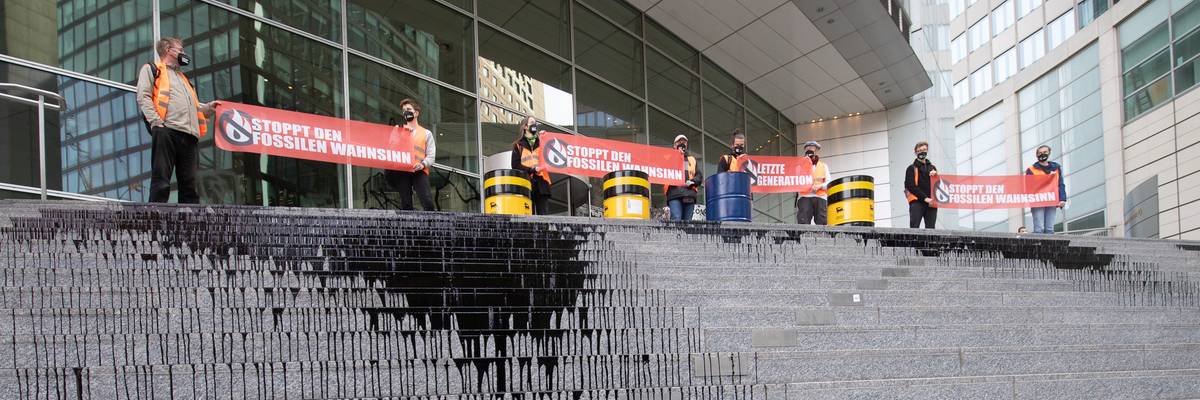
Demonstrators stand with banners during a protest by the group "Last Generation" at the Commerzbank headquarters splashed with black colored water running down the steps on April 11, 2022 in Germany. The group was calling for an immediate halt to all investment in and new expansion of fossil fuel infrastructure.
The climate movement's strategy to end fossil financing needs to evolve—and it already is.
Over the past two years, the State Financial Officers Foundation (SFOF)―a dark money group supported by climate-denying organizations, such as the Heartland Institute and the American Legislative Exchange Council (ALEC)―has organized Republicans to attack climate financial regulation, defeat the nominations of key Biden regulators, and divest state money from BlackRock in retaliation for its climate commitments. This year alone, Republicans have introduced more than 100 bills in 23 states that are designed to punish financial companies for taking action on climate.
This is the latest evolution of the GOP’s decades-long strategy to slow the transition off fossil fuels―an all-out attack on financial institutions they claim are “boycotting” fossil fuels. And it’s working. The world’s largest banks and investors have been falling over themselves to pledge loyalty to the fossil fuel industry.
Given this change of political terrain, the climate movement’s strategy to end fossil financing needs to evolve. Every year since 2017, there have been national days of actions targeting banks funding fossil fuels. During the height of the resistance to Line 3, there were actions at the banks financing the pipeline in over one hundred cities on a single day. Protestors have shut down streets and banking centers in New York, San Francisco, and Seattle time and time again. There is still a need for these kinds of awareness-raising actions—and if you’re not already plugged into Third Act’s national day of action on March 21st, you should find an action near you and get involved.
Shareholders, after all, are literally the people who own the company.
But alone, these kinds of actions aren’t enough. In response to an organized and strategic opposition, we need to refocus our strategy in several key ways. The most pressing of which is right around the corner: shareholder season.
Shareholder season is the time of year when every publicly-traded company in America has their Annual General Meeting (AGM). At AGMs investors vote on a variety of proposals introduced by fellow shareholders. Proposals can be about anything related to the way a company runs its business―executive pay, board diversity, the gender pay gap. In recent years, banks have faced shareholder proposals around their financing of fossil fuels. And 2023 will be no different.
In April and May, investors in Wall Street banks will vote on at least three shareholder proposals related to climate. One will call for a time-bound phase-out of financing for companies engaged in fossil fuel expansion. New York City and New York State have filed a series of anti-greenwashing resolutions that would push banks to use “absolute emissions” metrics when setting their climate targets for the energy sector, rather than the weaker “carbon intensity” metrics they’ve been using. The third resolution will push banks to create a comprehensive plan to achieve the 2030 emissions reduction targets they’ve already set.
These votes are some of the most important climate votes that you’ve never heard of. How they pan out will go a long way to determining how quickly big banks wind down their financing for coal, oil, and gas. Shareholders, after all, are literally the people who own the company.
This spring, it’s the climate movement’s job to organize constituents and pension fund members across the country to make sure that public money casts its vote for climate justice...
Unfortunately, in these elections, it’s not a democratic system where one person gets one vote. But there is one clear way that we can help influence the vote: public pensions.
Public pensions are some of the biggest investors in the country. California’s state pensions alone manage over $740 billion. Last year, the public pensions in many Democratic states, including the trifecta states of California, Washington, Colorado, New Jersey, Maryland, New Mexico, and Maine, voted against a resolution at US banks calling for an end to financing of fossil fuel expansion. Those six pension funds alone represent more than $1.2 trillion in investment capital, a significant percentage of the vote at many companies.
The good news? Public pensions manage public money. They are often overseen by elected officials. That means that they are accountable to their constituents and to everyday members of the pension fund: the teachers, public employees, and firefighters whose interests they are supposed to represent when casting their votes. This spring, it’s the climate movement’s job to organize constituents and pension fund members across the country to make sure that public money casts its vote for climate justice this shareholder season.
Dear Common Dreams reader, It’s been nearly 30 years since I co-founded Common Dreams with my late wife, Lina Newhouser. We had the radical notion that journalism should serve the public good, not corporate profits. It was clear to us from the outset what it would take to build such a project. No paid advertisements. No corporate sponsors. No millionaire publisher telling us what to think or do. Many people said we wouldn't last a year, but we proved those doubters wrong. Together with a tremendous team of journalists and dedicated staff, we built an independent media outlet free from the constraints of profits and corporate control. Our mission has always been simple: To inform. To inspire. To ignite change for the common good. Building Common Dreams was not easy. Our survival was never guaranteed. When you take on the most powerful forces—Wall Street greed, fossil fuel industry destruction, Big Tech lobbyists, and uber-rich oligarchs who have spent billions upon billions rigging the economy and democracy in their favor—the only bulwark you have is supporters who believe in your work. But here’s the urgent message from me today. It's never been this bad out there. And it's never been this hard to keep us going. At the very moment Common Dreams is most needed, the threats we face are intensifying. We need your support now more than ever. We don't accept corporate advertising and never will. We don't have a paywall because we don't think people should be blocked from critical news based on their ability to pay. Everything we do is funded by the donations of readers like you. When everyone does the little they can afford, we are strong. But if that support retreats or dries up, so do we. Will you donate now to make sure Common Dreams not only survives but thrives? —Craig Brown, Co-founder |
Over the past two years, the State Financial Officers Foundation (SFOF)―a dark money group supported by climate-denying organizations, such as the Heartland Institute and the American Legislative Exchange Council (ALEC)―has organized Republicans to attack climate financial regulation, defeat the nominations of key Biden regulators, and divest state money from BlackRock in retaliation for its climate commitments. This year alone, Republicans have introduced more than 100 bills in 23 states that are designed to punish financial companies for taking action on climate.
This is the latest evolution of the GOP’s decades-long strategy to slow the transition off fossil fuels―an all-out attack on financial institutions they claim are “boycotting” fossil fuels. And it’s working. The world’s largest banks and investors have been falling over themselves to pledge loyalty to the fossil fuel industry.
Given this change of political terrain, the climate movement’s strategy to end fossil financing needs to evolve. Every year since 2017, there have been national days of actions targeting banks funding fossil fuels. During the height of the resistance to Line 3, there were actions at the banks financing the pipeline in over one hundred cities on a single day. Protestors have shut down streets and banking centers in New York, San Francisco, and Seattle time and time again. There is still a need for these kinds of awareness-raising actions—and if you’re not already plugged into Third Act’s national day of action on March 21st, you should find an action near you and get involved.
Shareholders, after all, are literally the people who own the company.
But alone, these kinds of actions aren’t enough. In response to an organized and strategic opposition, we need to refocus our strategy in several key ways. The most pressing of which is right around the corner: shareholder season.
Shareholder season is the time of year when every publicly-traded company in America has their Annual General Meeting (AGM). At AGMs investors vote on a variety of proposals introduced by fellow shareholders. Proposals can be about anything related to the way a company runs its business―executive pay, board diversity, the gender pay gap. In recent years, banks have faced shareholder proposals around their financing of fossil fuels. And 2023 will be no different.
In April and May, investors in Wall Street banks will vote on at least three shareholder proposals related to climate. One will call for a time-bound phase-out of financing for companies engaged in fossil fuel expansion. New York City and New York State have filed a series of anti-greenwashing resolutions that would push banks to use “absolute emissions” metrics when setting their climate targets for the energy sector, rather than the weaker “carbon intensity” metrics they’ve been using. The third resolution will push banks to create a comprehensive plan to achieve the 2030 emissions reduction targets they’ve already set.
These votes are some of the most important climate votes that you’ve never heard of. How they pan out will go a long way to determining how quickly big banks wind down their financing for coal, oil, and gas. Shareholders, after all, are literally the people who own the company.
This spring, it’s the climate movement’s job to organize constituents and pension fund members across the country to make sure that public money casts its vote for climate justice...
Unfortunately, in these elections, it’s not a democratic system where one person gets one vote. But there is one clear way that we can help influence the vote: public pensions.
Public pensions are some of the biggest investors in the country. California’s state pensions alone manage over $740 billion. Last year, the public pensions in many Democratic states, including the trifecta states of California, Washington, Colorado, New Jersey, Maryland, New Mexico, and Maine, voted against a resolution at US banks calling for an end to financing of fossil fuel expansion. Those six pension funds alone represent more than $1.2 trillion in investment capital, a significant percentage of the vote at many companies.
The good news? Public pensions manage public money. They are often overseen by elected officials. That means that they are accountable to their constituents and to everyday members of the pension fund: the teachers, public employees, and firefighters whose interests they are supposed to represent when casting their votes. This spring, it’s the climate movement’s job to organize constituents and pension fund members across the country to make sure that public money casts its vote for climate justice this shareholder season.
Over the past two years, the State Financial Officers Foundation (SFOF)―a dark money group supported by climate-denying organizations, such as the Heartland Institute and the American Legislative Exchange Council (ALEC)―has organized Republicans to attack climate financial regulation, defeat the nominations of key Biden regulators, and divest state money from BlackRock in retaliation for its climate commitments. This year alone, Republicans have introduced more than 100 bills in 23 states that are designed to punish financial companies for taking action on climate.
This is the latest evolution of the GOP’s decades-long strategy to slow the transition off fossil fuels―an all-out attack on financial institutions they claim are “boycotting” fossil fuels. And it’s working. The world’s largest banks and investors have been falling over themselves to pledge loyalty to the fossil fuel industry.
Given this change of political terrain, the climate movement’s strategy to end fossil financing needs to evolve. Every year since 2017, there have been national days of actions targeting banks funding fossil fuels. During the height of the resistance to Line 3, there were actions at the banks financing the pipeline in over one hundred cities on a single day. Protestors have shut down streets and banking centers in New York, San Francisco, and Seattle time and time again. There is still a need for these kinds of awareness-raising actions—and if you’re not already plugged into Third Act’s national day of action on March 21st, you should find an action near you and get involved.
Shareholders, after all, are literally the people who own the company.
But alone, these kinds of actions aren’t enough. In response to an organized and strategic opposition, we need to refocus our strategy in several key ways. The most pressing of which is right around the corner: shareholder season.
Shareholder season is the time of year when every publicly-traded company in America has their Annual General Meeting (AGM). At AGMs investors vote on a variety of proposals introduced by fellow shareholders. Proposals can be about anything related to the way a company runs its business―executive pay, board diversity, the gender pay gap. In recent years, banks have faced shareholder proposals around their financing of fossil fuels. And 2023 will be no different.
In April and May, investors in Wall Street banks will vote on at least three shareholder proposals related to climate. One will call for a time-bound phase-out of financing for companies engaged in fossil fuel expansion. New York City and New York State have filed a series of anti-greenwashing resolutions that would push banks to use “absolute emissions” metrics when setting their climate targets for the energy sector, rather than the weaker “carbon intensity” metrics they’ve been using. The third resolution will push banks to create a comprehensive plan to achieve the 2030 emissions reduction targets they’ve already set.
These votes are some of the most important climate votes that you’ve never heard of. How they pan out will go a long way to determining how quickly big banks wind down their financing for coal, oil, and gas. Shareholders, after all, are literally the people who own the company.
This spring, it’s the climate movement’s job to organize constituents and pension fund members across the country to make sure that public money casts its vote for climate justice...
Unfortunately, in these elections, it’s not a democratic system where one person gets one vote. But there is one clear way that we can help influence the vote: public pensions.
Public pensions are some of the biggest investors in the country. California’s state pensions alone manage over $740 billion. Last year, the public pensions in many Democratic states, including the trifecta states of California, Washington, Colorado, New Jersey, Maryland, New Mexico, and Maine, voted against a resolution at US banks calling for an end to financing of fossil fuel expansion. Those six pension funds alone represent more than $1.2 trillion in investment capital, a significant percentage of the vote at many companies.
The good news? Public pensions manage public money. They are often overseen by elected officials. That means that they are accountable to their constituents and to everyday members of the pension fund: the teachers, public employees, and firefighters whose interests they are supposed to represent when casting their votes. This spring, it’s the climate movement’s job to organize constituents and pension fund members across the country to make sure that public money casts its vote for climate justice this shareholder season.