

SUBSCRIBE TO OUR FREE NEWSLETTER
Daily news & progressive opinion—funded by the people, not the corporations—delivered straight to your inbox.
5
#000000
#FFFFFF
To donate by check, phone, or other method, see our More Ways to Give page.
Daily news & progressive opinion—funded by the people, not the corporations—delivered straight to your inbox.

"This country needs an alternative to the Liberal-Conservative consensus that is doubling down on a future of climate-wrecking corporate welfare," said New Democratic Party Leader Avi Lewis.
On the heels of young Canadians suing over Prime Minister Mark Carney’s climate "failure" and people across the country mobilizing to urge the government to "stop fast-tracking destruction," the Liberal leader on Thursday made a pair of fossil fuel-related announcements that sparked fresh anger.
Carney and Alberta Premier Danielle Smith of the United Conservative Party announced that the province is partnering with the federally owned Trans Mountain Corporation and Calgary-based Pembina Pipeline Corporation for a proposed tar sands pipeline that would bring more oil to British Columbia's west coast.
"The proposed pipeline would generally follow the existing footprint of the federally owned Trans Mountain pipeline, running from Bruderheim, northeast of Edmonton, to the Roberts Bank export terminal in Delta, BC, south of Vancouver," the Canadian Broadcasting Corporation reported. "Smith said the project would send more than 1 million barrels to Asian markets every day, reducing Canada's reliance on the US."
"The Alberta government's submission to the federal government's Major Projects Office said the project would cost between $35.2 billion and $43.7 billion, including contingencies. Construction would start as early as 2027 and finish by 2034," CBC noted. "As for who foots the bill, Smith said detailed funding and the cost for taxpayers 'remains to be negotiated.'"
Sounding the alarm about the plans with a Friday blog post, 350 Canada country manager Atiya Jaffar wrote, "In other words, we can get ready to expect $35-100 billion of our taxpayer dollars wasted on building this dangerous pipe dream."
"Canada is headed in a dangerous direction. Expanding tar sands and the fracked gas industry is like pouring fuel on the flames of the climate emergency," she argued, urging Canadians to pressure their members of Parliament to sign what the advocacy group is calling a "People's MOU," a jab at the memorandum of understanding the federal and Alberta governments signed last year.
This week, heatwaves gripped communities across the country as we marked the 5 year anniversary of the 2021 Heat Dome. And yet, this is the week that Carney, Eby, and Danielle Smith teamed up to announce their plans to burn away our future! 350.org/west-coast-p...
[image or embed]
— 350 Canada (@350canada.bsky.social) July 3, 2026 at 2:44 PM
Smith and Carney's pipeline press conference came after shortly after the PM and BC Premier David Eby announced a "cooperative prosperity agreement" that the Wilderness Committee condemned as "an abandonment of both governments' efforts to fight climate change and protect the environment," given its provisions on the province's liquefied natural gas (LNG) and mining endeavors.
Although Eby, a member of the New Democratic Party (NDP), "has been a prominent critic of the Carney government's work with Alberta on pipeline plans," Politico reported Thursday, the provincial leader cut short a trip to Beijing, where he traveled to meet with PetroChina executives about LNG production, "to be at the prime minister's side" for the announcement.
Eby tried to stress that "this agreement doesn't require us to support any pipeline proposal from Alberta. However, as I've said before, we recognize our constitutional position, and we do not have the authority to stop a new pipeline. We will not be going to court to fight a pipeline project. Instead, we will ensure we fulfill our constitutional obligations in good faith."
"Pipelines are federal jurisdiction," he continued. "That's why this agreement matters. It ensures that the northern tanker ban stays in place, and it ensures that if a pipeline goes ahead, that British Columbians are fairly compensated for the environmental risks we would take on any new pipeline project."
Mark Carney, Danielle Smith and David Eby chose this record shattering #heatwave (which extends into Ontario & Quebec) as the backdrop for their plans to spend billions of dollars of our public $ to extract & export more fossil fuels. How do you feel about that? #cdnpoli #bcpoli #onpoli
[image or embed]
— Climate Justice Victoria (@climatejusticeyyj.bsky.social) July 3, 2026 at 12:01 PM
The Wilderness Committee's conservation and policy campaigner Lucero González responded, "Eby said he will ensure British Columbians are compensated for the environmental damage of another pipeline, but there is no compensation for the extinction of the southern resident orcas."
"How do you compensate for the unimaginable pain of an endangered orca like Tahlequah who has shown us her dead calves throughout the Salish Sea while each new megaproject continues to destroy their habitat?" González inquired.
Pointing to not only the potential increase in tanker traffic and oil spill risk but also the federal government's "proposed evisceration" of the Species at Risk Act, González declared that "Carney is showing us his enthusiastic willingness to accept and fund the extinction of endangered species and a future where oil and private profit are more valuable than the entire Salish Sea ecosystem.
As Politico highlighted, the prime minister's motivations for pushing the new pipeline include combating a separatist movement in one of the involved provinces:
The project is also aimed at easing separatist tensions in Alberta, where voters will decide in October if they want to hold a referendum to separate from Canada. Smith has blamed "10 years of bad Liberal policy" under former Prime Minister Justin Trudeau for fueling western alienation, pointing to climate rules and energy regulations she says hurt Alberta’s economy.
In a 17-minute video posted to his YouTube channel earlier this week, Carney acknowledged that his government’s energy policies will increase emissions. He argued that the climate policies championed by Trudeau had become a political wedge—and fodder for Alberta separatists.
Even before the video, advocacy organizations had partnered with a trio of young citizens in June to take legal action over the prime minister failing to bring Canada's 2030 emissions reduction plan into compliance with a key federal law.
Julia Levin of Environmental Defence, one of the groups behind the case, said last month that "PM Carney is betraying Canadians by taking a wrecking ball to our hard-fought climate progress. It is Canadians who are paying the price through wildfires, heat domes, rising food insecurity and high costs of living."
The pipeline announcement begins with Carney acknowledging, without a hint of irony, the “biblical weather” in Ottawa yesterday.Extreme weather huh? Like the kind exacerbated by climate change? You don’t say! Hm!!!!
[image or embed]
— Rachel Gilmore (@rachelgilmore.bsky.social) July 2, 2026 at 8:43 PM
The Wilderness Committee's associate director, Torrance Coste, similarly said Friday that "at a time when people across the country are suffering in extreme heat, wildfire evacuations, and devastating floods, pursuing the expansion of Canada's most polluting industry is utterly despicable."
"In the fight against climate change, Prime Minister Carney and Premier Eby are issuing their surrender, and resigning us to a future of ecological and economic decline," Coste added.
Stephen Harper's dream can finally be realized! And all it took was to screw over the next generations by destroying our climate and the livability of the planet.
[image or embed]
— Charles Latimer (@ch4rlie.bsky.social) July 3, 2026 at 2:52 PM
While Eby flew home to be by the prime minister's side for Thursday's first announcement, the NDP's recently elected national leader, Avi Lewis, delivered a scathing rebuke of a federal government that he said "will protect above all else: the profits of Big Oil."
"As we mark the five-year anniversary of a heat dome that killed 619 people in British Columbia—and as many communities across the country are facing extreme weather right now—Canadians deserve leadership that protects us," Lewis argued on social media. "Instead, this government is doubling down on yesterday's failed solutions and dragging us into further danger, risk, and insecurity."
The pipeline's "opaque and confusing public-private partnership ownership structure means it's very likely that we, the public, will not only bear the risks and the damages, but also the lion's share of the costs," he warned. "Canada's New Democrats unequivocally oppose this pipeline proposal. If anything, this is a pipeline to the courts. It ignores the federal government's legal responsibility to meaningfully consult Indigenous nations, including Treaty 8 nations in Alberta, threatens endangered species, and accelerates climate change. It will sow the very divisions the prime minister claims he wants to avoid."
"We do not achieve unity or prosperity from projects that pit communities against one another, all while a handful of oil and gas CEOs walk away with enormous profits," he continued. "While we're stuck fighting yesterday's battles over pipelines, and the prime minister openly admits that our emissions will rise, the rest of the world is racing ahead on renewables. We cannot afford to fall behind while other countries build the industries of the future. "
According to the NDP leader: "Canadians deserve better than being told our only choice is another fight over another pipeline. This country needs an alternative to the Liberal-Conservative consensus that is doubling down on a future of climate-wrecking corporate welfare."
"New Democrats are ready to build something bigger, safer, and better—a Canada that is a renewable energy superpower, with an east-west clean electricity grid and good green jobs in every region," he concluded. "Lower costs for families with home retrofits and heat pumps for all. Investing in the care economy as a nation-building project. That's what it looks like to build big things that actually unite this country."
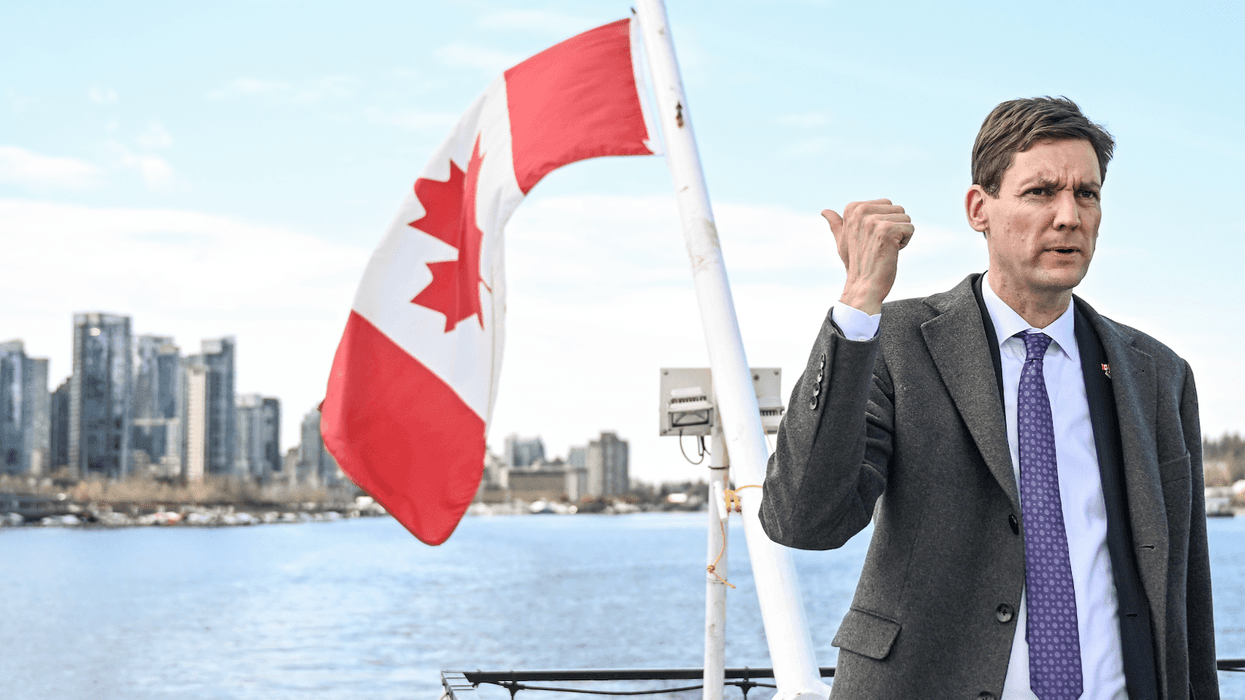
“To go to a foreign country and to ask for assistance in breaking up Canada, there’s an old-fashioned word for that," said one provincial premier.
The leader of British Columbia on Thursday excoriated separatists in neighboring Alberta who met secretly on several occasions with officials from the administration of President Donald Trump, whose frequent talk of making Canada the "51st state" has tanked relations with the US' northern neighbor.
The Financial Times reported Wednesday that leaders of the right-wing Alberta Prosperity Project (APP), who want the fossil fuel-rich province to become an independent nation, were welcomed for three meetings with Trump officials in Washington, DC since last April.
APP is reportedly seeking US assistance, including a $500 billion line of credit from the US Treasury Department to help bankroll an independent Alberta, if any potential independence referendum succeeds.
According to the CBC:
Organizers of the Alberta independence movement are collecting signatures in order to trigger a referendum in that province. The pro-independence campaign has been traveling across the province as organizers try to collect nearly 178,000 signatures over the next few months.
"To go to a foreign country and to ask for assistance in breaking up Canada, there's an old-fashioned word for that, and that word is treason," British Columbia Premier David Eby, who leads the center-left BC New Democratic Party, said in Ottawa.
"It is completely inappropriate to seek to weaken Canada, to go and ask for assistance, to break up this country from a foreign power and—with respect—a president who has not been particularly respectful of Canada's sovereignty," Eby continued.
"I think that while we can respect the right of any Canadian to express themselves to vote in a referendum, I think we need to draw the line at people seeking the assistance of foreign countries to break up this beautiful land of ours," he added.
APP co-founder Dennis Modry told the Financial Times Wednesday that the separatist movement is "not treasonous."
“What could be more noble than the pursuit of self-determination, the pursuit of your goals and aspirations, the pursuit of freedom and prosperity?” he asked.
Trump and some of his senior officials have repeatedly expressed their desire to annex Canada, despite polite but vehement Canadian rejection of such a union. Trump's coveting of Canada comes amid his threats to acquire Greenland by any means necessary, his planning for a possible Panama Canal takeover, and his attacks on Venezuela, Iran, Nigeria, and other countries.
Last week, US Treasury Secretary Scott Bessent poured more fuel on the fire by seemingly encouraging Albertan separatism.
"They have great resources. Albertans are a very independent people," Bessent said during a media interview. "Rumor [is] that they may have a referendum on whether they want to stay in Canada or not... People are talking. People want sovereignty. They want what the US has got."
Alberta Premier Danielle Smith of the province's United Conservative Party said Thursday that she "supports a strong and sovereign Alberta within a united Canada," even as critics—including Indigenous leaders—accuse her of making it easier for a pro-independence petition to succeed last year.
Smith said the she expects US officials to "confine their discussion about Alberta's democratic process to Albertans and to Canadians."
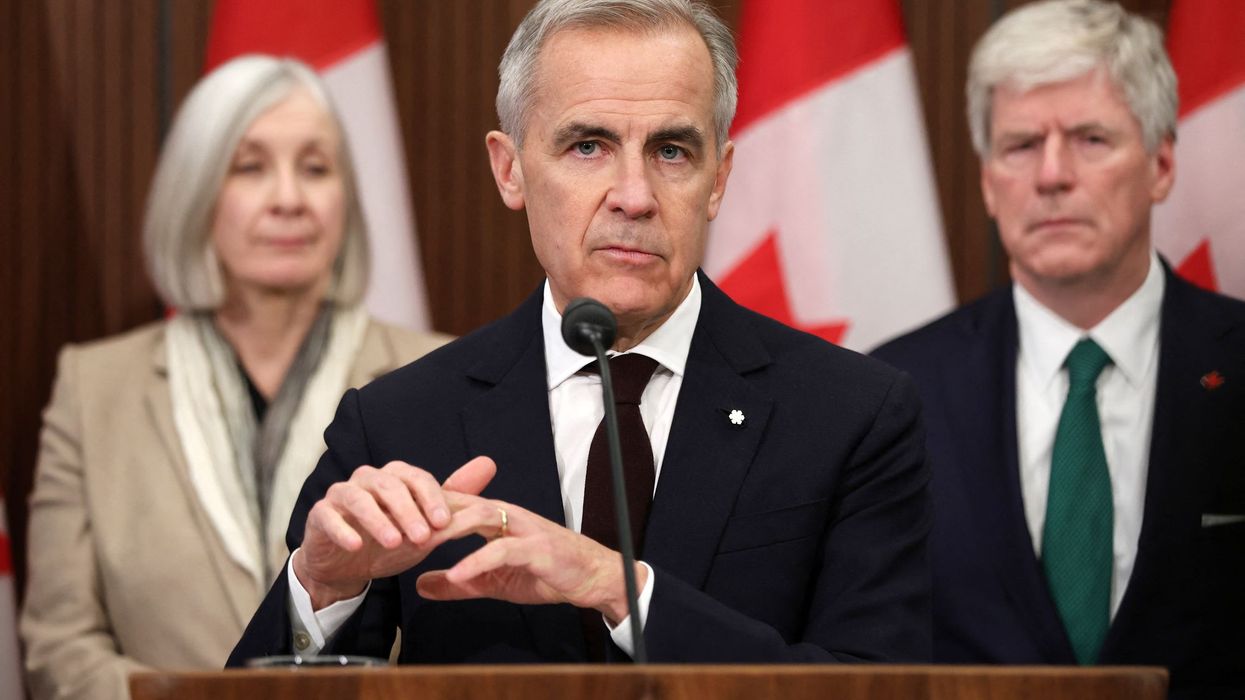
“We will use every tool in our toolbox to ensure that this pipeline does not go ahead,” said one First Nations leader after the deal struck between Prime Minister Mark Carney and the Conservative premier of Alberta.
First Nations groups backed by environmental and conservationist allies in Canada are denouncing a pipeline and tanker infrastructure agreement announced Thursday between Liberal Prime Minister Mark Carney and Conservative Alberta Premier Danielle Smith, calling it a betrayal and promising to fight its implementation tooth and nail.
“We will use every tool in our toolbox to ensure that this pipeline does not go ahead,” said Heiltsuk Nation Chief Marilyn Slett in response to the Carney-Smith deal that would bring tens of millions of barrels of tar sands oil from Alberta to the coast of British Columbia for export by building new pipeline and lifting a moratorium against oil tankers operating in fragile British Columbia coastal water.
While Carney, who argues that the pipeline is in Canada's economic interest, had vowed to secure the support of First Nations before finalizing any agreement with Alberta, furious reactions to the deal made it clear that promise was not met.
Xhaaidlagha Gwaayaai, the president of the Haida nation, was emphatic: "This project is not going to happen."
The agreement, according to the New York Times, is part of Carney’s "plan to curb Canada’s trade dependence on the United States, swings Canadian policy away from measures meant to fight climate change to focus instead on growing the oil and gas industry."
In a statement, the Union of British Columbia Indian Chiefs (UBCIC) "loudly" voiced its opposition to the memorandum of understanding signed by Carney and Smith.
"This MOU is nothing less than a high-risk and deeply irresponsible agreement that sacrifices Indigenous peoples, coastal communities, and the environment for political convenience," said Grand Chief Stewart Phillip, president of the UBCIC. "By explicitly endorsing a new bitumen pipeline to BC's coast and promising to rewrite the Oil Tanker Moratorium Act, the federal government is resurrecting one of the most deeply flawed and divisive ideas in Canadian energy politics."
Slett, who serves as secretary-treasurer of the UBCIC, said the agreement "was negotiated without the involvement of the very Nations who would shoulder those risks, and to suggest ‘Indigenous co-ownership’ of a pipeline while ignoring the clear opposition of Coastal First Nations is unacceptable."
Avi Lewis, running for the leadership of the progressive New Democratic Party (NDP) in the upcoming elections, decried the agreement as a failure of historic proportions.
"Carney’s deal with Danielle Smith is the sellout of the century: scrapping climate legislation for a pipeline that will never be built," said Lewis, a veteran journalist and climate activist. "We need power lines, not pipelines. Our path is through climate leadership and building good jobs in the clean economy."
Carney’s deal with Danielle Smith is the sellout of the century: scrapping climate legislation for a pipeline that will never be built.We need powerlines, not pipelines. Our path is through climate leadership & building good jobs in the clean economy.
[image or embed]
— Avi Lewis (@avilewis.ca) November 28, 2025 at 12:05 AM
In response to the deal, the minister of Canadian culture, Steven Guilbeault, who formerly served as environment minister under the previous Liberal administration, resigned in protest.
“Despite this difficult economic context, I remain one of those for whom environmental issues must remain front and center,” Guilbeault said in a statement.
"Over the past few months, several elements of the climate action plan I worked on as Minister of the Environment have been, or are about to be, dismantled,” he said. “In my view, these measures remain essential to our climate action plan.”
David Eby, the premier of British Columbia who opposes the new pipeline into his province and was not included in the discussions between Carney and Smith, echoed those who said the project is more dead than alive, despite the MOU, calling it a potential "energy vampire" that would distracts from better energy solutions that don't carry all the baggage of this proposed project.
“With all of the variables that have yet to be fulfilled—no proponent, no route, no money, no First Nations support—that it cannot draw limited federal resources, limited Indigenous governance resources, limited provincial resources away from the real projects that will employ people,” Eby added.
Keith Brooks, the program director at Environmental Defence, decried the deal as "worse than we had anticipated" and "a gift to the oil industry and Alberta Premier Smith, at the expense of practically everyone else."
"Filling this pipeline and expansion would require more oil sands mining, leading to more carbon pollution, more tailings, and worse impacts for communities near the tar sands," warned Brooks. "The pipeline to BC would have to cross some of the most challenging terrain in Canada. The impacts of construction would be severe, and the impacts of a spill, devastating."
Jessica Green, a professor at the University of Toronto focused on environmental politics, equated the "reckless" deal to a "climate dumpster fire" and called the push for more tar sands pipelines in Canada "the energy equivalent [of] investing in VHS tapes in 2025."
At least the United States under President Donald Trump, she added, "has the cojones to say it doesn’t give a shit about climate" while Carney, despite the contents of the deal with Alberta, "is still pretending that Canada does."
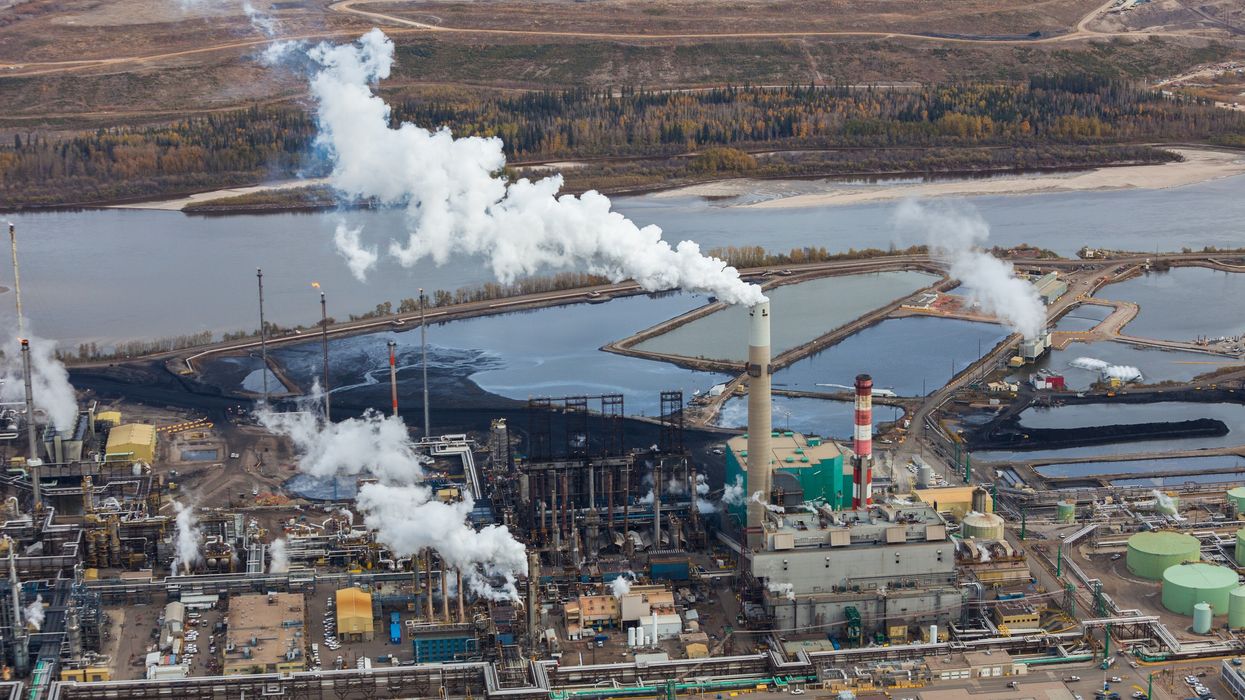
"In quantifying the astonishing and largely unreported levels," said a Greenpeace campaigner, "these scientists have validated what downwind Indigenous communities have been saying for decades."
Aircraft measurements of pollutants over the Athabasca tar sands in Alberta, Canada show levels exceeding industry reports by 1,900% to more than 6,300%, scientists revealed Thursday, underscoring the need for humanity to rapidly phase out fossil fuels.
While the Canadian government requires air quality monitoring around oil sands operations, industry figures focus on certain compounds. For this research, published Thursday in the journal Science, experts from Yale University and Environment and Climate Change Canada, a department of the Canadian government, accounted for a wider range of emissions.
After collecting data from 30 flights around 17 tar sands operations in 2018, "what we saw were very large emissions of total gas-phase organic carbon from these facilities," said co-author and Yale professor Drew Gentner in a statement. "On average, the majority of the total gas-phase organic carbon was from often overlooked compounds, which are typically outside of the scope of routine monitoring."
"This report backs up what the communities living in these areas experience—it is so bad they cannot open their windows because it hurts their lungs to breathe—especially at night."
Co-author John Liggio of Environment and Climate Change Canada noted that "the magnitude of the observed emissions from oil sands operations was larger than expected, considering that it was roughly equivalent to the sum of all other anthropogenic sources across Canada when including all the motor vehicles, all the solvents, all the other oil and gas sources, and everything else reported to the inventory."
Nadine Borduas-Dedekind, a University of British Columbia atmospheric chemist who has worked with Liggio but was not involved with this study, told Nature that "I'm concerned by how big this number is."
"You want to be measuring all this carbon. For air quality, for health, but also for climate," she said, explaining that some of the molecules are oxidized to planet-heating carbon dioxide.
Thanks to the tar sands deposits across northern Alberta, which are estimated to contain 1.7-2.5 trillion barrels of oil, Canada trails only Saudi Arabia and Venezuela in terms of total known reserves.
As Inside Climate News detailed Thursday:
The deposits do not technically hold crude oil, but instead a heavier hydrocarbon called bitumen, which must be heated and treated in order to form a liquid that can be piped and refined like oil. That process requires sprawling industrial operations of open pit mines, ever-growing waste ponds, and refinery-like "upgraders." The waste ponds have leached toxic chemicals into groundwater, and a heavy, sulfurous stench often settles over the region. The mines have stripped away an area larger than New York City, lands that had long been occupied by people from several Indigenous First Nations. One of those First Nations, Fort McKay, is now surrounded by mines.
Jean L'Hommecourt, an enrolled member of the Fort McKay First Nation, told Inside Climate News she wasn't shocked by the new findings.
"I was just like, eh, I knew all along," said L'Hommecourt, who has worked to clean up nearby operations. "We feel the physical effects here."
Jesse Cardinal of the Indigenous-led group Keepers of the Water similarly said to The Guardian, "We are told this is all within the limits and OK but this report backs up what the communities living in these areas experience—it is so bad they cannot open their windows because it hurts their lungs to breathe—especially at night."
Asked to comment on the research, Keith Stewart, a senior energy strategist for Greenpeace Canada, wrote in an email to The Independent, "I suppose 'Holy s***' isn't printable."
"In quantifying the astonishing and largely unreported levels of health-damaging air pollution coming out of oil sands operations, these scientists have validated what downwind Indigenous communities have been saying for decades," Stewart added. "This is making people sick, so our governments can and should require these companies to use some of their record-breaking profits to clean up the mess they've made."

For any other jurisdiction, diversifying the economy away from fossil fuels while building a thriving renewables sector would be a good news story to celebrate and accelerate—not pause.
In western Canada, the province of Alberta is poised to become a renewable energy superpower. Sadly, Alberta’s leadership wants to destroy that prospect, threatening billions in renewable energy projects currently in development.
Without consulting the renewables sector, Alberta announced a pause of new approvals of renewable projects over one megawatt for the next six months.
Criticism of the moratorium was swift and ongoing. It’s not just Canadian companies impacted. U.S. investors are taking a hit. Texas-based Proteus Power Developments LLC has spent millions on plans to build three solar farms in the province. Like other leaders in the renewable sector, its CEO was given no warning about the moratorium. “We got screwed,” he told reporters. Other U.S. companies with projects at risk include a subsidiary of Florida-based NextEra Energy Resources LLC and EDP Renewables, a firm with headquarters in Texas and Spain.
Alberta Minister of Affordability and Utilities Nathan Neudorf claims that the moratorium is motivated by complaints from rural communities and the need for policies for “land reclamation” and stability in the grid. The requirements for renewable developers could include mandatory security bonds, as well as paying for clean up of projects at the end of their life cycle. As the controversy continued, the Alberta Premier Danielle Smith blamed energy regulators for asking for the moratorium in letters—yet letters show no moratorium mentioned.
Where were these stringent requirements when oil sands tailings ponds were leaking chemicals into nearby Indigenous communities, causing damage to people’s health, the land, air, and water?
The provincial leadership’s sudden interest in checks and balances from the energy sector is curious at best, but reeks of hypocrisy. Where were these stringent requirements when oil sands tailings ponds were leaking chemicals into nearby Indigenous communities, causing damage to people’s health, the land, air, and water? Where is the concern that oil sands companies massively underpay for end of life cleanup, despite the frequency of oil spills? Internal documents from the Alberta Energy Regulator suggest cleanup of the tailings ponds alone would reach $130 billion. The regulator has only collected $1.6 billion for liabilities.
Once infamously known for its polluting oil sands industry, Alberta is now home to the fastest growth of solar and wind electricity generation in Canada. Last year, 17% of Alberta’s power came from wind and solar—exceeding the province’s 15% goal—and there are another 15 renewable energy projects before the Alberta Utilities Commission, representing hundreds of millions of dollars in investment. A Clean Energy Canada analysis found in a net-zero 2050 Canada, jobs in Alberta’s clean energy sector would grow 10% a year out to net-zero 2050—the fastest of any province or territory—significantly more than the job decline expected in fossil fuels. For any other jurisdiction, diversifying the economy away from fossil fuels while building a booming clean energy sector would be a good news story to celebrate and accelerate—not pause.
Why is Alberta’s leadership so keen to shut this booming industry down when the moratorium is at odds with conservative free-market principles that are strongly upheld in the region? Even usual supporters of Alberta’s United Conservative Party are scratching their heads. Could the government be more interested in pursuing the ideologies of its leadership and scoring political points instead of lowering Albertans’ energy bills? Perhaps it also has something to do with the power of the oil and gas sector and their relentless lobby to ensure continued expansion of fossil fuel production. They are threatened by wind and solar being cheaper at scale now than fossil fuels and the simple fact that no one owns the sun and the wind. That means no long-term dependency on their products, no fear of scarcity to milk while they jack the price and reap record profits. Power (in every sense of the word) will be redistributed. Heaven forbid.
As we emerge from the hottest July ever recorded on this planet, every headline, TV, and radio soundbyte has a climate expert urging governments to act urgently. For countries like Canada that have never met a climate target, this is largely due to the oil and gas sector being the biggest and fastest growing source of emissions in the country. Unless the world collectively cuts emissions faster and deeper, scientists say Canada can expect more climate impacts, including more frequent wildfires and floods.
While these headlines feel ominous, they fail to demonstrate that all hope isn’t lost. A poll released in July 2023 finds a strong majority of Canadians support the federal government introducing Clean Electricity Regulations, including 64% support in Alberta. Meanwhile, nearly 9 out of 10 Canadians want the federal government to match or give more financial support to the renewable energy sector than the oil and gas sector.
Instead of making headlines worldwide for out of control wildfires blanketing skies in smoke from Washington to New York City, Canada could be known as a clean energy powerhouse. Alberta could help lead the way—but only if the province’s leadership doesn’t let rhetoric win over economics and our safety.
If Alberta’s leadership were truly credible, polluters would have to follow the same rules to ensure communities are safeguarded from all energy projects. Now is the time to uplift energy solutions that work for our economy and climate instead of doubling down on the volatile boom-and-bust cycle of the fossil fuel industry.

"With a warming climate and some drier seasons," said one ecology expert, "this is going to become more common in Nova Scotia."
Officials and climate experts in Nova Scotia, Canada on Tuesday pointed to numerous climate-related factors that have contributed to the wildfires that are raging in the province this week, forcing the evacuation of more than 16,000 people and destroying roughly 200 homes and other structures.
The Tantallon fire in the Halifax area and the Barrington Lake fire in the southwestern county of Shelburne have burned through a combined 25,000 acres in the Maritime province, which, as one firefighter told the Canadian newspaper SaltWire, has historically been far less likely to experience such blazes than landlocked western provinces.
"This the worst fire I've ever been on," volunteer firefighter Capt. Brett Tetanish told SaltWire. "I've been on other large fires in Nova Scotia, Porters Lake, we lost structures there, but you don't see fires like this in Nova Scotia. You see these in Alberta."
Tetanish described a "surreal" scene as he drove toward the Tantallon fire on Sunday evening.
"We're driving on Hammonds Plains Road with fire on both sides of the road, structures on fire, cars abandoned and burnt in the middle of the road," he told SaltWire.
Other witnesses, including a filmmaker, posted videos on social media of "apocalyptic scenes" showing fires destroying homes and huge plumes of smoke rendering highways nearly invisible to drivers.
"I almost died," said the filmmaker. "The fire is spreading, it's very serious. We couldn't see anything."
Halfway through 2023, Nova Scotia has already experienced more wildfires than it did in all of 2022, according to the National Observer.
Karen McKendry, a wilderness outreach coordinator at the Ecology Action Center in Nova Scotia's capital, Halifax, told the Observer the province has experienced hotter dryer weather than normal this spring, making it easier for fires to spread.
"People haven't always, on a national scale, been thinking about Nova Scotia and wildfires," McKendry said. "What dominates the consciousness, rightly so in Canada, is what's happening out West. But with a warming climate and some drier seasons, this is going to become more common in Nova Scotia. So more fires, more widespread fires, more destructive fires from a human perspective as well."
The province's Department of Natural Resources and Renewables (DNRR) also warned last Friday that the wildfires were taking hold in the region less than a year after Hurricane Fiona downed what Premier Tim Houston called a "significant" number of trees across Nova Scotia.
"Fires in areas where Hurricane Fiona downed trees have the potential to move faster and burn more intensely, making them potentially more difficult to contain and control," said the DNRR. "At this time, needles, twigs, leaves, etc., support fire ignition and spread. With high winds, the spread can be rapid and intense."
Scientists last year linked warming oceans, fueled by the continued extraction of fossil fuels and emissions of planet-heating greenhouse gases, to Fiona's destruction in Eastern Canada.
Canadian Prime Minister Justin Trudeau warned Monday that the situation in Nova Scotia is "incredibly serious," prompting Saman Tabasinejad, acting executive director of Progress Toronto, to point to Trudeau's support for fossil fuel projects like the Trans Mountain Pipeline.
"This would be a great time to end fossil fuel subsidies and invest in a Green New Deal!" Tabasinejad said on Twitter.
More than 200 crews have been sent by government agencies from across the province, and Nova Scotia officials said Tuesday that both the Tantallon and Barrington Lake fires were still "out of control" two days after they began and were "rapidly moving."
Halifax Fire and the DNRR are investigating the cause of the fires.
McKendry pointed out that a number of anti-conservation activities may be linked to increased wildfires.
Roads being built "deep into our forests" have allowed more people opportunities to accidentally set fires, while the government has been "emptying our urban areas of wetlands," making it easier for blazes to spread widely.
"Do not delude yourself into thinking this is a one-off," journalist John Vaillant told SaltWire on Monday. "The world is more flammable than it has ever been."

In what climate advocates described as an example of "saying the quiet part loud," Alberta, Canada Energy Minister Sonya Savage in an interview last week said the rise of the coronavirus pandemic has created an ideal opportunity to build pipelines because large in-person demonstrations have become difficult to sustain.
"Now is a great time to be building a pipeline because you can't have protests of more than 15 people," Savage told Canadian Association of Oilwell Drilling Contractors podcast host John Bavil in a conversation released on May 22. "Let's get it built."
Bavil laughed at the remarks, but Savage, a member of the province's governing United Conservative Party (UCP), did not. The minister added that "people are not going to have tolerance and patience for protests that get in the way of people working."
"People need jobs and those types of ideological protests that get in the way are not going to be tolerated by ordinary Canadians," she said.
Savage was referring to the proposed Trans Mountain Pipeline, a priority of Liberal Prime Minister Justin Trudeau's climate-killing, pipeline-friendly energy agenda. As Common Dreams reported Monday, over 200 Canadian groups are demanding a just recovery from the pandemic that centers both health and the environment.
On Monday, Alberta New Democratic Party energy critic Irfan Sabir said that Savage's remarks did not come as a "shock."
"The UCP have already used the pandemic as an excuse to suspend environmental monitoring," said Sabir. "When combined with the minister's latest comments, this will harm the reputation of Alberta's energy industry and inhibit our ability to attract investment and get our product to market."
The comments went mostly unnoticed until Monday, when climate activists and campaigners like Fridays for Future founder Greta Thunberg began posting about the interview on social media.
"Well, at least we are seeing some honesty for once," tweeted Thunberg. "Unfortunately this how large parts of the world are run."
350.org founder Bill McKibben also weighed in on Twitter, saying that Savage "said the true part out loud."
"They're literally using Covid as a cover to build pipelines because they know protest is impossible," said McKibben.
I want to start by turning myself into Jason Kenney's investigators.
I admit to being against further oilsands development, making me a person of interest to the sleuths in Kenney's $30-million "war-room" who are tasked with vilifying oilsands critics. Of course, they're really hoping to unmask "foreign-funded special interests," and I don't have a single dollar of foreign backing. Still, I do what I can!
The war room is just one of the Alberta premier's bullying tactics, along with threatening Western separation, as he tries to intimidate critics and pressure the Trudeau government into approving the proposed Teck mine, a vast 293-square-kilometer open-pit mine, which would be the biggest tarsands mine yet.
Given that such an approval would hopelessly compromise any Canadian effort to battle climate change -- which, let's not forget, threatens the world including us here in Canada -- the answer must clearly be no. In the election last fall, two-thirds of the country voted for parties that advocated strong action on climate change.
The fact that this is seen as a difficult decision reveals the Trudeau government's keenness to be accommodating when dealing with opposition, which is coming from the right and backed by powerful business interests.
Meanwhile, there's a willingness to play hardball when opposition is coming from Indigenous people and powerful business interests are against them.
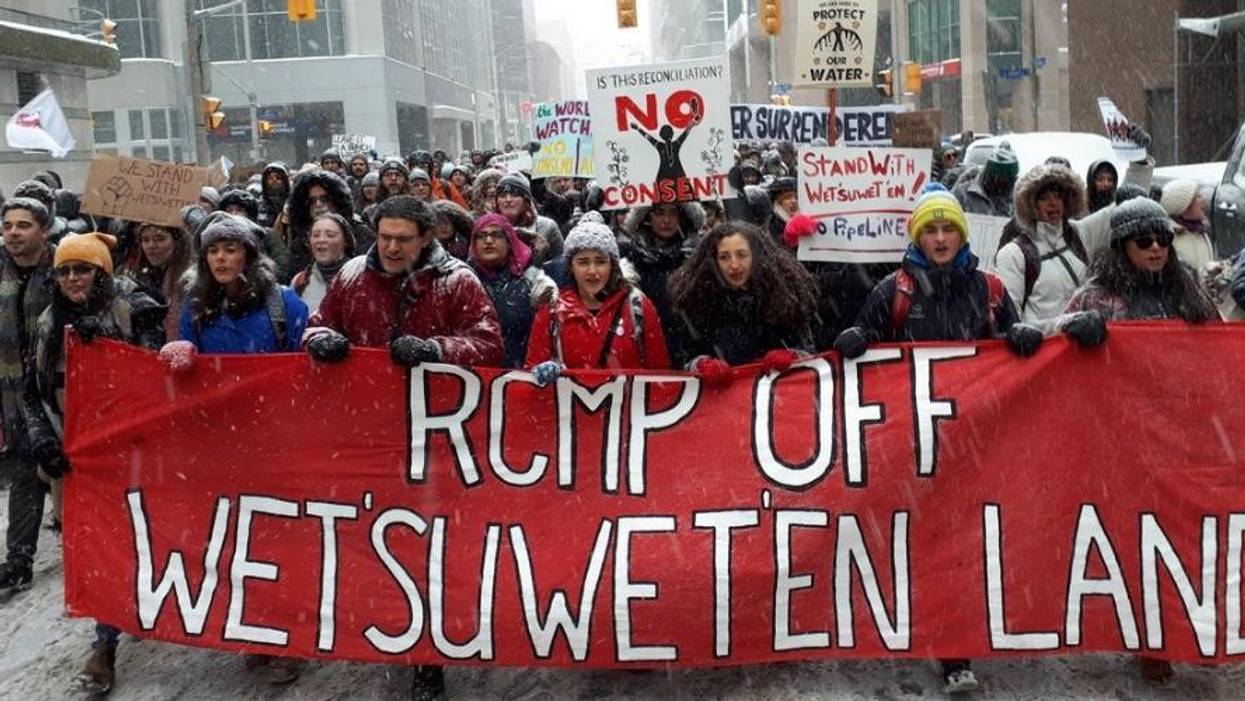
These hardball tactics have been on display in northwestern B.C. in recent weeks as Wet'suwet'en Indigenous protestors, trying to block a pipeline from crossing their land, have been confronted with highly militarized RCMP officers dressed in combat fatigues, bearing assault rifles and police dogs.
Chainsawing through a gate marked "Reconciliation," the RCMP have forcibly removed the occupiers -- that is, people occupying their own land -- amid prayers for Missing and Murdered Indigenous Women and Girls, sparking nationwide protests. Most of the media attention has focused on how disruptive the protests have been to southern train travel.
But the hardball tactics are alarming. The RCMP were prepared to shoot the Indigenous protestors, according to a report last December in the U.K. Guardian. Documents cited in the article show that RCMP commanders argued that "lethal overwatch is req'd" -- a term for deploying an officer able to use lethal force.
What makes the strong-armed clampdown so outrageous is that the natural gas pipeline, approved by the B.C. government and enforced by a court injunction, is to be built across land that has never been ceded. A 1997 Supreme Court of Canada decision ruled the title was held by the Wet'suwet'en hereditary chiefs.
Indigenous people have long been on the receiving end of strong-arm police tactics ordered by Canada's federal and provincial governments, particularly when they stood in the way of colonial settlement or resource extraction. From the late 1800s, Indigenous people were forcibly relocated to reserves, with their children sent to now-notorious residential schools.
In recent years, Canada has extended the national security apparatus to prevent protestors -- often Indigenous people protecting their lands -- from interfering with oil and gas developments.
Casting such protestors as terrorists, Stephen Harper's government -- with qualified support from Justin Trudeau's Liberals -- passed the 2015 Anti-Terrorism Act, which authorized police surveillance and arrest powers against those interfering with "critical infrastructure."

A California jury ruled Monday that Monsanto must pay a record $2 billion in damages to a couple that was diagnosed with cancer after using the company's weedkiller Roundup.
"We were finally allowed to show a jury the mountain of evidence showing Monsanto's manipulation of science, the media, and regulatory agencies to forward their own agenda despite Roundup's severe harm to the animal kingdom and humankind," said Michael Miller, an attorney for Alva and Alberta Pilliod.
The jury ruled that Monsanto--which was acquired by the German pharmaceutical giant Bayer last year--is liable for the Pilliods' non-Hodgkin's lymphoma (NHL), the third such ruling in less than a year.
"We've been fighting cancer for nine years. It was caused by Roundup. We can't do the things we used to do and we really resent Monsanto for that," Alberta Pilliod said at a press conference following the verdict.
As The Guardian reported, the "latest verdict is the largest by far and will increase pressure on Bayer, which has suffered share price drops in the wake of the verdicts and is now facing similar lawsuits from thousands of cancer patients, survivors and families who lost loved ones to NHL."
Wenonah Hauter, executive director of Food & Water Watch, said in a statement that the California jury's decision "shows that there's more than enough evidence that Roundup is an environmental and public health nightmare."
"But rather than act on this body of evidence," Hauter said, "the EPA continues to side with the chemical industry and recently announced it will continue to allow glyphosate, the active ingredient in Roundup, to be sold. It's time to ban this dangerous herbicide."

The Beaver Lake Cree Nation, Treaty No. 6 Area, Canada--I am driving down a rutted dirt road with Eric Lameman, a member of the Cree nation.
"Over there," he says, pointing out where he was born in a tent 61 years ago.
We stop the car and look toward a wooded grove.
"That's the mass grave," he says softly, indicating a clearing where dozens of Cree who died in a smallpox epidemic over a century ago are buried.
The Cree have been under relentless assault since the arrival of the European colonialists in the 1500s. Now the 500 inhabitants of the Cree reserve, where many live in small, boxy prefabricated houses, are victims of a new iteration of colonial exploitation, one centered on the extraction of oil from the vast Alberta tar sands. This atrocity presages the destruction of the ecosystem on which they depend for life. If the Cree do not stop the exploiters this time, they, along the exploiters, will die.
The reserve is surrounded by the tar sands, one of the largest concentrations of crude oil in the world. The sands produce 98% of Canada's oil and are the United States' largest source of imported oil. This oil, among the dirtiest fossil fuels on earth, is a leading cause of atmospheric pollution, releasing massive amounts of carbon dioxide. The production and consumption of one barrel of tar sands crude oil release 17% more carbon dioxide than production and consumption of a standard barrel of oil.
Tar sands oil is a thick, mucky, clay-like substance that is infused with a hydrocarbon called bitumen. The oil around Beaver Lake is extracted by a process known as steam-assisted gravity drainage, which occurs under the earth and is similar to fracking. Farther north, extraction is done by strip-mining the remote boreal forest of Alberta, 2 million acres of which have already been destroyed. The destruction of vast forests, sold to timber companies, and the scraping away of the topsoil have left behind poisoned wastelands. This industrial operation, perhaps the largest such project in the world, is rapidly accelerating the release of the carbon emissions that will, if left unchecked, soon render the planet uninhabitable for humans. The oil is transported thousands of miles to refineries as far away as Houston through pipelines and in tractor-trailer trucks or railroad cars. More than a hundred climate scientists have called for a moratorium on the extraction of tar sands oil. Former NASA scientist James Hansen has warned that if the tar sands oil is fully exploited, it will be "game over for the planet." He has also called for the CEOs of fossil fuel companies to be tried for high crimes against humanity.
It is hard, until you come here, to grasp the scale of the tar sands exploitation. Surrounding Beaver Lake are well over 35,000 oil and natural gas wells and thousands of miles of pipelines, access roads and seismic lines. (The region also contains the Cold Lake Air Weapons Range, which has appropriated huge tracts of traditional territory from the native inhabitants to test weapons.) Giant processing plants, along with gargantuan extraction machines, including bucket wheelers that are over half a mile long and draglines that are several stories high, ravage hundreds of thousands of acres. These stygian centers of death belch sulfurous fumes, nonstop, and send fiery flares into the murky sky. The air has a metallic taste. Outside the processing centers, there are vast toxic lakes known as tailings ponds, filled with billions of gallons of water and chemicals related to the oil extraction, including mercury and other heavy metals, carcinogenic hydrocarbons, arsenic and strychnine. The sludge from the tailings ponds is leaching into the Athabasca River, which flows into the Mackenzie, the largest river system in Canada. Nothing here, by the end, will support life. The migrating birds that alight at the tailings ponds die in huge numbers. So many birds have been killed that the Canadian government has ordered extraction companies to use noise cannons at some of the sites to scare away arriving flocks. Around these hellish lakes, there is a steady boom-boom-boom from the explosive devices.
The water in much of northern Alberta is no longer safe for human consumption. Drinking water has to be trucked in for the Beaver Lake reserve.
Streams of buses ferry workers, almost all of them men, up and down the roads, night and day. Tens of thousands from across Canada have come to work in the tar sands operations. Many live in Fort McMurray, about 180 miles from Beaver Lake, and work punishing 12-hour shifts for three weeks at a time before having a week off.
The Cree, the Dene and other tribes that live amid the environmental carnage and whose ancestral lands have been appropriated by the government to extract the tar sands oil suffer astronomical rates of respiratory and other illnesses. Cancer rates are 30% higher than in the rest of Alberta, according to the Alberta Cancer Board, which was disbanded soon after releasing this information in 2008.
When he was a child, Eric Lameman was taken from his parents by the government, a common practice a few decades ago, and sent to an Indian boarding school where beatings were routine, speaking Cree or any of the other indigenous languages was forbidden and native religious and cultural practices were outlawed. He says the forced severance from his family and his community, along with the banning of his traditions, was psychologically devastating. He remembers his father and other Cree elders on the reserve performing religious rituals in secret. He would sneak to the woods to watch them as, risking arrest, they clung to their beliefs and spiritual practices.
Lameman defied the efforts to wipe out his identity and his culture, which he nurtured in spite of the attempts to eradicate them. He remained a Cree. And he says it is only his Cree roots that keep him whole and make it possible for him to endure. He suffered extreme poverty. He also had periods of addiction and even episodes of violence. It is hard to avoid personal disintegration when the dominant culture seeks to eradicate your being. Canada's indigenous people represent 4 percent of the population, but they make up more than a quarter of the inmates in the nation's federal prisons. Lameman's wife left him and their young children. She died from alcoholism on the streets of Calgary. He worked as a heavy machine operator in the tar sands. He quit when he realized the land he was despoiling would never recover and he began to get sick. He survives now on welfare.
We are back in his small house, seated in the tiny kitchen. His daughter Crystal Lameman, an internationally known indigenous rights activist, heats juniper in an iron skillet until fumes of the pungent herb drift upward. We cup our hands and pull the smoke into our nostrils. The Cree and others say "smudging" cleanses negative energy, helps bring clarity and vision, and centers those exposed to the scent. We sit quietly.
The more the Cree recover their traditions to defy the capitalist mantra of hoarding, profit, exploitation, self-promotion and commodification of human beings and the earth, the more their life has an intrinsic value rather than a monetary value. This recovery is the antidote to despair. It grounds the Cree spiritually. It permits transcendence. It at once estranges them from reality and brings them closer to it. Resistance is not only about challenging the extraction companies in court, as the Cree have done in trying to block the tar sands industry and the pipelines from their traditional land; it is about holding fast to another orientation to reality, one that we all must adopt if we are to survive as a species. It is about the recovery of the sacred. The white exploiters seek not only to steal the land and natural resources and commit genocide against indigenous communities but to wipe out this competing ethic.
"I need my people," Eric Lameman says. "I need the ones that know our history, our language, our spiritual practices and our culture. I rely on them to pass it on to me so I can pass it on."
The exploiters have sought to corrupt the Cree and bastardize their traditions. Extraction companies have paid off some tribal leaders to support pipelines or surrender tribal territory to oil development. The companies use the quislings to mount propaganda campaigns in favor of extraction, to divide and weaken indigenous communities and to attempt to discredit leaders such as Crystal. The federal government last year staged a Cree religious ceremony, complete with honor songs and drums, to bless the Trans Mountain Expansion Project and Canada's $4.5 billion purchase of the Trans Mountain pipeline, developments that mean death for the Cree people.
"This is what they call reconciliation," Eric says bitterly.
"It's cultural appropriation," Crystal says. " 'Reconciliation' is a bullshit word. Reconciling with whom? Reconciling what? Reconciling us with the current colonial systems of exploitation? Until they dismantle the structures of exploitation there can be no reconciliation."
The man camps of tens of thousands of tar sands workers fuel the prostitution industry. Indigenous girls and women, living in squalor and poverty, are lured by the seemingly easy and fast money. Their sexual degradation soon leads to addictions to blunt the pain. This too is a legacy of colonialism. Canada began as a military and commercial outpost of Britain. The Hudson's Bay Company did not permit European women to immigrate to Canada. Brothels, populated by prostituted indigenous girls and women, were established alongside the military forts and trading posts. The Royal Canadian Mounted Police issued a report in 2015 that found that indigenous, or First Nations, women, who constitute 4.3% of Canada's female population, are four times more likely to go missing or be murdered than other Canadian women. They are 16% of female murder victims and are the objects of 11% of missing person's cases involving women.
"I was on a panel in Vancouver," Crystal Lameman says. "I used the word 'prostitution.' A trans person got up and told me to use the term 'sex work,' saying it was a choice. Impoverished and vulnerable indigenous girls and women do not choose to be prostitutes. They are forced into that world. Girls are conditioned for this from familial disintegration and sexual abuse. ... Sexual abuse, a common experience for girls in residential schools and the foster care system, is another one of the legacies of colonialism."
The infusion of workers with disposable incomes has also seen an explosion in drugs in northern Alberta such as crack cocaine and crystal meth, and with the drugs has come a rash of suicides among the native population. Suicide and non-suicidal intentional self-injuries are the leading causes of death for First Nations people under the age of 44 in Canada. Young indigenous males are 10 times more likely to kill themselves than other Canadians. Young indigenous females are 21 times more likely to commit suicide. Beaver Lake has not been spared, losing seven people to suicide in a 12-month period in 2014 and 2015. All of them were under the age of 44, and all were drug addicts or alcoholics.
"There are two roads into Fort McMurray," Crystal says. "There's Highway 63 and Highway 881, which runs through here. This is one of the stops for the drugs. The traffickers say, 'Well, there's a little town, we'll stop there and drop drugs there too. A lot of the drug runners are from small towns, from these communities. It is a quick way to make money."
"Our community used to be safe," she says. "We left the doors unlocked, even when we slept. We would leave our vehicles running. Nobody worried."
"It's dangerous now," she goes on, speaking of the rash of robberies by addicts. She adds, "You can't get into altercations. It's the drugs. They affect people's mental health. People live in fear."
The resurrection of the old ceremonial practices such as the annual sun dance, along with the traditional medicine camp, harvesting camps and sweat lodges, is about another way of being, one that honors the interconnectedness of all living beings, including the earth on which we depend for life.
"We are seeing the effects," Crystal says. "Our cultural practices and language embody a belief system that is the opposite of capitalism and globalization, the lust for money and material wealth."
"I used to think globally," she says. "I was in D.C. on the front lines. I was in the climate march in New York. I was everywhere. I traveled internationally. I was at every rally. But I wasn't here, at home, doing the real work. It's easier being out there, instead of being in our community. Yes, there is this big black cloud, but there is also another, beautiful side. The women in the community are bringing the ceremonies back. The more we return to the land, the closer we are to achieving holistic wellness. My community is not in despair. We are doing our diligence to be well again. I think about my dad. My dad was one of those people he's talking about [when he says] 'I had friends that I can't trust now because they're not well because of the drugs.' My dad was one of those in despair. But he has come back to us and to himself."