

SUBSCRIBE TO OUR FREE NEWSLETTER
Daily news & progressive opinion—funded by the people, not the corporations—delivered straight to your inbox.
5
#000000
#FFFFFF
To donate by check, phone, or other method, see our More Ways to Give page.
Daily news & progressive opinion—funded by the people, not the corporations—delivered straight to your inbox.

Trump’s intervention in Brazilian elections undermines a basic and generally cherished right to self-determination, as well as the right to democracy itself. It is even clearly illegal under the Charter of the Organization of American States, to which the US is a signatory.
One of the most important elections in recent Latin American history will take place Sunday in Brazil. Incumbent president Luiz Inácio Lula da Silva has recently been emphasizing the issue of national sovereignty. One reason: The challenger, Flávio Bolsonaro, has the strong backing of the Trump administration—and the US has been intervening heavily on his behalf.
In the last few months of Brazil’s election campaign, Trump has met with Bolsonaro at the White House, imposed new tariffs on Brazilian goods and tried to send State Department officials to Brazil. (Both Brazilian and American officials said the presence of Trump administration operatives would cast doubt on the integrity of the voting there.)
A letter last week to Secretary of State Marco Rubio from 31 members of Congress documented additional hostile actions and concluded that “the United States is acting as an agent of interference and destabilization.”
The election is forecast to be very close, and the sovereignty issue could be persuasive for swing voters.
Trump’s intervention undermines a basic and generally cherished right to self-determination, as well as the right to democracy itself. It is even clearly illegal under the Charter of the Organization of American States, to which the United States is a signatory.
But Brazilians currently have reasons to attach even more urgency to preserving their sovereignty and independence. This can be seen in the recent history of Brazil and Latin America and in the economic impact of political independence on living standards.
Starting with Brazil: Lula was a metalworker and union leader who helped found, and then lead, the Workers Party. He served two consecutive terms as president of Brazil from 2003 to 2010 and left office with one of the highest approval ratings in the world—83%.
There were compelling reasons for that, which stemmed from the government’s changes in economic and social policy. These changed the lives of tens of millions of people in Brazil. GDP per person, the most basic measure of living standards, grew about four times as fast as it did in the eight years prior to Lula’s presidency. Poverty was reduced by 61% and extreme poverty by 64%. There was also a 57% increase in the real (inflation-adjusted) minimum wage. University enrollment almost doubled.
Lula was able to implement these and other life-changing reforms because he broke with the “Washington consensus” policies that had governed economic decision-making in the region as perhaps never before, from 1980 to 2000. This included economic policies that were often decided at the International Monetary Fund or sometimes other Washington-controlled institutions. The result was a disaster: Those two decades saw the worst long-term economic growth failure in Latin America for more than 100 years.
This historic economic growth collapse helped bring about the election of left-of-center governments in the majority of the region for the first time. As in Brazil, these governments were more independent than the prior regional norm and therefore pursued more progressive and effective economic policies. The turnaround was historic: From 2002 to 2013, the percentage of the population of Latin America living in poverty fell to 28.4 from 45.6 after increasing over the prior two decades.
The independence that these governments were able to establish is what Rubio and Trump appear to most want to abolish. Hence their current efforts at regime change in Brazil. This is the big prize for Rubio. It’s the largest country in Latin America, and a Lula government won’t support the Trump administration in its illegal efforts to control the region. But Lula’s opponent would almost certainly be a solid Trump ally.
That is Flávio Bolsonaro, a senator handpicked by his father Jair Bolsonaro, who was president from 2019 to 2023; he has branded himself “Bolsonaro 2.0.”
Flávio and his team are trying to link Lula to the biggest bank fraud in Brazilian history, which forced a deposit insurance payout of almost $8 billion for about 800,000 victims. But the dirt is actually on Flávio and his allies. He is up to his neck in this scandal. Nothing on Lula.
Bolsonaro 1.0 took a page from the Trump election-denial playbook when he lost the election of 2022 to Lula. He was unable to get enough military commanders to support a decree to prevent Lula from taking office. The nation’s Supreme Court subsequently convicted Bolsonaro of leading an attempted coup. The Brazilian “January 6” was on Jan. 8, 2023, when supporters of the defeated president vandalized Congress, the presidential palace and the Supreme Court and demanded that the military intervene to overturn the election result.
Last year Trump tried to stop the trial of Bolsonaro by slapping Brazil with an additional 40% tariff. Most Brazilians rejected the economic collective punishment as an assault on their national sovereignty, electoral democracy and justice system—which it clearly was. Bolsonaro was convicted and sentenced to prison.
Almost every one of the democratically elected, social democratic governments that came to power in the 21st century faced efforts from Washington to weaken, destabilize or remove it. This reached the level of US-backed coups d’état in Bolivia, Honduras and Haiti. The U.S was also involved in a 2002 coup in Venezuela that was quickly reversed, followed by years of US efforts at regime change there—and later the economic sanctions that killed more than a hundred thousand people, destroying most of the Venezuelan economy in the process. Argentina has also suffered from repeated US interventions that have caused and worsened economic downturns and crises, with serious costs.
Most recently, Trump has increased the economic violence against Cuba, which is Rubio’s foremost target. Cuba’s infant mortality rate has increased 148% since the US began tightening its sanctions, which currently include a devastating cutoff of fossil fuel and electricity.
In the most recent national elections in Colombia (June 21) and Honduras (last Nov. 30), Trump was seen as threatening economic harm (implicitly in Colombia and more explicitly in Honduras), if these citizens did not vote for his chosen candidate.
This is the recent and regional context of the fight for Brazil’s future. The Trump-Rubio interventions, with the collaboration of the Bolsonaro clan, have made the Flávio campaign into another US regime change operation. This should be defeated, for the sake of Brazil and the whole hemisphere.
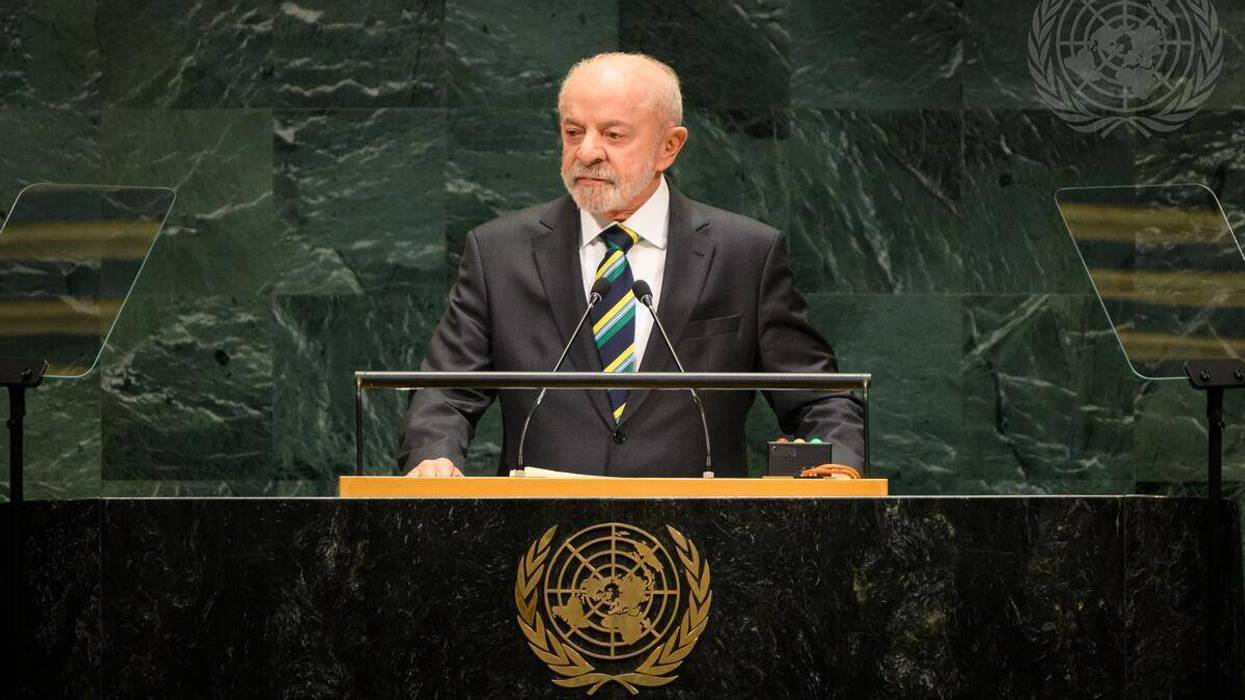
"Brazil has only one owner: The Brazilian people," said Brazilian President Luiz Inácio Lula da Silva.
The campaign of Brazilian President Luiz Inácio Lula da Silva released new advertisements this week that sounded alarms about the threat posed by US President Donald Trump to the country's sovereignty and resources.
One ad, released on Tuesday, features a Portuguese version of Puerto Rican music star Bad Bunny's song "Lo Que Le Pasó a Hawaii," the lyrics of which decry the damage done by US imperialism throughout the Western Hemisphere.
The ad consists of a video montage highlighting Brazil's rich cultural, ethnic, and ecological diversity, and ends with Lula saying, "Brazil has only one owner: The Brazilian people."
Do Latim, Silva é a própria selva: a raiz que brota do solo, o verde que resiste e a força viva da terra.
Durante séculos quiseram diminuir a nossa gente, mas foi na garra, no suor e na dignidade que cada Silva construiu este país.
A nossa força não se curva, a nossa bandeira… pic.twitter.com/iwujl0ojq0
— Lula (@LulaOficial) September 23, 2026
"Lo Que Le Pasó a Hawaii" was one of the songs that Bad Bunny performed during his acclaimed Super Bowl halftime show in February, which some critics saw as a joyful rebuke to the colonialist vision for Latin America that Trump has embraced throughout his second term.
According to a report published Thursday in Correio Braziliense, Bad Bunny gave Lula's team permission to use his music in the campaign video.
Another ad, released on Thursday, is more explicit in its warnings about Trump's ambitions for Latin America.
Unlike the video released Tuesday, the later ad directly links the unpopular US president to far-right politician Flávio Bolsonaro, who has emerged as Lula’s top rival for the presidency in upcoming elections and is the son of former Brazilian President Jair Bolsonaro, still serving a criminal sentence for efforts to overthrow Lula's government.
"Flávio Bolsonaro is Trump's candidate," says that ad's narrator. "And what Trump wants is to colonize Brazil, take our wealth, steal our future, and leave us behind."
"Flávio Bolsonaro," the narrator concludes, "is playing against the Brazilian people."
Flávio Bolsonaro é o candidato do Trump.
Quer entregar o nosso país e as nossas riquezas para os Estados Unidos.
Se depender dele, o Brasil vira colônia de novo.
Mas o Brasil só tem um dono: o povo brasileiro. pic.twitter.com/jOSJ83xcKb
— Lula (@LulaOficial) September 25, 2026
In a Thursday social media post, Lula said Bolsonaro “wants to deliver our country and our wealth to the United States,” adding that, if it were up to Bolsonaro, “Brazil will become a colony again.”
During a speech delivered at the United Nations General Assembly on Tuesday, Lula called out efforts to treat Brazil as a colony, although he didn’t mention the US directly.
“Brazil is no one’s backyard,” the Brazilian president said at one point.
“We will not allow the enemies of democracy—internal or external—to attack the will of the people," he said. "Brazilian democracy belongs to the Brazilians.”

At a time when so many Latin American governments have shifted to the right—or even the far right—all eyes are on Brazil.
This week marks the beginning of Brazil's presidential campaign, with the two front-runners—current President Luiz Inácio Lula da Silva and Senator Flávio Bolsonaro—officially launching their campaigns. After visiting Brazil and talking with politicians, activists, journalists, and ordinary citizens, I came away with the conviction that this is one of the most consequential presidential elections in Brazil's recent history. The outcome on October 4 will shape not only Brazil's future but also the political direction of Latin America.
President Luiz Inácio Lula da Silva, now 80 years old, is seeking a fourth presidential term. Brazil's Constitution allows presidents to serve only two consecutive terms, but they may run again after sitting out at least one term. That is how Lula returned to office in 2023 after governing from 2003 to 2010.
Following the four-year presidency of the far-right Jair Bolsonaro, Lula’s supporters say he has rebuilt many of the institutions and policies weakened under Bolsonaro. His government has reduced hunger, expanded social programs, strengthened environmental protections for the Amazon, and pursued a more independent foreign policy rather than simply following Washington's dictates. Brazil has reasserted itself as an important voice in the Global South, advocating for a more multipolar world and strengthening ties with countries across Africa, Asia, and Latin America.
Although Lula remains popular and has a good chance of winning the election, many Brazilians are frustrated by sluggish economic growth, persistent concerns about crime, and political fatigue after years of bitter polarization. His more ardent critics say Lula is a corrupt left-wing politician who has remained in public life for too long.
The outcome on October 4 will shape not only Brazil's future but also the political direction of Latin America.
Lula also has detractors on the left, who accuse him of being too centrist. They point to his inability to deliver many campaign promises, harsh austerity measures under his administration, policies that expand privatization, and his reluctance to reverse several of Bolsonaro-era regressive policies. They criticize him for moving too slowly on land reform and for accommodating powerful agribusiness and fossil fuel interests. Some also call on him to go much further in challenging US influence in Latin America, including by sending oil to Cuba as it suffers under the cruel decades-long US blockade.
Yet despite these criticisms, most of Brazil's progressive movements remain united behind Lula. Whatever their frustrations with his government, they see defeating the far right as the overriding priority. They also recognize that Brazil's far right is stronger, better organized, and more deeply rooted than it was a decade ago. They believe Lula's cautious approach reflects not only political pragmatism but also a desire to avoid provoking forces that have already demonstrated a willingness to challenge democratic institutions through violence.
That became clear when the right, led by President Jair Bolsonaro, refused to accept that Lula had won the 2022 elections. On January 8, 2023, Bolsonaro supporters stormed Brazil's Congress, Supreme Court, and presidential palace in an effort to overturn the election. The similarities with the January 6 insurrection by Trump supporters are striking.
But in Brazil, Bolsonaro was actually convicted for his role in the conspiracy. He is now serving a prison sentence under house arrest and is unable to run for president. So his movement is represented by his son, 45-year-old Senator Flávio Bolsonaro.
Flávio brings his own political baggage. His reputation was damaged by allegations that members of his legislative staff were required to kick back part of their taxpayer-funded salaries in a scheme to enrich him personally. His campaign has also been shaken by revelations that he sought millions of dollars from a jailed banker to finance a film celebrating his father's presidency in hopes of boosting his own presidential campaign. Even his own family has become a political liability. A bitter public dispute with his stepmother, former First Lady Michelle Bolsonaro, exposed deep divisions within the Bolsonaro movement and deprived him of one of the Brazilian right's most influential voices among women voters.
As Flávio struggles to broaden his support at home, he has sought help from abroad. Argentine President Javier Milei traveled to Brazil to campaign on his behalf. Donald Trump and members of his administration have openly supported Flávio, aggravating US-Brazil tensions that recently blew up when Lula's government refused visas to two US State Department officials on grounds that they intended to interfere in Brazil's democratic process. The Trump administration responded by revoking the US visa of Brazil's ambassador to Washington. The episode reflects growing concern about US attempts to influence Brazil’s election.
Perhaps the most astonishing example of foreign influence comes from Israel. Instead of announcing his presidential ambitions to the Brazilian people at home, Flávio first did so during a visit to Israel, where he accused Lula of antisemitism and pledged to move Brazil's embassy to Jerusalem. Benjamin Netanyahu later publicly endorsed him.
At a time when so many Latin American governments have shifted to the right—or even the far right—all eyes are on Brazil. It is Latin America's largest country, its largest economy, and one of the most influential voices in the Global South.
Polls show Lula with a narrow lead over Flávio. But if no candidate secures more than 50% of the vote in the October 4 first round, the election will go to a runoff between the top two contenders on October 25.
If Lula is reelected, Brazil is expected to continue pursuing an independent foreign policy, strengthening South-South cooperation, deepening its role in BRICS, and resisting efforts to pull Latin America back into Washington's geopolitical orbit. A Flávio Bolsonaro victory, by contrast, would likely bring Brazil into much closer alignment with the Trump administration and revive the nationalist, authoritarian politics associated with his father's presidency.
That is why so many Brazilians see this election as far more than a contest between two political rivals. For them, it is a choice between two fundamentally different visions of Brazil's future—and of its place in the world.