SUBSCRIBE TO OUR FREE NEWSLETTER
Daily news & progressive opinion—funded by the people, not the corporations—delivered straight to your inbox.
5
#000000
#FFFFFF
To donate by check, phone, or other method, see our More Ways to Give page.
Daily news & progressive opinion—funded by the people, not the corporations—delivered straight to your inbox.
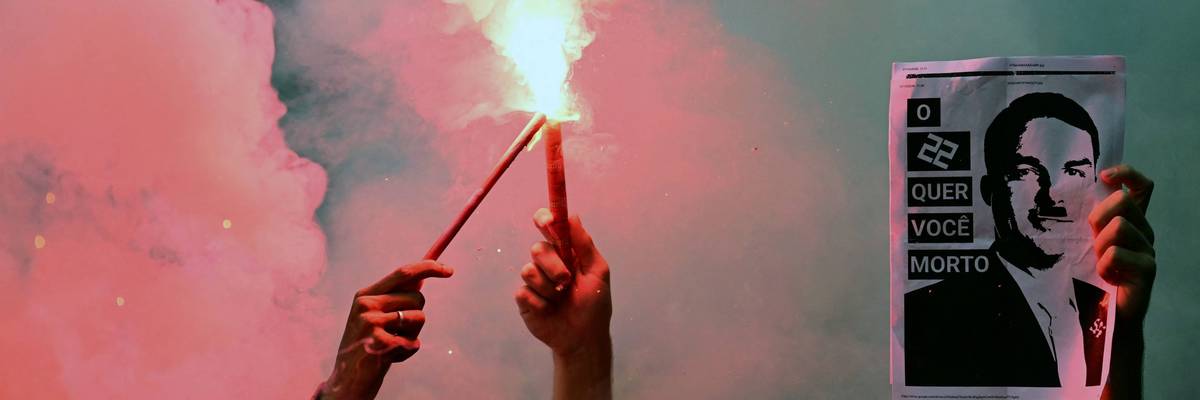
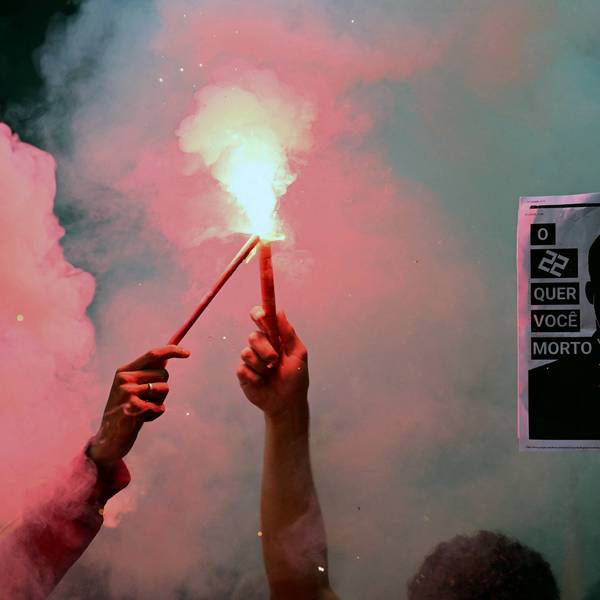
Students backing Brazil's President and presidential candidate Luiz Inacio Lula da Silva for the runoff election light flares while holding an image of right-wing candidate Flavio Bolsonaro personified as Adolf Hitler, during a march against the far-right, in Rio de Janeiro, Brazil on October 7, 2026.
The choice on October 25 should not be about Lula’s limited social democratic tendencies. It is about protecting the Brazilian democratic project from a complete fascistic takeover.
On October 4, Brazilians handed the far-right their best result in decades. Sen. Flávio Bolsonaro, eldest son and political heir of convicted coup plotter and former neofascist President Jair Bolsonaro, finished first with 47.03% of valid votes to left-wing President Luiz Inácio Lula da Silva’s 45.16%, according to Brazil’s electoral court. The two meet in a runoff on October 25.
With a gap of about 2.2 million votes, more than 33.4 million registered Brazilians stayed home, the highest first-round abstention rate since 1998. Polling suggests the ideological blocs are holding firm, showing a dead heat or a narrow Bolsonaro edge. That is despite a cascade of scandals for Flávio, and despite an estimated 1 million people marching for democracy on São Paulo’s Avenida Paulista on October 11.
So the outcome may rest on those who sat out round one. Their choice will decide whether Latin America’s largest democracy, and the forest that regulates the planet’s climate, fall to an oligarchic, US-aligned far-right. Here is what hangs in the balance.
A Flávio Bolsonaro presidency would restore a movement that tried to overturn an election by force, now armed with a congressional majority, a revenge agenda, and the backing of the world's most powerful government and military.
Under Jair Bolsonaro, Amazon clearing rose about 60%, with more than 45,000 square kilometers destroyed from 2019 to 2022, according to official data. Under Lula, deforestation fell roughly 45%, to its lowest level in over a decade.
Flávio wants to resume his father’s project, which environmental groups call “ecocide.” He said in August he does not believe climate change is real, and his 76-page government plan never mentions it, Folha de S.Paulo found. Instead, it pledges to slash Ibama, Funai, and ICMBio, the agencies that enforce environmental law, protect Indigenous peoples, and manage national parks. It promises “agile” licensing that Folha reports would approve development (including fracking) permits automatically when agencies miss deadlines.
“There is concern that activities now considered illegal could simply be legalized,” warned Taciana Stec of the climate institute Talanoa. As Breno Rodrigues de Messias Leite of the Federal University of Amazonas put it, “He will have to respond to his electoral base, which is precisely rural producers.” That base of agribusiness, ranchers, miners, and land-grabbers could essentially destroy the Amazon.
Flávio is running as his father’s proxy. Jair Bolsonaro is serving a 27-year sentence, handed down by the Supreme Court in September 2025, for leading a plot to overturn the 2022 election that included plans to assassinate Lula, Vice President Geraldo Alckmin, and Justice Alexandre de Moraes. It culminated on January 8, 2023, when Bolsonaro supporters ransacked Congress, the presidential palace, and the Supreme Court, the darkest day for Brazilian democracy since the dictatorship.
Flávio announced his candidacy after his father anointed him from prison, and said his first priority would be to release him. His brother Eduardo spent 2025 in Washington lobbying the Trump administration to punish Brazil with tariffs and sanctions over the prosecution. The sanctions have already had a disastrous impact on Brazil’s economy and sovereignty, and are hybrid warfare to meddle in the election in favor of Bolsonaro.
Now Flávio promises to go further. On October 6, he vowed to use Congress’ new right-wing majority to “change the Constitution” and "redemocratize” Brazil, reports The Rio Times. Coming from open fascists, it’s hard to believe their definition of “democracy.” “There is no way to accept the Supreme Federal Court the way it is,” he said. His plan would curb the powers of the court that convicted his father. His ironically named Liberal Party won 121 House seats and the largest Senate bloc, and his allies are closing in on the 308 votes needed to amend the Constitution.
One of the Bolsonarista camp’s positions has been the impeachment of Supreme Court judges and a purge of federal bureaucracy. In Bolsonarista vocabulary, "redemocratization" means dismantling the institutions that held anti-democratic destruction accountable. Lula’s efforts to crack down on foreign meddling by oligarchs, the US, Israel, and others would also be stopped, meaning Brazil’s democracy would essentially be held hostage by capitalist and foreign interests.
Flávio poses as an anti-establishment outsider. Yet Federal Police are investigating him for possible “money laundering, currency evasion, corruption” over the financing of Dark Horse, a hagiographic biopic of his father. Daniel Vorcaro, owner of the collapsed Banco Master and the center of one of Brazil’s largest financial scandals, allegedly sent R$61 million toward the film at Flávio’s request. The Intercept Brasil published voice notes of Flávio asking him for money.
A crypto platform handed out tokens to users sharing pro-Flávio content, which election lawyers called an illegal donation. Days before the first round, Meta blocked Lula’s campaign from running ads, citing unspecified violations. And the Bolsonaros sit at the center of a transnational far-right network. It runs through President Donald Trump, who hosted Flávio at the White House in May; Steve Bannon; Elon Musk, who waged war on Brazil’s Supreme Court in 2024; and now-convicted Israel- and Trump-linked, Argentine disinformation operative Fernando Cerimedo, who spread a toxic sludge of baseless fraud claims on various platforms and his own media networks after Jair’s 2022 defeat.
The Bolsonaros’ economic program serves that same oligarchic, far-right capitalist class. Flávio’s economic coordinator, Daniella Marques, calls Javier Milei’s Argentina a “great example” and has promised a R$200 billion “tesouraço,” or giant scissors, to public programs. Milei’s chainsaw drove Argentine poverty above 50% in his first months and has wiped tens of thousands of companies off the formal economy. Most of the public workforce has also been gutted. Flávio promises tax cuts, privatization, and an end to what he calls “dependence” on welfare, a threat to programs like Bolsa Família that tens of millions of poor Brazilians rely on.
Flávio would also surrender the sovereignty Brazil has built, including Pix—a free public payment system so successful that Washington targeted it in a 2025 trade probe—and diversified trade with China, the BRICS, and Europe. Lula's Brazil has also been a significant force in recognizing a Palestinian state, and in reforming the United Nations Security Council to balance the scales in favor of the Global South. Brazil has been a leader in multilateral finance and post-American economic sovereignty. Bolsonaro would gut all of it.
On October 7, a fire tore through a lab building at the Federal University of Pernambuco, a day after students there protested Flávio’s candidacy. Hours earlier, students had received messages threatening to “blow up the department” in Flávio's name. Bolsonarismo has instilled a climate of fear and terror, as these kinds of attacks are now commonplace by the far-right in Brazil. Bolsonaro has borrowed the “God, Homeland, Family” slogan linked to fascist movements.
With the far-right sweeping institutions across the hemisphere, Lula may be the last shield against a full-blown reactionary counterrevolution.
Jair Bolsonaro’s government slashed university budgets, and his movement smears them as factories of communism and enemies of the “homeland.” Flávio’s plan would tie research funding to business metrics like “productive impact.” Scholarships, he said in September, must be “for developing technology, innovation, artificial intelligence,” not fields that “add nothing.” Social sciences and humanities funding would likely be slashed, while there is a fast-tracking of AI and military expansion.
This is the family that made science denial a governing principle. Jair called Covid-19 a “little flu” and sabotaged vaccine purchases while more than 700,000 Brazilians died. A Senate inquiry recommended he be charged with crimes against humanity.
The Bolsonaros’ home base is Rio de Janeiro, where far-right militias of current and former police control whole neighborhoods, running extortion, land-grabbing, gambling, and drug and arms trafficking.
These militias are also in an all-out war against the left, with ties to the Bolsonaros. As a state legislator, Flávio honored Adriano da Nóbrega, an ex-police captain later identified as the leader of the militia hit squad known as the Crime Office, and employed Nóbrega’s mother and ex-wife. Ronnie Lessa, the ex-officer who confessed to murdering socialist councilwoman Marielle Franco in 2018, lived in Jair Bolsonaro’s gated condominium. This is the fascistic, militaristic, sheltered, nihilistic world the Bolsonaros live in.
Flávio also wants Salvadorian President Nayib Bukele’s model on security. After meeting El Salvador’s security minister in August, he promised 500,000 new prison spaces. “Brazil has few people in prison,” he said, in a country with more than 850,000 behind bars. He backs lowering the age of criminal responsibility to 14 and a national facial-recognition database, Brookings reports. He and his brother lobbied Washington to designate Brazilian gangs as terrorist organizations, which invites a US invasion. When Pete Hegseth posted video of a US missile obliterating a boat (a war crime), Flávio replied that “there are boats like this here in Rio de Janeiro.” He has pledged to join Trump’s “Shield of the Americas,” which has been used to bully left-wing governments and weaponize “narcoterrorism” to go after guerrillas and opponents, while shielding allies. Bolsonaro has also hinted at declaring a “state of exception” on crime, a euphemism for martial law. Most right-wing states in Latin America are now under a state of exception. The term, taking its origin in Nazi theorist Carl Schmitt, has been used in many Latin American autocracies to ban opposition, protests, and justify extrajudicial torture and murder.
Bolsonaro also has a horrific record on gender and LGBT+ rights. His father told a congresswoman she didn't even “deserve” to be raped, and told Playboy he would rather a son “die in an accident” than be gay. Liberal Party star Nikolas Ferreira donned a wig in Congress to mock trans women, and this year led a campaign to keep trans congresswoman Erika Hilton from chairing the Women’s Rights Commission. This, in the country that leads the world in killings of trans people.
This war on women and LGBT+ Brazilians is inseparable from the movement’s alliance with the evangelical far-right. Flávio sealed a partnership with megachurch pastor Silas Malafaia in May, betting that moral panic over “gender ideology” and “trans bathrooms” (echoing Trumpism) will deliver one of the country’s largest voting blocs. Alongside them was PL leader Sóstenes Cavalcante, sponsor of a 2024 bill to punish abortion after 22 weeks as homicide, even for rape survivors. A Bolsonaro government would pursue that agenda aggressively, even more as they would control Congress and the Supreme Court.
Under Lula, Brazil backed South Africa’s genocide case against Israel at the International Court of Justice, defended the International Criminal Court, and refused to choose sides in Washington’s new cold war. Flávio would reverse it all. He has pledged that Brazil will be a “brother of Israel,” move its embassy to Jerusalem, and join Milei and Israeli Prime Minister Netanyahu's Isaac Accords. In June, he offered Secretary of State Marco Rubio his transition team at the “disposal” of the US government. Bolsonaro launched his presidential campaign alongside Netanyahu.
Regionally, the right now governs Argentina, Chile, Bolivia, Colombia, Peru, Paraguay, Ecuador, Costa Rica, El Salvador, Honduras, Panama, and the Dominican Republic. Venezuela is a de facto US vassal state, and the Trump administration has signaled Cuba and Nicaragua are next.
If Brazil falls, Mexico would be the last major Latin American economy outside Washington’s thumb. An emboldened Trump administration, which has already threatened military action against Mexican cartels, would turn up the pressure on Claudia Sheinbaum, and may even look to topple her government.
This runoff is a referendum on democracy, human dignity, and ecological survival. A Flávio Bolsonaro presidency would restore a movement that tried to overturn an election by force, now armed with a congressional majority, a revenge agenda, and the backing of the world's most powerful government and military.
Lula is not above criticism. His government has backed oil drilling near the mouth of the Amazon and made its peace with agribusiness. But the choice on October 25 should not be about Lula’s limited social democratic tendencies. It is about protecting the Brazilian democratic project from a complete fascistic takeover.
Brazil, Latin America’s largest democracy, has survived colonial plunder, slavery, a 21-year dictatorship, neoliberal devastation, and multiple coup attempts. With the far-right sweeping institutions across the hemisphere, Lula may be the last shield against a full-blown reactionary counterrevolution. The 33 million Brazilians who stayed home on October 4 will need to show up, otherwise the world will get a whole lot darker.
Dear Common Dreams reader, It’s been nearly 30 years since I co-founded Common Dreams with my late wife, Lina Newhouser. We had the radical notion that journalism should serve the public good, not corporate profits. It was clear to us from the outset what it would take to build such a project. No paid advertisements. No corporate sponsors. No millionaire publisher telling us what to think or do. Many people said we wouldn't last a year, but we proved those doubters wrong. Together with a tremendous team of journalists and dedicated staff, we built an independent media outlet free from the constraints of profits and corporate control. Our mission has always been simple: To inform. To inspire. To ignite change for the common good. Building Common Dreams was not easy. Our survival was never guaranteed. When you take on the most powerful forces—Wall Street greed, fossil fuel industry destruction, Big Tech lobbyists, and uber-rich oligarchs who have spent billions upon billions rigging the economy and democracy in their favor—the only bulwark you have is supporters who believe in your work. But here’s the urgent message from me today. It's never been this bad out there. And it's never been this hard to keep us going. At the very moment Common Dreams is most needed, the threats we face are intensifying. We need your support now more than ever. We don't accept corporate advertising and never will. We don't have a paywall because we don't think people should be blocked from critical news based on their ability to pay. Everything we do is funded by the donations of readers like you. When everyone does the little they can afford, we are strong. But if that support retreats or dries up, so do we. Will you donate now to make sure Common Dreams not only survives but thrives? —Craig Brown, Co-founder |
On October 4, Brazilians handed the far-right their best result in decades. Sen. Flávio Bolsonaro, eldest son and political heir of convicted coup plotter and former neofascist President Jair Bolsonaro, finished first with 47.03% of valid votes to left-wing President Luiz Inácio Lula da Silva’s 45.16%, according to Brazil’s electoral court. The two meet in a runoff on October 25.
With a gap of about 2.2 million votes, more than 33.4 million registered Brazilians stayed home, the highest first-round abstention rate since 1998. Polling suggests the ideological blocs are holding firm, showing a dead heat or a narrow Bolsonaro edge. That is despite a cascade of scandals for Flávio, and despite an estimated 1 million people marching for democracy on São Paulo’s Avenida Paulista on October 11.
So the outcome may rest on those who sat out round one. Their choice will decide whether Latin America’s largest democracy, and the forest that regulates the planet’s climate, fall to an oligarchic, US-aligned far-right. Here is what hangs in the balance.
A Flávio Bolsonaro presidency would restore a movement that tried to overturn an election by force, now armed with a congressional majority, a revenge agenda, and the backing of the world's most powerful government and military.
Under Jair Bolsonaro, Amazon clearing rose about 60%, with more than 45,000 square kilometers destroyed from 2019 to 2022, according to official data. Under Lula, deforestation fell roughly 45%, to its lowest level in over a decade.
Flávio wants to resume his father’s project, which environmental groups call “ecocide.” He said in August he does not believe climate change is real, and his 76-page government plan never mentions it, Folha de S.Paulo found. Instead, it pledges to slash Ibama, Funai, and ICMBio, the agencies that enforce environmental law, protect Indigenous peoples, and manage national parks. It promises “agile” licensing that Folha reports would approve development (including fracking) permits automatically when agencies miss deadlines.
“There is concern that activities now considered illegal could simply be legalized,” warned Taciana Stec of the climate institute Talanoa. As Breno Rodrigues de Messias Leite of the Federal University of Amazonas put it, “He will have to respond to his electoral base, which is precisely rural producers.” That base of agribusiness, ranchers, miners, and land-grabbers could essentially destroy the Amazon.
Flávio is running as his father’s proxy. Jair Bolsonaro is serving a 27-year sentence, handed down by the Supreme Court in September 2025, for leading a plot to overturn the 2022 election that included plans to assassinate Lula, Vice President Geraldo Alckmin, and Justice Alexandre de Moraes. It culminated on January 8, 2023, when Bolsonaro supporters ransacked Congress, the presidential palace, and the Supreme Court, the darkest day for Brazilian democracy since the dictatorship.
Flávio announced his candidacy after his father anointed him from prison, and said his first priority would be to release him. His brother Eduardo spent 2025 in Washington lobbying the Trump administration to punish Brazil with tariffs and sanctions over the prosecution. The sanctions have already had a disastrous impact on Brazil’s economy and sovereignty, and are hybrid warfare to meddle in the election in favor of Bolsonaro.
Now Flávio promises to go further. On October 6, he vowed to use Congress’ new right-wing majority to “change the Constitution” and "redemocratize” Brazil, reports The Rio Times. Coming from open fascists, it’s hard to believe their definition of “democracy.” “There is no way to accept the Supreme Federal Court the way it is,” he said. His plan would curb the powers of the court that convicted his father. His ironically named Liberal Party won 121 House seats and the largest Senate bloc, and his allies are closing in on the 308 votes needed to amend the Constitution.
One of the Bolsonarista camp’s positions has been the impeachment of Supreme Court judges and a purge of federal bureaucracy. In Bolsonarista vocabulary, "redemocratization" means dismantling the institutions that held anti-democratic destruction accountable. Lula’s efforts to crack down on foreign meddling by oligarchs, the US, Israel, and others would also be stopped, meaning Brazil’s democracy would essentially be held hostage by capitalist and foreign interests.
Flávio poses as an anti-establishment outsider. Yet Federal Police are investigating him for possible “money laundering, currency evasion, corruption” over the financing of Dark Horse, a hagiographic biopic of his father. Daniel Vorcaro, owner of the collapsed Banco Master and the center of one of Brazil’s largest financial scandals, allegedly sent R$61 million toward the film at Flávio’s request. The Intercept Brasil published voice notes of Flávio asking him for money.
A crypto platform handed out tokens to users sharing pro-Flávio content, which election lawyers called an illegal donation. Days before the first round, Meta blocked Lula’s campaign from running ads, citing unspecified violations. And the Bolsonaros sit at the center of a transnational far-right network. It runs through President Donald Trump, who hosted Flávio at the White House in May; Steve Bannon; Elon Musk, who waged war on Brazil’s Supreme Court in 2024; and now-convicted Israel- and Trump-linked, Argentine disinformation operative Fernando Cerimedo, who spread a toxic sludge of baseless fraud claims on various platforms and his own media networks after Jair’s 2022 defeat.
The Bolsonaros’ economic program serves that same oligarchic, far-right capitalist class. Flávio’s economic coordinator, Daniella Marques, calls Javier Milei’s Argentina a “great example” and has promised a R$200 billion “tesouraço,” or giant scissors, to public programs. Milei’s chainsaw drove Argentine poverty above 50% in his first months and has wiped tens of thousands of companies off the formal economy. Most of the public workforce has also been gutted. Flávio promises tax cuts, privatization, and an end to what he calls “dependence” on welfare, a threat to programs like Bolsa Família that tens of millions of poor Brazilians rely on.
Flávio would also surrender the sovereignty Brazil has built, including Pix—a free public payment system so successful that Washington targeted it in a 2025 trade probe—and diversified trade with China, the BRICS, and Europe. Lula's Brazil has also been a significant force in recognizing a Palestinian state, and in reforming the United Nations Security Council to balance the scales in favor of the Global South. Brazil has been a leader in multilateral finance and post-American economic sovereignty. Bolsonaro would gut all of it.
On October 7, a fire tore through a lab building at the Federal University of Pernambuco, a day after students there protested Flávio’s candidacy. Hours earlier, students had received messages threatening to “blow up the department” in Flávio's name. Bolsonarismo has instilled a climate of fear and terror, as these kinds of attacks are now commonplace by the far-right in Brazil. Bolsonaro has borrowed the “God, Homeland, Family” slogan linked to fascist movements.
With the far-right sweeping institutions across the hemisphere, Lula may be the last shield against a full-blown reactionary counterrevolution.
Jair Bolsonaro’s government slashed university budgets, and his movement smears them as factories of communism and enemies of the “homeland.” Flávio’s plan would tie research funding to business metrics like “productive impact.” Scholarships, he said in September, must be “for developing technology, innovation, artificial intelligence,” not fields that “add nothing.” Social sciences and humanities funding would likely be slashed, while there is a fast-tracking of AI and military expansion.
This is the family that made science denial a governing principle. Jair called Covid-19 a “little flu” and sabotaged vaccine purchases while more than 700,000 Brazilians died. A Senate inquiry recommended he be charged with crimes against humanity.
The Bolsonaros’ home base is Rio de Janeiro, where far-right militias of current and former police control whole neighborhoods, running extortion, land-grabbing, gambling, and drug and arms trafficking.
These militias are also in an all-out war against the left, with ties to the Bolsonaros. As a state legislator, Flávio honored Adriano da Nóbrega, an ex-police captain later identified as the leader of the militia hit squad known as the Crime Office, and employed Nóbrega’s mother and ex-wife. Ronnie Lessa, the ex-officer who confessed to murdering socialist councilwoman Marielle Franco in 2018, lived in Jair Bolsonaro’s gated condominium. This is the fascistic, militaristic, sheltered, nihilistic world the Bolsonaros live in.
Flávio also wants Salvadorian President Nayib Bukele’s model on security. After meeting El Salvador’s security minister in August, he promised 500,000 new prison spaces. “Brazil has few people in prison,” he said, in a country with more than 850,000 behind bars. He backs lowering the age of criminal responsibility to 14 and a national facial-recognition database, Brookings reports. He and his brother lobbied Washington to designate Brazilian gangs as terrorist organizations, which invites a US invasion. When Pete Hegseth posted video of a US missile obliterating a boat (a war crime), Flávio replied that “there are boats like this here in Rio de Janeiro.” He has pledged to join Trump’s “Shield of the Americas,” which has been used to bully left-wing governments and weaponize “narcoterrorism” to go after guerrillas and opponents, while shielding allies. Bolsonaro has also hinted at declaring a “state of exception” on crime, a euphemism for martial law. Most right-wing states in Latin America are now under a state of exception. The term, taking its origin in Nazi theorist Carl Schmitt, has been used in many Latin American autocracies to ban opposition, protests, and justify extrajudicial torture and murder.
Bolsonaro also has a horrific record on gender and LGBT+ rights. His father told a congresswoman she didn't even “deserve” to be raped, and told Playboy he would rather a son “die in an accident” than be gay. Liberal Party star Nikolas Ferreira donned a wig in Congress to mock trans women, and this year led a campaign to keep trans congresswoman Erika Hilton from chairing the Women’s Rights Commission. This, in the country that leads the world in killings of trans people.
This war on women and LGBT+ Brazilians is inseparable from the movement’s alliance with the evangelical far-right. Flávio sealed a partnership with megachurch pastor Silas Malafaia in May, betting that moral panic over “gender ideology” and “trans bathrooms” (echoing Trumpism) will deliver one of the country’s largest voting blocs. Alongside them was PL leader Sóstenes Cavalcante, sponsor of a 2024 bill to punish abortion after 22 weeks as homicide, even for rape survivors. A Bolsonaro government would pursue that agenda aggressively, even more as they would control Congress and the Supreme Court.
Under Lula, Brazil backed South Africa’s genocide case against Israel at the International Court of Justice, defended the International Criminal Court, and refused to choose sides in Washington’s new cold war. Flávio would reverse it all. He has pledged that Brazil will be a “brother of Israel,” move its embassy to Jerusalem, and join Milei and Israeli Prime Minister Netanyahu's Isaac Accords. In June, he offered Secretary of State Marco Rubio his transition team at the “disposal” of the US government. Bolsonaro launched his presidential campaign alongside Netanyahu.
Regionally, the right now governs Argentina, Chile, Bolivia, Colombia, Peru, Paraguay, Ecuador, Costa Rica, El Salvador, Honduras, Panama, and the Dominican Republic. Venezuela is a de facto US vassal state, and the Trump administration has signaled Cuba and Nicaragua are next.
If Brazil falls, Mexico would be the last major Latin American economy outside Washington’s thumb. An emboldened Trump administration, which has already threatened military action against Mexican cartels, would turn up the pressure on Claudia Sheinbaum, and may even look to topple her government.
This runoff is a referendum on democracy, human dignity, and ecological survival. A Flávio Bolsonaro presidency would restore a movement that tried to overturn an election by force, now armed with a congressional majority, a revenge agenda, and the backing of the world's most powerful government and military.
Lula is not above criticism. His government has backed oil drilling near the mouth of the Amazon and made its peace with agribusiness. But the choice on October 25 should not be about Lula’s limited social democratic tendencies. It is about protecting the Brazilian democratic project from a complete fascistic takeover.
Brazil, Latin America’s largest democracy, has survived colonial plunder, slavery, a 21-year dictatorship, neoliberal devastation, and multiple coup attempts. With the far-right sweeping institutions across the hemisphere, Lula may be the last shield against a full-blown reactionary counterrevolution. The 33 million Brazilians who stayed home on October 4 will need to show up, otherwise the world will get a whole lot darker.
On October 4, Brazilians handed the far-right their best result in decades. Sen. Flávio Bolsonaro, eldest son and political heir of convicted coup plotter and former neofascist President Jair Bolsonaro, finished first with 47.03% of valid votes to left-wing President Luiz Inácio Lula da Silva’s 45.16%, according to Brazil’s electoral court. The two meet in a runoff on October 25.
With a gap of about 2.2 million votes, more than 33.4 million registered Brazilians stayed home, the highest first-round abstention rate since 1998. Polling suggests the ideological blocs are holding firm, showing a dead heat or a narrow Bolsonaro edge. That is despite a cascade of scandals for Flávio, and despite an estimated 1 million people marching for democracy on São Paulo’s Avenida Paulista on October 11.
So the outcome may rest on those who sat out round one. Their choice will decide whether Latin America’s largest democracy, and the forest that regulates the planet’s climate, fall to an oligarchic, US-aligned far-right. Here is what hangs in the balance.
A Flávio Bolsonaro presidency would restore a movement that tried to overturn an election by force, now armed with a congressional majority, a revenge agenda, and the backing of the world's most powerful government and military.
Under Jair Bolsonaro, Amazon clearing rose about 60%, with more than 45,000 square kilometers destroyed from 2019 to 2022, according to official data. Under Lula, deforestation fell roughly 45%, to its lowest level in over a decade.
Flávio wants to resume his father’s project, which environmental groups call “ecocide.” He said in August he does not believe climate change is real, and his 76-page government plan never mentions it, Folha de S.Paulo found. Instead, it pledges to slash Ibama, Funai, and ICMBio, the agencies that enforce environmental law, protect Indigenous peoples, and manage national parks. It promises “agile” licensing that Folha reports would approve development (including fracking) permits automatically when agencies miss deadlines.
“There is concern that activities now considered illegal could simply be legalized,” warned Taciana Stec of the climate institute Talanoa. As Breno Rodrigues de Messias Leite of the Federal University of Amazonas put it, “He will have to respond to his electoral base, which is precisely rural producers.” That base of agribusiness, ranchers, miners, and land-grabbers could essentially destroy the Amazon.
Flávio is running as his father’s proxy. Jair Bolsonaro is serving a 27-year sentence, handed down by the Supreme Court in September 2025, for leading a plot to overturn the 2022 election that included plans to assassinate Lula, Vice President Geraldo Alckmin, and Justice Alexandre de Moraes. It culminated on January 8, 2023, when Bolsonaro supporters ransacked Congress, the presidential palace, and the Supreme Court, the darkest day for Brazilian democracy since the dictatorship.
Flávio announced his candidacy after his father anointed him from prison, and said his first priority would be to release him. His brother Eduardo spent 2025 in Washington lobbying the Trump administration to punish Brazil with tariffs and sanctions over the prosecution. The sanctions have already had a disastrous impact on Brazil’s economy and sovereignty, and are hybrid warfare to meddle in the election in favor of Bolsonaro.
Now Flávio promises to go further. On October 6, he vowed to use Congress’ new right-wing majority to “change the Constitution” and "redemocratize” Brazil, reports The Rio Times. Coming from open fascists, it’s hard to believe their definition of “democracy.” “There is no way to accept the Supreme Federal Court the way it is,” he said. His plan would curb the powers of the court that convicted his father. His ironically named Liberal Party won 121 House seats and the largest Senate bloc, and his allies are closing in on the 308 votes needed to amend the Constitution.
One of the Bolsonarista camp’s positions has been the impeachment of Supreme Court judges and a purge of federal bureaucracy. In Bolsonarista vocabulary, "redemocratization" means dismantling the institutions that held anti-democratic destruction accountable. Lula’s efforts to crack down on foreign meddling by oligarchs, the US, Israel, and others would also be stopped, meaning Brazil’s democracy would essentially be held hostage by capitalist and foreign interests.
Flávio poses as an anti-establishment outsider. Yet Federal Police are investigating him for possible “money laundering, currency evasion, corruption” over the financing of Dark Horse, a hagiographic biopic of his father. Daniel Vorcaro, owner of the collapsed Banco Master and the center of one of Brazil’s largest financial scandals, allegedly sent R$61 million toward the film at Flávio’s request. The Intercept Brasil published voice notes of Flávio asking him for money.
A crypto platform handed out tokens to users sharing pro-Flávio content, which election lawyers called an illegal donation. Days before the first round, Meta blocked Lula’s campaign from running ads, citing unspecified violations. And the Bolsonaros sit at the center of a transnational far-right network. It runs through President Donald Trump, who hosted Flávio at the White House in May; Steve Bannon; Elon Musk, who waged war on Brazil’s Supreme Court in 2024; and now-convicted Israel- and Trump-linked, Argentine disinformation operative Fernando Cerimedo, who spread a toxic sludge of baseless fraud claims on various platforms and his own media networks after Jair’s 2022 defeat.
The Bolsonaros’ economic program serves that same oligarchic, far-right capitalist class. Flávio’s economic coordinator, Daniella Marques, calls Javier Milei’s Argentina a “great example” and has promised a R$200 billion “tesouraço,” or giant scissors, to public programs. Milei’s chainsaw drove Argentine poverty above 50% in his first months and has wiped tens of thousands of companies off the formal economy. Most of the public workforce has also been gutted. Flávio promises tax cuts, privatization, and an end to what he calls “dependence” on welfare, a threat to programs like Bolsa Família that tens of millions of poor Brazilians rely on.
Flávio would also surrender the sovereignty Brazil has built, including Pix—a free public payment system so successful that Washington targeted it in a 2025 trade probe—and diversified trade with China, the BRICS, and Europe. Lula's Brazil has also been a significant force in recognizing a Palestinian state, and in reforming the United Nations Security Council to balance the scales in favor of the Global South. Brazil has been a leader in multilateral finance and post-American economic sovereignty. Bolsonaro would gut all of it.
On October 7, a fire tore through a lab building at the Federal University of Pernambuco, a day after students there protested Flávio’s candidacy. Hours earlier, students had received messages threatening to “blow up the department” in Flávio's name. Bolsonarismo has instilled a climate of fear and terror, as these kinds of attacks are now commonplace by the far-right in Brazil. Bolsonaro has borrowed the “God, Homeland, Family” slogan linked to fascist movements.
With the far-right sweeping institutions across the hemisphere, Lula may be the last shield against a full-blown reactionary counterrevolution.
Jair Bolsonaro’s government slashed university budgets, and his movement smears them as factories of communism and enemies of the “homeland.” Flávio’s plan would tie research funding to business metrics like “productive impact.” Scholarships, he said in September, must be “for developing technology, innovation, artificial intelligence,” not fields that “add nothing.” Social sciences and humanities funding would likely be slashed, while there is a fast-tracking of AI and military expansion.
This is the family that made science denial a governing principle. Jair called Covid-19 a “little flu” and sabotaged vaccine purchases while more than 700,000 Brazilians died. A Senate inquiry recommended he be charged with crimes against humanity.
The Bolsonaros’ home base is Rio de Janeiro, where far-right militias of current and former police control whole neighborhoods, running extortion, land-grabbing, gambling, and drug and arms trafficking.
These militias are also in an all-out war against the left, with ties to the Bolsonaros. As a state legislator, Flávio honored Adriano da Nóbrega, an ex-police captain later identified as the leader of the militia hit squad known as the Crime Office, and employed Nóbrega’s mother and ex-wife. Ronnie Lessa, the ex-officer who confessed to murdering socialist councilwoman Marielle Franco in 2018, lived in Jair Bolsonaro’s gated condominium. This is the fascistic, militaristic, sheltered, nihilistic world the Bolsonaros live in.
Flávio also wants Salvadorian President Nayib Bukele’s model on security. After meeting El Salvador’s security minister in August, he promised 500,000 new prison spaces. “Brazil has few people in prison,” he said, in a country with more than 850,000 behind bars. He backs lowering the age of criminal responsibility to 14 and a national facial-recognition database, Brookings reports. He and his brother lobbied Washington to designate Brazilian gangs as terrorist organizations, which invites a US invasion. When Pete Hegseth posted video of a US missile obliterating a boat (a war crime), Flávio replied that “there are boats like this here in Rio de Janeiro.” He has pledged to join Trump’s “Shield of the Americas,” which has been used to bully left-wing governments and weaponize “narcoterrorism” to go after guerrillas and opponents, while shielding allies. Bolsonaro has also hinted at declaring a “state of exception” on crime, a euphemism for martial law. Most right-wing states in Latin America are now under a state of exception. The term, taking its origin in Nazi theorist Carl Schmitt, has been used in many Latin American autocracies to ban opposition, protests, and justify extrajudicial torture and murder.
Bolsonaro also has a horrific record on gender and LGBT+ rights. His father told a congresswoman she didn't even “deserve” to be raped, and told Playboy he would rather a son “die in an accident” than be gay. Liberal Party star Nikolas Ferreira donned a wig in Congress to mock trans women, and this year led a campaign to keep trans congresswoman Erika Hilton from chairing the Women’s Rights Commission. This, in the country that leads the world in killings of trans people.
This war on women and LGBT+ Brazilians is inseparable from the movement’s alliance with the evangelical far-right. Flávio sealed a partnership with megachurch pastor Silas Malafaia in May, betting that moral panic over “gender ideology” and “trans bathrooms” (echoing Trumpism) will deliver one of the country’s largest voting blocs. Alongside them was PL leader Sóstenes Cavalcante, sponsor of a 2024 bill to punish abortion after 22 weeks as homicide, even for rape survivors. A Bolsonaro government would pursue that agenda aggressively, even more as they would control Congress and the Supreme Court.
Under Lula, Brazil backed South Africa’s genocide case against Israel at the International Court of Justice, defended the International Criminal Court, and refused to choose sides in Washington’s new cold war. Flávio would reverse it all. He has pledged that Brazil will be a “brother of Israel,” move its embassy to Jerusalem, and join Milei and Israeli Prime Minister Netanyahu's Isaac Accords. In June, he offered Secretary of State Marco Rubio his transition team at the “disposal” of the US government. Bolsonaro launched his presidential campaign alongside Netanyahu.
Regionally, the right now governs Argentina, Chile, Bolivia, Colombia, Peru, Paraguay, Ecuador, Costa Rica, El Salvador, Honduras, Panama, and the Dominican Republic. Venezuela is a de facto US vassal state, and the Trump administration has signaled Cuba and Nicaragua are next.
If Brazil falls, Mexico would be the last major Latin American economy outside Washington’s thumb. An emboldened Trump administration, which has already threatened military action against Mexican cartels, would turn up the pressure on Claudia Sheinbaum, and may even look to topple her government.
This runoff is a referendum on democracy, human dignity, and ecological survival. A Flávio Bolsonaro presidency would restore a movement that tried to overturn an election by force, now armed with a congressional majority, a revenge agenda, and the backing of the world's most powerful government and military.
Lula is not above criticism. His government has backed oil drilling near the mouth of the Amazon and made its peace with agribusiness. But the choice on October 25 should not be about Lula’s limited social democratic tendencies. It is about protecting the Brazilian democratic project from a complete fascistic takeover.
Brazil, Latin America’s largest democracy, has survived colonial plunder, slavery, a 21-year dictatorship, neoliberal devastation, and multiple coup attempts. With the far-right sweeping institutions across the hemisphere, Lula may be the last shield against a full-blown reactionary counterrevolution. The 33 million Brazilians who stayed home on October 4 will need to show up, otherwise the world will get a whole lot darker.