SUBSCRIBE TO OUR FREE NEWSLETTER
Daily news & progressive opinion—funded by the people, not the corporations—delivered straight to your inbox.
5
#000000
#FFFFFF
To donate by check, phone, or other method, see our More Ways to Give page.
Daily news & progressive opinion—funded by the people, not the corporations—delivered straight to your inbox.
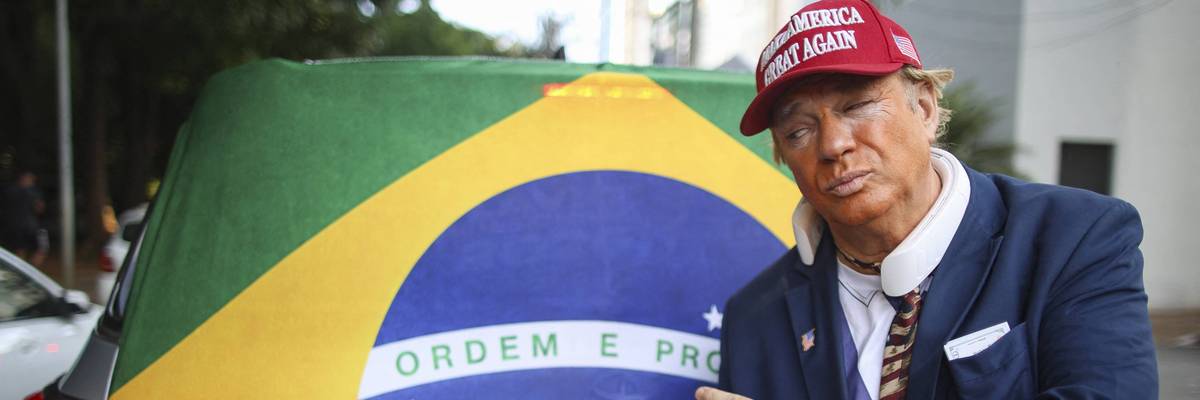
A man wearing a mask depicting US President Donald Trump attends a rally of Brazilian right-wing presidential candidate Flavio Bolsonaro in Goiania, Brazil, on September 27, 2026.
"The Trump-Rubio interventions, with the collaboration of the Bolsonaro clan, have made the Flávio campaign into another US regime change operation. This should be defeated."
Brazilian officials, pro-democracy advocates, and US lawmakers are growing increasingly concerned about apparent efforts by President Donald Trump and Secretary of State Marco Rubio to interfere in the Latin American country's upcoming election.
Reuters reported Wednesday that Brazil's spy agency "confirmed the existence of interference from the United States as well as Russia" in the presidential election, the first round of which will take place on October 4. Brazilian President Luiz Inácio Lula da Silva is running for reelection against Sen. Flavio Bolsonaro, the son of former far-right President Jair Bolsonaro—who is currently serving a 27-year prison sentence under house arrest for orchestrating a coup attempt in 2022.
Democratic lawmakers in the US have raised alarm about the Trump administration's election meddling in Brazil in recent days as the contest approaches. Earlier this week, Democratic Sens. Jeanne Shaheen (NH), Peter Welch (Vt.), and Tim Kaine (Va.) wrote in a letter to Rubio that "over the course of President Trump’s second term, we have seen US officials engage in a campaign of interference and destabilization in Brazil."
"The administration’s most recent actions point toward an effort to interfere with, and potentially undermine, Brazil's general election in October," the lawmakers wrote. "Senator and presidential candidate Flávio Bolsonaro’s recent Oval Office meeting with President Trump, undertaken while attempting to mitigate a domestic political scandal, underscores the administration's willingness to insert itself in the election."
The senators' letter followed a separate demand by more than 30 Democrats in the US House that Rubio "confirm whether the administration will commit to respecting Brazil’s electoral process and to recognizing its certified outcome." The House Democrats demanded a response from the Trump administration by October 1.
"Particularly given the tragic history of US involvement in the 1964 military coup against Brazil’s democratically elected government at the time, as well as subsequent US support for the resulting military dictatorship," the lawmakers wrote, "the United States has a responsibility to support the democratic institutions that so many Brazilians, across generations, struggled to build."
Trump has been a vocal defender of Flávio Bolsonaro's father, saying he is "not guilty of anything" and describing his prosecution as a "witch hunt"—echoing Trump's attack on investigations into his own effort to subvert the 2020 election in the US. Last year, Trump hit Brazil with a 40% tariff, accusing the country's leaders of "persecuting former President of Brazil Jair Bolsonaro."
"It was not just a trade maneuver," political scientist Octavio Amorim Neto said of the tariff in an interview published Thursday, noting that "Bolsonarism explicitly applauded [Trump's economic attack], while Brazil’s traditional right did not vigorously defend national sovereignty, saying that everything was Lula’s fault."
Over the summer, Brazil denied visas to two top US State Department officials "whom the Trump administration planned to dispatch on a mission to cast doubt on the fairness and integrity of the country’s electoral system," The Washington Post reported in July.
Mark Weisbrot, co-director of the Center for Economic and Policy Research, wrote in an op-ed for The Los Angeles Times earlier this week that Trump’s intervention in Brazil's electoral process "undermines a basic and generally cherished right to self-determination, as well as the right to democracy itself."
"It is even clearly illegal under the Charter of the Organization of American States, to which the United States is a signatory," wrote Weisbrot. "The Trump-Rubio interventions, with the collaboration of the Bolsonaro clan, have made the Flávio campaign into another US regime change operation. This should be defeated, for the sake of Brazil and the whole hemisphere."
Dear Common Dreams reader, It’s been nearly 30 years since I co-founded Common Dreams with my late wife, Lina Newhouser. We had the radical notion that journalism should serve the public good, not corporate profits. It was clear to us from the outset what it would take to build such a project. No paid advertisements. No corporate sponsors. No millionaire publisher telling us what to think or do. Many people said we wouldn't last a year, but we proved those doubters wrong. Together with a tremendous team of journalists and dedicated staff, we built an independent media outlet free from the constraints of profits and corporate control. Our mission has always been simple: To inform. To inspire. To ignite change for the common good. Building Common Dreams was not easy. Our survival was never guaranteed. When you take on the most powerful forces—Wall Street greed, fossil fuel industry destruction, Big Tech lobbyists, and uber-rich oligarchs who have spent billions upon billions rigging the economy and democracy in their favor—the only bulwark you have is supporters who believe in your work. But here’s the urgent message from me today. It's never been this bad out there. And it's never been this hard to keep us going. At the very moment Common Dreams is most needed, the threats we face are intensifying. We need your support now more than ever. We don't accept corporate advertising and never will. We don't have a paywall because we don't think people should be blocked from critical news based on their ability to pay. Everything we do is funded by the donations of readers like you. When everyone does the little they can afford, we are strong. But if that support retreats or dries up, so do we. Will you donate now to make sure Common Dreams not only survives but thrives? —Craig Brown, Co-founder |
Brazilian officials, pro-democracy advocates, and US lawmakers are growing increasingly concerned about apparent efforts by President Donald Trump and Secretary of State Marco Rubio to interfere in the Latin American country's upcoming election.
Reuters reported Wednesday that Brazil's spy agency "confirmed the existence of interference from the United States as well as Russia" in the presidential election, the first round of which will take place on October 4. Brazilian President Luiz Inácio Lula da Silva is running for reelection against Sen. Flavio Bolsonaro, the son of former far-right President Jair Bolsonaro—who is currently serving a 27-year prison sentence under house arrest for orchestrating a coup attempt in 2022.
Democratic lawmakers in the US have raised alarm about the Trump administration's election meddling in Brazil in recent days as the contest approaches. Earlier this week, Democratic Sens. Jeanne Shaheen (NH), Peter Welch (Vt.), and Tim Kaine (Va.) wrote in a letter to Rubio that "over the course of President Trump’s second term, we have seen US officials engage in a campaign of interference and destabilization in Brazil."
"The administration’s most recent actions point toward an effort to interfere with, and potentially undermine, Brazil's general election in October," the lawmakers wrote. "Senator and presidential candidate Flávio Bolsonaro’s recent Oval Office meeting with President Trump, undertaken while attempting to mitigate a domestic political scandal, underscores the administration's willingness to insert itself in the election."
The senators' letter followed a separate demand by more than 30 Democrats in the US House that Rubio "confirm whether the administration will commit to respecting Brazil’s electoral process and to recognizing its certified outcome." The House Democrats demanded a response from the Trump administration by October 1.
"Particularly given the tragic history of US involvement in the 1964 military coup against Brazil’s democratically elected government at the time, as well as subsequent US support for the resulting military dictatorship," the lawmakers wrote, "the United States has a responsibility to support the democratic institutions that so many Brazilians, across generations, struggled to build."
Trump has been a vocal defender of Flávio Bolsonaro's father, saying he is "not guilty of anything" and describing his prosecution as a "witch hunt"—echoing Trump's attack on investigations into his own effort to subvert the 2020 election in the US. Last year, Trump hit Brazil with a 40% tariff, accusing the country's leaders of "persecuting former President of Brazil Jair Bolsonaro."
"It was not just a trade maneuver," political scientist Octavio Amorim Neto said of the tariff in an interview published Thursday, noting that "Bolsonarism explicitly applauded [Trump's economic attack], while Brazil’s traditional right did not vigorously defend national sovereignty, saying that everything was Lula’s fault."
Over the summer, Brazil denied visas to two top US State Department officials "whom the Trump administration planned to dispatch on a mission to cast doubt on the fairness and integrity of the country’s electoral system," The Washington Post reported in July.
Mark Weisbrot, co-director of the Center for Economic and Policy Research, wrote in an op-ed for The Los Angeles Times earlier this week that Trump’s intervention in Brazil's electoral process "undermines a basic and generally cherished right to self-determination, as well as the right to democracy itself."
"It is even clearly illegal under the Charter of the Organization of American States, to which the United States is a signatory," wrote Weisbrot. "The Trump-Rubio interventions, with the collaboration of the Bolsonaro clan, have made the Flávio campaign into another US regime change operation. This should be defeated, for the sake of Brazil and the whole hemisphere."
Brazilian officials, pro-democracy advocates, and US lawmakers are growing increasingly concerned about apparent efforts by President Donald Trump and Secretary of State Marco Rubio to interfere in the Latin American country's upcoming election.
Reuters reported Wednesday that Brazil's spy agency "confirmed the existence of interference from the United States as well as Russia" in the presidential election, the first round of which will take place on October 4. Brazilian President Luiz Inácio Lula da Silva is running for reelection against Sen. Flavio Bolsonaro, the son of former far-right President Jair Bolsonaro—who is currently serving a 27-year prison sentence under house arrest for orchestrating a coup attempt in 2022.
Democratic lawmakers in the US have raised alarm about the Trump administration's election meddling in Brazil in recent days as the contest approaches. Earlier this week, Democratic Sens. Jeanne Shaheen (NH), Peter Welch (Vt.), and Tim Kaine (Va.) wrote in a letter to Rubio that "over the course of President Trump’s second term, we have seen US officials engage in a campaign of interference and destabilization in Brazil."
"The administration’s most recent actions point toward an effort to interfere with, and potentially undermine, Brazil's general election in October," the lawmakers wrote. "Senator and presidential candidate Flávio Bolsonaro’s recent Oval Office meeting with President Trump, undertaken while attempting to mitigate a domestic political scandal, underscores the administration's willingness to insert itself in the election."
The senators' letter followed a separate demand by more than 30 Democrats in the US House that Rubio "confirm whether the administration will commit to respecting Brazil’s electoral process and to recognizing its certified outcome." The House Democrats demanded a response from the Trump administration by October 1.
"Particularly given the tragic history of US involvement in the 1964 military coup against Brazil’s democratically elected government at the time, as well as subsequent US support for the resulting military dictatorship," the lawmakers wrote, "the United States has a responsibility to support the democratic institutions that so many Brazilians, across generations, struggled to build."
Trump has been a vocal defender of Flávio Bolsonaro's father, saying he is "not guilty of anything" and describing his prosecution as a "witch hunt"—echoing Trump's attack on investigations into his own effort to subvert the 2020 election in the US. Last year, Trump hit Brazil with a 40% tariff, accusing the country's leaders of "persecuting former President of Brazil Jair Bolsonaro."
"It was not just a trade maneuver," political scientist Octavio Amorim Neto said of the tariff in an interview published Thursday, noting that "Bolsonarism explicitly applauded [Trump's economic attack], while Brazil’s traditional right did not vigorously defend national sovereignty, saying that everything was Lula’s fault."
Over the summer, Brazil denied visas to two top US State Department officials "whom the Trump administration planned to dispatch on a mission to cast doubt on the fairness and integrity of the country’s electoral system," The Washington Post reported in July.
Mark Weisbrot, co-director of the Center for Economic and Policy Research, wrote in an op-ed for The Los Angeles Times earlier this week that Trump’s intervention in Brazil's electoral process "undermines a basic and generally cherished right to self-determination, as well as the right to democracy itself."
"It is even clearly illegal under the Charter of the Organization of American States, to which the United States is a signatory," wrote Weisbrot. "The Trump-Rubio interventions, with the collaboration of the Bolsonaro clan, have made the Flávio campaign into another US regime change operation. This should be defeated, for the sake of Brazil and the whole hemisphere."