SUBSCRIBE TO OUR FREE NEWSLETTER
Daily news & progressive opinion—funded by the people, not the corporations—delivered straight to your inbox.
5
#000000
#FFFFFF
To donate by check, phone, or other method, see our More Ways to Give page.
Daily news & progressive opinion—funded by the people, not the corporations—delivered straight to your inbox.
"It is well past time that the U.S., E.U., and other powerful actors in the international community seriously reconsider this cruel and often counterproductive mechanism," said one of the study's authors.
A study published this week in the British medical journal The Lancet Global Health revealed that unilateral economic sanctions cause more than 500,000 excess deaths annually, prompting renewed calls for the United States to end its use of a form of collective punishment that claims roughly as many lives as all the world's current wars combined.
The study, authored by Francisco Rodríguez, Silvio Rendón, and Mark Weisbrot of the Center for Economic and Policy Research (CEPR), is the first to examine the "effects of sanctions on age-specific mortality rates in cross-country panel data using methods designed to address causal identification in observational data."
Studying the effects of sanctions on 152 countries between 1971 and 2022, the researchers "showed a significant causal association between sanctions and increased mortality," with "the strongest effects for unilateral, economic, and U.S. sanctions."
"We estimated that unilateral sanctions were associated with an annual toll of 564,258 deaths," the study's authors noted, "similar to the global mortality burden associated with armed conflict."
🚨 NEW REPORT: The myth that sanctions are a humane alternative to war is shattered. Sanctions imposed by single countries cause massive civilian deaths, with children under 5 hit hardest. bit.ly/Sanctions_Study
[image or embed]
— Center for Economic and Policy Research (@ceprdc.bsky.social) July 23, 2025 at 6:14 AM
Weisbrot, CEPR's co-director, said in a statement: "It is immoral and indefensible that such a lethal form of collective punishment continues to be used, let alone that it has been steadily expanded over the years. And sanctions are widely misunderstood as being a less lethal, almost nonviolent, policy alternative to military force."
The researchers found that children younger than 5 years old made up 51% of all sanctions deaths during the three-decade study period. More than three-quarters of all sanctions deaths between 1971-2022 were of children under age 15 and people over 60.
The study also noted the repeated failure of U.S. sanctions to deliver policy goals like regime change. However, such measures have caused economies to collapse, harming everyday people far more than ostensibly targeted leaders, who have the power and resources to shield themselves from the worst effects of sanctions.
"Sanctions often fail to achieve their stated objectives and instead only punish the civilian populations of the targeted countries," said Rodríguez. "It is well past time that the U.S., [European Union], and other powerful actors in the international community seriously reconsider this cruel and often counterproductive mechanism."
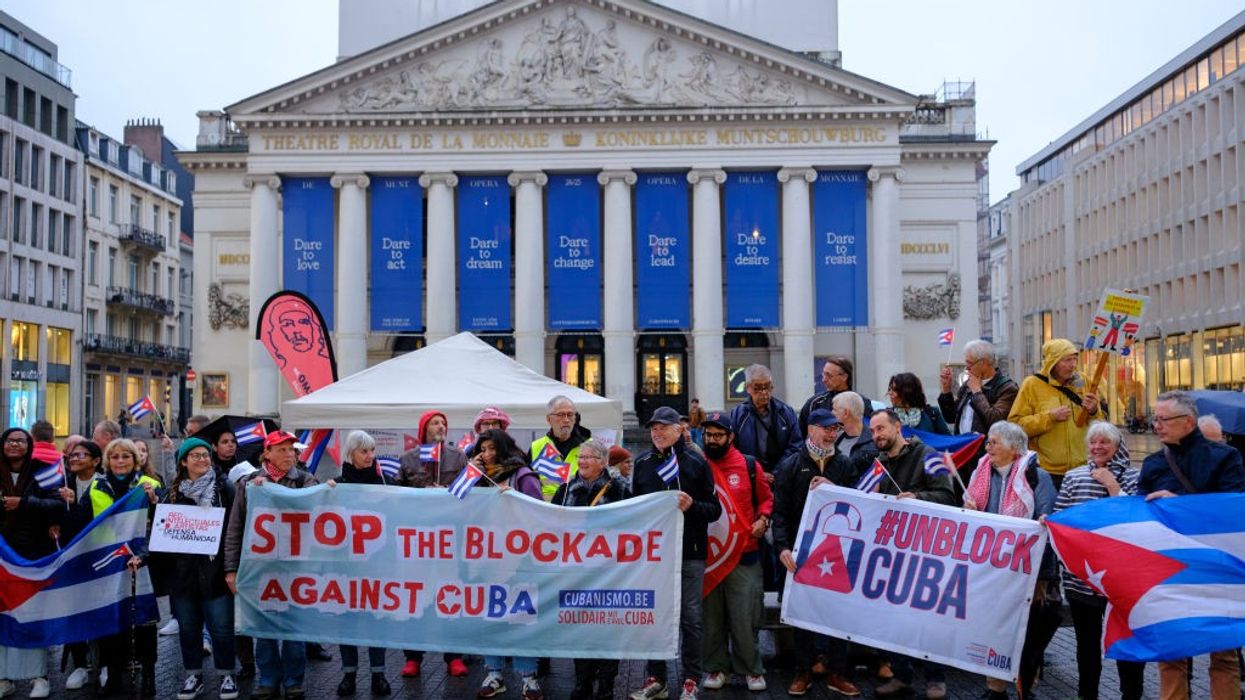
For six decades, the U.S. has imposed a crippling economic embargo on Cuba that has adversely affected all sectors of the socialist island's economy and severely limited Cubans' access to basic necessities including food, fuel, and medicines. The Cuban government claims the blockade cost the country's economy nearly $5 billion in just one 11-month period in 2022-23 alone. United Nations member states have perennially—and overwhelmingly—condemned the embargo.
In Venezuela, as many as 40,000 people died in 2017-18 due to U.S. sanctions, CEPR researchers found.
Some critics have noted that civilian suffering appears to be more than an incidental cost of U.S. sanctions—it is apparently often their very intent. Historian Arthur Schlesinger Jr.—a confidant of former President John F. Kennedy—claimed that JFK sought to unleash "the terrors of the Earth" on Cuba following Fidel Castro's successful overthrow of a U.S.-backed dictatorship, because "Castro was high on his list of emotions."
While the new study "found no statistical evidence of an effect" for United Nations sanctions, Mary Smith Fawzi and Sarah Zaidi conducted research for the U.N. Food and Agriculture Organization that was published in The Lancet in 1995 and revealed that as many as 576,000 Iraqi children died prematurely as a result of sanctions imposed by the U.N. Security Council—whose sanctioning capacity was heavily influenced by the United States—to target the regime of longtime Iraqi leader Saddam Hussein.
"Discussions in the 1990s on the effects on child mortality of sanctions on Iraq strongly influenced policy debates and were one of the main drivers of the subsequent redesign of sanctions on the government of Saddam Hussein," the authors of the new study wrote, citing Fawzi and Zaidi's research.
With Hussein's regime unmoved by the sanctions, Madeleine Albright, then U.S. secretary of state under President Bill Clinton, was asked if the human cost was too high. Albright infamously replied that "the price is worth it."
Ecuador's raid of the Mexican embassy in Quito "threatens the security of embassies and diplomats throughout the world," said one expert.
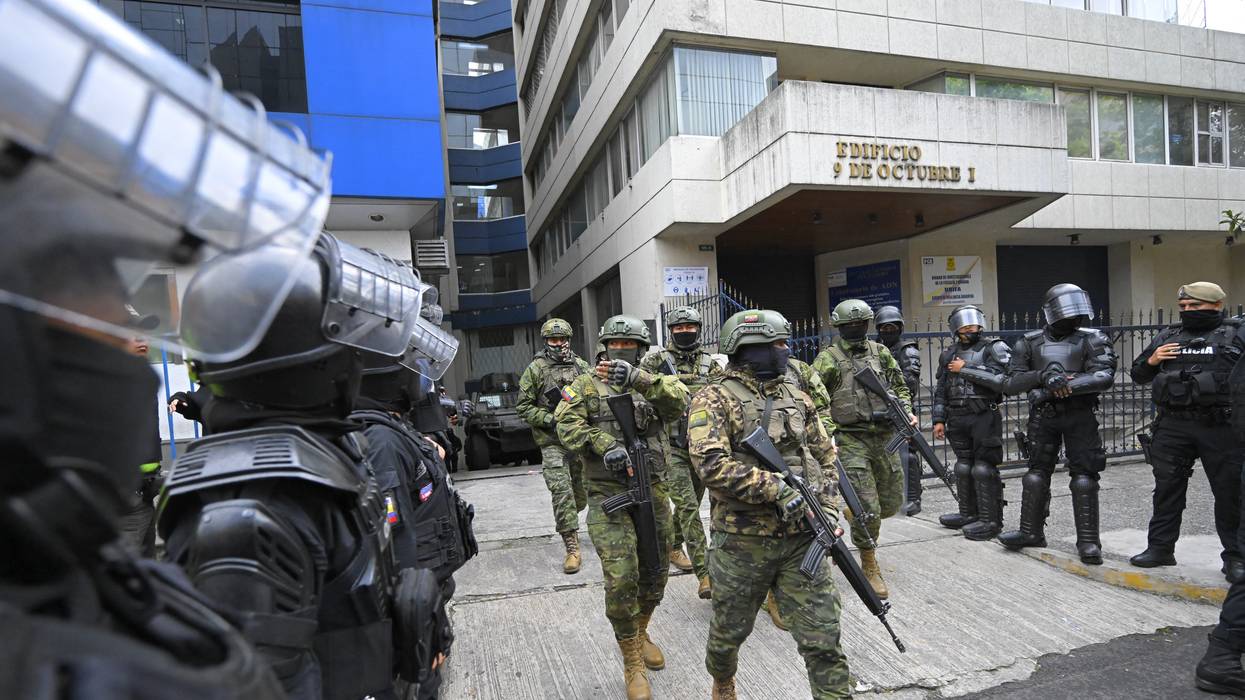
The Biden administration on Sunday faced calls to demand the immediate release of Ecuador's former vice president after Ecuadorian police stormed Mexico's embassy in Quito and forcibly seized the ex-official, a flagrant breach of the 1961 Vienna Convention.
"Ecuador's government has committed a very serious crime, one that threatens the security of embassies and diplomats throughout the world—not least those of the United States, which has threats to its embassies in much of the world," said Mark Weisbrot, co-director of the Center for Economic and Policy Research (CEPR). "The international community cannot allow this to happen."
The move sparked a diplomatic crisis and global outcry, with Latin American leaders slamming the right-wing Ecuadorian government for its "unacceptable infringement" on Mexico's sovereignty and "kidnapping" of Jorge Glas, who served as vice president under Ecuador's leftist former president Rafael Correa. Glas has reportedly been transferred to a maximum-security prison.
Correa supported lawmaker Luisa González in Ecuador's 2023 presidential contest, which she lost to President Daniel Noboa, the son of the richest man in Ecuador.
"The United States is providing crucial diplomatic, military, and material support to Ecuador."
The illegal raid of Mexico's embassy late Friday came hours after the Mexican government granted political asylum to Glas, who has been living in the embassy since December, when he announced he would appeal a judge's decision ordering him back to jail. Glas has been convicted of corruption and imprisoned repeatedly in recent years; the former vice president has said the charges are politically motivated.
CEPR noted Sunday that Ecuadorian Attorney General Diana Salazar "has long engaged in a campaign of lawfare and political persecution against former president Rafael Correa and other figures from the former Correa government."
"The charges against Correa have been shown to have so little credibility, and the evidence is so lacking, that Interpol for years has refused to act on Ecuador's red notice against him," the group said. "Belgium has granted him political asylum, and he can travel freely to almost anywhere in the world without fear of extradition. And last year, a Brazilian Supreme Court judge annulled evidence against Glas after authorities admitted it may have been tampered with."
Weisbrot stressed in his statement that "the United States is providing crucial diplomatic, military, and material support to Ecuador."
"Canada is currently seeking a 'free trade' agreement with Ecuador," Weisbrot added. "All of this should be suspended until Ecuador releases its former vice president, who it has kidnapped from Mexico's embassy."
As the Financial Times reported Sunday, Ecuador's right-wing president "is enjoying soaring popularity among Ecuadoreans and strong support from Washington after declaring an all-out war on drug trafficking." In February, the Biden administration declared its "unwavering support" for Ecuador's government and announced "$2.4 million in additional vehicles and security equipment to support the work of police."
FT noted that Noboa, the scion of a banana empire, has invoked "emergency powers to put troops on the streets and sent the army to take control of gang-ridden jails, using tactics partly borrowed from El Salvador's strongman leader Nayib Bukele."
While Noboa's "aggressive response initially reduced violence and brought a precarious sense of safety to places like Guayaquil," The New York Times observed, the "stability did not last."
"Over the Easter holiday, there were 137 murders in Ecuador, and kidnappings and extortion have worsened," the Times reported.
Thus far, the Biden administration's response to Ecuador's raid on Mexico's embassy has been tepid. In a social media post late Saturday, U.S. State Department spokesperson Matthew Miller wrote that the administration "condemns any violation of the Vienna Convention on Diplomatic Relations, which says that "agents of the receiving state may not enter" embassies "except with the consent of the head of mission."
"We encourage our partners Mexico and Ecuador to resolve their differences in accord with international norms," Miller added.
Ecuadorian police assaulted Roberto Canseco, Mexico's acting ambassador, during Friday's raid.
"This is totally unacceptable," the career diplomat told reporters. "They have hit me, they have pushed me to the ground. I physically tried to prevent them from entering. They searched the Mexican embassy in Quito like criminals."
"Everyone knows that the U.S. could end this today if we wanted to," said one analyst.
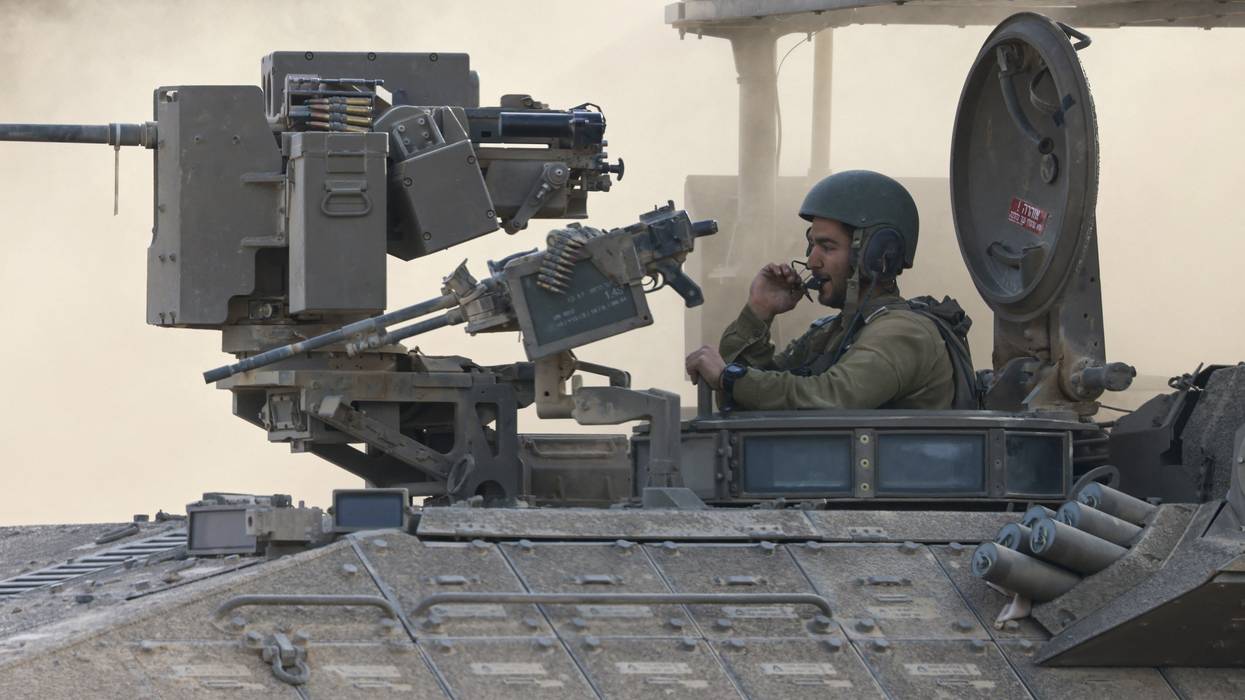
A new poll released Tuesday revealed that a majority of Americans want to the U.S. government to stop supplying the Israeli military with weaponry to carry out its brutal assault on Gaza that has killed over 30,000 Palestinians, most of them civilian men, women, and children.
As organizers called on Democratic voters in at least seven states to vote "uncommitted" on their Super Tuesday primary ballots on Tuesday to help push the Biden administration to demand a permanent cease-fire in Gaza, the YouGov poll provided another measure of Americans' growing outrage over their government's material and political support for the "genocidal" campaign by Israel's far-right government.
Commissioned by the Center for Economic and Policy Research (CEPR), the poll of 1,000 U.S. adults asked respondents whether they agreed with the statement: "The U.S. should stop weapons shipments to Israel until Israel discontinues its attacks on the people of Gaza."
Fifty-two percent of people said they agreed with the statement, while just 27% said they disagreed.
CEPR co-director Mark Weisbrot noted that while the call for a cease-fire "can mean different things to different people... the support for halting weapons shipments is specific and unambiguous."
Less than two weeks after scientists projected that at least 6,500 people would likely die in Gaza in the coming months even in the case of an immediate, permanent cease-fire, Weisbrot said many Americans may have "already moved past" the idea that a cease-fire is sufficient.
"Support for stopping U.S. weapons shipments to Israel has gained traction in recent days," noted CEPR, "as the Gaza death toll has surpassed 30,000 people, about two-thirds of them women and children."
Since the Biden administration's approval of weapons shipments to Israel since October, Israel has decimated civilian infrastructure across Gaza while also blocking nearly all humanitarian aid, leaving the entire population facing "crisis-level hunger" that is approaching famine in some areas.
"We have the power to stop this. Everyone knows that the U.S. could end this today if we wanted to," said Weisbrot, posting a video of European Union High Representative for Foreign Affairs and Security Policy Josep Borrell calling on U.S. President Joe Biden and other Western leaders to "provide less arms" to Israel, considering Biden's stated belief that too many civilians are being killed.
We have the power to stop this. Everyone knows that the U.S. could end this today if we wanted to. This is Josep Borell, the highest official of the European Union in charge of foreign policy, telling the United States government that they need to do something, like cut weapons… pic.twitter.com/F9y8zwgPxj
— Mark Weisbrot (@MarkWeisbrot) March 5, 2024
Tuesday's poll revealed that ending weapons shipments for Israel is popular across the political spectrum.
Sixty-two percent of people who voted for Biden in 2020 agreed that the U.S. should end shipments, while only 14% disagreed.
CEPR pointed out that "Among those who did not vote in the 2020 presidential elections—a key group containing voters that both Democrats and Republicans would like to turn out this year—fully 60% agreed that the U.S. should block weapons shipments."
The latter result is one "that the Biden campaign should be worried about," said Weisbrot. "These are the voters Biden needs to turn out to expand his base."
People who voted for former Republican President Donald Trump in 2020 were the only group in which a majority opposed halting weapons shipments, with 55% saying the shipments should continue. Thirty percent said they should stop.
"No one so extremist on economic issues has been elected president of a South American country," said U.S. economist Mark Weisbrot.
Javier Milei—a far-right admirer of former U.S. President Donald Trump who says that climate change is a "socialist lie" and who pledged to take a "chainsaw" to social programs—will be Argentina's next president after winning a decisive victory in Sunday's runoff.
Sergio Massa, Argentina's Peronist economy minister, conceded defeat Sunday evening to the 53-year-old Milei, a radical libertarian economist often called the "Trump of Argentina" who will take office amid a looming recession, triple-digit inflation, and a nearly 40% poverty rate in Latin America's third-largest economy.
Following Massa's concession speech, Argentinian election officials said that with nearly 87% of votes tallied, Milei had 56% and Massa 44%.
Gone Sunday were the baseless allegations of voter fraud that Milei supporters said cost him the first round of the presidential contest, as well as the chainsaw he often used as a prop to show how he would eviscerate social programs.
"No one so extremist on economic issues has been elected president of a South American country," economist Mark Weisbrot, co-director of the Center for Economic and Policy Research, warned Friday.
In addition to deploring socialism for "stealing the fruits of one person's labor and giving it to someone else," Milei has asserted that "all the policies that blame humans for climate change are false" and has called abortion—which has only been legal in Argentina since 2021—"murder."
Milei, a self-described "anarcho-capitalist" libertarian, is also an advocate of same-sex marriage, transgender rights, and drug legalization.
Referring to former center-right Argentinian President Mauricio Macri—a Milei supporter—Weisbrot said that "much of the current crisis in Argentina is a result of what happened during [his] administration, including unsustainable borrowing combined with large-scale capital flight, as well as an inflation-depreciation spiral that takes on a momentum of its own."
"But a crazed, economically suicidal approach would only make things worse—and as Argentina has experienced, things can get a lot worse," he added. "Milei displays a callous disregard for most people's living standards, values, and well-being, as well as a commitment to widely discredited economic policies, that is unprecedented."
Human rights defenders have also sounded the alarm over Milei and his running mate Victoria Villarruel's open admiration for Argentina's former U.S.-backed military dictatorship, whose reign of terror and repression spanned from 1976 to 1983.
Massa unsuccessfully tried to distance himself from intensely unpopular outgoing President Alberto Fernández and Vice President Cristina Fernández de Kirchner, a former president who was convicted last year of fraud.
And so now the next president of Argentina will be a man who wants to legalize the sale of children and human organs, renounce his country's monetary sovereignty in favor of the U.S. dollar, and says he receives political advice from his dead dog.
"God help us all," wrote one anti-Trump Republican group on social media.
As new government data on Thursday stoked fears of a looming recession--and even led to some claims that the nation is already experiencing one--progressives renewed calls for the Federal Reserve to stop hiking interest rates and policymakers to take on the corporate profiteering driving inflation.
"Reining in corporate greed is the key to bringing down costs for families and kickstarting economic growth."
The Bureau of Economic Analysis at the U.S. Department of Commerce released gross domestic product (GDP) figures that show two consecutive quarters of negative growth, which prompted some Republican lawmakers--hopeful to regain control of Congress later this year--to declare that "America is in a recession" and it is the Democrats' fault.
While two straight quarters of negative growth is often seen as a signal of recession, it is not that simple. Harvard University economist Jason Furman pointed out on Twitter Thursday there is "well over a 50% chance that Q1 and/or Q2 gets revised to positive."
"That's part of why NBER doesn't rely on advance GDP to call recessions," Furman added, referring to the National Bureau of Economic Research.
Alex Durante, an economist with the Tax Foundation think tank, told The Hill that "there's this perception, and people are not wrong to have it--it's probably even in my economics textbook from college--that it's two negative quarters of GDP that NBER uses to determine if there's a recession. That's actually not completely true. It actually looks at a wide variety of economic indicators to make that designation."
"They'll look at employment, personal income, durable goods, housing permits, so the GDP is certainly part of it, but they're looking at other indicators, as well," Durante explained.
As Dean Baker, senior economist and co-founder of the Center for Economic and Policy Research (CEPR), detailed Thursday:
The modest drop in GDP reported for the quarter is not good news, but it was hardly a surprise. It also was entirely due to inventory quirks, which will not be repeated in future quarters. Consumption is still growing at a respectable pace, as is investment.
The Fed has been raising interest rates ostensibly out of concern that the economy was growing too fast, causing inflation. This report should help to stem those fears. While people are apparently not so concerned about a recession to keep themselves from taking trips and going to restaurants, they are still not spending down their pandemic savings. The sharp drop in the inflation rate reported in the core [Personal Consumption Expenditures] deflator should also alleviate concerns about a wage-price spiral.
CEPR co-founder and co-director Mark Weisbrot argued in a Thursday opinion piece for MarketWatch that the Fed--which on Wednesday hiked interest rates for the second straight month--will be to blame if there is a recession.
"As many economists have noted, the vast majority of the increase in inflation that we have seen over the past 18 months has been a result of external shocks, most important the war in Ukraine, which has raised food and energy prices (the CPI energy index rose 41.6% over the past year from June); and the economic disruptions caused by the pandemic," Weisbrot wrote.
"Some of these prices have begun to reverse; and in any case it's difficult to see how the Fed's interest rate hikes are going to lower these prices, as Fed Chair Jerome Powell stated last month," he continued.
Critics of the Fed's interest rate hikes--from Sen. Elizabeth Warren (D-Mass.) and Rep. Pramila Jayapal (D-Wash.) to economists who formerly served in the federal government like Robert Reich and Claudia Sahm--have called on the central bank to rethink its approach, and some have taken aim at Powell.
Rakeen Mabud, chief economist and managing director of research and policy at the Groundwork Collaborative, said Thursday that the "GDP report makes it crystal clear that Jerome Powell is willing to push millions out of work and throw away our economic recovery in the name of an arbitrary 2% inflation target he doesn't even believe he can hit."
"We can all agree that fighting inflation should be a top priority," she added, "but asking the workers and families who have been hit hardest by rising prices to also bear the brunt of a potential recession is not just cruel--it's bad policy."
The GDP report came less than 24 hours after Senate Majority Leader Chuck Schumer (D-N.Y.) and Sen. Joe Manchin (D-W.Va.) announced the Inflation Reduction Act, compromise legislation on climate, healthcare, and taxes. While some progressives have concerns about the specifics on climate, others called on congressional Democrats to swiftly pass the budget reconciliation package, which follows months of obstruction by Manchin.
"Sky-high inflation is a major contributor to the economic slowdown, and nothing is driving up costs more on everyday families than corporate greed," said Kyle Herrig, president of the government watchdog Accountable.US, in a statement Thursday.
"Across industries, we've seen major corporations continue to post record high profits and approve billions of dollars in shareholder giveaways while disingenuously claiming to have no choice but to raise prices so high," he noted. "As Americans stare down the abyss of a potential recession, Fortune 500 c-suite executives are doing better than ever, averaging over $18 million in compensation while their workers' wages have severely lagged behind."
According to Herrig:
Reining in corporate greed is the key to bringing down costs for families and kickstarting economic growth, and fortunately Congress has the opportunity [to] do it. Passing the Inflation Reduction Act will ensure corporations will finally begin to pay their fair share in taxes. This bill will put billions of dollars more into the pockets of Americans by reducing the leverage Big Oil, health insurance, and drug companies have to charge whatever they please--all while creating thousands of new jobs. Congress must not squander the best opportunity they may have for years to create an economy that works for everyone, not just billionaires and greedy corporations.
Unrig Our Economy campaign director Sarah Baron similarly asserted that the legislation "is a significant step towards combating corporate greed and making an economy that works for working people," highlighting the same provisions as Herrig.
"The vast majority of Americans rightly blame corporate greed for driving inflation, so it is heartening to see Democrats unite around a bill that addresses the issue at its source," Baron said. "As the bill is considered by Congress, Unrig Our Economy urges all members to decide where they stand--with corporations or with the hardworking constituents they were elected to represent."
Groundwork Collaborative executive director Lindsay Owens also backed the bill, saying that "the Inflation Reduction Act gets it exactly right: We bring down costs for families by making needed public investments, not pulling back on spending when we need it most."
"We bring down energy costs when we invest in clean energy and lessen our dependence on Big Oil profiteers. We bring down healthcare costs when we use public power to counter Big Pharma and get a fair price for seniors. And we strengthen our democracy and our economy when the largest corporations contribute to these investments, instead of buying politicians to oppose them," she added. "Congress should send the Inflation Reduction Act to the president's desk as quickly as possible."
After the U.S.-backed attempt to overthrow elected Venezuelan President Nicolas Maduro by force fizzled out, the Trump administration on Monday moved to further strangle the Latin American nation's economy by imposing a full economic embargo.
President Donald Trump's executive order targeting Venezuela, according to the Washington Post, "blocks all property and assets of the government and its officials, and prohibits any transactions with them, including the Venezuelan Central Bank and the state oil company."
"The action puts Venezuela on par with Cuba, Iran, North Korea, and Syria, the only other countries under a similar full embargo," the Post reported.
Journalist and filmmaker Dan Cohen described the embargo as "economic terrorism":
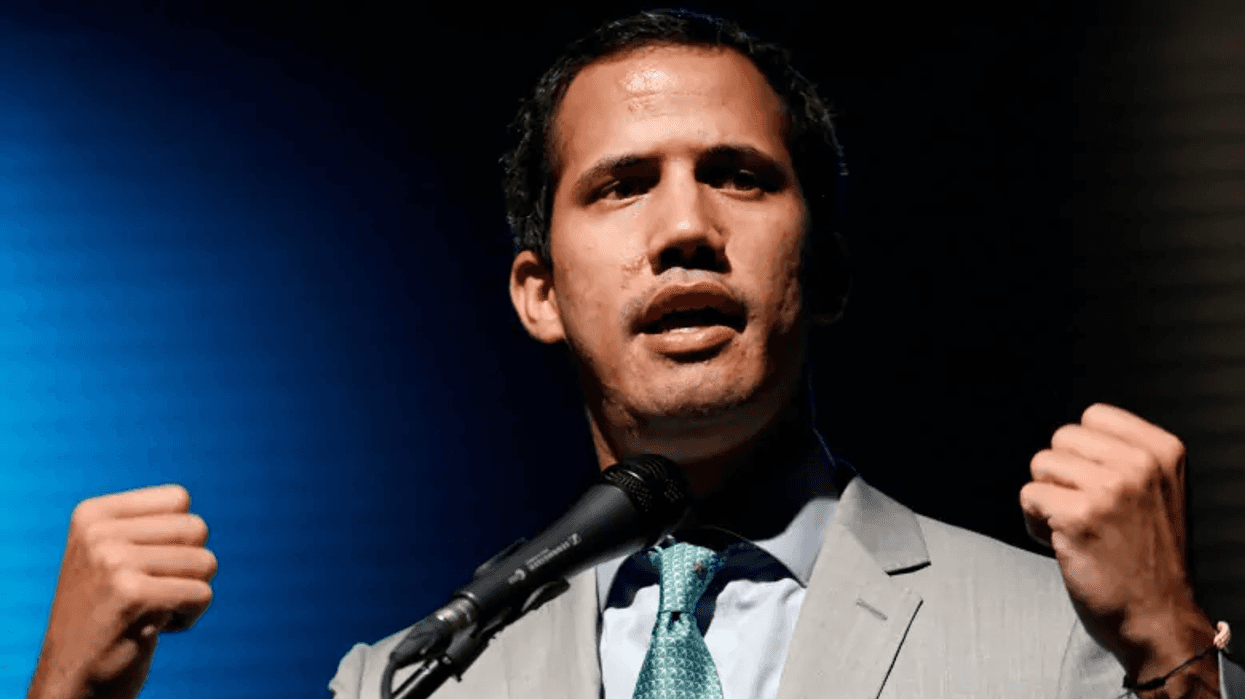
The Venezuelan economy has already been crippled by sweeping U.S. sanctions, which the Trump administration has expanded over the past several months in an attempt to overthrow Maduro and install opposition leader Juan Guaido.
As Common Dreams reported in April, a study published by the Center for Economic and Policy Research (CEPR) found that Trump's sanctions against Venezuela killed more than 40,000 people between 2017 and 2018.
"The sanctions are depriving Venezuelans of lifesaving medicines, medical equipment, food, and other essential imports," wrote CEPR's Mark Weisbrot, a co-author of the study. "This is illegal under U.S. and international law, and treaties that the U.S. has signed. Congress should move to stop it."
The Trump administration's decision to impose a full embargo on Venezuela was viewed as yet another attempt to oust Maduro--an effort that could do severe harm to the civilian population.
"Trump's action, the toughest yet against Maduro, not only bans U.S. companies from dealings with the Venezuela government but also appears to open the door to possible sanctions against foreign firms or individuals that assist it," HuffPost reported.
Responding to recent U.S. sanctions against Venezuela, journalist Ben Norton wrote, "The U.S. gov is telling the Venezuelan people that if they want to eat, they have to change their politics."
The embargo comes as Trump national security adviser John Bolton is in Peru to deliver an address Tuesday to the so-called International Conference on Democracy in Venezuela.
According to the Wall Street Journal, which obtained a copy of Bolton's prepared remarks, the national security adviser plans to claim that previous embargoes imposed by the U.S. were successful.
"It worked in Panama, it worked in Nicaragua once, and it will work there again, and it will work in Venezuela and Cuba!" Bolton will say, the Journal reported.
Though the Trump administration insisted the embargo will allow exceptions for humanitarian assistance such as food and medicine, experts said such exceptions will likely not have an effect in practice.
"The administration hasn't been very good at dedicating financial lines that would allow the purchase of food and medicine in sanctioned countries," sanctions expert Jeffrey Schott told the Journal. "In practice, we still block food and medicine because the parties in the targeted regime that want to import it can't get financing."
When previously unknown Venezuelan opposition politician Juan Guaido stood up in an East Caracas plaza and declared himself "interim president" of the South American country, Western corporate media were ebullient.
In those heady early days, corporate journalists could scarcely conceal their love affair with the 35-year-old politician, whom they likened to Barack Obama (CNN, 2/7/19) and described as a "freedom fighter" (Fox Business, 1/29/19) and Venezuela's "only democratically elected figure" (MSNBC, 1/24/19), who had "captured the heart of the nation" (New York Times, 3/4/19).
Nearly six months later, with Guaido no closer to ousting Venezuela's elected president, Nicolas Maduro, from Miraflores Presidential Palace, the enthusiasm has dampened. Now that the honeymoon is over, it would appear that corporate journalists have been compelled to reckon with some uncomfortable truths about Guaido, US sanctions and the coup they had been vigorously endorsing.
"Disappointed Venezuelans Lose Patience With Guaido," writes Reuters (7/1/19), in what might be read as a projection of its journalists' own frustration with Washington's failing coup.
After Guaido's self-proclamation in January, the corporate outlet (1/23/19) gushingly described him as a "salsa-loving baseball fan," who posed "the boldest challenge to socialist President Nicolas Maduro's rule in years."
Similarly, the CBC in January (1/23/19) labeled hard-right Popular Will party leader Guaido a long-time "activist" at the head of a "centrist social-democratic party." Most recently, the state network (6/29/19) declared that the opposition leader, depicted in a gloomy headshot, "has few cards to play--and not long to play them."
There is no clearer indication of the Western media's growing disillusionment than the gradual demotion of Guaido from "interim president" to "National Assembly president" or "opposition leader." For example, ABC News was referring to Guaido as "interim president" (often without the "self-proclaimed" prefix) as recently as May (5/3/19, 5/5/19). Fast forward two months, and the title is just "opposition leader" (6/26/19, 7/5/19).
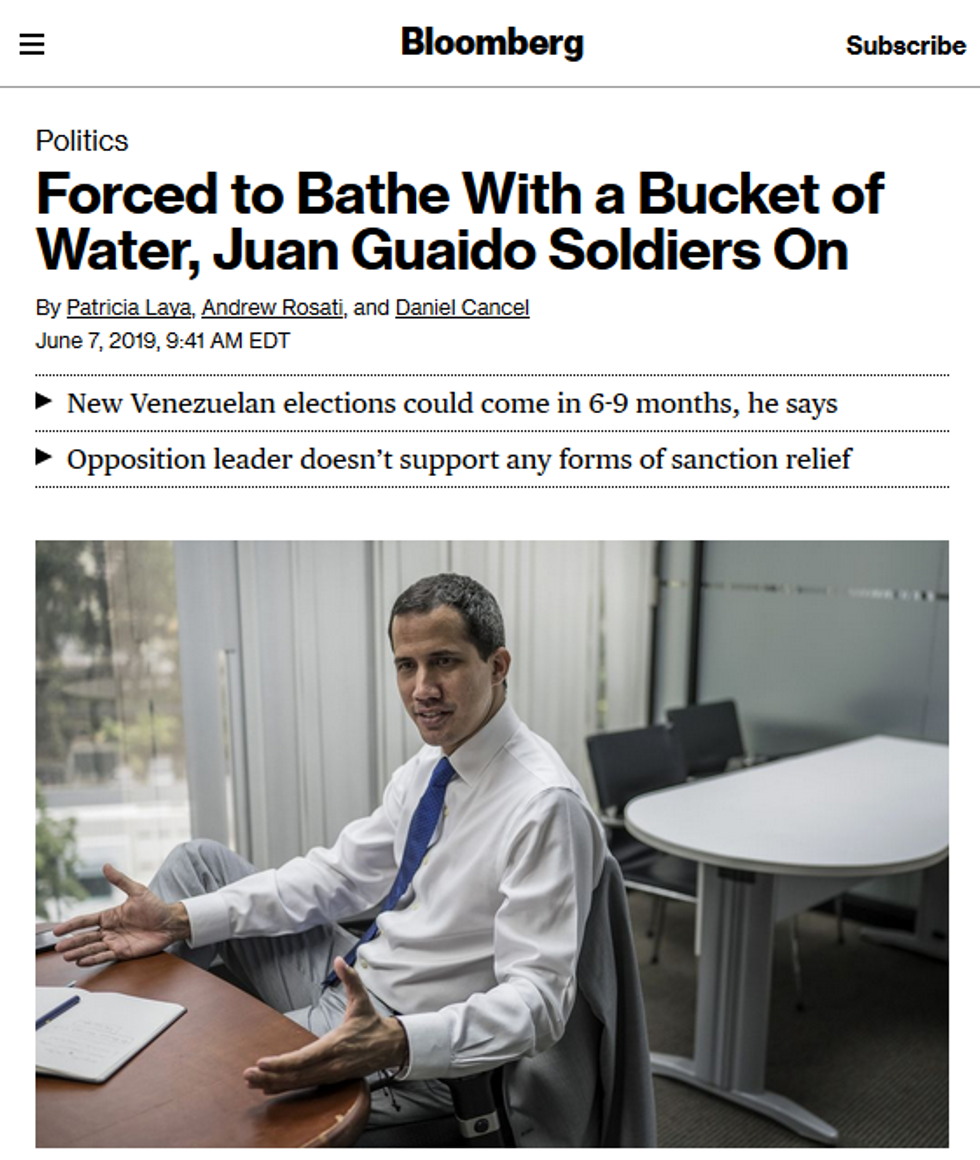
In yet another sign that the US-backed coup is running on empty, corporate journalists' triumphalist tone that followed Guaido's self-proclamation has given way to reports that he "remains defiant" (CNBC, 5/2/19), "soldiers on" (Bloomberg, 6/7/19) or is "under pressure" (Telegraph, 6/19/19).
The growing doubts from the media establishment mirror those in DC, with rumors circulating that Trump is "losing patience and interest" in Venezuela (Washington Post, 6/19/19). Having gone all in on a horse falling rapidly behind in the regime-change race, Secretary of State Mike Pompeo and "special representative" Elliott Abrams are now forced to take turns publicly reiterating US support for Guaido.
The opposition leader's fading luster has not been helped by a corruption scandal that accused his appointed envoys to Colombia of embezzling "humanitarian aid" money. The story was unveiled by the Miami-based and rabidly anti-government outlet PanamPost (6/18/19), and was too big to ignore. All the media could do was try to spin it as "Guaido Calls for Probe" (Reuters, 6/15/19), but the damage was done.
Guaido's failing coup has even led to a few cracks in the refusal of corporate outlets to acknowledge the devastating humanitarian toll of US sanctions on Venezuela since 2017, which were escalated in January when the Trump administration imposed an oil embargo, cutting the country off from its No. 1 cash buyer.
As Joe Emersberger reported for FAIR (6/14/19), on June 9 Reuters finally mentioned a study by economists Mark Weisbrot and Jeffrey Sachs that found US sanctions responsible for as many as 40,000 Venezuelan deaths in 2017-18.
Reuters had buried the report for over a month, and has since reverted to its standard practice of framing the humanitarian impact of US sanctions as a mere allegation by the Maduro administration.
A few exceptions notwithstanding (Financial Times, 7/7/19; Independent, 7/7/19, 4/26/19), the corporate press has all but suppressed the Weisbrot/Sachs report (FAIR.org, 6/26/19), with most outlets portraying Venezuela's economic destruction as a condition preceding US sanctions, imposed first under Obama in 2014-15 and ratcheted up by Trump in 2017.
The New York Times (7/6/19) elevates this mystification into an art form, presenting the collapse of Venezuelan agriculture, largely due to sanctions-induced fuel shortages, as the culmination of "six years of economic crisis under President Nicolas Maduro, whose policies of price controls, expropriations and state-sanctioned embezzlement have wiped out the country's private sector"--which sanctions have merely "worsened." Even more remarkably, the paper of record published an article (5/17/19) interviewing economists on the scale of Venezuela's crisis that managed to avoid quoting any anti-government economists critical of sanctions, such as Francisco Rodriguez, let alone mentioning the Weisbrot/Sachs study.
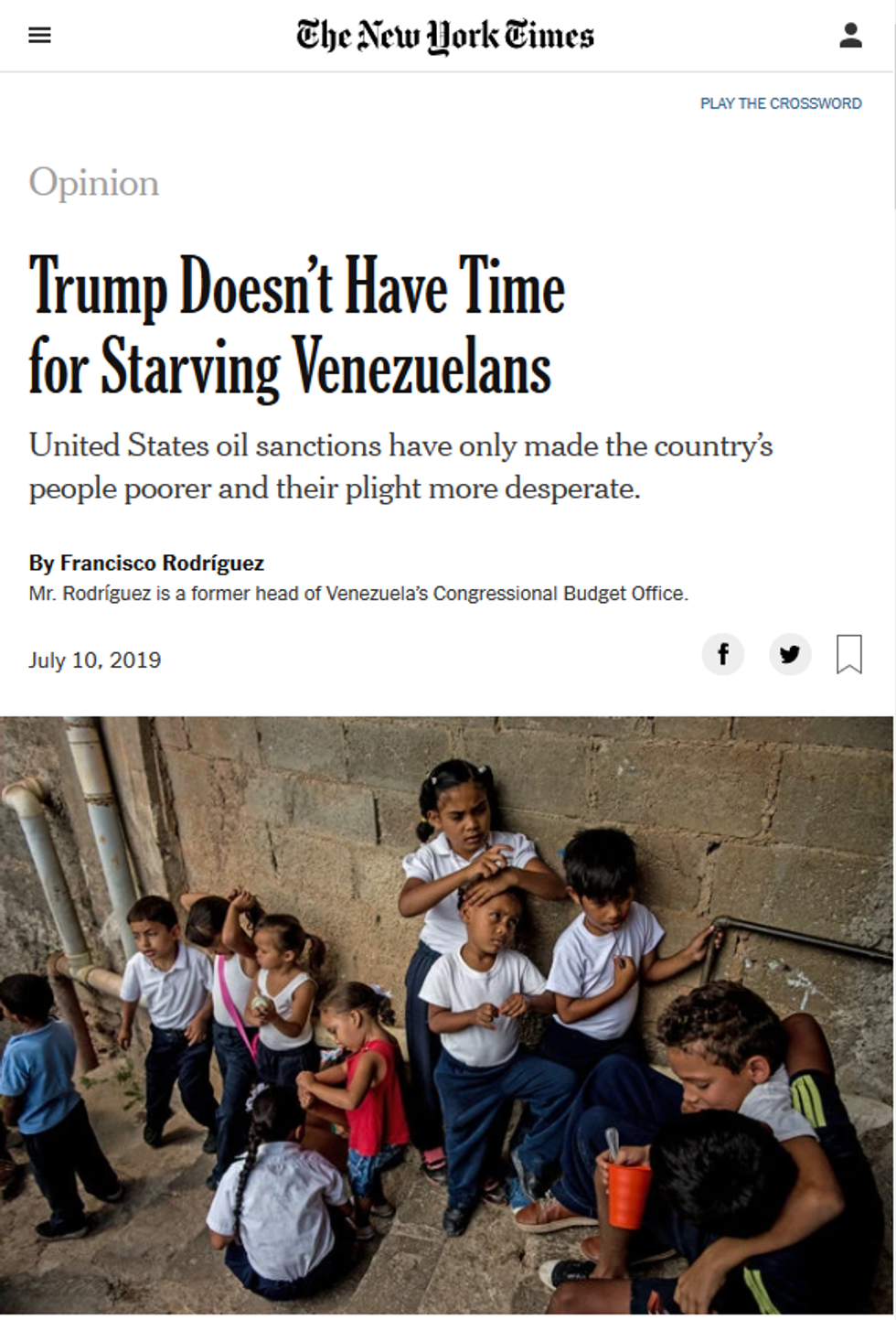
On the op-ed pages, some corporate outlets have been more candid about the danger that US sanctions could cause "famine" in Venezuela (Financial Times, 7/3/19; New York Times, 7/10/19, 2/28/19).
However, only in the Times op-ed by economist Francisco Rodriguez (7/10/19) does the public encounter an acknowledgement of the 2017 sanctions' role in Venezuela's current economic devastation. In other cases, corporate journalists continue to deny or downplay the existence of broad-ranging US economic sanctions all-together, pretending they only affect government officials.
The Guardian (5/21/19) went the farthest, referring to coercive US measures that have hit multiple sectors of the Venezuelan economy and resulted in thousands of deaths as "financial sanctions on Venezuela's president."
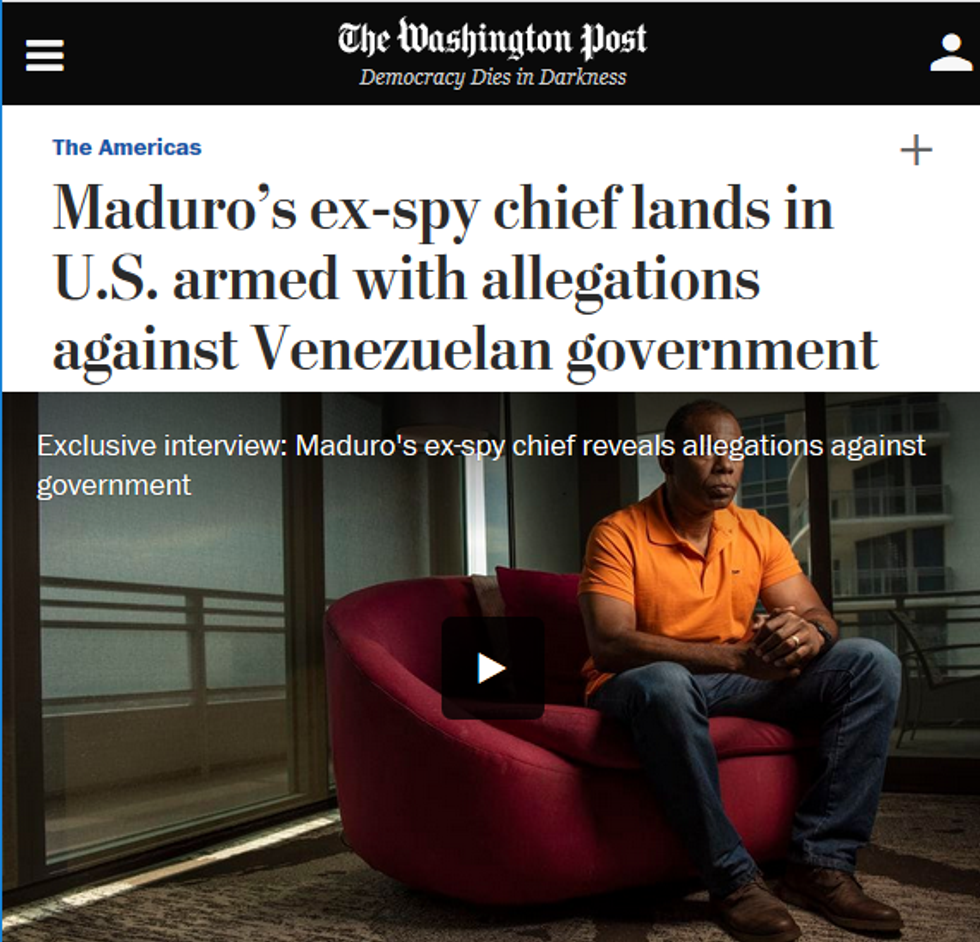
Disappointed by Guaido's fading star, Western reporters have labored to mint new pro-Washington heroes worthy of their regime change fantasies. In the wake of Guaido and Leopoldo Lopez's botched April 30 putsch, corporate media discovered a new champion in former Venezuelan intelligence chief Manuel Cristopher Figuera, who aided in the coup attempt.
In an exclusive interview, the Washington Post (6/24/19) glowingly described Figuera as "a muscular 55-year-old [who] was one of the revolution's true believers." Despite defecting from his country to collaborate with a hostile foreign power, the ex-top spy is heralded as a source of indisputable veracity, whose unsubstantiated claims about Cuban capture of Venezuelan politics (FAIR.org, 3/26/19) or Hezbollah activity in the country (FAIR.org, 5/24/19) are to be taken at face value.
As in the case of former intelligence czar Hugo "El Pollo" Carvajal (New York Times, 2/21/19), currently facing extradition to the US on drug charges, no effort is made to interrogate defectors' incentives to fabricate "information" that just happens to legitimate Washington's casus belli. The ultimate goal is not to prove any nefarious activity, which is highly implausible, but to provide moral justification for regime-change efforts.
In its quest for new anti-Maduro stalwarts, the corporate press does not draw the line at rehabilitating rogue spies "accused of arbitrary detentions and torture." In a remarkable feat of historical revisionism, AP's Joshua Goodman (6/25/19) exalts the "bravery" of former Caracas security chief Ivan Simonovis, who escaped house arrest and fled to the US last month.
Simonovis had been handed a 30-year sentence in 2009 for the death of two people when snipers opened fire at the Llaguno Bridge on April 11, 2002. A total of 19 pro- and anti-government demonstrators were killed in a massacre that Goodman falsely terms a "gunfight," setting the stage for a coup that temporarily ousted President Hugo Chavez.
Goodman ignores that "supercop" Simonovis' Metropolitan Police was notorious for its brutality, with even former chief Jhonny Campos casting doubt on the force's human rights record.
"Venezuela's Metropolitan Police was, without a doubt, the security force most reviled by the poorest members of society," observes George Ciccariello-Maher, an expert on Venezuelan popular movements:
Associated with political repression, drug dealing, kidnapping and rape, the Metropolitan Police was so loathed that residents of working-class barrios often demanded the army be sent in to replace them.
Goodman went on to approvingly cite Simonovis' contracting of former New York Police Commissioner William Bratton, himself accused of criminalizing poor communities with "broken windows" policing.
Western media's newfound doubts about Guaido and reluctant admissions of the deadly effects of sanctions are not a case of journalistic standards starting to take over. Rather, this cognitive dissonance reflects the utter disorientation that has come to characterize Guaido and his US handlers' operation. The end result is journalists, attempting to stay the US regime-change course tainted by Guaido's serial failures, laundering the reputations of the foulest of anti-government figures in the process.
While the mystery of who is responsible for sabotaging the two tankers in the Gulf of Oman remains unsolved, it is clear that the Trump administration has been sabotaging Iranian oil shipments since May 2, when it announced its intention to "bring Iran's oil exports to zero, denying the regime its principal source of revenue." The move was aimed at China, India, Japan, South Korea and Turkey, all nations that purchase Iranian oil and now face U.S. threats if they continue to do so. The U.S. military might not have physically blown up tankers carrying Iranian crude, but its actions have the same effect and should be considered acts of economic terrorists.
The Trump administration is also committing a massive oil heist by seizing $7 billion in Venezuela's oil assets--keeping the Maduro government from getting access to its own money. According to John Bolton, the sanctions on Venezuela will affect $11 billion worth of oil exports in 2019. The Trump administration also threatens shipping companies that carry Venezuelan oil. Two companies--one based in Liberia and the other in Greece--have already been slapped with penalties for shipping Venezuelan oil to Cuba. No gaping holes in their ships, but economic sabotage nonetheless.
Whether in Iran, Venezuela, Cuba, North Korea or one of the 20 countries under the boot of U.S. sanctions, the Trump administration is using its economic weight to try to exact regime change or major policy changes in countries around the globe.
Deadly
The U.S. sanctions against Iran are particularly brutal. While they have utterly failed to advance U.S. regime change goals, they have provoked growing tensions with U.S. trading partners across the world and inflicted terrible pain on the ordinary people of Iran. Although food and medicines are technically exempt from sanctions, U.S. sanctions against Iranian banks like Parsian Bank, Iran's largest non-state-owned bank, make it nearly impossible to process payments for imported goods, and that includes food and medicine. The resulting shortage of medicines is sure to cause thousands of preventable deaths in Iran, and the victims will be ordinary working people, not Ayatollahs or government ministers.
U.S. corporate media have been complicit in the pretense that U.S. sanctions are a non-violent tool to inflict pressure on targeted governments in order to force some kind of democratic regime change. U.S. reports rarely mention their deadly impact on ordinary people, instead blaming the resulting economic crises solely on the governments being targeted.
The deadly impact of sanctions is all too clear in Venezuela, where crippling economic sanctions have decimated an economy already reeling from the drop in oil prices, opposition sabotage, corruption and bad government policies. A joint annual report on mortality in Venezuela in 2018 by three Venezuelan universities found that U.S. sanctions were largely responsible for at least 40,000 additional deaths that year. The Venezuela Pharmaceutical Association reported an 85% shortage of essential medicines in 2018.
Absent U.S. sanctions, the rebound in global oil prices in 2018 should have led to at least a small rebound in Venezuela's economy and more adequate imports of food and medicine. Instead, U.S. financial sanctions prevented Venezuela from rolling over its debts and deprived the oil industry of cash for parts, repairs and new investment, leading to an even more dramatic fall in oil production than in the previous years of low oil prices and economic depression. The oil industry provides 95% of Venezuela's foreign earnings, so by strangling its oil industry and cutting Venezuela off from international borrowing, the sanctions have predictably - and intentionally - trapped the people of Venezuela in a deadly economic downward spiral.
A study by Jeffrey Sachs and Mark Weisbrot for the Center for Economic and Policy Research, titled "Sanctions as Collective Punishment: the Case of Venezuela," reported that the combined effect of the 2017 and 2019 U.S. sanctions are projected to lead to an astounding 37.4% decline in Venezuela's real GDP in 2019, on the heels of a 16.7% decline in 2018 and the over 60% drop in oil prices between 2012 and 2016.
In North Korea, many decades of sanctions, coupled with extended periods of drought, have left millions of the nation's 25 million people malnourished and impoverished. Rural areas in particular lack medicine and clean water. Even more stringent sanctions imposed in 2018 banned most of the country's exports, reducing the government's ability to pay for imported food to alleviate the shortages.
Illegal
One of the most egregious elements of U.S. sanctions is their extraterritorial reach. The U.S. slaps third-country businesses with penalties for "violating" U.S. sanctions. When the U.S. unilaterally left the nuclear deal and imposed sanctions, the U.S. Treasury Department bragged that in just one day, November 5, 2018, it sanctioned more than 700 individuals, entities, aircraft, and vessels doing business with Iran. Regarding Venezuela, Reuters reported that in March 2019 the State Department had "instructed oil trading houses and refiners around the world to further cut dealings with Venezuela or face sanctions themselves, even if the trades made are not prohibited by published U.S. sanctions."
An oil industry source complained to Reuters, "This is how the United States operates these days. They have written rules, and then they call you to explain that there are also unwritten rules that they want you to follow."
U.S. officials say that sanctions will benefit the people of Venezuela and Iran by pushing them to rise up and overthrow their governments. Since the use of military force, coups and covert operations to overthrow foreign governments have proven catastrophic in Afghanistan, Iraq, Haiti, Somalia, Honduras, Libya, Syria, Ukraine and Yemen, the idea of using the dominant position of the U.S. and the dollar in international financial markets as a form of "soft power" to achieve "regime change" may strike U.S. policymakers as an easier form of coercion to sell to a war-weary U.S. public and uneasy allies.
But shifting from the "shock and awe" of aerial bombardment and military occupation to the silent killers of preventable diseases, malnutrition and extreme poverty is far from a humanitarian option, and no more legitimate than the use of military force under international humanitarian law.
Denis Halliday was a UN Assistant Secretary General who served as Humanitarian Coordinator in Iraq and resigned from the UN in protest at the brutal sanctions on Iraq in 1998.
"Comprehensive sanctions, when imposed by the UN Security Council or by a State on a sovereign country, are a form of warfare, a blunt weapon that inevitably punishes innocent citizens," Denis Halliday told us. "If they are deliberately extended when their deadly consequences are known, sanctions can be deemed genocide. When U.S. Ambassador Madeleine Albright said on CBS 'Sixty Minutes' in 1996 that killing 500,000 Iraqi children to try to bring down Saddam Hussein was 'worth it,' the continuation of UN sanctions against Iraq met the definition of genocide."
Today, two UN Special Rapporteurs appointed by the UN Human Rights Council are serious independent authorities on the impact and illegality of U.S. sanctions on Venezuela, and their general conclusions apply equally to Iran. Alfred De Zayas visited Venezuela soon after the imposition of U.S. financial sanctions in 2017 and wrote an extensive report on what he found there. He found significant impacts due to Venezuela's long-term dependence on oil, poor governance and corruption, but he also strongly condemned U.S. sanctions and "economic warfare."
"Modern-day economic sanctions and blockades are comparable with medieval sieges of towns," De Zayas wrote. "Twenty-first century sanctions attempt to bring not just a town, but sovereign countries to their knees." De Zayas's report recommended that the International Criminal Court should investigate U.S. sanctions against Venezuela as a crime against humanity.
A second UN Special Rapporteur, Idriss Jazairy, issued a forceful statement in response to the failed U.S-backed coup in Venezuela in January. He condemned "coercion" by outside powers as a "violation of all norms of international law." "Sanctions which can lead to starvation and medical shortages are not the answer to the crisis in Venezuela," Jazairy said, "...precipitating an economic and humanitarian crisis...is not a foundation for the peaceful settlement of disputes."
Sanctions also violate Article 19 of the Charter of the Organization of American States, which explicitly prohibits intervention "for any reason whatever, in the internal or external affairs of any other State." It adds that it "prohibits not only armed force but also any other form of interference or attempted threat against the personality of the State or against its political, economic, and cultural elements."
Article 20 of the OAS Charter is equally pertinent: "No State may use or encourage the use of coercive measures of an economic or political character in order to force the sovereign will of another State and obtain from it advantages of any kind."
In terms of U.S. law, both the 2017 and 2019 sanctions on Venezuela are based on unsubstantiated presidential declarations that the situation in Venezuela has created a so-called "national emergency" in the United States. If U.S. federal courts were not so afraid to hold the executive branch accountable on matters of foreign policy, this could be challenged and very likely dismissed by a federal court even more quickly and easily than the similar case of a "national emergency" on the Mexican border, which is at least geographically connected to the United States.
Ineffective
There is one more critical reason for sparing the people of Iran, Venezuela and other targeted countries from the deadly and illegal impacts of U.S. economic sanctions: they don't work.
Twenty years ago, as economic sanctions slashed Iraq's GDP by 48% over 5 years and serious studies documented their genocidal human cost, they still failed to remove the government of Saddam Hussein from power. Two UN Assistant Secretaries General, Denis Halliday and Hans Von Sponeck, resigned in protest from senior positions at the UN rather than enforce these murderous sanctions.
In 1997, Robert Pape, then a professor at Dartmouth College, tried to resolve the most basic questions about the use of economic sanctions to achieve political change in other countries by collecting and analyzing the historical data on 115 cases where this was tried between 1914 and 1990. In his study, titled "Why Economic Sanctions Do Not Work," he concluded that sanctions had only been successful in 5 out of 115 cases.
Pape also posed an important and provocative question: "If economic sanctions are rarely effective, why do states keep using them?"
He suggested three possible answers:
We think that the answer is probably a combination of "all of the above." But we firmly believe that no combination of these or any other rationale can ever justify the genocidal human cost of economic sanctions in Iraq, North Korea, Iran, Venezuela or anywhere else.
While the world condemns the recent attacks on the oil tankers and tries to identify the culprit, global condemnation should also focus on the country responsible for the deadly, illegal and ineffective economic warfare at the heart of this crisis: the United States.
Big media have got some big things wrong on Venezuela. Who can forget CNN's May 5 claim that "pressure is mounting on Maduro to step down, following elections in January in which voters chose opposition leader Juan Guaido over him for president"?
As Dave Lindorff noted for FAIR.org, six reporters were credited for the story that contained this line. And none of them, or their editors, evidently knew that Guaido was not a candidate in presidential elections, which took place in May 2018, not January 2019; and which Nicolas Maduro won with 68 percent of the vote--an observer-endorsed, and credible, total, given the opposition's boycott of the balloting.
Guaido was a member of the National Assembly--which has been suspended by the Venezuelan Supreme Court--and he was chosen as president by himself, and ultimately by the Trump administration. As for "pressure...mounting on Maduro," Lindorff called that a "dubious reading of the post-coup attempt political terrain"--a view borne out by events.
A fortiori, elite media's fervent transmission of the dramatic story that Maduro was heartlessly blocking a bridge to turn away truckloads of much-needed foreign aid. "Humanitarian Aid Arrives for Venezuela--But Maduro Blocks It," was NPR's tagline; NPR was far from alone in not telling listeners that the bridge (with Colombia) described as blocked had never been open; that the Red Cross and UN, among others, had explicitly asked the US not to engage in these types of PR stunts; and that the Venezuelan government has a very rational reason to suspect the US would use humanitarian aid as a cover to smuggle in weapons to foment armed conflict, which is that the person running quarterback for Trump on the current Venezuela operation, Elliott Abrams, literally did just that 30 years ago.
Venezuela coverage suggests journalistic rigor is taking a backseat to whatever alchemy of profit protection and state fealty motivates elite media and, with valuable exceptions, shapes their presentation of events. But not just in these big, overt screwups, but in the drip drip drip of everyday coverage, the constructions used in ostensibly neutral accounts.
FAIR contributor Joe Emersberger recently engaged with Reuters about a May 22 article, "Venezuela Turns to Russia, Cuba, China in Health Crisis," which included the statement, about shortages of medicine and medical equipment, that:
the opposition blames that on economic incompetence and corruption by the leftist movement in power for two decades, but Maduro says US economic sanctions are the cause.
Emersberger asked the reporter, Stephanie Nebehay, why the piece made no mention of a study released a month ago by economists Mark Weisbrot and Jeffrey Sachs, which directly linked US sanctions to 40,000 deaths in Venezuela since August of 2017. She said she wasn't aware of the study--which is unsurprising, if she relied on her own outlet. As Emersberger pointed out, the news agency hadn't mentioned the study since it was released, despite the fact that it had been intensely debated in public by Venezuelan opposition economists--in other words, the kind of people Reuters and other Western media actually pay attention to on Venezuela.
Reuters did finally mention the study, in a June 9 piece by Nebehay. But the very next day, and since then, they and other outlets have continued, with occasional (and, again, valuable) exceptions, to portray the severe impact of US sanctions as an allegation, and one that only Maduro and other (presumably self-interested) Venezuelan officials have made.
The cynicism of that formulation is clear enough, but corporate media also report widely on Sen. Marco Rubio, who gleefully tweeted on May 16 that Maduro "can't access funds to rebuild electric grid."
Rubio didn't pretend he was referring to an imaginary electric grid used exclusively by Maduro. Reuters has itself referred to Rubio as the "leading voice in the crafting of President Donald Trump's Venezuela policy." But as Emersberger notes, that lengthy piece about US sanctions said absolutely nothing about their impact on the general population--with statements like "being blacklisted also crimps the lifestyle of Venezuelan officials' families" implying throughout that sanctions only affect the powerful. All the more reason, were it needed, to remember that when you're reading about official enemies, sometimes you may be getting less than half the story.
I emailed Stephanie Nebehay of Reuters on May 22 about her article, "Venezuela Turns to Russia, Cuba, China in Health Crisis" (5/22/19). Her article depicted the impact of US sanctions as an allegation that Venezuelan government officials are alone in making. The article stated:
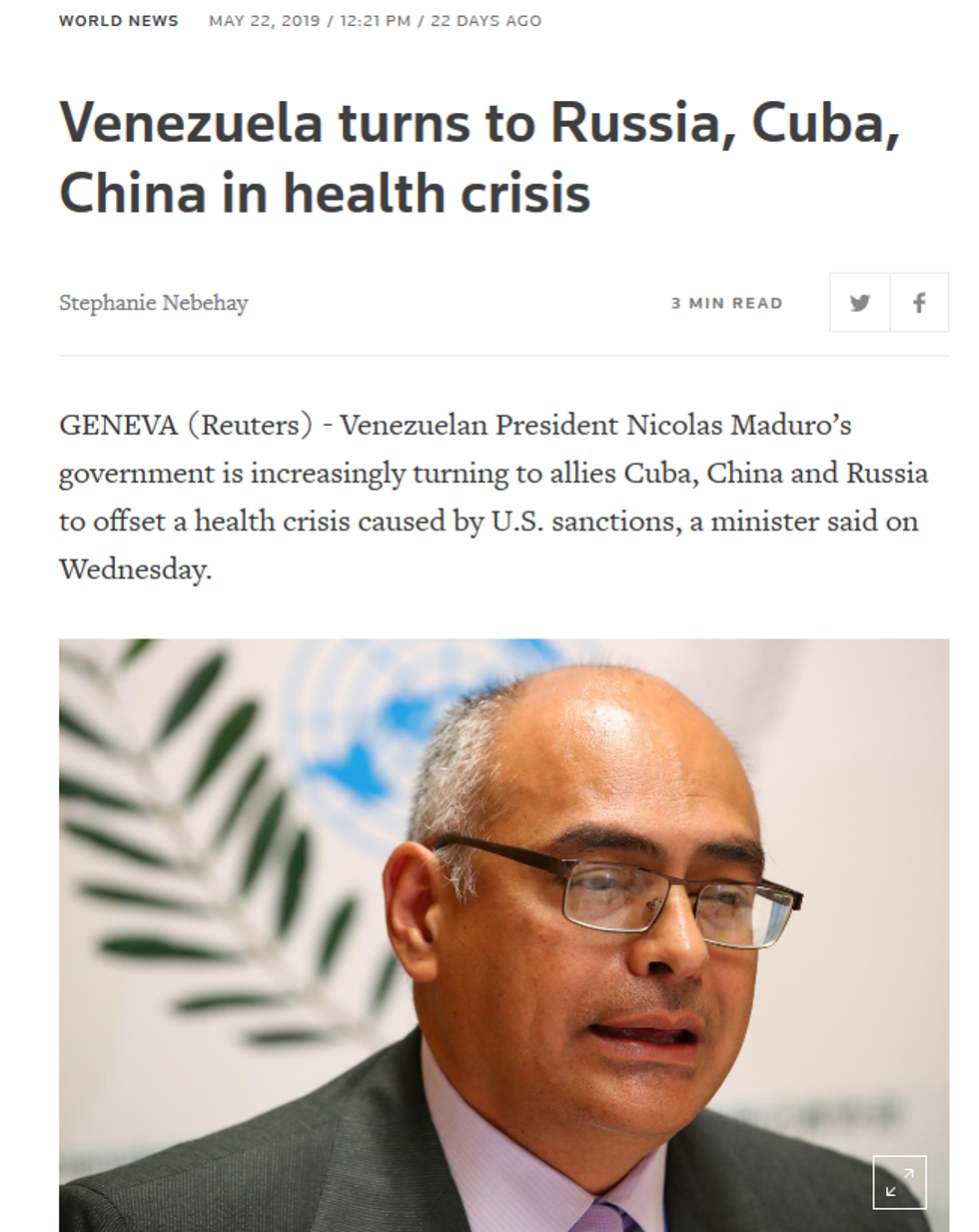
The opposition blames [medical shortages] on economic incompetence and corruption by the leftist movement in power for two decades, but [President Nicolas] Maduro says US economic sanctions are the cause.
I asked why the piece made no mention of a study (CEPR, 4/25/19) released a month earlier by economists Mark Weisbrot and Jeffrey Sachs, which directly linked US sanctions to 40,000 deaths in Venezuela since August of 2017.
Her reply to me on May 23 was quite telling:
I was not aware of that study, but am now and will bear in mind.
It would indeed have been impossible for a Reuters reporter to be aware of the study if they depended only on Reuters articles to keep informed. The news agency hadn't mentioned the study since it was released, never mind written an article about it.
I asked a contact I have at Reuters about this, and he was also surprised that Reuters hadn't even mentioned the study. He suggested I query some of Reuters' Venezuela-based reporters, which I did a few days later.
In my email to them, I passed along a list of news articles since August 2017, when Trump first dramatically intensified economic sanctions, that described worsening economic conditions. I also noted that though the Sachs/Weisbrot study was ignored by Reuters, it had been intensely debated in public by Venezuelan opposition economists (i.e., the kind of people Reuters and other Western media actually pay attention to on Venezuela).
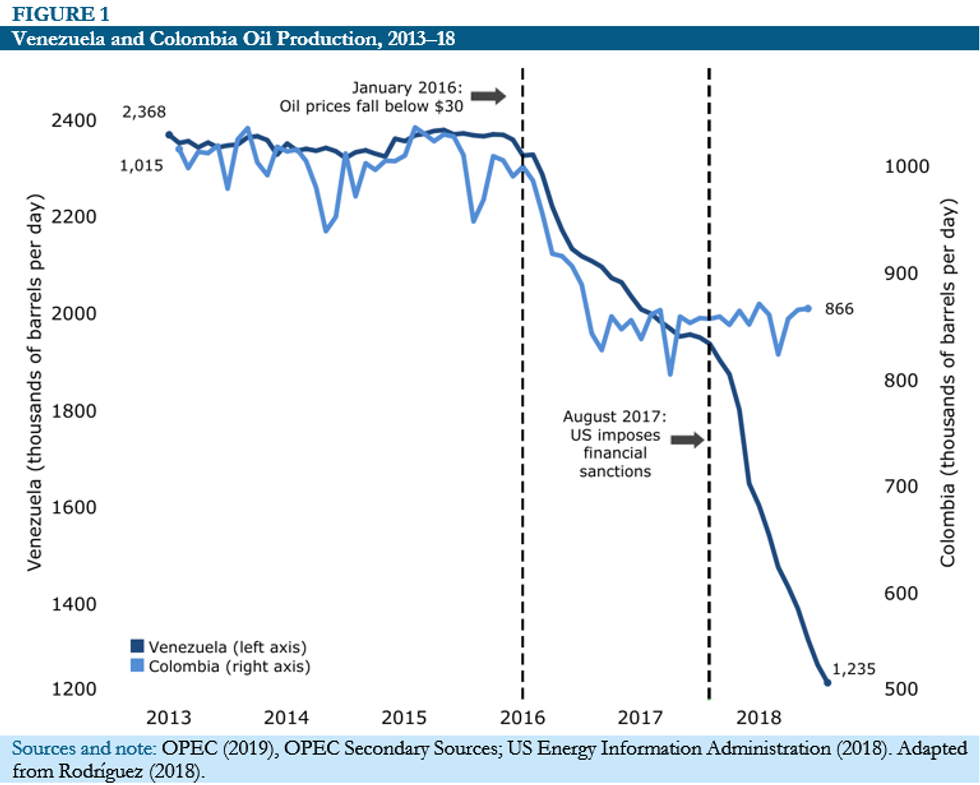
The Brookings Institution published a few rebuttals to the study (here and here), which I also pointed out to Reuters. The objections Brookings made were essentially already addressed by Weisbrot and Sachs in response to other critics.
On June 9, Reuters finally mentioned the study, at the end of an article by Nebehay, who is based in Geneva:
One study in April, co-authored by US economists Jeffrey Sachs and Mark Weisbrot, blamed sanctions for causing more deaths and disproportionately hitting the most vulnerable.
"We find that the sanctions have inflicted, and increasingly inflict, very serious harm to human life and health, including an estimated more than 40,000 deaths from 2017-2018," they said, arguing they were illegal under international law.
Nevertheless, since the day Nebehay replied to me, Reuters has continued to portray the severe impact of US sanctions as an allegation that only Maduro and other Venezuelan officials have made. It was even done by Reuters in an article published June 10, the day after the wire service finally mentioned the study:
The government of President Nicolas Maduro says Venezuela's economic problems are caused by US sanctions that have crippled the OPEC member's export earnings and blocked it from borrowing from abroad.
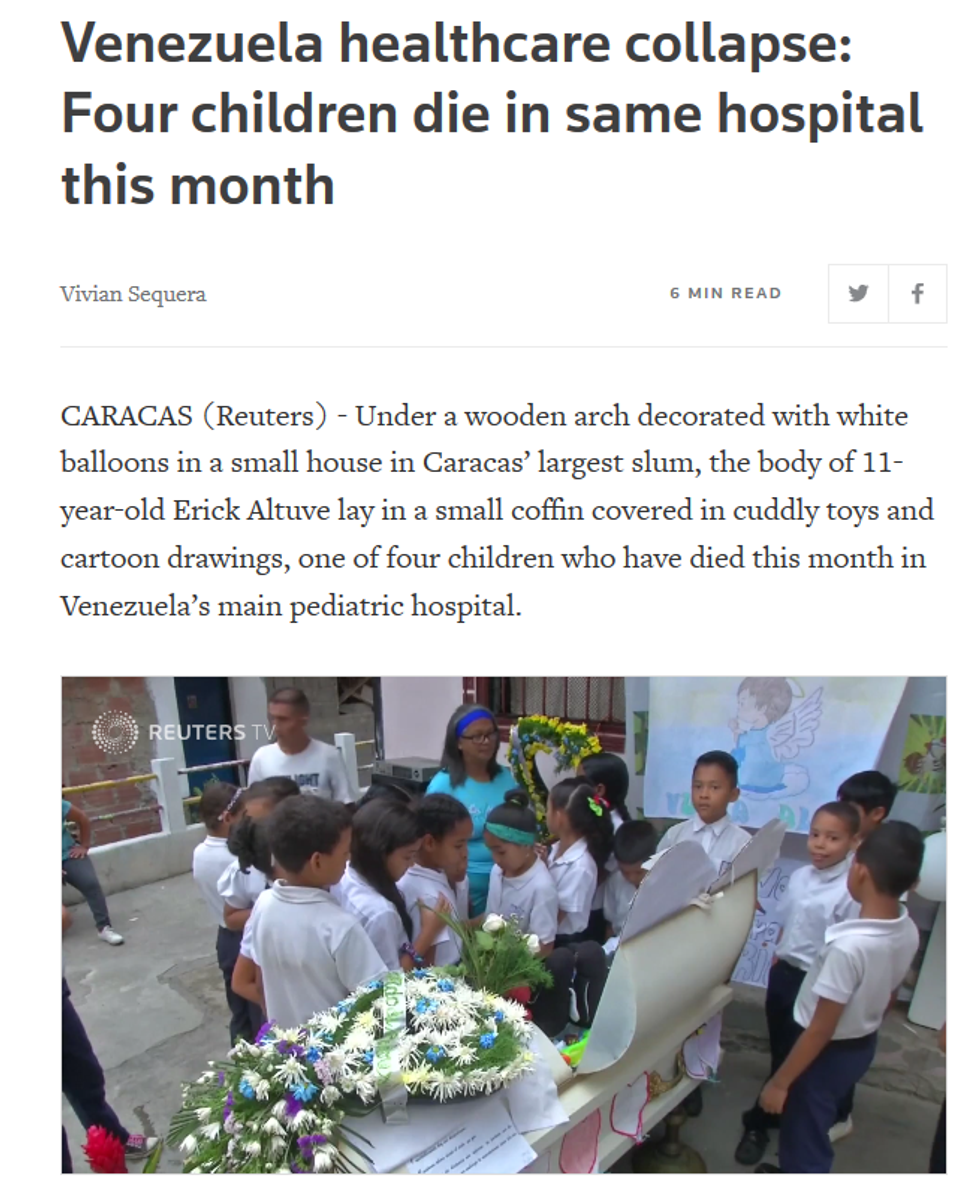
Other instances of Reuters representing the idea that US sanctions work as they are intended to do--in other words, that they hurt the Venezuelan economy--as an allegation made by Maduro or his government:
Two recent articles by Reuters, however, stated the obvious about the most recent US sanctions that were implemented in 2019:
But the study Reuters belatedly mentioned shows that US sanctions have been devastating to Venezuela's economy, and seriously aggravating the humanitarian crisis, since August 2017.
Apologists for Trump always rush to say that Venezuela's depression began years before Trump's sanctions--as if that made it acceptable to deliberately worsen a humanitarian crisis. To tweak an analogy Caitlin Johnstone used, think of a defense attorney saying, "Your Honor, I will show that the victim was already in intensive care when my client began to assault him."
Moreover, as Steve Ellner recently discussed, US support for an insurrectionist opposition in Venezuela goes back over a decade before the crisis, and was a factor in causing it. Economic sanctions Obama introduced in 2015 were also harmful--Weisbrot (The Hill, 11/6/16) in 2016 called them "ugly and belligerent enough to keep many investors from investing in Venezuela and to raise the country's cost of borrowing"--even before Trump's dramatic escalation of economic warfare that they paved the way for.
Putting aside a study by prominent US economists, the "Maduro says" formulation is also inexcusable because US Sen. Marco Rubio, who has been widely reported as a major influence on Trump's Venezuela policy, gleefully tweeted on May 16 that Maduro "can't access funds to rebuild electric grid."
Rubio didn't pretend he was referring to an imaginary electric grid used exclusively by Maduro. Reuters (5/30/19) has itself referred to Rubio as the "leading voice in the crafting of President Donald Trump's Venezuela policy," in a lengthy piece about US sanctions that said absolutely nothing about their impact on the general population, implying throughout that sanctions only impacted Maduro and other officials. ("Being blacklisted also crimps the lifestyle of Venezuelan officials' families," Reuters reported.)
My fellow FAIR contributor, Alan MacLeod, interviewed many Venezuela-based journalists for his book Bad News From Venezuela. He wrote last year (FAIR.org, 5/24/18):
Media copy and paste from news organizations like Reuters and Associated Press, which themselves employ many cheaper local journalists.
In Venezuela, these journalists are not neutral actors, but come from the highly partisan local media, affiliated with the opposition, leading to a situation where Western newsrooms see themselves as an ideological spearhead against Maduro, "the resistance" to the government.
Even worse than being the "resistance" to Maduro is that Reuters has often made itself the "assistance" to politicians like Rubio, who are vicious enough to celebrate the economic strangulation of millions of people.
Reuters may carry on as if it had never reported the study by Weisbrot and Sachs. Western media outlets are perfectly willing to ignore their own reporting when it suits powerful interests (Extra! Update, 10/02). It is therefore up to all of us to not be passive consumers of news, and continually bear in mind that the news we are getting about official enemies may be less than half the story.