Greetings from Michigan—I last wrote one of these dispatches on Sunday, from Kansas; since then I’ve been in Texas, where the remarkable James Talarico is apparently locked in a dead-heat race with the execrable Ken Paxton; now I’m headed to greater Lansing with my Third Act colleagues to try and boost the Senate fortunes of Abdul el-Sayed and the House race of Will Lawrence, once a founder of the Sunrise Movement. (If you want to join us, here’s the info). So you might say I’m taking this election seriously.
More seriously than I wish we had to. In democratic societies elections should always be important. But they shouldn’t, ideally, be the deciding factor between continued stability and whatever kind of creeping fascism we’re playing with. And they certainly shouldn’t be determining questions of planetary survival. But they are.
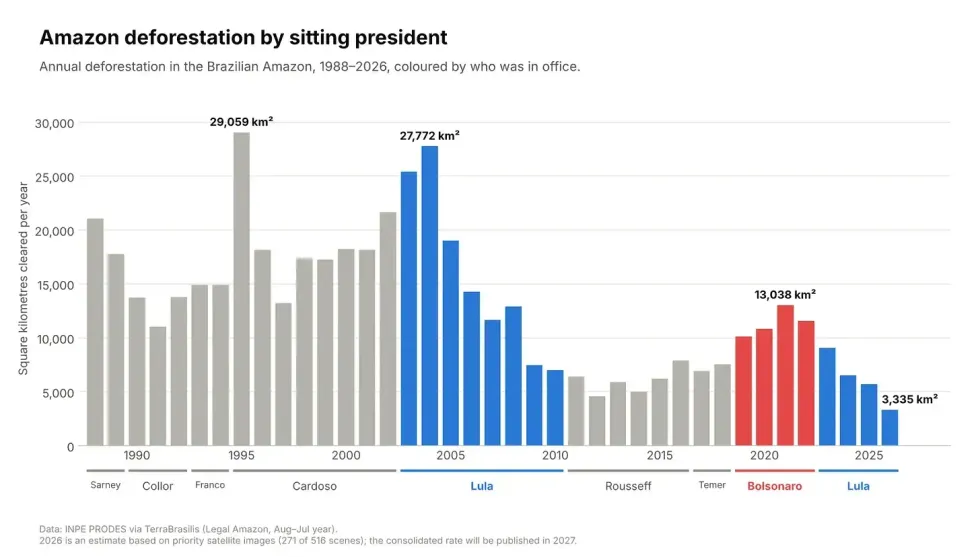
The chart above shows the rate of deforestation in the Amazon; it comes ahead of Sunday’s contest between the next Bolsonaro (think chainsaw) and the incumbent, Luiz Inácio Lula da Silva (think standing tree). As George Monbiot writes in The Guardian Thursday morning:
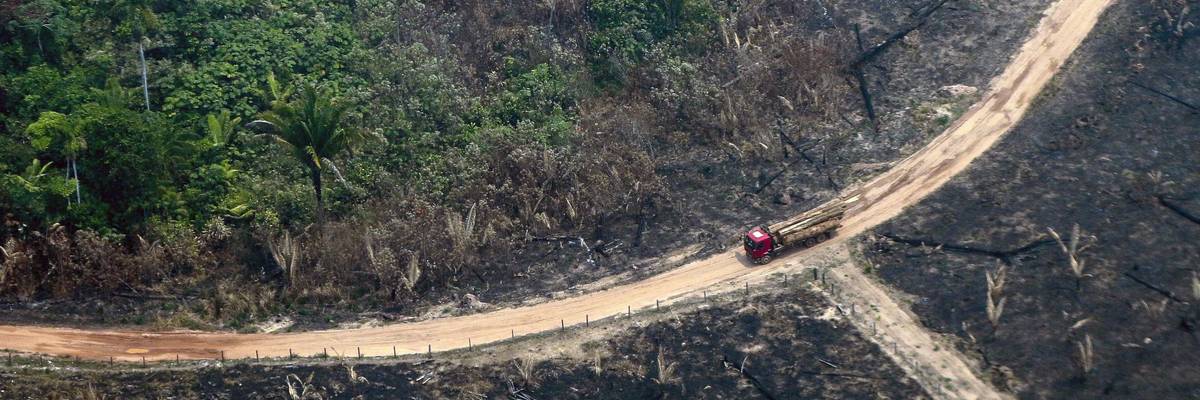
Physically and politically, Flávio Bolsonaro is the spitting image of his father, the jailed coup-plotter, Jair. When Jair Bolsonaro was president of Brazil, he appeared to see ecological destruction as a kind of a holy duty. The deforestation rate rose by 59% in his four years, and attacks on Indigenous people and other forest defenders, as well as invasions by illegal ranchers, loggers, and goldminers rocketed. The crudest forms of extractivism—regardless of their costs, or how they might hold back all kinds of progress—were a matter of policy.
The ideology of the far-right in Brazil has been described as “beef, Bible, and bullets”: violence against those who resist the seizure of their resources, an ultra-conservative evangelism, and the expansion of cattle ranching, which is both a potent symbol of far-right machismo and the primary driver of deforestation in the Amazon.
If you combine this with the knowledge that we’re very very near a tipping point in the Amazon, you start to get worried. The Amazon rainforest is almost an organism itself—it in essence generates half its own rainfall, recycling rainwater five to six times as air moves east to west across it. As early as 2018, my old friend, the dearly missed Tom Lovejoy, and his collaborator Carlos Nobre had a paper in Science that concluded:
We believe that negative synergies between deforestation, climate change, and widespread use of fire indicate a tipping point for the Amazon system to flip to non-forest ecosystems in eastern, southern, and central Amazonia at 20-25% deforestation.
The severity of the droughts of 2005, 2010, and 2015-16 could well represent the first flickers of this ecological tipping point. These events, together with the severe floods of 2009, 2012, (and 2014 over SW Amazonia), suggest that the whole system is oscillating. For the last two decades the dry season over the southern and eastern Amazon has been increasing. Large scale factors such as warmer sea surface temperatures over the tropical North Atlantic also seem to be associated with the changes on land.
Here’s what Nobre told the Times this week:
Legal deforestation, he said, put the Amazon at “total risk” and could sharply reduce rainfall throughout much of South America, threatening Brazilian agriculture and global food prices. Brazil is the world’s second-largest food exporter and could surpass the United States this year. “We are going to lose all of this,” Mr. Nobre said.
We may lose even more. It’s not at all clear that the Earth’s climate system can function if the Amazon begins to break down—along with the poles, it’s one of the planet’s handful of truly keystone physical systems. That its fate depends on an election is terrifying. Needless to say, the usual cast of characters like Elon Musk are allied with the chainsaw in this one. But of course Musk, fresh off his breathtaking betrayal of the Ukrainian people, is playing an even more critical role in America’s elections. As Laurent Belsie pointed out this week, the reason that Talarico may lose is largely down to this one man:
Mr. Musk’s biggest donation was $158 million to the GOP’s Senate Leadership Fund, which put that same amount into the Senate race in Texas—where Mr. Musk’s companies are based. On X, Mr. Musk has been urging people to vote for Texas Attorney General Ken Paxton, saying, “The fate of Texas and America is at stake.”
But more’s at stake even than that. Here’s this week’s United Nations Environment Programme report (titled, with more wit than usual for these things, The Point of Return) about just how far we’re overshooting the Paris climate accords. What it demonstrates is that the election of President Donald Trump plays an outsized role in keeping us from having a fighting chance. The venerable Seth Borenstein of The Associated Press headlined his story (a lesson for other headline writers) “US Is a Big Reason for the World Losing Ground in the Fight Against Climate Change, UN Report Says.”
In just a year, the projections for how much temperatures will rise even if governments keep their pledges has risen by two tenths of a degree Celsius—on a world where every tenth of a degree pushes another 140 million human souls into a dangerously hot zone. Here’s how Borenstein described it:
If all the countries do what they promise to reduce heat-trapping emissions, Earth will likely still warm another 2.2°F (1.2°C) above current temperatures, according to Wednesday’s update of climate calculations by the United Nations Environment Programme. That’s about two-tenths of a degree Fahrenheit (0.1°Ce) more than last year’s projections by the same science team.
“This is a worse outcome than expected last year, as a result of the formal withdrawal of the United States of America from the Paris Agreement and revised estimates of historical emissions,” the report said. The report also blames the United States for increased emissions last year, saying all the other top 20 major economies reduced their carbon pollution or at least slowed the growth in how much carbon dioxide was spewed from the burning of coal, oil, and gas.
“In terms of magnitude, the increase in the United States of America (133 megatons of CO2 equivalent) far exceeded that of all other countries and was driven by increased electricity demand and a rebound of coal power generation,” the report said. The 124 countries that increased emissions—not counting the 63 that decreased like most European nations—added 189 million tons of carbon dioxide in 2025, and 70% of that increase came from the US, according to the report.
Almost nobody who voted for Trump in 2024 thought (or, to be frank) cared that this would be the outcome. But that’s what happens on a world that is far too finely balanced. So we fight as hard as we can.
And we do it with some real champions in contention.
Brad Lander, for instance—Ayana Johnson just released the excellent conversation the two of us had with the soon-to-be New York representative, who will enter Congress as probably its most knowledgeable member about the connection between climate and finance. (Lander, to his immense credit, was detained by Israeli Defense Forces Wednesday for helping protect Palestinians who wanted to harvest their olives in the face of violence from West Bank settlers. He’s now safely out).
Or Justin Pearson. The Tennessee state rep, who led opposition to the Byhalia Pipeline and to Elon Musk’s Memphis AI pollution factory, seemed to have an inside track for a congressional seat until the Supreme Court gutted the Voting Rights Act this summer—Tennessee immediately redistricted to try and turn its congressional delegation lily-white. But Pearson is putting up a creditable fight in his Trump +20 district. As Katherine Burgess reports, analysts say:
Pearson’s longstanding opposition to data centers and other industrial polluters gives him credibility as he challenges [Brent] Taylor, who was an early supporter of Colossus 1 and received $10,000 in campaign funding from a political action committee associated with SpaceXAI.
Or in New York’s Hudson Valley, where embattled GOP incumbent Mike Lawler has been trying to save his seat with an attack on New York City’s congestion pricing law. As Charles Komanoff points out, he’s not very good at math:
Since Trump launched his war on Iran, the 260,000 households in NY-17 have coughed up $102 million more for gasoline—$390 per household—than they would have paid in the absence of the war. That collective toll, if you will, exceeds by 75% the $58 million they’ve paid in New York congestion charges (including surcharges on cab rides) since congestion pricing commenced in early 2025 (again, see the methodology below).
I’m hopeful Lawler’s opponent, Cait Conley, can beat him—she’s a West Point grad with three Bronze Stars.
Indeed I’m hopeful in lots of places—but I’m afraid to hope too. At this point our job is just to run through the tape, doing our level best wherever we are to win the last possible votes. (And then defend the election). If you have some money to spare, find a race to help. (The Environmental Voter Project is a good place to start). If you have some hours to spare, spend them phone banking. Work as if the planet depends on it, because sadly it does.
Greetings from Michigan—I last wrote one of these dispatches on Sunday, from Kansas; since then I’ve been in Texas, where the remarkable James Talarico is apparently locked in a dead-heat race with the execrable Ken Paxton; now I’m headed to greater Lansing with my Third Act colleagues to try and boost the Senate fortunes of Abdul el-Sayed and the House race of Will Lawrence, once a founder of the Sunrise Movement. (If you want to join us, here’s the info). So you might say I’m taking this election seriously.
More seriously than I wish we had to. In democratic societies elections should always be important. But they shouldn’t, ideally, be the deciding factor between continued stability and whatever kind of creeping fascism we’re playing with. And they certainly shouldn’t be determining questions of planetary survival. But they are.
The chart above shows the rate of deforestation in the Amazon; it comes ahead of Sunday’s contest between the next Bolsonaro (think chainsaw) and the incumbent, Luiz Inácio Lula da Silva (think standing tree). As George Monbiot writes in The Guardian Thursday morning:
Physically and politically, Flávio Bolsonaro is the spitting image of his father, the jailed coup-plotter, Jair. When Jair Bolsonaro was president of Brazil, he appeared to see ecological destruction as a kind of a holy duty. The deforestation rate rose by 59% in his four years, and attacks on Indigenous people and other forest defenders, as well as invasions by illegal ranchers, loggers, and goldminers rocketed. The crudest forms of extractivism—regardless of their costs, or how they might hold back all kinds of progress—were a matter of policy.
The ideology of the far-right in Brazil has been described as “beef, Bible, and bullets”: violence against those who resist the seizure of their resources, an ultra-conservative evangelism, and the expansion of cattle ranching, which is both a potent symbol of far-right machismo and the primary driver of deforestation in the Amazon.
If you combine this with the knowledge that we’re very very near a tipping point in the Amazon, you start to get worried. The Amazon rainforest is almost an organism itself—it in essence generates half its own rainfall, recycling rainwater five to six times as air moves east to west across it. As early as 2018, my old friend, the dearly missed Tom Lovejoy, and his collaborator Carlos Nobre had a paper in Science that concluded:
We believe that negative synergies between deforestation, climate change, and widespread use of fire indicate a tipping point for the Amazon system to flip to non-forest ecosystems in eastern, southern, and central Amazonia at 20-25% deforestation.
The severity of the droughts of 2005, 2010, and 2015-16 could well represent the first flickers of this ecological tipping point. These events, together with the severe floods of 2009, 2012, (and 2014 over SW Amazonia), suggest that the whole system is oscillating. For the last two decades the dry season over the southern and eastern Amazon has been increasing. Large scale factors such as warmer sea surface temperatures over the tropical North Atlantic also seem to be associated with the changes on land.
Here’s what Nobre told the Times this week:
Legal deforestation, he said, put the Amazon at “total risk” and could sharply reduce rainfall throughout much of South America, threatening Brazilian agriculture and global food prices. Brazil is the world’s second-largest food exporter and could surpass the United States this year. “We are going to lose all of this,” Mr. Nobre said.
We may lose even more. It’s not at all clear that the Earth’s climate system can function if the Amazon begins to break down—along with the poles, it’s one of the planet’s handful of truly keystone physical systems. That its fate depends on an election is terrifying. Needless to say, the usual cast of characters like Elon Musk are allied with the chainsaw in this one. But of course Musk, fresh off his breathtaking betrayal of the Ukrainian people, is playing an even more critical role in America’s elections. As Laurent Belsie pointed out this week, the reason that Talarico may lose is largely down to this one man:
Mr. Musk’s biggest donation was $158 million to the GOP’s Senate Leadership Fund, which put that same amount into the Senate race in Texas—where Mr. Musk’s companies are based. On X, Mr. Musk has been urging people to vote for Texas Attorney General Ken Paxton, saying, “The fate of Texas and America is at stake.”
But more’s at stake even than that. Here’s this week’s United Nations Environment Programme report (titled, with more wit than usual for these things, The Point of Return) about just how far we’re overshooting the Paris climate accords. What it demonstrates is that the election of President Donald Trump plays an outsized role in keeping us from having a fighting chance. The venerable Seth Borenstein of The Associated Press headlined his story (a lesson for other headline writers) “US Is a Big Reason for the World Losing Ground in the Fight Against Climate Change, UN Report Says.”
In just a year, the projections for how much temperatures will rise even if governments keep their pledges has risen by two tenths of a degree Celsius—on a world where every tenth of a degree pushes another 140 million human souls into a dangerously hot zone. Here’s how Borenstein described it:
If all the countries do what they promise to reduce heat-trapping emissions, Earth will likely still warm another 2.2°F (1.2°C) above current temperatures, according to Wednesday’s update of climate calculations by the United Nations Environment Programme. That’s about two-tenths of a degree Fahrenheit (0.1°Ce) more than last year’s projections by the same science team.
“This is a worse outcome than expected last year, as a result of the formal withdrawal of the United States of America from the Paris Agreement and revised estimates of historical emissions,” the report said. The report also blames the United States for increased emissions last year, saying all the other top 20 major economies reduced their carbon pollution or at least slowed the growth in how much carbon dioxide was spewed from the burning of coal, oil, and gas.
“In terms of magnitude, the increase in the United States of America (133 megatons of CO2 equivalent) far exceeded that of all other countries and was driven by increased electricity demand and a rebound of coal power generation,” the report said. The 124 countries that increased emissions—not counting the 63 that decreased like most European nations—added 189 million tons of carbon dioxide in 2025, and 70% of that increase came from the US, according to the report.
Almost nobody who voted for Trump in 2024 thought (or, to be frank) cared that this would be the outcome. But that’s what happens on a world that is far too finely balanced. So we fight as hard as we can.
And we do it with some real champions in contention.
Brad Lander, for instance—Ayana Johnson just released the excellent conversation the two of us had with the soon-to-be New York representative, who will enter Congress as probably its most knowledgeable member about the connection between climate and finance. (Lander, to his immense credit, was detained by Israeli Defense Forces Wednesday for helping protect Palestinians who wanted to harvest their olives in the face of violence from West Bank settlers. He’s now safely out).
Or Justin Pearson. The Tennessee state rep, who led opposition to the Byhalia Pipeline and to Elon Musk’s Memphis AI pollution factory, seemed to have an inside track for a congressional seat until the Supreme Court gutted the Voting Rights Act this summer—Tennessee immediately redistricted to try and turn its congressional delegation lily-white. But Pearson is putting up a creditable fight in his Trump +20 district. As Katherine Burgess reports, analysts say:
Pearson’s longstanding opposition to data centers and other industrial polluters gives him credibility as he challenges [Brent] Taylor, who was an early supporter of Colossus 1 and received $10,000 in campaign funding from a political action committee associated with SpaceXAI.
Or in New York’s Hudson Valley, where embattled GOP incumbent Mike Lawler has been trying to save his seat with an attack on New York City’s congestion pricing law. As Charles Komanoff points out, he’s not very good at math:
Since Trump launched his war on Iran, the 260,000 households in NY-17 have coughed up $102 million more for gasoline—$390 per household—than they would have paid in the absence of the war. That collective toll, if you will, exceeds by 75% the $58 million they’ve paid in New York congestion charges (including surcharges on cab rides) since congestion pricing commenced in early 2025 (again, see the methodology below).
I’m hopeful Lawler’s opponent, Cait Conley, can beat him—she’s a West Point grad with three Bronze Stars.
Indeed I’m hopeful in lots of places—but I’m afraid to hope too. At this point our job is just to run through the tape, doing our level best wherever we are to win the last possible votes. (And then defend the election). If you have some money to spare, find a race to help. (The Environmental Voter Project is a good place to start). If you have some hours to spare, spend them phone banking. Work as if the planet depends on it, because sadly it does.