SUBSCRIBE TO OUR FREE NEWSLETTER
Daily news & progressive opinion—funded by the people, not the corporations—delivered straight to your inbox.
5
#000000
#FFFFFF
To donate by check, phone, or other method, see our More Ways to Give page.
Daily news & progressive opinion—funded by the people, not the corporations—delivered straight to your inbox.
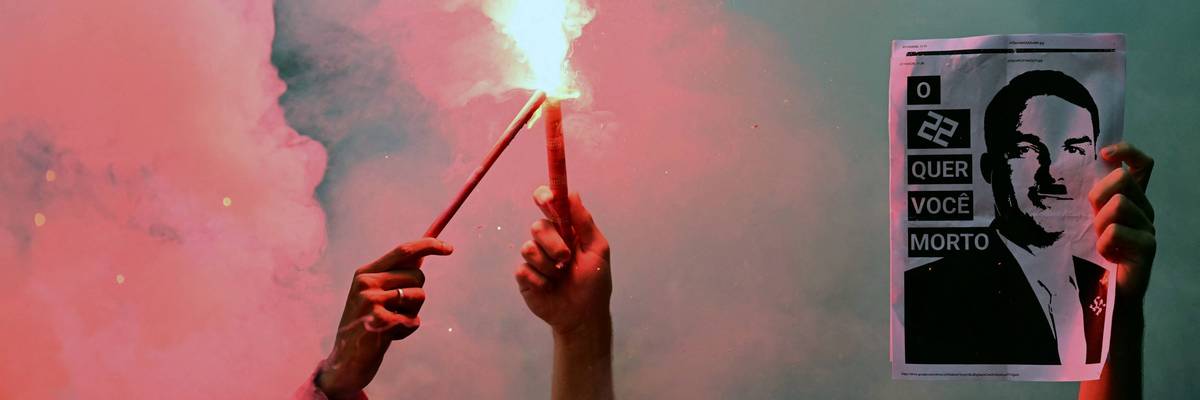
Students backing Brazilian President Luiz Inácio Lula da Silva in the upcoming runoff election light flares while holding an image of right-wing candidate Flavio Bolsonaro personified as Adolf Hitler, during a march against the far right, in Rio de Janeiro, Brazil on October 7, 2026.
Demonstrators marched after President Luiz Inácio Lula da Silva accused the Trump administration of meddling in the election in favor of Sen. Flávio Bolsonaro.
Days after elections in which right-wing Brazilian candidates won a significant number of seats and as President Luiz Inácio Lula da Silva headed to a runoff with Sen. Flávio Bolsonaro, students on Wednesday marched through Rio de Janeiro in support of the progressive Lula—and expressed fear over the growing influence of the far right in Brazil.
Thousands of Brazilians joined the student-led demonstrations, where some carried pictures of Bolsonaro made to look like Adolf Hitler and signs that read, "No to the father, no to the son" and "Never again Bolsonaro."
Bolsonaro, a senator who represents the right-wing Liberal Party, is the son of convicted former President Jair Bolsonaro, who is serving a 27-year sentence under house arrest for orchestrating a coup attempt after his election loss in 2022. Bolsonaro's supporters stormed government buildings on January 8, 2023, and the former president—a close ally of President Donald Trump—was found guilty of spreading misinformation about the country's voting system and encouraging his supporters to attack the Capitol.
At Wednesday's protest, one supporter of Lula expressed concern for the safety of her transgender wife and remembered the fear many lived with during the coronavirus pandemic, when the elder Bolsonaro refused to take part in basic public health precautions like social distancing and mask-wearing, sent unproven drugs to communities, and spread misinformation about vaccines. Nearly 600,000 people died of Covid-19 across Brazil—the second-highest death toll in the world after the United States.
"I remember my family's lives being at risk during the pandemic," Alice Carneiro told Agence France-Presse in Rio.
Bolsonaro won 47% of the vote on Sunday, while Lula, of the Worker's Party, had 45%. According to an analysis by the Center for Economic and Policy Research in the US, the Brazilian economy saw growth of 8.9% from 2022-25. Lula took office in 2023. His government has passed a new minimum wage law, expanded maternity leave, and increased benefits for low-income families.
The report also notes that high interest rates have raised borrowing costs for households and have increased the rate of delinquency.
Voters will go to the polls for the runoff election on October 25.
Ahead of the first round of voting this week, Lula's campaign accused the Trump administration of interfering in the country's elections.
The US abruptly shut down consular services in Brazil last Friday, citing unspecified "security concerns," and projecting a sense of "instability over the electoral environment,” according to Lula's campaign.
Attorney General Jorge Messias also called for a probe ahead of the election into reports that Trump planned to award $1 million to right-wing groups in Brazil, and Brazilian intelligence officials also briefed French and German diplomats on alleged election interference by the US.
Last year, Trump slapped the country with 40% tariffs, accusing Lula's government of "persecuting" Jair Bolsonaro. The former president's son has pledged to give amnesty to his father and the supporters who took part in the 2023 coup, should he win the election—like Trump, who pardoned January 6, 2021 insurrectionists when he returned to power.
The potential victory of Bolsonaro comes amid a wave of right-wing victories across Latin America, where candidates backed by Trump have won recent elections in Colombia, Chile, and Peru, and the Trump administration has partnered with several governments in joint military operations that officials say are aimed at cracking down on drug trafficking.
The march through Rio de Janeiro also coincided with mass student-led protests across France over cuts to education funding; demonstrations in India against the purging of voter rolls; marches by tens of thousands of people in Spain over housing affordability, sparked by public anger over the eviction of an 87-year-old woman; and protests against proposed budget cuts in Chile.
Dear Common Dreams reader, It’s been nearly 30 years since I co-founded Common Dreams with my late wife, Lina Newhouser. We had the radical notion that journalism should serve the public good, not corporate profits. It was clear to us from the outset what it would take to build such a project. No paid advertisements. No corporate sponsors. No millionaire publisher telling us what to think or do. Many people said we wouldn't last a year, but we proved those doubters wrong. Together with a tremendous team of journalists and dedicated staff, we built an independent media outlet free from the constraints of profits and corporate control. Our mission has always been simple: To inform. To inspire. To ignite change for the common good. Building Common Dreams was not easy. Our survival was never guaranteed. When you take on the most powerful forces—Wall Street greed, fossil fuel industry destruction, Big Tech lobbyists, and uber-rich oligarchs who have spent billions upon billions rigging the economy and democracy in their favor—the only bulwark you have is supporters who believe in your work. But here’s the urgent message from me today. It's never been this bad out there. And it's never been this hard to keep us going. At the very moment Common Dreams is most needed, the threats we face are intensifying. We need your support now more than ever. We don't accept corporate advertising and never will. We don't have a paywall because we don't think people should be blocked from critical news based on their ability to pay. Everything we do is funded by the donations of readers like you. When everyone does the little they can afford, we are strong. But if that support retreats or dries up, so do we. Will you donate now to make sure Common Dreams not only survives but thrives? —Craig Brown, Co-founder |
Days after elections in which right-wing Brazilian candidates won a significant number of seats and as President Luiz Inácio Lula da Silva headed to a runoff with Sen. Flávio Bolsonaro, students on Wednesday marched through Rio de Janeiro in support of the progressive Lula—and expressed fear over the growing influence of the far right in Brazil.
Thousands of Brazilians joined the student-led demonstrations, where some carried pictures of Bolsonaro made to look like Adolf Hitler and signs that read, "No to the father, no to the son" and "Never again Bolsonaro."
Bolsonaro, a senator who represents the right-wing Liberal Party, is the son of convicted former President Jair Bolsonaro, who is serving a 27-year sentence under house arrest for orchestrating a coup attempt after his election loss in 2022. Bolsonaro's supporters stormed government buildings on January 8, 2023, and the former president—a close ally of President Donald Trump—was found guilty of spreading misinformation about the country's voting system and encouraging his supporters to attack the Capitol.
At Wednesday's protest, one supporter of Lula expressed concern for the safety of her transgender wife and remembered the fear many lived with during the coronavirus pandemic, when the elder Bolsonaro refused to take part in basic public health precautions like social distancing and mask-wearing, sent unproven drugs to communities, and spread misinformation about vaccines. Nearly 600,000 people died of Covid-19 across Brazil—the second-highest death toll in the world after the United States.
"I remember my family's lives being at risk during the pandemic," Alice Carneiro told Agence France-Presse in Rio.
Bolsonaro won 47% of the vote on Sunday, while Lula, of the Worker's Party, had 45%. According to an analysis by the Center for Economic and Policy Research in the US, the Brazilian economy saw growth of 8.9% from 2022-25. Lula took office in 2023. His government has passed a new minimum wage law, expanded maternity leave, and increased benefits for low-income families.
The report also notes that high interest rates have raised borrowing costs for households and have increased the rate of delinquency.
Voters will go to the polls for the runoff election on October 25.
Ahead of the first round of voting this week, Lula's campaign accused the Trump administration of interfering in the country's elections.
The US abruptly shut down consular services in Brazil last Friday, citing unspecified "security concerns," and projecting a sense of "instability over the electoral environment,” according to Lula's campaign.
Attorney General Jorge Messias also called for a probe ahead of the election into reports that Trump planned to award $1 million to right-wing groups in Brazil, and Brazilian intelligence officials also briefed French and German diplomats on alleged election interference by the US.
Last year, Trump slapped the country with 40% tariffs, accusing Lula's government of "persecuting" Jair Bolsonaro. The former president's son has pledged to give amnesty to his father and the supporters who took part in the 2023 coup, should he win the election—like Trump, who pardoned January 6, 2021 insurrectionists when he returned to power.
The potential victory of Bolsonaro comes amid a wave of right-wing victories across Latin America, where candidates backed by Trump have won recent elections in Colombia, Chile, and Peru, and the Trump administration has partnered with several governments in joint military operations that officials say are aimed at cracking down on drug trafficking.
The march through Rio de Janeiro also coincided with mass student-led protests across France over cuts to education funding; demonstrations in India against the purging of voter rolls; marches by tens of thousands of people in Spain over housing affordability, sparked by public anger over the eviction of an 87-year-old woman; and protests against proposed budget cuts in Chile.
Days after elections in which right-wing Brazilian candidates won a significant number of seats and as President Luiz Inácio Lula da Silva headed to a runoff with Sen. Flávio Bolsonaro, students on Wednesday marched through Rio de Janeiro in support of the progressive Lula—and expressed fear over the growing influence of the far right in Brazil.
Thousands of Brazilians joined the student-led demonstrations, where some carried pictures of Bolsonaro made to look like Adolf Hitler and signs that read, "No to the father, no to the son" and "Never again Bolsonaro."
Bolsonaro, a senator who represents the right-wing Liberal Party, is the son of convicted former President Jair Bolsonaro, who is serving a 27-year sentence under house arrest for orchestrating a coup attempt after his election loss in 2022. Bolsonaro's supporters stormed government buildings on January 8, 2023, and the former president—a close ally of President Donald Trump—was found guilty of spreading misinformation about the country's voting system and encouraging his supporters to attack the Capitol.
At Wednesday's protest, one supporter of Lula expressed concern for the safety of her transgender wife and remembered the fear many lived with during the coronavirus pandemic, when the elder Bolsonaro refused to take part in basic public health precautions like social distancing and mask-wearing, sent unproven drugs to communities, and spread misinformation about vaccines. Nearly 600,000 people died of Covid-19 across Brazil—the second-highest death toll in the world after the United States.
"I remember my family's lives being at risk during the pandemic," Alice Carneiro told Agence France-Presse in Rio.
Bolsonaro won 47% of the vote on Sunday, while Lula, of the Worker's Party, had 45%. According to an analysis by the Center for Economic and Policy Research in the US, the Brazilian economy saw growth of 8.9% from 2022-25. Lula took office in 2023. His government has passed a new minimum wage law, expanded maternity leave, and increased benefits for low-income families.
The report also notes that high interest rates have raised borrowing costs for households and have increased the rate of delinquency.
Voters will go to the polls for the runoff election on October 25.
Ahead of the first round of voting this week, Lula's campaign accused the Trump administration of interfering in the country's elections.
The US abruptly shut down consular services in Brazil last Friday, citing unspecified "security concerns," and projecting a sense of "instability over the electoral environment,” according to Lula's campaign.
Attorney General Jorge Messias also called for a probe ahead of the election into reports that Trump planned to award $1 million to right-wing groups in Brazil, and Brazilian intelligence officials also briefed French and German diplomats on alleged election interference by the US.
Last year, Trump slapped the country with 40% tariffs, accusing Lula's government of "persecuting" Jair Bolsonaro. The former president's son has pledged to give amnesty to his father and the supporters who took part in the 2023 coup, should he win the election—like Trump, who pardoned January 6, 2021 insurrectionists when he returned to power.
The potential victory of Bolsonaro comes amid a wave of right-wing victories across Latin America, where candidates backed by Trump have won recent elections in Colombia, Chile, and Peru, and the Trump administration has partnered with several governments in joint military operations that officials say are aimed at cracking down on drug trafficking.
The march through Rio de Janeiro also coincided with mass student-led protests across France over cuts to education funding; demonstrations in India against the purging of voter rolls; marches by tens of thousands of people in Spain over housing affordability, sparked by public anger over the eviction of an 87-year-old woman; and protests against proposed budget cuts in Chile.