

SUBSCRIBE TO OUR FREE NEWSLETTER
Daily news & progressive opinion—funded by the people, not the corporations—delivered straight to your inbox.
5
#000000
#FFFFFF
To donate by check, phone, or other method, see our More Ways to Give page.
Daily news & progressive opinion—funded by the people, not the corporations—delivered straight to your inbox.
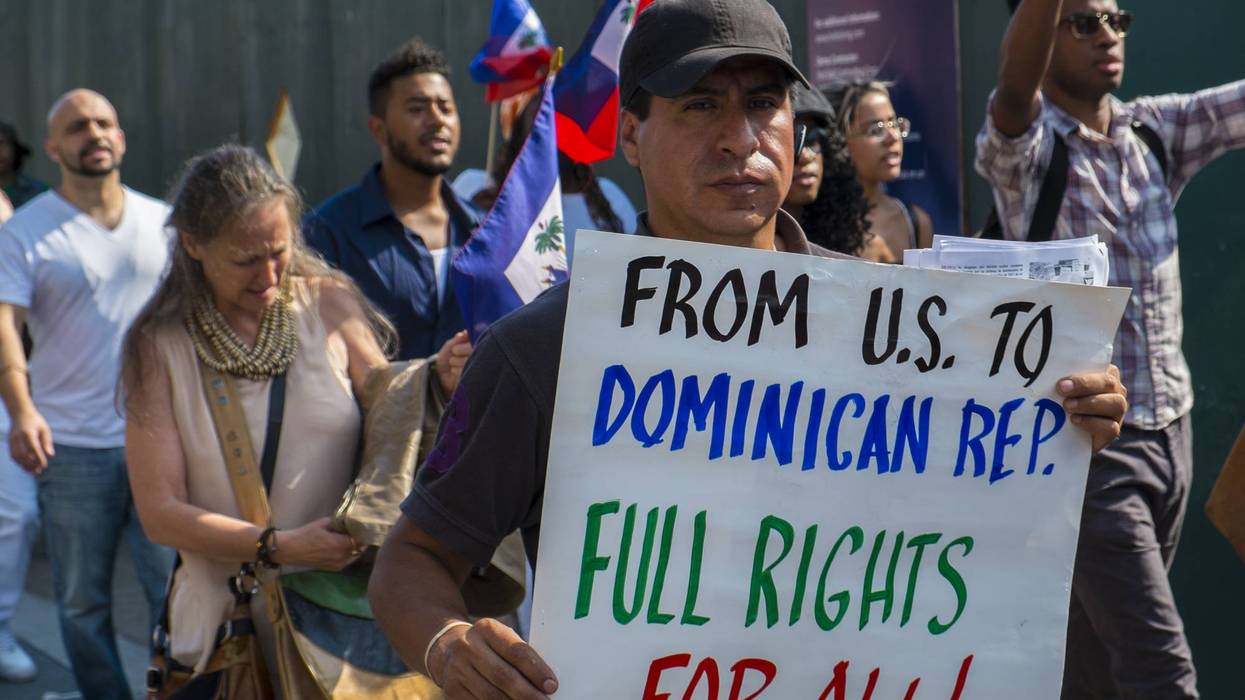
Racism and bigotry can never become the basis for deciding who gets rights and who belongs; families should never be stripped from their homes for the sake of violently manufacturing an ethnostate.
On April 1, the Supreme Court began hearing arguments in Trump v. Barbara, a class-action lawsuit challenging the Trump administration’s executive order to ban birthright citizenship for the children of undocumented immigrants.
Every lower court that has ruled on this issue thus far has found this executive order to be straightforwardly unconstitutional—and they are correct. The 14th Amendment is clear: “All persons born or naturalized in the United States, and subject to the jurisdiction thereof, are citizens of the United States and of the State wherein they reside.”
The Trump administration contends that to be “subject to the jurisdiction thereof” means one must owe “direct and immediate allegiance” to the United States and receive “protection” from it. Solicitor General D. John Sauer argues that the children of US citizens and formerly enslaved persons meet this test by virtue of having “a permanent domicile”—a permanent home they intend to stay indefinitely. By contrast, the children of undocumented immigrants “do not owe primary allegiance to the United States by virtue of domicile” because their parents “lack the legal capacity to establish domicile here.”
This reading adds much to the Citizenship Clause that is clearly not present. No plausible interpretation would assume that the drafters meant anything about loyalty, allegiance, or domiciles.
Ultimately, Trump’s birthright restrictions, like those implemented in the DR, are nothing more than racism and xenophobia masquerading as legitimate policy.
Those challenging the Trump administration argue: “The government is asking for nothing less than a remaking of our Nation’s constitutional foundations. The Order may be formally prospective, applying to tens of thousands of children born every month, and devastating families around the country. But worse yet, the government’s baseless arguments—if accepted—would cast a shadow over the citizenship of millions upon millions of Americans, going back generations.”
This warning should be taken seriously. We have already seen similar events play out in the Dominican Republic (DR).
In 1997, the mothers of Dilcia Yean and Violeta Bosico requested that the local registry office provide them with a copy of their daughters’ birth certificates. Without it, the children could not enroll in school and were at risk of deportation. While both Yean and Bosico were born in the DR to Dominican mothers, their fathers were Haitian temporary workers. On that basis, the registry denied their mothers’ request. This blatantly discriminatory denial effectively rendered the girls rightless and stateless.
Under the 1994 Dominican Constitution, both girls were entitled to birthright citizenship. Per the Constitution, citizenship is granted to “all persons born within the territory of the Republic, with the exception of the legitimate children of foreigners residing in the country in a diplomatic capacity or those who are in transit therein.” Important here is the “in transit” clause. As Ernesto Sagás notes, “This clause was originally designed to address the issue of children born on ships passing through Dominican ports, and whose parents were not intending to settle in the Dominican Republic.” However, over the years, politicians had argued (and at times acted as if) that clause extended to the children of temporary workers, like Yean and Bosico.
After years of obstruction from government officials, the mothers finally succeeded in obtaining their daughters’ birth certificates in 2001.
In 2003, the case was submitted to the Inter-American Court of Human Rights (IACHR). In court, the DR denied any wrongdoing. Rather, they defended a broad definition of “persons in transit” based on its 2004 General Migration Law (Ley No. 285-04). Under that Law, “temporary workers” were formally classified as “persons in transit.” The DR argued that Yean and Bosico were not Dominican nationals themselves because their fathers were Haitian temporary workers—their fathers were “in transit,” thus they too were “in transit.” The IACHR rejected this reasoning.
If the Supreme Court has any legitimacy left, they will do the right thing and end Trump’s birthright madness.
In September 2005, the IACHR ruled that the DR had violated several of the girls’ rights under the American Convention of Human Rights, including their right to a nationality, equal protection, and humane treatment. The IACHR ordered the Dominican government to award the girls $8,000 USD each, issue a public apology, and amend their domestic laws to make the procedure for acquiring birth certificates “simple, accessible, and reasonable since, to the contrary, applicants could remain stateless.”
In October 2005, the Senate of the Dominican Republic issued a resolution rejecting the IACHR’s decision. In December 2005, the Supreme Court of Justice of the Dominican Republic, in further defiance of the IACHR, upheld the General Migration Law’s broad definition of “persons in transit.”
In 2010, the DR took matters one step further by formally amending their Constitution. Under the 2010 Constitution, citizenship is granted to “persons born within the national territory, with the exception of the children of foreign nationals who are members of diplomatic and consular missions, of foreigners who are in transit or residing illegally within Dominican territory. Any foreigner defined as such under Dominican laws shall be considered a person in transit.” Importantly, this redefinition divorced the concept of “person in transit” from any notion of temporary stay. A person could, for instance, live continuously in the DR for years and still be considered “in transit.”
Initially, this did not impact people who already had Dominican citizenship. But in 2013, that too changed. The Constitutional Court of the Dominican Republic retroactively applied the new standard to all persons born between 1929 and 2010. The Court ordered the government to thoroughly review all birth registries within that period and remove any persons who no longer count as Dominican under the new guidelines. In the decade that followed, this ruling would strip as many as 245,000 Dominicans of their citizenship and trigger a humanitarian crisis.
Up to 86% of those impacted have been Dominicans of Haitian descent. This is no accident. It reflects the historical and persistent discrimination against Haitians rampant across the DR. The 2013 ruling made legal what people like Santiago Riverón, the mayor of Dajabón, at the Dominican-Haitian border, have long since thought. In an interview with journalist Marius Loiseau, Riverón claims that, “Haitians and Dominicans are like water and oil.” He continues, “They have already begun to invade us for good.”
Dominican President and Trump ally Luis Abinader echoes these sentiments. He remarks: “The rights of Dominicans will not be displaced. Our identity will not be diluted. Our generosity will not be exploited. Here, solidarity has limits.” He insists that stricter penalties against undocumented migrants are necessary to ensure that the “violence that is destroying Haiti will not cross over to the Dominican Republic.”
In October 2024, his administration announced plans to deport up to 10,000 undocumented migrants per week. Between then and March 2025, more than 180,000 people were forcibly deported to Haiti by Dominican officials. These mass deportations have fueled discrimination and racial profiling, excessive violence, arbitrary detention, and family separation as well as numerous human rights violations.
While there are many important differences between the DR and US, on the issue of immigration, the parallels are unmistakable. The Trump administration is also motivated by the belief that immigrants, including Haitians, pose an existential threat to the nation’s identity; that they are a serious risk to public safety; as well as a strain on social, political, and economic resources. Like Riverón and Abinader, President Trump insists that, given the scale of the “invasion,” aggressive immigration enforcement is necessary. This includes imposing denaturalization and immigrant arrest quotas. Even the formal justification for restricting birthright citizenship is similar. For both the Trump administration and the Dominican government, no matter how many years they have lived in the country or how long they intend to stay, an undocumented immigrant is always “in transit.” They never obtain a “permanent domicile.” The Dominican government does and the Trump administration aims to extend the purported ‘transientness’ of the parents to their children as a justification for denying them citizenship.
Ultimately, Trump’s birthright restrictions, like those implemented in the DR, are nothing more than racism and xenophobia masquerading as legitimate policy. If the Trump administration succeeds in restricting birthright citizenship, it—or a future MAGA presidency—will likely seek to build upon this ruling. Like the Constitutional Court of the DR, the Supreme Court may eventually rule to retroactively apply their decision to all persons born after the ratification of the 14th Amendment.
Racism and bigotry can never become the basis for deciding who gets rights and who belongs; families should never be stripped from their homes for the sake of violently manufacturing an ethnostate. What happened in the DR should be a cautionary tale for those of us in the US.
If the Supreme Court has any legitimacy left, they will do the right thing and end Trump’s birthright madness. That said, Trump cares little for democracy or the rule of law; regardless of how they decide, we will need to remain vigilant to protect ourselves, our loved ones, and our communities.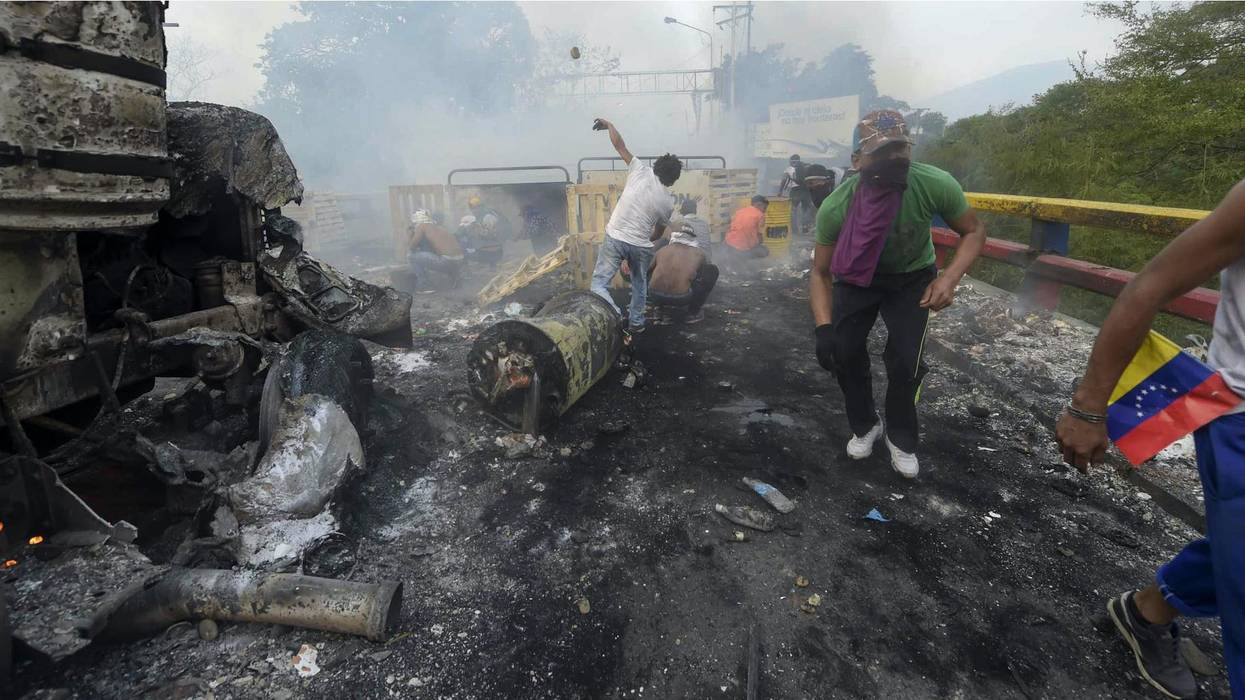
Progressive observers of United States foreign policy in Latin America were unsurprised yet still expressed alarm Thursday over details in a new report from the U.S. Agency for International Development that shows the Trump administration's humanitarian aid to Venezuela was at least partially motivated by a desire for regime change in Caracas.
"You didn't need to be a genius to see the U.S. was trying to force a dramatic confrontation, rather than trying to efficiently help needy Venezuelans."
--Vincent Bevins, journalist
The report (pdf) published earlier this month by the USAID inspector general's office states that "the U.S. government's key foreign policy goals" in Venezuela following President Nicolas Maduro's 2018 reelection were to "increase pressure on Maduro to step down" and "support Guaido's legitimacy as the interim president," a reference to the unelected opposition leader Juan Guaido, who has also received a show of support from President Joe Biden.
"Accordingly, USAID prioritized aid to the Venezuelan people in coordination with the interim president, including issuing in-kind grants to distribute humanitarian commodities inside Venezuela," the report says. This included supporting an unnamed Venezuelan NGO perceived as aligned with U.S. foreign policy objectives despite not knowing "whether the organization had the capacity to comply with USAID's legal and financial requirements."
The IG investigation found that out of 368 metric tons of humanitarian aid designated for delivery to Venezuela by the agency, only eight metric tons arrived in the country, with the rest going to Colombia and Somalia. Aid that was sent to Venezuela arrived in military transport planes, a move the report says "was not justified by operational needs as commercial transportation was available and less expensive."
The report also acknowledges that the failed February 2019 aid convoy organized by U.S. special representative Elliott Abrams--whose history in the region includes using humanitarian aid flights to arm Contra terrorists in Nicaragua and covering up massacres committed by U.S.-backed death squads in Guatemala and El Salvador--"contributed to a tense environment for humanitarian assistance funded by or associated with the U.S. government, as the Maduro regime publicly rejected pre-positioned commodities and initiated security crackdowns in Venezuela."
Additionally, it states that USAID's own officials determined that food aid purportedly sent to alleviate child hunger "was unnecessary because the nutritional status of Venezuelan children did not warrant its use at the time."
USAID, "concerned that the United Nations supported the Maduro regime," also minimized funding for U.N. agencies even though some of them "had infrastructure in Venezuela to deliver humanitarian commodities."
This, at a time when a combination of increasing U.S. economic sanctions, corruption and mismanagement, low oil prices, and natural disasters reversed some of the tremendous progress made by the Bolivarian Revolution--which began with former President Hugo Chavez and continued under Maduro--in improving the lives of poor Venezuelans.
The new report surprised few seasoned observers of the more than 100-year history of U.S. meddling in Venezuelan affairs, a timeline that includes hundreds of millions of dollars in USAID funding--including nine-figure spending on groups opposing the Bolivarian Revolution. Still, the USAID IG report raised eyebrows.
"This was incredibly obvious at the time, but it's shocking to see the details," said U.S. journalist and author Vincent Bevins of the report's contents.
USAID itself has a long history of foreign interference and subversion around the world. The agency funded death squads in El Salvador and Guatemala's genocidal army during the 1980s, the forced sterilization of Indigenous Peruvian women in the 1990s, Laotian heroin traffickers during the Vietnam War--to name but a handful of examples. USAID operatives also taught torture and democracy suppression to security forces in Latin American dictatorships including Brazil, the Dominican Republic, and Uruguay in the 1960s and 1970s.
More recently, USAID in 2010 launched a social media campaign with the goal of sparking civil unrest against the Fidel Castro-led government in Cuba. Around the same time, the agency infiltrated Cuba's burgeoning hip-hop scene in a bid to foment a youth uprising.
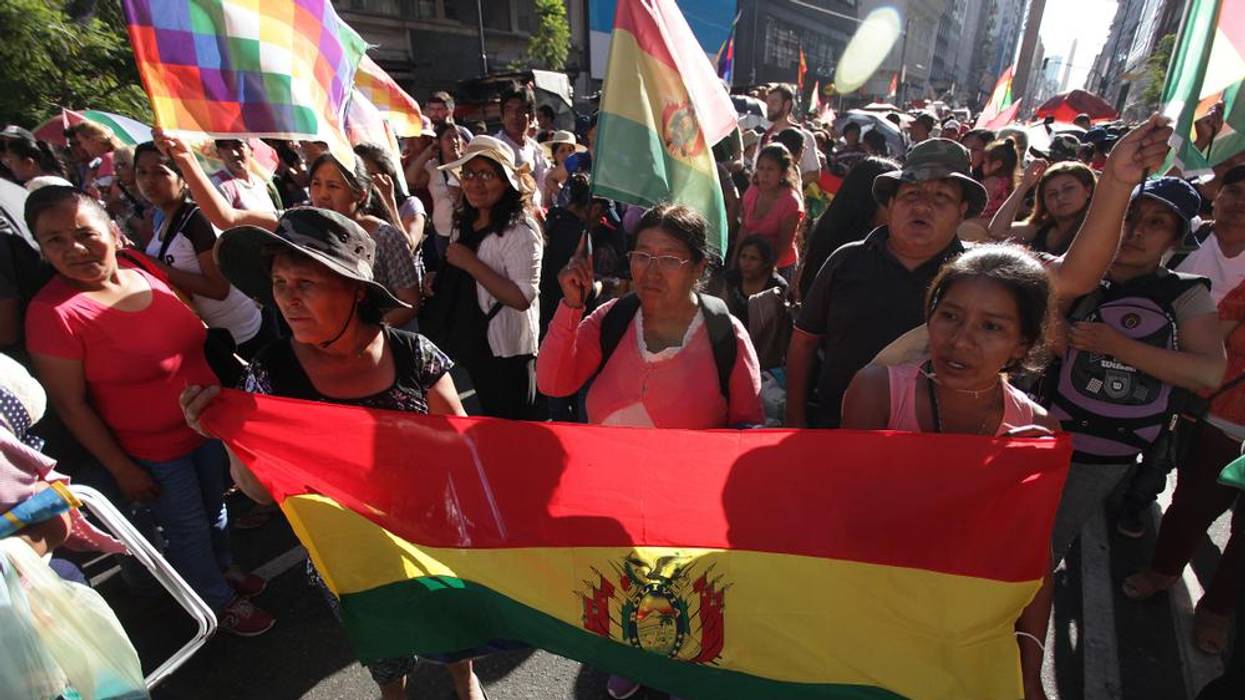
Experts at MIT recently concluded that there is no statistical evidence of fraud in the results of the Bolivian presidential elections last October. These findings debunk an earlier report by the Organization of American States (OAS), which were used to justify a right-wing coup d'etat in the Andean nation.
"All in all, the OAS' statistical analysis and conclusions would appear deeply flawed," the researchers, John Curiel and Jack R. Williams of the Election Data and Science Lab, wrote in the Washington Post. They added that the incumbent, Evo Morales, very likely garnered more than the 10 percent margin needed to avoid a second round vote.
The announcement has caused an international uproar.
The OAS mission's report alleging "intentional manipulation" to favor Morales' re-election led to an insurrection by the Bolivian armed forces and ultra right parties, as well as violent conflict in the streets. To date, an interim government headed by a minor member of parliament, Jeanine Anez, remains in power. Scores of pro-Morales protesters were killed in the mayhem that ensued after the regional organization called into question the legitimacy of the electoral process and ignited the chain of events that led to the coup.
As it turns out, Bolivia isn't the only election where the OAS has played a role in steering results, rather than monitoring and assuring democratic practice.
An analysis of recent election observation missions and statements by Secretary General Luis Almagro reveals a disturbing pattern of bias and a willingness to manipulate events and data for political purposes. More broadly, the Secretary General's revival of Cold War ideology and allegiance to the Trump administration has created a pattern that consistently favors right-wing governments and forces, while attacking or attempting to eliminate the left in power.
This behavior in a regional forum founded to resolve controversy poses a serious threat to democratic practice as well as the self-determination of nations.
Bolivia
The actions of the OAS Electoral Mission in Bolivia, headed by the Costa Rican Manuel Gonzalez Sanz, triggered a break with the democratic order, leading not only to the coup but the subsequent killings of pro-Morales protesters by security forces, who specifically targeted indigenous supporters of the nation's first indigenous president.
Indeed, the OAS accusations of "manipulation" in the Bolivian presidential elections catalyzed violent protests and unleashed massive human rights violations. As if awaiting a cue, armed right-wing forces mobilized to overthrow the elected government. The president and vice president, along with other high-level elected officials of the ruling MAS party, were forced to flee when their houses were set on fire and they came under attack.
Just hours after the polls closed, the OAS mission issued a press release before the vote count was finished, followed up two days later by a preliminary report calling into question Morales' lead of just over 10 percent. The report cited a "hard to explain" pause in the rapid count and other criticisms of the process.
Based on the report, right-wing forces that had hoped to gain power by forcing Morales into a second round of voting, protested. They were joined by some social organizations, staging demonstrations as well as burning buildings. When the armed forces stepped in threatening a coup, Morales resigned to avoid further bloodshed. A government of ultra-right-wing political figures took power, unleashing the attacks on indigenous peoples and Morales supporters.
An earlier analysis of the OAS reports by the Center for Economic and Policy Research showed that the mission provided no proof of fraud, and that the timing and accusations of the report played a critical political role in the subsequent chain of events. On February 27, the study by the MIT Election Data and Science Lab concluded:
"The OAS's claim that the stopping of the TREP [Transmission of Preliminary Electoral Results] during the Bolivian election produced an oddity in the voting trend is contradicted by the data. While there was a break in the reporting of votes, the substance of those later-reporting votes could be determined prior to the break. Therefore, we cannot find results that would lead us to the same conclusion as the OAS. We find it is very likely that Morales won the required 10 percentage point margin to win in the first round of the election on October 20, 2019."
By using its electoral mission to rashly question official elections results, the OAS report contributed to mob violence and the fall of the elected government. The openly racist and misogynist rightwing forces that came to power carried out at least one documented massacre of indigenous peoples.
When national and international voices protested the Bolivian coup d'etat, the OAS Secretary General retorted: "Yes, there was a coup in Bolivia on October 20, when Evo Morales committed electoral fraud" -- an unsubstantiated assertion that did not express a consensus view within the organization nor even reflect the language of the mission.
Following publication of the expert analysis, the OAS wrote a letter to the Washington Post, complaining that the study "is not honest, fact-based, or exhaustive." However, the organization has not presented a full scientific rebuttal or specific reasons for its assertion. In view of the doubts and the dire impact, the Mexican government has demanded an explanation from the OAS. Neither the OAS leadership nor the mission have responded to the request.
There are reports that the OAS followed the political dictates of the U.S. government in precipitating the Bolivian coup. The Los Angeles Times reported:
"Carlos Trujillo, the U.S. ambassador to the OAS, had steered the group's election-monitoring team to report widespread fraud and pushed the Trump administration to support the ouster of Morales. (The State Department denied Trujillo exercised undue influence on the report and said it respects the autonomy of the OAS. Trujillo, through a spokesman, declined a request for an interview.)"
The OAS's lack of transparency regarding its mission to Bolivia has compounded suspicions. Unlike other election observations, all of which should be included in the OAS public database, the 2019 Bolivia mission does not appear at all. The OAS press office has not responded to numerous queries regarding the omission of the data on the Bolivian mission, including the names of the members and other pertinent information.
The November 2017 presidential elections in Honduras provide another example of the OAS's political agenda. That year, right-wing incumbent president Juan Orlando Hernandez ran despite a ban on his seeking re-election, which was suspended by a highly questionable court ruling that declared the constitution itself unconstitutional.
On election night, after announcing that the opposition candidate Salvador Nasralla had established an "irreversible" lead, the Electoral Tribunal shut down the vote count and later returned to announce the incumbent's unlikely victory amid massive disbelief. The OAS mission questioned the re-election of President Juan Orlando Hernandez, known as JOH by his initials, and announced the elections too dirty to call. Almagro called for new elections.
By contrast, the Trump administration immediately endorsed the Honduran Electoral Tribunal's position and congratulated Orlando Herndandez on his supposed victory, while pressuring allies to do the same. Following the U.S. lead, Almagro eventually backed down from his insistence on new elections and accepted the incumbent government.
The Hondurans administration brutally repressed widespread popular protests following the election, leaving more than 30 opposition demonstrators dead. While the direct blame lies with the Honduran government, the OAS's inability to assure or restore clean elections, and its compliance with U.S. policy causing it to reverse its original position, contributed to the breakdown of rule of law in the country.
Today the political crisis continues to claim lives and forces thousands of Hondurans to emigrate every month.
OAS actions in the Dominican Republic's botched local elections on February 20 again reveal its bias.
The OAS pressured the island government to adopt an automated voting system that went bonkers on polling day. When Dominicans tried to vote, the names of certain candidates did not appear on the screens in nearly half the precincts. The OAS Electoral Observation Mission promised to study the failure, but to date has not been able to identify the technical problem, which it was its job to avoid, or explain why it didn't catch it earlier.
The Elections Board suspended the elections just hours after the polls opened and rescheduled them for March. Although local elections may seem minor, they are the forerunner to presidential elections in May and the results affect the campaigns. Dominicans are marching to demand the resignation of the Elections Board and call for fair elections, amid claims of fraud and sabotage.
Contrary to its actions in Bolivia, after the Dominican elections fiasco, the OAS mission did not immediately release a destabilizing report alleging manipulation. Instead, it supported the Elections Board's decision to reschedule elections and scrap the U.S.-based automated system, which cost the island a reported $80 million between equipment and the aborted elections.
Faced with a major breakdown in the system in the Dominican Republic, the OAS mission and its Secretary General did not point fingers, stating prudently: "To date there is no evidence to indicate a willful misuse of the electronic instruments designed for automated voting."
Despite the obvious discrepancy between the two cases, however, the OAS's press release used the opportunity to defend its Bolivia mission, promising to apply "the same standards of technical quality and professional rigor as the process that was recently carried out in Bolivia" -- leading some Dominicans to note on Twitter that the comparison was not reassuring.
Commentators have blamed the OAS in part for the breakdown in the Dominican system. In New York City, Dominican immigrants demonstrated in front of OAS headquarters against the "elections disaster" and called for to respect the vote. U.S. Congressman Adriano Epaillat demanded that the head of the Elections Board resign. But the scores of OAS observers working on-site in the country before, during, and after the events, have discreetly not criticized the government or explained what went wrong.
Protestors insist that the system failure favors the ruling Dominican Liberation Party by buying them an extra month. The ruling party's presidential candidate trails in polls for the May elections. President Danilo Medina has a close relationship with the U.S. government -- he met with Trump and four other leaders of Caribbean nations at Mar-a-Lago March 21, 2019 to consolidate support for Trump administration policies to remove Venezuelan president Nicolas Maduro from office and support Almagro's OAS re-election bid, apparently in return for investments in their nations.
Dominica
Almagro is invested in the results of elections in the Dominican Republic and other Caribbean nations. The Caribbean Community (CARICOM) holds 14 of the 34 votes in the OAS.
The small island nation of Dominica recently denounced Almagro's interference in its own December 6 elections. Prime Minister Roosevelt Skerrit, who has publicly rejected "interference in the internal affairs of any country" -- including Venezuela -- won reelection handily.
But just days before the voting, Almagro tweeted support for opposition demands, as demonstrations by anti-Skerrit forces grew violent. Dominica's foreign minister, Francine Baron, said to the OAS: "We are concerned by public pronouncements that have been made by the Secretary General, which display bias, disregard for the governments of member states, and call into question his role and the organization's role as an honest broker."
Democracy at Stake
Speaking in Mexico in August 2019, Almagro stated that if the public does not trust election results, it severely affects the quality of a democracy. However, his partisan role and the biased and dishonest actions of OAS election observation missions have severely undermined democracy in the region.
The region faces major challenges in the near future: 2020 presidential elections in Bolivia and the Dominican Republic, an upcoming Chilean constitutional referendum, and 2021 key presidential elections in Nicaragua, Peru, and Ecuador. These elections could either resolve or enflame political crises.
Impartial election observation by qualified experts can instill trust in the electoral process, expose corrupt and anti-democratic practices, and head off post-electoral conflicts. The region urgently needs an organization that is willing and able to play this role professionally -- and not act in favor of other regional interests and powers.

As Republicans in states around the country pass sweeping abortion bans, I think about what life could be like for women and girls if these laws take effect. I don't have to use my imagination.
Women and girls across Latin America are already living in places where abortion is heavily restricted or completely banned. In the past year, I've done research for Human Rights Watch in two countries that ban abortion completely, without any exceptions, even if the woman's life is in danger.
In the Dominican Republic, I spoke with Rosa Hernandez, whose daughter Rosaura Almonte Hernandez, known as "Esperancita," was diagnosed with leukemia. Doctors initially denied her chemotherapy because she was pregnant, and then refused to end the pregnancy because to do so would have been against the law. She died in 2012 at age 16. "They let my daughter die," her mother told me.
I met a health educator in the Dominican Republic who fought back tears as she told me how, a few weeks prior, she counseled a pregnant 11-year-old girl who had been raped by her stepfather. "She's just a little girl. She doesn't know what's going on in her life or in her body," she said. But because abortion is illegal even for pregnancies from rape or incest, the educator had no options other than to refer the girl for prenatal care.
In Honduras, I met a young woman facing jail time after having a miscarriage. Unaware that she was even pregnant, she went to a hospital in intense pain. Doctors suspected she had attempted an abortion and called the police. She was taken from the hospital in handcuffs and remains under court supervision pending a trial date.
This is what banning abortion looks like in 2019. And this is where the United States could be headed if the courts permit cruel state laws like those passed in Georgia and Alabama to weaken or dismantle the rights protected in the landmark 1973 Roe v. Wade decision.
When abortion is heavily restricted or banned, women from poor, rural and marginalized communities suffer most.
I carry these heartbreaking stories with me, but I also think of the dozens of women I've interviewed who told me how they defied strict abortion laws to end pregnancies they knew they couldn't continue. Research from around the world has shown that banning abortion doesn't stop it from happening -- it just drives it underground.
Clandestine abortion is safer than it used to be because of medication, but even in 2019, women still die from unsafe abortion.
In Brazil, a country where abortion is illegal except in strictly limited circumstances, Ingriane Barbosa Carvalho, a mother of three in her early 30s, died last year from a botched abortion by a back-alley provider. An obstetrician-gynecologist in the Dominican Republic told me about a 19-year-old woman who came to the hospital in septic shock after an unsafe abortion two years before. She died despite the doctor's efforts to save her.
When abortion is heavily restricted or banned, women from poor, rural and marginalized communities suffer most, as they may not be able to afford to travel to places where abortion is legal, or pay what it costs.
Around the world, an estimated 8 to 11 percent of maternal deaths are caused by unsafe abortion. In May, the Centers for Disease Control and Prevention released data showing that hundreds of women die in the United States each year from preventable complications related to pregnancy. Preventable maternal deaths will only increase if access to abortion is further restricted.
If policymakers in states like Alabama and Georgia are concerned with protecting life and reducing abortion, the new laws they are enacting will not have that effect. Unplanned pregnancies will still happen, as they always do, and women will still need abortions. But these will happen behind closed doors, and more women and girls will be injured or die.

Contradiction is the name of the game in current U.S. immigration policy. As states pass increasingly restrictive abortion laws, ostensibly to protect children, the fifth migrant child -- and the sixth overall -- has died in the custody of Customs and Border Patrol since December. The irony is not lost on any of us. How can the U.S. argue that its policies are meant to protect children? These actions are not about young people and they are not about families. But for immigrant parents and families, their sacrifice to leave children behind and migrate, or bring children with them to the border to request asylum is precisely all about children and trying to keep their families together.
Dismantling the other's family is a war strategy meant to deter migration, however, what they fail to comprehend is that people will always strive to take care of their families.
The U.S. government has chosen to fracture and separate the very unit that it argues it cares about most. When politicians and pundits claim that they need to protect "American values" built on family and church, they attack and dismantle families, the most sacred element for many immigrants. Dismantling the other's family is a war strategy meant to deter migration, however, what they fail to comprehend is that people will always strive to take care of their families. And families ultimately want to stay together; no mother wants to leave her babies behind, and no father wants to watch his three-year-old son ripped from his arms as the boys screams "Papa!" Again, American policies, whether about immigration or a woman's right to a safe abortion, are really not about the children.
During the last 10 years, I have conducted ethnographic research with immigrant populations from Mexico, the Dominican Republic and Brazil. I focused on immigrant mothers who had left children behind to come to the United States. Many others have acknowledged and gone to great lengths to explain the ultimate sacrifice performed by these women. In more than 100 interviews with mothers I learned that their first response as to why they migrate was always to benefit their children. Doubtlessly, the realities are more complex than the simple answer "for my children." However, what these women taught me was to what extraordinary lengths they would they go to provide for their offspring.
After a decade of researching and writing about transnational families - families divided by borders who continue to remain in close communication - I have learned that governments know nothing about the extent that parents will go to keep their families together. April 2018 changed everything. It's true that family detentions already existed, and deportations were on the rise well before President Trump was elected. But when the zero-tolerance policy and family separation began, it revealed to me is that this administration does not understand what matters for immigrants coming to the border. They do know that for immigrants, it is about the children. Thus, the very values that America upholds are the ones that they use to break up immigrant families and asylum seekers, both physically and emotionally.
Families separated across borders, and especially mothers who are away from their children, explain that their biggest fear is that their children will think they have abandoned them. The thought that their own children would understand separation as abandonment is painfully heart wrenching. When families are forcibly separated at the border and children don't know where the parents went, the panic of abandonment is too overwhelming. One mother shared that when she saw her seven-year old boy taken from her, she fainted. Now, reunited, the mother explained that the mere thought that her son would think she did not care about him or their family, was overwhelmingly devastating. It's all about the children.

Vietnam came to my attention when I was maybe eleven or twelve, during the last years of the Eisenhower administration.
There must have been some uptick that prompted public anticommunist saber-rattling about what really was already the U.S. war there. My father explained to me what was going on, that the military forces of the Viet Minh, a broad coalition struggling for national independence, led by the Communist Party of Vietnam, had defeated the French army in its seven-year attempt to restore colonial rule after having been displaced by the Japanese, against whom the Viet Minh also fought, during World War II.
After that defeat an international conference--in which the U.S. participated along with Cambodia, the People's Republic of China, France, Laos, the Soviet Union, United Kingdom, the Viet Minh, and the "State of Vietnam," created by France in 1949 as a colonial puppet government--at Geneva in 1954 agreed that Vietnam would be divided temporarily at the 17th Parallel into northern and southern administrative zones and that in 1956 an election would be held to reunify the country. The State of Vietnam, later re-christened the Republic of Vietnam as a US rather than French puppet, rejected the agreement, and the United States did not sign onto it but "took note" of the ceasefire agreements and declared that it would "refrain from threat or use of force to disturb them." In fact, the U.S. openly blocked the agreed-upon reunification election because, as President Eisenhower freely acknowledged, all indications were that Ho Chi Minh, leader of the Viet Minh and Communist Party and a widely revered national patriotic figure, would have won the election. Even as a kid, I was astounded that the U.S. could so blatantly arrogate to itself a right to determine which governments or election outcomes were legitimate in other countries and to depose or impose them unilaterally, including by force and violence up to terror and assassination.
"Even as a kid, I was astounded that the U.S. could so blatantly arrogate to itself a right to determine which governments or election outcomes were legitimate in other countries and to depose or impose them unilaterally, including by force and violence up to terror and assassination."
My dad, responding to my reaction, informed me of the much more general history of U.S. interventionism, partly through introducing me to the story of Smedley D. Butler, former Marine Commandant. Butler's striking 1935 testimony is worth repeating in this political moment:
I spent 33 years and 4 months in active service as a member of our country's most agile military force--the Marine Corps. I served in all commissioned ranks from a second lieutenant to Major-General. And during that period I spent most of my time being a high-class muscle man for Big Business, for Wall Street and for the bankers. In short, I was a racketeer for capitalism. I suspected I was just part of a racket at the time. Now I am sure of it. Like all members of the profession I never had an original thought until I left the service. My mental faculties remained in suspended animation while I obeyed the orders of the higher-ups. This is typical of everyone in the military service.
Thus, I helped make Mexico and especially Tampico safe for American oil interests in 1914. I helped make Haiti and Cuba a decent place for the National City Bank boys to collect revenues in. I helped in the raping of half a dozen Central American republics for the benefit of Wall Street. The record of racketeering is long. I helped purify Nicaragua for the international banking house of Brown Brothers 1909-12. I brought light to the Dominican Republic for American sugar interests in 1916. I helped make Honduras "right" for American fruit companies in 1903. In China in 1927 I helped see to it that Standard Oil went its way unmolested. During those years, I had, as the boys in the back room would say, a swell racket. I was rewarded with honors, medals, promotion. Looking back on it, I feel I might have given Al Capone a few hints. The best he could do was to operate his racket in three city districts. We Marines operated on three continents. (Smedley D. Butler, "America's Armed Forces: In Time of Peace," Common Sense 4 [November 1935])
My father also told me about the 1954 military coup against the legitimately elected government of Jacobo Arbenz in Guatemala. The U.S. government--through the CIA--armed, trained, and funded a military force to overthrow Arbenz and install a brutal military dictatorship, on the claim that Arbenz was soft on communism and, oh by the way, had ended exploitative labor practices from which the US-based United Fruit Company had benefitted.
And he also told me about the joint U.S./British coup in 1953 against Mohammad Mosaddegh, prime minister of the government of Iran, who had had the temerity to propose auditing the books of the Anglo-Iranian Oil Company and limiting the company's control over Iranian oil reserves. The coup installed a brutal dictatorship led first briefly by the military and then until the late 1970s by the repressive, kleptocratic monarchy of the Shah, Mohammad Reza Pahlavi. It was the U.S. imposition of the Shah, and its continuing support of his rule, that gave the 1979 revolution that overthrew him its anti-American character, not any bullshit like opposition to "modernity" or hating us for our freedom.
"It was the U.S. imposition of the Shah, and its continuing support of his rule, that gave the 1979 revolution that overthrew him its anti-American character, not any bullshit like opposition to 'modernity' or hating us for our freedom."
The U.S. remained a dominant political force in Guatemala after the 1954 coup against Arbenz. From the 1960s until well into the 1990s, one military dictatorship after another unleashed death squads and perpetrated massacres of indigenous populations suspected of alignment with the insurgent opposition - all with knowledge and ongoing support of the U.S. government. The more than half century of political and economic destabilization, repression, and terror encouraged and sustained by our government, although seldom discussed in this regard, has much to do with creating the conditions that send Guatemalans northward in desperate, often dangerous pursuit of safety and economic opportunity.
From the late 1950s forward I was old and aware enough to watch U.S. interventionism unfold in real time. The intervention in Vietnam expanded into a genocidal horror that continued until I was in my late twenties, of course. But there were others along the way. Like many progressives here and around the world, we followed the Cuban revolution closely, perhaps with a particular attentiveness because of our family there, and celebrated defeat of the brutal, U.S. backed dictator Fulgencio Batista. I was fourteen when the Bay of Pigs invasion, led by reactionary Cuban exiles, many of them former Batista cronies--and bankrolled, trained and supported by the John F. Kennedy administration--was repulsed by the Cuban military and militias. Less broadly known were the multiple attempts the U.S. made to assassinate Fidel Castro and its support of terrorist acts against the Cuban people, including the 1976 bombing of a Cuban airliner that killed seventy-three people. The U.S. also shielded the bombing's perpetrator, Luis Posada Carriles, from prosecution for that and other crimes until his death last year.
I was sixteen in 1963 when Juan Bosch, the first freely elected president of the Dominican Republic in nearly forty years, was overthrown by a military coup backed by the Kennedy administration. When a popular insurgency was poised to return Bosch to power in 1965, President Lyndon Johnson sent 42,000 US troops to shore up the regime installed by the coup. In 1964 the US backed a military coup in Brazil against the democratically elected government of Joao Goulart, who had, like Bosch, pursued an agenda of mildly egalitarian redistribution. Both Kennedy and Johnson administrations had plotted with the Brazilian right-wing and military to prepare and eventually execute the coup. In its aftermath Brazil was ruled by a murderous military junta until 1985.
The pattern of U.S. interventionism persisted and, if anything, increased in scale during the 1970s. In 1971 the CIA supported and participated in planning a bloody coup against the left-oriented government of Bolivia and installed reactionary Hugo Banzer's military dictatorship. The most blatant and egregious, and bloodiest, intervention during the decade--apart from the on-going carnage in Vietnam--was the 1973 coup against the popularly elected government of Salvador Allende in Chile.
"The pattern of U.S. interventionism persisted and, if anything, increased in scale during the 1970s." The military coup assassinated President Allende and unleashed a regime of extreme repression, death squads and all, and economic plunder and immiseration that beset the country until at least into the 1990s. U.S. corporations and government agencies mounted an open, concerted campaign--employing many of the techniques now on display in Venezuela, e.g., lies, disinformation, terror, economic sabotage--over several years before the coup to destabilize the Chilean economy and undermine the democratically elected government. As Ariel Dorfman and Armand Mattelart demonstrated in their wonderful book, The Empire's Old Clothes: What the Lone Ranger, Babar, and Other Innocent Heroes Do to Our Minds, even Disney and other comic books and cartoons were part of the increasingly bloodthirsty propaganda effort directed against Allende and his Unidad Popular government.
The Chilean coup installed the vicious dictatorship of Gen. Augusto Pinochet, who combined violent political repression and terror with giving control of economic policy to free-market ideologue Milton Friedman and his colleagues from the University of Chicago. Under Pinochet, Chile privatized public goods on a massive scale, became radically more unequal, and was a laboratory for the "Washington Consensus" that imposed austerity and neoliberal "reform" throughout Latin America and much of the rest of the world in the 1980s and 1990s. The misery that regime produced in Latin America eventually led to its repudiation in the "Pink Tide" of leftist governments elected in Venezuela, Bolivia, Brazil, Ecuador, Uruguay, and elsewhere in Latin America in this century.
Two years after the Chilean coup, in 1975, the U.S. and its right-wing allies, particularly in the southern cone of South America, implemented Operation Condor, a clandestine campaign of terror and assassination aimed at leftists, trade unions, and opposition political tendencies throughout the region. Operation Condor was supported by Nixon, Ford, Carter, and Reagan administrations and was a joint effort conducted by US-backed dictatorships in the region, mainly Argentina, Bolivia, Brazil, Chile, Paraguay, and Uruguay. Estimates are that under its aegis as many or more than 60,000 people were killed throughout the hemisphere, including the murder of Orlando Letelier, former Allende government official, along with co-worker Ronni Moffitt at the Institute for Policy Studies, by a car bomb in Washington, DC in 1976. The regional right-wing networks that came together in Operation Condor have persisted, as is reflected in the several joint meetings of ultra-right parties and organizations in Brazil and Venezuela as the campaigns against the governments led by the Workers Party in Brazil and the United Socialist Party of Venezuela intensified over the past decade.
In the late 1970s and 1980s, the U.S. interventionism in Central America that had continued unabated throughout the twentieth century rose to public consciousness and generated a significant protest movement in this country. In 1979, the Sandinista National Liberation Front overthrew the dynastic dictatorship of the Somoza family in Nicaragua. Instructively, the front was named for Augusto Cesar Sandino, who led resistance to the US occupation of the country from 1912 to 1934. The U.S., of course, supported the Somozas' rule until the bitter end, when President Jimmy Carter withdrew official support because of the regime's conspicuous human rights violations.
The Reagan administration, however, intensified "counterinsurgency" efforts in Central America. It waged a proxy war against the Sandinista government in contravention of Congress's specific prohibition and financed it through equally illegal arms sales to the new U.S. enemy, Iran. The U.S. proxy forces in Nicaragua--clustered in four groups of thugs known collectively as the "contras"--also apparently financed their operations via cocaine smuggling, allegedly with CIA support. The Carter administration also supported the right-wing coup in El Salvador in 1979, as well as the military dictatorship it installed, and the U.S., through both Carter and Reagan administrations, continued to bankroll that murderous dictatorship--which mounted atrocity upon atrocity, assassinations and massacres of civilians--and support it with materiel, money, and troops (euphemistically called "advisors") throughout its engagement in a twelve-year civil war against the left and other popular democratic forces. Reagan's architect/liaison to the Nicaraguan contras and the savage Salvadoran right-wing was Elliott Abrams, who recently crawled out of the sewer to serve a similar role for the Trump administration vis-a-vis Venezuela.
"The U.S. is an imperialist power that routinely disregards other nations' sovereignty, often enough violently."
This thumbnail sketch touches on most of the bigger, more dramatic cases of imperialist U.S. interventionism during the Cold War era, but it is schematic. Missing, for example, are the CIA's early 1960s machinations in the overthrow of successive governments in Ecuador, which led to sixteen years of military dictatorship and authoritarian rule; U.S. intervention in the newly independent Congo, including participating in the assassination of former prime minister Patrice Lumumba, or its plotting and participating in the bloody coup against the Sukarno government in Indonesia and subsequent atrocities.
My intention isn't to be exhaustive, only to cut through the fog of historical amnesia that obscures the reality that the U.S. is an imperialist power that routinely disregards other nations' sovereignty, often enough violently. Both Democratic and Republican administrations presume universal U.S. prerogative. It is telling that the U.S. does not recognize the authority of the International Criminal Court (ICC), which prosecutes war crimes, crimes against humanity, and genocide; indeed, Secretary of State Mike Pompeo has denied visas to ICC investigators conducting an inquiry into alleged U.S. war crimes in Afghanistan. From this perspective, it seems ironic, maybe even Freudian, that the U.S. foreign policy establishment in the Clinton administration created the notion "rogue state" to classify other governments it targeted as threats. This history also suggests something of a chickens-coming-home-to-roost quality about Russian interference in U.S. elections.
Considering that history should call for pause as the bipartisan interventionist consensus gears up once again, this time in an effort to topple the legitimately elected government of Venezuela. When I watched U.S. corporate media's straight coverage of what should have been the manifestly absurd spectacle of political unknown--less than 20 percent of the Venezuelan population had heard of him before the US anointed him--Juan Guaido's press conference declaring himself president and then swearing himself in, I couldn't decide whether it was so viscerally appalling because it reflects the extent to which post-Cold War interventionism has been normalized or because it brought to mind the automatically self-justificatory anticommunist interventionism of the pre-Vietnam years. In a matter of days, the media went from describing Guaido first as "the man who proclaimed himself president," then "the man the US recognizes as president," and then "interim president" and the elected president, Nicolas Maduro, as "self-proclaimed."
"History should call for pause as the bipartisan interventionist consensus gears up once again, this time in an effort to topple the legitimately elected government of Venezuela."
Moreover, a rhetoric centering on proclamation of "humanitarian crisis" freezes discussion of the situation in Venezuela on images of the immediate moment, ultimately not much more than captions for the decontextualized visuals, and sidesteps the political issues at stake as well as the origins of the nominal crisis. Absent from the discussion is the fact that the U.S. backed a failed 2002 coup against then second-term elected president Hugo Chavez. Similarly absent are references to other moves from the standard interventionist playbook--efforts to manipulate global commodities markets to reduce prices on key exports (e.g., oil in Venezuela, copper in Allende's Chile); freezing international assets and blockading exports and imports and then blaming the targeted government for economic instability; supporting economic and political sabotage (selective food shortages caused by grocery distributors' holding back shipments and trucking company strikes that paralyze commerce, accompanied by bogus stories of mass starvation). Nor does the overheated discussion uncritically retailed by corporate media from the official US disinformation campaign mention the right-wing opposition's history of openly inciting, provoking, and perpetrating violence, including assassination of United Socialist Party of Venezuela (PSUV) and government officials and activists, not to mention its militant denunciation of the PSUV government's egalitarian social and economic policy initiatives. And, as Max Blumenthal makes clear there is little reason to doubt that the recent countrywide blackout was the result of sabotage. [For credible, more comprehensive alternatives to the mainstream propaganda on Venezuela see here and here.]
We can only hope that the legitimately elected government of Venezuela will be able to withstand this onslaught, and that the U.S. will back away from its saber-rattling. It's a sign of the left's weakness that we can't do much more to affect U.S. policy. Nearly as disturbing as the reality of the U.S. government's disruptive efforts in Venezuela is the fact that the campaign aimed at demonizing and delegitimizing the Maduro government has provoked so little skepticism or protest in this country. In part, that lack of opposition is the product of nearly two decades of steady anti-Chavista propaganda--through Clinton, Bush, Obama, and Trump administrations--and a public discourse that has been primed to accept any outrageous charges aimed at the Bolivarian movement and government.
"Nearly as disturbing as the reality of the U.S. government's disruptive efforts in Venezuela is the fact that the campaign aimed at demonizing and delegitimizing the Maduro government has provoked so little skepticism or protest in this country."
The current effort to topple the Venezuelan government throws into relief another factor that undermines opposition to U.S. adventurism--the extent to which opposition to imperialism has been displaced by concerns with human rights violations or "humanitarian crisis" in debates about U.S. interventionism and the implications of that displacement. Others have examined the ease with which human rights discourse can accommodate imperialist agendas [see, e.g., Jean Bricmont, Humanitarian Imperialism: Using Human Rights to Sell War (Monthly Review, 2007); Samuel Moyn, Not Enough: Human Rights in an Unequal World (Belknap, 2018)]. Characterization of the situation in Venezuela as a humanitarian crisis has depoliticized discussion of the issues at stake there and debate about U.S. response. Thus proposals for a negotiated settlement, presumably with power-sharing, seem a plausible alternative to direct overthrow of the Maduro government. But the conflict in Venezuela doesn't stem from some abstract partisan polarization that could be ameliorated with the assistance of clever political scientists; it's a clash of two fundamentally and diametrically opposed understandings of how and in whose interests Venezuelan society should be organized and governed.
The opposition is rooted in the rabid right-wing and upper classes that have been militantly hostile to all of the social legislation and redistributive policies of the Chavez and Maduro governments. In addition to the failed coup against Hugo Chavez, the right has assassinated numerous local PSUV leaders and made multiple assassination attempts on President Maduro. Like its counterpart in Brazil, the Venezuelan right wing confronted the likelihood that the PSUV government was so popular with the poor and working classes that it was no longer possible to defeat it electorally. In Brazil, that concern led to a constitutional coup that impeached President Dilma Rousseff on trumped up charges and then convicted Workers Party leader and former president Luiz Inacio Lula da Silva, far and away the most popular politician in the country, on bogus corruption charges with what is effectively a life sentence behind bars [see William J. Mello and Altemar da Costa Muniz, "Class Struggle in Brazil: Who Will Defend the Working Class?"(nonsite.org, May 16, 2016); William J. Mello, "Class Struggle in Brazil: The Neoliberal Coup, an Attack on Workers and the Poor" (nonsite.org, July 11, 2018); and Andre Singer, "From a Rooseveltian Dream to the Nightmare of Parliamentary Coup"(nonsite.org, July 18, 2018)].
Humanitarian crisis cannot capture the deep, substantive, zero-sum political-economic nature of the conflict in Venezuela. That characterization seems to warrant a non-ideological call for urgency and compromise, but it is moralistic, not political. Moreover, much of the crisis has a Potemkin quality, produced through what Dan Cohen and Max Blumenthal describe as the "regime change laboratory" of the United States. I discuss below Marcie Smith's important examination of that apparatus and its links to "strategic nonviolence" as the equivalent of a left politics, also disconnected from class and political economy. This is politics that makes use of the symbolic architecture of insurgent social movement action to project an illusion of popular rising against tyranny. (One giveaway of the real focus of the demonstrations is that many of the signs brandished by demonstrators are in English.) Human rights discourse, because it ignores class and political economy, works well with that Potemkin activism, which mimes popular insurgency. For that reason it is important to consider how concern with human rights came to displace the earlier left focus on egalitarian social transformation.
"Humanitarian crisis cannot capture the deep, substantive, zero-sum political-economic nature of the conflict in Venezuela."
As Steve Striffler points out in his timely new book, Solidarity: Latin America and the US Left in the Era of Human Rights, human rights discourse gained currency as a framework for critique of U.S. foreign policy in the 1970s partly because it gave liberals a way to claim moral high ground in criticizing the Nixon administration for its support of horrible dictatorships in Latin America without confronting the imperialist political objectives they shared with Nixon. At the same time, those dictatorships extirpated or drove underground much of the left in the region; therefore, in the absence of a vibrant left with which to align, progressives in the U.S. committed to a politics of international solidarity with Latin America also increasingly were drawn toward human rights discourse. As Striffler indicates, this orientation toward a fundamentally non-political approach to international solidarity would have serious consequences down the line. He stresses the important role the Central America peace movement, and the Committee In Solidarity with the People of El Salvador (CISPES)--which was a committed, ideologically left organization--in particular, played in challenging the Reaganite agenda for the region and even mitigating the carnage the U.S. and its allies were able to perpetrate. He notes as well, however, regarding the broader solidarity movement that "lack of a mass-oriented organization limited the movement's capacity to act with coherence, with focus, or with the kind of political power necessary for changing the fundamentals of U.S.-Latin American relations."
The extent to which human rights discourse has displaced discussion of actual differences of and conflicts over political program also has facilitated military interventionism. What qualify as human rights abuses can be amorphous, and transgressions can exist in the eye of the beholder. How, for instance, does the United States not figure among the world's worst human rights violators with the highest per capita rate of incarceration, a third of its population with no or inadequate access to health care, the most extreme inequality in the world, indefinite incarceration at Guantanamo and elsewhere without due process or trial, extrajudicial killings of American citizens and others around the world? As Striffler argues regarding the emergent mobilization in the U.S. against Pinochet's human rights violations in Chile,
Liberal versions of human rights offered an anti-interventionism that was politically soft, one whose central requirement was that the US government not support military regimes that committed the grossest of human rights violations (in itself a worthy goal). The politics and policies of these regimes, as well as the politics of their opponents, were essentially irrelevant, as were the deeper motivations of the U.S. government and corporations in other parts of the world. This is an anti-interventionism that moves beyond the politics of the Cold War by ignoring it, in effect declaring traditional politics irrelevant and left solidarity obsolete, undesirable, or anachronistic (Solidarity, 117).
In the 1990s, U.S. foreign interventionism took on a new rhetorical patina. During the Cold War, violations of other nations' sovereignty, when justified at all, were cast as noble efforts to "save" the targeted countries from possible communist domination. In the heady moment after the Soviet Union's collapse some in the chattering classes enthused about an openly imperial vision, touting the new "unipolar" world and the US role as "hegemon." George H. W. Bush's 1991 US-led invasion of Iraq seemed to punctuate that enthusiasm. Enforcing human rights emerged over the Elder Bush and Clinton administrations as a high-minded defense of intervention.
For example, alongside exulting in the global hegemon narrative, the Bush administration concocted a hoax--retailed by a fifteen year-old girl who only much later, after the hoax had done its work, was exposed as the daughter of the Kuwaiti Ambassador to the United States and, of course, a member of the royal family--alleging that Iraqi soldiers had removed incubators from a Kuwaiti hospital and let hundreds of babies die. Perhaps the fictitious atrocity was intended to overcome the absurdity that the U.S. was concerned about Iraqi human rights violations in Kuwait in light of the Kuwaiti government's own horrible human rights record. The dead babies hoax was joined by preposterously hyperbolic claims about the power of the Iraqi army that included literal comparisons to Hitler. The corporate newsfotainment industry swallowed and regurgitated all those ridiculous claims hook, line, and sinker, just as they are now doing regarding Venezuela.
Since then, charges of human rights violations have been a standard fig leaf over U. S. military interventionism, in much the same way as the British marched through Africa in the late nineteenth century to stamp out the slave trade and, incidentally, expand an empire. The Clinton administration invaded Haiti in 1994 ostensibly to restore deposed President Jean-Bertrand Aristide, who had been elected with two-thirds of the vote in perhaps the first honest election in the country's history and who embraced a social-democratic program for Haiti. As later became clear, the U.S., while officially supporting Aristide's presidency, supported the coup plotters who deposed him as well [See Nathan J. Robinson, "Haiti's Clinton Problem" (Jacobin, October 22, 2016)]. Tellingly, when the Clinton administration restored Aristide to the presidency, it was with the stipulation that he drop his redistributive program and adopt the austerity regime proposed by the U.S.-backed opponent he'd handily defeated.
The elder Bush and Clinton administrations were instrumental in legitimizing humanitarian interventionism. After the Gulf War, the lame-duck Bush sent 25,000 combat troops to Somalia in support of a U.N. peacekeeping mission; the Clinton administration reduced the troop commitment significantlly but shifted the mission's focus to something more like what would now be called regime change, as U.S. forces turned to pursuit of "fugitive warlord" Gen. Mohammed Farah Aidid. Over his two terms Clinton--again with the assistance of the guide-dog news media--normalized the fundamentally Orwellian notion of "humanitarian bombing" with aerial bombing campaigns and/or missile attacks in Bosnia, Kuwait, Iraq, Afghanistan, Sudan, and Serbia. Some of those campaigns advanced a template for doubling down on humanitarian interventionism by invoking the imperative of stopping genocide as the reason for intervention. As Mahmood Mamdani argues in his important book examining the bases of the early 2000s' Darfur genocide hoax, Saviors and Survivors: Darfur, Politics, and the War on Terror, the genocide charge often is a gambit intended to preempt debate or calls for nuance in analysis or action because the charge implies a moral urgency that renders such calls for judiciousness as effectively complicit with evil. Salacious charges of human rights atrocities function in the same way to undercut debate about military interventionism.
Everyone knows the carnage that the U.S. has unleashed on the world during the George W. Bush, Obama, and Trump administrations, especially but by no means only, in the Middle East and Afghanistan, as well as how the "war on terror" has made permanent war everyday life and underwritten cartoonish characterizations like "failed state," "rogue state," and "axis of evil" that take the place of sober analysis. Jeremy Scahill's Dirty Wars: The World is a Battlefield provides an eye-opening and chilling account of the truly global scope and extent of U.S. interventionism.
Parallel to post-Cold War effusions about a "New World Order" led by the United States as sole superpower, elements of reactionary stab-in-the-back ideology about Vietnam infiltrated popular common sense even among liberals. Reaganites and other rightists had long yearned to purge themselves of the bad taste of defeat in Vietnam, particularly as they convinced themselves that the war was lost not on the battlefield but through the perfidy of spineless politicians and disloyal critics at home. This line--all too reminiscent of German reactionaries' great lie about the causes of defeat in World War I--had been reinforced as common sense through popular culture, e.g., in the Chuck Norris Missing in Action films and Sylvester Stallone's Rambo series in the 1980s, and propagation of the P.O.W./M.I.A. fantasy. Where in the 1970s liberals were likely to understand the lesson of the Vietnam War to be skepticism regarding military intervention, in the Reagan/Bush/Clinton years liberals generated their own sanitized version of overcoming the bad taste of Vietnam line, in the form of calls for national healing.
Part of the liberal posture of judiciousness was a mea culpa for the left's supposed sin of having been antagonistic to the soldiers who returned from Vietnam, despite the facts that a) no substantial evidence exists to support a claim that antiwar protesters assaulted returning GIs and b) it was ultimately the antiwar movement in the military that brought the war to an end (See H. Bruce Franklin, Vietnam and Other American Fantasies and MIA, or Mythmaking in America as well as Jerry Lembcke, The Spitting Image: Myth, Memory, and the Legacy of Vietnam). Franklin and Lembcke discuss how, for example, constant repetition of the lie that antiwar activists spat on returning soldiers in San Francisco has colonized Americans' consciousness to the extent that even veterans whose service records demonstrate that it couldn't possibly have happened to them came to believe that they'd personally had that experience.
"The liberal discourse of healing from Vietnam muddled opposition to the 1991 Gulf War, as it encouraged framing opposition to the war with declarations that it was opponents who really supported the troops, a claim that backhandedly legitimized the right-wing lie about the anti-Vietnam War movement."
A similar, and similarly telling, fiction is that only self-centered hippies and elitist students opposed the war. As Penny Lewis reports in Hardhats, Hippies, and Hawks: The Vietnam Antiwar Movement as Myth and Memory, opinion polls during the war showed that "working-class people were never more likely than their middle-class counterparts to support the war, and, in many instances, they were more likely to oppose it" and that "Johnson and Nixon found their most consistent support among more affluent and educated groups."
The liberal discourse of healing from Vietnam muddled opposition to the 1991 Gulf War, as it encouraged framing opposition to the war with declarations that it was opponents who really supported the troops, a claim that backhandedly legitimized the right-wing lie about the anti-Vietnam War movement by insisting that we take care not to repeat a non-existent earlier transgression. The sensibility underlying that odd "we support the troops" formulation--after all, when do rank-and-file soldiers decide whether or not to make war?--was consistent with representations of the war in late 1980s popular films like "Platoon" (1986) and "Full Metal Jacket" (1987), which focused on the horrors and irrationalities of the war as experienced by soldiers in the field. To that extent, the films could seem to occupy the space of antiwar narratives, but they were actually much closer to the right's stab-in-the-back line. ("The Deer Hunter" and "Apocalypse Now" in the late 1970s had similarly dressed up right-wing narratives about the war in antiwar garb--the former by depicting North Vietnamese soldiers as sadistic monsters and projecting onto them images and practices associated with the U.S. military; the latter by asserting, albeit subtly, at least before release of the extended version, "Apocalypse Now, Redux" with forty-nine minutes cut from the original release that make the point bluntly, that the U.S. failed because the politicians and desk generals didn't have the will to do what was necessary to win. "The Deer Hunter" and "Apocalypse Now" were more powerful as films than the pair from the late 1980s, but the latter films appeared at a moment more generally receptive to rehabilitation of the war.)
Although rumination on the experiences and perspectives of grunt troops in the field gives a sense of capturing the war's most immediate and authentic reality, it obscures the war's purposes, logic and contexts, especially its place in the long pattern of anti-democratic arrogance that has driven U.S. foreign policy against any regimes or movements that indicate greater regard for the well-being of their own citizenries than for U.S. corporate and geopolitical interests. In contrast to the field troops who embody that authenticity, the distant headquarters' commanders appear in those films as clueless bureaucrats and hamstrung, deskbound generals committed to managing a public relations war more than one on the battlefield. This view is essentially the same as the stab-in-the-back story, minus only explicit allegations of betrayal, and that distinction says much about the limits of liberal opposition to U.S. military interventionism in general, particularly in the Cold War and post-Cold War period.
Tellingly, the films dissolve into superficially apolitical hand-wringing about senseless, tragic irrationalities, perverse incentives, and naive, self-defeating good intentions. None of those banalities even acknowledge, much less object to, how that war fit into a pattern of U.S. interventionism. Worse, all that cheap moralism leaves the implication that a more carefully and rationally managed intervention might have been acceptable, perhaps even successful, while not copping to a coherent notion of what success might have been. The imperialist right, never squeamish in its views of the extent of U.S. prerogative, was and remains on hand to fill in clear, and bloody and repressive, standards for both what a better-managed intervention would have been like, what criteria would have defined success, and how it would have been attained. This is one of the ways that liberals can differ from reactionaries only insofar as nominal commitments to civility hold them back from admitting the implications of the actions and policy courses they support. They thus bring to mind Bertolt Brecht's caustic 1935 comparison of liberal anti-fascists to "those who wish to eat their veal without slaughtering the calf. They are willing to eat the calf, but they dislike the sight of blood. They are easily satisfied if the butcher washes his hands before weighing the meat" (Bertolt Brecht, Writing the Truth: Five Difficulties). This is also a helpful perspective to keep in mind when considering the phenomenon of "constitutional coup," which the U.S. and its anti-democratic allies have pursued in recent years against duly elected leftist governments in Paraguay, Brazil and Venezuela. And the Obama administration, lest we forget, backed an old-fashioned coup in 2009 against the elected leftist government of Manuel Zelaya in Honduras.
In the nearly two decades since the September 11, 2001 attacks, sentimental expressions of support for military personnel have become an everyday ritual stifling dissent from militarist foreign policy. Not long after the invasions of Afghanistan and Iraq came the conformist convention of exhortation to make public expressions of support and appreciation for military personnel for "keeping us safe," or "protecting our freedom," when the truth is that U.S. intervention across the globe more likely does exactly the opposite. Then came small gestures of special consideration--e.g., boarding flights early, etc.--and special discounts and perqs in commercial transactions, often enough limiting to military personnel what might have been decent customer service for all. Eventually, that acknowledgment morphed into the ubiquitous, banal "thank you for your service" greeting. The gesture's banality obscures its more deeply insidious character. Some years ago, as my flight approached Orlando, a flight attendant instructed passengers to pull down the shades and turn on the flight attendant call button lights, while she dimmed the cabin lights and read the horrid poem, "It Is the Soldier," which begins "It is the soldier, not the minister, Who has given us freedom of religion," and includes such other gems as "It is the soldier, not the campus organizer, Who has given us the freedom to protest." She then urged us to give a round of applause to acknowledge all the active duty military personnel and veterans on board. I usually keep my head buried in a book during these demands for public display of militarism dressed up as patriotism. Fortunately, in this case the other person in my row seemed just as put off as I was.
"In the nearly two decades since the September 11, 2001 attacks, sentimental expressions of support for military personnel have become an everyday ritual stifling dissent from militarist foreign policy."
It has been chilling to watch as this society has become steadily more militarized since Sept 11. An effect of nearly two decades of war is that a large enough percentage of the population has participated directly in military action in Iraq, Afghanistan or elsewhere--2.8 million individuals (more than in Vietnam) and more than 5.4 million deployments--that shared experience in either invasion or occupation is now a common basis for bonding among random strangers, especially those under forty-five years of age, that is, those with no memory of Vietnam or even Grenada, the Caribbean island nation of 100,000 that the Reagan administration invaded in 1983 to topple a government it didn't like or even George H. W. Bush's 1989 invasion of Panama.
Moreover, the stab-in-the-back lie about Vietnam has become so thoroughly embedded as cultural common sense that, two decades after the Gulf War and phony antiwar films, even President Barack Obama rehearsed a version of the right-wing fantasy in 2012 by asserting that Vietnam veterans had "often been blamed for a war you didn't start when you should have been commended for serving your country with valor...It was a national shame, a disgrace that never should have happened. And that's why here today we resolve that it will not happen again." Obama's speech was part of an effort explicitly intended to rehabilitate the Vietnam War as a worthy and patriotic undertaking (pdf) through honoring and recognizing Veterans. Nor was this a one-off move for Obama. In his "patriotism speech" on the campaign trail, just after he'd secured the nomination in 2008, he complained that
some of those in the so-called counter-culture of the '60s reacted not merely by criticizing particular government policies, but by attacking the symbols, and in extreme cases the very idea of America itself, by burning flags; by blaming America for all that was wrong with the world; and, perhaps most tragically, by failing to honor those veterans coming home from Vietnam, something that remains a national shame to this day.
Increasing militarization and proliferation of an empty, depoliticized human rights discourse, especially as aided by corporate news media that function all too enthusiastically as a steno pool for the State Department and military establishment, have produced a way of thinking and talking about international affairs that never rises above the level of puerile morality plays and Manichaean battles of Good and Evil. Reagan described the Soviet Union as an "evil empire." The George W. Bush administration began with straining to link governments which it opposed to international terror networks. Cuba, Venezuela, Iran, North Korea, Syria have been lumped together with no particular justification. Bush's minions began referring to President Hugo Chavez as a dictator, despite the fact that he was repeatedly re-elected with larger margins than any American president and in elections universally rated among the cleanest and most open in the world. "Dictator" is a pejorative applied to the head of any government the U.S. opposes.
Of course, the corporate media and the liberal chattering class seldom object to aggressive U.S. interventions, military or otherwise, in the affairs of other states on the principle of respecting other nations' sovereignty. Instead, in delineating what it's supposed to mean to be "informed," they reinforce the imperialist--what other term could reasonably apply?--view that reduces the world to a morphing, unstable assortment of global "threats" that the U.S. must manage, contain, neutralize, or overcome. Television commercials for the armed forces that, e.g., tout the U.S. Navy as a "global force for good" or the Marines as "the first to move towards the sounds of tyranny, injustice and despair," [See Smedley D. Butler above] hammer on that same message. A new Air Force ad manages to go a step further and joins militarism with neoliberal feminism and superhero fantasy in celebrating female pilots.
"Of course, the corporate media and the liberal chattering class seldom object to aggressive U.S. interventions, military or otherwise, in the affairs of other states on the principle of respecting other nations' sovereignty."
It was only a matter of time before human rights anti-interventionism would become human rights interventionism. As human rights activism was removed from conventional left projects of social transformation and took on an intentionally apolitical character, it accommodated ever more easily to a tit-for-tat liberal moralism that defines human rights violations in abstract ways that conveniently ignore both the sources of conflict in other countries and domestic U.S. conditions and practices. In the 1990s, allegations of genocide raised the moral stakes of non-intervention. In addition to charges emerging from the wars in the Balkans, human rights advocates' responses to the mass murder of Tutsi people by the Hutu majority government in the Rwandan civil war helped impel toward the transition from anti-interventionist to interventionist human rights ideology. Assertions that the West stood idly by as the Hutu government slaughtered Tutsis and moderate Hutus sparked comparisons to Nazi exterminism and provoked declarations that no similar travesty should ever again be permitted to occur. Suggestions that western inaction stemmed from lack of concern for Africans' suffering only redoubled the sense of righteousness that attached to the indignation.
Genocide thus became the gold standard for justifying demands for intervention in contravention of national sovereignty because, as Mamdani argued regarding Darfur, charging genocide raises the bar of moral urgency to the highest height, from which any skepticism or hesitation is tantamount to criminal complicity. (The genocide charge vis-a-vis western Sudan was ratified by U.S. Secretary of State Colin Powell, who certainly was familiar enough with genocide, given his record in Vietnam and role in retailing the lies that sold George W. Bush's trumped up war on Iraq.) Others may recall as well how curious it was for those with anti-imperialist sensibilities to see Save Darfur activists contemptuously dismiss concerns for Sudanese sovereignty as immoral pettifoggery and demand that the U.S., NATO, or whatever western military force invade western Sudan immediately to stop the purported genocide.
Moral panic completely displaced sober political analysis, and the Save Darfur movement, which was largely propelled by boutique fashion consumption and celebrity endorsement, was a moral panic with little possibility of unpalatable consequences for the righteous. Indeed, Mamdani suggested that an element of the Save Darfur movement's appeal was that it gave Americans a vehicle for acting out antiwar protest without risking hostility for opposing the U.S. wars of aggression simultaneously engulfing Afghanistan and Iraq. Genocide claims appeal also because human rights activism is largely conducted by and through NGOs, which depend on performance-based fundraising, and that in turn requires metrics of atrocity--body counts--to demonstrate both urgency of need and organizational accomplishment. Much interest-group agitation and advocacy proceeds through urging a perspective that glosses over nuance in order to stress the extent and significance of issues or groups advocated for, and that can provide a material springboard for launching moral panic, e.g., as we have seen regarding such issues as sex trafficking and ritual satanic child abuse. And once underway, moral panic warrants cavalier attitudes toward protections like due process, right to confront one's accuser, or national sovereignty. It's not difficult to see how human rights activism can become human rights imperialism, particularly because moral panic eschews consideration of both the concrete sources of conflict and the possible consequences of actions taken in favor of commitment to righteous, and depoliticized, moral urgency. In anthropologist Roger Lancaster's succinct judgment, "Nothing but nothing good can come of this approach. It paves the way for public emotion, not public opinion. It degrades the public sphere and cretinizes the public."
Beginning in the early 2000s a series of highly visible insurgencies erupted in several former republics of the Soviet Union, the Balkans, the Middle East and elsewhere, often lumped together not quite accurately as the "color revolutions" and eventually including the "Arab Spring." These have generally followed similar scripts - large, mediagenic, and militant street demonstrations, generic charges of corruption and authoritarianism, calls for equally generic democracy, and, instructively, many protest signs written in English for consumption by international media. To a more hard-bitten political sensibility many of these eruptions seemed to have a Potemkin quality, in part because a) their complaints and demands were so diffuse, b) they didn't seem clearly rooted in particular sectors of the population, and c) they were so conspicuously directed toward foreign, English-speaking audiences. I couldn't figure out why the New York Times seemed so enthralled with some of them, especially the so-called Arab Spring insurgencies. Then the picture began to clear up.
The object of these insurgencies, or "revolutions," has been "regime change," the familiar nickname--it's really not a euphemism any more--for U.S.-led efforts to topple other governments. As Marcie Smith shows in a powerful forthcoming article, "A False Peace: Gene Sharp, Nonviolence, and Class Struggle," (nonsite.org, April 2019), those color revolutions were largely orchestrated with US assistance, typically from the National Endowment for Democracy, a Reagan era nonprofit created in 1983 to subvert governments around the world, and the Albert Einstein Institution (AEI), a related nonprofit formed the same year and committed to "defending democratic freedoms and institutions; opposing oppression, dictatorship and genocide; and reducing reliance on violence as an instrument of policy." As Smith reports:
Through the 1980s, 1990s, and 2000s, AEI and its affiliates would track, build relationships with, and train nonviolent protesters. AEI did not prioritize fighting dictators in U.S. client states like Saudi Arabia, Zaire, Chile, El Salvador, or Guatemala. Rather, it consistently focused its efforts in countries where political leadership was resisting NATO's geostrategic priorities and/or the privatization-focused economic programs being pushed by the World Bank, International Monetary Fund, and U.S. Treasury: countries like the Soviet Union, Burma, Thailand, Tibet, Yugoslavia, China, Cuba, Venezuela, Iran, and post-collapse Belarus, Ukraine, and Georgia. Most of these target regimes were corrupt and dictatorial to varying degrees; the citizenry had plenty of reason to want change. But always, "the social demands for bread, for work, for effective public services, even for an end to police repression, that drove people into the streets" remained unmet. Rather, where AEI's nonviolent revolution succeeded, the policies of the International Monetary Fund-enforced "Washington Consensus" followed: selling off state assets, deregulating and privatizing state or worker-owned industry, removing price controls, establishing free trade zones, and making cuts to social spending.
Smith recounts an extraordinary history through which U.S. subversion has been staged as a popular-seeming pageantry of protest marches, demonstrations, and calls for democracy, evoking imagistic comparisons to the mass protests of the US civil rights, antiwar and student movements. She tracks that history partly through the career of Gene Sharp, a founder of the Albert Einstein Institution, and widely understood to be a "guru" of nonviolent political resistance. Sharp, she points out, "was compared to Gandhi, praised by progressive heavyweights like Howard Zinn and Noam Chomsky [and] was, in general, viewed as an ally of the downtrodden and a friend of the left."
She argues, however, that Sharp "is better understood as one of the most important U.S. defense intellectuals of the latter twentieth century. Sharp developed his core theories between the 1960s and 1980s at the Center for International Affairs at Harvard, an elite Cold War institute initially co-directed by Henry Kissinger and future CIA chief Robert Bowie, where he worked closely with Nobel prize winning game theorist Thomas Schelling. Sharp held the appointment for thirty years. He advocated for a 'politics of nonviolent action' on the basis of strategy, not sentiment, and his ideas were embedded in a steady, demonstrable commitment to laissez-faire economics and a vanguard neoliberal hostility to the 'centralized state.'"
She elaborates,
With the rise of the Reagan-era foreign policy of communist "rollback," Sharp began promoting "strategic nonviolence" internationally through the Albert Einstein Institution (AEI), which he co-founded with Peter Ackerman, then right hand man to "junk bond king" Michael Milken, and later a Cato Institute board member. With the help of AEI consultant Colonel Robert Helvey, a former Defense Intelligence Agency attache and Dean of the National Defense Intelligence College, AEI trained activists around the world, consistently in countries with administrations opposing the International Monetary Fund, World Bank, and U.S. Treasury-led "Washington Consensus." Sharp's symbolic warfare did not offer opposition activists strategies for organizing toward, winning, and using state power to transform social relations or even invigorate democracy. Rather, it was designed to collapse governments by dissolving the common will that buttresses them. Sharp's nonviolent "ju-jitsu" was effective, distinguishing itself as a powerful weapon of entropy in the U.S. "regime change" arsenal. In the wake of nonviolent regime collapse in places like the Soviet Union and Yugoslavia, life was re-ordered according to the dictates of Wall Street and the City.
It is particularly significant that Smith argues that Sharp, who died in 2018, and the tendency with which he was associated, contributed substantially to shaping the mindset and strategic orientations of the U.S. left during the 1970s and 1980s.
Sharp also had a major impact on the domestic politics of the U.S. left, most importantly through something called Movement for a New Society (MNS), a national activist network started in 1971. Though Sharp was never a member, he was a mentor to MNS founder George Lakey, and his ideas helped form the bedrock of MNS ideology: "revolutionary nonviolence." Echoing Sharp, "revolutionary nonviolence" sought to topple governments through cross-class, consensus-based direct action, called "strategic nonviolence," in order to usher in a decentralized world society. MNS argued that this plan was better than pursuing state power or engaging in class struggle. In the 1970s and 1980s, MNS widely promoted these ideas through then-novel mass activist training programs in the anti-nuclear, peace, environmental, feminist, LGBT, and Central American solidarity movements. MNS disbanded in 1987, but their legacy is far-reaching: strategic nonviolence is the dominant strategy of U.S. protest movements today, and revolutionary nonviolence the strongest ideological tendency, with significant effects on attitudes about the state, class struggle, and political organization and culture.
This perspective on Sharp and the nature of his political involvements is controversial. Many highly regarded progressives who associated with him have denounced Sharp's left critics, claiming that charges linking him, AEI and their activities to U.S. foreign policy interests are ill-intended lies and slander. In 2008 Stephen Zunes assembled 138 signatories--including Zinn, Chomsky, and Daniel Ellsberg--to an "Open Letter in Support of Gene Sharp and Strategic Nonviolent Action" (pdf) that retails such denunciations and allows that, at best, criticisms "represent a gross misunderstanding of the nature of strategic nonviolent action in the struggle for political freedom."
It's understandable that those with personal connections to Sharp and his initiatives would be inclined to think well of and defend them. Yet, Smith's article is deeply researched, carefully argued, and persuasive. It's noteworthy as well that the defenses of Sharp, AEI, and "strategic nonviolent action in the struggle for political freedom" miss the point in an instructive way. Zunes's statement asserts, "The nature of the Institution's work, however, is transpartisan, cutting across political boundaries and conceptions, making its resources available to virtually anyone who is interested in learning about strategic nonviolent action. Providing educational materials and consultation on strategic nonviolent action to particular individuals, therefore, should not be misinterpreted as endorsing their ideological agenda or as evidence of collaboration with any government."
Smith demonstrates that that claim is hardly true in practice: as she points out, the list of regimes targeted for campaigns of "strategic nonviolent action" overlaps far too closely with those on the U.S. hit list. The assertion that "[p]roviding educational materials and consultation on strategic nonviolent actions to particular individuals should not be misinterpreted as endorsing their ideological agenda or as evidence of collaboration with any government" at best is incredibly naive or illustrates, in the spirit of the Brecht quote above, what's wrong with proceduralist liberalism. That people with a history of opposition to U.S. imperialism can take it seriously also illustrates a fundamental problem with a notion of progressive politics that subordinates pursuit of an affirmative vision of social transformation to a belief, which is at the same time technicistic and mystical, that action--or "resistance"--is a politics in itself. Liza Featherstone, Doug Henwood, and Christian Parenti--in their essay titled "Action Will Be Taken: Left Anti-Intellectualism and Its Discontents"--sounded the alarm more than a decade ago about the rise of that tendency in the cultural space that would be occupied by a serious left.
The young troublemakers of today do have an ideology and it is as deeply felt and intellectually totalizing as any of the great belief systems of yore. The cadres who populate those endless meetings, who bang the drum, who lead the "trainings" and paint the puppets, do indeed have a creed. They are Activismists. That's right, Activismists. This brave new ideology combines the political illiteracy of hyper-mediated American culture with all the moral zeal of a nineteenth century temperance crusade. In this worldview, all roads lead to more activism and more activists. And the one who acts is righteous.
"The cadres who populate those endless meetings, who bang the drum, who lead the "trainings" and paint the puppets, do indeed have a creed. They are Activismists. That's right, Activismists."
That turn in part is an accommodation to a history of defeat for a programmatic left. If it's not possible to win anything bold, it's understandable that some who want a better world will be drawn to views that emphasize different standards of success. Smith shows, however, that the notion that nonviolent action is a politics in itself marks the convergence point of naive, purely formalist liberal proceduralism, mendacity, willful self-delusion, self-gratifying moralistic activistism, understandable impatience in the face of clear outrages, and acceptance--intentional or not--of neoliberal capitalism as nature.
As Smith observes, this is a "progressive" activism that is largely blind to political economy and class struggle. It doesn't seriously examine the political and structural conflicts that underlie unrest in the countries toward which activists direct their judgments. It relies on what Lancaster describes as a degraded and cretinized public discourse in which moralistic cliches stand in for analysis. Corruption, for example, is an ambiguous charge, as is tyranny, or state repression; as characterizations, they can depend on perspective and social position - the concrete interests with which one aligns in a particular social order. A presumptive mindset that governments' actions are oppressive and protest demonstrations express popular will reflects the extent to which a fundamentally reactionary anti-statism is embedded in several political tendencies that operate as a left in the United States. Without moorings to definite constituencies or need to consider strategic realpolitik as a constraint on one's own political practice, freelance radicals have little basis for making nuanced, pragmatic judgments about left movements and governments that have to navigate maintaining broad, internally contradictory coalitions while trying not to undermine their larger transformative objectives. Such disconnected radicals often don't grasp the reality that movements actually contesting for and trying to consolidate power and to govern inevitably have to improvise through messiness and contradictions.
That mindset has fueled ultraleft denunciations of the SYRIZA government in Greece for not leaving the Eurozone, despite the massive hardships that move would have imposed on the Greek population and, perhaps more to the point, SYRIZA wouldn't have been able to win if they hadn't pledged not to withdraw. Similar pro forma ultraleft denunciations were directed toward the Workers Party governments of both Lula and especially Dilma Rousseff in Brazil for conciliating capital and toward the Chavista government in Venezuela for cronyism, corruption, and caudillismo. Nominal leftists have attacked Evo Morales on similar grounds for his pursuit of a fourth presidential term. In part this inclination to pontificate is an expression of the arrogance that only ignorance can produce; the absence of sophisticated knowledge and understanding can make for a superficial clarity that facilitates making clean, peremptory judgments. Some western leftists' hyper-judgmental disposition regarding the perceived political inadequacies of leftist governments may partly stem from frustration that those governments don't live up to expectations projected onto them by radicals in the advanced capitalist world hoping for revolutionary inspiration. (Trotskyists, of course, are never satisfied with any movement that actually can attain power.) To some extent also the tendency to judge those governments smacks of a characteristically American presumption that we get to pass judgment on any and every government in the world by standards we propound. That mindset also can play neatly into, even perfume, our own state's imperialist agendas, which, to put it mildly, are never blind to political economy and capitalist class power.
Brazil offers a concrete example of how the left in form, right in essence regime change game plan can work. What became the Potemkin demonstrations against Dilma began as an insignificant student protest against a small increase in bus and train fares, which the right joined and overwhelmed to transform it into an anti-Workers Party/anti-Dilma mobilization. The knee-jerk anti-statist, anti-political party stances embraced at least rhetorically by some social movement activists provided easy portals for the right's entry and takeover. The fantasy of politically pure, spontaneous popular uprising gave cover to the right's systematic efforts to undermine the genuinely popular Workers Party government. Right-wing forces turned the demonstrations into an anti-government campaign driven by their signature charges of corruption. As the demonstrations continued, their reactionary character became clearer; signs in English disclosed one intended audience, and those in Portuguese calling for return of the dictatorship indicated another.
Consistent with Smith's account of how strategic nonviolence campaigns aim to destabilize governments by undermining their legitimacy, the spectacle of the demonstrations left an exaggerated impression of the breadth of the social base those in the streets represented. In both Brazil and Venezuela, the popular governments threatened to become so deeply institutionalized and broadly popular that they'd be nearly invincible electorally. In both cases, generic charges of corruption and militant street demonstrations of dubious origin carried the right's campaigns of destabilization. In Brazil the effects of this campaign were a) to neutralize or immobilize, cast suspicion on or block politically organized sectors from engaging in immediate debates and b) in the longer term to weaken the prevailing mechanisms of political engagement and dispute, as well as the options available for political change. That politics as spectacle and its constant drumbeat of condemnation of the government helped to disorganize politics and create fertile ground for the right. It led to withdrawal of sectors of society that had in the past supported the left, which in turn led to low voter turnout and prompted politically less committed elected officials to flee to political parties outside the Workers Party's coalition. Most of all, in disconnecting politics from concrete issues, it muddled and debased political debate and--along with Dilma's impeachment and Lula's arrest and incarceration--ultimately weakened the political alliance needed to govern.
"Even many of those who consider themselves radicals, while denouncing corporate bias and ideological censorship, assume that progressive political strategy should require pressuring capitalist media to provide a neutral forum for anti-imperialist and anti-capitalist perspectives. They won't; they're on the other side."
The signs in English gave away that those demonstrations were partly intended to discredit the Workers Party government in U.S. public opinion. And, as with the similar but more violent demonstrations in Venezuela, they were successful at least in clouding the actual issues at stake in the political struggle within the country. The drift of much of the internationally oriented U.S. left away from political economy and toward a reflexive anti-statism also contributed to confusion and misunderstanding here about what was actually going on in Brazil. Since Dilma's removal from office, the government has been on a mission to dismantle the apparatus of social protections the Workers Party had secured and now may even be moving toward a second stage of the coup that will return the country to military rule.
A non-, or perhaps worse, consciously "post"-ideological left in the U.S. can fail to notice class struggle in disruptive or violent politics elsewhere. That myopia no doubt is reinforced by a U.S. politics that is primarily an electoral and interest-group affair and without deep ideological differences between the dominant parties. No matter how much political scientists and the commentariat from which they take their cues go on about the problem of partisan polarization, the putative remedy of bipartisanship gives away the reality that the substantive differences in mainstream political debate are incremental, all neatly encompassed within hegemonic neoliberalism. Thus, as Steve Striffler noted in his essay at Common Dreams earlier this week, "Venezuela, US Solidarity, and the Future of Socialism," a left that is both institutionally weak and operates within that hegemonic neoliberal politics can be swayed or immobilized by charges framed on decontextualized proceduralist allegations and depoliticized human rights rhetoric. Because this sort of left is not animated by a vision of socialist transformation and is understandably motivated to move in from the margins of political discourse, its adherents sometimes even join in U.S. propaganda campaigns against demonized governments in the interest of preserving "credibility." I can't count how many entreaties I've received since the 1980s to sign onto some ritual denunciation of purported human rights abuses by governments the U.S. opposed. The rationale has always been the same: if we expect our defenses of left governments or political programs to be taken seriously, we must show that we're even-handed in denouncing abuses. These entreaties beg questions like, "Taken seriously by whom? Credibility in whose eyes?" The answer to those questions can be only the public "conversation" conducted through corporate media by opinion-shaping elites, i.e., credibility in the eyes of the principal architects and propagandists of imperialist interventionism.
The inclination is an artifact of the broader progressive movement's powerlessness and retreat from a coherent vision of social transformation, as is reflected in the commonly expressed call to resist oppression. Smith and Striffler both discuss the problem of a broader U.S. left that has no clear social base or class politics. Not being tied to a particular base or political program encourages seeking to inform and appeal to a diffuse, general population--the "people" or the "public"--as a political approach. And the goal of reaching a diffuse public underwrites concern with gaining or maintaining access to mainstream media, which in turn disposes toward projecting watered-down, moralistic formulations that seem acceptable to liberal sensibilities. In "Ritual Protest and the Theater of Dissent" (nonsite.org, March 3, 2017), Virginia Hotchkiss examines this phenomenon's perverse impact on protest and mass demonstrations as a form of political expression. Her description of the emergence of an industry that facilitates formulation of ostensibly insurgent politics as a public relations project tracks closely to Smith's description of Sharp et al.'s "politics of nonviolent action." Cautioning about what she calls "Social Movement, Inc.," Hotchkiss observes:
The politics that inform these actions, where not entirely opaque, are based on a semi-spiritual belief that the right recipe of symbolism, passion, and powerful visuals will inspire significant political action that will alter the course of this or that unjust policy or state of affairs. Organizers want to inspire the people who view their protest images on their phones. To this end, they reach for cliched tropes of earlier social movements to galvanize the imagination of onlookers. They sing the familiar songs, sometimes with their own lyrics added in, and steel themselves in the unimpeachable credentials of social justice saints of yore. In one characteristic overreach, an organizer told a crowd that they were the "Harriet Tubmans" of the environmental movement, freeing people from the slavery of fossil fuels. Historical inspiration belongs in these fights, but an equation with Tubman exposes the delusion of demonstrators who believe they are in the midst of a powerful social movement instead of a tired ritual.
Alongside this myth of the spark that will set the prairie on fire, there is generally the belief that the person targeted, be it a governor, CEO, or even the President, will "do the right thing" if confronted with demonstrations that make a powerful appeal to his or her moral compass. Both "theories of change" rely almost entirely on a media strategy, and thus the steady drift of Social Movement Inc. into PR land.
Even many of those who consider themselves radicals, while denouncing corporate bias and ideological censorship, assume that progressive political strategy should require pressuring capitalist media to provide a neutral forum for anti-imperialist and anti-capitalist perspectives. They won't; they're on the other side. The stubborn belief that corporate media must give opposition voices an honest hearing is an effect of decades of defeat and the incoherence that has resulted from it, including a "left" political imagination whose horizons have retracted to incremental modifications of liberal capitalism. The reality of powerlessness feeds a sense that the exigencies of the moment supersede the need to struggle to build the power necessary for pursuing a transformative agenda. Inability to mobilize mass action in support of unconventional positions--e.g., defense of the PSUV government in Venezuela or its PT counterpart in Brazil against U.S.-backed right-wing attacks--calls forth, simultaneously, public expressions of existentially defiant but politically impotent rhetoric and opportunistic appeals to a moralistic least common denominator like objection to alleged atrocities and human rights violations.
As Striffler makes clear in his essay, that failure is not only one for international solidarity; failure to articulate a clear defense of efforts to build socialism in Venezuela and elsewhere also undermines our own struggle for socialist transformation here.

Corporate media have always attacked leftists for their positions on Venezuela, a country consistently demonized and misrepresented in the US press (FAIR.org, 6/1/02, 11/1/05, 4/1/13, 2/22/19). But with President Donald Trump's latest tightening of sanctions, and signs of a build-up to a long-rumored invasion (Fox News, 2/27/19), the media's Venezuela-baiting has been turned up to 11.
The political right is uniting with establishment Democrats in denouncing presidential hopeful Bernie Sanders for his supposedly pro-dictatorship stance on Venezuela. And the media are piling on.
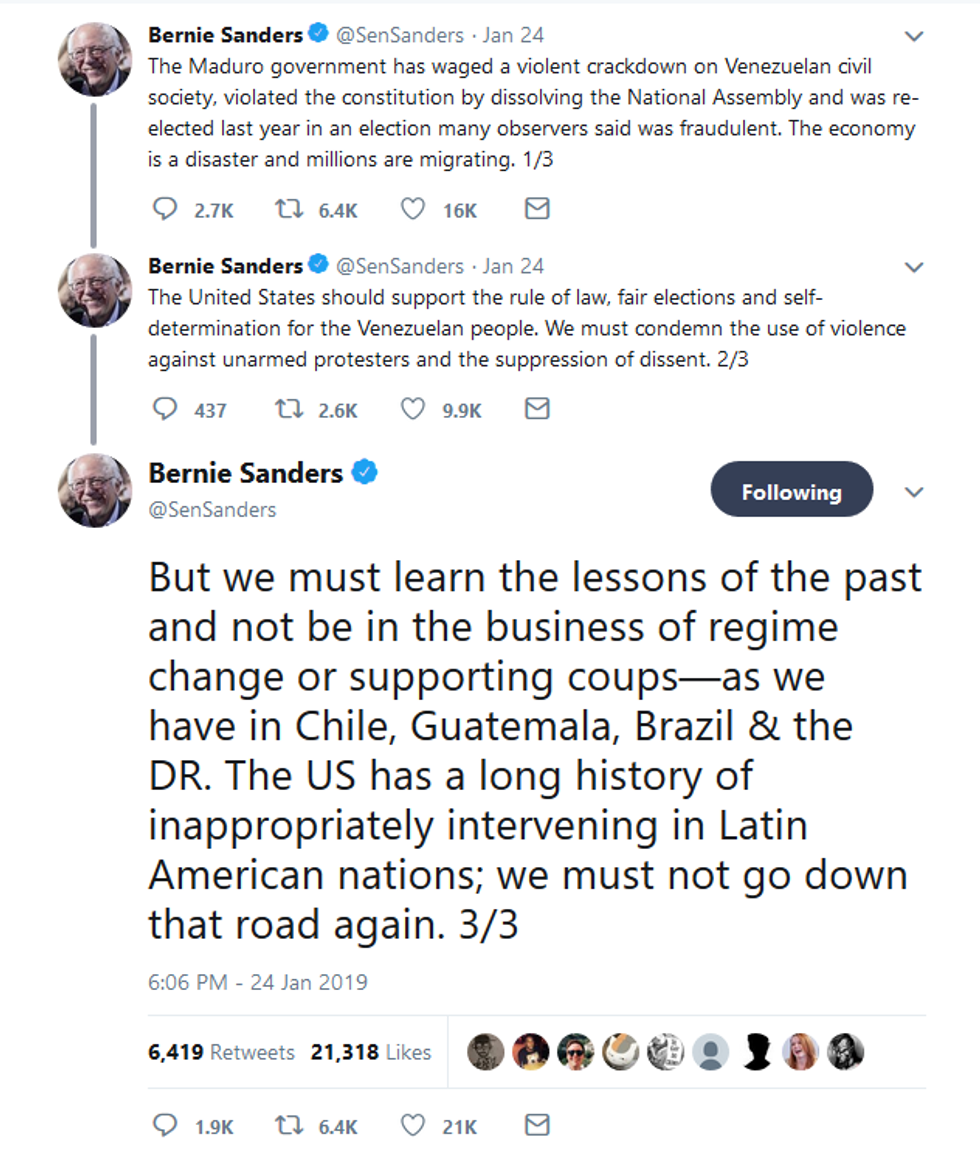
Yet Sanders' statements on the Venezuelan crisis were quite critical of President Nicolas Maduro, saying his 2018 re-election was a vote "many observers said was fraudulent." He condemned his "violent crackdown on Venezuelan civil society," and insisted "humanitarian aid" be allowed in the country. He has consistently maintained a strongly adversarial position to Venezuela, calling Maduro's predecessor Hugo Chavez a "dead Communist dictator."
In fact, the 2018 Venezuelan elections were watched over and endorsed as free by over 150 international observers, although media uniformly ignored those bothersome facts (FAIR.org, 5/23/18). It should also be noted that "civil society" is not a neutral, but a highly loaded term (FAIR.org, 1/31/19). In a study of over 500 articles across a 20-year period, I found that the term was used exclusively to refer to the light-skinned US-backed Venezuelan elite, and never once to the largely black, largely working-class groups who support the government.
The UN and Red Cross have also rejected the US "aid" Sanders demands be let in as politically motivated, and have long worked closely with the Venezuelan government in supplying and distributing genuine international aid across the country. Moreover, the McClatchy DC bureau (2/7/19) has already exposed how weapons are being smuggled into the country from the US. Thus, the senator's statements echoed and supported many of Trump, John Bolton and Elliott Abrams' discredited regime change talking points.
But at the same time, Sanders stopped short of openly endorsing the Trump administration's attempt to overthrow the Maduro government, warning, "We must learn the lessons of the past and not be in the business of regime change or supporting coups--as we have in Chile, Guatemala, Brazil & the DR."
Some in the establishment applauded Sanders' position. In a Foreign Policy essay headlined "The Left Keeps Getting Venezuela Wrong" (1/28/19), writer James Bloodworth distinguished Sanders from left politicians like Ilhan Olmar and Tulsi Gabbard who supposedly "favor dictators--as long as they mouth anti-American platitudes":
It's possible to oppose US interventionism without making further excuses for the dictatorship in Caracas. The unequivocal statements put out by US Sen. Bernie Sanders make a nonsense of the idea that the left has some duty to protect dictators simply because they purport to be socialists.
(Bloodworth has turned Venezuela-baiting Western politicians into a career, writing the same article for years--Spectator, 11/23/13; London Independent, 2/19/14; International Business Times, 7/4/17; New Statesman, 8/2/17; Huffington Post, 5/22/18.)
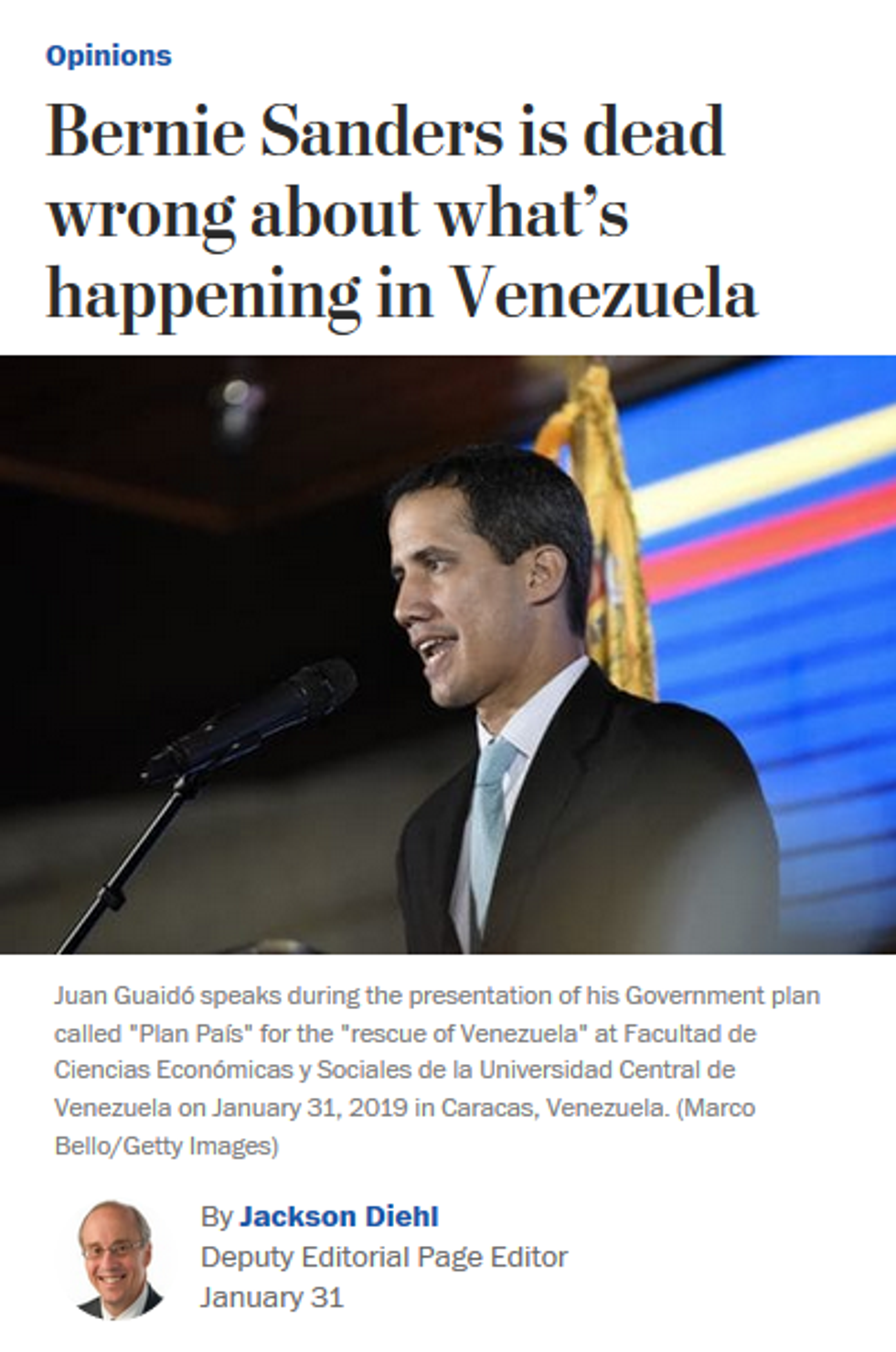
Yet most corporate media coverage condemned Sanders' position as a shameful, slavish support of a dictatorship. The Wall Street Journal (1/28/19) attacked the senator for worrying about "regime change":
Regime change is exactly what the people of Venezuela want. Bernie is siding with the dictator, who survives in power only because of the military and Cuban intelligence.
The Washington Post's Jackson Diehl (1/31/19) wrote that Sanders was "poorly informed" and "dead wrong" about Venezuela, since in Diehl's view the "US has avoided full-scale confrontation with Venezuela" for decades--ignoring Washington's support for overthrowing the Venezuelan government going back at least to 2002, and devastating sanctions that have crippled Venezuela's oil industry and access to credit.
The Washington Examiner (2/21/19) wrote of the senator's "choking immorality" and "rank hypocrisy" for refusing to call for the removal of Maduro, aka "the child butcher of Venezuela." The Miami Herald (2/1/19) began an article, "Shame on you, Bernie Sanders!"--claiming that, by "parroting a dictator's propaganda," he was doing Trump a favor by driving voters to the president's supposedly more sensible position on the country.
Politico (2/21/19) increased the pressure on Sanders, claiming he could not be the Democratic nominee while endorsing a "dictator," giving free rein to multiple sources to attack him for his supposedly "disgusting," "clueless" and "extremely ignorant" comments, which proved "he is not going to be the nominee of the Democratic Party" because "he does not understand this situation."
Politico presented Maduro as an isolated tyrant and the White House's regime change position as common sense. In a nod to balance, it did inform readers that countries like North Korea, Syria, Iran and Russia opposed the plan. It did not inform readers that states such as Norway, Italy, Switzerland, Mexico and South Africa, nations that are not continually demonized in the US media, also recognize Maduro's government.
For over a month, the media have continued to pursue Sanders with the same question. Sanders was grilled live at a town hall by Wolf Blitzer on February 25 (CNN, 2/26/19): "Why have you stopped short of calling Maduro of Venezuela a dictator?" the journalist demanded.
In reality, 75 percent of the world's countries have rejected the US position that Juan Guaido is the legitimate president of Venezuela, according to a study by Venezuelanalysis (2/6/19). The UN has formally condemned the US sanctions, with a UN special rapporteur comparing them to a "medieval siege" and declaring the US guilty of "crimes against humanity" (London Independent, 1/26/19). These inconvenient truths that form the basis for international understanding of the situation have not been reported by the New York Times, CNN, MSNBC or other national news outlets.
International opinion, never in favor of the US, is fast turning actively hostile to Trump's plans, most of which are tacitly or explicitly endorsed by Sanders. The US was excoriated at a UN Security Council meeting (2/26/19), while the unity of the Lima Group--a collection of right-wing Latin American states created by Washington with the express intention of regime change in Venezuela--is disintegrating. Even Brazil's fascist government has backed away from Trump's military build-up, stating under no circumstances would it be part of an invasion (The Hill, 2/25/19). Other key partners like Colombia, Chile and Peru made similar statements, while important European allies Spain and Germany have categorically rejected the military option (Guardian, 2/25/19). Thus, in trying to isolate Venezuela, the extreme position the US has taken has virtually isolated itself.
Nevertheless, the media continue to heap pressure on Sanders to conform to Washington's aggressive foreign policy, deemed too extreme even for far-right governments like Brazil to countenance. Despite his denouncing Maduro and backing the US's dubious "humanitarian" demands, his reminder that the US has a record of "inappropriately intervening in Latin American nations" appears to be too much for columnists and TV anchors to accept.
In their seminal study of the media, Manufacturing Consent, Edward Herman and Noam Chomsky argued that there is an all-pervading anti-socialist secular religion in the press. They noted that leftists at home are constantly accused of supporting the "atrocities" of "socialist" countries, keeping them permanently on the defensive and demanding they support reactionary policies abroad in order to prove their democratic credentials.
So useful is Venezuela-baiting that it is being used around the world to chide leftist politicians into supporting regime change. The Daily Telegraph (2/4/19) claimed that "the tragedy of Venezuela" shows how "dangerous" UK Labour Party leader Jeremy Corbyn is, while the Daily Express (2/5/19) accused Corbyn of "moral bankruptcy" for his failure to sufficiently denounce Maduro. Meanwhile, leftist Greek Prime Minister Alexis Tsipras has been condemned for his failure to support those "fighting for a democratic Venezuela" (Ekathimerini, 2/7/19).
Sanders has faced similar baiting before, over his position on Russia--another official enemy. Despite consistently endorsing the Russiagate narrative and condemning President Vladimir Putin for interfering in US elections, he was constantly attacked as a Russian puppet himself (FAIR.org, 7/27/18). The Washington Post (11/12/17) asked its readers, "When Russia interferes with the 2020 election on behalf of Democratic nominee Bernie Sanders, how will liberals respond?"
The reality is that nothing but complete capitulation to this extractive right-wing tactic will be accepted. Redbaiting is a time-honored technique of enforcing discipline by directing flak for those who step outside the range of "respectable" opinion. Sanders should know this; he once shared a stage with Chomsky (5/20/85), introducing the professor's lecture on how the US media distort the image of Latin American countries as a first step towards military intervention. They also attempt to destroy and defame anyone not sufficiently excited by the prospect of regime change in America's "backyard."

Progressive voices opposed to war, meddling in the complex political conflicts of foreign nations, and concerned about the very likely negative results of yet another U.S. foreign intervention are siding with Sen. Bernie Sanders (I-Vt.) after he drew fire from pro-interventionist forces within the Democratic Party for his stance against regime change in Venezuela.
In an interview with Univision on Thursday, Sanders said that while he doesn't believe it is his place to say whether or not opposition leader Juan Guaido--who last month, in coordination with the Trump administration, declared himself the "interim president"--should be considered be the legitimate leader of Venezuela, he does back pro-democracy efforts in the country even while opposing anything that resembles a U.S.-backed overthrow of President Nicolas Maduro.
"I think the United States has got to work with the international community to make sure that there is a free and fair election in Venezuela," Sanders said. However, he added, the U.S. "must not use military force and intervene again as it has done in the past in Latin America... whether it was Chile or Brazil or the Dominican Republic or Guatemala. The United States has a very bad record of intervening in Latin American countries and that must not happen again. The future of Venezuela must be left to the Venezuelan people."
Watch the full interview:
Sanders' remarks come as political pressure continues to build inside Venezuela, with opposition forces led by Guaido joining forces with the Trump administration to orchestrate a conflict at the Colombia border this weekend with a showdown over supplies and foreign aid.
While the editorial pages of newspapers like the Washington Post continue to treat what's happening near the border as a legitimate effort to bring humanitarian aid to struggling Venezuelans, critics say there is no reason whatsoever to treat members of Trump's foreign policy team--including Secretary of State Mike Pompeo, national security advisor John Bolton, and the State Department's special representative to Venezuela Elliott Abrams--as having anything but ulterior and nefarious motives. As journalist and media critic Adam Johnson wrote for TruthDig on Friday:
No one actually thinks the same Donald Trump who kicked off his run for the White House by calling Mexicans rapists, and subsequently, as president, left Puerto Rico for dead after Hurricane Maria, cares at all about the Venezuelan poor. No one actually thinks the murderers row of Cold Warriors--led by two of the most extreme right-wingers in American politics, Venezuela envoy Elliott Abrams and national security adviser John Bolton--cares at all about the starving people in Venezuela or their plight. No one reading this, be they right, left, center, libertarian, or communist, actually buys the prevailing narrative that the U.S. is sending "aid" to Venezuela as a humanitarian gesture.
So why is everyone pretending otherwise?
In a recent video at The Intercept produced for his "Intercepted" podcast, journalist Jeremy Scahill and his guests laid out some of the key background on the current situation in Venezuela alongside historical context:
According to Scahill, the Trump administration has been "openly plotting to bring down the government of Nicolas Maduro in Caracas. It is being openly promoted as a campaign to steal Venezuelan oil for the benefit of U.S. corporations, and some powerful Democrats are cheering Trump on and joining the conspiracy."
But as the crisis contines to snowball, human rights lawyer Alfred de Zayas, former U.N. Independent Expert on the Promotion of a Democratic and Equitable International Order, has been among those criticizing the Trump admininstration, lawmakers from both parties, and members of the corporate media in the U.S. for their ongoing push for regime change in Venezuela:
Meanwhile, in response to Sanders standing firmly against a new regime change effort by the U.S. government--this time in Venezuela--Rep. Donna Shalala (D-Fla.) told Politico that because of such a position, "He is not going to be the nominee of the Democratic Party." While Shalala represents a district where many Venezuelan-Americans and Venezuelan ex-patriots opposed to Maduro live, she charged that Sanders "has demonstrated again that he does not understand this situation" and said, "I absolutely disagree with his imprecision in not saying Maduro must go."
As Sophie Weiner put it in her Friday morning headline for Splinter News: "Bernie Sanders Isn't Pro-Coup Enough for Florida Democrats." According to Weiner:
Venezuelan President Nicolas Maduro is a dangerous dictator who needs to be ousted from power immediately! All good and honest politicians in America, left or right, should completely support any and all intervention in this matter, and should recognize the opposition party leader, Juan Guaido, as the rightful ruler of the country!
This is the U.S. foreign policy blob's line. And god help you if you even stray from it even a little bit, as 2020 Democratic candidate Sen. Bernie Sanders has.
In his response to comments by Shalala and others, Sanders' deputy chief of staff Ari Rabin-Havt said that such arguments for intervention--without taking into account the consequences--represent "the long and horrific history of American politicians imposing their will on the people of Latin America." His boss, Robin-Havt reiterated, "stands with the Venezuelan people to demand free and fair elections and for self-determination for all people around the world."
Ben Rhodes, meanwhile, who served as deputy national security advisor under former President Barack Obama and no dove when it comes to U.S. foreign policy, appeared to agree with those calling Shalala's remarks a "bit of an overreaction" and warned that it remains very possible to be critical of the Maduro government--as Sanders has been--while still warning against another U.S.-backed overthrow of a foreign government.
"It is possible to think that a) Venezuelans would be much better off without Maduro, and b) Trump's policy (and bluster) is creating the impression of U.S.-imposed regime change which raises lots of risks, including military intervention," Rhodes said in a four-part thread on Twitter on Friday morning.
"It doesn't help that Trump is obviously disingenuous," Rhodes continued. "He embraces dictators around the world while talking up democracy in Venezuela and Cuba. And he unsubtly--in his SOTU and in Miami--views Venezuela as a domestic political issue tied to his 2020 reelection campaign."
He concluded by saying that "the political-media consensus that Dems should have no daylight with Trump on Venezuela adds to a tradition: it is seen as politically damaging to oppose U.S.-imposed or supported regime change, despite the results of those efforts (which often get worse after regime change). This mindset leads to repeated mistakes and the removal of any nuance from hugely impactful policy debates."
While others made clear their skepticism of Rhodes as a reliable voice of anti-interventionist wisdom, journalist Glenn Greenwald gave credit to the comments even as he noted their "(pleasantly) surprising source":
According to Greenwald, Shalala's objections to Sanders' position of non-intervention--especially given the people with whom she is aligning--create a troubling indictment of her foreign policy thinking, not his:
The patently cynical declaration of a national state of emergency by President Donald Trump (aka *45) offers a teachable moment on history, politics and empire. The lies and fear-mongering of those in power, the propaganda to legitimize violating the sovereignty of other nations, the use of fake manufactured crises and old war criminals to promote new atrocities--these are all time-tested tactics of the politics of the USA.
The naked psychological shortcomings of the current head of state leading to undisciplined statements which reveal truth is new, offering a unique opportunity for people to ask the right questions and learn the right lessons.
New too is Congress invoking the 1973 War Powers Resolution as a check against executive overreach. Yet this was driven by the loose tongue of *45 putting a dollar value on life following the Saudi murder of Jamal Khashoggi. The rot of empire begins from within. Concern for human rights in Yemen didn't animate Congress, but rather exposed money-mad policy undermining US soft-power.
The so-called "leadership" of *45 encouraged the US National Security Advisor John Bolton to reveal that Venezuela policy is driven by US oil company opportunism (the recycling of this unrepentant criminal to policy point man is a lesson in itself on the myth of accountability and rule of law). U.S. intervention in Guatemala, Dominican Republic, Chile and so on were likewise driven by corporatism, but prior administrations were better at sticking to the script of promoting democracy. Listen closely to the current U.S. administration talk about Saudi Arabia, Venezuela, and Mexico.
So, there are indeed silver linings to *45--giving us the opportunity to learn and to shake-up and transform business as usual. Always ask: Why should I believe you? Why so many lies? In whose interest? Follow the money. Be curious - listen, read and learn.
Listen to Jeremy Scahill in this recent podcast episode. Read Chalmers Johnson's "The Sorrows of Empire," Sheldon Wolin's "Democracy Incorporated," John Stockwell's "In Search of Enemies," and Jenny Pearce's "Under The Eagle."
The Federalist Society has used *45 and Republican legislators to pack the federal courts. The rule of law is near dead.
The rule of the people must catalyze an uprising against plutocracy, war profiteering, and the savage wars of empire. The mass President's Day protests today, like the grassroots mobilization for a green new deal, are cause for optimism. Our story is not finished.

As Venezuelan President Nicolas Maduro urges the international community to condemn an ongoing U.S.-backed effort to overthrow him and calls for peaceful negotiations with critics led by self-declared "Interim President" Juan Guaido, the Cuban government--which supports Maduro--claimed on Thursday that the Trump administration is moving special forces closer to Venezuela "in preparation for a military adventure under the guise of a 'humanitarian intervention.'"
In a lengthy statement denouncing the steps President Donald Trump and his allies have taken to oust Maduro--particularly National Security Advisor John Bolton and Republican Sen. Marco Rubio (Fla.)--the Cuban government said:
Between February 6 and 10 of 2019, several military transport aircraft have flown to the Rafael Miranda Airport in Puerto Rico, the San Isidro Air Base in the Dominican Republic, and other strategically located Caribbean Islands, most certainly without the knowledge of the governments of those nations. These flights took off from U.S. military facilities where Special Operation Troops and U.S. Marine Corps units operate. These units have been used for covert operations, even against leaders of other countries.
Pointing to a draft resolution that the Trump administration recently introduced at the U.N. Security Council that expresses concern about the humanitarian conditions of Venezuela, Cuba concluded:
[T]he U.S. intends to fabricate a humanitarian pretext in order to launch a military attack on Venezuela and, by resorting to intimidation, pressure, and force, is seeking to introduce into this sovereign nation's territory allegedhumanitarian aid... It is obvious that the United States is paving the way to forcibly establish a humanitarian corridor under international supervision, invoke the obligation to protect civilians, and take all necessary steps. It is worth recalling that similar behaviors and pretexts were used to by the U.S. during the prelude to wars it launched against Yugoslavia, Iraq, and Libya, which resulted in tremendous human losses and caused enormous suffering.
The warnings out of Cuba come after Guaido vowed on Tuesday that foreign aid--which has already begun arriving along the border with Colombia and Brazil--will enter Venezuela on Feb. 23 in spite of objections from Maduro, who has also characterized offerings of aid as part of a "political war of American empire" and "warmongering in order to take over" Venezuela.
Since Trump recognized Guaido as Venezuela's leader last month, he has appointed war hawk Elliott Abrams as a special representative to the country, repeatedly threatened military action if Maduro doesn't turn over power to Guaido, and seized billions of dollars in Venezuelan oil assets. In its statement on Thursday, Cuba charged U.S. actions are "causing serious humanitarian damage and harsh deprivation" to the people of Venezuela.
During a press conference late last month announcing the sanctions on Venezuela's state-owned oil company, Bolton--in a move that critics said was "likely not an accident"--held up a notepad on which he had written "5,000 troops to Colombia." A few days later, Bolton suggested that if Maduro keeps refusing to leave office, he could find himself locked up in a U.S. military prison at the Guantanamo Bay Naval Station in Cuba.