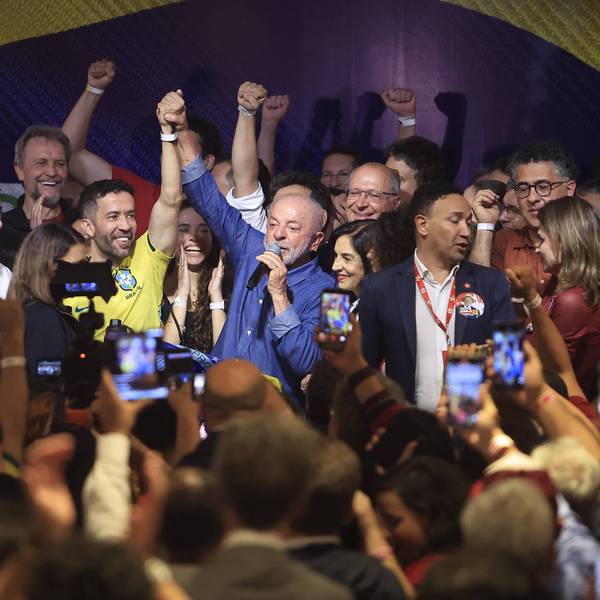
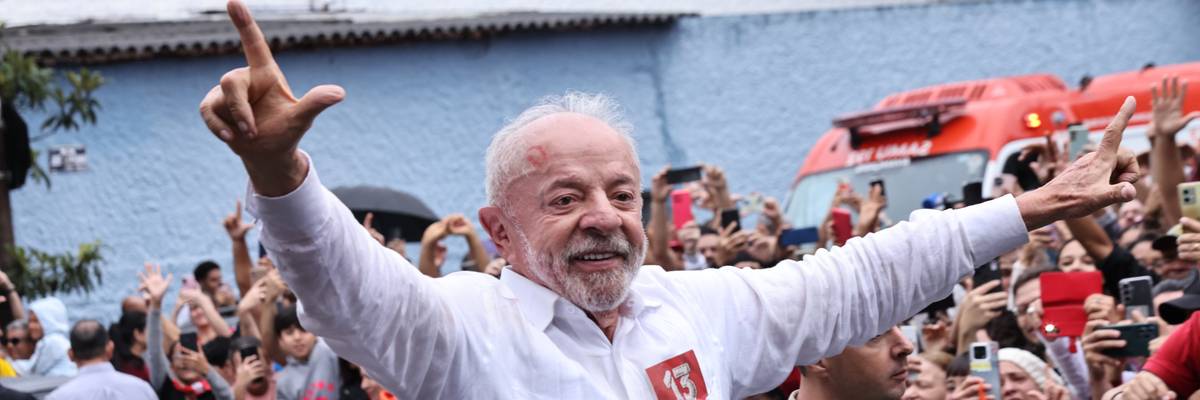
Luiz Inácio Lula Da Silva, incumbent president of Brazil and presidential candidate waves supporters after casting his vote during general election day on October 25, 2026 in Sao Paulo, Brazil.
Lula's Win a Rebuke of Trump and a Triumph for Latin America
The Brazilian leader framed the election as a choice between a sovereign Brazil charting its own course and one subordinated to Washington’s geopolitical agenda. Sunday’s election result shows that the Brazilian people have made their choice.
At 80, President Luiz Inacio Lula da Silva has pulled off an extraordinary political victory. After losing the first round to Flavio Bolsonaro, son of former President Jair Bolsonaro, by 47 percent to 45 percent, Lula defied the odds to secure a stunning second-round victory, with 51.8 percent of the vote against Bolsonaro’s 48.2 percent.
His triumph confounded every pre-election poll and crowned a dramatic campaign revival that few had anticipated.
Lula’s victory in Latin America’s largest country does more than halt the far right’s return to power in Brazil. It breaks a succession of right-wing electoral victories across the region and deals a major blow to United States President Donald Trump’s increasingly interventionist agenda in the Western Hemisphere.
When Bolsonaro unexpectedly defeated Lula in the first round, the result sent shockwaves across Brazil and beyond. For the government, the defeat was particularly startling given its strong socioeconomic record. What followed was an extraordinary three-week political mobilisation that transformed the sluggish first-round campaign of Lula’s Workers’ Party into an existential confrontation over the future of democracy and sovereignty in Brazil.
The economic record was hardly that of a government heading for defeat. Brazil’s economy grew by a cumulative 9.2 percent between 2023 and 2025, compared with an average of just 5.6 percent among its South American neighbours. Unemployment fell from 9.3 percent in 2022 to a historic low of 5.4 percent in 2026.
Brazil also exited the United Nations Hunger Map in 2025, after having returned to it under the Bolsonaro senior administration. In the Amazon, deforestation fell to its lowest level in decades, a sharp reversal of the trend under his predecessor.
Not everything has been rosy under the Lula administration. Millions of Brazilians have remained trapped in credit-card debt, struggling with extremely high interest rates, while an explosion of online gambling has devastated the livelihoods of families. The run-off result sent a clear signal that there was social discontent.
Lula responded with unusually bold measures: a sweeping debt-relief initiative and restrictions on online betting, as well as expanded social benefits, fuel subsidies, and the transition from a six-day to a five-day working week. These policies sought to reconnect the government’s macroeconomic achievements with the everyday economic anxieties of Brazilian voters.
Bolsonaro offered a radically different vision for Brazil: sweeping spending cuts, privatisations, lower taxes and, above all, an iron-fisted response to crime and insecurity. His proposals included building five maximum-security prisons modelled on El Salvador’s notorious penitentiary system and authorising lethal force against heavily armed criminals.
Bolsonaro also pledged to pardon his father, sentenced to 27 years for plotting to overturn the 2022 election, and to grant clemency to those convicted over the January 8, 2023 assault on Brazil’s democratic institutions. For his supporters, this represented an opportunity to reverse what they considered judicial persecution. For his opponents, it threatened to rehabilitate the attempted coup and undermine judicial independence.
Lula’s campaign came back re-energised, with many young Brazilians mobilising at the grassroots level. The campaign was able to overcome even algorithmic bias by social media giants like Meta, which favoured Bolsonaro.
Ultimately, the election became a battle not only over Brazil’s democracy but also its sovereignty. Trump’s administration has intervened conspicuously in Brazilian politics throughout Lula’s term, imposing punitive tariffs, sanctioning a Supreme Court justice involved in Jair Bolsonaro’s prosecution and openly embracing his son’s candidacy.
In May, Trump received Flavio Bolsonaro in the Oval Office. Two days later, Secretary of State Marco Rubio designated Brazil’s two largest crime organisations as foreign terrorist organisations, a measure Flavio had publicly requested.
These designations carry implications extending far beyond electoral politics. They potentially open the door to US military operations on Brazilian territory under Washington’s expanding war on so-called “narcoterrorism”. The world saw how one such foreign terrorist designation enabled the US to intervene militarily in Venezuela and abduct its sitting president.
Whereas Trump seeks to draw Latin America’s largest country into Washington’s expanding system of hemispheric military dominance, Lula has defended Brazil’s strategic autonomy, insisting that cooperation against organised crime must respect national sovereignty.
He framed the election as a choice between a sovereign Brazil charting its own course and one subordinated to Washington’s geopolitical agenda. Sunday’s election result shows that the Brazilian people have made their choice.
Importantly, Lula’s victory may mark a turning point in Latin America’s rightward shift. Since Trump’s return to the White House, the right has scored a string of electoral victories in Honduras, Chile, and Bolivia, among others. But Lula’s re-election suggests that its momentum may be faltering.
The result comes just ahead of the US midterms and could deliver a significant setback to the strength of Trump’s leadership in the Americas. In Argentina, President Javier Milei — who regularly attacks Lula and threw all his weight behind Bolsonaro — has been sliding in the polls ahead of next year’s presidential election. In Chile, President Jose Antonio Kast has suffered an even more precipitous collapse in public support.
Mexico’s Claudia Sheinbaum, for her part, has likely breathed a sigh of relief. A Lula defeat would have left her increasingly isolated in a region gravitating towards Mexico’s northern neighbour. Instead, Latin America’s two most populous countries and largest economies will remain firmly on the left for the foreseeable future.
It is too early to declare the region’s rightward turn over. But Lula’s victory raises the possibility that the wave has already crested. Brazil will not be joining Trump’s Shield of the Americas, and while the “Donroe Doctrine” remains a threat, its moment of greatest ascendancy may already be behind it.
Lula’s victory is a vindication of a lifetime spent fighting for society’s most marginalized and disenfranchised. And its significance extends far beyond Brazil’s borders. For defenders of democracy, multilateralism, international law, environmental protection and the sovereignty of the Global South, it sends a powerful message: the far right’s advance is neither inevitable nor irreversible. Not in Brazil. Not anywhere.
We are at a crossroads
This country and this world are at a monumental crossroads. In a few short weeks, US voters will have an opportunity to beat back the forces of fascism and confront the billionaires who are rigging the economy, our media system, and our democracy, making it increasingly impossible for ordinary people to get by. We’re not just talking about the election. We’re talking about what must be done once these fascist elements are vanquished from power. We need a bolder set of solutions than what either major party has so far been willing to offer and a working-class movement ready to fight like hell for it. Trump didn't emerge from nowhere. The conditions that fueled MAGA authoritarianism were created by decades of radical neoliberal economic policies and a corrupt political system dominated by corporate interests. They slashed taxes on the super-rich, promising that the benefits would trickle down. They said giveaways to the corporate titans would make life more affordable for the rest of us. It was all bullshit. And when a bitter, betrayed populace searches for someone to blame, right-wing demagogues have little trouble finding scapegoats. People know when they're being lied to, but you won't hear any of this from the corporate media. Only independent journalism—powered and funded by people who believe in building a better world—can deliver truly trustworthy daily news. Our Fall Campaign is underway, and we need your help. To power our newsroom through the rest of the year, we need to raise $125,000 by midnight on October 31. So if you share our vision, please contribute whatever you can to sustain our work. |
At 80, President Luiz Inacio Lula da Silva has pulled off an extraordinary political victory. After losing the first round to Flavio Bolsonaro, son of former President Jair Bolsonaro, by 47 percent to 45 percent, Lula defied the odds to secure a stunning second-round victory, with 51.8 percent of the vote against Bolsonaro’s 48.2 percent.
His triumph confounded every pre-election poll and crowned a dramatic campaign revival that few had anticipated.
Lula’s victory in Latin America’s largest country does more than halt the far right’s return to power in Brazil. It breaks a succession of right-wing electoral victories across the region and deals a major blow to United States President Donald Trump’s increasingly interventionist agenda in the Western Hemisphere.
When Bolsonaro unexpectedly defeated Lula in the first round, the result sent shockwaves across Brazil and beyond. For the government, the defeat was particularly startling given its strong socioeconomic record. What followed was an extraordinary three-week political mobilisation that transformed the sluggish first-round campaign of Lula’s Workers’ Party into an existential confrontation over the future of democracy and sovereignty in Brazil.
The economic record was hardly that of a government heading for defeat. Brazil’s economy grew by a cumulative 9.2 percent between 2023 and 2025, compared with an average of just 5.6 percent among its South American neighbours. Unemployment fell from 9.3 percent in 2022 to a historic low of 5.4 percent in 2026.
Brazil also exited the United Nations Hunger Map in 2025, after having returned to it under the Bolsonaro senior administration. In the Amazon, deforestation fell to its lowest level in decades, a sharp reversal of the trend under his predecessor.
Not everything has been rosy under the Lula administration. Millions of Brazilians have remained trapped in credit-card debt, struggling with extremely high interest rates, while an explosion of online gambling has devastated the livelihoods of families. The run-off result sent a clear signal that there was social discontent.
Lula responded with unusually bold measures: a sweeping debt-relief initiative and restrictions on online betting, as well as expanded social benefits, fuel subsidies, and the transition from a six-day to a five-day working week. These policies sought to reconnect the government’s macroeconomic achievements with the everyday economic anxieties of Brazilian voters.
Bolsonaro offered a radically different vision for Brazil: sweeping spending cuts, privatisations, lower taxes and, above all, an iron-fisted response to crime and insecurity. His proposals included building five maximum-security prisons modelled on El Salvador’s notorious penitentiary system and authorising lethal force against heavily armed criminals.
Bolsonaro also pledged to pardon his father, sentenced to 27 years for plotting to overturn the 2022 election, and to grant clemency to those convicted over the January 8, 2023 assault on Brazil’s democratic institutions. For his supporters, this represented an opportunity to reverse what they considered judicial persecution. For his opponents, it threatened to rehabilitate the attempted coup and undermine judicial independence.
Lula’s campaign came back re-energised, with many young Brazilians mobilising at the grassroots level. The campaign was able to overcome even algorithmic bias by social media giants like Meta, which favoured Bolsonaro.
Ultimately, the election became a battle not only over Brazil’s democracy but also its sovereignty. Trump’s administration has intervened conspicuously in Brazilian politics throughout Lula’s term, imposing punitive tariffs, sanctioning a Supreme Court justice involved in Jair Bolsonaro’s prosecution and openly embracing his son’s candidacy.
In May, Trump received Flavio Bolsonaro in the Oval Office. Two days later, Secretary of State Marco Rubio designated Brazil’s two largest crime organisations as foreign terrorist organisations, a measure Flavio had publicly requested.
These designations carry implications extending far beyond electoral politics. They potentially open the door to US military operations on Brazilian territory under Washington’s expanding war on so-called “narcoterrorism”. The world saw how one such foreign terrorist designation enabled the US to intervene militarily in Venezuela and abduct its sitting president.
Whereas Trump seeks to draw Latin America’s largest country into Washington’s expanding system of hemispheric military dominance, Lula has defended Brazil’s strategic autonomy, insisting that cooperation against organised crime must respect national sovereignty.
He framed the election as a choice between a sovereign Brazil charting its own course and one subordinated to Washington’s geopolitical agenda. Sunday’s election result shows that the Brazilian people have made their choice.
Importantly, Lula’s victory may mark a turning point in Latin America’s rightward shift. Since Trump’s return to the White House, the right has scored a string of electoral victories in Honduras, Chile, and Bolivia, among others. But Lula’s re-election suggests that its momentum may be faltering.
The result comes just ahead of the US midterms and could deliver a significant setback to the strength of Trump’s leadership in the Americas. In Argentina, President Javier Milei — who regularly attacks Lula and threw all his weight behind Bolsonaro — has been sliding in the polls ahead of next year’s presidential election. In Chile, President Jose Antonio Kast has suffered an even more precipitous collapse in public support.
Mexico’s Claudia Sheinbaum, for her part, has likely breathed a sigh of relief. A Lula defeat would have left her increasingly isolated in a region gravitating towards Mexico’s northern neighbour. Instead, Latin America’s two most populous countries and largest economies will remain firmly on the left for the foreseeable future.
It is too early to declare the region’s rightward turn over. But Lula’s victory raises the possibility that the wave has already crested. Brazil will not be joining Trump’s Shield of the Americas, and while the “Donroe Doctrine” remains a threat, its moment of greatest ascendancy may already be behind it.
Lula’s victory is a vindication of a lifetime spent fighting for society’s most marginalized and disenfranchised. And its significance extends far beyond Brazil’s borders. For defenders of democracy, multilateralism, international law, environmental protection and the sovereignty of the Global South, it sends a powerful message: the far right’s advance is neither inevitable nor irreversible. Not in Brazil. Not anywhere.