SUBSCRIBE TO OUR FREE NEWSLETTER
Daily news & progressive opinion—funded by the people, not the corporations—delivered straight to your inbox.
5
#000000
#FFFFFF
To donate by check, phone, or other method, see our More Ways to Give page.
Daily news & progressive opinion—funded by the people, not the corporations—delivered straight to your inbox.
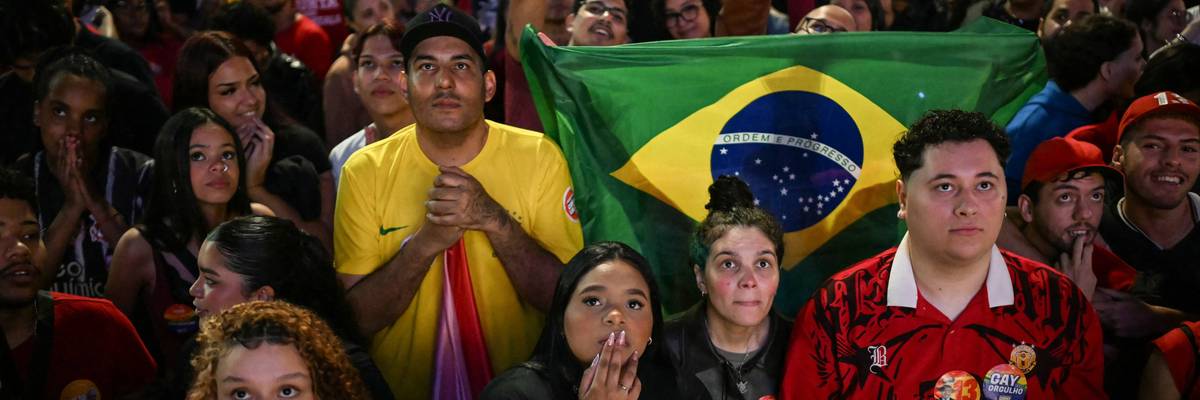
Supporters of Brazilian President Luiz Inácio Lula da Silva react after the first results of the presidential election in São Paulo, Brazil on October 4, 2026.
Ahead of Sunday's contest, Brazil's government and Lula's presidential campaign called for investigations into alleged Trump administration efforts to interfere in the Latin American country's politics.
Brazil's presidential election headed to a runoff on Sunday after neither incumbent President Luiz Inácio Lula da Silva nor challenger Flávio Bolsonaro—the son of former President Jair Bolsonaro and ally of US President Donald Trump—received enough votes to win outright.
The younger Bolsonaro, whose father is serving a 27-year prison sentence under house arrest for orchestrating a coup attempt in 2022, led Lula by two percentage points in the first round, with the final tally standing at 47% to 45%. The runoff will take place on October 25.
Sunday's results—which included major conservative wins in down-ballot contests—heightened fears of another far-right victory in Latin America, where candidates backed by Trump have swept to power in recent elections, including in Colombia, Peru, and Chile. Ahead of Sunday's contest, Lula's campaign, Brazil's intelligence agency, and outside observers accused the Trump administration of meddling in the high-stakes election in an effort to oust Lula and return an ally to the nation's presidency.
Just days before the election, Lula's team called for an investigation after the Trump administration halted US consular services in Brazil, citing "security concerns."
Additionally, Lula's government is calling for a probe of "alleged efforts by the United States to interfere in the country’s domestic politics through the diversion of funds to far-right causes," Al Jazeera reported last week.
"Attorney General Jorge Messias called for the probe on Thursday, one day after the British newspaper The Guardian published a story suggesting that the administration of United States President Donald Trump planned to award $1 million to right-wing civil groups opposing the Brazilian Supreme Court," the outlet noted. "Messias stated in a social media post that foreign meddling 'cannot be tolerated' and that the report represented 'an important alert for Brazilian sovereignty.'"
Mark Weisbrot, co-director of the US-based Center for Economic and Policy Research, called the Trump administration's interference "another US regime change operation," pointing to the aggressive tariffs Trump imposed on Brazilian goods last year and the US State Department's attempt to send two top officials to "cast doubt on the fairness and integrity of the country’s electoral system," as The Washington Post reported earlier this year.
Trump, who hosted Flávio Bolsonaro at the White House in May, said last week that he was following the Brazilian election "very closely" and described the contest as "very important." A key Trump ally in the region, Argentine President Javier Milei—whose austerity agenda has fueled an increase in poverty in his country—traveled to Brazil in July to support Bolsonaro's campaign against Lula.
Flávio Bolsonaro, a sitting senator, wasn't the only member of the Bolsonaro family seeking greater political power in Sunday's elections. Jair Bolsonaro's wife, Michelle, and his second son, Carlos, both won seats in Brazil's Senate.
The Guardian reported that "of the 54 senators elected, 34 were from the right or far-right."
Following the results, Lula told supporters in Sāo Paulo on Sunday that "we have just had a lesson in Brazilian democracy."
"The result is often unexpected. We can never get everything we wanted. I confess to you that I was convinced I was going to win the election in the first round," said Lula. "But we have a second round."
"From tomorrow we will launch a new campaign," Lula added, "a campaign with only two candidates [where] we will be able to show the difference between our proposals for Brazil."
Dear Common Dreams reader, It’s been nearly 30 years since I co-founded Common Dreams with my late wife, Lina Newhouser. We had the radical notion that journalism should serve the public good, not corporate profits. It was clear to us from the outset what it would take to build such a project. No paid advertisements. No corporate sponsors. No millionaire publisher telling us what to think or do. Many people said we wouldn't last a year, but we proved those doubters wrong. Together with a tremendous team of journalists and dedicated staff, we built an independent media outlet free from the constraints of profits and corporate control. Our mission has always been simple: To inform. To inspire. To ignite change for the common good. Building Common Dreams was not easy. Our survival was never guaranteed. When you take on the most powerful forces—Wall Street greed, fossil fuel industry destruction, Big Tech lobbyists, and uber-rich oligarchs who have spent billions upon billions rigging the economy and democracy in their favor—the only bulwark you have is supporters who believe in your work. But here’s the urgent message from me today. It's never been this bad out there. And it's never been this hard to keep us going. At the very moment Common Dreams is most needed, the threats we face are intensifying. We need your support now more than ever. We don't accept corporate advertising and never will. We don't have a paywall because we don't think people should be blocked from critical news based on their ability to pay. Everything we do is funded by the donations of readers like you. When everyone does the little they can afford, we are strong. But if that support retreats or dries up, so do we. Will you donate now to make sure Common Dreams not only survives but thrives? —Craig Brown, Co-founder |
Brazil's presidential election headed to a runoff on Sunday after neither incumbent President Luiz Inácio Lula da Silva nor challenger Flávio Bolsonaro—the son of former President Jair Bolsonaro and ally of US President Donald Trump—received enough votes to win outright.
The younger Bolsonaro, whose father is serving a 27-year prison sentence under house arrest for orchestrating a coup attempt in 2022, led Lula by two percentage points in the first round, with the final tally standing at 47% to 45%. The runoff will take place on October 25.
Sunday's results—which included major conservative wins in down-ballot contests—heightened fears of another far-right victory in Latin America, where candidates backed by Trump have swept to power in recent elections, including in Colombia, Peru, and Chile. Ahead of Sunday's contest, Lula's campaign, Brazil's intelligence agency, and outside observers accused the Trump administration of meddling in the high-stakes election in an effort to oust Lula and return an ally to the nation's presidency.
Just days before the election, Lula's team called for an investigation after the Trump administration halted US consular services in Brazil, citing "security concerns."
Additionally, Lula's government is calling for a probe of "alleged efforts by the United States to interfere in the country’s domestic politics through the diversion of funds to far-right causes," Al Jazeera reported last week.
"Attorney General Jorge Messias called for the probe on Thursday, one day after the British newspaper The Guardian published a story suggesting that the administration of United States President Donald Trump planned to award $1 million to right-wing civil groups opposing the Brazilian Supreme Court," the outlet noted. "Messias stated in a social media post that foreign meddling 'cannot be tolerated' and that the report represented 'an important alert for Brazilian sovereignty.'"
Mark Weisbrot, co-director of the US-based Center for Economic and Policy Research, called the Trump administration's interference "another US regime change operation," pointing to the aggressive tariffs Trump imposed on Brazilian goods last year and the US State Department's attempt to send two top officials to "cast doubt on the fairness and integrity of the country’s electoral system," as The Washington Post reported earlier this year.
Trump, who hosted Flávio Bolsonaro at the White House in May, said last week that he was following the Brazilian election "very closely" and described the contest as "very important." A key Trump ally in the region, Argentine President Javier Milei—whose austerity agenda has fueled an increase in poverty in his country—traveled to Brazil in July to support Bolsonaro's campaign against Lula.
Flávio Bolsonaro, a sitting senator, wasn't the only member of the Bolsonaro family seeking greater political power in Sunday's elections. Jair Bolsonaro's wife, Michelle, and his second son, Carlos, both won seats in Brazil's Senate.
The Guardian reported that "of the 54 senators elected, 34 were from the right or far-right."
Following the results, Lula told supporters in Sāo Paulo on Sunday that "we have just had a lesson in Brazilian democracy."
"The result is often unexpected. We can never get everything we wanted. I confess to you that I was convinced I was going to win the election in the first round," said Lula. "But we have a second round."
"From tomorrow we will launch a new campaign," Lula added, "a campaign with only two candidates [where] we will be able to show the difference between our proposals for Brazil."
Brazil's presidential election headed to a runoff on Sunday after neither incumbent President Luiz Inácio Lula da Silva nor challenger Flávio Bolsonaro—the son of former President Jair Bolsonaro and ally of US President Donald Trump—received enough votes to win outright.
The younger Bolsonaro, whose father is serving a 27-year prison sentence under house arrest for orchestrating a coup attempt in 2022, led Lula by two percentage points in the first round, with the final tally standing at 47% to 45%. The runoff will take place on October 25.
Sunday's results—which included major conservative wins in down-ballot contests—heightened fears of another far-right victory in Latin America, where candidates backed by Trump have swept to power in recent elections, including in Colombia, Peru, and Chile. Ahead of Sunday's contest, Lula's campaign, Brazil's intelligence agency, and outside observers accused the Trump administration of meddling in the high-stakes election in an effort to oust Lula and return an ally to the nation's presidency.
Just days before the election, Lula's team called for an investigation after the Trump administration halted US consular services in Brazil, citing "security concerns."
Additionally, Lula's government is calling for a probe of "alleged efforts by the United States to interfere in the country’s domestic politics through the diversion of funds to far-right causes," Al Jazeera reported last week.
"Attorney General Jorge Messias called for the probe on Thursday, one day after the British newspaper The Guardian published a story suggesting that the administration of United States President Donald Trump planned to award $1 million to right-wing civil groups opposing the Brazilian Supreme Court," the outlet noted. "Messias stated in a social media post that foreign meddling 'cannot be tolerated' and that the report represented 'an important alert for Brazilian sovereignty.'"
Mark Weisbrot, co-director of the US-based Center for Economic and Policy Research, called the Trump administration's interference "another US regime change operation," pointing to the aggressive tariffs Trump imposed on Brazilian goods last year and the US State Department's attempt to send two top officials to "cast doubt on the fairness and integrity of the country’s electoral system," as The Washington Post reported earlier this year.
Trump, who hosted Flávio Bolsonaro at the White House in May, said last week that he was following the Brazilian election "very closely" and described the contest as "very important." A key Trump ally in the region, Argentine President Javier Milei—whose austerity agenda has fueled an increase in poverty in his country—traveled to Brazil in July to support Bolsonaro's campaign against Lula.
Flávio Bolsonaro, a sitting senator, wasn't the only member of the Bolsonaro family seeking greater political power in Sunday's elections. Jair Bolsonaro's wife, Michelle, and his second son, Carlos, both won seats in Brazil's Senate.
The Guardian reported that "of the 54 senators elected, 34 were from the right or far-right."
Following the results, Lula told supporters in Sāo Paulo on Sunday that "we have just had a lesson in Brazilian democracy."
"The result is often unexpected. We can never get everything we wanted. I confess to you that I was convinced I was going to win the election in the first round," said Lula. "But we have a second round."
"From tomorrow we will launch a new campaign," Lula added, "a campaign with only two candidates [where] we will be able to show the difference between our proposals for Brazil."