SUBSCRIBE TO OUR FREE NEWSLETTER
Daily news & progressive opinion—funded by the people, not the corporations—delivered straight to your inbox.
5
#000000
#FFFFFF
To donate by check, phone, or other method, see our More Ways to Give page.
Daily news & progressive opinion—funded by the people, not the corporations—delivered straight to your inbox.
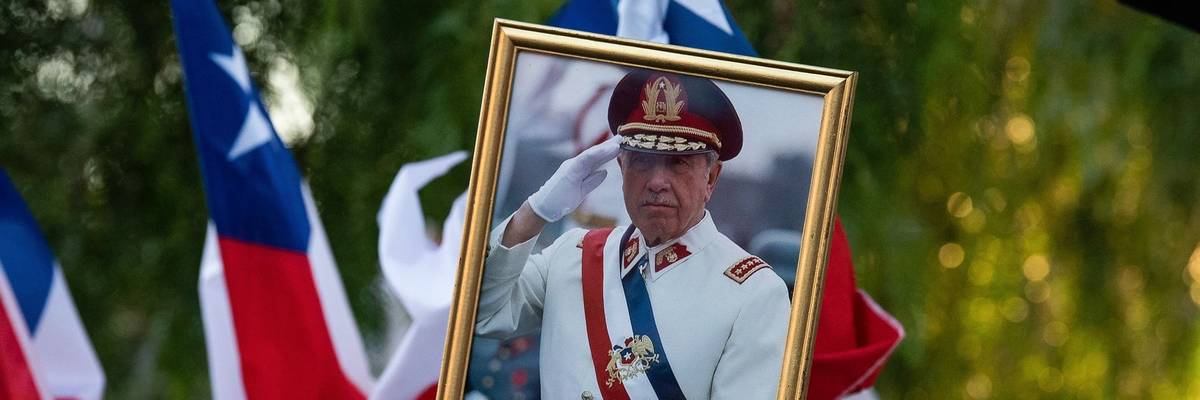
Supporters of presidential candidate José Antonio Kast of Chile's Republican Party celebrate with an image of former Chilean President Augusto Pinochet following the 2025 presidential election on December 14, 2025, in Santiago, Chile.
José Antonio Kast has described the dictator who ended democracy for nearly two decades and presided over the persecution of tens of thousands of dissidents as someone who brought "order" to Chile.
José Antonio Kast, a far-right former lawmaker, won over 58% of the vote in Chile's runoff elections on Sunday over Jeannette Jara, the labor minister under outgoing left-wing President Gabriel Boric, to become the nation's next president.
The win came despite Kast's open admiration for General Augusto Pinochet, who ended civilian rule in Chile after taking power through a coup d'etat in 1973, overthrowing its democratically elected socialist leader in a US Central Intelligence Agency-backed plot and implementing a radical program of economic austerity.
Until he was ousted by a democratic referendum in 1990, Pinochet governed Chile as a military dictatorship rife with human rights abuses, resulting in his indictment by a Spanish court in 1996 for crimes against humanity. His regime assassinated or "disappeared" nearly 3,200 people, while tens of thousands were tortured and more forced into exile.
Human rights groups have accused Kast and his family—the patriarch of which was a member of the Nazi Party who fled to Chile in 1950—of collaboration with the Pinochet regime's detention of opponents. The president-elect's brother was a minister for Pinochet during the dictatorship.
Kast will be the first president of Chile since its return to democracy to have campaigned for and voted “Yes” in the 1988 plebiscite for the dictator to stay in power for another eight years despite his reign of terror.
But rather than distance himself from Pinochet's legacy, Kast has described himself as his spiritual successor.
In 2017, during his first of three presidential campaigns, Kast told a local newspaper that “if he were alive,” Pinochet “would vote for me.” Kast later described Pinochet as someone who brought “order” to Chile, comments that the Buenos Aires Times wrote in 2021, “railed many who are still scarred by this dark period in the country’s history.”
But Kast's nostalgia for that period of repression was not enough to hobble him this time around. At a time when the right is making gains across Latin America, Kast's policy agenda sits at the nexus point between the free market fundamentalism of Argentina's Javier Milei and the police state ambitions of El Salvador's Nayib Bukele.
He has pledged an economic program in the same vein as Pinochet's and, later, Milei's "shock therapy," proposing an unprecedented cut of $21 billion in public spending over his term, paired with a reduction in taxes on the wealthy.
Kast has pledged that these cuts would only affect "waste" and "political" spending, but not impact social programs that benefit Chileans. But economic analysts, including Javiera Toro, Chile's social development minister, have argued that a cut of that size would inevitably cut into the social safety net, including its popular state pension program and others related to health, housing, and education.
Kast successfully martialed fear of high crime (even though it actually fell under Boric's tenure) into outrage toward the nation's undocumented migrants—mainly from Venezuela—whom he has pledged to deport en masse. As in the US, where President Donald Trump is also spearheading a mass deportation operation, immigrants in Chile commit crimes at lower rates than those born in the country.
Last year, Kast visited the sprawling prison complex where Bukele has used emergency powers to detain tens of thousands of people as part of his sweeping war on gangs, often in punishing conditions where they've faced torture. Amnesty International described it as a "state policy of massive and arbitrary deprivation of liberty." Kast said he'd like to implement a similar policy in Chile.
Kast immediately raised fears for the future of Chile's democracy in his victory speech, vowing to form an "emergency government" when he takes power in 2026. However, he will not command a majority in Chile's legislature, which may make the delivery of his agenda more challenging.
Jenny Pribble, professor of political science and global studies at the University of Richmond, told Al Jazeera: “It remains to be seen if Kast could or would pursue such an approach, but if Chile follows the Salvadoran model, it would constitute significant democratic backsliding.”
Dear Common Dreams reader, It’s been nearly 30 years since I co-founded Common Dreams with my late wife, Lina Newhouser. We had the radical notion that journalism should serve the public good, not corporate profits. It was clear to us from the outset what it would take to build such a project. No paid advertisements. No corporate sponsors. No millionaire publisher telling us what to think or do. Many people said we wouldn't last a year, but we proved those doubters wrong. Together with a tremendous team of journalists and dedicated staff, we built an independent media outlet free from the constraints of profits and corporate control. Our mission has always been simple: To inform. To inspire. To ignite change for the common good. Building Common Dreams was not easy. Our survival was never guaranteed. When you take on the most powerful forces—Wall Street greed, fossil fuel industry destruction, Big Tech lobbyists, and uber-rich oligarchs who have spent billions upon billions rigging the economy and democracy in their favor—the only bulwark you have is supporters who believe in your work. But here’s the urgent message from me today. It's never been this bad out there. And it's never been this hard to keep us going. At the very moment Common Dreams is most needed, the threats we face are intensifying. We need your support now more than ever. We don't accept corporate advertising and never will. We don't have a paywall because we don't think people should be blocked from critical news based on their ability to pay. Everything we do is funded by the donations of readers like you. When everyone does the little they can afford, we are strong. But if that support retreats or dries up, so do we. Will you donate now to make sure Common Dreams not only survives but thrives? —Craig Brown, Co-founder |
José Antonio Kast, a far-right former lawmaker, won over 58% of the vote in Chile's runoff elections on Sunday over Jeannette Jara, the labor minister under outgoing left-wing President Gabriel Boric, to become the nation's next president.
The win came despite Kast's open admiration for General Augusto Pinochet, who ended civilian rule in Chile after taking power through a coup d'etat in 1973, overthrowing its democratically elected socialist leader in a US Central Intelligence Agency-backed plot and implementing a radical program of economic austerity.
Until he was ousted by a democratic referendum in 1990, Pinochet governed Chile as a military dictatorship rife with human rights abuses, resulting in his indictment by a Spanish court in 1996 for crimes against humanity. His regime assassinated or "disappeared" nearly 3,200 people, while tens of thousands were tortured and more forced into exile.
Human rights groups have accused Kast and his family—the patriarch of which was a member of the Nazi Party who fled to Chile in 1950—of collaboration with the Pinochet regime's detention of opponents. The president-elect's brother was a minister for Pinochet during the dictatorship.
Kast will be the first president of Chile since its return to democracy to have campaigned for and voted “Yes” in the 1988 plebiscite for the dictator to stay in power for another eight years despite his reign of terror.
But rather than distance himself from Pinochet's legacy, Kast has described himself as his spiritual successor.
In 2017, during his first of three presidential campaigns, Kast told a local newspaper that “if he were alive,” Pinochet “would vote for me.” Kast later described Pinochet as someone who brought “order” to Chile, comments that the Buenos Aires Times wrote in 2021, “railed many who are still scarred by this dark period in the country’s history.”
But Kast's nostalgia for that period of repression was not enough to hobble him this time around. At a time when the right is making gains across Latin America, Kast's policy agenda sits at the nexus point between the free market fundamentalism of Argentina's Javier Milei and the police state ambitions of El Salvador's Nayib Bukele.
He has pledged an economic program in the same vein as Pinochet's and, later, Milei's "shock therapy," proposing an unprecedented cut of $21 billion in public spending over his term, paired with a reduction in taxes on the wealthy.
Kast has pledged that these cuts would only affect "waste" and "political" spending, but not impact social programs that benefit Chileans. But economic analysts, including Javiera Toro, Chile's social development minister, have argued that a cut of that size would inevitably cut into the social safety net, including its popular state pension program and others related to health, housing, and education.
Kast successfully martialed fear of high crime (even though it actually fell under Boric's tenure) into outrage toward the nation's undocumented migrants—mainly from Venezuela—whom he has pledged to deport en masse. As in the US, where President Donald Trump is also spearheading a mass deportation operation, immigrants in Chile commit crimes at lower rates than those born in the country.
Last year, Kast visited the sprawling prison complex where Bukele has used emergency powers to detain tens of thousands of people as part of his sweeping war on gangs, often in punishing conditions where they've faced torture. Amnesty International described it as a "state policy of massive and arbitrary deprivation of liberty." Kast said he'd like to implement a similar policy in Chile.
Kast immediately raised fears for the future of Chile's democracy in his victory speech, vowing to form an "emergency government" when he takes power in 2026. However, he will not command a majority in Chile's legislature, which may make the delivery of his agenda more challenging.
Jenny Pribble, professor of political science and global studies at the University of Richmond, told Al Jazeera: “It remains to be seen if Kast could or would pursue such an approach, but if Chile follows the Salvadoran model, it would constitute significant democratic backsliding.”
José Antonio Kast, a far-right former lawmaker, won over 58% of the vote in Chile's runoff elections on Sunday over Jeannette Jara, the labor minister under outgoing left-wing President Gabriel Boric, to become the nation's next president.
The win came despite Kast's open admiration for General Augusto Pinochet, who ended civilian rule in Chile after taking power through a coup d'etat in 1973, overthrowing its democratically elected socialist leader in a US Central Intelligence Agency-backed plot and implementing a radical program of economic austerity.
Until he was ousted by a democratic referendum in 1990, Pinochet governed Chile as a military dictatorship rife with human rights abuses, resulting in his indictment by a Spanish court in 1996 for crimes against humanity. His regime assassinated or "disappeared" nearly 3,200 people, while tens of thousands were tortured and more forced into exile.
Human rights groups have accused Kast and his family—the patriarch of which was a member of the Nazi Party who fled to Chile in 1950—of collaboration with the Pinochet regime's detention of opponents. The president-elect's brother was a minister for Pinochet during the dictatorship.
Kast will be the first president of Chile since its return to democracy to have campaigned for and voted “Yes” in the 1988 plebiscite for the dictator to stay in power for another eight years despite his reign of terror.
But rather than distance himself from Pinochet's legacy, Kast has described himself as his spiritual successor.
In 2017, during his first of three presidential campaigns, Kast told a local newspaper that “if he were alive,” Pinochet “would vote for me.” Kast later described Pinochet as someone who brought “order” to Chile, comments that the Buenos Aires Times wrote in 2021, “railed many who are still scarred by this dark period in the country’s history.”
But Kast's nostalgia for that period of repression was not enough to hobble him this time around. At a time when the right is making gains across Latin America, Kast's policy agenda sits at the nexus point between the free market fundamentalism of Argentina's Javier Milei and the police state ambitions of El Salvador's Nayib Bukele.
He has pledged an economic program in the same vein as Pinochet's and, later, Milei's "shock therapy," proposing an unprecedented cut of $21 billion in public spending over his term, paired with a reduction in taxes on the wealthy.
Kast has pledged that these cuts would only affect "waste" and "political" spending, but not impact social programs that benefit Chileans. But economic analysts, including Javiera Toro, Chile's social development minister, have argued that a cut of that size would inevitably cut into the social safety net, including its popular state pension program and others related to health, housing, and education.
Kast successfully martialed fear of high crime (even though it actually fell under Boric's tenure) into outrage toward the nation's undocumented migrants—mainly from Venezuela—whom he has pledged to deport en masse. As in the US, where President Donald Trump is also spearheading a mass deportation operation, immigrants in Chile commit crimes at lower rates than those born in the country.
Last year, Kast visited the sprawling prison complex where Bukele has used emergency powers to detain tens of thousands of people as part of his sweeping war on gangs, often in punishing conditions where they've faced torture. Amnesty International described it as a "state policy of massive and arbitrary deprivation of liberty." Kast said he'd like to implement a similar policy in Chile.
Kast immediately raised fears for the future of Chile's democracy in his victory speech, vowing to form an "emergency government" when he takes power in 2026. However, he will not command a majority in Chile's legislature, which may make the delivery of his agenda more challenging.
Jenny Pribble, professor of political science and global studies at the University of Richmond, told Al Jazeera: “It remains to be seen if Kast could or would pursue such an approach, but if Chile follows the Salvadoran model, it would constitute significant democratic backsliding.”