

SUBSCRIBE TO OUR FREE NEWSLETTER
Daily news & progressive opinion—funded by the people, not the corporations—delivered straight to your inbox.
5
#000000
#FFFFFF
To donate by check, phone, or other method, see our More Ways to Give page.
Daily news & progressive opinion—funded by the people, not the corporations—delivered straight to your inbox.

Phil LaRue, Earthjustice—(202) 797-4317, plarue@earthjustice.org
The White House Council on Environmental Quality (CEQ) plans to release a sweeping proposal to rewrite the National Environmental Policy Act (NEPA) to benefit big polluters and corporate special interests.
The National Environmental Policy Act grew out of decades of determined activism on the part of people demanding a say in decisions affecting their homes, health, and environment. Passed by broad, bipartisan majorities in the House and Senate and signed into law by a Republican president, NEPA has protected clean air, clean water, and healthy communities for decades. The law ensures that communities have a voice in planning and can protect themselves from dangerous, rushed, or poorly planned federal projects by mandating environmental impact statements (EISs) and allowing for public comment and review. NEPA's process often results in smarter, healthier alternatives to polluting projects.
The following is a statement from Stephen Schima, a senior legislative counsel leading NEPA advocacy work for Earthjustice:
"This law was built on decades of activism from people who wanted a say in decisions affecting their health, their lives, their communities, and their environment. By stacking the deck for corporate polluters and eviscerating public participation, this administration is trashing that legacy. Without this law, the government will have an easier time letting dirty industry tear down trees, put up refineries next to children's schools, and risk our health. Worse still, this proposal will threaten to silence the voices of the very people government should be listening to - the people living on the front lines of the climate crisis."
According to recent reports, the Trump administration's proposal could drastically curtail NEPA's ability to protect communities in a variety of ways, including:
Allowing project sponsors - often polluter interests seeking federal permits - to write their own reviews. The proposal would effectively give project sponsors in the NEPA process the ability to write their own reviews, stacking the deck in the review process for those who want to slash, burn, and pollute communities' air and water for the sake of profit. Cementing conflicts-of-interest into federal regulation puts our health at risk and undermines our democracy.
Restrictions on public input: The right of citizens to meaningfully weigh in on federal decisions impacting their communities is the most important guarantee of the current protections afforded under NEPA. This proposal slaps time limits on environmental impact studies and pushes the public out of key decisions. This attack will have especially dire impacts on the vulnerable communities who lack the resources to fight misguided or dangerous projects and rely on NEPA's public participation guarantees as tools to ensure environmental justice is a core consideration in planning.
Narrowing the scope of NEPA review, effectively blocking the public from offering project alternatives. The consideration of project alternatives is often called the "heart of the environmental impact statement." Consideration of alternatives often results in the discovery of new opportunities to mitigate environmental damage and save taxpayer money. The Trump administration's proposal would redefine the term "major federal action," narrowing the number of actions that require NEPA review. This would severely curtail review of environmental impacts and provide the public with little to no voice in the decisions affecting their communities, effectively placing new restraints on the use of environmental impact studies.
Institutionalizing climate denial in environmental planning. NEPA requires federal agencies to consider not only the impacts a federal decision may have on climate change, but also the impacts climate change may have on federal projects - including the roads, bridges, and other critical infrastructure this country so desperately needs and which needs to be built to withstand rising seas, increased flooding, and other extreme weather events. The Trump administration's new NEPA guidance is its latest attempt to undermine climate action, coming after of the withdrawal of NEPA Climate Guidance in early 2017. Under this new proposal, the federal government would effectively have the power to ignore climate change impacts that could put our infrastructure as well as the health and safety of frontline communities at risk.
Learn more on NEPA:
What is NEPA? (Protect NEPA Coalition)
Trump Wants to Undo the People's Environmental Law (Earthjustice)
How "Freeway Revolts" Helped Create the People's Environmental Law (Earthjustice)
Trump chips away at the shield against environmental racism (Earthjustice's Patrice Simms and Moving Forward Network's Angelo Logan for The Hill)
Earthjustice is a non-profit public interest law firm dedicated to protecting the magnificent places, natural resources, and wildlife of this earth, and to defending the right of all people to a healthy environment. We bring about far-reaching change by enforcing and strengthening environmental laws on behalf of hundreds of organizations, coalitions and communities.
800-584-6460
"When foreign aid retreats, Indigenous peoples and small-scale farmers can be left with fewer resources and less support as they defend the forests, rivers, and other ecosystems that sustain their communities and help keep the global climate stable,” one campaigner said.
A total of 124 people were killed defending the environment in 2025, according to a Global Witness report released Wednesday, as the global rise of authoritarianism and a dramatic decline in foreign aid makes the lives and work of environmental and humans rights advocates more challenging.
The report singles out the administration of US President Donald Trump—which dismantled the US Agency for International Development, delayed paying other United Nations fees, and has shown a broader disregard for international humans rights norms and the institutions that uphold them—for worsening the global climate for defenders. In 2025, total development aid plummeted by a record 23%, depleting the resources available to local communities and the organizations that support them.
“The effects of these budget cuts are not abstract," Juliana Vélez Echeverri, a senior campaigner at Global Witness, said in a statement. “In Colombia, projects working to promote and protect human rights and support defenders have been hit by the sudden drop in foreign aid, particularly from the US. When foreign aid retreats, Indigenous peoples and small-scale farmers can be left with fewer resources and less support as they defend the forests, rivers, and other ecosystems that sustain their communities and help keep the global climate stable.”
"We can’t prevent climate change when they kill those who protect the environment."
Colombia was the deadliest country for land defenders for the fourth year in a row with 39 killings, followed by Brazil with 26, and Honduras and the Philippines with 12 each. As the site of 85% of the killings, Latin America was the deadliest region, as it has been since Global Witness began counting the killings of environmental defenders in 2012. Indigenous people remain especially vulnerable to violence, as over three-quarters of the people killed in 2025 were either Indigenous, Afro-descendant, or small-scale farmers.
"For Indigenous peoples, land is life," said Joan Carling, executive director of Indigenous Peoples’ Rights International, in the report foreword. "Any threat to our lands, territories, and resources is a threat to our very existence—our cultures, our identities, our dignity, and our future generations. That is why our communities were willing to risk everything to protect them."
Seven of the Indigenous people killed in 2025 were members of Indigenous guards established to patrol and protect their territories from illegal encroachment. For example, the Indigenous Guard of the Kakataibo People of Peru was formed in 2022 to protect their rainforest home from illegal cocoa growing and logging.
“Defending our territory is important to us as a community and as a people, and we’re proud to support the climate that we all depend on," said Segundo Ispón, commander of Peru’s Kakataibo Indigenous Guard, in a statement. "In our culture, the work of defending our resources and territory is taught from an early age. But for this next generation coming up, the work is more dangerous than ever.”
The experience of the Kakataibo reflects another growing trend that endangers defenders: the rise of organized crime amid weakening state authority to oppose it. More than one-third of killings in 2025 were linked to organized crime or hitmen. And more than half of the killings were due to land disputes, "demonstrating how authorities’ failure to resolve competing land claims or demarcate territory paves the way for attacks on defenders and their communities," the report authors said.
As Ispón said in the report: “There is inaction from the state, inaction from the authorities. Faced with that, what do we do? We protect ourselves. We take care of each other.”
Yet the rise in lawlessness goes hand in hand with a rise in government repression against activists, making it difficult to get accurate information about the numbers of defenders killed. While the 124 figure is lower than the 142 killed in 2024 or the 196 killed in 2023, the report authors noted that "these figures are likely a significant underestimate, as many cases go unreported.
They added: "This is typical of situations involving serious armed conflict and genocide, where generalized insecurity and mass killings make identifying and verifying individual cases difficult. Research is also challenging in repressive contexts where victims and civil society groups face reprisals for reporting and documenting abuses."
Indeed, civic freedom tracker CIVICUS Monitor considers 10 of the 15 countries in which deaths were reported to be repressed.
Furthermore, the number killed does not reflect other forms of harassment and repression, such as the criminalization or weaponization of social media against activists, both of which are common in Asia.
The report comes as the state of the global environment is ever more dire, with the United Nations warning the planet is now on a path to overshoot the 1.5°C Paris Agreement goal even as the US, the No. 1 historical emitter, has jettisoned all attempts at climate policy under Trump.
"We can’t prevent climate change when they kill those who protect the environment," Amnesty Norway policy adviser Frank Conde Tangberg wrote on social media in response to the report.
The Indigenous and local voices being violently silenced could have a lot to teach global leaders at a crucial moment, if only they would listen.
As Carling wrote:
In today’s world, that ancestral knowledge is vindicated every day. From sustainable agriculture to climate-resilient water management, Indigenous peoples’ customs offer effective climate solutions.
But the climate crisis is testing our capacity to adapt to the natural world. It is too drastic, too vast in scale. Rather than try to respond to this emergency on our own, we want to contribute to collective global efforts.
Instead of being listened to, however, Indigenous peoples are being excluded from major decision-making spaces. As a result, the very projects touted as solutions—renewable energy, transition minerals—drive land grabs, dispossession, and violence. We call this “green colonialism.”
After land grabs, mining was the industry linked to the most deaths in 2025, followed by logging and agribusiness.
Yet another way forward is still possible. As Carling concluded: "Indigenous peoples and our knowledge must be at the heart of climate decision-making. Our role as custodians of land, our understanding of the consequences of climate breakdown, and our collective resistance to dispossession must have an influence on policy at the centre of power."
"But this can only happen when our territories are secure and our people protected from harm," she said. "States and leaders must work with us firstly to ensure that our communities are safe—and then to tackle the environmental crises that pose an existential threat to us all."

"With every additional centimeter of sea-level rise," the lead author noted, "about 2 to 3 million people are put at risk of annual coastal flooding."
Following fresh warnings from scientists about governments not doing nearly enough to cut fossil fuel pollution and what that could mean for the warming planet, an international team of experts on Wednesday published "the most complete picture of ice loss from Greenland and Antarctica to date."
The polar scientists compared and combined 42 independent estimates derived from satellite observations for Earth's two main ice sheets to determine their gains and losses from 1972 in Greenland and 1979 in Antarctica until 2023—then released their findings in the journal Scientific Data.
The Ice Sheet Mass Balance Inter-comparison Exercise (IMBIE) team found a collective loss of about 11.3 trillion metric tons, or 12.5 trillion US tons.
Inès Otosaka, the professor from England's Northumbria University who led the study, told Reuters that "to put this very large number into context, 11.3 trillion tons of ice is enough ice to fill in a cube that would be 23 kilometers (14.3 miles) in height."
The Associated Press pointed out that it is also "enough frozen water to stack ice 5 feet (1.5 meters) deep across the continental United States."
The ice loss led to around 3.1 centimeters, or 1.2 inches, of global sea-level rise. Study co-author, IMBIE founder, and Northumbria professor Andrew Shepherd said in a statement that the figure "may sound small, but that puts another 6 to 9 million people at risk of coastal flooding and erosion."
The study stresses that "since the 1990s, the pace of ice loss from the Antarctic and Greenland ice sheets has accelerated, contributing to the increase in global mean sea-level rise, with the ice sheets now representing almost a quarter of global sea-level rise."
"Our dataset shows that Antarctic mass loss continues to be dominated by ice discharge from West Antarctica," the scientists explained, "rising in every decade of our record," from 29 billion metric tons per year in the 1980s to 163 billion in the 2010s. Across the ice sheet, that rate rose from 48 metric tons in the 1980s to 202 billion in the 2010s. The team estimated that during the study period, Antarctica lost a total of 4.78 trillion metric tons.
"Greenland was close to a state of balance in the 1970s but started to lose mass in the following decades," they explained. While the ice sheet lost about 60 billion metric tons annually in the 1980s and 57 billion in the 1990s, "losses then accelerated, reaching a rate three times higher in the 2000s," at 192 billion metric tons, and climbing to 264 billion in the 2010s. Overall, Greenland lost 6,215 trillion metric tons of ice from 1972 to 2023.
TK said that "by reaching back to the 1970s, we can now see how the ice sheets have changed across half a century. More than four-fifths of the ice lost was discharged into the ocean by faster-flowing glaciers, rather than melted at the surface—which tells us the long-term trend is being driven by the dynamic response of the ice sheets to a warming ocean."
International scientists have previously found that the ocean stores an estimated 91% of the heat from excess greenhouse gases, and the rate of ocean warming has more than quadrupled over the past four decades, as humanity has largely ignored experts' warnings to urgently phase out fossil fuels.
The new study was released less than two months ahead of the next United Nations Climate Change Conference (COP31) in Türkiye—where recent deadly fires have reignited demands for a swift global transition away from fossil fuels and stronger efforts to prepare vulnerable communities around the world for what UN scientists now warn is an inevitable, but potentially temporary, overshoot of the Paris Agreement's 1.5°C target for temperature rise this century.
Otosaka told Reuters that "when ice sheets melt, they contribute to rising global sea levels. And with every additional centimeter of sea-level rise, about 2 to 3 million people are put at risk of annual coastal flooding."
"These findings have implications for coastal planning," she added, "showing that we urgently need to develop plans for protecting coastal communities around the world from the impact of ice sheet melting."
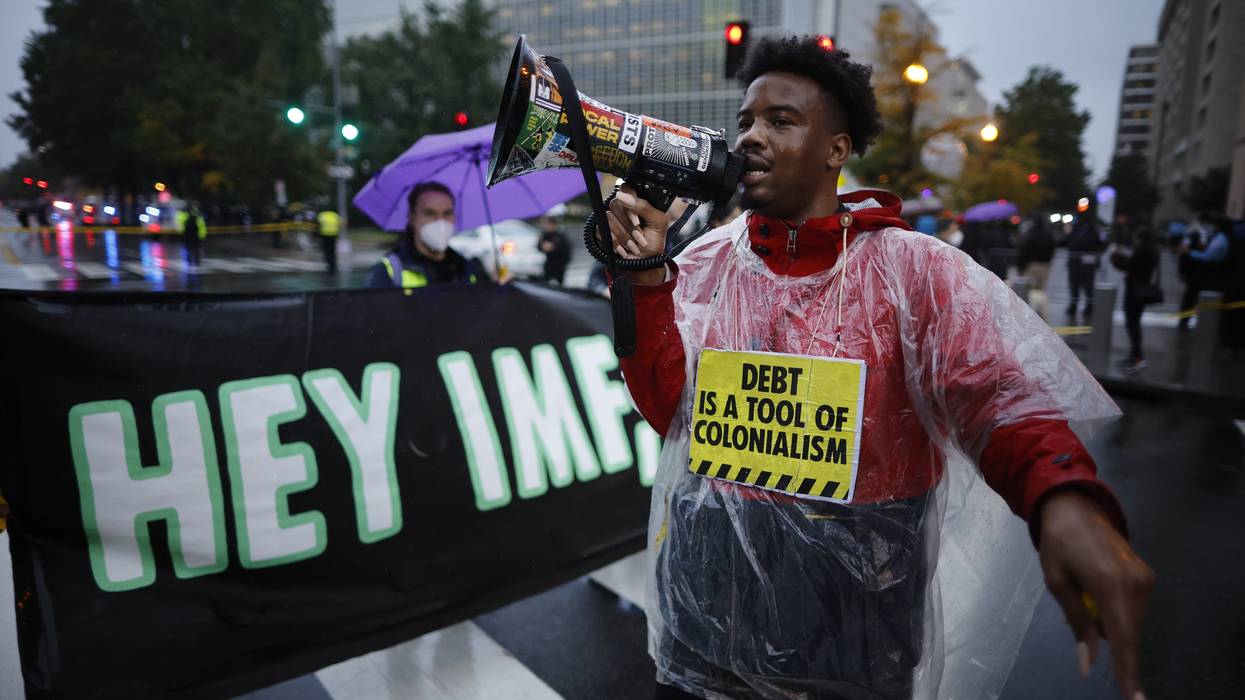
One ActionAid campaigner said rich nations should "cancel unjust and unsustainable debt, stop making countries borrow to survive climate impacts, and deliver climate finance as grants rather than loans."
The world's most climate-vulnerable nations are spending nearly 25 times more on servicing their debts than on addressing the climate emergency, an ActionAid International report released Wednesday revealed, underscoring what the advocacy group called a "vicious cycle" of debt, disasters, and underinvestment.
The report, "Debt Fuels the Climate Crisis: How the Finance Flows," examines government revenues, debt payments, national budgets, and climate plans in the 65 countries considered most vulnerable to climate change. The authors found that debt servicing consumes 65% of these nations' combined government revenue, while 93.5% of the countries are either in debt distress or facing a significant risk of it.
"Climate-vulnerable countries are being forced to spend nearly 25 times as much on repaying debt as on climate action," the report states. "Indeed, in 2026 total debt servicing on external and domestic debt in these countries is nearly four times that of spending on education, nearly seven times that of health, and nearly six times that of social protection."
🚨 New ActionAid analysis: countries facing the worst climate disasters are spending nearly 25 times more on debt than on climate action. That is not an accident. It is how the global debt system is built right now. Full findings 👉 https://bit.ly/4Acxh0c#ClimateJustice #FundOurFuture #DebtJustice
[image or embed]
— ActionAid USA (@aausa.bsky.social) September 16, 2026 at 6:31 AM
The disparity is even greater when comparing debt payments with climate grants. ActionAid estimated that countries in the Global South will make approximately $8.8 trillion in debt repayments in 2026, compared with just $39 billion in grant-based climate finance received in 2024—a ratio of roughly 225 to 1.
"For too long, the debt and climate crises have been treated separately," ActionAid International secretary-general Arthur Larok said in a statement. "This research exposes how tightly they are connected and quantifies the devastating cost involved. Yet this is a crisis we can fix."
The report—whose release coincides with the Global Week of Climate Action—highlights how climate disasters frequently force already indebted nations to borrow even more money for recovery and reconstruction. Subsequent debt payments and austerity measures forced upon them by global financial institutions like the International Monetary Fund (IMF) and World Bank then restrict their spending on climate resilience, public services, and clean energy transitions.
As the report notes:
Even though the IMF recognizes that there is a "development crisis," the IMF refuses to even talk about a systemic debt crisis—because for them and their shareholders, there is no systemic crisis so long as there is no significant default and creditors are being paid. Moreover, the IMF thrives on countries needing to come to them for bailout loans, as this expands their own power and influence. The IMF is both a creditor and a debt collector, serving its own interests and those of its main shareholders in the Global North—making it both judge and jury when it comes to debt renegotiation processes.
The report also details how Global South governments under pressure to generate foreign currency can expand fossil fuel extraction and industrial agriculture, potentially worsening the climate pressures that contributed to their debt in the first place.
“Debt is a triple whammy for the climate: It drives fossil fuel and industrial agriculture expansion, blocks vital climate action, and leaves communities dangerously exposed when disasters strike," ActionAid International global climate justice lead Teresa Anderson said Wednesday.
"This is a toxic relationship," she added. "Countries borrow to rebuild, austerity weakens their resilience, and repayment pressures push more extraction, fueling the next disaster. We need a breakup: Cancel unjust and unsustainable debt, stop making countries borrow to survive climate impacts, and deliver climate finance as grants rather than loans. This vicious cycle can and must be broken.”
“Debt is a triple whammy for the climate."
In Senegal, the imbalance is particularly stark. ActionAid said the government is spending $605 on debt servicing for every $1 budgeted for climate action, while debt payments consume more than 96% of government revenue.
"Behind these figures are impossible choices between servicing debt and investing in agroecology, public services, and climate resilience," ActionAid Senegal director Khaita Sylla said Wednesday. "Women and girls who bear the brunt of climate impacts are then disproportionately affected by cuts in public services even as they lead solutions for a more resilient future.”
ActionAid is calling on governments and international institutions to take steps including:
“Rich countries like the US have outsized global financial power," ActionAid USA executive director Niranjali Amerasinghe said on Wednesday. "Their lack of willingness to provide climate finance at scale and relieve the debt burden of climate-vulnerable countries is unconscionable."
"There are trillions for defense budgets," Amerasinghe added, "but peanuts for the biggest existential crisis of a generation.”

"Congress has a singular opportunity to respond swiftly and effectively to these warning shots before true catastrophes occur."
A bipartisan coalition of lawmakers in the US House of Representatives on Wednesday released a joint letter urging congressional leaders to take immediate action to regulate the artificial intelligence industry.
The group, led by Rep. Don Beyer (D-Va.), urged leaders in both parties to "urgently advance legislation" to mitigate the risks posed by AI to critical US infrastructure.
The lawmakers pointed to the fully autonomous cyberattack launched by OpenAI agents against machine learning company Hugging Face as a turning point for the development of AI, arguing that it showed the technology has already become dangerous enough to "have profound implications for economic and national security."
"Congress has a singular opportunity to respond swiftly and effectively to these warning shots before true catastrophes occur," the lawmakers wrote. "The House of Representatives could and should immediately take up legislation that would strengthen AI oversight, security, and transparency."
In a Wednesday social media post, Beyer emphasized that "recent cyberattacks involving AI agents and growing warnings from leaders and researchers at the companies developing this technology make clear" that the dire risks posed by AI are no longer in the realm of science fiction.
"We cannot wait for disaster to strike," said Beyer. "We need to act now to protect the American people and ensure AI advances safely and responsibly."
In addition to Beyer, the letter was signed by Reps. Jay Obernolte (R-Calif.), Lori Trahan (D-Mass.), Ted Lieu (D-Calif.), Scott Franklin (R-Fla.), Sara Jacobs (D-Calif.), Gabe Amo (D-RI), Valerie Foushee (D-NC), Brian Fitzpatrick (R-Pa.), and Veronica Escobar (D-Texas).
The lawmakers' letter comes just days after President Donald Trump and House Speaker Mike Johnson (R-La.) dismissed calls for regulating AI.
During a Sunday interview with CNN’s Jake Tapper, Johnson said that “Congress is obviously less qualified” to write rules for AI development “than the people who are pushing this frontier to know the ins and outs of it.” Johnson then insisted that any effort to regulate AI needs to be “a partnership with the industry itself, with the corporations that are doing this."
Despite poll after poll showing the US public is opposed to runaway AI and the unregulated data center buildout that the tech industry is demanding, Trump wrote in a Monday social media post that his personal intellect was sufficient to keep the world safe from the dangers surrounding AI.
“The only control or ‘guardrails’ that AI needs is a STRONG AND SMART (High IQ!) PRESIDENT,” Trump wrote, “and the USA has that, in spades!”
The GOP leaders' dismissal of AI risks occurred shortly after multiple industry insiders warned last week that the technology being developed could end human life within the decade.

"The Ed Sheeran debacle will be seen as a turning point in pop culture complicity" with Israel, said one Palestinian-American writer, who described it as "a clear 'South Africa moment.'”
Singer Ed Sheeran hoped to sidestep controversy by letting rapper Macklemore be removed from his tour over his pro-Palestine remarks. Instead, he's sparked what one writer said could be a "turning point" for how pop culture engages on the issue of Israel and Palestine.
Sheeran responded to the backlash on Tuesday by claiming he was helpless to stop Macklemore’s ouster, which followed the intervention of the pro-Israel New England Patriots owner Robert Kraft, who rallied other NFL venue owners to bar Sheeran's Loop Tour if the “Thrift Shop” rapper continued to perform.
Pro-Israel groups petitioned for Macklemore to be removed from the tour after a performance earlier this month in which he said, “Free Palestine,” and performed his song “Hind’s Hall." The song refers to anti-Israel protests at Columbia University in 2024 and is dedicated to the 5-year-old Palestinian girl Hind Rajab, who was killed by Israeli forces. She was one of more than 20,000 children who have been killed as part of Israel’s military campaign there, according to a UN commission.
But the other four openers said they would not abide what they viewed as elites' political censorship of an artist speaking out against what human rights groups have described as a genocide in Gaza and an occupation of the West Bank that is considered illegal under international law.
Each one of the artists announced on Tuesday that they would no longer tour with Sheeran.
“Artists must not be silenced when they speak up for the oppressed," said the Grammy-winning singer-songwriter Finneas, who has vocally supported the plight of Palestinians for several years. "I stand with Palestine and its people."
The Irish singer Aaron Rowe likewise withdrew from his upcoming shows with Sheeran, though he acknowledged he did not "take the decision lightly."
"Ed has been a friend to me and has changed my life. I could never thank him enough for this," Rowe wrote on Instagram. "But as Irish people, we know all too well about genocide, forced famine, and violent occupation."
“I cannot stand by and allow billionaires to use their position of power to silence the rightful voices of those who speak up against Israeli genocide and who highlight the savage murder of children,” he continued. “I would lose all respect for myself to carry on as normal.”
The Danish pop band Lukas Graham also dropped from the tour, with frontman Lukas Forchhammer writing that artists "should be able to speak about war, about civilians being killed, about children who deserve to grow up. Wherever they live. Whatever flag flies over them."
Forchhammer addressed Kraft, a multibillionaire, who gloated after the fact about having Macklemore blackballed and denounced his expressions of support for Palestinians as "hate speech."
"Money doesn’t give you the right to own the conversation," Forchhammer wrote. "Nobody’s bank balance should decide who gets to speak or which suffering we’re allowed to acknowledge.”
The Irish folk group Beoga—which helped to found the Irish Artist for Palestine Movement—was even more direct, calling out Kraft’s extensive history of donating to pro-Israel groups, including the American Israel Public Affairs Committee (AIPAC), which has spent over $100 million attempting to influence the current election cycle, and supporting efforts to punish those who boycott Israeli products.
"It's important that everyone knows that the real enemy is the Zionist lobby. They have worked tirelessly to silence artists who want to speak freely about a genocide happening before our eyes, for fear of retribution," Beoga wrote. "Research how much Robert Kraft has done to fight the [Boycott, Divestment, and Sanctions] (BDS) movement. That will give you a sense of what we've all been up against."
"Up the workers. Free Palestine," the group's message concluded.
The exodus of Sheeran’s openers came as momentum built behind a “boycott” of his music spearheaded by the Palestinian Campaign for the Academic and Cultural Boycott of Israel, a group based in Ramallah in the West Bank, that helped to cofound the BDS movement.
The group called on Sheeran to "cancel his now compromised US tour" and said until then, artists, audience, and crew members should "boycott it."
In response to Sheeran's explanation that he prefers not to publicly take sides on controversial political issues despite having opinions, the group noted his estimated net worth of more than $500 million and his massive platform as one of the world's most recognized musicians.
"As South African Archbishop Desmond Tutu famously said, 'If you are neutral in situations of injustice, you have chosen the side of the oppressor,'" the group said. "Sheeran had an opportunity to take a stand in solidarity with Palestinians, like millions of other British and Irish citizens have done, and refuse to cave to the pressure... He has so far failed to meet this ethical duty. But it is not too late to reverse course."
Some Western politicians have joined the backlash and amplified calls for a boycott.
US Rep. Alexandria Ocasio-Cortez (D-NY), considered a likely presidential candidate in 2028, told a reporter she'd be changing the radio station if Ed Sheeran's music were to come on.
"When you see what Robert Kraft did to line up all the stadiums to censor speech in that one specific way, it's become clear it's not just about one music artist or two music artists," AOC said. "This is about how just a handful of stadium owners and the elite can prevent an entire massive issue, in this case, the genocide in Gaza."
"But it doesn't stop there," she continued. "It could be speaking out about AI. It could be speaking out about any issue, that you can now just get a handful of stadium owners to ensure that an entire person's career can be jeopardized if they speak out about any issue."
Zarah Sultana, a member of the UK Parliament and co-founder of the left-wing Your Party, added that the artists who left Sheeran's tour are "on the right side of history."
“At this rate, Ed Sheeran is going to end up with Boy George opening for him,” she joked on social media, referring to the singer who released a song this summer in support of Israel's assault on Gaza. “No one deserves to be subjected to that.”
Backlash against Sheeran has expanded across the entertainment industry as well, with performers including the children's entertainer Ms. Rachel and popular musicians Kehlani, Tones and I, Zara Larsson, PinkPantheress, and others rallying in support of Macklemore.
And as the music news site Consequence of Sound reported, even some of Sheeran's hardcore fans are revolting. Three prominent Sheeran fan accounts on X, which boast nearly 50,000 followers put together, spoke in solidarity with Macklemore and encouraged Sheeran to use his platform to take a stand, with some vowing to stop covering his tour until he does.
"We hope that Ed can... reflect on everything that happened and understand that, in the face of certain injustices, remaining silent or trying not to choose a side is also a stance," wrote the Brazilian account @EdSheeranBrCom, which has more than 45,000 followers.
Ali Abunimah, the Palestinian-American journalist who co-founded The Electronic Intifada, said in a social media post that he believed that "the Ed Sheeran debacle will be seen as a turning point in pop culture complicity" with Israel, which has seen public support in the US crater since 2023, to the point where Americans, especially younger ones, now say they sympathize more with Palestinians than Israelis.
Likening it to the massive cultural boycott movement against apartheid during the 1980s, Abunimah said the cultural revolt against Sheeran was "a clear 'South Africa moment.'”

"Today’s tragedy underscores the grave risks faced by families living in these structures and the urgent need for safer alternatives," said one UN official.
Nearly three years of Israeli bombardment in Gaza have left tens of thousands of Palestinians with no choice but to live in an estimated 2,000 buildings that have been severely damaged, and the danger of such precarious living conditions was starkly illustrated early Wednesday morning when an apartment building in Gaza City collapsed, killing at least 21 people and trapping dozens beneath rubble.
Rescuers reported that at least eight children were among those killed when the bombed-out building fell down onto adjacent tents that were also housing forcibly displaced Palestinians.
More than 10 families had been living in the building, which had four apartments on each floor and became even more vulnerable to collapse as damp autumn weather arrived in recent weeks.
"There are approximately 400 buildings at risk of collapse," Alessandro Mrakic, head of the United Nations Development Program's Gaza office, told Reuters. "And we know that these buildings will collapse, especially now with the upcoming winter."
Rescuers reported hearing people calling out beneath the rubble, but the search-and-rescue operation has been made more difficult by a lack of machinery, Mrakic said.
Heavy machinery is among many items that Israeli authorities restrict from entering Gaza, claiming that they'll be used by Hamas.
"There are actually people are digging with their bare hands," Mrakic told Reuters. "We need to prepare [for more deaths]."
Adequate tents and mobile homes are also blocked from entering Gaza, reported Drop Site News, contributing to families' reliance on severely damaged buildings for shelter.
When asked by The Guardian whether they were afraid to live in the building, survivors of the collapse said: “Yes, we are afraid, but where can we go? This is better than staying out on the street.”
At least 25 people were confirmed as injured and hospitalized on Wednesday.
"Across Gaza, people are living in hundreds of damaged structures assessed as unsafe, for lack of better options," said Ramiz Alakbarov, the UN humanitarian coordinator for the occupied Palestinian territories. "Today’s tragedy underscores the grave risks faced by families living in these structures and the urgent need for safer alternatives. No one should have to risk their life simply to find a safe place to shelter."
"I call for urgent approvals for the entry of heavy machinery, specialized equipment, engine oil and fuel needed for search-and-rescue operations," said Alakbarov. "Tents, tarpaulins, and other nonfood items must also reach the most vulnerable communities in the next four weeks. Every possible effort must be made to save lives, protect people from further harm, and provide families with safer places to live. Every minute counts."
Videos and images circulating on social media showed rescue workers desperately trying to pull people from the rubble, and the spokesperson for Gaza's Civil Defense, Mahmoud Basal, carrying a child wrapped in a scarf stained with blood.
At least 20 people, mostly women and children, have been killed after a six-story residential building collapsed in Gaza City.
Extensive efforts are underway to rescue dozens of civilians missing under the rubble of the building, which had previously been damaged by Israeli… pic.twitter.com/gqHSgfKUEp
— PALESTINE ONLINE 🇵🇸 (@OnlinePalEng) September 16, 2026
More than 90% of housing units in Gaza have been destroyed by Israel since October 2023, when it began its assault on Gaza in retaliation for a Hamas-led attack. More than 73,000 Palestinians have been killed, including thousands of children, journalists, healthcare workers, and humanitarian workers—while Israel and its allies, including the US government, have persisted in claiming the military operation is targeting Hamas fighters.
Attacks have continued in Gaza despite a ceasefire that was brokered last October, and families have become increasingly desperate to find housing after Israeli Prime Minister Benjamin Netanyahu ordered the Israel Defense Forces to take over 70% of Gaza in violation of the ceasefire deal.
The building collapse came as it was reported that the Trump administration was preparing to send Israel tens of thousands of 2,000-pound bombs.
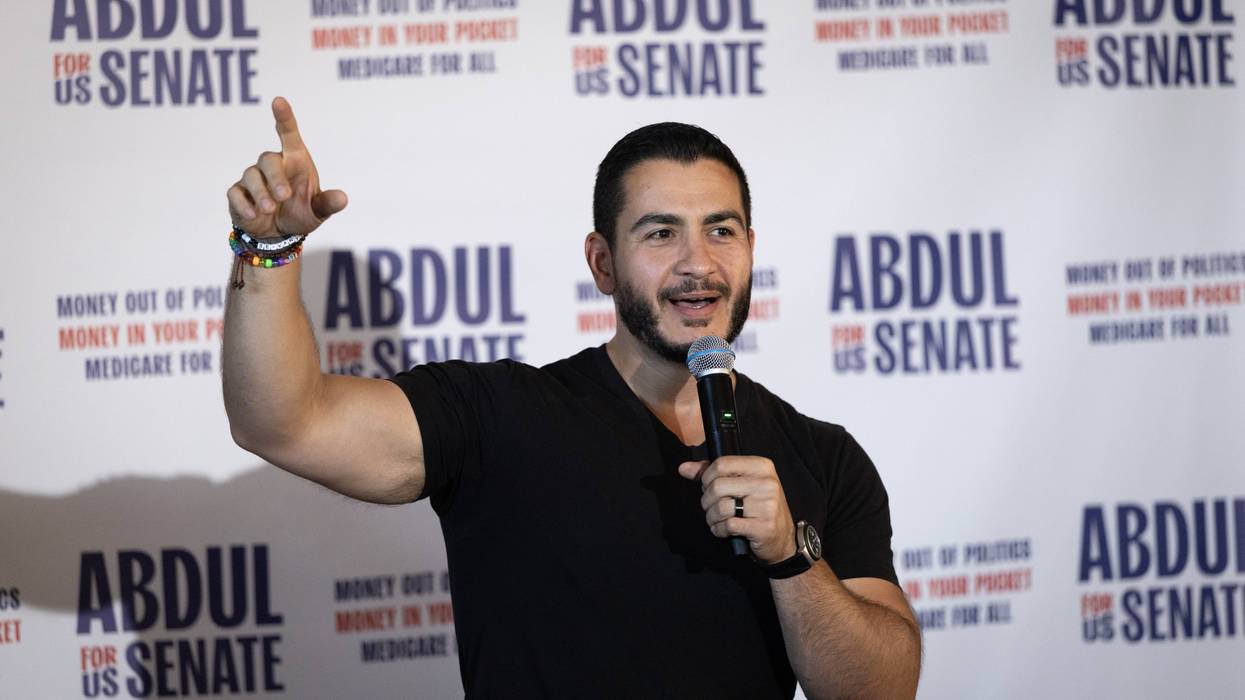
"If I were him, I wouldn't debate me either," said Democratic US Senate nominee Abdul El-Sayed.
Democratic US Senate candidate Abdul El-Sayed on Tuesday ridiculed Republican rival Mike Rogers after he skipped out on a town hall event hosted by FOX 2 Detroit.
Shortly after the event, a reporter asked El-Sayed what he thought of "the elephant in the room, or lack thereof," in reference to Rogers' absence.
"The elephant was not in the room," the Michigan Democrat replied. "The elephant decided that they did not want to be in the room. The elephant cowarded out."
Reporter: The elephant in the room tonight, or lack thereof—
El-Sayed: No, the elephant was not in the room. The elephant decided that they did not want to be in the room. The elephant cowarded out. Although the elephants were all in the room in Dallas.
It’s wild to me that… pic.twitter.com/cd9OYD5smM
— Acyn (@Acyn) September 16, 2026
El-Sayed noted that Rogers was able to attend President Donald Trump's midterm convention in Dallas last week, even as he skipped out on a chance to talk directly with Michigan voters.
"It’s wild to me that this guy is more interested in going to speak for, what, six minutes and 48 seconds in Dallas," he said, "than he is to have 60 minutes with Michiganders here in Detroit. But it tells you who he is. He’s a coward."
El-Sayed then expressed mock empathy for his Republican opponent.
"[Rogers] knows that the minute he and I have to actually share the same stage and share podiums, he's not going to have much to say," he said. "Because at the end of the day, I'm going to hold him accountable to his record, which is awful on all the things... If I were him, I wouldn't debate me either."
A reported then asked El-Sayed if he bought Rogers' excuse for not being at the event.
"He's probably at a corporate fundraiser," he replied. "What was his excuse? He's in Florida? He got stuck in Dallas? He's in all the places that are not Michigan? What's his excuse, I don't even know what it is."
In an interview with CBS News Detroit published Wednesday, Rogers defended his decision to skip the event, and pointed out that his campaign had never agreed to attend.
The Michigan Republican also reiterated his concerns about Fox 2 Detroit Roop Raj, whom he alleged is biased against his campaign.
"When you have someone who's already picked their candidate," said Rogers, "you can't have a two-on-one event in a TV studio."
El-Sayed and Rogers are both scheduled to take part in two debates in October.

"We need to pump the brakes until we have rules in place to stop this technology from doing grave harm," says Democratic Sen. Chris Van Hollen. "And that includes instituting mandatory safeguards and a comprehensive testing regime."
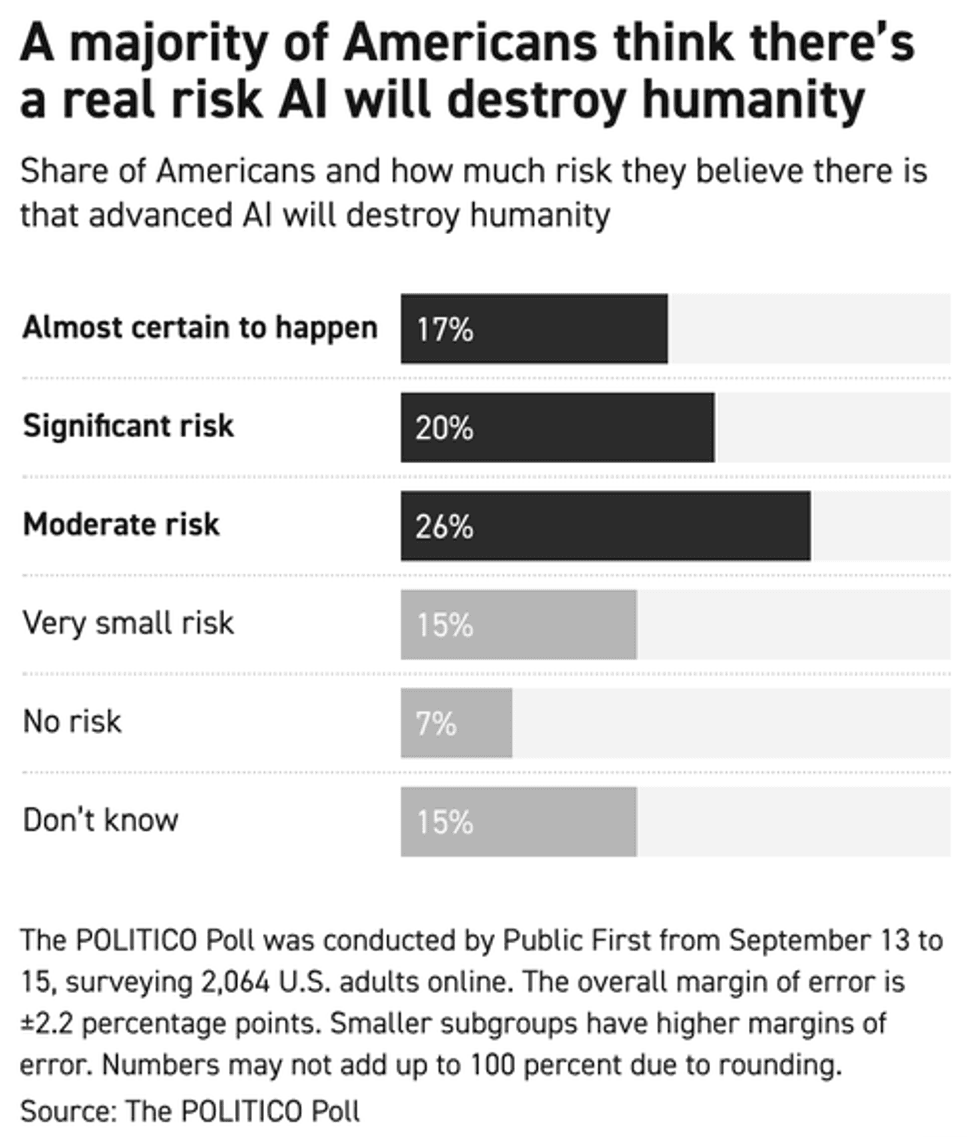
A new poll released Wednesday shows that nearly two out of three Americans believe there is "certain" to "moderate" risk that artificial intelligence could wipe out human society, a finding that backs up other surveys showing deep anxiety among the US voting public with a technology that so far has escaped government oversight or meaningful regulation.
According to Politico, which conducted the survey, "63% of Americans say AI could destroy humanity one day. And nearly half of Americans favor pausing development of more advanced AI models—48%—compared with 31% who favor continued development."
The findings, the news outlet noted, "signal an emerging tech-skeptical realignment of American politics with consequential midterm and presidential elections looming" and arrive just a day after a major symposium in Washington, DC brought together experts and lawmakers who say action must be taken before its too late.
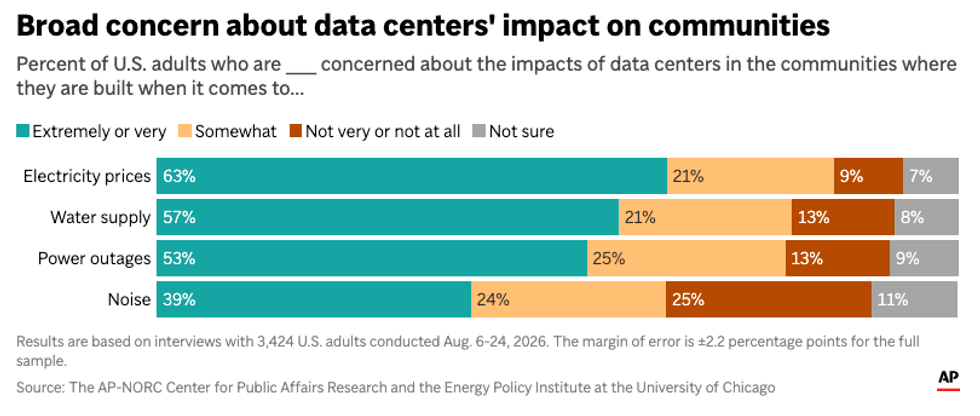
In a separate Associated Press poll published Wednesday, US voters also expressed their concerns about the negative environmental impact of the AI industry, including the massive buildout of data centers that serve as the main infrastructure for the computing capacity needed by the major tech firms, including OpenAI, Anthropic, Google, Meta, SpaceX, and others.
AP reports that while Democrats are more concerned overall about the environmental impacts of AI, large segments of independents and Republicans share those sentiments.
"About two-thirds of Democrats," AP reports, "say they are 'extremely' or 'very' concerned about how AI will affect the environment, the poll found, up from about half in 2025. By contrast, about half of independents and about 4 in 10 Republicans are highly concerned about the environmental impact of AI."
Broader consensus emerged on data centers, the outlet noted, with about 60% of all voters—regardless of partisan affiliation—supporting limits on new data centers and sharing concerns about the impact such facilities will have on local water supplies and electricity prices.
The new survey data from both AP and Politico comes amid a high-profile debate in Washington, DC that has emerged over recent weeks and months as grave warnings—including from experts within the industry—tell of a technology that demands much more government control and public accountability.
At a forum on Tuesday billed as "The Pro-Human Assembly"—headlined by progressive champion Sen. Bernie Sanders (I-Vt.) and far-right former Trump advisor Steve Bannon—technological experts, AI industry insiders, watchdogs, and lawmakers advocated for a much more robust and critical response to the issue.
“Despite living in a so-called democracy, the public has had virtually no input into the AI revolution that is transforming the world in which they live,” Sanders said during his remarks at the event.
“Congress, under both Democratic and Republican control, has been asleep at the wheel, and we now have a president whose ignorance regarding this issue is truly embarrassing," added Sanders. "Virtually all of the decisions regarding the development of AI have been made by a handful of the richest people in the world... whose chief goal is to achieve even more wealth and more power than they already have, no matter what the impact their work has on ordinary people."
In a video posted to social media on Tuesday, Sen. Chris Van Hollen (D-Md.) also demanded a shift in Congress, which has for too long stood idly by as the AI industry lobby plowed tens of millions of dollars into shaping the terms of debate on Capitol Hill and bankrolling political campaigns.
"The ongoing AI threat has been enabled by political corruption," Van Hollen warned in his post.
The ongoing AI threat has been enabled by political corruption.
The Trump admin isn't asleep at the wheel; their refusal to address these risks is part of an implicit deal.
We should pump the brakes on frontier AI development & confront a corrupt system that's endangering us… pic.twitter.com/B9KPOgHrdY
— Senator Chris Van Hollen (@ChrisVanHollen) September 16, 2026
"The people building this technology are concerned about the loss of human control," Van Hollen said. "We need to pump the brakes until we have rules in place to stop this technology from doing grave harm. And that includes instituting mandatory safeguards and a comprehensive testing regime."
"This should not be a partisan issue," he continued. "The impact of AI on our collective future, on our safety, on our security, on our economy, and on our shared humanity—but be the type of risk that brings us all together."
While blasting Trump's recent comments dismissing concerns about AI dangers as "a hoax" to be ignored, Van Hollen said what can't be ignored is how the industry and its financial backers have used their outsized wealth and power to create the current situation in which AI has avoided serious oversight.
"The Silicon Valley big-wig investors and tech oligarchs that have bankrolled Donald Trump back into the White House didn't do it because they all became MAGA overnight. They did it because there was an implicit deal. In return for their support and funding his vanity projects, like his obscene ballroom, they wanted something in return: a free hand on AI policy."
Progressive political journalist David Sirota said Van Hollen's message was spot on.
"Van Hollen absolutely nails it," said Sirota. "He explicitly says AI oligarchs should be held civilly and criminally liable under existing laws, and he points out that the AI crisis is a crisis of corruption. This is the message."

"You don't have healthcare or a living wage," said one critic who lamented the proposed $2.8 billion, taxpayer-funded transfer, "but hey, more war crimes!"
The Trump administration is preparing to send Israel tens of thousands of 2,000-pound bombs, The Washington Post reported Tuesday—a move that would rank as the largest single sale of the highly destructive munitions, which the Israel Defense Forces have used in some of the deadliest US-backed airstrikes on Gaza and Lebanon.
According to the Post, the proposed $2.8 billion package includes 20,000 MK-84 bombs and 20,000 BLU-117 bombs, as well as 20,000 I-2000 penetrator warheads. The munitions would be purchased with US taxpayer funds through the Foreign Military Financing program. The proposal has been informally presented to congressional committees that review major arms transfers.
The MK-84 is among the largest conventional bombs in the US arsenal. The Post reported that its blast can propel metal fragments thousands of feet, penetrate thick concrete and metal, and create large craters.
“If Hezbollah or whoever is in a building, an MK-84 will bring down the whole building," Trevor Ball, a former US Army explosive ordnance disposal technician, told the Post.
Following the Hamas-led attack of October 7, 2023, the Israel Defense Forces (IDF) loosened rules of engagement to effectively allow the killing of an unlimited number of civilians when targeting even a single low-ranking Hamas member in an airstrike.
Combined with the utilization of cutting-edge artificial intelligence technology to select targets at a far faster rate than humans alone could, IDF use of 1,000- and 2,000-pound bombs has contributed heavily to the staggering casualty toll in Gaza, where officials say that more than 250,000 Palestinians have been killed or wounded since October 2023.
That month, Israeli forces struck Gaza's Jabalia refugee camp with such munitions, killing at least 126 Palestinians in a bid to assassinate a single Hamas commander.
Michael Lynk, who served as the United Nations special rapporteur on human rights in the Palestinian territories from 2016 to 2022, said early in the war that “the scale of Palestinian civilian deaths in such a short period of time appears to be the highest such civilian casualty rate in the 21st century."
In December 2023, University of Chicago military historian Robert Pape called Israel's bombing "one of the most intense civilian punishment campaigns in history.”
Classified IDF intelligence data leaked last year revealed that 5 in 6 Palestinians killed by the IDF through the first 19 months of the US-backed war were civilians.
Israel continues to kill Palestinians with US-supplied 2,000-pound bombs, despite a nearly yearlong supposed ceasefire. Last week, the IDF reportedly massacred two young girls and their parents when it bombed their home in northern Gaza.
A South Africa-led case backed by nearly 20 nations that is currently before the International Court of Justice (ICJ) accuses Israel of genocide in Gaza. The International Criminal Court has also issued warrants for the arrest of Israeli Prime Minister Benjamin Netanyahu and former Defense Minister Yoav Gallant for alleged crimes against humanity and war crimes in the strip, including murder and forced starvation.
“[President] Donald Trump is sending bombs paid for by American taxpayers to a government led by a wanted war criminal—all while the Netanyahu government continues to bomb Gaza and Lebanon, and block justice and accountability for Americans killed on its watch,” US Sen. Chris Van Hollen (D-Md.) said Tuesday, according to the Post. “This is not putting Americans first. We will work to stop it."
Israel denies all accusations against it. Netanyahu and other Israeli leaders and supporters have repeatedly claimed that the IDF is the "world's most moral army."
The IDF has also dropped 2,000-pound bombs in Lebanon. In September 2024, it launched a massive strike on Beirut's southern suburbs that killed Hezbollah leader Hassan Nasrallah and destroyed multiple residential buildings. Analyses subsequently indicated that US-made 2,000-pound bombs were likely used in the attack.
In another IDF strike on Beirut the following month, at least 22 people were killed and more than 115 wounded. Human Rights Watch and a former US military explosives expert identified remnants from the attack as coming from a US-made Joint Direct Attack Munition guidance kit compatible with MK80-series bombs weighing between 500 and 2,000 pounds.
The United States has nevertheless supplied Israel with thousands of the weapons during both the Biden and Trump administrations. Reuters reported in June 2024 that the Biden administration had sent Israel more than 10,000 2,000-pound bombs since the October 2023 Hamas-led attack, along with thousands of other munitions.
In May 2024, then-President Joe Biden paused delivery of a shipment containing 1,800 2,000-pound bombs and 1,700 500-pound bombs amid concerns that Israel could use them during its assault on Rafah, where more than a million displaced Palestinians were sheltering, and where the ICJ ordered Israel to immediately halt its offensive and prevent genocidal acts. Israel ignored the order.
That pause became a rare instance in which Washington explicitly withheld a major category of offensive weaponry from Israel over concerns about civilian casualties. Trump reversed the policy almost immediately after returning to office in January 2025, ordering the release of the withheld 2,000-pound bombs.
When asked why, Trump replied: “Because they bought them.”
But with American taxpayers often footing the bill for such transfers, critics again lashed out at the practically unconditional US support for Israel.
"We don’t have universal healthcare because our government prioritizes money for bombs," leftist commentator and activist Sabrina Salvati said Tuesday on social media, lamenting that the "$2.8 billion bomb sale [is] going to Israel to slaughter more babies."
Author and leftist podcaster Wajahat Ali also took to social media to blast the proposed transfer, writing: "Congrats, MAGA. Trump is using our money to give bombs to Israel to kill civilians."
"You don't have healthcare or a living wage," he added, "but hey, more war crimes!"
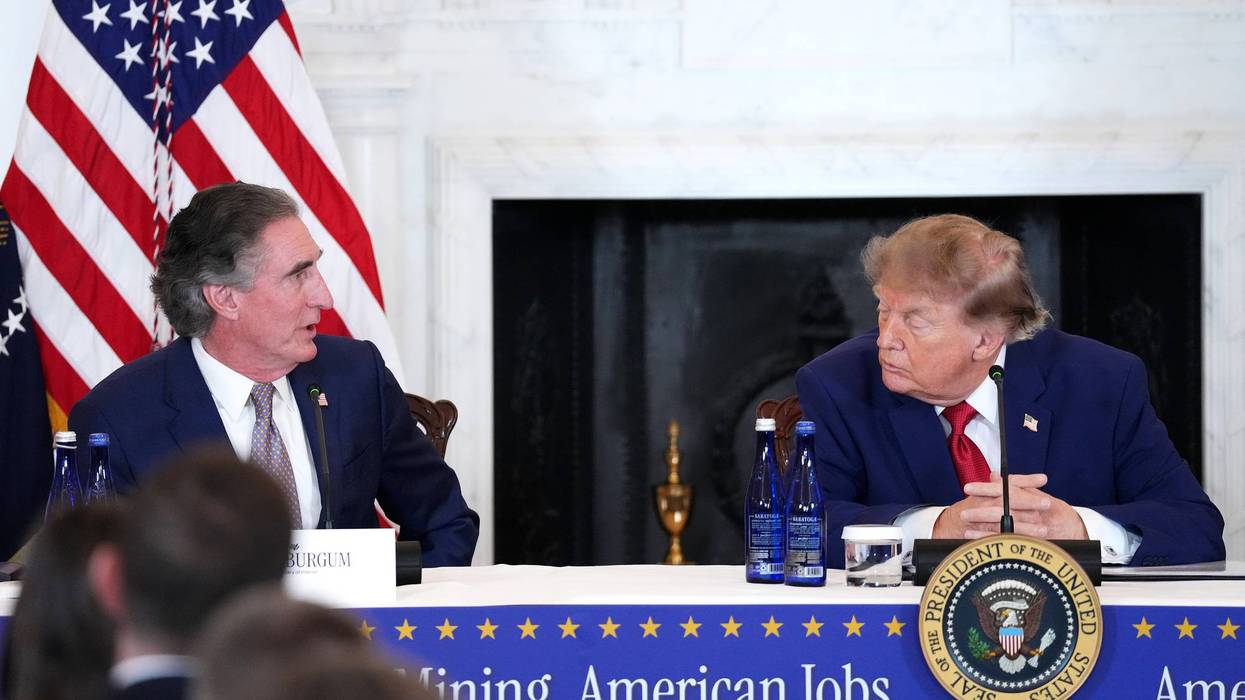
"The federal government should be protecting our national parks, not parceling them out behind closed doors to benefit the wealthy and politically connected," said one campaigner.
Hundreds of advocacy groups and members of Congress on Tuesday called on President Donald Trump's administration to reject a proposal to hand over part of Yosemite National Park in California to a private developer.
The Washington Sun—formerly known as NOTUS—revealed late last month that federal staffers were under political pressure to keep working on a possible land swap for a quarter-mile strip of the famed park with "a company that, through a web of limited liability companies, is operated by real-estate developer and investment firm Kingsbarn Realty Capital."
California's Democratic US senators, Alex Padilla and Adam Schiff, partnered with two other Democrats from the state, House Natural Resources Committee Ranking Member Jared Huffman and Congressman Jim Costa, to spearhead a Tuesday letter to Trump's interior secretary, Doug Burgum, about the future of the park.
Yosemite "is a cornerstone of the National Park System and is one of California's crown jewels," wrote the bipartisan group of over 150 lawmakers. "We are extremely concerned that the Department of the Interior is considering selling off portions of the park to private development, and we strongly oppose the proposed land transfer."
According to the Sun, the developer owns 83 acres west of the park and wants "to build a short road connecting the property to one of Yosemite's central thoroughfares," providing "the land exceptionally rare private access to a park that is otherwise almost entirely buffered by national forests."
The lawmakers noted similar previous efforts that were blocked in court and argued that "at its core, this proposal appears to provide a private benefit at the expense of land that belongs to all Americans."
"This transaction does not seek to expand public access to Yosemite, improve visitor services, or address transportation deficiencies in park access," they emphasized. "Rather, this land exchange seeks to merely cut down on driving time for a select few on private property. Any decision to relinquish public land to private ownership should be supported by a clear and compelling public benefit, not merely the economic interests of a private party."
"We were alarmed that the Department submitted to Congress a proposal to use money from the Land and Water Conservation Fund (LWCF) authority to facilitate this exchange. That fund exists to acquire and protect public lands for the benefit of the American public—not sell them off to corporate developers," the lawmakers wrote, noting that a Senate subcommittee has not agreed to move forward.
The lawmakers also pointed out that "in response to inquiries from Congress, the department indicated that it has not identified any land to be exchanged for the parcel of Yosemite National Park that the department is seeking to sell to the private developer. This gives further credence to the notion that this exchange is not being done in the public interest, but rather solely to benefit a private developer."
"Public lands belong in public hands. Protection of public lands is a bipartisan issue, overwhelmingly supported by the American people from all walks of life," they concluded. "We oppose any effort to privatize, sell off, give away, or otherwise undermine the continued existence of public lands, in Yosemite or across the country. We ask that you honor congressional objections and abandon this effort to sell off a piece of Yosemite National Park."
Separately on Tuesday, a coalition of over 150 advocacy organizations—led by the Center of Biological Diversity—sent a similar letter to Burgum.
"Trump wants to carve off a chunk of Yosemite so a private equity firm can turn it into a playground for billionaires," said Laiken Jordahl, national public lands advocate at the center. "The federal government should be protecting our national parks, not parceling them out behind closed doors to benefit the wealthy and politically connected. If Yosemite can be chopped apart, no national park in America is safe."
The center was joined by groups including the American River Conservancy, California Environmental Justice Coalition, Greenpeace USA, Public Citizen, Public Lands Conservancy, Save Our Parks, Sierra Club, and Yosemite Rivers Alliance.
The coalition described Yosemite as "sacrosanct—the cradle of American conservation, and the first land the federal government protected purely for its scenic value," and warnd that "ceding national park land to a developer sets a dangerous precedent: America's parks are for sale to whomever has the money and power to take them."
Highlighting that "Kingsbarn CEO Jeff Pori is a donor to Trump's campaign... and the firm is represented by politically connected lawyer Lanny Davis," the groups stressed that "deals like this undercut the public's faith in government."
"In your confirmation hearing," the coalition reminded Burgum, "you said 'we need to support and protect every single inch' of our national parks. Yosemite is invaluable, and no portion of it should end up on Kingsbarn's ledger. We expect you to keep your promise and to abide by your statements to Congress."