SUBSCRIBE TO OUR FREE NEWSLETTER
Daily news & progressive opinion—funded by the people, not the corporations—delivered straight to your inbox.
5
#000000
#FFFFFF
To donate by check, phone, or other method, see our More Ways to Give page.
Daily news & progressive opinion—funded by the people, not the corporations—delivered straight to your inbox.
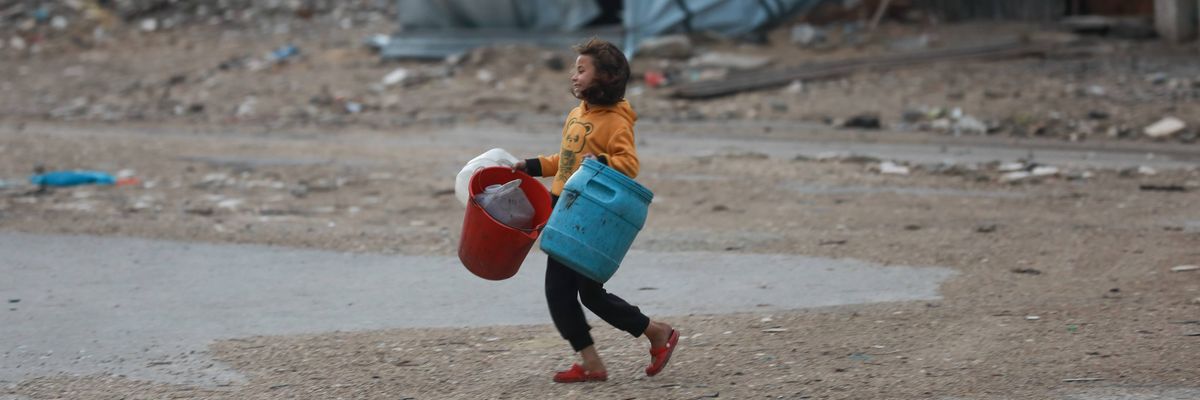
Palestinians fill plastic containers and cans with water distributed by tankers as they struggle with a severe water crisis caused by heavy damage to infrastructure from Israeli attacks in Gaza City, Gaza on January 13, 2026.
"Needs in Gaza exceed far beyond the aid and reconstruction materials Israel is allowing in and the situation will worsen if Israel’s collective punishment and illegal blockade continues," said one water utility official.
Along with continuing its killing of Palestinians in Gaza and its destruction of civilian infrastructure more than three months after a "ceasefire" deal was reached, the Israeli government is violating the agreement by continuing to block humanitarian aid from entering the exclave—making it impossible for aid groups to ensure people there have adequate water as extreme weather makes the problem even worse.
As 100 days since the ceasefire agreement were marked Wednesday, international aid group Oxfam described the work it's been doing to try to restore water wells and other crucial infrastructure, but warned that Israel's decision to block 37 humanitarian organizations—including two Oxfam chapters—has made it difficult to provide Palestinians with a sustainable water supply.
As aid flows have continued to be restricted by Israel, Oxfam workers have been working "around the clock with experts from local partner organizations, to restore vital water wells—even sifting through rubble to salvage and repurpose damaged materials, including sheet metal," the group said.
They've managed to restore wells in Gaza City and Khan Younis and are now providing at least 156,000 residents with water, but parts of Gaza "remain inaccessible and construction costs have also doubled, due to the lack of materials being allowed in," said Oxfam.
“We did not just re-open these wells," said Wassem Mushtaha, Gaza response lead for Oxfam. "We have been solving a moving puzzle under the siege and restrictions to make the wells operational—salvaging parts, repurposing equipment, and paying inflated prices to get critical components, all while trying to keep our teams safe."
Mushtaha emphasized that Oxfam has over $2 million worth of "aid and water and sanitation equipment ready to enter Gaza," but Israeli authorities have repeatedly refused to allow the materials to enter since March 2025.
Oxfam has managed to reach more than 1.3 million people in Gaza with assistance since October 2023, when Israel began bombarding the exclave and blocking humanitarian relief in retaliation for a Hamas-led attack, but 1.1 million people are still in "urgent need of assistance in the harsh winter conditions," which have included freezing temperatures and intense polar winds in recent days.
That storm killed at least seven children, and United Nations Children's Fund (UNICEF) spokesperson James Elder emphasized Wednesday that they died because the "man-made shortage" of food and medicine had left them defenseless against the conditions.
“We are talking about layers upon layers of rejection [of aid],” Elder told Al Jazeera.
A recent survey by Oxfam found that despite the ceasefire agreement, 87% of people in Khan Younis and Gaza City still had no access to basic essentials and 89% were depending on unsustainable water trucking "to get just the bare minimum level of water needed to survive."
A Palestinian refugee named Nahla told the UN Relief and Works Agency for Palestine Refugees in the Near East that "water decides everything. How much we drink, how we cook, how we clean our children."
More than 80% of water networks, pumping stations, main lines, tanks, and wells have been destroyed, and of Gaza's three water desalination plants, just one is operational.
Damage to sewer systems has caused overflow which is compounded by flooding, raising the risk of the spread of diseases. Eighty-four percent of households reported members of their families had suffered from outbreaks of disease in recent weeks.
"Yet basic equipment like water pumps, sandbags, and construction materials such as timber and plywood needed to reinforce shelters and drainage are delayed or rejected under 'dual-use' restrictions and bureaucratic clearance processes," Oxfam said, with Israeli authorities claiming the materials can't enter Gaza because they could feasibly be used as weapons.
Monther Shoblaq, director general of the Coastal Municipalities Water Utility, one of Oxfam's partners, commended the group's staff for "going to such lengths to bring water access to those who need it so desperately," and noted that "the equipment needed is just across the border, blocked from entry."
"Agencies are having to resort to salvaging materials from the rubble of bombed water infrastructure and the remains of people’s homes, repurposing parts, and paying inflated prices," said Shoblaq. "This is the direct result of Israeli restrictions, last-resort measures forced by siege conditions."
"Needs in Gaza exceed far beyond the aid and reconstruction materials Israel is allowing in and the situation will worsen if Israel’s collective punishment and illegal blockade continues," Shoblaq added. "Water deprivation is just one of the many human rights violations Israel has undertaken with impunity. Oxfam and other organizations who have operated in Gaza for decades must be allowed to respond at the scale."
More than 440 Palestinians have been killed in Israeli strikes since the so-called "ceasefire" began, and more than 2,500 residential buildings have been destroyed.
Dear Common Dreams reader, It’s been nearly 30 years since I co-founded Common Dreams with my late wife, Lina Newhouser. We had the radical notion that journalism should serve the public good, not corporate profits. It was clear to us from the outset what it would take to build such a project. No paid advertisements. No corporate sponsors. No millionaire publisher telling us what to think or do. Many people said we wouldn't last a year, but we proved those doubters wrong. Together with a tremendous team of journalists and dedicated staff, we built an independent media outlet free from the constraints of profits and corporate control. Our mission has always been simple: To inform. To inspire. To ignite change for the common good. Building Common Dreams was not easy. Our survival was never guaranteed. When you take on the most powerful forces—Wall Street greed, fossil fuel industry destruction, Big Tech lobbyists, and uber-rich oligarchs who have spent billions upon billions rigging the economy and democracy in their favor—the only bulwark you have is supporters who believe in your work. But here’s the urgent message from me today. It's never been this bad out there. And it's never been this hard to keep us going. At the very moment Common Dreams is most needed, the threats we face are intensifying. We need your support now more than ever. We don't accept corporate advertising and never will. We don't have a paywall because we don't think people should be blocked from critical news based on their ability to pay. Everything we do is funded by the donations of readers like you. When everyone does the little they can afford, we are strong. But if that support retreats or dries up, so do we. Will you donate now to make sure Common Dreams not only survives but thrives? —Craig Brown, Co-founder |
Along with continuing its killing of Palestinians in Gaza and its destruction of civilian infrastructure more than three months after a "ceasefire" deal was reached, the Israeli government is violating the agreement by continuing to block humanitarian aid from entering the exclave—making it impossible for aid groups to ensure people there have adequate water as extreme weather makes the problem even worse.
As 100 days since the ceasefire agreement were marked Wednesday, international aid group Oxfam described the work it's been doing to try to restore water wells and other crucial infrastructure, but warned that Israel's decision to block 37 humanitarian organizations—including two Oxfam chapters—has made it difficult to provide Palestinians with a sustainable water supply.
As aid flows have continued to be restricted by Israel, Oxfam workers have been working "around the clock with experts from local partner organizations, to restore vital water wells—even sifting through rubble to salvage and repurpose damaged materials, including sheet metal," the group said.
They've managed to restore wells in Gaza City and Khan Younis and are now providing at least 156,000 residents with water, but parts of Gaza "remain inaccessible and construction costs have also doubled, due to the lack of materials being allowed in," said Oxfam.
“We did not just re-open these wells," said Wassem Mushtaha, Gaza response lead for Oxfam. "We have been solving a moving puzzle under the siege and restrictions to make the wells operational—salvaging parts, repurposing equipment, and paying inflated prices to get critical components, all while trying to keep our teams safe."
Mushtaha emphasized that Oxfam has over $2 million worth of "aid and water and sanitation equipment ready to enter Gaza," but Israeli authorities have repeatedly refused to allow the materials to enter since March 2025.
Oxfam has managed to reach more than 1.3 million people in Gaza with assistance since October 2023, when Israel began bombarding the exclave and blocking humanitarian relief in retaliation for a Hamas-led attack, but 1.1 million people are still in "urgent need of assistance in the harsh winter conditions," which have included freezing temperatures and intense polar winds in recent days.
That storm killed at least seven children, and United Nations Children's Fund (UNICEF) spokesperson James Elder emphasized Wednesday that they died because the "man-made shortage" of food and medicine had left them defenseless against the conditions.
“We are talking about layers upon layers of rejection [of aid],” Elder told Al Jazeera.
A recent survey by Oxfam found that despite the ceasefire agreement, 87% of people in Khan Younis and Gaza City still had no access to basic essentials and 89% were depending on unsustainable water trucking "to get just the bare minimum level of water needed to survive."
A Palestinian refugee named Nahla told the UN Relief and Works Agency for Palestine Refugees in the Near East that "water decides everything. How much we drink, how we cook, how we clean our children."
More than 80% of water networks, pumping stations, main lines, tanks, and wells have been destroyed, and of Gaza's three water desalination plants, just one is operational.
Damage to sewer systems has caused overflow which is compounded by flooding, raising the risk of the spread of diseases. Eighty-four percent of households reported members of their families had suffered from outbreaks of disease in recent weeks.
"Yet basic equipment like water pumps, sandbags, and construction materials such as timber and plywood needed to reinforce shelters and drainage are delayed or rejected under 'dual-use' restrictions and bureaucratic clearance processes," Oxfam said, with Israeli authorities claiming the materials can't enter Gaza because they could feasibly be used as weapons.
Monther Shoblaq, director general of the Coastal Municipalities Water Utility, one of Oxfam's partners, commended the group's staff for "going to such lengths to bring water access to those who need it so desperately," and noted that "the equipment needed is just across the border, blocked from entry."
"Agencies are having to resort to salvaging materials from the rubble of bombed water infrastructure and the remains of people’s homes, repurposing parts, and paying inflated prices," said Shoblaq. "This is the direct result of Israeli restrictions, last-resort measures forced by siege conditions."
"Needs in Gaza exceed far beyond the aid and reconstruction materials Israel is allowing in and the situation will worsen if Israel’s collective punishment and illegal blockade continues," Shoblaq added. "Water deprivation is just one of the many human rights violations Israel has undertaken with impunity. Oxfam and other organizations who have operated in Gaza for decades must be allowed to respond at the scale."
More than 440 Palestinians have been killed in Israeli strikes since the so-called "ceasefire" began, and more than 2,500 residential buildings have been destroyed.
Along with continuing its killing of Palestinians in Gaza and its destruction of civilian infrastructure more than three months after a "ceasefire" deal was reached, the Israeli government is violating the agreement by continuing to block humanitarian aid from entering the exclave—making it impossible for aid groups to ensure people there have adequate water as extreme weather makes the problem even worse.
As 100 days since the ceasefire agreement were marked Wednesday, international aid group Oxfam described the work it's been doing to try to restore water wells and other crucial infrastructure, but warned that Israel's decision to block 37 humanitarian organizations—including two Oxfam chapters—has made it difficult to provide Palestinians with a sustainable water supply.
As aid flows have continued to be restricted by Israel, Oxfam workers have been working "around the clock with experts from local partner organizations, to restore vital water wells—even sifting through rubble to salvage and repurpose damaged materials, including sheet metal," the group said.
They've managed to restore wells in Gaza City and Khan Younis and are now providing at least 156,000 residents with water, but parts of Gaza "remain inaccessible and construction costs have also doubled, due to the lack of materials being allowed in," said Oxfam.
“We did not just re-open these wells," said Wassem Mushtaha, Gaza response lead for Oxfam. "We have been solving a moving puzzle under the siege and restrictions to make the wells operational—salvaging parts, repurposing equipment, and paying inflated prices to get critical components, all while trying to keep our teams safe."
Mushtaha emphasized that Oxfam has over $2 million worth of "aid and water and sanitation equipment ready to enter Gaza," but Israeli authorities have repeatedly refused to allow the materials to enter since March 2025.
Oxfam has managed to reach more than 1.3 million people in Gaza with assistance since October 2023, when Israel began bombarding the exclave and blocking humanitarian relief in retaliation for a Hamas-led attack, but 1.1 million people are still in "urgent need of assistance in the harsh winter conditions," which have included freezing temperatures and intense polar winds in recent days.
That storm killed at least seven children, and United Nations Children's Fund (UNICEF) spokesperson James Elder emphasized Wednesday that they died because the "man-made shortage" of food and medicine had left them defenseless against the conditions.
“We are talking about layers upon layers of rejection [of aid],” Elder told Al Jazeera.
A recent survey by Oxfam found that despite the ceasefire agreement, 87% of people in Khan Younis and Gaza City still had no access to basic essentials and 89% were depending on unsustainable water trucking "to get just the bare minimum level of water needed to survive."
A Palestinian refugee named Nahla told the UN Relief and Works Agency for Palestine Refugees in the Near East that "water decides everything. How much we drink, how we cook, how we clean our children."
More than 80% of water networks, pumping stations, main lines, tanks, and wells have been destroyed, and of Gaza's three water desalination plants, just one is operational.
Damage to sewer systems has caused overflow which is compounded by flooding, raising the risk of the spread of diseases. Eighty-four percent of households reported members of their families had suffered from outbreaks of disease in recent weeks.
"Yet basic equipment like water pumps, sandbags, and construction materials such as timber and plywood needed to reinforce shelters and drainage are delayed or rejected under 'dual-use' restrictions and bureaucratic clearance processes," Oxfam said, with Israeli authorities claiming the materials can't enter Gaza because they could feasibly be used as weapons.
Monther Shoblaq, director general of the Coastal Municipalities Water Utility, one of Oxfam's partners, commended the group's staff for "going to such lengths to bring water access to those who need it so desperately," and noted that "the equipment needed is just across the border, blocked from entry."
"Agencies are having to resort to salvaging materials from the rubble of bombed water infrastructure and the remains of people’s homes, repurposing parts, and paying inflated prices," said Shoblaq. "This is the direct result of Israeli restrictions, last-resort measures forced by siege conditions."
"Needs in Gaza exceed far beyond the aid and reconstruction materials Israel is allowing in and the situation will worsen if Israel’s collective punishment and illegal blockade continues," Shoblaq added. "Water deprivation is just one of the many human rights violations Israel has undertaken with impunity. Oxfam and other organizations who have operated in Gaza for decades must be allowed to respond at the scale."
More than 440 Palestinians have been killed in Israeli strikes since the so-called "ceasefire" began, and more than 2,500 residential buildings have been destroyed.