5
#000000
#FFFFFF
To donate by check, phone, or other method, see our More Ways to Give page.
Daily news & progressive opinion—funded by the people, not the corporations—delivered straight to your inbox.
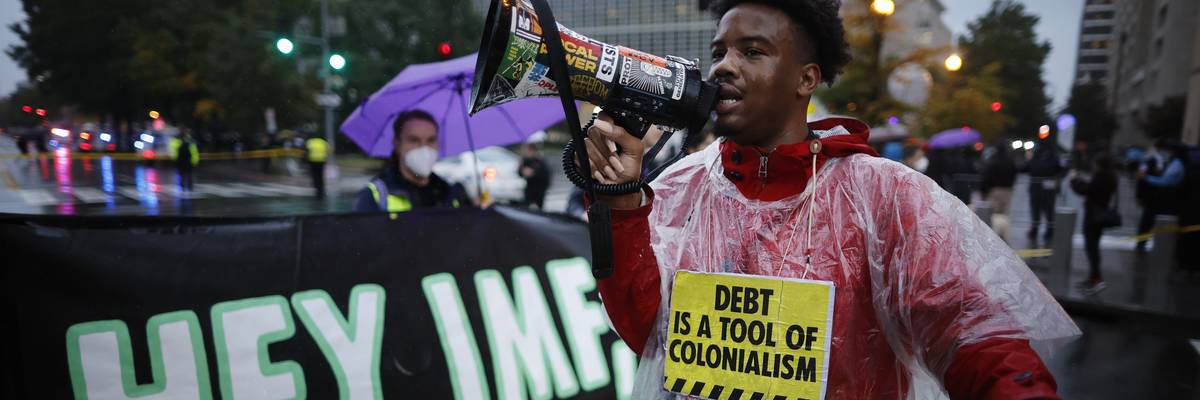
Activists from Extinction Rebellion and Debt for Climate shut down vehicle traffic in an attempt to block people from entering the annual meetings of the International Monetary Fund and the World Bank in Washington, DC on October 13, 2022.
One ActionAid campaigner said rich nations should "cancel unjust and unsustainable debt, stop making countries borrow to survive climate impacts, and deliver climate finance as grants rather than loans."
The world's most climate-vulnerable nations are spending nearly 25 times more on servicing their debts than on addressing the climate emergency, an ActionAid International report released Wednesday revealed, underscoring what the advocacy group called a "vicious cycle" of debt, disasters, and underinvestment.
The report, "Debt Fuels the Climate Crisis: How the Finance Flows," examines government revenues, debt payments, national budgets, and climate plans in the 65 countries considered most vulnerable to climate change. The authors found that debt servicing consumes 65% of these nations' combined government revenue, while 93.5% of the countries are either in debt distress or facing a significant risk of it.
"Climate-vulnerable countries are being forced to spend nearly 25 times as much on repaying debt as on climate action," the report states. "Indeed, in 2026 total debt servicing on external and domestic debt in these countries is nearly four times that of spending on education, nearly seven times that of health, and nearly six times that of social protection."
🚨 New ActionAid analysis: countries facing the worst climate disasters are spending nearly 25 times more on debt than on climate action. That is not an accident. It is how the global debt system is built right now. Full findings 👉 https://bit.ly/4Acxh0c#ClimateJustice #FundOurFuture #DebtJustice
[image or embed]
— ActionAid USA (@aausa.bsky.social) September 16, 2026 at 6:31 AM
The disparity is even greater when comparing debt payments with climate grants. ActionAid estimated that countries in the Global South will make approximately $8.8 trillion in debt repayments in 2026, compared with just $39 billion in grant-based climate finance received in 2024—a ratio of roughly 225 to 1.
"For too long, the debt and climate crises have been treated separately," ActionAid International secretary-general Arthur Larok said in a statement. "This research exposes how tightly they are connected and quantifies the devastating cost involved. Yet this is a crisis we can fix."
The report—whose release coincides with the Global Week of Climate Action—highlights how climate disasters frequently force already indebted nations to borrow even more money for recovery and reconstruction. Subsequent debt payments and austerity measures forced upon them by global financial institutions like the International Monetary Fund (IMF) and World Bank then restrict their spending on climate resilience, public services, and clean energy transitions.
As the report notes:
Even though the IMF recognizes that there is a "development crisis," the IMF refuses to even talk about a systemic debt crisis—because for them and their shareholders, there is no systemic crisis so long as there is no significant default and creditors are being paid. Moreover, the IMF thrives on countries needing to come to them for bailout loans, as this expands their own power and influence. The IMF is both a creditor and a debt collector, serving its own interests and those of its main shareholders in the Global North—making it both judge and jury when it comes to debt renegotiation processes.
The report also details how Global South governments under pressure to generate foreign currency can expand fossil fuel extraction and industrial agriculture, potentially worsening the climate pressures that contributed to their debt in the first place.
“Debt is a triple whammy for the climate: It drives fossil fuel and industrial agriculture expansion, blocks vital climate action, and leaves communities dangerously exposed when disasters strike," ActionAid International global climate justice lead Teresa Anderson said Wednesday.
"This is a toxic relationship," she added. "Countries borrow to rebuild, austerity weakens their resilience, and repayment pressures push more extraction, fueling the next disaster. We need a breakup: Cancel unjust and unsustainable debt, stop making countries borrow to survive climate impacts, and deliver climate finance as grants rather than loans. This vicious cycle can and must be broken.”
“Debt is a triple whammy for the climate."
In Senegal, the imbalance is particularly stark. ActionAid said the government is spending $605 on debt servicing for every $1 budgeted for climate action, while debt payments consume more than 96% of government revenue.
"Behind these figures are impossible choices between servicing debt and investing in agroecology, public services, and climate resilience," ActionAid Senegal director Khaita Sylla said Wednesday. "Women and girls who bear the brunt of climate impacts are then disproportionately affected by cuts in public services even as they lead solutions for a more resilient future.”
ActionAid is calling on governments and international institutions to take steps including:
“Rich countries like the US have outsized global financial power," ActionAid USA executive director Niranjali Amerasinghe said on Wednesday. "Their lack of willingness to provide climate finance at scale and relieve the debt burden of climate-vulnerable countries is unconscionable."
"There are trillions for defense budgets," Amerasinghe added, "but peanuts for the biggest existential crisis of a generation.”
Dear Common Dreams reader, It’s been nearly 30 years since I co-founded Common Dreams with my late wife, Lina Newhouser. We had the radical notion that journalism should serve the public good, not corporate profits. It was clear to us from the outset what it would take to build such a project. No paid advertisements. No corporate sponsors. No millionaire publisher telling us what to think or do. Many people said we wouldn't last a year, but we proved those doubters wrong. Together with a tremendous team of journalists and dedicated staff, we built an independent media outlet free from the constraints of profits and corporate control. Our mission has always been simple: To inform. To inspire. To ignite change for the common good. Building Common Dreams was not easy. Our survival was never guaranteed. When you take on the most powerful forces—Wall Street greed, fossil fuel industry destruction, Big Tech lobbyists, and uber-rich oligarchs who have spent billions upon billions rigging the economy and democracy in their favor—the only bulwark you have is supporters who believe in your work. But here’s the urgent message from me today. It's never been this bad out there. And it's never been this hard to keep us going. At the very moment Common Dreams is most needed, the threats we face are intensifying. We need your support now more than ever. We don't accept corporate advertising and never will. We don't have a paywall because we don't think people should be blocked from critical news based on their ability to pay. Everything we do is funded by the donations of readers like you. When everyone does the little they can afford, we are strong. But if that support retreats or dries up, so do we. Will you donate now to make sure Common Dreams not only survives but thrives? —Craig Brown, Co-founder |
The world's most climate-vulnerable nations are spending nearly 25 times more on servicing their debts than on addressing the climate emergency, an ActionAid International report released Wednesday revealed, underscoring what the advocacy group called a "vicious cycle" of debt, disasters, and underinvestment.
The report, "Debt Fuels the Climate Crisis: How the Finance Flows," examines government revenues, debt payments, national budgets, and climate plans in the 65 countries considered most vulnerable to climate change. The authors found that debt servicing consumes 65% of these nations' combined government revenue, while 93.5% of the countries are either in debt distress or facing a significant risk of it.
"Climate-vulnerable countries are being forced to spend nearly 25 times as much on repaying debt as on climate action," the report states. "Indeed, in 2026 total debt servicing on external and domestic debt in these countries is nearly four times that of spending on education, nearly seven times that of health, and nearly six times that of social protection."
🚨 New ActionAid analysis: countries facing the worst climate disasters are spending nearly 25 times more on debt than on climate action. That is not an accident. It is how the global debt system is built right now. Full findings 👉 https://bit.ly/4Acxh0c#ClimateJustice #FundOurFuture #DebtJustice
[image or embed]
— ActionAid USA (@aausa.bsky.social) September 16, 2026 at 6:31 AM
The disparity is even greater when comparing debt payments with climate grants. ActionAid estimated that countries in the Global South will make approximately $8.8 trillion in debt repayments in 2026, compared with just $39 billion in grant-based climate finance received in 2024—a ratio of roughly 225 to 1.
"For too long, the debt and climate crises have been treated separately," ActionAid International secretary-general Arthur Larok said in a statement. "This research exposes how tightly they are connected and quantifies the devastating cost involved. Yet this is a crisis we can fix."
The report—whose release coincides with the Global Week of Climate Action—highlights how climate disasters frequently force already indebted nations to borrow even more money for recovery and reconstruction. Subsequent debt payments and austerity measures forced upon them by global financial institutions like the International Monetary Fund (IMF) and World Bank then restrict their spending on climate resilience, public services, and clean energy transitions.
As the report notes:
Even though the IMF recognizes that there is a "development crisis," the IMF refuses to even talk about a systemic debt crisis—because for them and their shareholders, there is no systemic crisis so long as there is no significant default and creditors are being paid. Moreover, the IMF thrives on countries needing to come to them for bailout loans, as this expands their own power and influence. The IMF is both a creditor and a debt collector, serving its own interests and those of its main shareholders in the Global North—making it both judge and jury when it comes to debt renegotiation processes.
The report also details how Global South governments under pressure to generate foreign currency can expand fossil fuel extraction and industrial agriculture, potentially worsening the climate pressures that contributed to their debt in the first place.
“Debt is a triple whammy for the climate: It drives fossil fuel and industrial agriculture expansion, blocks vital climate action, and leaves communities dangerously exposed when disasters strike," ActionAid International global climate justice lead Teresa Anderson said Wednesday.
"This is a toxic relationship," she added. "Countries borrow to rebuild, austerity weakens their resilience, and repayment pressures push more extraction, fueling the next disaster. We need a breakup: Cancel unjust and unsustainable debt, stop making countries borrow to survive climate impacts, and deliver climate finance as grants rather than loans. This vicious cycle can and must be broken.”
“Debt is a triple whammy for the climate."
In Senegal, the imbalance is particularly stark. ActionAid said the government is spending $605 on debt servicing for every $1 budgeted for climate action, while debt payments consume more than 96% of government revenue.
"Behind these figures are impossible choices between servicing debt and investing in agroecology, public services, and climate resilience," ActionAid Senegal director Khaita Sylla said Wednesday. "Women and girls who bear the brunt of climate impacts are then disproportionately affected by cuts in public services even as they lead solutions for a more resilient future.”
ActionAid is calling on governments and international institutions to take steps including:
“Rich countries like the US have outsized global financial power," ActionAid USA executive director Niranjali Amerasinghe said on Wednesday. "Their lack of willingness to provide climate finance at scale and relieve the debt burden of climate-vulnerable countries is unconscionable."
"There are trillions for defense budgets," Amerasinghe added, "but peanuts for the biggest existential crisis of a generation.”
The world's most climate-vulnerable nations are spending nearly 25 times more on servicing their debts than on addressing the climate emergency, an ActionAid International report released Wednesday revealed, underscoring what the advocacy group called a "vicious cycle" of debt, disasters, and underinvestment.
The report, "Debt Fuels the Climate Crisis: How the Finance Flows," examines government revenues, debt payments, national budgets, and climate plans in the 65 countries considered most vulnerable to climate change. The authors found that debt servicing consumes 65% of these nations' combined government revenue, while 93.5% of the countries are either in debt distress or facing a significant risk of it.
"Climate-vulnerable countries are being forced to spend nearly 25 times as much on repaying debt as on climate action," the report states. "Indeed, in 2026 total debt servicing on external and domestic debt in these countries is nearly four times that of spending on education, nearly seven times that of health, and nearly six times that of social protection."
🚨 New ActionAid analysis: countries facing the worst climate disasters are spending nearly 25 times more on debt than on climate action. That is not an accident. It is how the global debt system is built right now. Full findings 👉 https://bit.ly/4Acxh0c#ClimateJustice #FundOurFuture #DebtJustice
[image or embed]
— ActionAid USA (@aausa.bsky.social) September 16, 2026 at 6:31 AM
The disparity is even greater when comparing debt payments with climate grants. ActionAid estimated that countries in the Global South will make approximately $8.8 trillion in debt repayments in 2026, compared with just $39 billion in grant-based climate finance received in 2024—a ratio of roughly 225 to 1.
"For too long, the debt and climate crises have been treated separately," ActionAid International secretary-general Arthur Larok said in a statement. "This research exposes how tightly they are connected and quantifies the devastating cost involved. Yet this is a crisis we can fix."
The report—whose release coincides with the Global Week of Climate Action—highlights how climate disasters frequently force already indebted nations to borrow even more money for recovery and reconstruction. Subsequent debt payments and austerity measures forced upon them by global financial institutions like the International Monetary Fund (IMF) and World Bank then restrict their spending on climate resilience, public services, and clean energy transitions.
As the report notes:
Even though the IMF recognizes that there is a "development crisis," the IMF refuses to even talk about a systemic debt crisis—because for them and their shareholders, there is no systemic crisis so long as there is no significant default and creditors are being paid. Moreover, the IMF thrives on countries needing to come to them for bailout loans, as this expands their own power and influence. The IMF is both a creditor and a debt collector, serving its own interests and those of its main shareholders in the Global North—making it both judge and jury when it comes to debt renegotiation processes.
The report also details how Global South governments under pressure to generate foreign currency can expand fossil fuel extraction and industrial agriculture, potentially worsening the climate pressures that contributed to their debt in the first place.
“Debt is a triple whammy for the climate: It drives fossil fuel and industrial agriculture expansion, blocks vital climate action, and leaves communities dangerously exposed when disasters strike," ActionAid International global climate justice lead Teresa Anderson said Wednesday.
"This is a toxic relationship," she added. "Countries borrow to rebuild, austerity weakens their resilience, and repayment pressures push more extraction, fueling the next disaster. We need a breakup: Cancel unjust and unsustainable debt, stop making countries borrow to survive climate impacts, and deliver climate finance as grants rather than loans. This vicious cycle can and must be broken.”
“Debt is a triple whammy for the climate."
In Senegal, the imbalance is particularly stark. ActionAid said the government is spending $605 on debt servicing for every $1 budgeted for climate action, while debt payments consume more than 96% of government revenue.
"Behind these figures are impossible choices between servicing debt and investing in agroecology, public services, and climate resilience," ActionAid Senegal director Khaita Sylla said Wednesday. "Women and girls who bear the brunt of climate impacts are then disproportionately affected by cuts in public services even as they lead solutions for a more resilient future.”
ActionAid is calling on governments and international institutions to take steps including:
“Rich countries like the US have outsized global financial power," ActionAid USA executive director Niranjali Amerasinghe said on Wednesday. "Their lack of willingness to provide climate finance at scale and relieve the debt burden of climate-vulnerable countries is unconscionable."
"There are trillions for defense budgets," Amerasinghe added, "but peanuts for the biggest existential crisis of a generation.”