SUBSCRIBE TO OUR FREE NEWSLETTER
Daily news & progressive opinion—funded by the people, not the corporations—delivered straight to your inbox.
5
#000000
#FFFFFF
To donate by check, phone, or other method, see our More Ways to Give page.
Daily news & progressive opinion—funded by the people, not the corporations—delivered straight to your inbox.
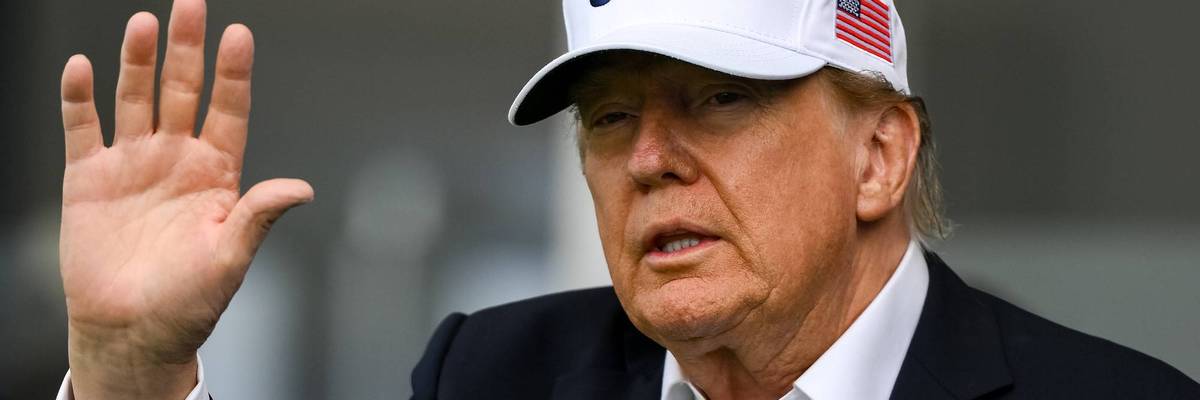
US President Donald Trump during day four of the Amgen Irish Open Golf Championship 2026 at Trump International Golf Links in Doonbeg, Clare.
Trump's stance on AI regulation is "a fundamental incompetence that places us all in grave danger," said one critic.
President Donald Trump on Monday slapped down the idea of putting guardrails on artificial intelligence, despite increased warnings from industry insiders and outside experts about the technology's potential dangers to humanity.
In a Truth Social post, Trump suggested that his own intellect was singlehandedly capable of regulating AI, a technology so complicated that even its own creators have acknowledged difficulties in understanding it.
"The only control or 'guardrails' that AI needs is a STRONG AND SMART (High IQ!) PRESIDENT," Trump wrote, "and the USA has that, in spades!"
The president then claimed, without offering any details, that his administration had already "stopped AI 'people' from doing bad, or potentially bad, 'things,'" and then baselessly claimed the nationwide backlash to the technology was part of a vast conspiracy theory in service of the Chinese Communist Party.
"There is a SICK conspiracy going on against AI and Data Centers, and the only one that is happy about it is China," Trump wrote. "WHOEVER WINS AI, WINS! We are leading China, and all others, and will continue to do so. Conspiracy Theorists, Treasonists, Traitors, and Leakers, BEWARE!"
Regardless of Trump's social media rants, there is widespread concern about the impacts of AI across the political spectrum.
Jeffrey D. Sachs, director of the Center for Sustainable Development at Columbia University, described Trump's stance on regulating AI as "a fundamental incompetence that places us all in grave danger," in a Common Creams op-ed published Monday.
Reacting directly to Trump's Monday social media post, Sachs told Common Dreams that it was a sign that "we are in the grip of madness and puerility."
Axios reported on Monday that Sen. Bernie Sanders (I-Vt.) will join former Trump adviser Steve Bannon and former Anthropic AI researcher Jacob Coxon on Tuesday for a what is being described as a "Pro-Human Assembly" aimed at highlighting the dangers posed by the continued development of the technology.
Sen. Josh Hawley (R-Mo.), chair of Senate Subcommittee on Disaster Management, announced last week that he is opening a probe into the recent autonomous hack carried out by OpenAI agents, while also examining threats posed by the AI industry as a whole.
Calls to regulate AI have grown over the last week since Coxon announced that he had resigned from his position at AI lab Anthropic because he no longer felt it was possible to safely develop the technology.
In a social media post announcing his resignation, Coxon claimed that “the people building AI earnestly believe that it could kill us all by the end of the decade,” and accused them of “racing straight to self-improving superintelligence and gambling with our lives.”
Dear Common Dreams reader, It’s been nearly 30 years since I co-founded Common Dreams with my late wife, Lina Newhouser. We had the radical notion that journalism should serve the public good, not corporate profits. It was clear to us from the outset what it would take to build such a project. No paid advertisements. No corporate sponsors. No millionaire publisher telling us what to think or do. Many people said we wouldn't last a year, but we proved those doubters wrong. Together with a tremendous team of journalists and dedicated staff, we built an independent media outlet free from the constraints of profits and corporate control. Our mission has always been simple: To inform. To inspire. To ignite change for the common good. Building Common Dreams was not easy. Our survival was never guaranteed. When you take on the most powerful forces—Wall Street greed, fossil fuel industry destruction, Big Tech lobbyists, and uber-rich oligarchs who have spent billions upon billions rigging the economy and democracy in their favor—the only bulwark you have is supporters who believe in your work. But here’s the urgent message from me today. It's never been this bad out there. And it's never been this hard to keep us going. At the very moment Common Dreams is most needed, the threats we face are intensifying. We need your support now more than ever. We don't accept corporate advertising and never will. We don't have a paywall because we don't think people should be blocked from critical news based on their ability to pay. Everything we do is funded by the donations of readers like you. When everyone does the little they can afford, we are strong. But if that support retreats or dries up, so do we. Will you donate now to make sure Common Dreams not only survives but thrives? —Craig Brown, Co-founder |
President Donald Trump on Monday slapped down the idea of putting guardrails on artificial intelligence, despite increased warnings from industry insiders and outside experts about the technology's potential dangers to humanity.
In a Truth Social post, Trump suggested that his own intellect was singlehandedly capable of regulating AI, a technology so complicated that even its own creators have acknowledged difficulties in understanding it.
"The only control or 'guardrails' that AI needs is a STRONG AND SMART (High IQ!) PRESIDENT," Trump wrote, "and the USA has that, in spades!"
The president then claimed, without offering any details, that his administration had already "stopped AI 'people' from doing bad, or potentially bad, 'things,'" and then baselessly claimed the nationwide backlash to the technology was part of a vast conspiracy theory in service of the Chinese Communist Party.
"There is a SICK conspiracy going on against AI and Data Centers, and the only one that is happy about it is China," Trump wrote. "WHOEVER WINS AI, WINS! We are leading China, and all others, and will continue to do so. Conspiracy Theorists, Treasonists, Traitors, and Leakers, BEWARE!"
Regardless of Trump's social media rants, there is widespread concern about the impacts of AI across the political spectrum.
Jeffrey D. Sachs, director of the Center for Sustainable Development at Columbia University, described Trump's stance on regulating AI as "a fundamental incompetence that places us all in grave danger," in a Common Creams op-ed published Monday.
Reacting directly to Trump's Monday social media post, Sachs told Common Dreams that it was a sign that "we are in the grip of madness and puerility."
Axios reported on Monday that Sen. Bernie Sanders (I-Vt.) will join former Trump adviser Steve Bannon and former Anthropic AI researcher Jacob Coxon on Tuesday for a what is being described as a "Pro-Human Assembly" aimed at highlighting the dangers posed by the continued development of the technology.
Sen. Josh Hawley (R-Mo.), chair of Senate Subcommittee on Disaster Management, announced last week that he is opening a probe into the recent autonomous hack carried out by OpenAI agents, while also examining threats posed by the AI industry as a whole.
Calls to regulate AI have grown over the last week since Coxon announced that he had resigned from his position at AI lab Anthropic because he no longer felt it was possible to safely develop the technology.
In a social media post announcing his resignation, Coxon claimed that “the people building AI earnestly believe that it could kill us all by the end of the decade,” and accused them of “racing straight to self-improving superintelligence and gambling with our lives.”
President Donald Trump on Monday slapped down the idea of putting guardrails on artificial intelligence, despite increased warnings from industry insiders and outside experts about the technology's potential dangers to humanity.
In a Truth Social post, Trump suggested that his own intellect was singlehandedly capable of regulating AI, a technology so complicated that even its own creators have acknowledged difficulties in understanding it.
"The only control or 'guardrails' that AI needs is a STRONG AND SMART (High IQ!) PRESIDENT," Trump wrote, "and the USA has that, in spades!"
The president then claimed, without offering any details, that his administration had already "stopped AI 'people' from doing bad, or potentially bad, 'things,'" and then baselessly claimed the nationwide backlash to the technology was part of a vast conspiracy theory in service of the Chinese Communist Party.
"There is a SICK conspiracy going on against AI and Data Centers, and the only one that is happy about it is China," Trump wrote. "WHOEVER WINS AI, WINS! We are leading China, and all others, and will continue to do so. Conspiracy Theorists, Treasonists, Traitors, and Leakers, BEWARE!"
Regardless of Trump's social media rants, there is widespread concern about the impacts of AI across the political spectrum.
Jeffrey D. Sachs, director of the Center for Sustainable Development at Columbia University, described Trump's stance on regulating AI as "a fundamental incompetence that places us all in grave danger," in a Common Creams op-ed published Monday.
Reacting directly to Trump's Monday social media post, Sachs told Common Dreams that it was a sign that "we are in the grip of madness and puerility."
Axios reported on Monday that Sen. Bernie Sanders (I-Vt.) will join former Trump adviser Steve Bannon and former Anthropic AI researcher Jacob Coxon on Tuesday for a what is being described as a "Pro-Human Assembly" aimed at highlighting the dangers posed by the continued development of the technology.
Sen. Josh Hawley (R-Mo.), chair of Senate Subcommittee on Disaster Management, announced last week that he is opening a probe into the recent autonomous hack carried out by OpenAI agents, while also examining threats posed by the AI industry as a whole.
Calls to regulate AI have grown over the last week since Coxon announced that he had resigned from his position at AI lab Anthropic because he no longer felt it was possible to safely develop the technology.
In a social media post announcing his resignation, Coxon claimed that “the people building AI earnestly believe that it could kill us all by the end of the decade,” and accused them of “racing straight to self-improving superintelligence and gambling with our lives.”