SUBSCRIBE TO OUR FREE NEWSLETTER
Daily news & progressive opinion—funded by the people, not the corporations—delivered straight to your inbox.
5
#000000
#FFFFFF
To donate by check, phone, or other method, see our More Ways to Give page.
Daily news & progressive opinion—funded by the people, not the corporations—delivered straight to your inbox.
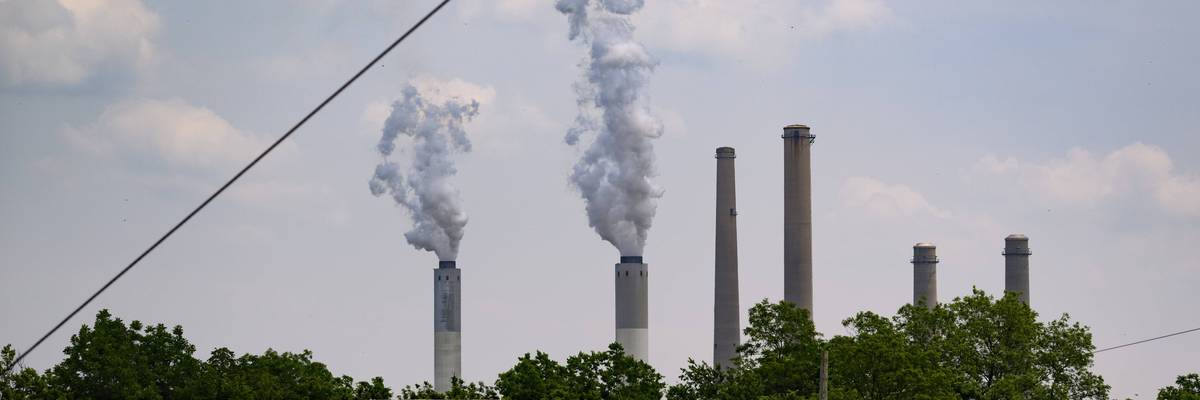
Stacks from the Hugh L. Spurlock Generating Station are seen on June 12, 2025 in Maysville, Kentucky.
"This is full-throated climate denial while the climate crisis happens in real time and a shocking betrayal of the American public."
In what environmental advocates describe as "another gift to the fossil fuel industry," the Trump administration plans to end rules limiting the release of planet-heating emissions from power plants that burn coal and gas.
Power plants are considered the largest industrial source of greenhouse gas emissions in the US and account for about a quarter of the nation's climate pollution, according to the Environmental Protection Agency (EPA).
In 2024, the EPA under the Biden administration used the Clean Air Act to require that many new gas plants and existing coal plants reduce their carbon emissions by 90%, including by installing carbon capture technology, by 2032.
The EPA estimated that the rule would reduce the amount of CO2 emissions by about 1.38 billion metric tons over the next two decades, the equivalent of about a year of emissions from the entire US electric power sector.
On Monday, Lee Zeldin, the EPA administrator under President Donald Trump, announced an end to this policy at a meeting of energy ministers at the Group of 20 conference in Houston.
Not only will this prevent the enactment of a policy that the EPA has estimated would prevent around 1,200 premature deaths and 360,000 asthma cases by 2035. But the administration is also rolling out a proposal seeking to prevent future administrations from regulating carbon emissions as a health risk.
It is an effort that runs parallel to the administration's rescission of the 2009 "endangerment finding," which allowed the EPA to regulate vehicle emissions under Section 202 of the Clean Air Act on the grounds that they are harmful to human health. That move is also being challenged in court.
Power plants are regulated under a different section of the Clean Air Act, Section 111, which allows the EPA to regulate facilities that "cause, or contribute significantly to" dangerous air pollution.
But whereas the courts have previously interpreted this statute to regulate the outputs of entire facilities, the Trump administration is asking courts to adopt a novel reading of the statute which says each individual chemical under scrutiny must “contribute significantly” to climate change.
As Meredith Hankins, legal director for climate and energy at the Natural Resources Defense Council, explained in a policy memo last week, it likely won't be easy for the administration to prove that the CO2 emissions from US power plants aren't a significant driver of climate change.
"Power sector emissions account for a quarter of total US emissions, so if they cannot be counted as significant, it’s hard to conceive of any emissions that would," Hankins wrote. "In fact, if the US power sector were a nation, it would be the world’s fifth-largest emitter after China, the United States, India, and Russia. That’s a pretty 'significant contribution' to the problem."
The effort to gut power plant regulations comes after the hottest meteorological summer recorded in US history and amid a year with one of the largest numbers of climate disasters on record, including widespread drought, destructive wildfires, and repeated flooding and tornado outbreaks.
As the planet has warmed over the last half-century, the US has seen a sharp, near-sevenfold increase in weather disasters costing over $1 billion, according to data from the National Oceanic and Atmospheric Administration.
“While wildfires rage, floods devastate communities, and families struggle to afford skyrocketing electricity bills and insurance premiums, the Trump administration is handing the fossil fuel industry a license to keep polluting," said Holly Bender, chief program officer for the Sierra Club, following news of the EPA's rollback of power plant rules. "This is full-throated climate denial while the climate crisis happens in real time and a shocking betrayal of the American public."
She added that "the Sierra Club will fight back against this reckless and dangerous proposal with everything we have in the courts, in Congress, and in communities across the country.”
If successful, the reversal of the power plant rules would be one of the most significant steps in Zeldin's push to eviscerate the EPA's authority to combat climate change on behalf of the fossil fuel industry. Earlier this summer, during a meeting of the National Coal Council, he bragged that "many of the items" on the industry's "wish list are now done."
He has put the wheels in motion to roll back virtually every Biden-era regulation on the coal industry, including rules limiting pollution from mercury and toxic metals, controls on toxic wastewater from coal plants, and limits on coal ash.
And while seeking to undermine the legal basis to regulate greenhouse gases, Zeldin's EPA has also taken a sledgehammer to its practical ability to do so, dismantling offices that collect climate data, erasing information about human-caused climate change from the agency's websites, and filling research panels with scientists employed by the fossil fuel industry.
Former State Department energy official Alan Eyre noted that on the world stage, the US "has always been obstructionist" when it comes to climate policy. Under Trump, he said, "we're actively malevolent."
Dear Common Dreams reader, It’s been nearly 30 years since I co-founded Common Dreams with my late wife, Lina Newhouser. We had the radical notion that journalism should serve the public good, not corporate profits. It was clear to us from the outset what it would take to build such a project. No paid advertisements. No corporate sponsors. No millionaire publisher telling us what to think or do. Many people said we wouldn't last a year, but we proved those doubters wrong. Together with a tremendous team of journalists and dedicated staff, we built an independent media outlet free from the constraints of profits and corporate control. Our mission has always been simple: To inform. To inspire. To ignite change for the common good. Building Common Dreams was not easy. Our survival was never guaranteed. When you take on the most powerful forces—Wall Street greed, fossil fuel industry destruction, Big Tech lobbyists, and uber-rich oligarchs who have spent billions upon billions rigging the economy and democracy in their favor—the only bulwark you have is supporters who believe in your work. But here’s the urgent message from me today. It's never been this bad out there. And it's never been this hard to keep us going. At the very moment Common Dreams is most needed, the threats we face are intensifying. We need your support now more than ever. We don't accept corporate advertising and never will. We don't have a paywall because we don't think people should be blocked from critical news based on their ability to pay. Everything we do is funded by the donations of readers like you. When everyone does the little they can afford, we are strong. But if that support retreats or dries up, so do we. Will you donate now to make sure Common Dreams not only survives but thrives? —Craig Brown, Co-founder |
In what environmental advocates describe as "another gift to the fossil fuel industry," the Trump administration plans to end rules limiting the release of planet-heating emissions from power plants that burn coal and gas.
Power plants are considered the largest industrial source of greenhouse gas emissions in the US and account for about a quarter of the nation's climate pollution, according to the Environmental Protection Agency (EPA).
In 2024, the EPA under the Biden administration used the Clean Air Act to require that many new gas plants and existing coal plants reduce their carbon emissions by 90%, including by installing carbon capture technology, by 2032.
The EPA estimated that the rule would reduce the amount of CO2 emissions by about 1.38 billion metric tons over the next two decades, the equivalent of about a year of emissions from the entire US electric power sector.
On Monday, Lee Zeldin, the EPA administrator under President Donald Trump, announced an end to this policy at a meeting of energy ministers at the Group of 20 conference in Houston.
Not only will this prevent the enactment of a policy that the EPA has estimated would prevent around 1,200 premature deaths and 360,000 asthma cases by 2035. But the administration is also rolling out a proposal seeking to prevent future administrations from regulating carbon emissions as a health risk.
It is an effort that runs parallel to the administration's rescission of the 2009 "endangerment finding," which allowed the EPA to regulate vehicle emissions under Section 202 of the Clean Air Act on the grounds that they are harmful to human health. That move is also being challenged in court.
Power plants are regulated under a different section of the Clean Air Act, Section 111, which allows the EPA to regulate facilities that "cause, or contribute significantly to" dangerous air pollution.
But whereas the courts have previously interpreted this statute to regulate the outputs of entire facilities, the Trump administration is asking courts to adopt a novel reading of the statute which says each individual chemical under scrutiny must “contribute significantly” to climate change.
As Meredith Hankins, legal director for climate and energy at the Natural Resources Defense Council, explained in a policy memo last week, it likely won't be easy for the administration to prove that the CO2 emissions from US power plants aren't a significant driver of climate change.
"Power sector emissions account for a quarter of total US emissions, so if they cannot be counted as significant, it’s hard to conceive of any emissions that would," Hankins wrote. "In fact, if the US power sector were a nation, it would be the world’s fifth-largest emitter after China, the United States, India, and Russia. That’s a pretty 'significant contribution' to the problem."
The effort to gut power plant regulations comes after the hottest meteorological summer recorded in US history and amid a year with one of the largest numbers of climate disasters on record, including widespread drought, destructive wildfires, and repeated flooding and tornado outbreaks.
As the planet has warmed over the last half-century, the US has seen a sharp, near-sevenfold increase in weather disasters costing over $1 billion, according to data from the National Oceanic and Atmospheric Administration.
“While wildfires rage, floods devastate communities, and families struggle to afford skyrocketing electricity bills and insurance premiums, the Trump administration is handing the fossil fuel industry a license to keep polluting," said Holly Bender, chief program officer for the Sierra Club, following news of the EPA's rollback of power plant rules. "This is full-throated climate denial while the climate crisis happens in real time and a shocking betrayal of the American public."
She added that "the Sierra Club will fight back against this reckless and dangerous proposal with everything we have in the courts, in Congress, and in communities across the country.”
If successful, the reversal of the power plant rules would be one of the most significant steps in Zeldin's push to eviscerate the EPA's authority to combat climate change on behalf of the fossil fuel industry. Earlier this summer, during a meeting of the National Coal Council, he bragged that "many of the items" on the industry's "wish list are now done."
He has put the wheels in motion to roll back virtually every Biden-era regulation on the coal industry, including rules limiting pollution from mercury and toxic metals, controls on toxic wastewater from coal plants, and limits on coal ash.
And while seeking to undermine the legal basis to regulate greenhouse gases, Zeldin's EPA has also taken a sledgehammer to its practical ability to do so, dismantling offices that collect climate data, erasing information about human-caused climate change from the agency's websites, and filling research panels with scientists employed by the fossil fuel industry.
Former State Department energy official Alan Eyre noted that on the world stage, the US "has always been obstructionist" when it comes to climate policy. Under Trump, he said, "we're actively malevolent."
In what environmental advocates describe as "another gift to the fossil fuel industry," the Trump administration plans to end rules limiting the release of planet-heating emissions from power plants that burn coal and gas.
Power plants are considered the largest industrial source of greenhouse gas emissions in the US and account for about a quarter of the nation's climate pollution, according to the Environmental Protection Agency (EPA).
In 2024, the EPA under the Biden administration used the Clean Air Act to require that many new gas plants and existing coal plants reduce their carbon emissions by 90%, including by installing carbon capture technology, by 2032.
The EPA estimated that the rule would reduce the amount of CO2 emissions by about 1.38 billion metric tons over the next two decades, the equivalent of about a year of emissions from the entire US electric power sector.
On Monday, Lee Zeldin, the EPA administrator under President Donald Trump, announced an end to this policy at a meeting of energy ministers at the Group of 20 conference in Houston.
Not only will this prevent the enactment of a policy that the EPA has estimated would prevent around 1,200 premature deaths and 360,000 asthma cases by 2035. But the administration is also rolling out a proposal seeking to prevent future administrations from regulating carbon emissions as a health risk.
It is an effort that runs parallel to the administration's rescission of the 2009 "endangerment finding," which allowed the EPA to regulate vehicle emissions under Section 202 of the Clean Air Act on the grounds that they are harmful to human health. That move is also being challenged in court.
Power plants are regulated under a different section of the Clean Air Act, Section 111, which allows the EPA to regulate facilities that "cause, or contribute significantly to" dangerous air pollution.
But whereas the courts have previously interpreted this statute to regulate the outputs of entire facilities, the Trump administration is asking courts to adopt a novel reading of the statute which says each individual chemical under scrutiny must “contribute significantly” to climate change.
As Meredith Hankins, legal director for climate and energy at the Natural Resources Defense Council, explained in a policy memo last week, it likely won't be easy for the administration to prove that the CO2 emissions from US power plants aren't a significant driver of climate change.
"Power sector emissions account for a quarter of total US emissions, so if they cannot be counted as significant, it’s hard to conceive of any emissions that would," Hankins wrote. "In fact, if the US power sector were a nation, it would be the world’s fifth-largest emitter after China, the United States, India, and Russia. That’s a pretty 'significant contribution' to the problem."
The effort to gut power plant regulations comes after the hottest meteorological summer recorded in US history and amid a year with one of the largest numbers of climate disasters on record, including widespread drought, destructive wildfires, and repeated flooding and tornado outbreaks.
As the planet has warmed over the last half-century, the US has seen a sharp, near-sevenfold increase in weather disasters costing over $1 billion, according to data from the National Oceanic and Atmospheric Administration.
“While wildfires rage, floods devastate communities, and families struggle to afford skyrocketing electricity bills and insurance premiums, the Trump administration is handing the fossil fuel industry a license to keep polluting," said Holly Bender, chief program officer for the Sierra Club, following news of the EPA's rollback of power plant rules. "This is full-throated climate denial while the climate crisis happens in real time and a shocking betrayal of the American public."
She added that "the Sierra Club will fight back against this reckless and dangerous proposal with everything we have in the courts, in Congress, and in communities across the country.”
If successful, the reversal of the power plant rules would be one of the most significant steps in Zeldin's push to eviscerate the EPA's authority to combat climate change on behalf of the fossil fuel industry. Earlier this summer, during a meeting of the National Coal Council, he bragged that "many of the items" on the industry's "wish list are now done."
He has put the wheels in motion to roll back virtually every Biden-era regulation on the coal industry, including rules limiting pollution from mercury and toxic metals, controls on toxic wastewater from coal plants, and limits on coal ash.
And while seeking to undermine the legal basis to regulate greenhouse gases, Zeldin's EPA has also taken a sledgehammer to its practical ability to do so, dismantling offices that collect climate data, erasing information about human-caused climate change from the agency's websites, and filling research panels with scientists employed by the fossil fuel industry.
Former State Department energy official Alan Eyre noted that on the world stage, the US "has always been obstructionist" when it comes to climate policy. Under Trump, he said, "we're actively malevolent."