SUBSCRIBE TO OUR FREE NEWSLETTER
Daily news & progressive opinion—funded by the people, not the corporations—delivered straight to your inbox.
5
#000000
#FFFFFF
To donate by check, phone, or other method, see our More Ways to Give page.

A Gallup survey released Friday found that a larger percentage of Americans sympathize with the Palestinians than with the Israelis in the decades-long Middle East conflict, which has exploded over the past two and a half years with the Hamas-led attack on Israel and the latter's genocidal response—fueled by military and diplomatic support from the US government.
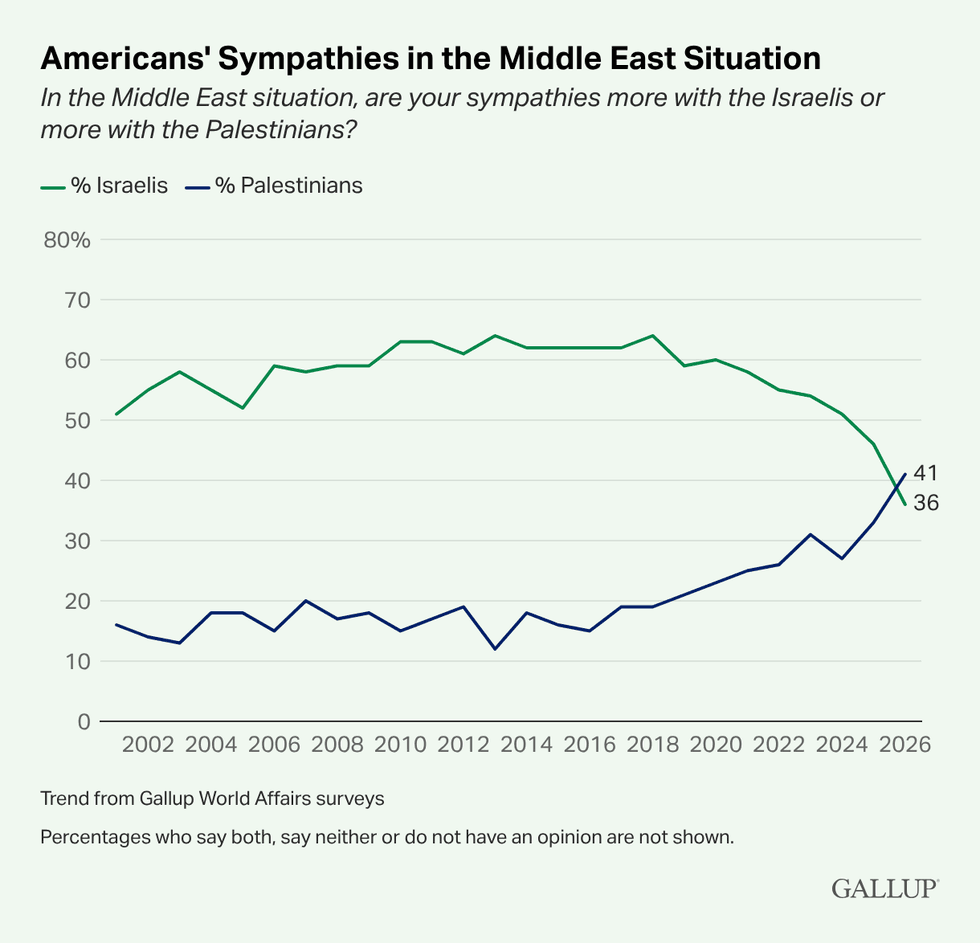
The new poll marks the first time since Gallup began tracking the question in 2001 that a larger portion of respondents (41%) expressed sympathy for the Palestinians than the Israelis (36%) "in the Middle East situation." The organization noted that while "the five-percentage-point difference is not statistically significant," it "contrasts with a clear lead for the Israelis only a year ago (46% vs. 33%) and larger leads over the prior 24 years."
"From 2001 to 2025, Israelis consistently held double-digit leads in Americans’ Middle East sympathies, with the gap averaging 43 points between 2001 and 2018," Gallup reported. "However, public opinion began narrowing in 2019, several years before the Oct. 7, 2023, Hamas attack on Israel and the subsequent war in Gaza. The cumulative effect of gradual changes in US attitudes since then has led to the Israelis no longer being viewed more sympathetically."
Notably, the Gallup survey shows that "Americans of all age groups have grown more sympathetic to the Palestinians in recent years." A majority of Americans between the ages of 18 and 34 (53%) said they sympathize more with the Palestinians and 23% said they sympathize more with the Israelis, "a record low for the age group," according to Gallup.
The survey also showed a "near reversal" among Americans aged 35 to 54—with 46% now saying they sympathize more with the Palestinians—and the "narrowest gap in sympathies" Gallup has ever recorded for Americans aged 55 and older.
In terms of political affiliation, Gallup found that "Americans’ shifting sympathies in the Middle East situation this year are mostly driven by changes among political independents," who now sympathize more with the Palestinians than the Israelis by a margin of 41% to 30%.
"It is difficult to overstate the significance of this," Trita Parsi, executive vice president of the Quincy Institute for Responsible Statecraft, wrote in response to the Gallup survey. "This is a key reason why Israel—and its supporters in the US—have a sense of desperate urgency when it comes to war with Iran and annexation of Palestine."
"The window for these aggressions with US support is closing," Parsi added.
The new poll also found that Americans' support for a Palestinian state is at its highest level in more than two decades as current Israeli leaders vow to prevent Palestinian statehood and ramp up their illegal annexation of territory—an effort effectively endorsed by the Trump administration.
A Gallup survey released Friday found that a larger percentage of Americans sympathize with the Palestinians than with the Israelis in the decades-long Middle East conflict, which has exploded over the past two and a half years with the Hamas-led attack on Israel and the latter's genocidal response—fueled by military and diplomatic support from the US government.
The new poll marks the first time since Gallup began tracking the question in 2001 that a larger portion of respondents (41%) expressed sympathy for the Palestinians than the Israelis (36%) "in the Middle East situation." The organization noted that while "the five-percentage-point difference is not statistically significant," it "contrasts with a clear lead for the Israelis only a year ago (46% vs. 33%) and larger leads over the prior 24 years."
"From 2001 to 2025, Israelis consistently held double-digit leads in Americans’ Middle East sympathies, with the gap averaging 43 points between 2001 and 2018," Gallup reported. "However, public opinion began narrowing in 2019, several years before the Oct. 7, 2023, Hamas attack on Israel and the subsequent war in Gaza. The cumulative effect of gradual changes in US attitudes since then has led to the Israelis no longer being viewed more sympathetically."
Notably, the Gallup survey shows that "Americans of all age groups have grown more sympathetic to the Palestinians in recent years." A majority of Americans between the ages of 18 and 34 (53%) said they sympathize more with the Palestinians and 23% said they sympathize more with the Israelis, "a record low for the age group," according to Gallup.
The survey also showed a "near reversal" among Americans aged 35 to 54—with 46% now saying they sympathize more with the Palestinians—and the "narrowest gap in sympathies" Gallup has ever recorded for Americans aged 55 and older.
In terms of political affiliation, Gallup found that "Americans’ shifting sympathies in the Middle East situation this year are mostly driven by changes among political independents," who now sympathize more with the Palestinians than the Israelis by a margin of 41% to 30%.
"It is difficult to overstate the significance of this," Trita Parsi, executive vice president of the Quincy Institute for Responsible Statecraft, wrote in response to the Gallup survey. "This is a key reason why Israel—and its supporters in the US—have a sense of desperate urgency when it comes to war with Iran and annexation of Palestine."
"The window for these aggressions with US support is closing," Parsi added.
The new poll also found that Americans' support for a Palestinian state is at its highest level in more than two decades as current Israeli leaders vow to prevent Palestinian statehood and ramp up their illegal annexation of territory—an effort effectively endorsed by the Trump administration.
A Gallup survey released Friday found that a larger percentage of Americans sympathize with the Palestinians than with the Israelis in the decades-long Middle East conflict, which has exploded over the past two and a half years with the Hamas-led attack on Israel and the latter's genocidal response—fueled by military and diplomatic support from the US government.
The new poll marks the first time since Gallup began tracking the question in 2001 that a larger portion of respondents (41%) expressed sympathy for the Palestinians than the Israelis (36%) "in the Middle East situation." The organization noted that while "the five-percentage-point difference is not statistically significant," it "contrasts with a clear lead for the Israelis only a year ago (46% vs. 33%) and larger leads over the prior 24 years."
"From 2001 to 2025, Israelis consistently held double-digit leads in Americans’ Middle East sympathies, with the gap averaging 43 points between 2001 and 2018," Gallup reported. "However, public opinion began narrowing in 2019, several years before the Oct. 7, 2023, Hamas attack on Israel and the subsequent war in Gaza. The cumulative effect of gradual changes in US attitudes since then has led to the Israelis no longer being viewed more sympathetically."
Notably, the Gallup survey shows that "Americans of all age groups have grown more sympathetic to the Palestinians in recent years." A majority of Americans between the ages of 18 and 34 (53%) said they sympathize more with the Palestinians and 23% said they sympathize more with the Israelis, "a record low for the age group," according to Gallup.
The survey also showed a "near reversal" among Americans aged 35 to 54—with 46% now saying they sympathize more with the Palestinians—and the "narrowest gap in sympathies" Gallup has ever recorded for Americans aged 55 and older.
In terms of political affiliation, Gallup found that "Americans’ shifting sympathies in the Middle East situation this year are mostly driven by changes among political independents," who now sympathize more with the Palestinians than the Israelis by a margin of 41% to 30%.
"It is difficult to overstate the significance of this," Trita Parsi, executive vice president of the Quincy Institute for Responsible Statecraft, wrote in response to the Gallup survey. "This is a key reason why Israel—and its supporters in the US—have a sense of desperate urgency when it comes to war with Iran and annexation of Palestine."
"The window for these aggressions with US support is closing," Parsi added.
The new poll also found that Americans' support for a Palestinian state is at its highest level in more than two decades as current Israeli leaders vow to prevent Palestinian statehood and ramp up their illegal annexation of territory—an effort effectively endorsed by the Trump administration.