5
#000000
#FFFFFF
To donate by check, phone, or other method, see our More Ways to Give page.
Daily news & progressive opinion—funded by the people, not the corporations—delivered straight to your inbox.
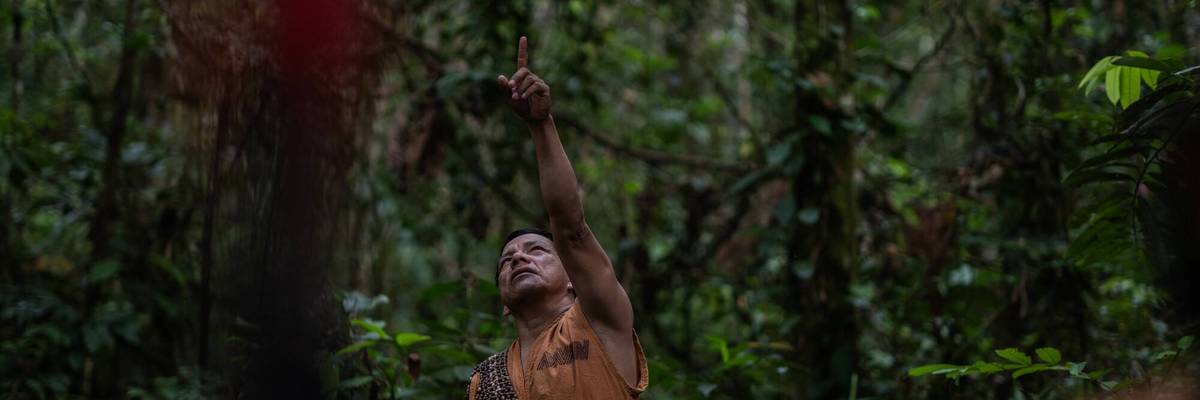
In the community of Yamino, the fith anniversary of the Kakataibo Indegenous guard was celebrated.
"When foreign aid retreats, Indigenous peoples and small-scale farmers can be left with fewer resources and less support as they defend the forests, rivers, and other ecosystems that sustain their communities and help keep the global climate stable,” one campaigner said.
A total of 124 people were killed defending the environment in 2025, according to a Global Witness report released Wednesday, as the global rise of authoritarianism and a dramatic decline in foreign aid makes the lives and work of environmental and humans rights advocates more challenging.
The report singles out the administration of US President Donald Trump—which dismantled the US Agency for International Development, delayed paying other United Nations fees, and has shown a broader disregard for international humans rights norms and the institutions that uphold them—for worsening the global climate for defenders. In 2025, total development aid plummeted by a record 23%, depleting the resources available to local communities and the organizations that support them.
“The effects of these budget cuts are not abstract," Juliana Vélez Echeverri, a senior campaigner at Global Witness, said in a statement. “In Colombia, projects working to promote and protect human rights and support defenders have been hit by the sudden drop in foreign aid, particularly from the US. When foreign aid retreats, Indigenous peoples and small-scale farmers can be left with fewer resources and less support as they defend the forests, rivers, and other ecosystems that sustain their communities and help keep the global climate stable.”
"We can’t prevent climate change when they kill those who protect the environment."
Colombia was the deadliest country for land defenders for the fourth year in a row with 39 killings, followed by Brazil with 26, and Honduras and the Philippines with 12 each. As the site of 85% of the killings, Latin America was the deadliest region, as it has been since Global Witness began counting the killings of environmental defenders in 2012. Indigenous people remain especially vulnerable to violence, as over three-quarters of the people killed in 2025 were either Indigenous, Afro-descendant, or small-scale farmers.
"For Indigenous peoples, land is life," said Joan Carling, executive director of Indigenous Peoples’ Rights International, in the report foreword. "Any threat to our lands, territories, and resources is a threat to our very existence—our cultures, our identities, our dignity, and our future generations. That is why our communities were willing to risk everything to protect them."
Seven of the Indigenous people killed in 2025 were members of Indigenous guards established to patrol and protect their territories from illegal encroachment. For example, the Indigenous Guard of the Kakataibo People of Peru was formed in 2022 to protect their rainforest home from illegal cocoa growing and logging.
“Defending our territory is important to us as a community and as a people, and we’re proud to support the climate that we all depend on," said Segundo Ispón, commander of Peru’s Kakataibo Indigenous Guard, in a statement. "In our culture, the work of defending our resources and territory is taught from an early age. But for this next generation coming up, the work is more dangerous than ever.”
The experience of the Kakataibo reflects another growing trend that endangers defenders: the rise of organized crime amid weakening state authority to oppose it. More than one-third of killings in 2025 were linked to organized crime or hitmen. And more than half of the killings were due to land disputes, "demonstrating how authorities’ failure to resolve competing land claims or demarcate territory paves the way for attacks on defenders and their communities," the report authors said.
As Ispón said in the report: “There is inaction from the state, inaction from the authorities. Faced with that, what do we do? We protect ourselves. We take care of each other.”
Yet the rise in lawlessness goes hand in hand with a rise in government repression against activists, making it difficult to get accurate information about the numbers of defenders killed. While the 124 figure is lower than the 142 killed in 2024 or the 196 killed in 2023, the report authors noted that "these figures are likely a significant underestimate, as many cases go unreported.
They added: "This is typical of situations involving serious armed conflict and genocide, where generalized insecurity and mass killings make identifying and verifying individual cases difficult. Research is also challenging in repressive contexts where victims and civil society groups face reprisals for reporting and documenting abuses."
Indeed, civic freedom tracker CIVICUS Monitor considers 10 of the 15 countries in which deaths were reported to be repressed.
Furthermore, the number killed does not reflect other forms of harassment and repression, such as the criminalization or weaponization of social media against activists, both of which are common in Asia.
The report comes as the state of the global environment is ever more dire, with the United Nations warning the planet is now on a path to overshoot the 1.5°C Paris Agreement goal even as the US, the No. 1 historical emitter, has jettisoned all attempts at climate policy under Trump.
"We can’t prevent climate change when they kill those who protect the environment," Amnesty Norway policy adviser Frank Conde Tangberg wrote on social media in response to the report.
The Indigenous and local voices being violently silenced could have a lot to teach global leaders at a crucial moment, if only they would listen.
As Carling wrote:
In today’s world, that ancestral knowledge is vindicated every day. From sustainable agriculture to climate-resilient water management, Indigenous peoples’ customs offer effective climate solutions.
But the climate crisis is testing our capacity to adapt to the natural world. It is too drastic, too vast in scale. Rather than try to respond to this emergency on our own, we want to contribute to collective global efforts.
Instead of being listened to, however, Indigenous peoples are being excluded from major decision-making spaces. As a result, the very projects touted as solutions—renewable energy, transition minerals—drive land grabs, dispossession, and violence. We call this “green colonialism.”
After land grabs, mining was the industry linked to the most deaths in 2025, followed by logging and agribusiness.
Yet another way forward is still possible. As Carling concluded: "Indigenous peoples and our knowledge must be at the heart of climate decision-making. Our role as custodians of land, our understanding of the consequences of climate breakdown, and our collective resistance to dispossession must have an influence on policy at the centre of power."
"But this can only happen when our territories are secure and our people protected from harm," she said. "States and leaders must work with us firstly to ensure that our communities are safe—and then to tackle the environmental crises that pose an existential threat to us all."
Dear Common Dreams reader, It’s been nearly 30 years since I co-founded Common Dreams with my late wife, Lina Newhouser. We had the radical notion that journalism should serve the public good, not corporate profits. It was clear to us from the outset what it would take to build such a project. No paid advertisements. No corporate sponsors. No millionaire publisher telling us what to think or do. Many people said we wouldn't last a year, but we proved those doubters wrong. Together with a tremendous team of journalists and dedicated staff, we built an independent media outlet free from the constraints of profits and corporate control. Our mission has always been simple: To inform. To inspire. To ignite change for the common good. Building Common Dreams was not easy. Our survival was never guaranteed. When you take on the most powerful forces—Wall Street greed, fossil fuel industry destruction, Big Tech lobbyists, and uber-rich oligarchs who have spent billions upon billions rigging the economy and democracy in their favor—the only bulwark you have is supporters who believe in your work. But here’s the urgent message from me today. It's never been this bad out there. And it's never been this hard to keep us going. At the very moment Common Dreams is most needed, the threats we face are intensifying. We need your support now more than ever. We don't accept corporate advertising and never will. We don't have a paywall because we don't think people should be blocked from critical news based on their ability to pay. Everything we do is funded by the donations of readers like you. When everyone does the little they can afford, we are strong. But if that support retreats or dries up, so do we. Will you donate now to make sure Common Dreams not only survives but thrives? —Craig Brown, Co-founder |
A total of 124 people were killed defending the environment in 2025, according to a Global Witness report released Wednesday, as the global rise of authoritarianism and a dramatic decline in foreign aid makes the lives and work of environmental and humans rights advocates more challenging.
The report singles out the administration of US President Donald Trump—which dismantled the US Agency for International Development, delayed paying other United Nations fees, and has shown a broader disregard for international humans rights norms and the institutions that uphold them—for worsening the global climate for defenders. In 2025, total development aid plummeted by a record 23%, depleting the resources available to local communities and the organizations that support them.
“The effects of these budget cuts are not abstract," Juliana Vélez Echeverri, a senior campaigner at Global Witness, said in a statement. “In Colombia, projects working to promote and protect human rights and support defenders have been hit by the sudden drop in foreign aid, particularly from the US. When foreign aid retreats, Indigenous peoples and small-scale farmers can be left with fewer resources and less support as they defend the forests, rivers, and other ecosystems that sustain their communities and help keep the global climate stable.”
"We can’t prevent climate change when they kill those who protect the environment."
Colombia was the deadliest country for land defenders for the fourth year in a row with 39 killings, followed by Brazil with 26, and Honduras and the Philippines with 12 each. As the site of 85% of the killings, Latin America was the deadliest region, as it has been since Global Witness began counting the killings of environmental defenders in 2012. Indigenous people remain especially vulnerable to violence, as over three-quarters of the people killed in 2025 were either Indigenous, Afro-descendant, or small-scale farmers.
"For Indigenous peoples, land is life," said Joan Carling, executive director of Indigenous Peoples’ Rights International, in the report foreword. "Any threat to our lands, territories, and resources is a threat to our very existence—our cultures, our identities, our dignity, and our future generations. That is why our communities were willing to risk everything to protect them."
Seven of the Indigenous people killed in 2025 were members of Indigenous guards established to patrol and protect their territories from illegal encroachment. For example, the Indigenous Guard of the Kakataibo People of Peru was formed in 2022 to protect their rainforest home from illegal cocoa growing and logging.
“Defending our territory is important to us as a community and as a people, and we’re proud to support the climate that we all depend on," said Segundo Ispón, commander of Peru’s Kakataibo Indigenous Guard, in a statement. "In our culture, the work of defending our resources and territory is taught from an early age. But for this next generation coming up, the work is more dangerous than ever.”
The experience of the Kakataibo reflects another growing trend that endangers defenders: the rise of organized crime amid weakening state authority to oppose it. More than one-third of killings in 2025 were linked to organized crime or hitmen. And more than half of the killings were due to land disputes, "demonstrating how authorities’ failure to resolve competing land claims or demarcate territory paves the way for attacks on defenders and their communities," the report authors said.
As Ispón said in the report: “There is inaction from the state, inaction from the authorities. Faced with that, what do we do? We protect ourselves. We take care of each other.”
Yet the rise in lawlessness goes hand in hand with a rise in government repression against activists, making it difficult to get accurate information about the numbers of defenders killed. While the 124 figure is lower than the 142 killed in 2024 or the 196 killed in 2023, the report authors noted that "these figures are likely a significant underestimate, as many cases go unreported.
They added: "This is typical of situations involving serious armed conflict and genocide, where generalized insecurity and mass killings make identifying and verifying individual cases difficult. Research is also challenging in repressive contexts where victims and civil society groups face reprisals for reporting and documenting abuses."
Indeed, civic freedom tracker CIVICUS Monitor considers 10 of the 15 countries in which deaths were reported to be repressed.
Furthermore, the number killed does not reflect other forms of harassment and repression, such as the criminalization or weaponization of social media against activists, both of which are common in Asia.
The report comes as the state of the global environment is ever more dire, with the United Nations warning the planet is now on a path to overshoot the 1.5°C Paris Agreement goal even as the US, the No. 1 historical emitter, has jettisoned all attempts at climate policy under Trump.
"We can’t prevent climate change when they kill those who protect the environment," Amnesty Norway policy adviser Frank Conde Tangberg wrote on social media in response to the report.
The Indigenous and local voices being violently silenced could have a lot to teach global leaders at a crucial moment, if only they would listen.
As Carling wrote:
In today’s world, that ancestral knowledge is vindicated every day. From sustainable agriculture to climate-resilient water management, Indigenous peoples’ customs offer effective climate solutions.
But the climate crisis is testing our capacity to adapt to the natural world. It is too drastic, too vast in scale. Rather than try to respond to this emergency on our own, we want to contribute to collective global efforts.
Instead of being listened to, however, Indigenous peoples are being excluded from major decision-making spaces. As a result, the very projects touted as solutions—renewable energy, transition minerals—drive land grabs, dispossession, and violence. We call this “green colonialism.”
After land grabs, mining was the industry linked to the most deaths in 2025, followed by logging and agribusiness.
Yet another way forward is still possible. As Carling concluded: "Indigenous peoples and our knowledge must be at the heart of climate decision-making. Our role as custodians of land, our understanding of the consequences of climate breakdown, and our collective resistance to dispossession must have an influence on policy at the centre of power."
"But this can only happen when our territories are secure and our people protected from harm," she said. "States and leaders must work with us firstly to ensure that our communities are safe—and then to tackle the environmental crises that pose an existential threat to us all."
A total of 124 people were killed defending the environment in 2025, according to a Global Witness report released Wednesday, as the global rise of authoritarianism and a dramatic decline in foreign aid makes the lives and work of environmental and humans rights advocates more challenging.
The report singles out the administration of US President Donald Trump—which dismantled the US Agency for International Development, delayed paying other United Nations fees, and has shown a broader disregard for international humans rights norms and the institutions that uphold them—for worsening the global climate for defenders. In 2025, total development aid plummeted by a record 23%, depleting the resources available to local communities and the organizations that support them.
“The effects of these budget cuts are not abstract," Juliana Vélez Echeverri, a senior campaigner at Global Witness, said in a statement. “In Colombia, projects working to promote and protect human rights and support defenders have been hit by the sudden drop in foreign aid, particularly from the US. When foreign aid retreats, Indigenous peoples and small-scale farmers can be left with fewer resources and less support as they defend the forests, rivers, and other ecosystems that sustain their communities and help keep the global climate stable.”
"We can’t prevent climate change when they kill those who protect the environment."
Colombia was the deadliest country for land defenders for the fourth year in a row with 39 killings, followed by Brazil with 26, and Honduras and the Philippines with 12 each. As the site of 85% of the killings, Latin America was the deadliest region, as it has been since Global Witness began counting the killings of environmental defenders in 2012. Indigenous people remain especially vulnerable to violence, as over three-quarters of the people killed in 2025 were either Indigenous, Afro-descendant, or small-scale farmers.
"For Indigenous peoples, land is life," said Joan Carling, executive director of Indigenous Peoples’ Rights International, in the report foreword. "Any threat to our lands, territories, and resources is a threat to our very existence—our cultures, our identities, our dignity, and our future generations. That is why our communities were willing to risk everything to protect them."
Seven of the Indigenous people killed in 2025 were members of Indigenous guards established to patrol and protect their territories from illegal encroachment. For example, the Indigenous Guard of the Kakataibo People of Peru was formed in 2022 to protect their rainforest home from illegal cocoa growing and logging.
“Defending our territory is important to us as a community and as a people, and we’re proud to support the climate that we all depend on," said Segundo Ispón, commander of Peru’s Kakataibo Indigenous Guard, in a statement. "In our culture, the work of defending our resources and territory is taught from an early age. But for this next generation coming up, the work is more dangerous than ever.”
The experience of the Kakataibo reflects another growing trend that endangers defenders: the rise of organized crime amid weakening state authority to oppose it. More than one-third of killings in 2025 were linked to organized crime or hitmen. And more than half of the killings were due to land disputes, "demonstrating how authorities’ failure to resolve competing land claims or demarcate territory paves the way for attacks on defenders and their communities," the report authors said.
As Ispón said in the report: “There is inaction from the state, inaction from the authorities. Faced with that, what do we do? We protect ourselves. We take care of each other.”
Yet the rise in lawlessness goes hand in hand with a rise in government repression against activists, making it difficult to get accurate information about the numbers of defenders killed. While the 124 figure is lower than the 142 killed in 2024 or the 196 killed in 2023, the report authors noted that "these figures are likely a significant underestimate, as many cases go unreported.
They added: "This is typical of situations involving serious armed conflict and genocide, where generalized insecurity and mass killings make identifying and verifying individual cases difficult. Research is also challenging in repressive contexts where victims and civil society groups face reprisals for reporting and documenting abuses."
Indeed, civic freedom tracker CIVICUS Monitor considers 10 of the 15 countries in which deaths were reported to be repressed.
Furthermore, the number killed does not reflect other forms of harassment and repression, such as the criminalization or weaponization of social media against activists, both of which are common in Asia.
The report comes as the state of the global environment is ever more dire, with the United Nations warning the planet is now on a path to overshoot the 1.5°C Paris Agreement goal even as the US, the No. 1 historical emitter, has jettisoned all attempts at climate policy under Trump.
"We can’t prevent climate change when they kill those who protect the environment," Amnesty Norway policy adviser Frank Conde Tangberg wrote on social media in response to the report.
The Indigenous and local voices being violently silenced could have a lot to teach global leaders at a crucial moment, if only they would listen.
As Carling wrote:
In today’s world, that ancestral knowledge is vindicated every day. From sustainable agriculture to climate-resilient water management, Indigenous peoples’ customs offer effective climate solutions.
But the climate crisis is testing our capacity to adapt to the natural world. It is too drastic, too vast in scale. Rather than try to respond to this emergency on our own, we want to contribute to collective global efforts.
Instead of being listened to, however, Indigenous peoples are being excluded from major decision-making spaces. As a result, the very projects touted as solutions—renewable energy, transition minerals—drive land grabs, dispossession, and violence. We call this “green colonialism.”
After land grabs, mining was the industry linked to the most deaths in 2025, followed by logging and agribusiness.
Yet another way forward is still possible. As Carling concluded: "Indigenous peoples and our knowledge must be at the heart of climate decision-making. Our role as custodians of land, our understanding of the consequences of climate breakdown, and our collective resistance to dispossession must have an influence on policy at the centre of power."
"But this can only happen when our territories are secure and our people protected from harm," she said. "States and leaders must work with us firstly to ensure that our communities are safe—and then to tackle the environmental crises that pose an existential threat to us all."