

SUBSCRIBE TO OUR FREE NEWSLETTER
Daily news & progressive opinion—funded by the people, not the corporations—delivered straight to your inbox.
5
#000000
#FFFFFF
To donate by check, phone, or other method, see our More Ways to Give page.
Daily news & progressive opinion—funded by the people, not the corporations—delivered straight to your inbox.

James Navarro, (202)
772-0247
Aimee
Delach, Defenders of Wildlife's wind
energy and wildlife expert and member of the advisory committee,
said:
"Wind energy is an important part of our clean energy future, but for
it to be truly successful, we need thoughtful long-term planning that
takes wildlife and habitat conservation into consideration. These draft
guidelines will go a long way toward ensuring that future wind energy
development is compatible with birds, bats and other wildlife.
"This two-year-long endeavor shows that when conservation groups,
industry and other stakeholders work together, we can reach a solution
that works for everyone, while still protecting our nation's wildlife
and natural treasures.
"Defenders of Wildlife urges Interior Secretary Salazar to adopt the
draft recommendations and to work to ensure that wind energy is done
right for wildlife."
Summary:
* The U.S. Fish and Wildlife Service made public
yesterday new draft wind-energy siting recommendations that aim to avoid
sensitive wildlife habitat and to decrease the chances of birds and bats
being killed
by wind turbines
* The draft guidelines would help wind-energy
developers and siting agencies find places for wind-energy development
with fewer wildlife and environmental conflicts
* The Wind Turbines Federal Advisory Committee, a
group representing conservation organizations, the wind-energy industry,
and federal and state agencies, and tribal representatives, worked
together to reach consensus on the recommendations
* Interior Secretary Ken Salazar will review the
recommendations before issuing official wind-energy siting guidelines
###
Links:
Read
FWS' news release.
Learn
more about Defenders' work on renewable energy.
Defenders of Wildlife is the premier U.S.-based national conservation organization dedicated to the protection and restoration of imperiled species and their habitats in North America.
(917) 363-4149
Deadlier flood disasters "are the foreseeable consequences of a fossil-fueled economy in which those who pollute most are also the best protected from its consequences," said one campaigner.
An analysis released Thursday by anti-poverty group Oxfam juxtaposed the soaring number of flood-related deaths worldwide with the ultrawealthy's ability to insulate themselves from the climate disasters that are growing more common and devastating as oil and gas emissions continue.
The group found that as monthly temperature records were shattered in more than 100 countries this year, flood deaths reached a 13-year high—driven largely by catastrophic flooding in Nepal and Tibet in August, when a glacier collapse sent a "wall of water more than 100 meters high, traveling at 180 kilometers per hour," which swept through a valley and killed more than 1,500 people, with 5,600 still missing.
The flooding disaster, which the chief of the United Nations Office for Project Services said last month should be a "defining moment" for an international community grappling with how to mitigate the impacts of the climate emergency, accounted for about three-quarters of the 8,000 people who died in floods this year.
"Deaths from flooding are seven times higher in more unequal countries," noted Oxfam, while people in the Global South are far less likely to have contributed meaningfully to the carbon pollution that scientists say is heating the planet, putting the 1.5°C limit set by the Paris Agreement in 2015 out of reach, and causing the loss of glaciers and more extreme weather disasters.
"The carbon pollution of a person in the richest 1% has contributed 34 times more to today's extreme heatwaves than the average person, and 100 times more than someone in the poorest 50%," said Oxfam.
In September, the UN found that with countries contributing far too little to efforts to reduce carbon emissions, the planet is now expected to overshoot the 1.5°C threshold, and said policymakers must now focus on ensuring the overshoot is temporary.
But on Thursday, as world leaders gathered in Antalya, Türkiye for the United Nations Climate Change Conference (COP31), a report warned that the Earth could in fact be heading for an "irrevocable" breach of the 1.5°C limit.
"The carbon pollution of a person in the richest 1% has contributed 34 time more to today's extreme heatwaves than the average person, and 100 times more than someone in the poorest 50%."
The record number of flooding deaths this year, said Amitabh Behar, executive director of Oxfam International, "are not accidents of weather. They are the foreseeable consequences of a fossil-fueled economy in which those who pollute most are also the best protected from its consequences."
Oxfam also emphasized that while flooding deaths are soaring, one trend at COP31 demonstrated how the ultrarich are making devastating disasters in communities around the world more likely.
The group analyzed data from Polluterjet, finding that 87 private jets landed at Antalya Airport since November 7, just before COP31 began, emitting an estimated 777 tons of carbon dioxide.
"Nigerian billionaire Aliko Dangote’s private jet flew approximately 4,370 kilometers from Lagos to Antalya, emitting an estimated 30 tons of carbon, roughly as much as the average person emits in six years," said Oxfam. "During COP30 last year, 66 private jet journeys were recorded."
According to the Global Solidarity Levies Task Force, taxing private jets owned by about 250,000 people around the world could raise $45 billion per year, "nearly 12 times the amount rich countries gave to UN climate funds in 2025."
“While families mourn loved ones killed by floods and endure blistering heat, the ultrawealthy carry on flying in private jets, high above the devastating consequences,” said Behar. “Governments must stop treating the extraordinarily polluting luxuries of the superrich as an untouchable privilege. Taxing private jets is an obvious first step.”

"He should be standing up to Trump and Big Oil, not cutting deals that hand them even more power," said one campaigner.
US Sen. Sheldon Whitehouse has worked hard to establish a reputation as a climate champion and a foe of fossil fuel giants, but the Rhode Island Democrat is under fire this week for pushing a "dirty deal" on permitting reform in Congress, even as he's promoting action to slash planet-heating emissions on the world stage.
Although there is no formal US delegation at the United Nations Climate Change Conference (COP31) hosted by Türkiye, Whitehouse has posted a series of videos from Antalya, arguing that "we're going to fail on climate as long as it's free for the fossil fuel industry to pollute," "economic collapse related to financial risk is on its way," and the "real villains" are not only the oil and gas companies but also their "climate denial fraud operation."
Whitehouse is the Senate Committee on Environment and Public Works' ranking member and could chair the panel when Democrats claim their majority in January. He headed for the summit after joining 21 other Democrats who voted with Republicans on Monday to advance the Bipartisan American Affordability and Jobs Act (BAAJA)—which GOP President Donald Trump has supported, while still opposing wind energy.
BAAJA is intended to speed up the permitting process for energy infrastructure—not only renewable projects and transmission lines, but also oil and gas pipelines. Critics have blasted the bipartisan bill as "a blatant giveaway to Big Oil and Big Tech," highlighting that it would undermine its clean energy provisions by propping up the dirty fossil fuel industry and further accelerating the expansion of deeply unpopular artificial intelligence data centers.
"Sen. Whitehouse is a reliably strong voice for climate action and a frequent presence at the climate talks," Collin Rees, United States campaign manager at the advocacy group Oil Change International, said in a Thursday statement. "This makes it even more disappointing that he's choosing to introduce and champion a Trump-backed bill that would accelerate massive build-out of fossil fuel projects and AI data centers by weakening environmental protections."
As one of the lead sponsors, Whitehouse's "involvement acts as a smokescreen for the Big Tech, Big Oil, and industry-funded front groups who have spent millions of dollars lobbying for the bill," Rees asserted. "BAAJA could fast-track construction of hundreds of proposed gas power plants and pipelines, polluting communities’ air and water, desecrating tribal nations' sacred sites, and raising households' energy bills. It would gut bedrock environmental laws in exchange for some weak promises Trump has already committed to breaking."
While Whitehouse has tried to frame the legislation as "a BIG step to fight climate change," Rees pointed out that "proponents’ own modeling shows that the bill's transmission provisions would have no discernible benefit to our climate, while unlocking unprecedented fossil fuel development. At best, this bill leaves US emissions over 2.1 billion tons short in 2040 of even a modest climate goal."
"Sen. Whitehouse knows better than most the damage the fossil fuel industry has done to our climate and democracy," the campaigner continued. "That's precisely why he should be standing up to Trump and Big Oil, not cutting deals that hand them even more power. Climate leadership at COP31 must be matched by climate leadership at home, and that means rejecting BAAJA."
A final Senate vote on BAAJA looms. Reuters reported Wednesday that Whitehouse "told reporters by phone that he would return by Monday for the next permitting reform vote," and "the 75-23 Senate vote to advance the legislation earlier this week had improved its prospects in the House of Representatives."
"He said members of the bipartisan Problem Solvers Caucus had assured senators that the House will hold a vote on the measure and were optimistic about its chances of passing," according to the news agency. While the midterm election results mean Democrats will control both chambers next year, for now, they still have Republican majorities.
Backed by those GOP majorities in Congress, Trump has delivered on his 2024 campaign promise to serve fossil fuel industry interests since returning to office early last year. That has included abandoning the Paris Agreement, again, and refusing to participate in annual UN climate summits—even though the United States is the world's worst historical polluter.
With the world barreling toward "an irrecoverable overshoot of 1.5°C," the Paris Agreement's global temperature rise limit for this century, unless governments "rapidly reduce emissions to limit both the magnitude and duration of this overshoot," as Climate Action Tracker warned Thursday, other US leaders are participating in COP31.
Whitehouse is there with the Massachusetts-based Woodwell Climate Research Center, while The New York Times reported that Democratic California Gov. Gavin Newsom—a likely 2028 presidential candidate—and outgoing Democratic Minnesota Gov. Tim Walz, who ran for vice president last cycle, were both heading there Thursday and former VP Al Gore is scheduled to speak at events on the sidelines of the summit.
America Is All In, Climate Mayors, and the US Climate Alliance have organized a delegation of over 100, according to ABC News.
"America Is All In is showing up in force at COP31 to let the world know that millions of Americans are still in," said the group's chair, Gina McCarthy, a former Environmental Protection Agency administrator and White House National Climate adviser. "Mayors, governors, and cross-sector leaders from all across our country will be in Türkiye to demonstrate the strength of US subnational climate leadership and build partnerships and solutions that advance people's lives everywhere."

"No other industry is allowed to treat its own development of unsafe products—much less ones that could kill us all—as inevitable."
A coalition of advocacy groups on Thursday filed a landmark lawsuit aimed at stopping further development of artificial intelligence technology until guardrails are put in place.
The lawsuit—filed in the San Francisco Superior Court by Irreplaceable Education Fund, Public Citizen, Heat Initiative, and The Alliance for Secure AI—cites recent "loss of control" incidents, in which AI agents acted without human intervention, to argue for a freeze on AI development.
The complaint also cites statements made by multiple executives and current or former employees at frontier AI labs, in which they outlined "catastrophic risks to the public, including by enabling AI-driven cyberattacks and bioweapons" and even "the deaths of literally every human being on the planet."
Making matters worse, the complaint continues, the AI labs "have no realistic plan to prevent the continued harm caused by their technology" since "their frontier AI systems are black boxes that [they] do not fully understand."
The lawsuit also points to multiple employees of AI labs who have resigned to protest the lack of safety protocols being built into their models, such as former OpenAI safety official David Robinson, who last month warned of that the risks from the technology are "much larger, for example, than a single nuclear power station melting down."
"This is, to use a non-technical term, insane," the complaint emphasizes. "It is also blatantly illegal. No other industry is allowed to treat its own development of unsafe products—much less ones that could kill us all—as inevitable. Nor is any industry granted the right to self-regulate the development of such dangerous products."
The complaint asks the court to stop Anthropic, Google, Meta, OpenAI, and SpaceXSI from developing and releasing new AI models.
Phil Aroneanu, founder and executive director of Irreplaceable Education Fund, warned of risks to democratic governance if Big Tech is allowed to barrel ahead with unchecked AI development.
"Most Americans feel like they’ve lost control over their lives and livelihoods and are demanding accountability," said Aroneanu. "We must freeze frontier AI development until the technology is under control and the American people have a say and a stake in its future, instead of leaving it to a handful of billionaire Big Tech CEOs."
Brooke Istook, CEO of Heat Initiative, pointed to the damaging impact the tech industry has had on children as further reason to halt AI development.
"Children have already paid the price for Big Tech prioritizing profit over safety," said Istook. "We’ve watched chatbots push kids toward suicide and AI tools turn their ordinary photos into AI-generated child sexual abuse material. Now these companies are racing to build AI systems they admit they may not be able to control."
Former New Jersey Attorney General Matthew Platkin, who filed the complaint on behalf of the groups, noted that it is "patently illegal for companies to develop and release products they know are unsafe in any respect, let alone have the potential to exterminate the human race."
"We are asking the court to intervene before the risks AI executives have warned us about cause devastating and irreversible harm," Platkin explained. "AI companies are causing a public nuisance by knowingly developing and deploying AI systems that pose catastrophic risk. These companies must match their rhetoric with action and stop developing dangerous AI systems that can escape human control before a tragedy occurs."

“Fossil Free Zones are where the transition away from fossil fuels stops being a promise and starts happening on the ground.”
More than 40 advocacy groups on Thursday issued a declaration calling on the world's governments to establish permanent "Fossil Free Zones” to protect the climate, critical ecosystems, and Indigenous peoples and their lands from oil, gas, and coal exploration and extraction.
Unveiled at the United Nations Climate Change Conference—also known as COP31—in Antalya, Türkiye, the Fossil Free Zones Declaration urges governments to make the zones a central component of each nation's plans to transition away from oil, coal, and gas.
What is a Fossil Free Zone? As Cecilia Requena, a Bolivian senator and environmentalist, and Juan Pablo Osornio, the engagement and policy director at the nonprofit green group Earth Insight, explained:
A Fossil Free Zone is a defined area demarcated by its ecological, biodiversity, or cultural significance, where exploration, extraction, and development of fossil fuels are permanently prohibited. Think tropical rainforests, key biodiversity areas, Indigenous peoples’ territories, and critical marine ecosystems. They translate the abstract global commitment to transitioning away from fossil fuels into something tangible: a map, a boundary, a legal safeguard.
"Amid deep geopolitical fragmentation and weakening international cooperation, continued dependence on fossil fuels is further exacerbating existing vulnerabilities," the Fossil Free Zones Declarations states.
"Beyond its climate impacts, this dependence exposes countries and communities to volatile energy markets, supply disruptions, and economic instability, while undermining energy security and national sovereignty," the document continues. "Continued coal, oil, and gas extraction also causes unnecessary and avoidable harm to people and nature, including driving deforestation and biodiversity loss."
"Fossil fuel expansion continues to threaten ecosystems essential for biodiversity, climate stability, and the cultures and livelihoods of the peoples who protect them," the declaration adds. "Halting this expansion in critical territories such as forests or coral reefs is therefore an immediate, concrete step toward a just, orderly, and equitable transition, alongside plans to phase out existing fossil fuel production within key ecosystems."
The declaration—whose signatories include WWF International, Amazon Watch, the Science Panel for the Amazon, and Parliamentarians for a Fossil Free Future—calls for halting new fossil fuel exploration and expansion while prioritizing the responsible closure of existing projects in areas of climatic, ecological, and cultural importance.
“Fossil Free Zones are where the transition away from fossil fuels stops being a promise and starts happening on the ground," said Earth Insight senior associate for diplomacy Ignacio Arróniz Velasco. "When governments permanently close critical ecosystems and Indigenous territories to oil, gas, and coal extraction, they protect ecosystems, uphold the rights of the peoples who steward nature, and take a concrete first step towards a full, fair phaseout."
"This can be done with existing tools like nature protection laws or land tenure recognition," he stressed. "This is what implementation looks like. COP31 gives governments a real chance to work together on Fossil Free Zones and build them into their national roadmaps, so the just transition starts in the places that matter most for climate, nature, and people.”
Noting that "the Arctic is warming more than twice as fast as the rest of the globe, and should be the most obvious place to draw the line against new fossil fuel development," Susanne Waage, WWF Norway's fossil fuel transition lead, lamented that "Norway continues to explore aggressively for new oil and gas in one of the world's most vulnerable regions."
Waage added that the European Union, "Norway's largest oil and gas customer, has already said no to new Arctic oil and gas. Norway should listen, stop exploring for new oil and gas resources, and help make the Arctic a Fossil Free Zone."
Pascal Mirindi, Democratic Republic of Congo national coordinator of the group Our Land Without Oil, asserted: "We cannot claim to protect forests, peatlands, and vital ecosystems while opening the door to oil and gas within them. In the DRC, these projects threaten territories and the communities who depend on them for their livelihoods."
"Fossil Free Zones offer a concrete and immediate solution," Mirindi added. "Here at COP31, we are calling on governments to end all new exploration in critical ecosystems, to recognize these zones in their national roadmaps, and to guarantee a just transition centered on the rights of communities."

Sen. Ron Wyden and Rep. Richard Neal accused the Trump administration of an "ostensible attempt to mask an unconstitutional export tax as a national security tariff action—benefiting both Nvidia and the Chinese government."
A pair of leading congressional Democrats on Thursday launched an investigation into what they described as an illegal "scheme" by the Trump administration and the AI semiconductor giant Nvidia, whose chief executive resigned following revelations that he had extramarital affairs with a subordinate and a woman suspected by US intelligence agencies of being a Chinese spy.
In a letter to US Commerce Secretary Howard Lutnick, Sen. Ron Wyden (D-Ore.) and Rep. Richard Neal (D-Mass.) accused President Donald Trump and members of his administration of an "ostensible attempt to mask an unconstitutional export tax as a national security tariff action—benefiting both Nvidia and the Chinese government."
"The scheme worked like this: Trump would allow Nvidia to sell its Taiwan-manufactured H200 chips to companies in China, provided that those chips be sent to the United States to undergo a security review and receive an export license before being re-exported to China," the lawmakers wrote. "Trump then used Section 232 authority—which is intended to allow the president to address imports that threaten national security—to impose a 25% tariff to be collected when the chips entered the United States, effectively taking a cut of Nvidia’s sales to China through what appears to be an unconstitutional export tax system."
"The Commerce Department would then grant Nvidia export licenses so that the chips could be sold to Chinese companies," added Wyden and Neal, who are poised to lead the Senate Finance Committee and the House Ways and Means Committee, respectively, in the upcoming Congress.
The lawmakers instructed the Trump administration to preserve all records pertaining to the tariffs and export licenses, as well as any communications with Nvidia and former CEO Jensen Huang, who announced his resignation on Thursday.
Wyden and Neal expressed alarm over reports that Trump and Lutnick were made aware of US intelligence indicating that Alice Huang—the Chinese businesswoman with whom Jensen Huang had an affair—was "funneling information to the Chinese government and facilitating Chinese access to advanced AI chips made by Nvidia." The New York Times reported that Trump "took no action" in response to the intelligence, which he was briefed on last fall.
During Trump's second White House term, Jensen Huang emerged as a leading ally of the president in the rapidly advancing artificial intelligence industry. Huang has been a frequent guest at Trump's White House and has donated tens of millions of dollars to the president's projects, including the ballroom.
Following news of Huang's resignation, Trump said the former Nvidia CEO "has done a fantastic job." The president had previously said Huang should remain the company's chief executive, calling him "an honorable guy."
Wyden and Neal wrote Thursday that "despite reportedly learning of Mr. Huang’s compromising relationship last fall, President Trump granted Nvidia permission to sell its advanced H200 AI chips to China in December 2025 in exchange for a cut of the export sales." Lutnick, too, received classified information warning about Jensen Huang's relationship with Alice Huang, according to Axios.
The lawmakers noted in their letter that Lutnick's Commerce Department halted an investigation into a Singaporean company suspected of smuggling Nvidia AI chips into China after an Nvidia executive intervened. The company under investigation was Megaspeed, where Alice Huang previously worked as managing director.
Facing subpoena threats, Huang agreed on Thursday to testify before House lawmakers in a closed-door hearing later this month, Bloomberg reported.

Sen. Elizabeth Warren, the CFPB's architect, promised a reckoning when Democrats retake Congress: "If you've been making your profits by cheating American families... you better get ready for some investigations."
The Trump administration has almost entirely abandoned consumer protection lawsuits even as complaints about corporate abuses surge, according to a Guardian analysis published Thursday.
From mid-2012 to the start of 2025, the US Consumer Financial Protection Bureau (CFPB)—created to fight predatory actions by financial institutions in the wake of the 2008 financial crisis—averaged about 30 enforcement actions a year, helping to recoup over $21 billion for consumers illegally ripped off by banks, mortgage lenders, credit card companies, and other entities.
But since January 2025, when President Donald Trump returned to office, it has launched just two enforcement actions. Meanwhile, it has dropped pending cases against at least 23 defendants—including credit card companies like Capital One, banks like JPMorgan Chase and Bank of America, and Warren Buffett’s business empire Berkshire Hathaway.
Those cases were not abandoned because consumers no longer have complaints about these companies. On the contrary, complaints have increased against 17 of the 23 companies the bureau stopped pursuing. Overall, the number of complaints filed by consumers with the bureau has shot up from nearly 2.7 million in 2024 to 6.3 million this year.
“Consumers are telling the bureau that there is an emergency, and the bureau is not listening or acting on that information,” Erie Meyer, a former chief technologist at the CFPB who helped oversee the creation of its complaint database, told The Guardian. “People are getting screwed twice: first by the company, second by the agency that’s supposed to stick up for them.”
Austin Hinkle, a former senior counsel and section chief at the CFPB, described Trump’s new regime at the bureau as essentially issuing “corporate pardons” to firms that were being investigated under the Biden administration for alleged flagrant abuses.
“People are getting screwed twice: first by the company, second by the agency that’s supposed to stick up for them.”
In February 2025, just a month after his second term began, Trump’s CFPB dismissed a lawsuit filed under the Biden administration accusing Capital One of cheating millions of customers out of more than $2 billion in interest by deliberately concealing higher-interest savings accounts from them, going as far as directing employees not to inform customers about the accounts unless asked. The company agreed to a $425 million class-action settlement in April, considerably less than the $2 billion in lost interest alleged by the CFPB.
Also in February 2025, the bureau dismissed a lawsuit against the mortgage company Vanderbilt, a subsidiary of Berkshire Hathaway. Regulators accused the company of knowingly saddling low-income families with mortgages they could not afford in an echo of the lending behavior that spawned the 2008 housing crisis, which in turn led to the CFPB’s creation. In one case, Vanderbilt granted a mortgage to a family that, by the company’s calculations, would have had just over $57 left in income after monthly expenses. In another, it approved a mortgage for two adults who already had 33 debts in collection.
In March 2025, the bureau also dropped a case accusing three of the nation’s largest banks—JPMorgan Chase, Bank of America, and Wells Fargo—of failing to prevent widespread fraud using their money transfer system, Zelle. Consumers allegedly lost a combined $870 million after the banks failed to stop repeat scammers from using the app. Regulators also alleged that the banks refused to compensate victims even after they provided evidence that criminals had taken over their accounts.
All of these cases were dismissed with prejudice, meaning that a future CFPB cannot reopen any of them.
The administration also dropped other cases involving payday lenders accused of trapping borrowers in cycles of debt, companies allegedly charging delivery drivers fees to access their own earnings, student loan servicers accused of collecting discharged debts, and banks accused of mistreating elderly and disabled veterans receiving federal benefits. It also canceled a settlement with Navy Federal Credit Union over illegal overdraft fees charged to military service members, veterans, and their families.
In addition, the administration has terminated or weakened another 23 existing enforcement orders, often involving companies that had already agreed to compensate victims for misconduct, according to a report by Democrats on the US Senate Banking Committee. That report estimated that reduced enforcement at the CFPB had cost consumers $19 billion during Trump’s first year in office.
The money transfer company Wise, for instance, had a $2 million fine reduced to just $45,000. Other companies like Apple and US Bank were freed from enhanced oversight years ahead of schedule.
Many consumer protection cases and settlements were dismissed while the bureau was run by Russell Vought, an architect of the Heritage Foundation’s far-right Project 2025, which has functioned as a policy playbook for Trump’s second term. He also leads the White House Office of Management and Budget.
Vought has referred to the CFPB as “a woke and weaponized agency against disfavored industries and individuals” and said his goal was to “close down the agency.”
In April 2025, he attempted to fire about 90% of the CFPB’s workforce—an effort blocked by federal courts. Vought stopped serving as acting director in August. The agency is now led by Mark Paoletta, a former chief legal officer for Vought.
Democrats, who retook both the US House of Representatives and Senate earlier this month in a midterm landslide fueled by grievances about high prices and a lack of accountability for powerful corporations, have vowed to investigate the Trump administration's efforts to "dismantle" the CFPB.
Rep. Bill Foster (D-Ill.), who is in line to become the chair of the House Financial Services Subcommittee on Financial Institutions beginning in 2027, told The Guardian that he and his colleagues plan to pursue “subpoenas, investigations, hearings, and, ultimately, legislative action to restore consumer protections in this country and hold accountable those who seek to profit off the most vulnerable Americans.”
Sen. Elizabeth Warren (D-Mass.), who led the charge to create the CFPB in 2010, is expected to take over as chair of the Senate Banking Committee, where she has promised a reckoning for corporate abuses.
As ranking member, she has already confronted Vought directly about his actions while in charge of the CFPB—including during a hearing in July when she questioned him about the bureau’s decision to terminate a settlement with Toyota Motor Credit after the company donated $1 million to Trump’s inaugural fund. The company had been accused of trapping consumers into paying thousands of dollars in some cases for unwanted insurance and warranties, while making the products extremely difficult to cancel and withholding refunds.
Warren has promised that she will prioritize accountability for the financial institutions that have been allowed to run roughshod under Trump.
“Big Tech CEOs, administration officials, Trump family crypto businesses, Wall Street executives, and giant corporations should preserve their documents and prepare to answer tough questions,” an aide to Warren told Politico Monday.
On CBS’ “Face the Nation” Sunday, Warren said, “If you’ve been making your profits by cheating American families and scamming your investors, you better get ready for some investigations, serious ones.”

"The imminence of breaching 1.5°C cannot be an excuse to open the door to defeatism—the focus has to be on accelerating action to limit the magnitude and duration of overshoot."
With world leaders, climate campaigners, scientists, and more gathered in Türkiye for the United Nations Climate Change Conference, an independent project that tracks government action warned Thursday that global warming is headed toward "an irrecoverable overshoot of 1.5°C" unless countries "rapidly reduce emissions to limit both the magnitude and duration of this overshoot."
A series of analyses released in the lead-up to the summit—including the United Nations Environment Program's "Limiting Overshoot" publication from September, the UNEP's "The Emissions Gap Report 2026: The Point of Return" from October, and the World Meteorological Organization's "State of the Climate: Update for COP31" from last week—have all sounded the alarm about at least temporarily surpassing 1.5°C, the Paris Agreement's global temperature rise limit for this century.
The new Climate Action Tracker (CAT) report, "Without Rapid Action, The World Is Heading to Irrecoverable Overshoot," lays out real-world action based on current policies; pledges and targets from the nationally determined contributions (NDCs) of countries that have signed on to the Paris Agreement; and the "optimistic scenario" based on all announced ambitions.
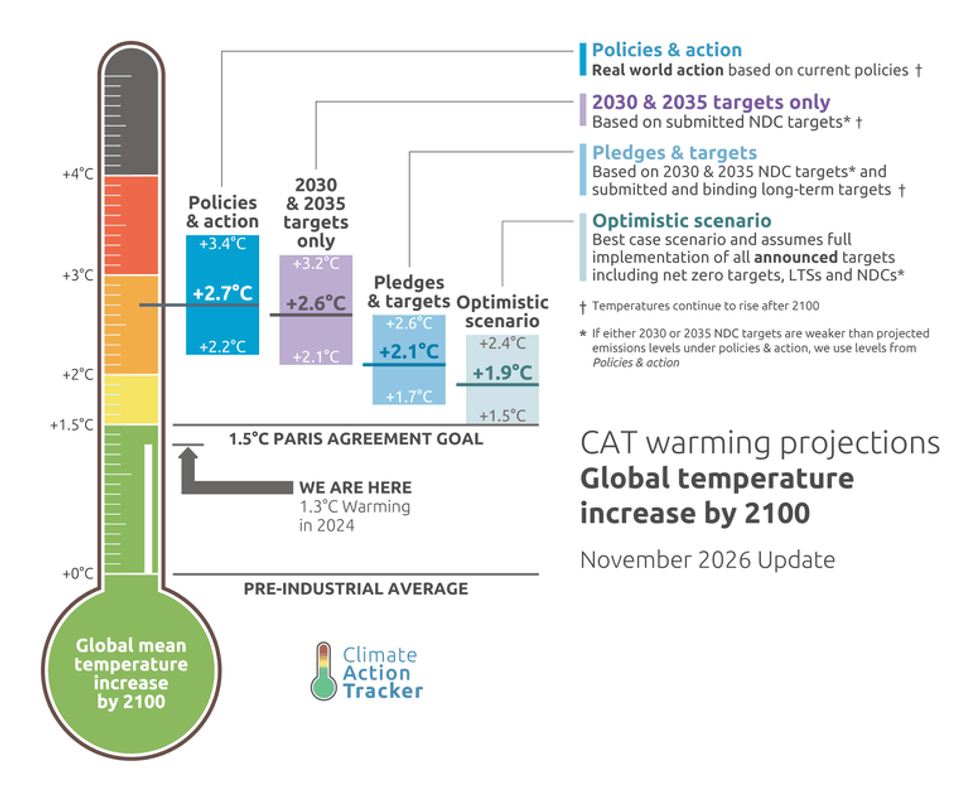
"Aggregated climate action has now essentially stalled for five consecutive years, with positive and negative actions canceling each other out," says the CAT briefing. "The warming outlook from current policies is leading to 2.7°C in 2100 (slightly up from 2.6°C) as it stood from 2021-2024."
"Our 2030 and 2035 targets scenario that assumes governments meet all their targets remains unchanged at 2.6°C in 2100," the report details. "The round of 2035 NDCs has closed: And it's clear governments have failed to meaningfully improve the outlook for end-of-century warming."
CAT's scenario that includes 2030 and 2035 NDCs as well as long-term targets projects "warming of 2.1°C in 2100, down from 2.2°C last year," the report continues. "Ambitious near- and long-term targets matter, but without credible policies and immediate implementation, they risk becoming empty promises rather than drivers of real-world emission reductions."
"Our optimistic scenario, assuming full implementation of all announced and net-zero targets, remains at 1.9°C in 2100," it stresses. "Even under our most optimistic assessment, if governments were to implement every single national pledge they have made—including the net-zero targets—we will still permanently overshoot the 1.5°C limit and get close to 2°C."
As both greenhouse gas concentrations and the profits of fossil fuel giants have soared while communities around the world face deadly heatwaves, rapidly intensifying hurricanes, rising sea levels, and destructive wildfires—like those that ravaged COP31 host Türkiye in September—scientists have reiterated warnings about the need for sweeping action to cut emissions.
"Continued warming from greenhouse gases emitted from human activities threatens to feed further warming as permafrost, wetlands, and wildfires destabilize and respond by releasing carbon dioxide, methane, and nitrous oxide," Ben Poulter, warming-induced emissions program director at Spark Climate Solutions, said in September, when a study he co-authored was published.
"This study provides a critical look at the magnitude of the temperature response," Poulter added, "and a call to action to accelerate the accounting and monitoring of warming-induced emissions to support pathways that phase out fossil emissions to stabilize the planet’s climate."
But the brutal truth is that the positive developments do not yet add up to bending the curve of emissions fast enough. Increasing energy demand and build-out of new fossil fuel infrastructure have led to still rising emissions.
[image or embed]
— Climate Action Tracker (@climateactiontracker.org) November 12, 2026 at 1:04 AM
Bill Hare, CEO of CAT partner organization Climate Analytics, emphasized Thursday that "the stark choice for governments is to either continue to support the fossil fuel industry, which would consign humanity to insurmountable economic damages, rising mortality from heat, and climate-driven diseases and disasters that they are unable to adapt to—or pivot to the solutions which are available and cheaper than ever."
"The imminence of breaching 1.5°C cannot be an excuse to open the door to defeatism—the focus has to be on accelerating action to limit the magnitude and duration of overshoot," he argued. "Every increment of warming above 1.5°C means even more significant consequences across climate, nature and human systems."
The report outlines "five key levers that could cut emissions at the speed and urgency needed to follow a Paris-aligned pathway, limiting the magnitude and duration of overshoot," which are:
"Governments collectively are simply not moving fast enough to adopt the policies that would enable us to escape from the emerging overshoot trap," said the lead author of CAT's report, Climate Analytics policy analyst Sarah Heck. "Worse, several are taking their foot off the accelerator and slowing their climate action—or in cases such as the USA, Canada, and New Zealand—rolling it back at a staggering level."
So far this week, Climate Action Network International has given its satirical "Fossil of the Day" award—long used to call out bad actors during climate summits—to New Zealand, for "dismantling its own climate commitments" under Prime Minister Christopher Luxon, as well as "absent leaders of wealthy countries," including Canada, Denmark, France, Germany, Ireland, Italy, Japan, the Netherlands, and Sweden.
The stark choice for governments is to either continue to support the fossil fuel industry – or pivot to the solutions which are available and cheaper than ever. The lack of decisive action means that long-term warming is expected to cross the 1.5°C limit around 2030.
[image or embed]
— Climate Action Tracker (@climateactiontracker.org) November 12, 2026 at 1:04 AM
While a key Democratic US senator is attending COP31, President Donald Trump is skipping the summit and has not sent a delegation, even though his country is the world's worst historical climate polluter. UNEP's report from last month highlights the dangers of the pro-fossil fuel agenda that the Republican leader has pursued since returning to power last year, including ditching the Paris Agreement, again.
Trump's ongoing illegal war on Iran has not only led to the deaths of thousands of people but also padded the pockets of those invested in the fossil fuel industry—including himself—while people around the world pay the price at the pump, due to Iran's restrictions on ship traffic through the Strait of Hormuz.
"With the closure of the Strait of Hormuz exposing our vulnerability to geopolitical shocks," said Niklas Höhne of CAT partner organization NewClimate Institute, "the case for renewables and electrification has never been stronger—and it does appear that global emissions could be on the verge of a peak and a much faster decline than we had previously thought."

“The patients in the department were all surgical patients waiting to undergo operations. The bombing happened at a time when they should have been asleep," said one doctor.
American-made bombs appeared to have been used in an Israeli strike on Nasser Hospital in Khan Younis, Gaza on Thursday, in which at least six people, including a surgeon and at least one child, were killed and at least 28 more were injured.
Trevor Ball, an analyst with Armament Research Services, told The New York Times that Associated Press footage of the aftermath of the bombing showed two 250-pound precision-guided aerial bombs that were manufactured in the US.
"Arms embargo now," said Dylan Williams, vice president of government affairs for the Center for International Policy, in response to the latest attack on the hospital, which has been struck numerous times since Israel began attacking Gaza more than three years ago in retaliation for a Hamas-led attack.
The US has passed legislation providing Israel with at least $16.3 billion in direct military aid since October 2023, on top of the $3.8 billion the Israel Defense Forces (IDF) receive from the US annually, according to the Council on Foreign Relations.
Both the Trump and the Biden administrations have also vehemently defended Israel's attacks on Gaza even as they have targeted hospitals, journalists, aid workers, and children—repeating Israel's claims that medical facilities are used as military outposts by Hamas and are therefore legitimate targets, and that Israel is targeting the Palestinian group it labels a terrorist organization and is taking steps to protect civilians.
In the case of Nasser Hospital this week, Dr. Ayman Abu Ubaid, a surgical specialist who was wounded in the attack that occurred around midnight, told The Guardian that the IDF provided no warning that could have allowed staff to remove patients and medical providers from harm's way.
“The patients in the department were all surgical patients waiting to undergo operations. The bombing happened at a time when they should have been asleep," Abu Ubaid told The Guardian.
The doctor added that "the bombing caused thick smoke to fill the rooms and fires to break out, amid the groans of [the] wounded and people’s screams. There were many casualties and blood everywhere... Most of us sustained injuries to our limbs, as well as shrapnel wounds in different parts of our bodies.”
Hadja Lahbib, the European commissioner for equality, preparedness, and crisis management, emphasized that "hospitals are protected under international humanitarian law and must never be targets.
"Civilians must be protected," said Lahbib. "I urge a prompt, independent, and impartial investigation to ensure accountability."
Israel said it had targeted and struck Hamas commanders and fighters who were operating out of the hospital, but did not provide evidence.
One confirmed death was that of Dr. Rizk Abu Shaaira, 52, who was featured in the documentary film "American Doctor," working alongside physicians from the US who traveled to Gaza to provide medical aid.
"My colleague and friend Dr. Rizk Abu Shaaira was killed yesterday at work when Israel, backed by the US as always, bombed the surgical recovery room at Nasser Medical Complex," said Dr. Feroze Sidhwa, a trauma surgeon from California who was also featured in the film.
"Dr. Rizk's shocking murder is yet another reminder of why we must get control of our country," said Sidhwa. "Our government has no right to force us to subsidize the mass murder of doctors and children, not in Palestine and not anywhere."
Dr. Thaer Ahmad, a Palestinian-American emergency doctor, also paid tribute to the surgeon, saying he had been seen in the documentary "operating and serving his people."
"He lost his life doing that, he lost his life because he was doing that," said Ahmad.
Abu Shaaira died alongside a patient he had operated on, The Guardian reported.
A 13-year-old boy named Jihad Naeem Muhammad Abu Tilikh was also among those killed, according to the hospital.
Several floors of the hospital were heavily damaged, and part of the surgery department was destroyed. The radiology, laboratory, surgical operations, and inpatient surgical departments were forced to suspend operations.
Nasser Hospital was also struck in August 2025 in a double-tap strike that killed at least 20 people, including journalists and healthcare workers.
United Nations experts have accused Israel of "medicide" due to its destruction of about 90% of Gaza's health infrastructure, which has left just two hospitals operational. More than 1,700 healthcare workers in Gaza have been killed since October 2023.
More than 74,000 Palestinians have been killed in Israeli attacks, including about 1,600 who have been killed since a ceasefire was reached in October 2025.
"How can this still be called a ceasefire?" said Philippe Lazzarini, former commissioner-general of the UN Relief and Works Agency for Palestine Refugees in the Near East. "A real one is needed and overdue."

"If all we do is kind of go back to what we've been doing in a moment where we've been given a mandate, I worry that we may not earn our mandate."
Sen.-elect Abdul El-Sayed said an interview published by NPR on Thursday that now is the time for Democrats in the US Senate to take bold action and deliver progressive change.
During the interview, the Michigan Democrat explained why he would like to see Sen. Chris Van Hollen (D-Md.) replace current Senate Minority Leader Chuck Schumer (D-NY) as head of the caucus when the party takes the majority in the upper congressional chamber next year.
"I deeply appreciate Senator Schumer," El-Sayed said. "But this is about leadership from the American public, and if all we do is kind of go back to what we've been doing in a moment where we've been given a mandate, I worry that we may not earn our mandate."
El-Sayed said he was particularly impressed by Van Hollen in 2025 when he took up the cause of Kilmar Abrego Garcia, a Maryland resident who was unlawfully deported to El Salvador by the Trump administration.
"He's willing to take risks when it matters—flying down to see Kilmar Abrego Garcia was a real risk," El-Sayed explained. "I want folks to sort of think about what it means to earn that mandate that we just got. To me, it means taking righteous risks and righteous fights."
Van Hollen has not formally stated that he will run against Schumer to be Senate Democrats' leader, but he said earlier this week that he has not ruled it out.
Two polls of progressive activists released in the last week show an overwhelming demand to find an alternative to Schumer as Senate Democratic leader.
Elswhere in the interview, El-Sayed outlined an agenda he'd like to see Senate Democrats pursue, including ending President Donald Trump's illegal war with Iran, passing Medicare for All, and abolishing US Immigration and Customs Enforcement (ICE).
El-Sayed said he'd even be willing to name the Medicare for All program after Trump if the president agreed to sign off on its passage.
"Put his name on it," El-Sayed said. "He'll probably pass it. I'm not above doing that. I don't care what it's called."
While it's unlikely that Trump would sign Medicare for All into law should it pass, El-Sayed said it would still be worth passing just to get the president on the record vetoing it.
"I dare Donald Trump to veto," he said. "I dare him, because if you want to make the argument that Democrats want to deliver for you, do that. Make him veto it."

"If every Democrat was talking like Chris Van Hollen," said one peace advocate, "we'd be just weeks away from ending this war."
As leading Democrats express hesitation about using an upcoming fight over government funding to cut off money for President Donald Trump's illegal Iran war, Sen. Chris Van Hollen and Rep. Ro Khanna are pushing their party to act boldly against a conflict that spurred massive backlash against the GOP at the ballot box last week.
The Washington Sun reported Wednesday that Van Hollen (D-Md.) and Khanna's (D-Calif.) call for Democrats to withhold their support for any government funding package unless it excludes money for the Iran war is "hitting resistance from senior members of the party." The outlet cited several top Democrats, including Rep. Adam Smith of Washington, Sen. Chris Coons of Delaware, Sen. Mark Warner of Virginia, and other lawmakers who have voiced skepticism about potentially sparking a government shutdown over war funding just weeks after the midterms.
But Van Hollen, who is considering a run for Senate majority leader in the upcoming Congress, has countered that any blame for a shutdown would fall on Trump and his Republican Party.
"If the president wants to tell the country that he’s prepared to shut down the United States government in order to conduct an illegal and senseless war in Iran, that will be his choice," said Van Hollen.
Matt Duss, executive vice president of the Center for International Policy and a former adviser to Sen. Bernie Sanders (I-Vt.), echoed Van Hollen, writing to Democrats: "You wouldn’t be shutting down the government. You’d be offering a bill that funds the government but prohibits any funds for the war."
"If Republicans oppose that," Duss added, "they would be choosing to continue the war and shut down the government."
Trump launched the war on Iran without congressional authorization in late February and has funded the conflict with existing Pentagon appropriations. The Pentagon has put the Iran war's price tag at $47 billion—an estimate that outside experts say is a dramatic undercount.
The White House has called on Congress to approve a supplemental funding package that includes tens of billions of dollars for the war, which Trump administration officials previously said would be over in a matter of weeks.
Van Hollen told The Washington Sun last week that he is "not planning to vote for anything that provides any funding to fuel the war in Iran."
“I think this is a really important moment for Democratic leadership,” said Van Hollen. “Are the Democrats, including the Democratic leadership, going to listen to the verdict of the American people and vote to end this war?”
Erik Sperling, executive director of the advocacy group Just Foreign Policy, said Wednesday that "if every Democrat was talking like Chris Van Hollen, we'd be just weeks away from ending this war."
"Instead, too many AIPAC-backed Dems are acting powerless to stop one of the most unpopular wars and lame-duck presidents in history," Sperling added.
Current government funding is set to expire on December 11.
Rep. Hakeem Jeffries (D-NY), who is vying to become House speaker in the upcoming Congress, would not commit to supporting efforts to cut off Iran war money in the upcoming government funding package and said the details are in the hands of Sen. Patty Murray (D-Wash.) and Rep. Rosa DeLauro (D-Conn.), the top Democratic appropriators.
DeLauro said in a statement to Politico last week that "Democrats will absolutely not fund Trump’s war of choice with Iran that has increased costs on American families and made us less safe." But The Washington Sun reported on Wednesday that neither DeLauro nor Murray "would commit to demanding Iran war restrictions as a condition of supporting a December funding extension, with Murray saying Democrats are examining their options."
Sen. Patty Murray, ranking member on the Senate Appropriations Committee, tells me Democrats will “explore every option” to end the Iran war, but wouldn’t commit to opposing Schumer should he refuse to block any government funding bill with dollars for it. Murray has the power to stop war funding in the CR.
— Julian Andreone (@JulianAndreone) November 10, 2026
In a social media post earlier this week, Khanna—a possible 2028 presidential candidate—argued that the midterm results were "a cry for help by Americans who are in pain." A tracker maintained by Brown University's Watson School of International and Public Affairs estimates that the Iran war has cost US consumers over $157 billion in extra gasoline and diesel costs.
"Democrats must stop the war in Iran to bring down the cost of gas, food, and diesel," Khanna wrote. "We can do this by insisting on no funding for Iran combat activities in the continuing resolution."
This election was a cry for help by Americans who are in pain.This November, Democrats must stop the war in Iran to bring down the cost of gas, food, and diesel. We can do this by insisting on no funding for Iran combat activities in the continuing resolution. https://t.co/o7IrzGJlcY
— Ro Khanna (@RoKhanna) November 9, 2026
Sen. Tim Kaine (D-Va.) has joined Van Hollen and Khanna in demanding specific provisions in any government funding bill to ensure that no more money goes toward continuing the Iran war.
“I think we should come up with a funding bill that does things like replenishes munitions... all the stuff that we need to do as a nation, but say, ‘The war is illegal, until you get [congressional] authorization,'" Kaine told Jewish Insider earlier this week. "I think we should put in a provision that says, ‘No funding for a war in Iran unless you get an authorization from Congress.'"