SUBSCRIBE TO OUR FREE NEWSLETTER
Daily news & progressive opinion—funded by the people, not the corporations—delivered straight to your inbox.
5
#000000
#FFFFFF
To donate by check, phone, or other method, see our More Ways to Give page.
Daily news & progressive opinion—funded by the people, not the corporations—delivered straight to your inbox.
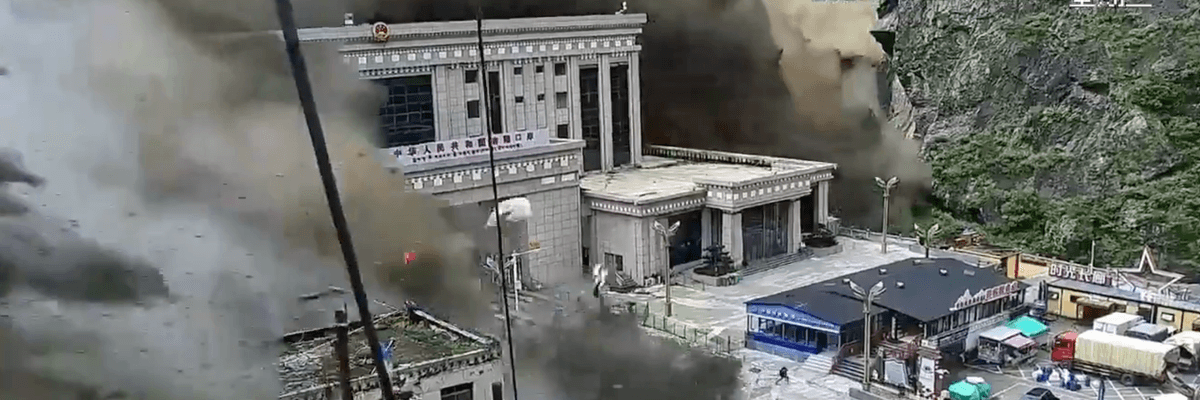
A flash flood and mudslide swept through Nepal's Rasuwa district along the border with Tibet on August 26, 2026.
"Delay is deadly," said one campaigner. "Without a rapid transition away from fossil fuels, the planet will continue to heat up and lives can be lost in a flash.”
Scientists and climate action campaigners on Thursday pointed to the collapse of a glacier as a likely cause of disastrous flash flooding in Tibet and Nepal's Rasuwa district, where emergency workers are searching for more than 1,300 missing people after water and mud poured into the Trishuli River valley, crashing through villages where thousands of people live and sweeping away bridges, homes, and miles of roads.
An initial assessment by geologists and glaciologists found that in satellite imagery taken before the flooding, a glacier was seen about 4,000 feet above the valley where at least 353 people were later killed Wednesday by the rushing waters and mudslide.
The glacier appeared about 2 million square feet smaller after the flooding, while the valley was "strewn with ice and mud" and the nearby river was "swollen beyond its banks, submerging the surrounding vegetation beneath murky brown floodwaters.
The scientists said an "ice avalanche"—a massive chunk of ice that fell off a glacier in the mountainous region and into the valley below, was likely at least partially to blame for the flash flooding, but noted that it was too early to rule out other or additional causes.
The satellite imagery appeared to show that "a glacier in the area basically snapped off in a clean break, allowing it to fall just over a vertical kilometer to the valley bottom,” Daniel Shugar, a geologist at the University of Calgary in Canada, told The New York Times. "The bottom looks like a bomb exploded—it’s just deposits from the broken-up glacier."
The chunk of ice was likely about 2,000 feet wide, Shugar told the Times, and fell nearly 4,000 feet—a fall that would have "pulverized" the ice into water.
Aakriti Dotel, national network coordinator for the climate action group Nepalese Youth for Climate Action said the floods were "another painful reminder of the growing climate crisis facing Nepal and the Himalayas."
"As our glaciers melt and extreme weather events become increasingly unpredictable, communities living downstream are bearing the devastating consequences," said Dotel. "We mourn the lives lost and the livelihoods affected and call for urgent global climate action. There must be stronger support for vulnerable mountain communities, and accountability from those most responsible for the climate crisis.”
The disaster stunned officials in the area, where there had been no rainfall before the floodwaters and mudslide overtook the region.
Intense videos circulating on social media Wednesday showed people attempting to run away as water and mud crashed into villages in the region.
🇳🇵🌊 Nepal flash flood kills at least 95, hundreds missing
➤ A massive flash flood swept away villages in Nepal’s mountainous Rasuwa district near the Tibet border Wednesday, killing at least 95 people and leaving hundreds missing, including 384 tourists and eight South Korean…
— Drop Site (@DropSiteNews) August 26, 2026
Tom Fletcher, the United Nations humanitarian chief, said he had mobilized $2 million from the UN Global Emergency Fund "to save lives with emergency medical care, shelter, water."
The secretary-general of the Nepal Red Cross told CNN that about 20,000 houses have been "swept away" in the region.
"These people do not have anything," said Rishi Khanal. "To feed them for some time, some days is a very serious thing to us... The shelter problem is there. The drinking water problem is there."
A truly desperate assessment out of Nepal from the Secretary General of @NepalRedCross: pic.twitter.com/QrJ4vZhmSz
— Becky Anderson (@BeckyCNN) August 26, 2026
A police officer in the village of Syabrubesi told the Times that waves of water crashed into his police station Wednesday morning, right after he got off the phone with a friend who had warned him a flood was headed toward the town.
“One of my senior officers and I were together when the wave struck. I was thrown out, but he was unlucky and was buried or swept away,” he told the newspaper. “I cannot explain how big the waves were. They engulfed several-meters-high buildings in a fraction of seconds... It wasn’t just water. It was a combination of boulders, sand, and thick sludge.”
Seven people were working at the station when the flood hit, and the officer is one of three who have been found alive. He said he was concerned that the other four are among the missing.
Homes, schools, government buildings, and the office of a hydropower project are among the infrastructure destroyed in Syabrubesi.
More than 160 glaciers in Nepal have entirely melted in recent decades, as scientists have warned that continued fossil fuel extraction is heating the planet and causing dangerous extreme weather. The area of the country's glaciers also shrank by about one-quarter between 1970-2010.
At The Conversation, Levan Tielidze, a research fellow in glacial geomorphology at Monash University, wrote that "it’s too early to say this was the exact cause. But we know that the great ice stores of the Himalayas—known as the world’s 'third pole' because it contains the largest amount of snow and ice after the Arctic and Antarctic—are no longer safe."
Tielidze continued:
What happened in Nepal is likely due to an enormous ice-and-rock landslide sweeping down a mountain pass and gathering up ice, water, rock, trees and dirt.
The landslide was so large it was originally thought to be an earthquake, as the seismic energy registered as a 4.4 magnitude quake on seismographs.
By the time it reached Gyirong Port—a China-Nepal border crossing—the wall of debris resembled a tsunami of dirt. Early estimates suggest the wave may have been 30 meters high.
Rising global temperatures have been linked to previous collapses of glaciers, including in Switzerland last year when the Birch Glacier wiped out nearly an entire town of 300 residents, who had evacuated before the disaster. Eleven mountain climbers were also killed by a glacier collapse in Italy in 2022.
“Every destabilized glacier in a warming Himalaya is a ticking time bomb that can go off unannounced, and when it does, those least responsible for the climate crisis pay with their lives," said Savio Carvalho, head of campaigns and networks for 350.org. "This moment of grief has a clear message for world leaders: Delay is deadly. Rich countries must finally deliver the finance and protection they owe frontline communities. Without a rapid transition away from fossil fuels, the planet will continue to heat up and lives can be lost in a flash.”
Dear Common Dreams reader, It’s been nearly 30 years since I co-founded Common Dreams with my late wife, Lina Newhouser. We had the radical notion that journalism should serve the public good, not corporate profits. It was clear to us from the outset what it would take to build such a project. No paid advertisements. No corporate sponsors. No millionaire publisher telling us what to think or do. Many people said we wouldn't last a year, but we proved those doubters wrong. Together with a tremendous team of journalists and dedicated staff, we built an independent media outlet free from the constraints of profits and corporate control. Our mission has always been simple: To inform. To inspire. To ignite change for the common good. Building Common Dreams was not easy. Our survival was never guaranteed. When you take on the most powerful forces—Wall Street greed, fossil fuel industry destruction, Big Tech lobbyists, and uber-rich oligarchs who have spent billions upon billions rigging the economy and democracy in their favor—the only bulwark you have is supporters who believe in your work. But here’s the urgent message from me today. It's never been this bad out there. And it's never been this hard to keep us going. At the very moment Common Dreams is most needed, the threats we face are intensifying. We need your support now more than ever. We don't accept corporate advertising and never will. We don't have a paywall because we don't think people should be blocked from critical news based on their ability to pay. Everything we do is funded by the donations of readers like you. When everyone does the little they can afford, we are strong. But if that support retreats or dries up, so do we. Will you donate now to make sure Common Dreams not only survives but thrives? —Craig Brown, Co-founder |
Scientists and climate action campaigners on Thursday pointed to the collapse of a glacier as a likely cause of disastrous flash flooding in Tibet and Nepal's Rasuwa district, where emergency workers are searching for more than 1,300 missing people after water and mud poured into the Trishuli River valley, crashing through villages where thousands of people live and sweeping away bridges, homes, and miles of roads.
An initial assessment by geologists and glaciologists found that in satellite imagery taken before the flooding, a glacier was seen about 4,000 feet above the valley where at least 353 people were later killed Wednesday by the rushing waters and mudslide.
The glacier appeared about 2 million square feet smaller after the flooding, while the valley was "strewn with ice and mud" and the nearby river was "swollen beyond its banks, submerging the surrounding vegetation beneath murky brown floodwaters.
The scientists said an "ice avalanche"—a massive chunk of ice that fell off a glacier in the mountainous region and into the valley below, was likely at least partially to blame for the flash flooding, but noted that it was too early to rule out other or additional causes.
The satellite imagery appeared to show that "a glacier in the area basically snapped off in a clean break, allowing it to fall just over a vertical kilometer to the valley bottom,” Daniel Shugar, a geologist at the University of Calgary in Canada, told The New York Times. "The bottom looks like a bomb exploded—it’s just deposits from the broken-up glacier."
The chunk of ice was likely about 2,000 feet wide, Shugar told the Times, and fell nearly 4,000 feet—a fall that would have "pulverized" the ice into water.
Aakriti Dotel, national network coordinator for the climate action group Nepalese Youth for Climate Action said the floods were "another painful reminder of the growing climate crisis facing Nepal and the Himalayas."
"As our glaciers melt and extreme weather events become increasingly unpredictable, communities living downstream are bearing the devastating consequences," said Dotel. "We mourn the lives lost and the livelihoods affected and call for urgent global climate action. There must be stronger support for vulnerable mountain communities, and accountability from those most responsible for the climate crisis.”
The disaster stunned officials in the area, where there had been no rainfall before the floodwaters and mudslide overtook the region.
Intense videos circulating on social media Wednesday showed people attempting to run away as water and mud crashed into villages in the region.
🇳🇵🌊 Nepal flash flood kills at least 95, hundreds missing
➤ A massive flash flood swept away villages in Nepal’s mountainous Rasuwa district near the Tibet border Wednesday, killing at least 95 people and leaving hundreds missing, including 384 tourists and eight South Korean…
— Drop Site (@DropSiteNews) August 26, 2026
Tom Fletcher, the United Nations humanitarian chief, said he had mobilized $2 million from the UN Global Emergency Fund "to save lives with emergency medical care, shelter, water."
The secretary-general of the Nepal Red Cross told CNN that about 20,000 houses have been "swept away" in the region.
"These people do not have anything," said Rishi Khanal. "To feed them for some time, some days is a very serious thing to us... The shelter problem is there. The drinking water problem is there."
A truly desperate assessment out of Nepal from the Secretary General of @NepalRedCross: pic.twitter.com/QrJ4vZhmSz
— Becky Anderson (@BeckyCNN) August 26, 2026
A police officer in the village of Syabrubesi told the Times that waves of water crashed into his police station Wednesday morning, right after he got off the phone with a friend who had warned him a flood was headed toward the town.
“One of my senior officers and I were together when the wave struck. I was thrown out, but he was unlucky and was buried or swept away,” he told the newspaper. “I cannot explain how big the waves were. They engulfed several-meters-high buildings in a fraction of seconds... It wasn’t just water. It was a combination of boulders, sand, and thick sludge.”
Seven people were working at the station when the flood hit, and the officer is one of three who have been found alive. He said he was concerned that the other four are among the missing.
Homes, schools, government buildings, and the office of a hydropower project are among the infrastructure destroyed in Syabrubesi.
More than 160 glaciers in Nepal have entirely melted in recent decades, as scientists have warned that continued fossil fuel extraction is heating the planet and causing dangerous extreme weather. The area of the country's glaciers also shrank by about one-quarter between 1970-2010.
At The Conversation, Levan Tielidze, a research fellow in glacial geomorphology at Monash University, wrote that "it’s too early to say this was the exact cause. But we know that the great ice stores of the Himalayas—known as the world’s 'third pole' because it contains the largest amount of snow and ice after the Arctic and Antarctic—are no longer safe."
Tielidze continued:
What happened in Nepal is likely due to an enormous ice-and-rock landslide sweeping down a mountain pass and gathering up ice, water, rock, trees and dirt.
The landslide was so large it was originally thought to be an earthquake, as the seismic energy registered as a 4.4 magnitude quake on seismographs.
By the time it reached Gyirong Port—a China-Nepal border crossing—the wall of debris resembled a tsunami of dirt. Early estimates suggest the wave may have been 30 meters high.
Rising global temperatures have been linked to previous collapses of glaciers, including in Switzerland last year when the Birch Glacier wiped out nearly an entire town of 300 residents, who had evacuated before the disaster. Eleven mountain climbers were also killed by a glacier collapse in Italy in 2022.
“Every destabilized glacier in a warming Himalaya is a ticking time bomb that can go off unannounced, and when it does, those least responsible for the climate crisis pay with their lives," said Savio Carvalho, head of campaigns and networks for 350.org. "This moment of grief has a clear message for world leaders: Delay is deadly. Rich countries must finally deliver the finance and protection they owe frontline communities. Without a rapid transition away from fossil fuels, the planet will continue to heat up and lives can be lost in a flash.”
Scientists and climate action campaigners on Thursday pointed to the collapse of a glacier as a likely cause of disastrous flash flooding in Tibet and Nepal's Rasuwa district, where emergency workers are searching for more than 1,300 missing people after water and mud poured into the Trishuli River valley, crashing through villages where thousands of people live and sweeping away bridges, homes, and miles of roads.
An initial assessment by geologists and glaciologists found that in satellite imagery taken before the flooding, a glacier was seen about 4,000 feet above the valley where at least 353 people were later killed Wednesday by the rushing waters and mudslide.
The glacier appeared about 2 million square feet smaller after the flooding, while the valley was "strewn with ice and mud" and the nearby river was "swollen beyond its banks, submerging the surrounding vegetation beneath murky brown floodwaters.
The scientists said an "ice avalanche"—a massive chunk of ice that fell off a glacier in the mountainous region and into the valley below, was likely at least partially to blame for the flash flooding, but noted that it was too early to rule out other or additional causes.
The satellite imagery appeared to show that "a glacier in the area basically snapped off in a clean break, allowing it to fall just over a vertical kilometer to the valley bottom,” Daniel Shugar, a geologist at the University of Calgary in Canada, told The New York Times. "The bottom looks like a bomb exploded—it’s just deposits from the broken-up glacier."
The chunk of ice was likely about 2,000 feet wide, Shugar told the Times, and fell nearly 4,000 feet—a fall that would have "pulverized" the ice into water.
Aakriti Dotel, national network coordinator for the climate action group Nepalese Youth for Climate Action said the floods were "another painful reminder of the growing climate crisis facing Nepal and the Himalayas."
"As our glaciers melt and extreme weather events become increasingly unpredictable, communities living downstream are bearing the devastating consequences," said Dotel. "We mourn the lives lost and the livelihoods affected and call for urgent global climate action. There must be stronger support for vulnerable mountain communities, and accountability from those most responsible for the climate crisis.”
The disaster stunned officials in the area, where there had been no rainfall before the floodwaters and mudslide overtook the region.
Intense videos circulating on social media Wednesday showed people attempting to run away as water and mud crashed into villages in the region.
🇳🇵🌊 Nepal flash flood kills at least 95, hundreds missing
➤ A massive flash flood swept away villages in Nepal’s mountainous Rasuwa district near the Tibet border Wednesday, killing at least 95 people and leaving hundreds missing, including 384 tourists and eight South Korean…
— Drop Site (@DropSiteNews) August 26, 2026
Tom Fletcher, the United Nations humanitarian chief, said he had mobilized $2 million from the UN Global Emergency Fund "to save lives with emergency medical care, shelter, water."
The secretary-general of the Nepal Red Cross told CNN that about 20,000 houses have been "swept away" in the region.
"These people do not have anything," said Rishi Khanal. "To feed them for some time, some days is a very serious thing to us... The shelter problem is there. The drinking water problem is there."
A truly desperate assessment out of Nepal from the Secretary General of @NepalRedCross: pic.twitter.com/QrJ4vZhmSz
— Becky Anderson (@BeckyCNN) August 26, 2026
A police officer in the village of Syabrubesi told the Times that waves of water crashed into his police station Wednesday morning, right after he got off the phone with a friend who had warned him a flood was headed toward the town.
“One of my senior officers and I were together when the wave struck. I was thrown out, but he was unlucky and was buried or swept away,” he told the newspaper. “I cannot explain how big the waves were. They engulfed several-meters-high buildings in a fraction of seconds... It wasn’t just water. It was a combination of boulders, sand, and thick sludge.”
Seven people were working at the station when the flood hit, and the officer is one of three who have been found alive. He said he was concerned that the other four are among the missing.
Homes, schools, government buildings, and the office of a hydropower project are among the infrastructure destroyed in Syabrubesi.
More than 160 glaciers in Nepal have entirely melted in recent decades, as scientists have warned that continued fossil fuel extraction is heating the planet and causing dangerous extreme weather. The area of the country's glaciers also shrank by about one-quarter between 1970-2010.
At The Conversation, Levan Tielidze, a research fellow in glacial geomorphology at Monash University, wrote that "it’s too early to say this was the exact cause. But we know that the great ice stores of the Himalayas—known as the world’s 'third pole' because it contains the largest amount of snow and ice after the Arctic and Antarctic—are no longer safe."
Tielidze continued:
What happened in Nepal is likely due to an enormous ice-and-rock landslide sweeping down a mountain pass and gathering up ice, water, rock, trees and dirt.
The landslide was so large it was originally thought to be an earthquake, as the seismic energy registered as a 4.4 magnitude quake on seismographs.
By the time it reached Gyirong Port—a China-Nepal border crossing—the wall of debris resembled a tsunami of dirt. Early estimates suggest the wave may have been 30 meters high.
Rising global temperatures have been linked to previous collapses of glaciers, including in Switzerland last year when the Birch Glacier wiped out nearly an entire town of 300 residents, who had evacuated before the disaster. Eleven mountain climbers were also killed by a glacier collapse in Italy in 2022.
“Every destabilized glacier in a warming Himalaya is a ticking time bomb that can go off unannounced, and when it does, those least responsible for the climate crisis pay with their lives," said Savio Carvalho, head of campaigns and networks for 350.org. "This moment of grief has a clear message for world leaders: Delay is deadly. Rich countries must finally deliver the finance and protection they owe frontline communities. Without a rapid transition away from fossil fuels, the planet will continue to heat up and lives can be lost in a flash.”