SUBSCRIBE TO OUR FREE NEWSLETTER
Daily news & progressive opinion—funded by the people, not the corporations—delivered straight to your inbox.
5
#000000
#FFFFFF
To donate by check, phone, or other method, see our More Ways to Give page.
Daily news & progressive opinion—funded by the people, not the corporations—delivered straight to your inbox.
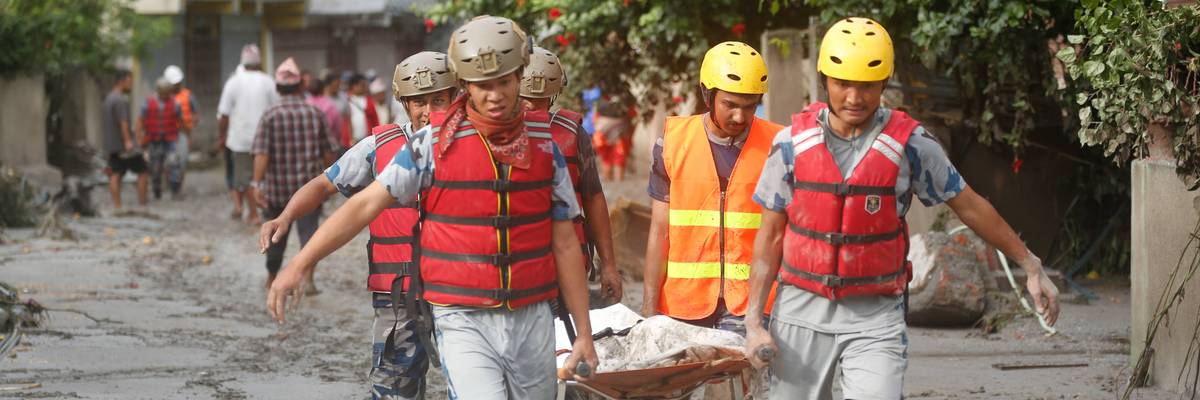
A damaged section of a highway in Nuwakot, central Nepal, is seen on August 27, 2026, following an outburst of a glacial lake in Tibet. Rescue teams collect the bodies of people killed in the flooding, while residents displaced by the disaster shelter in elevated areas.
Deadlier flood disasters "are the foreseeable consequences of a fossil-fueled economy in which those who pollute most are also the best protected from its consequences," said one campaigner.
An analysis released Thursday by anti-poverty group Oxfam juxtaposed the soaring number of flood-related deaths worldwide with the ultrawealthy's ability to insulate themselves from the climate disasters that are growing more common and devastating as oil and gas emissions continue.
The group found that as monthly temperature records were shattered in more than 100 countries this year, flood deaths reached a 13-year high—driven largely by catastrophic flooding in Nepal and Tibet in August, when a glacier collapse sent a "wall of water more than 100 meters high, traveling at 180 kilometers per hour," which swept through a valley and killed more than 1,500 people, with 5,600 still missing.
The flooding disaster, which the chief of the United Nations Office for Project Services said last month should be a "defining moment" for an international community grappling with how to mitigate the impacts of the climate emergency, accounted for about three-quarters of the 8,000 people who died in floods this year.
"Deaths from flooding are seven times higher in more unequal countries," noted Oxfam, while people in the Global South are far less likely to have contributed meaningfully to the carbon pollution that scientists say is heating the planet, putting the 1.5°C limit set by the Paris Agreement in 2015 out of reach, and causing the loss of glaciers and more extreme weather disasters.
"The carbon pollution of a person in the richest 1% has contributed 34 times more to today's extreme heatwaves than the average person, and 100 times more than someone in the poorest 50%," said Oxfam.
In September, the UN found that with countries contributing far too little to efforts to reduce carbon emissions, the planet is now expected to overshoot the 1.5°C threshold, and said policymakers must now focus on ensuring the overshoot is temporary.
But on Thursday, as world leaders gathered in Antalya, Türkiye for the United Nations Climate Change Conference (COP31), a report warned that the Earth could in fact be heading for an "irrevocable" breach of the 1.5°C limit.
"The carbon pollution of a person in the richest 1% has contributed 34 time more to today's extreme heatwaves than the average person, and 100 times more than someone in the poorest 50%."
The record number of flooding deaths this year, said Amitabh Behar, executive director of Oxfam International, "are not accidents of weather. They are the foreseeable consequences of a fossil-fueled economy in which those who pollute most are also the best protected from its consequences."
Oxfam also emphasized that while flooding deaths are soaring, one trend at COP31 demonstrated how the ultrarich are making devastating disasters in communities around the world more likely.
The group analyzed data from Polluterjet, finding that 87 private jets landed at Antalya Airport since November 7, just before COP31 began, emitting an estimated 777 tons of carbon dioxide.
"Nigerian billionaire Aliko Dangote’s private jet flew approximately 4,370 kilometers from Lagos to Antalya, emitting an estimated 30 tons of carbon, roughly as much as the average person emits in six years," said Oxfam. "During COP30 last year, 66 private jet journeys were recorded."
According to the Global Solidarity Levies Task Force, taxing private jets owned by about 250,000 people around the world could raise $45 billion per year, "nearly 12 times the amount rich countries gave to UN climate funds in 2025."
“While families mourn loved ones killed by floods and endure blistering heat, the ultrawealthy carry on flying in private jets, high above the devastating consequences,” said Behar. “Governments must stop treating the extraordinarily polluting luxuries of the superrich as an untouchable privilege. Taxing private jets is an obvious first step.”
This country and this world are at a monumental crossroads. US voters have an opportunity to beat back the forces of fascism and confront the billionaires who are rigging the economy, our media system, and our democracy, making it increasingly impossible for ordinary people to get by. We’re not just talking about the election. We’re talking about what must be done once these fascist elements are vanquished from power. We need a bolder set of solutions than what either major party has so far been willing to offer and a working-class movement ready to fight like hell for it. Trump didn't emerge from nowhere. The conditions that fueled MAGA authoritarianism were created by decades of radical neoliberal economic policies and a corrupt political system dominated by corporate interests. They slashed taxes on the super-rich, promising that the benefits would trickle down. They said giveaways to the corporate titans would make life more affordable for the rest of us. It was all bullshit. And when a bitter, betrayed populace searches for someone to blame, right-wing demagogues have little trouble finding scapegoats. People know when they're being lied to, but you won't hear any of this from the corporate media. Only independent journalism—powered and funded by people who believe in building a better world—can deliver truly trustworthy daily news. If you share our vision, please contribute whatever you can to sustain our work. |
An analysis released Thursday by anti-poverty group Oxfam juxtaposed the soaring number of flood-related deaths worldwide with the ultrawealthy's ability to insulate themselves from the climate disasters that are growing more common and devastating as oil and gas emissions continue.
The group found that as monthly temperature records were shattered in more than 100 countries this year, flood deaths reached a 13-year high—driven largely by catastrophic flooding in Nepal and Tibet in August, when a glacier collapse sent a "wall of water more than 100 meters high, traveling at 180 kilometers per hour," which swept through a valley and killed more than 1,500 people, with 5,600 still missing.
The flooding disaster, which the chief of the United Nations Office for Project Services said last month should be a "defining moment" for an international community grappling with how to mitigate the impacts of the climate emergency, accounted for about three-quarters of the 8,000 people who died in floods this year.
"Deaths from flooding are seven times higher in more unequal countries," noted Oxfam, while people in the Global South are far less likely to have contributed meaningfully to the carbon pollution that scientists say is heating the planet, putting the 1.5°C limit set by the Paris Agreement in 2015 out of reach, and causing the loss of glaciers and more extreme weather disasters.
"The carbon pollution of a person in the richest 1% has contributed 34 times more to today's extreme heatwaves than the average person, and 100 times more than someone in the poorest 50%," said Oxfam.
In September, the UN found that with countries contributing far too little to efforts to reduce carbon emissions, the planet is now expected to overshoot the 1.5°C threshold, and said policymakers must now focus on ensuring the overshoot is temporary.
But on Thursday, as world leaders gathered in Antalya, Türkiye for the United Nations Climate Change Conference (COP31), a report warned that the Earth could in fact be heading for an "irrevocable" breach of the 1.5°C limit.
"The carbon pollution of a person in the richest 1% has contributed 34 time more to today's extreme heatwaves than the average person, and 100 times more than someone in the poorest 50%."
The record number of flooding deaths this year, said Amitabh Behar, executive director of Oxfam International, "are not accidents of weather. They are the foreseeable consequences of a fossil-fueled economy in which those who pollute most are also the best protected from its consequences."
Oxfam also emphasized that while flooding deaths are soaring, one trend at COP31 demonstrated how the ultrarich are making devastating disasters in communities around the world more likely.
The group analyzed data from Polluterjet, finding that 87 private jets landed at Antalya Airport since November 7, just before COP31 began, emitting an estimated 777 tons of carbon dioxide.
"Nigerian billionaire Aliko Dangote’s private jet flew approximately 4,370 kilometers from Lagos to Antalya, emitting an estimated 30 tons of carbon, roughly as much as the average person emits in six years," said Oxfam. "During COP30 last year, 66 private jet journeys were recorded."
According to the Global Solidarity Levies Task Force, taxing private jets owned by about 250,000 people around the world could raise $45 billion per year, "nearly 12 times the amount rich countries gave to UN climate funds in 2025."
“While families mourn loved ones killed by floods and endure blistering heat, the ultrawealthy carry on flying in private jets, high above the devastating consequences,” said Behar. “Governments must stop treating the extraordinarily polluting luxuries of the superrich as an untouchable privilege. Taxing private jets is an obvious first step.”