SUBSCRIBE TO OUR FREE NEWSLETTER
Daily news & progressive opinion—funded by the people, not the corporations—delivered straight to your inbox.
5
#000000
#FFFFFF
To donate by check, phone, or other method, see our More Ways to Give page.
Daily news & progressive opinion—funded by the people, not the corporations—delivered straight to your inbox.
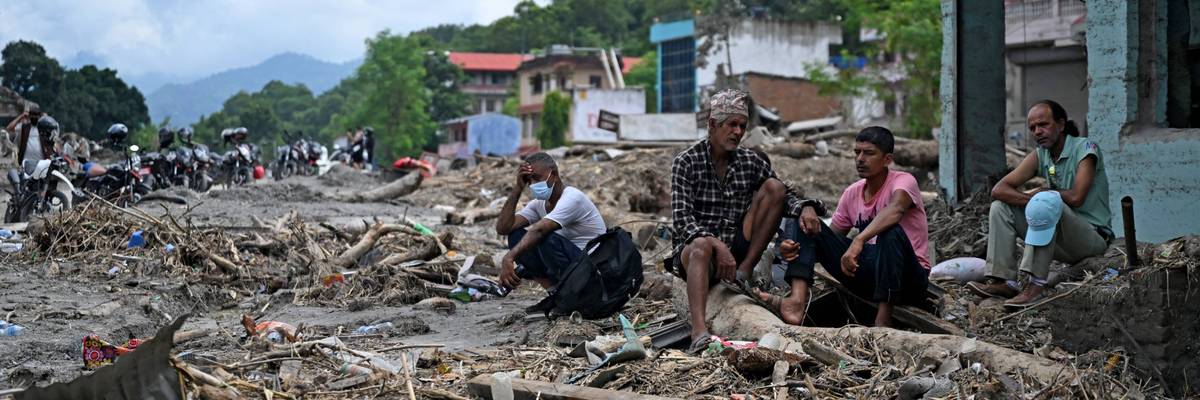
Residents sit beside debris following flash floods in Devighat, in Nepal’s Nuwakot district, on August 31, 2026.
"Leaders must get serious by cutting emissions faster," said UN Secretary-General António Guterres in a report released as COP31 kicked off in Türkiye.
The Earth is hurtling deeper into a climate emergency, with 2026 on track to be one of the four hottest years ever recorded, ocean temperatures and sea levels hitting record highs, and glacier melt accelerating at an alarming pace, according to a report released Monday by the World Meteorological Organization as the United Nations Climate Change Conference kicked off in Türkiye.
The WMO's "State of the Climate" report "shows that the past 12 years have individually been the warmest on record, with the past four years being the top four," according to a summary of the 25-page publication.
WMO further noted that "the global average surface temperature for January–September 2026 was about 1.47°C above the preindustrial average," or right on the brink of the 1.5°C of warming beyond which scientists say the risks of catastrophic and potentially irreversible climate impacts increase substantially.
2026 is on track to be one of 4 warmest years on record, marked by exceptional global temperatures, melting ice, rising sea levels, and a very strong El Niño that will unleash more heat & extreme weather into 2027.New WMO #StateOfClimate #COP31 Update↪️ https://bit.ly/stateofclimateCOP31pr
[image or embed]
— World Meteorological Organization (@wmo-global.bsky.social) November 9, 2026 at 12:33 AM
UN scientists said last month that the Paris Agreement's goal of limiting warming to 1.5°C this century is no longer achievable without an overshoot.
The 1.47°C figure "is likely to rise through the end of the year because of the warming effect of El Niño, which has been intensifying since August and is expected to be the strongest on record by December," the report's summary states. El Niño is the warm phase of a pattern in the Pacific Ocean whose impact on disrupts weather, ecosystems, and economies.
According to WMO:
Earth’s energy imbalance is rising... The imbalance reached its highest level since monitoring began, as greenhouse gases trap unprecedented amounts of heat and upset the equilibrium between incoming energy from the sun and outgoing energy. The ocean absorbs 90% of this excess heat, and 2026 is on track to be the 10th successive year of record ocean warmth.
Sea level is the highest on record, and sea-surface temperatures hit monthly records during 2026. The long-term retreat of glaciers continues—the annual mass loss of ice in 2025 would have filled five Olympic pools every second of the year. Freshwater storage has been dwindling since 2014.
“Extreme weather has made headlines throughout 2026. Behind the headlines and the statistics in this report are people who suffered the loss of loved ones, threats to their health and safety, flooded homes, failed harvests, empty shelves, lack of water, and choking air," WMO Secretary General Celeste Saulo said in the report.
"The past four years have been the warmest in the 177-year observational record, and the heat in the oceans is breaking records for the 10th year in a row," she continued. "The ongoing El Niño is forecast to be one of the strongest on record, and the heat it releases from the ocean will continue to fuel high temperatures and extreme weather into 2027."
“El Niño and indeed the state of the global climate in 2026 gives new meaning to the phrase off the charts," Saulo added. "El Niño doesn't add new heat to the planet. It releases heat from the ocean, which is the warmest ever measured. There is simply more heat available to release."
Indeed, climate scientists are warning that the planet is closer than previously thought to tipping points leading to hellish feedback loops and a "hothouse Earth."
United Nations Secretary-General António Guterres responded to the WMO report in a statement, saying: "We have entered a new age of climate extremes. A supersized El Niño is colliding with a planet already superheated by manmade climate change. Climate records keep falling. The human costs keep rising. And those least responsible are suffering first and worst."
"Leaders must get serious by cutting emissions faster, accelerating a just transition from fossil fuels, and delivering the finance and protection vulnerable countries need," he added.
The "State of the Climate" report was released on the first day of the UN summit, or COP31, in Antalya, Türkiye. Advocacy groups warned that world leaders must commit to phase out fossil fuels, finance a just transition to a post-carbon economy, and protect vulnerable populations from worsening climate harms.
“No country can confront this crisis alone. Those who have contributed least to global warming are often suffering the greatest harms. COP31 must deliver collective action that reflects this profound injustice,” Marta Schaaf, Amnesty International's program director for climate, environmental and social justice, and corporate accountability, said Monday.
“The world is not running out of climate warnings. It is running out of excuses," she continued. "After more than 30 years of climate negotiations, governments can no longer hide behind promises of future action or avoid confronting their fossil fuel industry allies."
"The climate crisis is not a failure of knowledge, but a failure of political courage," Schaaf added. "It is time to break the stranglehold of corporate power over political decision-making and end the fossil fuel era before it ends us."
Oil Change International global policy senior strategist Shady Khalil asserted that “we know what needs to happen. Governments must stop fossil fuel expansion, plan a fair phaseout of existing production, and invest public money in renewable energy and economic diversification."
"Wealthy countries must move first and fastest and provide the finance needed to make this transition possible everywhere," he added.
This country and this world are at a monumental crossroads. US voters have an opportunity to beat back the forces of fascism and confront the billionaires who are rigging the economy, our media system, and our democracy, making it increasingly impossible for ordinary people to get by. We’re not just talking about the election. We’re talking about what must be done once these fascist elements are vanquished from power. We need a bolder set of solutions than what either major party has so far been willing to offer and a working-class movement ready to fight like hell for it. Trump didn't emerge from nowhere. The conditions that fueled MAGA authoritarianism were created by decades of radical neoliberal economic policies and a corrupt political system dominated by corporate interests. They slashed taxes on the super-rich, promising that the benefits would trickle down. They said giveaways to the corporate titans would make life more affordable for the rest of us. It was all bullshit. And when a bitter, betrayed populace searches for someone to blame, right-wing demagogues have little trouble finding scapegoats. People know when they're being lied to, but you won't hear any of this from the corporate media. Only independent journalism—powered and funded by people who believe in building a better world—can deliver truly trustworthy daily news. If you share our vision, please contribute whatever you can to sustain our work. |
The Earth is hurtling deeper into a climate emergency, with 2026 on track to be one of the four hottest years ever recorded, ocean temperatures and sea levels hitting record highs, and glacier melt accelerating at an alarming pace, according to a report released Monday by the World Meteorological Organization as the United Nations Climate Change Conference kicked off in Türkiye.
The WMO's "State of the Climate" report "shows that the past 12 years have individually been the warmest on record, with the past four years being the top four," according to a summary of the 25-page publication.
WMO further noted that "the global average surface temperature for January–September 2026 was about 1.47°C above the preindustrial average," or right on the brink of the 1.5°C of warming beyond which scientists say the risks of catastrophic and potentially irreversible climate impacts increase substantially.
2026 is on track to be one of 4 warmest years on record, marked by exceptional global temperatures, melting ice, rising sea levels, and a very strong El Niño that will unleash more heat & extreme weather into 2027.New WMO #StateOfClimate #COP31 Update↪️ https://bit.ly/stateofclimateCOP31pr
[image or embed]
— World Meteorological Organization (@wmo-global.bsky.social) November 9, 2026 at 12:33 AM
UN scientists said last month that the Paris Agreement's goal of limiting warming to 1.5°C this century is no longer achievable without an overshoot.
The 1.47°C figure "is likely to rise through the end of the year because of the warming effect of El Niño, which has been intensifying since August and is expected to be the strongest on record by December," the report's summary states. El Niño is the warm phase of a pattern in the Pacific Ocean whose impact on disrupts weather, ecosystems, and economies.
According to WMO:
Earth’s energy imbalance is rising... The imbalance reached its highest level since monitoring began, as greenhouse gases trap unprecedented amounts of heat and upset the equilibrium between incoming energy from the sun and outgoing energy. The ocean absorbs 90% of this excess heat, and 2026 is on track to be the 10th successive year of record ocean warmth.
Sea level is the highest on record, and sea-surface temperatures hit monthly records during 2026. The long-term retreat of glaciers continues—the annual mass loss of ice in 2025 would have filled five Olympic pools every second of the year. Freshwater storage has been dwindling since 2014.
“Extreme weather has made headlines throughout 2026. Behind the headlines and the statistics in this report are people who suffered the loss of loved ones, threats to their health and safety, flooded homes, failed harvests, empty shelves, lack of water, and choking air," WMO Secretary General Celeste Saulo said in the report.
"The past four years have been the warmest in the 177-year observational record, and the heat in the oceans is breaking records for the 10th year in a row," she continued. "The ongoing El Niño is forecast to be one of the strongest on record, and the heat it releases from the ocean will continue to fuel high temperatures and extreme weather into 2027."
“El Niño and indeed the state of the global climate in 2026 gives new meaning to the phrase off the charts," Saulo added. "El Niño doesn't add new heat to the planet. It releases heat from the ocean, which is the warmest ever measured. There is simply more heat available to release."
Indeed, climate scientists are warning that the planet is closer than previously thought to tipping points leading to hellish feedback loops and a "hothouse Earth."
United Nations Secretary-General António Guterres responded to the WMO report in a statement, saying: "We have entered a new age of climate extremes. A supersized El Niño is colliding with a planet already superheated by manmade climate change. Climate records keep falling. The human costs keep rising. And those least responsible are suffering first and worst."
"Leaders must get serious by cutting emissions faster, accelerating a just transition from fossil fuels, and delivering the finance and protection vulnerable countries need," he added.
The "State of the Climate" report was released on the first day of the UN summit, or COP31, in Antalya, Türkiye. Advocacy groups warned that world leaders must commit to phase out fossil fuels, finance a just transition to a post-carbon economy, and protect vulnerable populations from worsening climate harms.
“No country can confront this crisis alone. Those who have contributed least to global warming are often suffering the greatest harms. COP31 must deliver collective action that reflects this profound injustice,” Marta Schaaf, Amnesty International's program director for climate, environmental and social justice, and corporate accountability, said Monday.
“The world is not running out of climate warnings. It is running out of excuses," she continued. "After more than 30 years of climate negotiations, governments can no longer hide behind promises of future action or avoid confronting their fossil fuel industry allies."
"The climate crisis is not a failure of knowledge, but a failure of political courage," Schaaf added. "It is time to break the stranglehold of corporate power over political decision-making and end the fossil fuel era before it ends us."
Oil Change International global policy senior strategist Shady Khalil asserted that “we know what needs to happen. Governments must stop fossil fuel expansion, plan a fair phaseout of existing production, and invest public money in renewable energy and economic diversification."
"Wealthy countries must move first and fastest and provide the finance needed to make this transition possible everywhere," he added.