SUBSCRIBE TO OUR FREE NEWSLETTER
Daily news & progressive opinion—funded by the people, not the corporations—delivered straight to your inbox.
5
#000000
#FFFFFF
To donate by check, phone, or other method, see our More Ways to Give page.
Daily news & progressive opinion—funded by the people, not the corporations—delivered straight to your inbox.
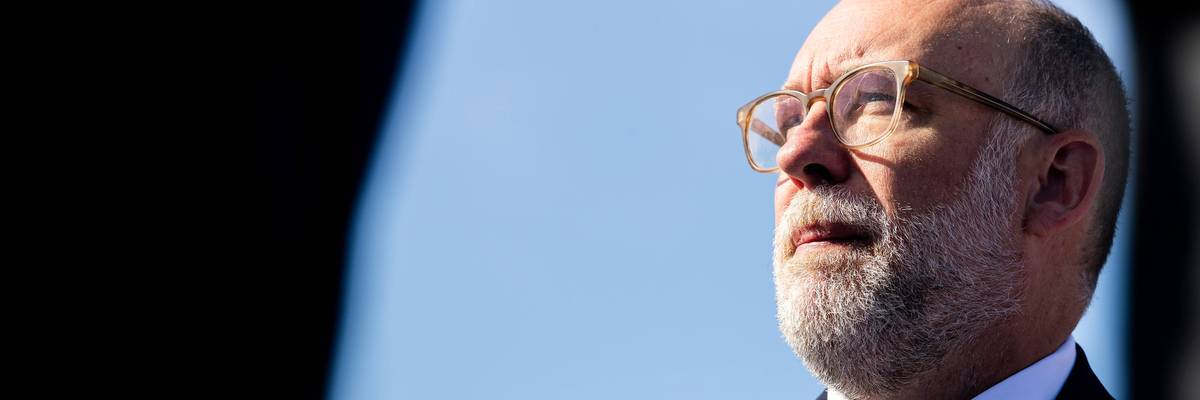
Director of the US Office of Management and Budget and former acting Consumer Financial Protection Bureau chair Russell Vought looks on during a "Steel Across America" event ahead of the 25th anniversary of the September 11th attacks on the Ellipse near the White House on September 8, 2026, in Washington, DC.
Sen. Elizabeth Warren, the CFPB's architect, promised a reckoning when Democrats retake Congress: "If you've been making your profits by cheating American families... you better get ready for some investigations."
The Trump administration has almost entirely abandoned consumer protection lawsuits even as complaints about corporate abuses surge, according to a Guardian analysis published Thursday.
From mid-2012 to the start of 2025, the US Consumer Financial Protection Bureau (CFPB)—created to fight predatory actions by financial institutions in the wake of the 2008 financial crisis—averaged about 30 enforcement actions a year, helping to recoup over $21 billion for consumers illegally ripped off by banks, mortgage lenders, credit card companies, and other entities.
But since January 2025, when President Donald Trump returned to office, it has launched just two enforcement actions. Meanwhile, it has dropped pending cases against at least 23 defendants—including credit card companies like Capital One, banks like JPMorgan Chase and Bank of America, and Warren Buffett’s business empire Berkshire Hathaway.
Those cases were not abandoned because consumers no longer have complaints about these companies. On the contrary, complaints have increased against 17 of the 23 companies the bureau stopped pursuing. Overall, the number of complaints filed by consumers with the bureau has shot up from nearly 2.7 million in 2024 to 6.3 million this year.
“Consumers are telling the bureau that there is an emergency, and the bureau is not listening or acting on that information,” Erie Meyer, a former chief technologist at the CFPB who helped oversee the creation of its complaint database, told The Guardian. “People are getting screwed twice: first by the company, second by the agency that’s supposed to stick up for them.”
Austin Hinkle, a former senior counsel and section chief at the CFPB, described Trump’s new regime at the bureau as essentially issuing “corporate pardons” to firms that were being investigated under the Biden administration for alleged flagrant abuses.
“People are getting screwed twice: first by the company, second by the agency that’s supposed to stick up for them.”
In February 2025, just a month after his second term began, Trump’s CFPB dismissed a lawsuit filed under the Biden administration accusing Capital One of cheating millions of customers out of more than $2 billion in interest by deliberately concealing higher-interest savings accounts from them, going as far as directing employees not to inform customers about the accounts unless asked. The company agreed to a $425 million class-action settlement in April, considerably less than the $2 billion in lost interest alleged by the CFPB.
Also in February 2025, the bureau dismissed a lawsuit against the mortgage company Vanderbilt, a subsidiary of Berkshire Hathaway. Regulators accused the company of knowingly saddling low-income families with mortgages they could not afford in an echo of the lending behavior that spawned the 2008 housing crisis, which in turn led to the CFPB’s creation. In one case, Vanderbilt granted a mortgage to a family that, by the company’s calculations, would have had just over $57 left in income after monthly expenses. In another, it approved a mortgage for two adults who already had 33 debts in collection.
In March 2025, the bureau also dropped a case accusing three of the nation’s largest banks—JPMorgan Chase, Bank of America, and Wells Fargo—of failing to prevent widespread fraud using their money transfer system, Zelle. Consumers allegedly lost a combined $870 million after the banks failed to stop repeat scammers from using the app. Regulators also alleged that the banks refused to compensate victims even after they provided evidence that criminals had taken over their accounts.
All of these cases were dismissed with prejudice, meaning that a future CFPB cannot reopen any of them.
The administration also dropped other cases involving payday lenders accused of trapping borrowers in cycles of debt, companies allegedly charging delivery drivers fees to access their own earnings, student loan servicers accused of collecting discharged debts, and banks accused of mistreating elderly and disabled veterans receiving federal benefits. It also canceled a settlement with Navy Federal Credit Union over illegal overdraft fees charged to military service members, veterans, and their families.
In addition, the administration has terminated or weakened another 23 existing enforcement orders, often involving companies that had already agreed to compensate victims for misconduct, according to a report by Democrats on the US Senate Banking Committee. That report estimated that reduced enforcement at the CFPB had cost consumers $19 billion during Trump’s first year in office.
The money transfer company Wise, for instance, had a $2 million fine reduced to just $45,000. Other companies like Apple and US Bank were freed from enhanced oversight years ahead of schedule.
Many consumer protection cases and settlements were dismissed while the bureau was run by Russell Vought, an architect of the Heritage Foundation’s far-right Project 2025, which has functioned as a policy playbook for Trump’s second term. He also leads the White House Office of Management and Budget.
Vought has referred to the CFPB as “a woke and weaponized agency against disfavored industries and individuals” and said his goal was to “close down the agency.”
In April 2025, he attempted to fire about 90% of the CFPB’s workforce—an effort blocked by federal courts. Vought stopped serving as acting director in August. The agency is now led by Mark Paoletta, a former chief legal officer for Vought.
Democrats, who retook both the US House of Representatives and Senate earlier this month in a midterm landslide fueled by grievances about high prices and a lack of accountability for powerful corporations, have vowed to investigate the Trump administration's efforts to "dismantle" the CFPB.
Rep. Bill Foster (D-Ill.), who is in line to become the chair of the House Financial Services Subcommittee on Financial Institutions beginning in 2027, told The Guardian that he and his colleagues plan to pursue “subpoenas, investigations, hearings, and, ultimately, legislative action to restore consumer protections in this country and hold accountable those who seek to profit off the most vulnerable Americans.”
Sen. Elizabeth Warren (D-Mass.), who led the charge to create the CFPB in 2010, is expected to take over as chair of the Senate Banking Committee, where she has promised a reckoning for corporate abuses.
As ranking member, she has already confronted Vought directly about his actions while in charge of the CFPB—including during a hearing in July when she questioned him about the bureau’s decision to terminate a settlement with Toyota Motor Credit after the company donated $1 million to Trump’s inaugural fund. The company had been accused of trapping consumers into paying thousands of dollars in some cases for unwanted insurance and warranties, while making the products extremely difficult to cancel and withholding refunds.
Warren has promised that she will prioritize accountability for the financial institutions that have been allowed to run roughshod under Trump.
“Big Tech CEOs, administration officials, Trump family crypto businesses, Wall Street executives, and giant corporations should preserve their documents and prepare to answer tough questions,” an aide to Warren told Politico Monday.
On CBS’ “Face the Nation” Sunday, Warren said, “If you’ve been making your profits by cheating American families and scamming your investors, you better get ready for some investigations, serious ones.”
This country and this world are at a monumental crossroads. US voters have an opportunity to beat back the forces of fascism and confront the billionaires who are rigging the economy, our media system, and our democracy, making it increasingly impossible for ordinary people to get by. We’re not just talking about the election. We’re talking about what must be done once these fascist elements are vanquished from power. We need a bolder set of solutions than what either major party has so far been willing to offer and a working-class movement ready to fight like hell for it. Trump didn't emerge from nowhere. The conditions that fueled MAGA authoritarianism were created by decades of radical neoliberal economic policies and a corrupt political system dominated by corporate interests. They slashed taxes on the super-rich, promising that the benefits would trickle down. They said giveaways to the corporate titans would make life more affordable for the rest of us. It was all bullshit. And when a bitter, betrayed populace searches for someone to blame, right-wing demagogues have little trouble finding scapegoats. People know when they're being lied to, but you won't hear any of this from the corporate media. Only independent journalism—powered and funded by people who believe in building a better world—can deliver truly trustworthy daily news. If you share our vision, please contribute whatever you can to sustain our work. |
The Trump administration has almost entirely abandoned consumer protection lawsuits even as complaints about corporate abuses surge, according to a Guardian analysis published Thursday.
From mid-2012 to the start of 2025, the US Consumer Financial Protection Bureau (CFPB)—created to fight predatory actions by financial institutions in the wake of the 2008 financial crisis—averaged about 30 enforcement actions a year, helping to recoup over $21 billion for consumers illegally ripped off by banks, mortgage lenders, credit card companies, and other entities.
But since January 2025, when President Donald Trump returned to office, it has launched just two enforcement actions. Meanwhile, it has dropped pending cases against at least 23 defendants—including credit card companies like Capital One, banks like JPMorgan Chase and Bank of America, and Warren Buffett’s business empire Berkshire Hathaway.
Those cases were not abandoned because consumers no longer have complaints about these companies. On the contrary, complaints have increased against 17 of the 23 companies the bureau stopped pursuing. Overall, the number of complaints filed by consumers with the bureau has shot up from nearly 2.7 million in 2024 to 6.3 million this year.
“Consumers are telling the bureau that there is an emergency, and the bureau is not listening or acting on that information,” Erie Meyer, a former chief technologist at the CFPB who helped oversee the creation of its complaint database, told The Guardian. “People are getting screwed twice: first by the company, second by the agency that’s supposed to stick up for them.”
Austin Hinkle, a former senior counsel and section chief at the CFPB, described Trump’s new regime at the bureau as essentially issuing “corporate pardons” to firms that were being investigated under the Biden administration for alleged flagrant abuses.
“People are getting screwed twice: first by the company, second by the agency that’s supposed to stick up for them.”
In February 2025, just a month after his second term began, Trump’s CFPB dismissed a lawsuit filed under the Biden administration accusing Capital One of cheating millions of customers out of more than $2 billion in interest by deliberately concealing higher-interest savings accounts from them, going as far as directing employees not to inform customers about the accounts unless asked. The company agreed to a $425 million class-action settlement in April, considerably less than the $2 billion in lost interest alleged by the CFPB.
Also in February 2025, the bureau dismissed a lawsuit against the mortgage company Vanderbilt, a subsidiary of Berkshire Hathaway. Regulators accused the company of knowingly saddling low-income families with mortgages they could not afford in an echo of the lending behavior that spawned the 2008 housing crisis, which in turn led to the CFPB’s creation. In one case, Vanderbilt granted a mortgage to a family that, by the company’s calculations, would have had just over $57 left in income after monthly expenses. In another, it approved a mortgage for two adults who already had 33 debts in collection.
In March 2025, the bureau also dropped a case accusing three of the nation’s largest banks—JPMorgan Chase, Bank of America, and Wells Fargo—of failing to prevent widespread fraud using their money transfer system, Zelle. Consumers allegedly lost a combined $870 million after the banks failed to stop repeat scammers from using the app. Regulators also alleged that the banks refused to compensate victims even after they provided evidence that criminals had taken over their accounts.
All of these cases were dismissed with prejudice, meaning that a future CFPB cannot reopen any of them.
The administration also dropped other cases involving payday lenders accused of trapping borrowers in cycles of debt, companies allegedly charging delivery drivers fees to access their own earnings, student loan servicers accused of collecting discharged debts, and banks accused of mistreating elderly and disabled veterans receiving federal benefits. It also canceled a settlement with Navy Federal Credit Union over illegal overdraft fees charged to military service members, veterans, and their families.
In addition, the administration has terminated or weakened another 23 existing enforcement orders, often involving companies that had already agreed to compensate victims for misconduct, according to a report by Democrats on the US Senate Banking Committee. That report estimated that reduced enforcement at the CFPB had cost consumers $19 billion during Trump’s first year in office.
The money transfer company Wise, for instance, had a $2 million fine reduced to just $45,000. Other companies like Apple and US Bank were freed from enhanced oversight years ahead of schedule.
Many consumer protection cases and settlements were dismissed while the bureau was run by Russell Vought, an architect of the Heritage Foundation’s far-right Project 2025, which has functioned as a policy playbook for Trump’s second term. He also leads the White House Office of Management and Budget.
Vought has referred to the CFPB as “a woke and weaponized agency against disfavored industries and individuals” and said his goal was to “close down the agency.”
In April 2025, he attempted to fire about 90% of the CFPB’s workforce—an effort blocked by federal courts. Vought stopped serving as acting director in August. The agency is now led by Mark Paoletta, a former chief legal officer for Vought.
Democrats, who retook both the US House of Representatives and Senate earlier this month in a midterm landslide fueled by grievances about high prices and a lack of accountability for powerful corporations, have vowed to investigate the Trump administration's efforts to "dismantle" the CFPB.
Rep. Bill Foster (D-Ill.), who is in line to become the chair of the House Financial Services Subcommittee on Financial Institutions beginning in 2027, told The Guardian that he and his colleagues plan to pursue “subpoenas, investigations, hearings, and, ultimately, legislative action to restore consumer protections in this country and hold accountable those who seek to profit off the most vulnerable Americans.”
Sen. Elizabeth Warren (D-Mass.), who led the charge to create the CFPB in 2010, is expected to take over as chair of the Senate Banking Committee, where she has promised a reckoning for corporate abuses.
As ranking member, she has already confronted Vought directly about his actions while in charge of the CFPB—including during a hearing in July when she questioned him about the bureau’s decision to terminate a settlement with Toyota Motor Credit after the company donated $1 million to Trump’s inaugural fund. The company had been accused of trapping consumers into paying thousands of dollars in some cases for unwanted insurance and warranties, while making the products extremely difficult to cancel and withholding refunds.
Warren has promised that she will prioritize accountability for the financial institutions that have been allowed to run roughshod under Trump.
“Big Tech CEOs, administration officials, Trump family crypto businesses, Wall Street executives, and giant corporations should preserve their documents and prepare to answer tough questions,” an aide to Warren told Politico Monday.
On CBS’ “Face the Nation” Sunday, Warren said, “If you’ve been making your profits by cheating American families and scamming your investors, you better get ready for some investigations, serious ones.”