SUBSCRIBE TO OUR FREE NEWSLETTER
Daily news & progressive opinion—funded by the people, not the corporations—delivered straight to your inbox.
5
#000000
#FFFFFF
To donate by check, phone, or other method, see our More Ways to Give page.
Daily news & progressive opinion—funded by the people, not the corporations—delivered straight to your inbox.
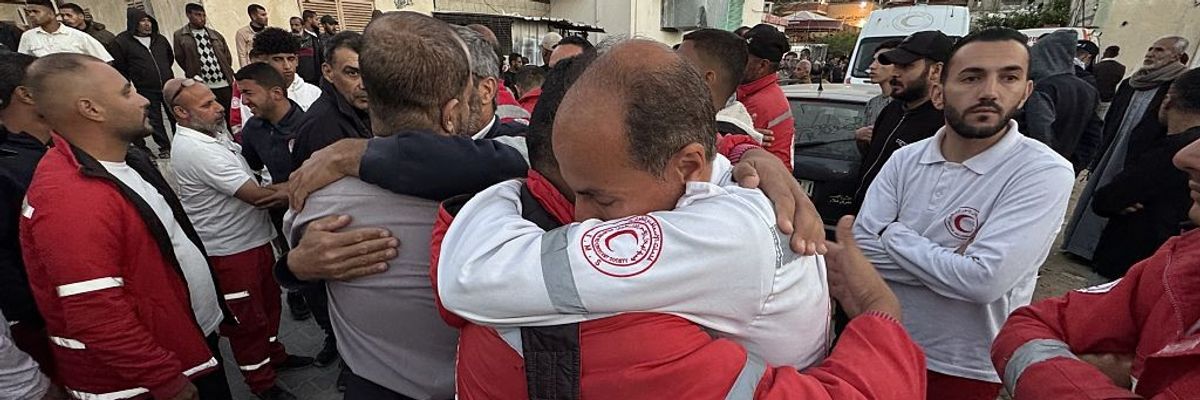
The bodies of eight civil defense and Palestinian Red Crescent members who were killed by the Israel Defense Forces in Rafah, Gaza were brought to Nasser Hospital in Khan Younis on March 30, 2025.
"No state should be above the law," said Younis Alkhatib of the Palestine Red Crescent Society. "The international community is obliged to protect humanitarians and to stop impunity."
The United Nations humanitarian affairs office said Tuesday that the new record of 383 aid workers killed last year while performing their lifesaving jobs was "shocking"—but considering Israel's relentless attacks on civilians, medical staff, journalists, and relief workers in Gaza, it was no surprise that the bombardment of the enclave was a major driver of the rise in aid worker deaths in 2024.
Nearly half of the aid workers killed last year—181 of them—were killed in Israeli attacks in Gaza, while 60 died in Sudan amid the civil war there.
The United Nations Office for the Coordination of Humanitarian Affairs (OCHA) recorded a 31% increase in aid worker killings compared to 2023, the agency said as it marked World Humanitarian Day.
"Even one attack against a humanitarian colleague is an attack on all of us and on the people we serve," said Tom Fletcher, the UN under-secretary-general for humanitarian affairs. "Attacks on this scale, with zero accountability, are a shameful indictment of international inaction and apathy."
Israel and its top allies, including the United States, have persisted in claiming it is targeting Hamas in its attacks on Gaza, which have killed more than 62,000 people—likely a significant undercount by the Gaza Health Ministry. It has also repeatedly claimed that its attacks on aid workers and other people protected under international law were "accidental."
"Every attack is a grave betrayal of humanity, and the rules designed to protect them and the communities they serve. Each killing sends a dangerous message that their lives were expendable. They were not."
"As the humanitarian community, we demand—again—that those with power and influence act for humanity, protect civilians and aid workers, and hold perpetrators to account," said Fletcher.
The UN Security Council adopted a resolution in May 2024 reaffirming that humanitarian staff must be protected in conflict zones—a month after the Israel Defense Forces struck a convoy including seven workers from the US-based charity World Central Kitchen, killing all of them.
More than a year later, said OCHA, "the lack of accountability remains pervasive."
The UN-backed Aid Worker Security Database's provisional numbers for 2025 so far show that at least 265 aid workers have been killed this year, with one of the deadliest attacks perpetrated by the IDF against medics and emergency responders in clearly marked vehicles in Gaza. Eight of the workers were with the Palestine Red Crescent Society, which on Tuesday noted that "Palestinian humanitarian workers have been deliberately targeted more than anywhere else."
"No state should be above the law," said Younis Alkhatib, president of the humanitarian group. "The international community is obliged to protect humanitarians and to stop impunity."
UN Secretary-General António Guterres said Tuesday that humanitarian workers around the world "are the last lifeline for over 300 million people" living in conflict and disaster zones.
What is missing as advocates demand protection for aid workers and as "red lines are crossed with impunity," said Guterres, is "political will—and moral courage."
"Humanitarians must be respected and protected," he said. "They can never be targeted."
Olga Cherevko of OCHA emphasized that despite Israel's continued bombardment of Gaza's healthcare systemsystem and its attacks at aid hubs, humanitarian workers continue their efforts to save lives "day in and day out."
"I think as a humanitarian, I feel powerless sometimes in Gaza because I know what it is that we can do as humanitarians when we're enabled to do so, both here in Gaza and in any other humanitarian crisis," said Cherevko. "We continue to face massive impediments for delivering aid at scale, when our missions are delayed, when our missions lasted 12, 14, 18 hours; the routes that we're given are dangerous, impassible, or inaccessible."
Israel has blocked the United Nations and other established aid agencies that have worked for years in the occupied Palestinian territories from delivering lifesaving aid in recent months, pushing the entire enclave towards famine.
The International Committee of the Red Cross (ICRC) added in a statement that "our colleagues continue to show up not because they are fearless, but because the suffering is too urgent to ignore. Yet, courage is not protection, and dedication does not deflect bullets."
"The rules of war are clear: Humanitarian personnel must be respected and protected," said the ICRC. "Every attack is a grave betrayal of humanity, and the rules designed to protect them and the communities they serve. Each killing sends a dangerous message that their lives were expendable. They were not."
Along with the aid workers who were killed worldwide last year, 308 were injured, 125 were kidnapped, and 45 were detained for their work.
"Violence against aid workers is not inevitable," said Fletcher. "It must end."
This country and this world are at a monumental crossroads. US voters have an opportunity to beat back the forces of fascism and confront the billionaires who are rigging the economy, our media system, and our democracy, making it increasingly impossible for ordinary people to get by. We’re not just talking about the election. We’re talking about what must be done once these fascist elements are vanquished from power. We need a bolder set of solutions than what either major party has so far been willing to offer and a working-class movement ready to fight like hell for it. Trump didn't emerge from nowhere. The conditions that fueled MAGA authoritarianism were created by decades of radical neoliberal economic policies and a corrupt political system dominated by corporate interests. They slashed taxes on the super-rich, promising that the benefits would trickle down. They said giveaways to the corporate titans would make life more affordable for the rest of us. It was all bullshit. And when a bitter, betrayed populace searches for someone to blame, right-wing demagogues have little trouble finding scapegoats. People know when they're being lied to, but you won't hear any of this from the corporate media. Only independent journalism—powered and funded by people who believe in building a better world—can deliver truly trustworthy daily news. If you share our vision, please contribute whatever you can to sustain our work. |
The United Nations humanitarian affairs office said Tuesday that the new record of 383 aid workers killed last year while performing their lifesaving jobs was "shocking"—but considering Israel's relentless attacks on civilians, medical staff, journalists, and relief workers in Gaza, it was no surprise that the bombardment of the enclave was a major driver of the rise in aid worker deaths in 2024.
Nearly half of the aid workers killed last year—181 of them—were killed in Israeli attacks in Gaza, while 60 died in Sudan amid the civil war there.
The United Nations Office for the Coordination of Humanitarian Affairs (OCHA) recorded a 31% increase in aid worker killings compared to 2023, the agency said as it marked World Humanitarian Day.
"Even one attack against a humanitarian colleague is an attack on all of us and on the people we serve," said Tom Fletcher, the UN under-secretary-general for humanitarian affairs. "Attacks on this scale, with zero accountability, are a shameful indictment of international inaction and apathy."
Israel and its top allies, including the United States, have persisted in claiming it is targeting Hamas in its attacks on Gaza, which have killed more than 62,000 people—likely a significant undercount by the Gaza Health Ministry. It has also repeatedly claimed that its attacks on aid workers and other people protected under international law were "accidental."
"Every attack is a grave betrayal of humanity, and the rules designed to protect them and the communities they serve. Each killing sends a dangerous message that their lives were expendable. They were not."
"As the humanitarian community, we demand—again—that those with power and influence act for humanity, protect civilians and aid workers, and hold perpetrators to account," said Fletcher.
The UN Security Council adopted a resolution in May 2024 reaffirming that humanitarian staff must be protected in conflict zones—a month after the Israel Defense Forces struck a convoy including seven workers from the US-based charity World Central Kitchen, killing all of them.
More than a year later, said OCHA, "the lack of accountability remains pervasive."
The UN-backed Aid Worker Security Database's provisional numbers for 2025 so far show that at least 265 aid workers have been killed this year, with one of the deadliest attacks perpetrated by the IDF against medics and emergency responders in clearly marked vehicles in Gaza. Eight of the workers were with the Palestine Red Crescent Society, which on Tuesday noted that "Palestinian humanitarian workers have been deliberately targeted more than anywhere else."
"No state should be above the law," said Younis Alkhatib, president of the humanitarian group. "The international community is obliged to protect humanitarians and to stop impunity."
UN Secretary-General António Guterres said Tuesday that humanitarian workers around the world "are the last lifeline for over 300 million people" living in conflict and disaster zones.
What is missing as advocates demand protection for aid workers and as "red lines are crossed with impunity," said Guterres, is "political will—and moral courage."
"Humanitarians must be respected and protected," he said. "They can never be targeted."
Olga Cherevko of OCHA emphasized that despite Israel's continued bombardment of Gaza's healthcare systemsystem and its attacks at aid hubs, humanitarian workers continue their efforts to save lives "day in and day out."
"I think as a humanitarian, I feel powerless sometimes in Gaza because I know what it is that we can do as humanitarians when we're enabled to do so, both here in Gaza and in any other humanitarian crisis," said Cherevko. "We continue to face massive impediments for delivering aid at scale, when our missions are delayed, when our missions lasted 12, 14, 18 hours; the routes that we're given are dangerous, impassible, or inaccessible."
Israel has blocked the United Nations and other established aid agencies that have worked for years in the occupied Palestinian territories from delivering lifesaving aid in recent months, pushing the entire enclave towards famine.
The International Committee of the Red Cross (ICRC) added in a statement that "our colleagues continue to show up not because they are fearless, but because the suffering is too urgent to ignore. Yet, courage is not protection, and dedication does not deflect bullets."
"The rules of war are clear: Humanitarian personnel must be respected and protected," said the ICRC. "Every attack is a grave betrayal of humanity, and the rules designed to protect them and the communities they serve. Each killing sends a dangerous message that their lives were expendable. They were not."
Along with the aid workers who were killed worldwide last year, 308 were injured, 125 were kidnapped, and 45 were detained for their work.
"Violence against aid workers is not inevitable," said Fletcher. "It must end."