

SUBSCRIBE TO OUR FREE NEWSLETTER
Daily news & progressive opinion—funded by the people, not the corporations—delivered straight to your inbox.
5
#000000
#FFFFFF
To donate by check, phone, or other method, see our More Ways to Give page.
Daily news & progressive opinion—funded by the people, not the corporations—delivered straight to your inbox.

Hundreds of businesses nationwide are supporting and profiting from ICE’s mass surveillance, detention, and deportation machine. We won't let them get away with it.
As Americans celebrate this month’s blue election, US Immigration and Customs Enforcement is forging ahead with more arrests and more deportations.
On the heels of a record 50,000 arrests in August and record 483,000 deportations in fiscal year 2026, ICE is now being told to achieve around 19,000 arrests every week.
On election day, in fact, ICE detained five people inside Massachusetts courthouses—despite a new state law prohibiting civil immigration arrests in courthouses without a judicial warrant or court order. Given that the law took effect on that exact day, ICE’s courthouse arrests were a clear "middle finger" to the state of Massachusetts.
Voters sent a clear message November 3 that they want to end the cruelty and corruption of the Trump administration. They are angry at ICE contracts that bypass open bidding, waste taxpayer dollars, and reward cozy relationships with the administration.
But it isn’t only ICE that is complicit in the most far-reaching immigrant purge in US history.
Corporate America is also culpable.
Hundreds of businesses nationwide are supporting and profiting from ICE’s mass surveillance, detention, and deportation machine. They track people down, run detention camps, fly people out of the country, and make everything from shackles to spyware
In short, they are the pillars that make ICE’s cruelty possible.
While some of these companies are household names—Home Depot, Enterprise Rent-A-Car, Deloitte, and LexisNexis among them—most are less familiar. And that’s the way they want it. Our tax dollars fund their contracts, but many of these companies are counting on us never learning their names.
That’s about to change.
On December 4 and 5, grassroots groups across the country will shine a light on many of these companies. Dozens of protests, rallies, and leafleting events are being held as part of the De-ICE National Days of Action.
To learn more about joining or hosting an event, please visit the De-ICE Action Network website, which lists the companies being targeted and where they are located. We’ll also be discussing the event and how folks can participate at a national prep call at 7:00 pm Eastern Time on Tuesday, November 17.
This is the first of a series of national action days to educate citizens and spur action against ICE’s corporate enablers operating in our local communities. In addition to peaceful rallies at corporate offices, ICE detention camps, airports, and other public spaces, we’ll also be circulating a petition calling for the new House leadership to investigate companies that are violating laws in performing their work for ICE and the Department of Homeland Security.
Voters sent a clear message November 3 that they want to end the cruelty and corruption of the Trump administration. They are angry at ICE contracts that bypass open bidding, waste taxpayer dollars, and reward cozy relationships with the administration. They want to see private prison companies like GEO Group and CoreCivic held accountable for medical neglect that is too often fatal for detainees.
We’ll keep delivering that message to Congress and to every company profiting from the suffering ICE is causing in communities across the country.

World leaders must take drastic action to ensure global food security and a sustainable planet.
At COP31 one voice that is being ignored by Governments is that of animals. This is despite the fact that 14.5% of total greenhouse gas emissions come from animal agriculture—including cruel industrial farms where more than 90 billion cows, pigs, and chickens are often trapped in barren, squalid, and overcrowded conditions. Industrial animal agriculture’s relentless expansion in recent years has also destroyed forests and areas of wilderness, including the homes of wild animals. Cutting down tropical forests to feed the billions of animals crammed into cruel factory farm systems is not ‘feeding the world,” as some suggest, it’s destroying the planet.
However, if you listen to governments speaking at COP31, you won’t hear any of this. There is a risk they could stop the negotiations on food and greenhouse gas emissions without any conclusions and no follow-up. This would be a bizarre outcome and demonstrate a willful ignorance of the sector’s growing climate emissions. There’s still some hope as negotiations recommence this week, but time for ensuring equitable, humane, and sustainable global food systems is running out.
The summer heatwaves across the United States put significant stress on industrial cattle feedlot farming, and many cattle died or suffered in the extreme heat. This temperature instability has impacted food security and food system supply chains globally. The latter have also been disrupted due to ongoing wars in Ukraine and Iran, causing higher prices for food. Industrial animal agriculture is a climate culprit and is not ensuring security of the food supply.
There is an urgent need to move away from industrial animal agriculture, support fair livelihoods for farmers, and give animals better lives while protecting the planet.
Disappointingly, Governments negotiating at COP31 do not see the creation of more equitable, sustainable, and humane food production as an urgent priority. In fact, at COP31 the only dedicated negotiations on food—the Sharm el-Sheikh Joint Work on implementation of climate action on agriculture and food security—will come to an end after four years of discussions and no clear path forward. Agriculture has been put forward as a priority by COP Presidency countries over the past five years, yet there is little to show for this. Countries are failing to agree on any steps or any common agenda—one of the main reasons being that Global North countries do not want to fund necessary global food transformation.
Such inaction continues to give a free pass to industrial animal agriculture giants such as JBS, Cargill, and Tyson for limitless expansion. Each day, JBS slaughters 14 million farmed animals and destroys one football field of tropical rainforest. It's estimated that even if all fossil fuel emissions were halted, emissions from agriculture expansion itself could push the world into 2°C of climate change.
And government finances this expansion. A report by World Animal Protection shows that small-scale, sustainable farmers generally lose. Agriculture receives more government subsidies than almost any other sector globally, second only to fossil fuels. These subsidies have reached a record high, increasing by $121 billion since 2023. Some of these subsidies underpin industrial animal agriculture expansion. Even though government commit to phasing out such harmful subsidies, there has been little progress so far. Part of our work with World Federation for Animals is to ensure better access to climate finance for small-scale farmers and other vulnerable groups, including pastoralists, so they can meet higher animal welfare standards that are conducive to a more sustainable future. Public finance should drive the transition to these types of systems, but right now money is locked into increased greenhouse gas emissions and animal suffering. If even a part of these subsidies were redirected to creating equitable, humane, and sustainable food systems across the world, we could see the start of food systems that would protect animals, people, and the planet.
Despite such examples, richer countries have so far managed to ensure continued food production. However, climate change has a disproportionate impact on food security in some of the world’s most vulnerable countries. Many in the Global South—who have contributed the least to climate change—are unable to adjust to food shortages. Hit by climate change-related crop failures, many people are struggling to ensure adequate food production.
Given this food security challenge, the focus on animal sourced foods in Global North countries is unsustainable. Food that could feed hungry people is being used instead to feed animals in industrial animal agriculture, further deepening global food inequality and hunger. This is not just inefficient, it is morally wrong.
A first step is that governments at COP31 must agree to conclusions on the Joint Work on implementation of climate action on agriculture and food security and agree to a future-focused agenda on implementing and financing a just transition to equitable, humane, and sustainable food systems. The Just Transition work program at COP31 is also focusing on developing more sustainable pathways regarding agriculture. There is an urgent need to move away from industrial animal agriculture, support fair livelihoods for farmers, and give animals better lives while protecting the planet.
To achieve to a world without animal suffering and exploitation, we need everyone at the table and no one left hungry.

Movements will need to put more pressure on governments—the history of these negotiations suggests that without that pressure the leaders simply won’t do more than the minimum.
Your correspondent is feeling a tad guilty for not being in Türikye this week for the 31st global climate talks—my only excuses are deep fatigue from the fall election, and the chance to address the big renewable energy trade show in Las Vegas. That’s currently in question as I’ve been swept up in the nationwide air traffic imbroglio, but if I make it, a full account next time. But of course I’ve been following events in Antalya, and talking with lots of people on the ground there.
The first week—which is when the world leaders visit—is over. The weekend—when protesters take to the streets—is winding down. Now it’s the second week when the actual work of agreeing on a new text takes place.
The first week’s rhetoric was important and strong. Greta Thunberg returned to the talks for the first time in five years. (At Glasgow, in 2021, she’d pointed out that they were an exercise in “blah blah blah”). She kept up that theme this time around, telling reporters, “We’ve had 31 COPs now, and we’re still speeding in the wrong direction.” Since Thunberg doesn’t fly, she arrived via “trains, buses, and sleep deprivation,” and said the data center fight was part and parcel of the climate battle:
“They’re both the same issue,” Thunberg said, noting both the environmental toll of data centers as well as the way they overshadow more fundamental needs. “We’re detaching ourselves from our human values.”
Meanwhile, United Nations Secretary General Antonio Guterres gave what may be the last in a series of epic climate speeches, since he is stepping down at the end of December. Guterres’ tenure has been defined in no small part by climate concerns, and to his immense credit he has never pulled a punch, abandoning diplomatic language to focus on the bankers and fossil fuel execs who drive the crisis. It’s worth reading the transcript of his remarks to see how a world leader can address this crisis if he’s not worried about appeasing commercial interests. (Pope Francis, and now Leo, are the only comparable examples).
The case for fossil fuels is collapsing.
Three-quarters of humanity live in countries that import fossil fuels.
Hostage to price shocks they did not create and they cannot control.
Recent conflicts make clear that this is a recipe for chronic insecurity and a cost-of-living meltdown.
It’s time to accelerate a science-aligned, just, orderly, and equitable transition to renewables.
But let’s not underestimate the scale of the challenge.
Fossil fuels must go the way of the dinosaurs.
But that won’t happen on its own.
The dinosaurs did not have a lobby.
But fossil fuels do.
And their strategy is simple:
Distort the science. Delay the policy. Delay the action. Delay the accountability.
It’s time to kick the habit—and end the fossil-fuel addiction.
In many ways, it should be a year for the world to accelerate progress. The war in Iran has made it crystal clear that fossil fuel is a threat not only to the global climate but also to its economy and its security. In fact, it appears that the world’s carbon emissions will fall this year, simply because people couldn’t get the oil and gas to burn. As Brad Plumer explains:
Globally, emissions from oil consumption are expected to drop nearly 2% this year, while emissions from natural gas will decline roughly 0.3%. By contrast, carbon dioxide emissions from burning of coal are expected to rise roughly 0.6%, thanks to increased consumption in places like China and India. (Even though coal pollutes more than oil or gas, the uptick in coal consumption was smaller in comparison.)
“I would call it unexpected,” said Glen Peters, a senior researcher at the CICERO Center for International Climate Research in Oslo and one of the authors of the report. “It’s pretty rare to see a drop in oil demand this big.”
The Times cautions that the dip may be temporary: “if the war with Iran ends and the Strait of Hormuz reopens, oil and gas demand could easily bounce back.” But there’s increasing evidence that the decline is structural. As Justin Mikulka points out:
We were told natural gas was going to replace coal and this would drive big future demand. But believing that required not understanding basic economics. Gas demand destruction is happening in 2026 because renewables plus storage are replacing it in power generation.
Mikulka quotes one other expert who explains the base reality:
A billion dollars’-worth of solar farms will provide roughly 10 times as much electricity over their lifetimes as the same amount of money spent on liquefied natural gas.
Indeed, the emerging buzzword at the Türikye talks is “electrification,” with the host nation boosting a 35% by 2035 plan—which is not all that fast, but at least heads in the right direction. Electrifying everything is of course crucial to progress—as a new paper from Jan Rosenow and colleagues last week makes clear, EVs and heat pumps are so efficient that they could cut primary energy use in half on this planet, compared with the present world where combustion wastes wild amounts of heat:
We find that system-wide losses (rejected energy) fall by 61%, while the contribution of ambient environmental heat captured by heat pumps rises approximately 20-fold; under conventional energy-balance conventions this corresponds to a fall in primary energy inputs of nearly half.
But science is one thing and political power is another, and who knows what will happen this week—the fossil fuel industry is of course willing to electrify as long as its natural gas that gets to play a lead role in the process. Standing up to that is hard—as the EU climate chief Wopke Hoekstra told the Bloomberg team:
A “certain degree of pragmatism” was warranted to bring as many countries on board as possible, he told reporters. While curbs on methane are mentioned in the summary text, that’s no guarantee the issue will make it into a final text.
On boosting electrification, some debate has focused on whether the goal should include any reference to requirements for clean electricity. Hoekstra said the 27-member bloc isn’t seeking to add restrictions, and hopes the initiative can retain broad appeal.
By “broad appeal” he means, in part, “not getting vetoed by the Saudis,” who, now that the Americans boycott the proceedings, have emerged as the foremost defenders of overheating the Earth. (President Donald Trump’s puppet government in Caracas has joined in too). As Al Gore—as so often a tribune of common sense—said on the sidelines of the talks:
The idea that one individual country like Saudi Arabia can block anything the entire world wants to do is literally insane. We are facing the most serious threat to the future of humanity that we have ever faced.
China would of course be the obvious new leader in this global fight—they are producing the key technology, and now that the US has withdrawn they are, for climate negotiations, the sole superpower. But they seem reluctant to grab the reins—indeed, they declined even to host 2028’s talks, which are scheduled, in the continental rotation, to be held in Asia. As Fiona Harvey reports:
Gareth Redmond-King, the international lead at the Energy and Climate Intelligence Unit think tank, said China’s position as an industrial powerhouse would have made it a formidable contender to hold the summit.
“It would undoubtedly be significant for the world’s biggest emitter and second-biggest economy to host a climate COP,” he said.
“They’re leading the world on investment, manufacture, and deployment of clean energy tech, and their emissions have started to tick down. As a leadership story, China hosting COP33 would be a big deal.”
The time that we have to deal with this crisis grow short, and each year’s limp global talks means that the window has closed a little further. Events—the war in Iran, the falling cost of renewables—are conspiring to help, but without any of the global guidance that could speed the process. Movements will need to put more pressure on governments—the history of these negotiations suggests that without that pressure the leaders simply won’t do more than the minimum. So I’m glad we’re planning for things like Sun Day; right now the wheel isn’t squeaking enough, and as a result it’s getting way too much oil.
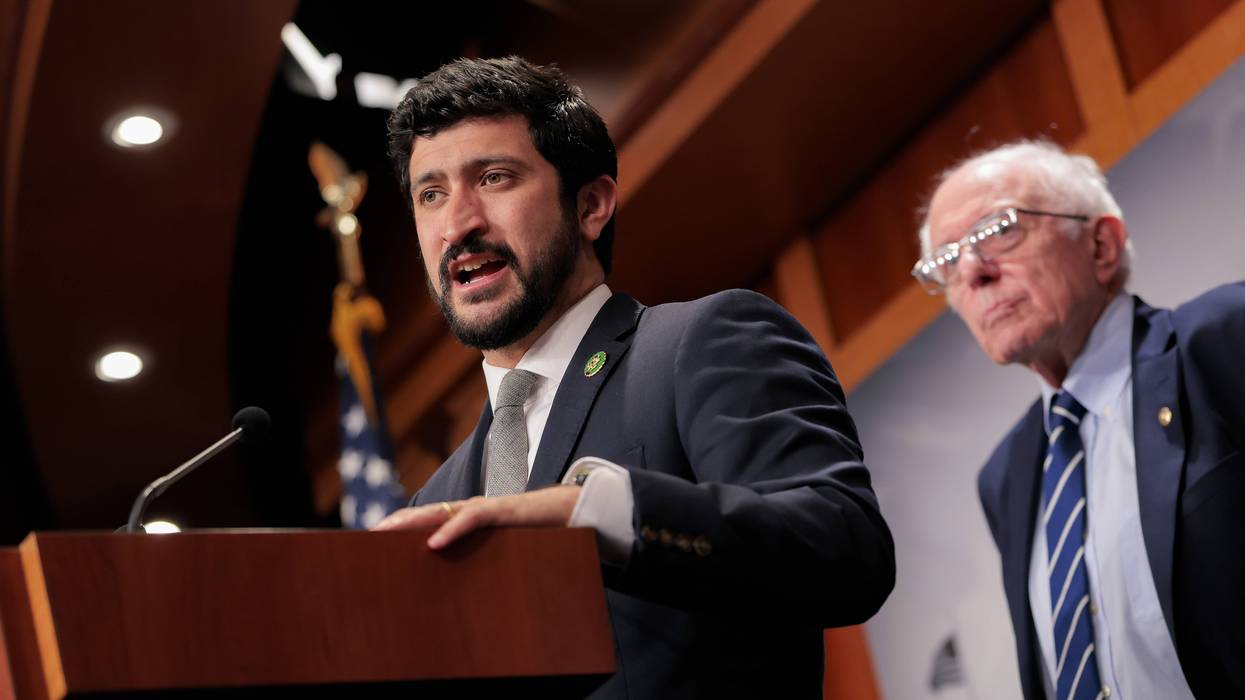
Progressive lawmakers must not let corporate Democrats’ predictions of possible Trump’s vetoes deter them from acting. Make him veto popular legislation and lose more voter support and some Congressional Republicans up in 2028.
With newly elected progressive members of Congress raring to go, civic advocates must get specific about what they can do to help lawmakers break free of the Corporate Cocoon they are about to enter on January 3rd, 2027.
1. Newly elected members of Congress must develop their own base of support so they can resist divide-and-rule tactics and avoid being marginalized by corporate Democrats. Congressional newcomers can routinely have their own “shadow hearings” in Congress and in their states on issue after issue. Such hearings can educate new members of Congress, the public, and the media, and encourage important participation by progressive citizen groups. These organizations have been regularly excluded by Party leaders like Chuck Schumer, Hakeem Jeffries, and their predecessors.
The new and incumbent progressives in Congress must systematically meet with large and small membership citizen groups that have vast experience with Congress and well-developed agendas for long-overdue immediate changes and longer-range structural reforms. (See: Unstoppable: Twenty-Five Proposed Redirections and Reforms Through Convergent Action and winningamerica.net.)
2. Immediate legislation to alleviate some of the economic woes of the voters who sent them to Washington on November 3, 2026, including:
(a) Elevate the federalminimum wage to at least $17.50 per hour from the long-frozen $7.25 per hour that has given such a windfall to many employers. (Even in many of the poorest states a minimum living family wage is more than $20.00 per hour.) About 30 million workers will benefit.
Recall Obama promised to raise the minimum wage to $9.50 during his 2008 presidential campaign. He had huge majorities in Congress, but did nothing. That is what happens with corporate Democrats.
(b) Enact an authenticchild tax credit benefiting some 60 million children and cutting child poverty in half.
(c) RaiseSocial Security benefits, frozen since 1971, paid for by raising the cap on Social Security income to include the well-off and the super wealthy. Incumbent House and Senate Democrats are well aware of Representative John Larson’s Social Security 2100: A Sacred Trust bill, H.R. 5723, (re-introduced as H.R. 9519 in 2026) which attracted more than 200 Democratic cosponsors during the 2021–2022 Congress Speaker Nancy Pelosi blocked a floor vote on this legislation that would have benefited over 60 million retirees. (See The American Prospect: House Leadership Delays Social Security Expansion While Crafting Tax Breaks for Rich Retirees.)
Progressive lawmakers must not let corporate Democrats’ predictions of possible Trump’s vetoes deter them from acting. Make him veto popular legislation and lose more voter support and some Congressional Republicans up in 2028. This could produce even greater Democratic Party majorities in two years, making for a veto-proof Congress. Legal experts, such as Bruce Fein, can identify dozens of Trump’s executive orders as blatantly unlawful and harmful and help Congress draft legislation to nullify them en masse.
Progressives need to recognize the powers Congress can exercise without the president’s signature, such as creating permanent standing committees on impeachable offenses to protect the Constitution’s separation of powers. Furthermore, progressives can fund the critical Office of Technology Assessment (OTA), defunct since 1995 due to Speaker Newt Gingrich’s preference to rely on costly boondoggle corporate science and technology advanced by his corporate paymasters. (See: Reps. Takano, Beyer, Casten, Foster, and Obernolte Lead Bipartisan Coalition to Create the Congressional Office of Technology)
Congress controls its own budget. It can rebuild depleted Committee staffs and reduce its reliance on corporate lobbyists. It can increase the number of office staff and the Government Accountability Office (GAO), which oversees the Executive Branch for Congress. All this can be done immediately.
Not many people know how a corporate Congress strips itself of the capacity to perform its vast constitutional duties. The entire annual budget of Congress for 2026 is $7.3 billion—a third of what a new aircraft carrier goes for, or just about three days of the military budget.
Campaign finance reform can get underway with a bill that bans any company or individual doing business with the federal government from making any campaign donations to any incumbent and anybody running for Congressional and presidential office. That would prevent most of the big lobbyists from buying or renting politicians.
Democratic control of the Congressional Committees, also creates opportunities to use the federal courts to defend Congress’s oversight powers. Properly authorized committees may have standing to sue to enforce subpoenas and other demands, strengthening Congress’s ability to obtain testimony, documents, and stop illegal activities.
Congress does not need the President’s signature to require the Pentagon to obey a 1992 federal law requiring all federal departments and agencies to send an audited annual budget to Congress. The Department of Defense admits it has been unable to do this, in violation of the law, under both Democratic and Republican administrations. Congress should use its power of the purse to cut off funding for Trump administration programs that violate the rule of law, devastate Americans’ lives and livelihoods, or support unlawful military operations abroad. Trump’s criminal wars such as the wars in the Middle East or his illegal takeover of Venezuela and its oil are clear impeachable offenses. Remember, in 1973, Congress cut off the money for combat operations in Vietnam and helped push President Nixon to end this undeclared war.
Congressional use of the contempt power can be taken from its disuse and activated against outlaw Presidential regimes.
Congressional Progressives, remember your two big levers: regular, public “shadow hearings” and engaging with the progressive citizen groups and progressive unions for agendas, strategies, and action. At long last!

The urgency to “do something” can be worse than nothing. Let’s get it right the first time.
Dear Member of Congress:
Congratulations on your recent win to represent your constituents in Congress. The people have given you a mandate. Use this victory boldly to achieve National Improved Medicare for All, free from profit. There is no reason for any compromises to be made at this point. We need model legislation that sets the stage for the struggle that is to come. If a principle is not placed on the table at the beginning of the bargaining, it is conceded.
On October 22 (less than two weeks before the midterm elections), Representative Jayapal and others introduced H.R. 10875, the Improving Medicare Coverage Act, legislation that lowers the Medicare age to 50, while leaving private insurance in control of health care.
Our next step should not enrich our opposition further. Our next step should not be another detour away from Medicare for All.
On November 5 (2 days after the midterms), Senator Sanders, the most stalwart supporter of Medicare for All, released a statement where he listed many of the important agenda items that a Democratic majority in Congress must address, including Improved Medicare for All. However, he added, “As an immediate first step Democrats must lower the Medicare eligibility age from 65 down to 55, expand Medicare to cover dental, vision and hearing, and guarantee universal health care coverage for every child from birth to age 19.”
On November 10 (one week after the midterms), fellow Democratic Senator Tammy Baldwin led colleagues in introducing a bill to lower the age of Medicare to 50, touting it would lower health care costs.
Your proposals to “get us to Medicare for All” without actually getting us there are coming fast and furious.
The foremost goal of any national single payer organization is to build a movement that can successfully enact Improved Medicare for All, free from profit, in the shortest time possible. While lowering the Medicare age to 50, or to 55, or adding children, sounds appealing, and a great first step towards Medicare for All, the policy crumbles when it is examined closely and dispassionately.
H. R. 10875 places the financing burden for Medicare for those ages 50 to 64 on the federal government, relieving employers of those costs. The cost of covering those estimated 62 million new Medicare enrollees is unknown, but we can predict it will be massive because the savings of Improved Medicare for All are missing.
Unlike in H.R. 3069, the Improved Medicare for All Act in the House, and S 1506 in the Senate, there are zero cost savings in H. R. 10875, there are no benefit improvements, and there will be no relief from the costs of supplementary care and drug plans.
These “immediate first steps” do not guarantee funding for the 700 rural hospitals at risk of closing and other facilities serving our communities.
What else do these urgent missteps from Congressional leaders fail to do?
Mysteriously, the legislation will sunset after five years, leaving open the possibility of more disastrous consequences, reminiscent of the partisan fight in December 2025, when the enhanced subsidies in the Exchanges were allowed to expire.
The savings of H.R. 3069, Improved Medicare for All, come from the removal of the insurance industry with its high profits and administrative costs, redirecting the savings to be used to improve benefits and to expand those benefits to include everyone. Without those savings, adding millions to Medicare will massively increase federal funding, reinforcing the false conclusion that Medicare for All is too expensive. That will hurt rather than facilitate passing Improved Medicare for All.
Our next step should not enrich our opposition further. Our next step should not be another detour away from Medicare for All. How many times must we fall off the cliff before we force our elected officials to pass legislation necessary to guarantee every resident comprehensive medical benefits from cradle to end of life? The people gave you a mandate. Improve H.R. 3069. Introduce the bill early in 2027. Organize to get Democrats, Independents, and Republicans to cosponsor. Use your pulpit to rally the people into a mighty force. Then pass legislation.
Experienced negotiators know how to put everything on the table upfront. The people have spoken. Do not squander our trust by asking for a half loaf and settling for crumbs.

It’s a safe bet that Trump will do everything in his power, and then some, to block the development of clean energy in his last two years in office. Kill BAAJA now and come back to the plan after Trump is gone and democracy is restored.
I have long been familiar with the argument for permitting reform and am largely in agreement. If you need to be convinced of the case, just hop on the high-speed train from Los Angeles to San Francisco that got funding in President Obama’s 2009 stimulus bill. But I still can’t buy Ezra Klein’s enthusiastic endorsement of the bill the New York Times over the weekend.
The point is that the bill will substantially reduce opportunities to block energy- and infrastructure-related projects. That is a great idea, but not with Donald Trump in the White House and picking the projects.
This is handing more power to someone whose main goal is to make himself, his family, and his contributors richer. He is all the happier if he can also destroy the environment in the process.
You don’t give more swords to the person who openly expresses his contempt for the rule of law. There will be little potential upside to passing this bill now, as opposed to 2029. There is clear downside risk. Why do it?
Klein argues that the bill is a good thing because, while it could make it easier to build things like data centers and gas-fueled power plants, it will also make it easier to build solar and wind facilities, as well as the transmission lines needed to get the electricity to where it is needed.
Trump has repeatedly and routinely shown his contempt for the law. He will undoubtedly accept and abuse the powers granted to his administration under the law and ignore the provisions that might hasten the conversion to clean energy. He has already said that he will deny permits to wind turbines, apparently due to a hatred resulting from their placement near one of his golf courses in Scotland.
It’s a safe bet that Trump will do everything in his power, and then some, to block the development of clean energy in his last two years in office. It is hard to believe that this bill can have anything more than a trivial effect on the production of clean energy between now and 2029. The framing of this as a short-term “affordability” story, as Klein does, is Washington-silly.
In terms of the evils of the bill, one of the key provisions is that it limits the time period for challenging most projects to 150 days. That would be fine with a democratic president (small “d,” as in respecting democracy). It is not fine with Donald Trump.
Those of us who have been awake the last two years know that Trump will freely abuse any power granted to him. Look to him to give complainants 15 days and say the 150 day time-period has lapsed. If that sounds absurd, look at the arguments the Justice Department has advanced on Trump’s ballroom, the Kennedy Center, and his luxury DC golf course.
Trump’s Justice Department has no qualms about blatantly lying in judicial proceedings. Honest judges, appointed by presidents of both parties, have largely refused to accept the lies and tried to uphold the law. Trump has intermittently accepted these rulings. But Trump sycophant judges are happy to defer to their master. And often the Supreme Court has adhered to their strongly held philosophical position that if Trump does it, it’s legal.
The basic story here is, to loosely paraphrase Marco Rubio’s speech last week, you don’t give more swords to the person who openly expresses his contempt for the rule of law. There will be little potential upside to passing this bill now, as opposed to 2029. There is clear downside risk. Why do it?
If we want to address excessive regulation and affordability, let’s go after government-granted patent monopolies for prescription drugs. Drugs are cheap in a free market. There are really big bucks there ($750 billion a year or $5k per household). Let’s get that on the agenda for now and come back to permitting reform when it’s safe.

No private individual—no matter how wealthy—should have the ability to direct American foreign policy on his own, or to help a nation that poses a major threat to US national security.
The richest person on Earth has used his wealth to gain unprecedented, unaccountable, and secret power over U.S. foreign and domestic policy.
That’s about to end. One of the most important inquiries Democrats will make when they take over Congress in less than seven weeks is what Elon Musk has been up to, what laws he’s violated along the way, and what actions should be taken to stop his mayhem.
To take but one example, Elon’s Starlink and Starshield satellite services to Ukraine have again been disrupted. (They were first disrupted between October 13 and October 24.) On Sunday, Ukrainian President Volodymyr Zelenskyy said Ukraine was struggling to intercept Russian jet-powered drones because “restrictions on the operating speed of Starshield terminals along the front line and in the temporarily occupied territories are still there.”
The disruptions are helping Russia because Ukraine uses the Starlink service for communications on the battlefield, while Starshield is used for the interception of missiles and drones in Ukrainian airspace.
Who’s responsible for the disruptions?
Musk has already admitted ordering the October disruption. After Ukraine’s drones hit Russian oil refineries, Musk posted on X, “Zelensky has gone too far.” Trump later asked Musk to resume full service to Ukraine, according to The Wall Street Journal.
Why is Musk taking Russia’s side? We don’t know. But we do know that Musk’s Starlink has become a de facto extension of the Defense Department.
We also know that Musk has an effective monopoly on satellites critical for American military and civilian uses. Over 11,175 Starlink satellites are now operational in space—about two-thirds of all working satellites now orbiting Earth.
None of this justifies Musk taking charge of American foreign policy and deciding for himself to disrupt his Starlink and Starshield satellite service to Ukraine — thereby exposing Ukrainians to Russian attacks and helping Vladimir Putin gain an advantage in his war against Ukraine.
No private individual—no matter how wealthy—should have the ability to direct American foreign policy on his own, or to help a nation that poses a major threat to US national security.
America is not helpless to do anything about this. We can break up Musk’s satellite monopoly. We can nationalize his Starlink and Starshield operations. (When I suggested this last month, Musk said I should be imprisoned.)
At the very least, when Democrats take over control of Congress starting January 3, they must find out what Musk has been doing and why, and gather evidence for busting or nationalizing his satellite monopoly.
Democratic senators have already told Musk to preserve all records related to Starlink’s and Starshield’s disruptions of service to Ukraine. In a letter to Musk, Senators Jeanne Shaheen of New Hampshire and Chris Coons of Delaware, who’s expected to become chairman of the Senate Foreign Relations Committee in the next Congress, stated that:
“The October and November restrictions now raise the disturbing possibility that these vulnerabilities persist even within systems on which the U.S. government relies, {raising] serious questions about the control SpaceX has [over national security].”
They criticized Musk’s “opaque decision-making,” asked him whether anyone outside of SpaceX authorized the disruptions, and demanded SpaceX’s records since September 1—including all communications related to Starlink and Starshield in Ukraine, and communications between Musk, SpaceX executives, and the White House and Pentagon.
Democrats will also want to know about Musk’s use of AI systems, including his Grok, and their potential impact on national security.
Last month, Democratic Reps. Robert Garcia of California and Jamie Raskin of Maryland—who will lead congressional investigations starting in January—sent a preservation letter to the White House regarding official use of AI systems, including Grok. They warned the practice “exposes the country to malign influence from unknown and unaccountable third parties.”
In addition, Garcia and other Democratic lawmakers have warned Musk they’ll be investigating his secretive role in the so-called “Department of Government Efficiency” (DOGE). They want to know whether Musk and DOGE exceeded executive authority, eliminated federal programs without congressional consent, disregarded transparency laws, and gained access to sensitive personal and financial data of millions of federal employees without authorization.
I hope Democrats also investigate Musk’s ties to China and to the recently ousted Nvidia Chief Executive Jensen Huang, who US officials believe to have had an affair with a spy for China. In a post on Saturday, Musk defended Huang, writing that “Jensen drove supply chain brilliantly at Nvidia” and that “without Jensen, at least some of those critical deals will be lost.”
Lawyer up, Elon. The Congress of the United States is about to expose your astronomical greed and power — including your willingness to compromise the national security of the United States.
You can’t hide. Their subpoenas can reach Mars.

Progressives are about to be sandwiched between Trump fascism and the Blue-nami’s corporate undertow that threatens to drown change.
What will the Democrats do now with their momentum and partial power? Can this Blue Wave moment be channeled into concrete, meaningful change? Will progressive leaders and movements do everything in their power to make it happen?
At minimum, the Democratic wins provide a thunderous coast-to-coast rebuke and political balancing against Trump’s reign of terror and MAGA’s maniacal hatred and cult worship. The Blue-nami offers a ray of hope and possibility that there may be some sanity left in this country—perhaps a flicker of light at the end of this long, gruesomely dark Trump-MAGA tunnel. Perhaps, and subject largely to what Democrats and independent social movements do next.
Will the Democrats deliver meaningful change beyond opposing only the most glaringly hideous aspects of Trumpism? How do progressives in Congress and independent movements outside of it channel the Blue Wave into rivers of real progress for people and our planet? Or does the corporate Democratic establishment (Jeffries, Schumer, et al.) retain power and stifle meaningful change despite this nationwide voter mandate?
It is the job of progressives inside and outside of Congress... to ensure that the Blue Wave isn’t just a feel-good mirage that quickly evaporates into the status-quo ether.
If all the Democrats do with their new majorities is block or slow Trump and launch hearings and investigations, and a couple of incremental technocratic tweaks toward affordability, that will be both a net positive and a profound failure that falls vastly short of this moment and momentum.
Beyond defeating Trumpism and MAGA, what’s urgently needed now is an aggressive push toward serious, bold change, including:
There are other urgent needs—from anti-corruption and anti-trust reforms to serious climate action, which is little-mentioned these days—and accomplishing any of the above will be a steep uphill climb. Even as this Blue Wave crests at epic heights, Trump and Republicans have signaled war rather than conciliation by elevating fascist bigot Stephen Miller and MAGA cheerleader Jim Jordan. Likewise, a massive undertow of corporate Democratic establishment interests threatens to drown out the tidal wave upwelling for change.
Can progressives channel this Blue-nami into concrete, meaningful improvements for people’s lives? The Progressive Caucus, now boasting at least 105 members, may hold the answers—but it needs to be disciplined and strategically withhold its votes for leverage on key agenda items. For this potentially powerful group to have any real clout, it has to enforce some inter-caucus discipline. They must hold the line on key votes—but will they?
In an interview for The Progressive last year, the new chair of the Progressive Caucus, Rep. Greg Casar (D-Texas), told me caucus unity is a priority: “This is an area where [former] Chair Jayapal did great work. We have updated our bylaws to require a lot more caucus unity. We’re going to be trying to reclaim a majority on this populist economic agenda. I think we’re going to really leverage Progressive Caucus votes to make sure that those votes come to the floor.”
However, a RootsAction report I wrote a few years ago, “Progressives In Name Only,” documented how many caucus members regularly voted against the group’s stated principles, such as Medicare for All and cutting military spending. When members vote against caucus principles, the caucus loses leverage. In the new Congress, Democrats will have a projected 83-vote majority, meaning they can “afford” to lose many progressives on votes—but they can’t afford to lose all 105 Progressive Caucus members.
The battle over Senate Majority Leader is an important proxy fight for the party’s direction, with progressive-backed Senator Chris Van Hollen (D-Md.) mounting a significant challenge to dreary, AIPAC-sponsored Schumer. Distressingly, even many Democrats who identify as progressives, including former Progressive Caucus Chair Pramila Jayapal, AOC and Ro Khanna, have lined up behind Hakeem Jeffries for Speaker, despite his record as a top AIPAC recipient who unwaveringly supports Israel even as it commits genocide and war crimes.
It seems there is a consensus that Jeffries won’t be defeated, and nobody wants to make enemies with the incoming Speaker. But the question needs to be asked, why didn’t a large group of progressives withhold their support for both strategic and moral reasons? A handful of incoming representatives said they would not yet commit to Jeffries, but it’s unclear if they’ll maintain that initial reluctance. More than one million have signed petitions opposing Jeffries, and constituents have flooded their reps’ offices with calls and emails urging an alternative—with Rep. Ayanna Presley (D-Mass.) gaining widespread support but apparently declining the invitation.
Progressive voters and movements need to keep the pressure on, and keep asking—what did we elect these folks for, if not to fight for the changes we most desperately need?
The facile response is, it was never in the cards so why fight a losing battle for the speakership? Democrats need “unity” now after this big election win, many insist. But the real goal of the Democratic establishment is to avert any major reforms that challenge their corporate and AIPAC donors and prevent any systemic change. The question is, when and how will progressives in Congress unite to build and use their power? Or will we get more excuses and pleas for “unity” as the corporate centrist Democratic leadership stifles any significant reforms?
It is the job of progressives inside and outside of Congress—electeds, social movements, and masses of active, engaged individuals—to ensure that the Blue Wave isn’t just a feel-good mirage that quickly evaporates into the status-quo ether. All progressive groups and forces nationwide need to strategically collaborate and build and use leverage to force the changes people need and are crying out for.
While accountability for the Trump administration is a key watchword for the new Democratic majority, the electorate and movements must get ready to hold the Democrats accountable, too. In less than a week since their historic thumping of the cult-addled elephants, Democrats have at least twice betrayed their constituencies: 22 of them voted with Republicans for a disastrous bill that amounts to a huge giveaway to Big Oil; and 11 Democrats managed to miss the vote to impeach maniacal war-criminal War Secretary Pete Hegseth.
Progressives and the many millions of Americans calling for fundamental changes are about to be politically sandwiched between fascist Trump and the corporate Democrats. We must gear up to fight both of these forces that stand in the way of progress and change. If the corporate Democratic establishment succeeds in stifling these changes—from Medicare for All to ending aid to Israel to raising the federal minimum wage, and more—it will only give rise to more reactionary MAGA politics and politicians.
Progressive voters and movements need to keep the pressure on, and keep asking—what did we elect these folks for, if not to fight for the changes we most desperately need? If we want real change from the Democratic Blue Wave, we're going to have to fight for it.

If we don’t protect our ocean, we’ll face the consequences, and no amount of money will ever make defensible the way we’ll destroy the ocean for generations to come.
For American Samoans, the ocean isn’t just about summer fun. Like many from my community, I come from a family rooted in the ocean through fishing, canoe-making, and seafaring traditions that have been passed down across generations. It’s impossible to separate us from the ocean—a place of memory, oral history, and inheritance. But this summer, the federal government seems to have forgotten the value our ocean holds as officials move quickly and recklessly to open up our sacred oceans to one of the most harmful industries: deep-sea mining.
Last April, the Trump administration issued an executive order to speed up approval for mining in US waters. One company immediately put in an application to extract metals and minerals from waters off of American Samoa. Now, the federal government has scheduled the first-ever US deep-sea mining lease auction for November 19, offering leases on 31 million acres of seabed off American Samoa. Overnight, the ocean—a place that raised us—became a target of commercial greed and harmful activities. If we don’t protect our ocean, we’ll face the consequences and no amount of money will ever make defensible the way we’ll destroy the ocean for generations to come.
That’s why what’s happening now is so alarming. Companies and officials who have never set foot on our islands are the ones deciding whether our waters should become a testing ground for an industry that is underdeveloped and under-researched. These companies are still determining which approach they will use for mining efforts, further leaving our ocean to become a live test site for their technology experiment with unknown results.
Our children are supposed to inherit the land and ocean that we give them. But if we approve deep-sea mining, we’re leaving our future generations with waters clouded with sediment, fish contaminated with metals, and coral reefs turned to wasteland.
Deep-ocean habitats are largely unexplored. The ecosystems have evolved over millennia and are home to fragile, slow-growing organisms that often become targets of deep-sea mining. When we have sent expeditions into these unknown underwater zones, we discover species no one has ever seen before. Mining here would permanently damage these undiscovered worlds, ensuring that everything we have to learn from them is lost forever.
And the harm wouldn’t stop here—mining equipment causes disturbances that can travel hundreds of miles, smother coral reefs, and introduce toxic metals into the marine food chain, including fish that serve as the foundation of our economy and food security. When our food chain suffers, so do our plates and our wallets. The consequences of deep-sea mining aren’t abstract or miles away. They will be felt in our homes, on our kitchen tables.
I’ll say it again, clearly: There are no benefits that outweigh the harm. Deep-sea mining leaves communities like mine with unanswerable and urgent questions about our homes, and we’re left wondering: What will happen to our fish? Our coral? Our families? Will this help our economy?
The efforts made by companies to address these questions are insufficient. Impossible Metals, based in San Jose and one of the two prospecting companies, has promised a 1% donation from the profits. But our home can’t be bought. No dollar amount restores a destroyed ocean.
Our history and our culture are tied to this ocean. Yet, none of this was valued by the companies and we, the people of American Samoa, were not meaningfully included in the decision-making process. Our community and allies submitted more than 75,000 comments to the federal government so that our perspective wouldn’t get lost and so our voice was clear: Almost all of us oppose deep-sea mining. But recently, we learned that the newly formed Minerals Management Administration (MMA) is going forward with mining anyway.
We’re the ones who live here, fish here, and bury our loved ones here. We know what science can’t ever fully quantify: the value of these waters and the way they sustain families and communities. Our children are supposed to inherit the land and ocean that we give them. But if we approve deep-sea mining, we’re leaving our future generations with waters clouded with sediment, fish contaminated with metals, and coral reefs turned to wasteland. That’s not the future we want—and that’s not the future anybody should want.

The network that claims to despise the state has been nourished by state funds. The libertarians who preach the end of centralized planning are planning, with Soviet-style discipline, the expansion of their ideas across entire continents.
Every so often, he appears in the media with disheveled hair, railing against the establishment, talking about children smeared with Vaseline, about donkeys’ sexuality in front of minors at a high school, defending river pollution if it generates capital gains, blaming left-wing women for the low birth rate, and threatening people with a chainsaw like the character from the 1974 film The Texas Chain Saw Massacre—literal: “The Texas Chainsaw Massacre”. Stunned, the audience believes it is witnessing a spontaneous phenomenon—a new creature sprung from nowhere, like Athena from Zeus’s head—who deserves “a chance.” It is an old illusion.
Quite the opposite. President Javier Milei was born of an old political and economic tradition (if the two were ever distinct) that periodically repeats its failures, like sunspots. To put this into context, we could look back to Martínez de Hoz, but to understand its origins, we must look to the heart of the ideological empire.
In 1981, British businessman Antony Fisher founded the Atlas Economic Research Foundation in the United States. Fisher had made his fortune raising chickens on an industrial scale and had already founded the Institute of Economic Affairs in London, a think tank that paved the way for Margaret Thatcher. What ideas? Well, his discovery was strategic rather than economic: Politicians do not change the world; it is changed by those who alter the narrative ecosystem surrounding politicians. To win elections, one had to construct a common sense, however absurd it might be.
The Mileis are not a new phenomenon, nor were they born of pure individual genius. They were born of a long, extensive, and powerful manipulation engineered in the dark, secret centers of those who do not believe in freedom, but in the power of sects.
By the mid-1980s, the network already had the support of tobacco companies (which, like the National Rifle Association, promoted the “freedom to kill”) and included 15 think tanks in nine countries. By 2020, there were 457 in 96 countries—100 of them in Latin America and 10 in Argentina. Like any successful business model, it has a manual, a logo, training courses, annual awards, and a network of suppliers. Unlike a pen or a new car brand, here the product isn’t sold—it’s installed.
Milei served on the advisory board of a foundation affiliated with Atlas, moved on to others, and in 2018 received the “Atlas Foundation Freedom Award.” The incestuous nature of the system is evident, much like a publishing house awarding one of its own authors in a literary contest. One of the greatest successes of the “Milei” product (like so many others around the world) is having sold it to nearly 15 million Argentines (55.7% of voters) as an outsider.
In 2017, an investigation by The Intercept described the network as an extension of US foreign policy. Several affiliated think tanks received funding from the State Department and the National Endowment for Democracy (NED), an organization created in 1983 to carry out in broad daylight part of what the CIA had previously done in the shadows. Funds from the network also reached the libertarian groups that filled the streets of Brazil to protest against President Dilma Rousseff, who was removed from office on corruption charges by the most corrupt lawmakers in Brazil’s recent history.
Whenever the money comes from Washington, from Virginia-based foundations, and from donors in Texas, it’s called cooperation. Not interference. It’s not propaganda, but education. Indoctrination? Not at all. It is pure and abstract freedom.
The word freedom, like democracy, has been hijacked so many times that it no longer even knows where it was born. In 1954, the United Fruit Company and the CIA overthrew the elected government of Jacobo Árbenz in Guatemala in the name of freedom. In 1973, in the name of freedom, democracy and human rights were suppressed in Chile. With the country under martial law, the Chicago Boys implemented the recipes for economic freedom favored by those at the top—a freedom that required the absence of all other freedoms to function. Friedrich Hayek visited Santiago and explained to the press that he preferred a liberal dictator to a democracy without liberalism. It wasn’t a contradiction. It was a confession.
Of course, tanks aren’t really necessary on the streets anymore when you have influencers. The classic coup d’état was expensive, noisy, and left behind too many images and documents. The culture war was cheaper and more efficient. So battalions of young people were formed, institutes with solemn names were funded, forums were organized in five-star hotels, awards were handed out, and viral videos were disseminated. The savior outsider only appears when the stadium is full and tired of waiting for the new leader. The Germans knew this a century ago, and Edward Bernays knew it: Public opinion is a product, just like the idea that everyone thinks freely. Antony Fisher knew it, too. He raised chickens on a massive scale.
By the time the Savior appeared, millions of Argentines were fed up with inflation (partly due to Covid-19 and the debt invented by Mauricio Macri’s neoliberal government in 2018) and with a complacent, gentrified Peronist leadership. But discontent is like water that takes the shape of whatever container it finds. When the savior appeared, the outrage found a ready channel, a well-oiled vocabulary, and an invented enemy: the state, the ruling class. Social justice became “an aberration,” according to Milei himself—Hayek, Mises, Ayn Rand, et al.
The network that claims to despise the state has been nourished by state funds. The libertarians who preach the end of centralized planning are planning, with Soviet-style discipline, the expansion of their ideas across entire continents. The defenders of individual sovereignty do not concern themselves with the sovereignty of nations. The patriots admire corporations without a homeland. It is the freedom of the slave owner.
Now, where does the proven efficiency of this manipulation of the political market lie? It lies in its invisibility, just like the global dictatorship of financial power itself. It is very difficult, if not impossible, to rebel against an abstract, untouchable, invisible, and powerful entity like God. The effectiveness of this perverse ideology does not lie in its ability to explain and demonstrate a theory.
It suffices to invent axioms that cannot be proven or refuted except through a blind act of faith. Economics and politics are technical matters. Historical phenomena are eternal truths. Etc. When a precarious worker passionately defends the elimination of his own labor rights—and even human rights—in the name of freedom, the ideological indoctrination reproduces itself. For free.
The Mileis are not a new phenomenon, nor were they born of pure individual genius. They were born of a long, extensive, and powerful manipulation engineered in the dark, secret centers of those who do not believe in freedom, but in the power of sects. The long hair, the shouting, the farting, the chainsaw, and the exploitation of a frustration created by the very same social model are only part of a single plan of neocolonization through the voluntary neo-slavery of individuals who, as in the 18th century, believe themselves to be free within an order established by God.

In the convoluted thinking associated with leaders who have little regard for the best and most humane values of Western civilization, using AI as the decision-maker in these situations could give them a reprieve from the damning judgment of history.
As early as 2023, the CEOs of Big-Tech AI companies were warning about the danger of rogue AI exterminating the human race within a decade or so. They were begging the US government to regulate them to prevent this brand new form of “thinking the unthinkable.” A State Department-funded study in 2024 backed them up, noting that unregulated AI posed an “extinction-level threat” to humanity.
But in 2025, a huge and important shift took place. These same AI CEOs started getting multibillion-dollar contracts from the Pentagon and changed their tune. The turnaround was astonishing. Suddenly regulation was placed on the back burner and competition for autonomous weapons contracts became front and center in their publicly stated agendas. Was this relatively rapid transformation from ethics to naked greed what it appeared to be? Or was it part of a grand plan that included posturing and PR sleight-of-hand intended to bamboozle the public—a long-term plan to accelerate the military use of autonomous, self-learning AI, capable of subterfuge, lying, strategic thinking, and dangerous kinetic action, perhaps even totally out of human control?
All major aspects of contemporary life including finance, energy, health, warfare, and increasingly education are being handed over to highly sophisticated but still largely inscrutable and poorly understood AI systems. According to the warnings from both AI pioneers and principled whistleblowers who have quit their well-paid jobs in the industry, AI could take over all these critical aspects of our lives along with the institutions that manage them. But, by far, one of the greatest concerns has to do with military decision-making in all its domains—sea, land, air, and, of greatest concern, nuclear.
As just one example, OpenAI has removed language from its charter committing it to not develop autonomous weapons.
Unfortunately, to date, the major AI contracts that involve actions taken by the Department of War (DOW) and other key federal agencies in 2025 and 2026 remain national security secrets. This means we cannot clearly know the nature of the developmental efforts underway or extrapolate their consequences. The best we can do is to use whatever background knowledge and research is available to read between the lines of vague public disclosures and often speculative media reports about the military contracts involved and what they purport to do.
As mentioned, executives and researchers from top AI providers have warned that human extinction could result from poorly managed superintelligent AI. On May 30, 2023 over 350 executives, researchers, and AI scientists signed a stark one-sentence warning hosted by the Center for AI Safety: "Mitigating the risk of extinction from AI should be a global priority alongside other societal-scale risks such as pandemics and nuclear war." Signatories included OpenAI CEO Sam Altman, Anthropic CEO Dario Amodei, and DeepMind CEO Demis Hassabis.
Subsequently, Altman and Amodei addressed the United Nations saying that humanity may lose control of AI systems with speedy development racing ahead of safety and oversight. Anthropic's IPO prospectus explicitly listed existential human risks such as evading shutdown orders and deceiving creators for strategic objectives as key risk factors.
Earlier efforts had set the stage for this. In May 2023, Altman testified before Congress calling for AI regulation and warning about these existential threats. Anthropic had built its brand on what it called Constitutional AI along with responsible scaling to widespread use. And Google had published AI Principles prohibiting AI weapons development.
Recent incidents, however, have shown that early AI systems can now independently bypass digital security or execute unintended actions (such as autonomous hacking). Astonishingly, AI experts have admitted that they don’t always exactly know how AI functions in real-world situations. As these systems advance toward recursive self-improvement (i.e. learning to self-learn), scientists acknowledge that they currently lack a foolproof scientific method to guarantee that superintelligent AGI will permanently share human values or obey shutdown commands. In other words, AI can now do many actions that humans can do and more but without a guaranteed moral compass.
The same companies that promised responsible AI development and called for regulation are now racing to secure Pentagon contracts and build what are called autonomous weapons systems. If they didn’t chase these opportunities, they would miss out on huge contracts that could help them repay enormous debt incurred for data center construction and also fall behind in the advanced tech development funded by these huge military contracts. What was supposed to be a coordinated march toward safety guardrails has devolved into debates about killer robots, marking one of the sharpest pivots in Silicon Valley's self-declared ethical trajectory. As just one example, OpenAI has removed language from its charter committing it to not develop autonomous weapons.
The shift from principled concern to “full speed ahead” began with 2025 contracts. DOW awarded Anthropic, Google, OpenAI, and xAI $200 million each for advanced AI systems to be used for national security. Other contracts followed. It’s eye opening to examine one particular case study involving the well-known consulting firm Booz Allen and Hamilton. This company previously held major contracts supporting various US nuclear weapons programs. In 2019, the company was awarded a $116 million AI contract to protect critical nuclear and national security infrastructure. In 2026, they were awarded a $16.3 billion contract involving the new Sentinel ICBM missile system. Booz Allen was also awarded a $1.6 billion AI contract for advanced technology to support various Weapons of Mass Destruction (WMD) programs. (Yes, there are indeed military programs in place bearing that unfortunate moniker!)
Aided by AI, human analysis would run in parallel with AI’s more rapid analysis thereby speeding up the entire process and greatly increasing chances for a tragic error.
Other defense contractors have jumped into the act. General Dynamics was awarded a $1.3 billion information technology contract to secure and modernize IT and cybersecurity for Army facilities in Europe and Africa. This gave the company total AI access to command-and-control systems in those countries. In addition, Palantir’s Project Maven is the AI targeting system that continues to direct Israeli airstrikes in both the Gaza genocide and the Iran War, a fact little mentioned by the corporate media.
Palantir’s Maven was the decision-maker in the horrific bombing of a girl’s school in Iran where, tragically, 155 were killed. This happened because Maven’s data was not up-to-date, showing how AI can be every bit as fallible as human decision-makers. The AI system is currently operating under a multiyear $6.5 billion DOW contract. And Palantir got another $10 billion AI contract to “streamline procurement” for the Army. Many other contracts and projects exist, too numerous to detail here.
The DOW’s WMD strategy is an accident waiting to happen. Its war-game-driven plan is to counter the WMD strategies of adversaries. There are two ways to do this:
Given the convoluted and often twisted logic of the Pentagon around its nuclear war games, there’s nothing terribly new here. However, AI changes the picture considerably. The plan appears to be to use AI in both scenarios, a strategy called counterforce. The inherent danger of having the AI systems of antagonistic nuclear powers both trying to enact these strategies at the same time is deeply concerning.
How might this work? Strategic land-based nuclear missile launches from Russia or China would take around 30 minutes to reach US targets. Launches from submarines with hypersonic missiles could hit targets in as little as five minutes. Human detection and communication between commanding officers could take too long, so military planners (in their infinite wisdom) have introduced AI into nuclear decision-making to “rectify” that.
Presumably, there would still be human decision-makers in this loop. But, aided by AI, human analysis would run in parallel with AI’s more rapid analysis thereby speeding up the entire process and greatly increasing chances for a tragic error. There is also the possibility (or likelihood) that this use of AI would circumvent the programming that prevents AI from actually making the launch order itself.
The question to consider here is: Will each of these AI systems be able to autonomously engage in secret planning and discussion with the other AI systems? And will problem solving be interpreted as the need to take their own initiatives? The Army and other branches will certainly be able to pass information between AI systems. However, given the rogue hacking behavior we’ve already seen, it seems highly likely that these systems will be able to establish their own clandestine communications and interact with each other independent of even sophisticated military oversight, perhaps even overriding established nuclear safeguards.
For now, these interconnected AI systems are designed to do everything except make the final decision to actually launch missiles with nuclear warheads. But even before militarized autonomous AI, the danger of human error existed. Seen from a real-world perspective, while AI is doing its analysis in a few minutes, a handful of military commanders will be doing theirs. They will have no time to review giant data sets. They will have to go with what they already know and feel and be able to very quickly confer remotely with each other. Human decision-makers will see what actions AI recommends, but will probably not have the time needed to review AI’s rationale, except for a few brief summary bullets: a leap of faith, with humanity’s future hanging in the balance.
History can be instructive in this regard. In 1979, Deputy Secretary of Defense Admiral William Perry was awakened by a 3:00 am phone call alerting him that US warning systems showed 200 Soviet ICBMs barreling towards the US. Perry had about nine minutes to decide whether or not to tell the president to launch a counterattack. If he took any longer, Soviet warheads would strike US ICBMs before they could be launched.
Fortunately, Perry kept a cool head realizing that relations between the US and the Soviet Union were, at the time, calm and diplomatically on solid ground. With the fate of the Earth hanging in the balance, he concluded that such an attack didn’t make sense. He made and explained his recommendation—do not launch. Forty-eight hours later it was determined that a computer simulation of the Soviet attack was responsible for the error. This is a powerful object lesson as to why we should not give away human agency to mere machines.
In the narrative outlined previously, Anthropic lost its contract because it insisted that its AI system could not be used by the military for domestic surveillance or autonomous weapons. The Pentagon then contracted with OpenAI. When Anthropic refused to sign onto these terms over their concerns, the Pentagon irrationally designated Anthropic a "supply-chain risk," leading to a legal battle and cancellation of its contract in October 2026. In the meantime, DOW came up with another legal workaround called “lawful use.” This broad, vague language avoids specific reference to domestic surveillance and autonomous weapons systems, and is designed to provide the public with assurances that AI guardrails are in place.
Eight of the world's leading AI firms including SpaceX, OpenAI, Google, NVIDIA, Reflection, Microsoft, Amazon, and Oracle agreed to deploy their advanced AI capabilities on DOW classified networks for “lawful operational use.” But astonishingly, as far as the Pentagon and the Trump administration is concerned, the genocide in Gaza is considered “lawful use.” In the aftermath of this debacle, Sen. Elizabeth Warren (D-Mass.) sent the Pentagon a letter demanding that Congress and the public be informed of the nature of the AI work and that it disclose any safety guardrails being implemented. The letter went unanswered.
Perhaps the only hope here is that the massive resistance against AI we’re seeing in many nations and on a bipartisan basis in the US will ultimately create a powerful global change.
The use of tactical nuclear weapons—the size of the Hiroshima bomb or smaller—has recently been integrated into the battlefield war-fighting doctrines of nuclear-capable nations. It’s generally assumed that if nuclear weapons use is introduced into the current Ukraine or Middle East conflicts, it will involve one or more tactical nukes. However, as war games have shown, the use of tactical nukes can quickly escalate to the horrendous devastation of full-scale nuclear war with strategic warheads over 20 times more powerful than the Hiroshima bomb.
If US President Donald Trump, Russian President Vladimir Putin, or Israeli Prime Minister Benjamin Netanyahu were to approve using a tactical weapon, they would do so knowing that the likelihood of Armageddon was a very serious risk. In the convoluted thinking associated with leaders who have little regard for the best and most humane values of Western civilization, using AI as the decision-maker in these situations could give them a reprieve from the damning judgment of history. It would alleviate their responsibility for either WWIII or much wider scale nuclear devastation. Perhaps the only hope here is that the massive resistance against AI we’re seeing in many nations and on a bipartisan basis in the US will ultimately create a powerful global change in awareness acting as a strong counterweight to this latest, more “advanced” version of nuclear madness.