

SUBSCRIBE TO OUR FREE NEWSLETTER
Daily news & progressive opinion—funded by the people, not the corporations—delivered straight to your inbox.
5
#000000
#FFFFFF
To donate by check, phone, or other method, see our More Ways to Give page.
Daily news & progressive opinion—funded by the people, not the corporations—delivered straight to your inbox.
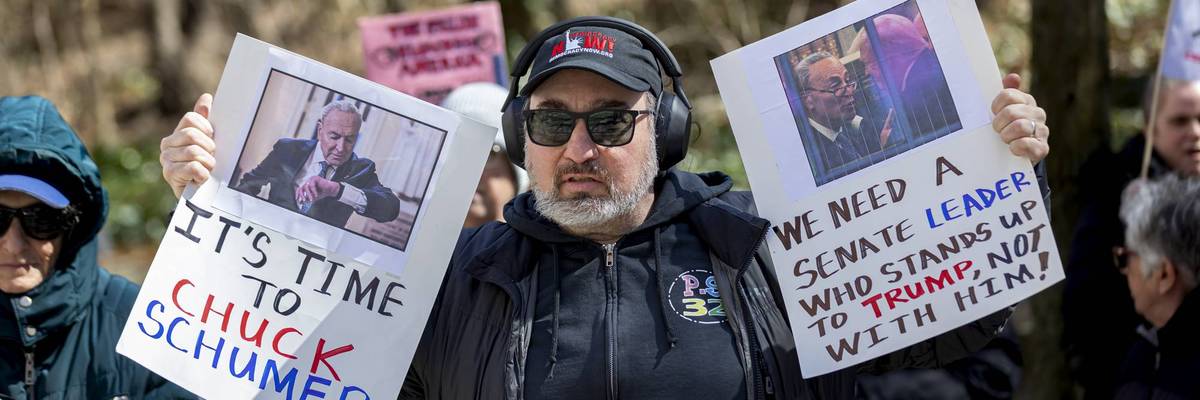
Hundreds rally outside of Senate Minority Leader Chuck Schumer's (D-NY) home. Protestors are calling for Schumer to resign after what they call "a devastating lack of leadership" after he voted for a GOP-written funding patch to avert a government shutdown, claiming it was the better of two bad options. .
Progressives are about to be sandwiched between Trump fascism and the Blue-nami’s corporate undertow that threatens to drown change.
What will the Democrats do now with their momentum and partial power? Can this Blue Wave moment be channeled into concrete, meaningful change? Will progressive leaders and movements do everything in their power to make it happen?
At minimum, the Democratic wins provide a thunderous coast-to-coast rebuke and political balancing against Trump’s reign of terror and MAGA’s maniacal hatred and cult worship. The Blue-nami offers a ray of hope and possibility that there may be some sanity left in this country—perhaps a flicker of light at the end of this long, gruesomely dark Trump-MAGA tunnel. Perhaps, and subject largely to what Democrats and independent social movements do next.
Will the Democrats deliver meaningful change beyond opposing only the most glaringly hideous aspects of Trumpism? How do progressives in Congress and independent movements outside of it channel the Blue Wave into rivers of real progress for people and our planet? Or does the corporate Democratic establishment (Jeffries, Schumer, et al.) retain power and stifle meaningful change despite this nationwide voter mandate?
It is the job of progressives inside and outside of Congress... to ensure that the Blue Wave isn’t just a feel-good mirage that quickly evaporates into the status-quo ether.
If all the Democrats do with their new majorities is block or slow Trump and launch hearings and investigations, and a couple of incremental technocratic tweaks toward affordability, that will be both a net positive and a profound failure that falls vastly short of this moment and momentum.
Beyond defeating Trumpism and MAGA, what’s urgently needed now is an aggressive push toward serious, bold change, including:
There are other urgent needs—from anti-corruption and anti-trust reforms to serious climate action, which is little-mentioned these days—and accomplishing any of the above will be a steep uphill climb. Even as this Blue Wave crests at epic heights, Trump and Republicans have signaled war rather than conciliation by elevating fascist bigot Stephen Miller and MAGA cheerleader Jim Jordan. Likewise, a massive undertow of corporate Democratic establishment interests threatens to drown out the tidal wave upwelling for change.
Can progressives channel this Blue-nami into concrete, meaningful improvements for people’s lives? The Progressive Caucus, now boasting at least 105 members, may hold the answers—but it needs to be disciplined and strategically withhold its votes for leverage on key agenda items. For this potentially powerful group to have any real clout, it has to enforce some inter-caucus discipline. They must hold the line on key votes—but will they?
In an interview for The Progressive last year, the new chair of the Progressive Caucus, Rep. Greg Casar (D-Texas), told me caucus unity is a priority: “This is an area where [former] Chair Jayapal did great work. We have updated our bylaws to require a lot more caucus unity. We’re going to be trying to reclaim a majority on this populist economic agenda. I think we’re going to really leverage Progressive Caucus votes to make sure that those votes come to the floor.”
However, a RootsAction report I wrote a few years ago, “Progressives In Name Only,” documented how many caucus members regularly voted against the group’s stated principles, such as Medicare for All and cutting military spending. When members vote against caucus principles, the caucus loses leverage. In the new Congress, Democrats will have a projected 83-vote majority, meaning they can “afford” to lose many progressives on votes—but they can’t afford to lose all 105 Progressive Caucus members.
The battle over Senate Majority Leader is an important proxy fight for the party’s direction, with progressive-backed Senator Chris Van Hollen (D-Md.) mounting a significant challenge to dreary, AIPAC-sponsored Schumer. Distressingly, even many Democrats who identify as progressives, including former Progressive Caucus Chair Pramila Jayapal, AOC and Ro Khanna, have lined up behind Hakeem Jeffries for Speaker, despite his record as a top AIPAC recipient who unwaveringly supports Israel even as it commits genocide and war crimes.
It seems there is a consensus that Jeffries won’t be defeated, and nobody wants to make enemies with the incoming Speaker. But the question needs to be asked, why didn’t a large group of progressives withhold their support for both strategic and moral reasons? A handful of incoming representatives said they would not yet commit to Jeffries, but it’s unclear if they’ll maintain that initial reluctance. More than one million have signed petitions opposing Jeffries, and constituents have flooded their reps’ offices with calls and emails urging an alternative—with Rep. Ayanna Presley (D-Mass.) gaining widespread support but apparently declining the invitation.
Progressive voters and movements need to keep the pressure on, and keep asking—what did we elect these folks for, if not to fight for the changes we most desperately need?
The facile response is, it was never in the cards so why fight a losing battle for the speakership? Democrats need “unity” now after this big election win, many insist. But the real goal of the Democratic establishment is to avert any major reforms that challenge their corporate and AIPAC donors and prevent any systemic change. The question is, when and how will progressives in Congress unite to build and use their power?
It is the job of progressives inside and outside of Congress—electeds, social movements, and masses of active, engaged individuals—to ensure that the Blue Wave isn’t just a feel-good mirage that quickly evaporates into the status-quo ether. All progressive groups and forces nationwide need to strategically collaborate and build and use leverage to force the changes people need and are crying out for.
While accountability for the Trump administration is a key watchword for the new Democratic majority, the electorate and movements must get ready to hold the Democrats accountable, too. In less than a week since their historic thumping of the cult-addled elephants, Democrats have at least twice betrayed their constituencies: 22 of them voted with Republicans for a disastrous bill that amounts to a huge giveaway to Big Oil; and 11 Democrats managed to miss the vote to impeach maniacal war-criminal War Secretary Pete Hegseth.
Progressives and the many millions of Americans calling for fundamental changes are about to be politically sandwiched between fascist Trump and the corporate Democrats. We must gear up to fight both of these forces that stand in the way of progress and change. If the corporate Democratic establishment succeeds in stifling these changes—from Medicare for All to ending aid to Israel to raising the federal minimum wage, and more—it will only give rise to more reactionary MAGA politics and politicians.
Progressive voters and movements need to keep the pressure on, and keep asking—what did we elect these folks for, if not to fight for the changes we most desperately need? If we want real change from the Democratic Blue Wave, we're going to have to fight for it.
This country and this world are at a monumental crossroads. US voters have an opportunity to beat back the forces of fascism and confront the billionaires who are rigging the economy, our media system, and our democracy, making it increasingly impossible for ordinary people to get by. We’re not just talking about the election. We’re talking about what must be done once these fascist elements are vanquished from power. We need a bolder set of solutions than what either major party has so far been willing to offer and a working-class movement ready to fight like hell for it. Trump didn't emerge from nowhere. The conditions that fueled MAGA authoritarianism were created by decades of radical neoliberal economic policies and a corrupt political system dominated by corporate interests. They slashed taxes on the super-rich, promising that the benefits would trickle down. They said giveaways to the corporate titans would make life more affordable for the rest of us. It was all bullshit. And when a bitter, betrayed populace searches for someone to blame, right-wing demagogues have little trouble finding scapegoats. People know when they're being lied to, but you won't hear any of this from the corporate media. Only independent journalism—powered and funded by people who believe in building a better world—can deliver truly trustworthy daily news. If you share our vision, please contribute whatever you can to sustain our work. |
What will the Democrats do now with their momentum and partial power? Can this Blue Wave moment be channeled into concrete, meaningful change? Will progressive leaders and movements do everything in their power to make it happen?
At minimum, the Democratic wins provide a thunderous coast-to-coast rebuke and political balancing against Trump’s reign of terror and MAGA’s maniacal hatred and cult worship. The Blue-nami offers a ray of hope and possibility that there may be some sanity left in this country—perhaps a flicker of light at the end of this long, gruesomely dark Trump-MAGA tunnel. Perhaps, and subject largely to what Democrats and independent social movements do next.
Will the Democrats deliver meaningful change beyond opposing only the most glaringly hideous aspects of Trumpism? How do progressives in Congress and independent movements outside of it channel the Blue Wave into rivers of real progress for people and our planet? Or does the corporate Democratic establishment (Jeffries, Schumer, et al.) retain power and stifle meaningful change despite this nationwide voter mandate?
It is the job of progressives inside and outside of Congress... to ensure that the Blue Wave isn’t just a feel-good mirage that quickly evaporates into the status-quo ether.
If all the Democrats do with their new majorities is block or slow Trump and launch hearings and investigations, and a couple of incremental technocratic tweaks toward affordability, that will be both a net positive and a profound failure that falls vastly short of this moment and momentum.
Beyond defeating Trumpism and MAGA, what’s urgently needed now is an aggressive push toward serious, bold change, including:
There are other urgent needs—from anti-corruption and anti-trust reforms to serious climate action, which is little-mentioned these days—and accomplishing any of the above will be a steep uphill climb. Even as this Blue Wave crests at epic heights, Trump and Republicans have signaled war rather than conciliation by elevating fascist bigot Stephen Miller and MAGA cheerleader Jim Jordan. Likewise, a massive undertow of corporate Democratic establishment interests threatens to drown out the tidal wave upwelling for change.
Can progressives channel this Blue-nami into concrete, meaningful improvements for people’s lives? The Progressive Caucus, now boasting at least 105 members, may hold the answers—but it needs to be disciplined and strategically withhold its votes for leverage on key agenda items. For this potentially powerful group to have any real clout, it has to enforce some inter-caucus discipline. They must hold the line on key votes—but will they?
In an interview for The Progressive last year, the new chair of the Progressive Caucus, Rep. Greg Casar (D-Texas), told me caucus unity is a priority: “This is an area where [former] Chair Jayapal did great work. We have updated our bylaws to require a lot more caucus unity. We’re going to be trying to reclaim a majority on this populist economic agenda. I think we’re going to really leverage Progressive Caucus votes to make sure that those votes come to the floor.”
However, a RootsAction report I wrote a few years ago, “Progressives In Name Only,” documented how many caucus members regularly voted against the group’s stated principles, such as Medicare for All and cutting military spending. When members vote against caucus principles, the caucus loses leverage. In the new Congress, Democrats will have a projected 83-vote majority, meaning they can “afford” to lose many progressives on votes—but they can’t afford to lose all 105 Progressive Caucus members.
The battle over Senate Majority Leader is an important proxy fight for the party’s direction, with progressive-backed Senator Chris Van Hollen (D-Md.) mounting a significant challenge to dreary, AIPAC-sponsored Schumer. Distressingly, even many Democrats who identify as progressives, including former Progressive Caucus Chair Pramila Jayapal, AOC and Ro Khanna, have lined up behind Hakeem Jeffries for Speaker, despite his record as a top AIPAC recipient who unwaveringly supports Israel even as it commits genocide and war crimes.
It seems there is a consensus that Jeffries won’t be defeated, and nobody wants to make enemies with the incoming Speaker. But the question needs to be asked, why didn’t a large group of progressives withhold their support for both strategic and moral reasons? A handful of incoming representatives said they would not yet commit to Jeffries, but it’s unclear if they’ll maintain that initial reluctance. More than one million have signed petitions opposing Jeffries, and constituents have flooded their reps’ offices with calls and emails urging an alternative—with Rep. Ayanna Presley (D-Mass.) gaining widespread support but apparently declining the invitation.
Progressive voters and movements need to keep the pressure on, and keep asking—what did we elect these folks for, if not to fight for the changes we most desperately need?
The facile response is, it was never in the cards so why fight a losing battle for the speakership? Democrats need “unity” now after this big election win, many insist. But the real goal of the Democratic establishment is to avert any major reforms that challenge their corporate and AIPAC donors and prevent any systemic change. The question is, when and how will progressives in Congress unite to build and use their power?
It is the job of progressives inside and outside of Congress—electeds, social movements, and masses of active, engaged individuals—to ensure that the Blue Wave isn’t just a feel-good mirage that quickly evaporates into the status-quo ether. All progressive groups and forces nationwide need to strategically collaborate and build and use leverage to force the changes people need and are crying out for.
While accountability for the Trump administration is a key watchword for the new Democratic majority, the electorate and movements must get ready to hold the Democrats accountable, too. In less than a week since their historic thumping of the cult-addled elephants, Democrats have at least twice betrayed their constituencies: 22 of them voted with Republicans for a disastrous bill that amounts to a huge giveaway to Big Oil; and 11 Democrats managed to miss the vote to impeach maniacal war-criminal War Secretary Pete Hegseth.
Progressives and the many millions of Americans calling for fundamental changes are about to be politically sandwiched between fascist Trump and the corporate Democrats. We must gear up to fight both of these forces that stand in the way of progress and change. If the corporate Democratic establishment succeeds in stifling these changes—from Medicare for All to ending aid to Israel to raising the federal minimum wage, and more—it will only give rise to more reactionary MAGA politics and politicians.
Progressive voters and movements need to keep the pressure on, and keep asking—what did we elect these folks for, if not to fight for the changes we most desperately need? If we want real change from the Democratic Blue Wave, we're going to have to fight for it.

