SUBSCRIBE TO OUR FREE NEWSLETTER
Daily news & progressive opinion—funded by the people, not the corporations—delivered straight to your inbox.
5
#000000
#FFFFFF
To donate by check, phone, or other method, see our More Ways to Give page.
Daily news & progressive opinion—funded by the people, not the corporations—delivered straight to your inbox.
"If Brazil had tried the crimes of the military dictatorship, it certainly wouldn't be trying another coup attempt now," said one leftist lawmaker. "We can't fix the past, but we can write a new story!"
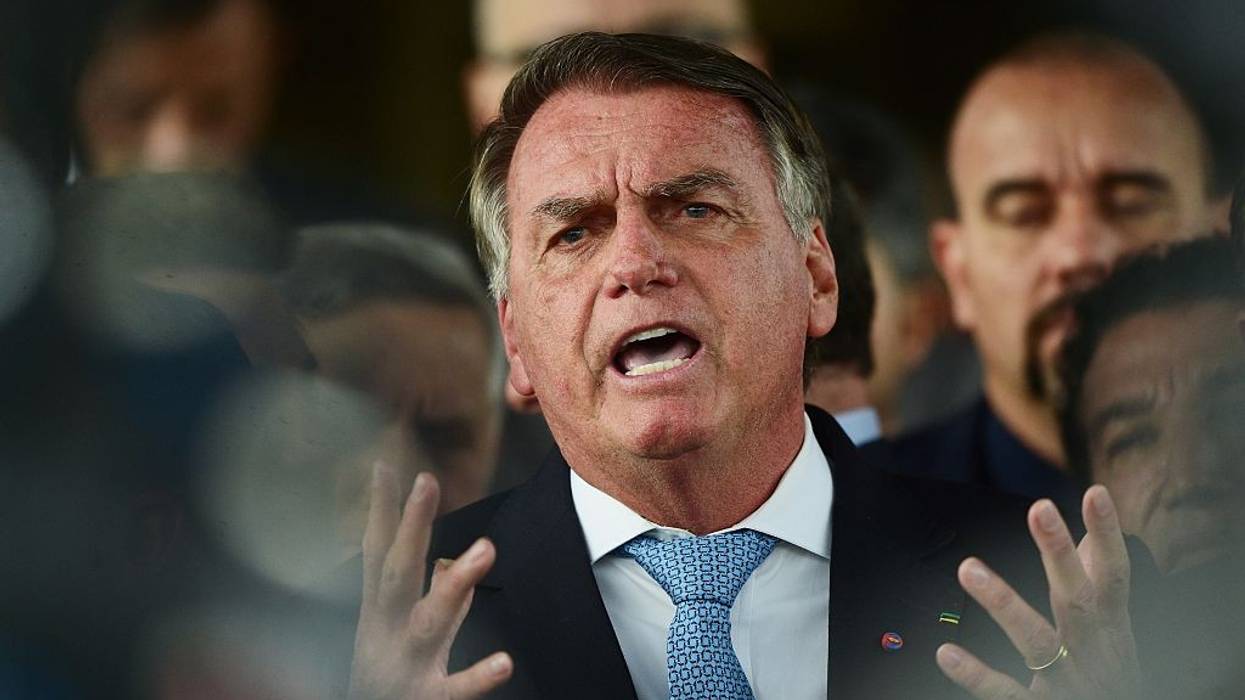
Brazilian leftists including President Luiz Inácio Lula da Silva hailed Wednesday's unanimous ruling by a panel of the Federal Supreme Court compelling former far-right President Jair Bolsonaro and seven associates to stand trial for alleged crimes including an attempted coup d'état following his loss to Lula in the 2022 presidential election.
The panel voted 5-0 to accept a complaint filed by the office of Brazilian Attorney General Jorge Messias to indict Bolsonaro, former Brazilian Intelligence Agency Director Alexandre Ramagem, former Navy Commander Almir Garnier, former Justice Minister Anderson Torres, former Institutional Security Bureau Minister Augusto Heleno, former presidential aide Mauro Cid, former Defense Minister Paulo Sérgio Nogueira, and former Defense Minister and presidential Chief of Staff Walter Braga Netto.
Bolsonaro will stand trial for allegedly attempting a coup, involvement in an armed criminal organization, attempted violent abolition of the democratic rule of law, violent damage of state property, and other charges. A coup conviction carries a sentence of up to 12 years' imprisonment under Brazilian law. However, if convicted on all counts, Bolsonaro and his co-defendants could face decades behind bars.
"It's clear that the former president tried to stage a coup."
The eight defendants are accused of being the "crucial core" of a plan to overturn the results of the 2022 election, which Lula narrowly won in a runoff. Like U.S. President Donald Trump in 2020, Bolsonaro and many of his supporters falsely claimed the contest was "stolen" by the opposition. And like in the U.S., those claims fueled mob attacks on government buildings. Around 1,500 Bolsonaro supporters were arrested in the days following the storming of Congress and the presidential offices.
In February, Prosecutor-General Paulo Gonet indicted Bolsonaro and 33 others for their alleged roles in a plot to overturn the election that included poisoning Lula and also assassinating Vice President Geraldo Alckmin and Supreme Court Justice Alexadre de Moraes, one of the five judges on the panel that issued Wednesday's ruling.
"It's clear that the former president tried to stage a coup," Lula, who is on a four-day state visit to Japan, said in response to the high court's decision. "It is clear from all the evidence that he tried to contribute to my assassination, assassination of the vice president, assassination of the former president of the Brazilian Electoral Court, and everybody knows what happened."
Lula said that Bolsonaro "knows what he did... and he knows that it was not right," adding that "he should prove his innocence... and he will go free."
"Now, he has no way of proving that he is innocent, since he has no way of proving that he did not attempt the coup," Lula added. "I just hope the justice system will do justice."
The former president is already banned from running for any office until 2030 due to his abuse of power related to baseless claims of electoral fraud.
Bolsonaro and his supporters have been pushing for amnesty, an effort Lula recently said "means he's basically saying, 'Guys, I'm guilty.'"
Erika Hilton, a member of the Chamber of Deputies—the lower house of Brazil's Congress—representing Rio de Janeiro in the Socialism and Liberty Party (PSOL), said Thursday on social media, "NO AMNESTY FOR COUP PLOTTERS!"
"We cannot allow these people to be acquitted," Hilton stressed. "This is because the Bolsonarists in Congress want to pardon them, just as the coup plotters of 1964 were pardoned. And Brazil cannot make that mistake again."
Hilton was referring to the U.S.-backed coup that overthrew the democratically elected leftist government of President João Goulart and installed 21 years of military rule characterized by forced disappearances, torture—sometimes taught by U.S. operatives—and extrajudicial murder of at least hundreds of people.
Former Brazilian President Dilma Rousseff, who is a member of Lula's Workers' Party (PT), was tortured by the regime. Bolsonaro, an army officer during the dictatorship, has prasied the military regime while taunting its victims and lauding one of its leading torturers as a "national hero."
Other leftist lawmakers and observers invoked the dictatorship in urging the government to deliver justice to Bolsonaro and his alleged accomplices.
"If Brazil had tried the crimes of the military dictatorship, it certainly wouldn't be trying another coup attempt now," argued Helder Salomão, a PT deputy from Espírito Santo. "It's also true that people like Bolsonaro wouldn't go this far. We can't fix the past, but we can write a new story!"
Ricardo Pereira, a professor and journalist, said on social media that "a despicable figure" like Bolsonaro would not have risen to power had Brazil tried dictatorship-era criminals, adding that "we are belatedly cleaning up history, but at least we are doing this."
Addressing reports that Bolsonaro may attempt to flee to Argentina—which is ruled by right-wing President Javier Milei—or the United States, where he applied for a visa amid his mounting legal troubles in 2023, Ivan Valente, a PSOL deputy representing São Paulo, said: "Thinking about escaping? It won't work, fugitive, you'll get jailed!"
A date for Bolsonaro's trial has not yet been set. The chair of the Supreme Court panel is expected to issue a legal framework within days.
"Then, [Moraes] prepares a report and requests a trial date," Eloísa Machado, a law professor at the Fundacão Getulio Vargas University in São Paulo, told The Associated Press on Wednesday. "After this stage, prosecutors and defense attorneys will present their final arguments before the court rules on whether to acquit or convict."
Responding to Wednesday's ruling, Bolsonaro told the Supreme Court justices, "If I go to jail, I will give you a lot of work."
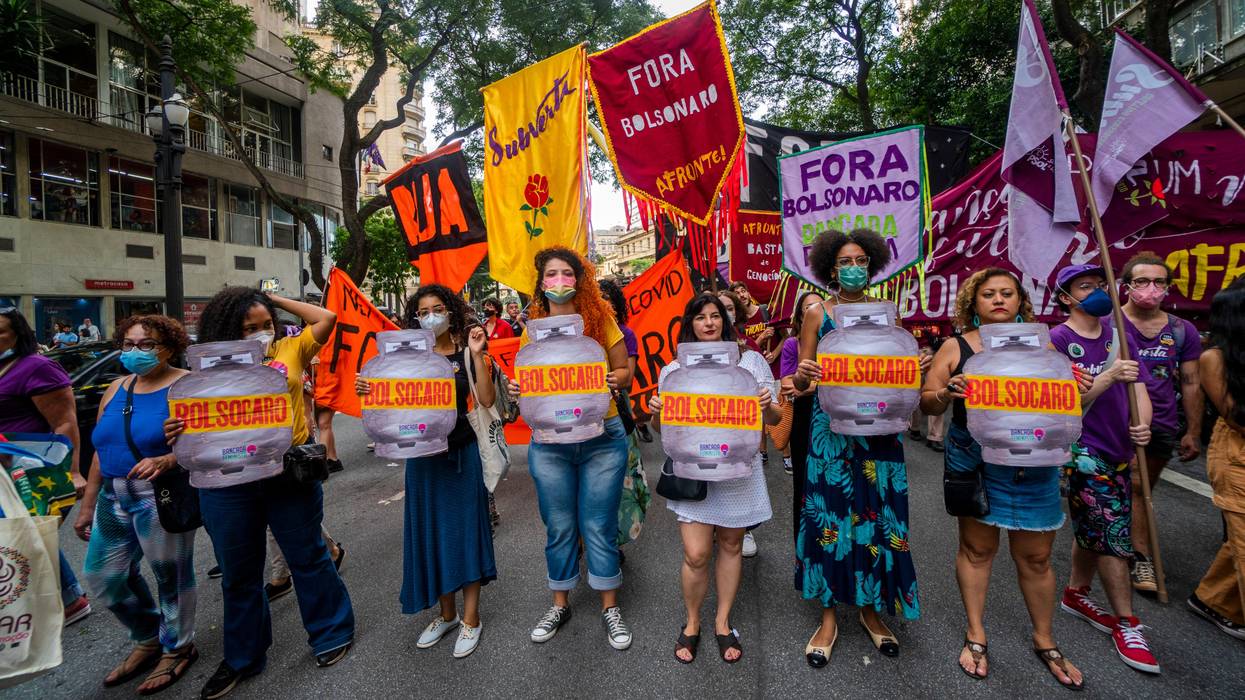
More than 800,000 Brazilians have signed a pro-democracy manifesto ahead of nationwide demonstrations this Thursday and amid growing fears that right-wing President Jair Bolsonaro--who is trailing by double-digits in recent polling--may attempt a coup if he is not reelected in October.
"There is nothing more important than defending democracy and elections."
The proclamation, published by the University of Sao Paulo School of Law, asserts that "the solution to the immense challenges facing Brazilian society necessarily involves respect for the results of the elections. In civic vigil against attempts at ruptures, we cry out in unison: Democratic rule of law, always!"
The letter, which never mentions Bolsonaro by name, is set to be read on Thursday--National Student's Day--at what's being billed as a national mobilization across Brazil in defense of democracy and free elections and against cuts in education spending.
Groups including Unified Workers' Central (CUT), the country's main national trade union center, plan to hit the streets in at least 21 of Brazil's 26 state capitals, as well as in the national capital Brasilia.
"There is nothing more important than defending democracy and elections," CUT president Sergio Nobre told Reconta Ai. "CUT will support all initiatives, manifestos, and actions taken in defense of democracy, the electoral system, and electronic voting machines."
Bolsonaro has often cast baseless aspersions upon Brazil's electronic voting system, which has been in use since 1996 without evidence of irregularities.
Former President Luiz Inacio Lula da Silva--a member of the leftist Workers' Party--leads Bolsonaro by 10 points in aggregate polling for the first round contest, which will take place on October 2. Da Silva's aggregate lead rises to a formidable 17 points in runoff round surveys.
Democracy defenders fear that Bolsonaro and his running mate, former Defense Minister Walter Braga Netto, will be true to their threats to reject the results of the election if they lose under the current electronic voting system.
"We are going through a moment of immense danger to democratic normality, of risk to the institutions of the republic, and of insinuations of contempt for the results of the elections," the new manifesto warns.
The publication continues:
Groundless attacks unaccompanied by evidence question the fairness of the electoral process and the democratic rule of law so hard won by Brazilian society. Threats to other powers and sectors of civil society and the incitement to violence and the breakdown of the constitutional order are intolerable.
We have recently witnessed authoritarian rants that have jeopardized secular American democracy. There, attempts to destabilize democracy and the people's confidence in the fairness of the elections were unsuccessful. Here, they won't be either.
"Imbued with the civic spirit that underpinned the 1977 Letter to Brazilians... we call on Brazilians to be alert in the defense of democracy and respect for the election result," the document's authors implore. "In today's Brazil there is no more room for authoritarian setbacks. Dictatorship and torture belong to the past."
"We have recently witnessed authoritarian rants that have jeopardized secular American democracy."
Brazilian lawyer and former Justice Minister Jose Carlos Dias helped write both the new manifesto and the 1977 Letter to Brazilians, a denunciation of the U.S.-backed military dictatorship that had ruled the country since seizing power in a 1964 coup supported by the CIA and the administration of then-President Lyndon B. Johnson, who ordered a naval task force to Brazil for possible intervention.
The dictatorship--during which Bolsonaro, an army paratrooper, rose through the ranks--ruled through state terror and torture, which was taught by U.S. agents using political prisoners as test subjects. Victims included future leftist President Dilma Rousseff, whose torturer, as well as the dictatorship itself, have been praised by Bolsonaro.
Just as the 1977 letter added fuel to the flames of resistance that eventually brought down the dictatorship and ushered in a transition to democracy, Dias believes the new manifesto can make a difference today.
"I lived under one dictatorship and I do not want to live under another," the 83-year-old told The Guardian. "Brazil is in intensive care. We have an utterly deranged president who... pays homage to torturers and dictators. We face the risk of having to live through a dictatorship once again--and this is inconceivable."
"The polls show [Bolsonaro] will be defeated. But there's no doubt that he's laying the groundwork for a coup," Dias asserted.
"It's my belief that he wants to repeat what happened in the Capitol in the United States," he added, a reference to the deadly January 6, 2021 insurrection spurred by then-U.S. President Donald Trump's "Big Lie" that the 2020 presidential election was stolen by Democrats.
The new Brazilian proclamation follows a July 26 manifesto signed by more than 3,000 business leaders including some of the nation's wealthiest people defending the country's electronic voting system.
Related Content

Earlier in July, a group of Brazilian Jewish academics, jurists, and politicians published a proclamation calling on voters to "defeat Nazi sympathizers" by voting for da Silva in the first round, for "if there is a second round, [Bolsonaro] points to the possibility of a military coup."
Bolsonaro has dismissed signatories to the manifestos--who include da Silva, Rousseff, and many of Brazil's most popular and respected figures--as "cock-faced" and "without character."
"I won't use other adjectives," he said during a speech to bankers on Monday, "because I'm a very polite person."
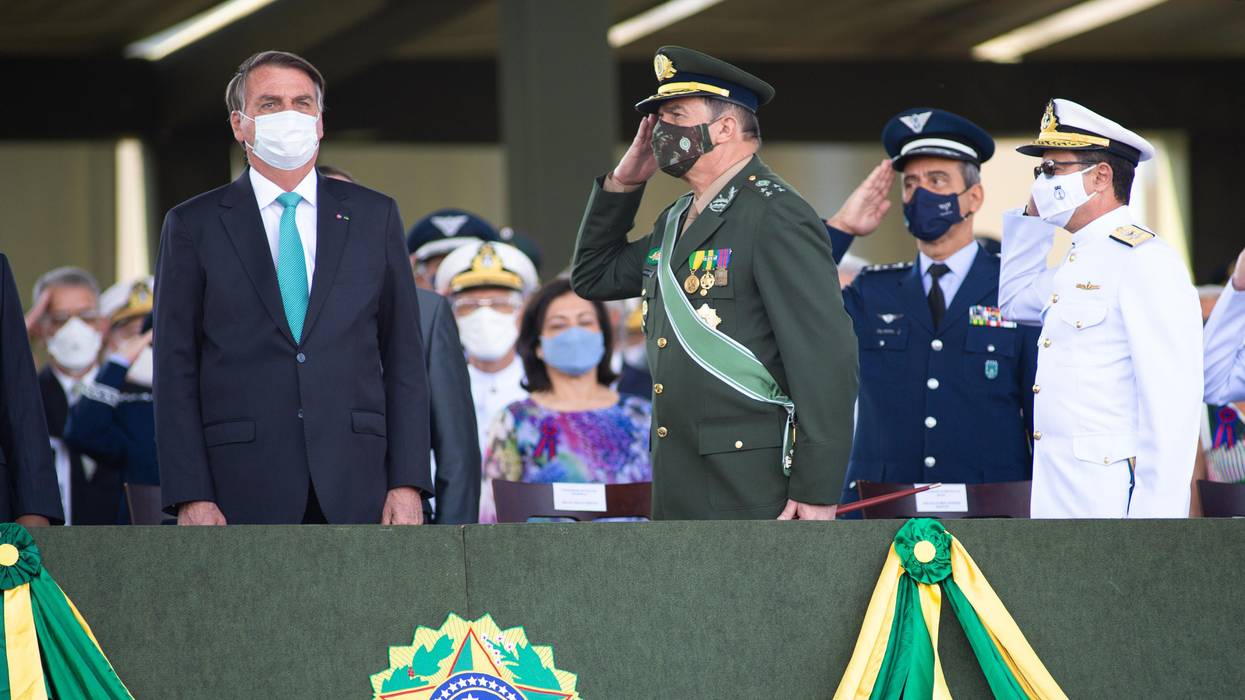
Amid fears that Brazilian President Jair Bolsonaro could attempt a military coup if he loses this October's presidential contest, a group of U.S. congressional Democrats this week proposed a measure that would suspend security aid to Brazil if its armed forces intervene in the election.
Brasilwire's Brian Mier first reported that Reps. Tom Malinowski (D-N.J.), Albio Sires (D-N.J.), Joaquin Castro (D-Texas), Susan Wild (D-Pa.), Ilhan Omar (D-Minn.), and Hank Johnson (D-Ga.) introduced an amendment to the National Defense Authorization Act (NDAA) for Fiscal Year 2023 which, if approved, would require the secretary of state "to review actions by Brazilian armed forces related to that country's October 2022 presidential elections and to consider such actions under statutory guardrails on U.S. security assistance."
"It calls for the discontinuation of security assistance," an insider with knowledge of the measure told Mier. Such assistance to Brazil consists mostly of joint military exercises and six-figure financial support. U.S. President Joe Biden has requested $800,000 in international military education and training funds for Brazil next fiscal year.
The unnamed insider characterized the proposed NDAA amendment as "basically a way of saying, 'you need to consider whether these actions amount to a coup because, if so, that would necessitate cutting off U.S. assistance.'"
As Bolsonaro and his allies continue their unfounded attacks on the integrity of Brazil's electronic voting system, recent polls show him trailing former leftist President Luiz Inacio Lula da Silva--who is running for the office again after being cleared of corruption charges last year--by double digits.
Bolsonaro, who decades ago declared his intention to stage a coup if he was ever elected president, has said he may not accept the results of the election if he loses under the current voting system.
His running mate, Walter Braga Netto, recently told a group of Brazilian business leaders that the armed forces will not honor the results of October's election unless the Superior Election Court changes the ballot system.
Related Content

The last time there was a military coup in Brazil--many progressive observers consider the 2016 impeachment and ouster of former President Dilma Rousseff, also of da Silva's leftist Workers' Party, a political coup--it was backed by the United States.
In 1964, President Lyndon B. Johnson ordered a naval task force to the South American country as far-right elements of the Brazilian military deposed Joao Goulart, the democratically elected president, and his progressive government. Two decades of military dictatorship followed. The regime's forces were trained--including in torture--by U.S. agents.
Bolsonaro, a former army paratrooper who rose through the ranks during and after the dictatorship, has repeatedly praised the brutal regime, under which tens of thousands of people were tortured, murdered, and disappeared. He also infamously honored as a "national hero" a former army officer who tortured Rousseff when she was a young resistance fighter.
While serving as Bolsonaro's defense minister, Braga Netto--who rose to the rank of army captain during the dictatorship--once released an official statement arguing that the 1964 coup should be "understood and celebrated."
Marcelo Rubens Paiva--a Brazilian writer whose father, Rubens Paiva, was disappeared by the military dictatorship in 1971--tweeted earlier this week that Bolosnaro chose Braga Netto as his running mate "not to raise or aggregate votes, but to consolidate his power, with someone obedient and allied to a coup."
A group of Brazilian Jewish academics, jurists, and politicians this week published a manifesto calling on voters to "defeat Nazi sympathizers" by voting for da Silva in the first round, for "if there is a second round, [Bolsonaro] points to the possibility of a military coup."
"Bolsonaro made it very clear that he is not just any extremist," they wrote. "In his statements, he showed his contempt for women, Blacks, Indigenous people, LGBT+, and all minorities, and his willingness to fight--if possible to destroy--everything that was not in accordance with their militia lifestyle and pining for fascism."
The manifesto cited Bolsonaro's "deconstruction of human rights, salary squeezes and high prices, [and] contempt for science--which officially claimed the lives of almost 700,000 people" during the Covid-19 pandemic.
It also notes the return of hunger--which was largely eradicated during the Lula and Rousseff administrations--the destruction of the Amazon rainforest and murder of its Indigenous inhabitants and defenders, and the "gradual strangulation" of the press.
"We have reached the point where all of this can change," the statement's signers asserted. "The elections are approaching, although the militiamen--street or digital--organize themselves to silence the polls and the justice system."
"The polls will be the battleground and the vote our weapon," they added. "We have the obligation and the challenge to defeat fascism."
Progressives around the world cheered Friday as former student activist Gabriel Boric was sworn in as Chile's new president, marking the most profound shift in the Andean nation's political direction since the restoration of democracy and the end of a U.S.-backed military dictatorship three decades ago.
"This is the best generation of young politicians Chile has had in 50 years."
"Before the people and peoples of Chile I promise," Boric said during his swearing-in ceremony at Congress in Valparaiso, "know that we are going to do our best to rise to the challenges we face as a country."
Guests at the Boric's inauguration included a representative from each of Chile's Indigenous peoples, Chilean activists including Gustavo Gatica--who was left blind after being shot in the face during a 2019 Estallido social protest against inequality--as well as foreign dignitaries such as former Brazilian President Dilma Rousseff and former British Labour Party leader Jeremy Corbyn.
Speaking on behalf of the Peace and Justice Project he founded, Corbyn wished Boric "all the best and all our support and solidarity," adding that the new president "has a huge task to heal the wounds of the past, close the gap between the richest and the poorest, and give hope to the next generation."
At age 36, Boric--a democratic socialist who ran on a platform of sweeping progressive reforms--is the youngest-ever Chilean president. He was one of the leading figures in the 2011-13 student protests against educational and societal inequities. Boric was subsequently elected twice to the national Chamber of Deputies representing Magallanes, the Chilean Antarctic region, and emerged as a leading advocate for constitutional reform during the Estallido social uprising, which began in 2019 over a subway fare hike in Santiago and was violently repressed under former right-wing President Sebastian Pinera, a billionaire businessman.
Boric decisively defeated Jose Antonio Kast--head of the far-right Republican Party and a former supporter of longtime U.S.-backed military dictator Gen. Augusto Pinochet--in the runoff round of last year's presidential election. Kast, the son of a German Nazi military officer, ran on a neoliberal economic, law-and-order, and anti-immigrant platform, and also opposes abortion and same-sex marriage.
With 14 women among its 24 ministers, Boric's will be the first majority-woman cabinet in the history of the Western Hemisphere. Its members will include Defense Minister Maya Fernandez Allende--the granddaughter of Salvador Allende, the democratically elected Marxist president who killed himself after he was deposed in the U.S.-backed 1973 coup that brought Pinochet to power--and Sports Minister Alexandra Benado and Education Minister Marco Antonio Avila, the first openly LGBTQ+ cabinet officials in Chilean history.
Marigen Vargas, a 62-year-old who traveled all night to attend Friday's inauguration, told Reuters that Boric "reminds me of Allende, but I hope it has a happier ending. We want a more united, happier Chile."
Boric has vowed to be a president "of all Chileans" while working to expand and improve the welfare state and combat inequality in a nation where the richest 1% of the people hold more than a quarter of all wealth. Constitutional reform--in a 2020 plebiscite, 78% of Chilean voters approved a constitutional re-write--will loom large in his administration.
"It's impossible to separate Boric's victory from the constitutional process," writes U.S. democratic socialist activist David Duhalde. "Many voted for him in order to preserve the process started by the Estallido social. Had Kast won, he would have been unable to stop the drafting, but could have used the bully pulpit of the presidency to push for a 'no' vote in the national referendum to accept or reject the replacement."
The direction of the new government was evident in its first official act: the dismissal of 139 lawsuits that the Pinera administration had filed against protesters charged with violating the dictatorship-era State Security Law during the Estallido social.
In a statement, Justice Minister Marcela Rios and Interior and Public Security Minister Izkia Siches explained the new administration is seeking to ensure that the security law "is not used for unjust and disproportionate persecution."
The ministers also promised to begin the process of determining reparations "for the victims of human rights violations."
Luis Maira, an 81-year-old former leftist federal deputy forced into exile during the Pinochet regime and a mentor to Boric, told The Guardian that "this is the best generation of young politicians Chile has had in 50 years."
"Without a shadow of a doubt," he added, "Boric is leading us into a new chapter of Chilean history."
Beset by political, public health, and environmental crises amid an emerging progressive consensus for his impeachment, historic Cabinet turnover, and soaring Covid-19 deaths, Brazilian President Jair Bolsonaro on Thursday faced a chorus of calls to resign.
"There is no shortage of examples of the way authoritarianism can emerge from the shadows if societies are careless and fail to speak up in defense of democratic values."
--Presumptive 2022 presidential candidates
Calling Bolsonaro "a threat to democracy," opposition lawmakers on Wednesday filed an impeachment request against the far-right president, accusing him of attempting to co-opt the country's military "in an authoritarian way," according to O Globo.
The lawmakers' move came a day after the heads of all three branches of the armed forces resigned following Bolsonaro's dismissal of Defense Minister Gen. Fernando Azevedo e Silva on Monday.
"The use of the armed forces by violent means or based on grave institutional threats is an extremely serious matter," the lawmakers wrote. "Given the dark past lived by Brazil's democratic institutions, such conduct rises to the level of criminal responsibility."
March 31 marked the 57th anniversary of the 1964 U.S.-backed coup that overthrew the democratically elected reformist President Joao Goulart and ushered in a 21-year period of military dictatorship, under which tens of thousands of people--including future President Dilma Rousseff--were tortured, murdered, or disappeared.
Bolsonaro, an army officer during the dictatorship, has prasied the military regime while taunting its victims and lauding one of its leading torturers as a "national hero."
Remembering the coup, former Chamber of Deputies President Arlindo Chinaglia--who like Rousseff and former President Luiz Inacio Lula da Silva is a member of the Workers' Party (PT)--told The Guardian that "we have a president who is trying to pressure the armed forces into serving his coup-mongering, authoritarian delusions."
Marcelo Freixo, a federal deputy representing Rio de Janeiro for the Socialism and Liberty Party (PSOL), asserted Wednesday that Brazilians "cannot be bystanders to this barbarism."
"There is an attempt by the president to organize a coup," said Freixo. "It is already underway, and that is why we are reacting."
On Wednesday, six potential candidates for the 2022 presidential election released a joint statement remembering the destruction of democracy in 1964 and warning that three decades after the restoration of the democratic constitution, "Brazil's democracy is under threat."
"There is no shortage of examples of the way authoritarianism can emerge from the shadows if societies are careless and fail to speak up in defense of democratic values," cautioned the statement.
On the same day, Bolsonaro's replacement defense minister, Gen. Walter Souza Braga Netto, raised eyebrows and ire by releasing an official Defense Ministry statement arguing that the 1964 coup should be "understood and celebrated."
"Events that took place 57 years ago... can only be understood from the context of the time," said Braga. "Brazilians realized the emergency and took to the streets, with broad support from the press, political leaders, churches, the business sector, various sectors of organized society, and the armed forces."
Compounding Bolsonaro's troubles, opposition leaders on Wednesday also asked the Federal Court of Accounts (TCU) to investigate the president for alleged improper payments to social media influencers to promote scienticially dubious Covid-19 treatments.
"It is absurd for the federal government to continue sponsoring advertising campaigns that encourage so-called early treatment, a practice widely contested by the scientific community, without any proof of its effectiveness," the lawmakers' request stated.
One of the departing military chiefs, army Gen. Edson Leal Pujol, had angered Bolsonaro by criticizing his handling of the coronavirus pandemic, which according to Johns Hopkins University has claimed over 321,000 Brazilian lives, the world's second-highest death toll after the United States.
More than 66,000 Brazilians have died of Covid-19 in March, with epidemiologists warning that the crisis will worsen.
Bolsonaro--who has been dubbed the "Trump of the Tropics" for his political and ideological affinity with the former U.S. president--has dismissed Covid-19 as a "little flu," and has refused to follow or promote mask-wearing, quarantine measures, and social distancing. Bolsonaro, who contracted the virus last year, has also encouraged large gatherings and disparaged vaccines.
Adding insult to political injury, "Bolzo Day" trended on Twitter Thursday--April Fools' Day, or as it's called in Brazil, the Day of Lies.
A Brazilian Supreme Court justice on Monday annulled several criminal convictions against former President Luiz Inacio Lula da Silva, restoring the leftist icon's political rights and opening the door for a 2022 bid to unseat far-right President Jair Bolsonaro.
"The decision today affirms the incompetence of the Curitiba federal court and recognizes that we have always been right."
--Attorneys' statement
Folha de Sao Paulo reports Edson Fachin of the Supreme Federal Tribunal ruled that da Silva--commonly called "Lula"--should not have been prosecuted in the city of Curitiba for alleged corruption in the infamous Operation Car Wash scandal. Fachin's ruling was not an acquittal. The justice warned da Silva could still be tried in the capital Brasilia if prosecutors there decide to pursue one of the three other corruption cases in which no verdicts have yet been reached.
In a statement, da Silva's lawyers blasted the "incompetence" and "lawfare" of the Curitiba federal court and the "irreparable damage" caused by Sergio Moro, a judge in the case who allegedly colluded with prosecutors and would later serve as Bolsonaro's justice minister until a falling out with the president led to his firing last April.
Da Silva greeted Monday's news by tweeting that "the decision today affirms the inompetence of the Curitiba federal court and recognizes that we have always been right in this long legal battle."
The restoration of da Silva's political rights means he is likely to run against Bolsonaro in next year's election. "Lula is back in the game," declared the leading Brazilian financial daily Valor Economico.
"The election starts today," Brazilian journalist Thomas Traumann told The Guardian. "It's virtually impossible Lula won't be a candidate. In American terms, it's going to be like [Bernie] Sanders versus [Donald] Trump."
Bolsonaro is a far-right bigot and misogynist who is a climate change and coronavirus skeptic and has praised Brazil's former U.S.-backed dictatorship, under which both da Silva and his successor Dilma Rousseff were jailed. Rousseff was tortured.
Da Silva, a member of the leftist Workers' Party who served as president from 2003 to 2011, is a former labor organizer and an icon of the Brazilian left adored by millions of his compatriots for his lifelong advocacy for the poor, workers, minorities, and rural and Indigenous people. As president, he lifted millions of Brazilians from poverty through sweeping social programs including Fome Zero (Zero Hunger) and Bolsa Familia (Family Allowance), while presiding over Brazil's rise into the top tier of world economies.
However, da Silva's focus on social uplift at the expense of the oligarchy earned him powerful enemies at home, and his solidarity with leftist Latin American leaders and opposition to U.S. imperialism roiled Washington and Wall Street.
Da Silva, who served 580 days behind bars after he was sentenced to over 12 years' imprisonment for Car Wash-related corruption, was released from prison in November 2019 after the Supreme Court found his incarceration unlawful. Both da Silva and Rousseff--who in 2016 was impeached and forced to resign over the scandal--maintain their innocence and accuse right-wing adversaries of perpetrating a political coup.
Rousseff's successor, right-wing President Michel Temer, was also arrested and charged in connection with Car Wash.
Coups have been one of the greatest threats to democracy. The people elect a daring leader willing to take on the status quo. And then, as in Iran in 1953 or Chile in 1973, the military pushes the leader aside to take control. Sometimes the generals remain in power; sometimes they restore a royal to the throne. Often some external force--a foreign intelligence agency, a cabal of corporate interests--plays a key role in denying the people their democratic choice.
Such coups still take place around the world--in Thailand in 2014, in Egypt in 2013, in Honduras in 2009. These more recent coups all give off the rank odor of desperation, as the old order resorts to extreme measures to stave off the demands of a democratic age.
Or maybe not.
A new era has dawned in the world of politics. Like nationalism, authoritarianism did not fade away in the dimming light of the twentieth century. And those who shout "coup" in a crowded political theater are now as likely to be the authoritarians themselves. They present themselves as various iterations of St. George fighting the dragon of the "deep state" on behalf of all the good people back in the village.
It's nonsense, of course. But such nonsense can translate into the winning margin in a close election.
Impeachment as Coup
The prime example of this relatively new phenomenon is Donald Trump. The president has emphasized one message above all during the impeachment proceedings. As he has tweeted:
As I learn more and more each day, I am coming to the conclusion that what is taking place is not an impeachment, it is a COUP, intended to take away the Power of the People.
An ad released by his campaign called the impeachment process "nothing short of a coup and it must be stopped." The final image is of Trump himself with two thumbs up, as though he has personally stopped the coup with nothing other than a glowing review of his own performance in office. Fox News has dutifully followed this script by repeating Trump's language throughout its line-up of putative pundits.
While all the sober citizens of NPRLand watch the Democrats play by the rules in the congressional hearings, the rest of the country is primed to view the proceedings as a circus, a witch hunt, a clown show. They are being led to believe that the very procedure designed to ensure the rule of law is in fact a profound violation of that law.
This is what makes Trump the consummate populist. According to his own self-serving narrative, the elites have always been out to get him, particularly now that he has clawed his way to the top. He should have won the popular vote in 2016 - if it weren't for the (imaginary) meddling of Ukraine. He should have implemented his flagship projects (like the Wall) - if it weren't for the machinations of the (imaginary) "deep state." His party should have won the 2018 mid-term elections - if it weren't for (imaginary) voter fraud. In the dog-whistle symphony of Republican Party politics, Trump's supporters substitute their own imaginary villains: Jews, women, African Americans, Muslims, the undocumented.
Trump implicitly argues that all of these "non-People" - check out the telling visuals in the aforementioned campaign ad - are teaming up under the rubric of the Democratic Party to "steal" back the election from the People. The president must fabricate "the People" in this way because of what should be obvious to everyone: the majority of voters didn't want him to be president, find his policies repugnant, and communicated that disgust very clearly in the 2018 elections.
The truly remarkable part of the "impeachment equals coup" argument is that it's coming from the same people who love to carry around pocket Constitutions. Dahlia Lithwick wrote in Slate back in January 2011:
Members of the Tea Party are really into the Constitution. We know this because on Thursday, House Republicans propose to read the document from start to finish on the House floor, and they also propose to pass a rule requiring that every piece of new legislation identify the source of its constitutional authority.
If they'd read the Constitution from front to finish, they'd know that the document explicitly identifies impeachment as a legal way of removing a president. It's the law of the land. The Democrats have been scrupulous in observing the letter of this law even when it has been counterproductive to do so.
The way Trump talks about impeachment, it sounds as if Alexandra Ocasio-Cortez would suddenly sit in the Oval Office if the president were removed from office. Actually, it would be Vice President Mike Pence. It's a very strange coup indeed that removes a member of one party and replaces him with someone equally noxious from the very same party.
It would be a different matter if the U.S. military were plotting to unseat Trump and replace him with a four-star general. That would indeed be a coup. But the Pentagon has remained loyal to its commander-in-chief, even as he has intervened in several military court proceedings, ignored the sage advice of military advisors (as in Syria), and disparaged key military allies (like South Korea).
The only threat of a coup is, of course, from Trump himself. He has "joked" about serving indefinitely as president. He has attempted to circumvent all the democratic mechanisms designed to constrain his executive power. He seems to delight in flouting the Constitution. Given an inch of executive power, he won't be satisfied until he gets the whole nine yards.
Revolution as Coup
No one would confuse the French revolution for a coup. It was a popular uprising against the monarchy. No one would label the American revolution a coup. It was an anti-colonial struggle for independence. The Haitian revolution, the Russian revolution of February 1918, the Iranian revolution: these were all popular transformations of the existing order.
But today, a number of popular revolts have been labelled coups. The Euromaidan revolution in Ukraine in 2014, for instance, was a protest started by students upset over Viktor Yanukovych's decision to backtrack on a promise to sign an association agreement with the European Union. When the riot police attacked the students, a million people showed up on the streets in Kyiv and protests broke out around the country. Women, and feminist organizations in particular, played a key role, as did other social movements. Nationalist and far right-wing organizations like Svoboda were also present. But a transpartisan consensus emerged over the illegitimacy of the Yanukovych government, his corruption and violations of human rights. This consensus eventually brought enough pressure to bear on the Ukrainian parliament to vote overwhelmingly to impeach Yanukovych - who'd already fled Kyiv - and announce early elections.
Nevertheless, Russian President Vladimir Putin has claimed that what took place in Ukraine was a coup sponsored by the United States. Incredibly, some U.S. voices on the left and even the center have echoed this argument, despite the clearly popular nature of the uprising. Certainly some key U.S. figures, like the State Department's Victoria Nuland, supported the protestors. And plenty of U.S. moves - like the attempted expansion of NATO to Russia's doorstep - raised tensions in the region. But direct U.S. involvement in the Euromaidan, beyond Nuland's distribution of pastries to the protestors (and the riot police), was minimal.
Most critically, the Ukrainian military did not play a role in ousting the Yanukovych regime. Did the subsequent government in Ukraine make mistakes? Of course. But that doesn't somehow make the Euromaidan events retroactively a coup.
From Protest to Coup
The protests against Evo Morales in Bolivia bore a superficial resemblance to the Euromaidan events of 2014. Responding to charges of election fraud in the October election, Bolivians of various political backgrounds, including some trade unionists, feminists, and members of indigenous communities, began to protest. The dissatisfaction with Morales had begun with his earlier refusal to accept the results of a referendum that failed to abolish term limits. Morales argued before the constitutional court that term limits violated his human rights, eventually gaining the "right" to run for his fourth term.
But that's where the similarities end. Morales was a genuinely popular leader, which Yanukovych was not. Morales had brought about many important social reforms, reducing the poverty rate from 60 percent in 2006 to 36 percent in 2017. "His first act as president was to form a constituent assembly charged with writing a new constitution that radically extended political and social rights -- such as equal access to water, work, health, education and housing -- to historically marginalized groups, while offering indigenous autonomy and land rights," writes Natasha Bennett in The Washington Post.
Morales was very likely to win this year's presidential election. The only question was the margin and whether he'd win in the first round. In the face of protests over the election results, he even promised to hold another election.
That's when the military "suggested" that Morales resign. The military's intervention was perhaps not as heavy-handed as in the "post-modern coup" in Turkey in 1997, which led to the resignation of then-president Necmettin Erbakan, but it produced a similar result when Morales stepped down.
And that's when the true takeover occurred, as second vice president of the Bolivian Senate Jeanine Anez Chavez assumed power. Her crackdown on protests have led to at least 30 deaths. She has exempted the military from prosecution for its use of force, has aligned herself with the Christian far right, and consolidated her political control despite the strength of Morales's party Mas. The Trump administration, not surprisingly, has embraced Anez.
An agreement with Mas mandates elections within 120 days. If Anez respects the agreement, if the elections are free and fair, if the military returns to its barracks, then the Bolivian coup might turn out to be limited in scope. But those are a lot of ifs. And it remains a significant step backward for all the marginalized groups that benefited during the Morales era.
The Parliamentary Coup?
When Dilma Rousseff was impeached in Brazil in 2016, she declared the process a "parliamentary coup." Rather than a perpetrator of corruption, she has argued that she was the victim of it: a corrupt elite had her removed to protect itself from investigations.
Rousseff's charge seems to resemble Trump's. Impeachment is as much a part of the Brazilian constitution as the U.S. constitution. She wasn't impeached over major misconduct but rather the narrow charge of concealing a budget deficit. On the other hand, a majority of Brazilians supported impeachment hearings and Rousseff's approval rating was in the low teens.
The impeachment may well have been unfair, but it's hard to call it a coup. Rather, it reflects the deeply divided nature of Brazilian politics and the pervasiveness of corruption such that all sides can weaponize accusations of influence-peddling. In addition to the persistence of caudillo-like leaders in the region--like Brazil's current leader Jair Bolsonaro or Venezuela's Nicolas Maduro--the region still struggles with unmanageable violence, a culture of impunity, deep economic inequality, and fragile political institutions.
But Latin America is not unique in this regard. The debate over whether an impeachment is a "coup"--in Brazil, in Ukraine, in the United States--speaks to the giant step backward that democracy has taken over the last decade. For better or worse, there is no longer a consensus around "normal" democratic practice. The polarization of the electorate now allows for two entirely different concepts of democracy to co-exist - one determined by the rule of law and the other determined by the powerful.
Yes, yes, I know: the rule of law reflects the interests of the powerful. That principle was certainly on display in Brazil. But the rule of law also protects the weak against the predations of the strong. And in this brave new world that Trump presides over, this latter understanding of the rule of law is under siege. It can be seen in how the Trumps of the world are attacking the courts, attempting to roll back the gains of social movements in the area of human rights, and undermining a range of watchdog institutions.
If Trump wins in the Senate and then at the polls in 2020, he won't just beat the impeachment rap. Like Putin in Russia, Viktor Orban in Hungary, Recep Tayyip Erdogan in Turkey, and (so far) Benjamin Netanyahu in Israel, he'll have successfully destroyed the mechanisms that stand in the way of his absolutism.
Hydroelectric power from dams might be the thorniest issue that proponents of the Green New Deal (GND) have to grapple with. Providing more energy than solar and wind combined, dams could well become the key backup "renewable" if it otherwise proves impossible to get off of fossil fuels fast enough.
Rivers and lakes are an integral part of human existence, with virtually all major inland cities being located next to one of them. They provide water for drinking, bathing, food, and medicine. Their sustenance is not just for humans but for untold numbers of tiny organisms, insects, reptiles, amphibians, birds and mammals. Rivers integrate plant and animal life forms and connect human communities to each other.
As capitalism grew, rivers were used to transport huge quantities of lumber from clear cuts, oil from under the ground and coal ripped from mountains. Rivers have been used for trash disposal, as if carrying it somewhere else would make it vanish. Rivers can't make industrial and agricultural poisons disappear either: they can only carry them to lakes, seas and oceans, where they contribute to huge dead zones. Victors of battles have let rivers float human bodies to remind those living downstream of their military prowess.
The advent of electricity meant that those seeking to dominate nature found an extraordinary tool at their disposal - hydro-electric power from dams. There are 57,000 large dams in the world and more could be on the way. Thus, it is important that GND advocates clarify whether they support building more dams or endorse a moratorium on their construction.
Dams were an integral part of economic expansion under Franklin Roosevelt's original New Deal. Building new dams continued after FDR, providing about a third of US electrical power in the 1950s. That proportion has declined in the 21st century, mainly because of expanded fossil fuel use. The greatest wave of global dam-building has been since World War II and 80% of their current use is for hydro-power.
Dams have fragmented over two-thirds of the planet's long rivers. One of the most infamous is Brazil's Belo Monte Dam on the Xingu River. First planned in 1975, it would be the second largest dam system in Brazil and the fourth largest in the world; but opposition stalled it. It was revived during the presidency of Lula da Silva, and tension over its construction mounted under Dilma Rousseff's government. In May 2016 the first turbine went online; 16 main turbines were functioning in September 2019, and completion is scheduled for 2020.
Mongolia hopes to use dams as part of a strategy to move away from fossil fuels. Its action plan is called the "Green Development Policy," which seems to echo the "Green New Deal" proposals of western countries. The Selenge River, a transnational body of water originating in Mongolia, contributes over half the water to Russia's Lake Baikal, which is so huge that it contains about one-fifth of the world's unfrozen fresh water. Other lakes in the area are already shrinking due to water withdrawal, and Lital Khaikin of Toward Freedom tells us that "encroachment of heavy industry threatens the fragile balance of the Baikal and the river-systems that are connected to it."
With many calling for expansion of large dams, it is necessary to consider what this would mean for river life forms, for people living next to or downstream from dams, and for climate change, and what the social and economic costs would be. Here are 10 potential problems with dams.
1. Dams destroy species and disrupt balances between species that make up ecosystems.
According to International Rivers, "The number-one cause of species extinction is habitat loss." Due to the assault on rivers, freshwater ecosystems are likely experiencing the highest loss in biodiversity - higher even than those on land.
The decline of a species often has ripple effects on other species. When salmon reproduction is interrupted on the lower Snake River Dams in the Pacific Northwest, orcas may starve because so few salmon reach the ocean. The first dolphin species made extinct by humans was the river dolphin of the Yangtze, caused by the construction of China's Three Gorges Dam. Less well-known examples abound. The Kihansi Spray Toad of Tanzania - whose habitat was a small area in the spray zone of the Kihansi River waterfall - became extinct in the wild because the Kihansi Dam reduced the spray zone by 90%, dooming the toad.
Plants are likewise threatened by dams. Rowan Jacobsen's 2019 Scientific American article describes how the Falls-of-the-Ohio scurfpea, whose habitat was limited to a few Ohio River islets, became extinct in the 1920s due to dam construction. Another 2019 Scientific American article explains that 85% of insects along the Colorado River lay eggs on its banks. As water levels go up and down according to power needs, the insect eggs often get too dry to survive. This is particularly unnerving because a 2017 paper in the journal PLOS ONE documented a decline of more than 75% in flying insect mass in Germany.
The plants and animals mentioned here are a small cross-section of known species rendered extinct by dams. The key phrase is "known species": it is impossible to know how many undiscovered species of reptiles, amphibians, insects, microorganisms and even birds and mammals no longer exist due to dams. It is also unclear how these extinctions affect broader ecosystems.
Why do dams have such devastating consequences for life forms? They block fish migration and sometimes completely separate spawning habitats from rearing habitats. Still water in a dam's reservoir is a profoundly different environment than flowing water in a river to which species have adapted over millennia. Sediments are critical for maintaining river life downstream but instead accumulate at the bottom of the reservoir. As the NGO International Rivers explains, "Changes in temperature, chemical composition, dissolved oxygen levels and the physical properties of a reservoir are often not suitable to the aquatic plants and animals that evolved with a given river system." Industrial and agricultural chemicals that settle and concentrate in the reservoir are not healthy for fish and other living things.
2. Dams drive people from their homes.
Those of us who grew up watching American TV in the 1950s and 60s had a steady diet of troops driving Indians off the landscape of the country's West. In more recent times, dam-building has done the same thing. The US government, for example, took reservation land from Yuma Indians to build the Hoover Dam in 1933. By the early 1940s, 22 dams were planned for North Dakota, which required evacuating 20,000 people, including many Native Americans.
In Mexico, the building of 4,000 dams from 1936 to 2006 involved the removal of 185,000 people. As Brazil built Belo Monte, the government claimed that only 16,000 people were displaced. But those affected indicated that a more realistic number was 40,000. As dam-building has expanded, an estimated 80 million people have been pushed out of their homes worldwide.
3. Dams undermine indigenous cultures.
Cultural traditions are often closely connected to specific plants, animals, landmarks and bodies of water. When building the New Deal's Grand Coulee Dam robbed land from Native Americans, it broke their connection to salmon. Little known in the western world are efforts by Mongolia to expand dam construction in its northern provinces on the Selenge River and its tributary Eg River. The proposed Shuren Dam on the Selenge would have flooded sacred heregsuurs (graveyards) and archaeological sites in neighboring areas. The Egiin Gol Dam on the Eg would have caused extensive displacement of Mongolian herder communities whose link to Omul, a local species of whitefish, would have been severed. Though opposition led to the canceling of both projects in 2017, what remains is Mongolia's hopes to attract foreign investment from multinational corporations seeking resource extraction and hydro-electricity to power mining operations. Similar projects are reaching their tentacles across the planet.
Re-emergence of stagnant plans is exactly what happened with Brazil's Belo Monte Dam, which was resurrected after being stalled by intense opposition. When it was being massively opposed, a coalition formed between the Munduruku and other Amazonian tribes of Juruna, Kayapo, Xipaya, Kuruaya, Asurini, Parakana, and Arara who occupied the main construction site of the $14 billion undertaking. In June 2013, Munduruku leaders released a letter (translated by Glenn H. Shepard) which included the following:
"We know how the law of nature works through the teachings of the ancients ... animals teach us things that we don't know, and we can interpret the messages ... The animals warn us of dangers that are about to happen... Non-Indians say these are just superstitions but it is for real... You should not play with nature: for us, this is very dangerous... All animals have have mother-spirits, whether fish, or forest animals, birds, plants, fire, earth, wind, waters, even spirit beings, they all have lives... We have sacred places along our Tapajos river and we, the Munduruku, do not disturb these places... What government is this that is speaking against us? And declaring war to finish us off in order to then give our lands to the big landowners, agribusiness, hydro-electric dams and mining companies?"
4. Dams affect far more people than they displace.
People do not have to be pushed out of their homes or watch the flooding of sacred places to be affected by dams. An estimated 400-800 million people in the world who live downstream from dams lose access to clean water, are poisoned by industrial development, and watch resources such as fish shrink along with the quantity of water flowing through rivers. Those living in tropical areas can experience an increase in diseases such as malaria, filariasis, yellow fever, dengue, and schistosomiasis.
5. Conflicts over dams result in the arrest and killing of earth protectors.
Since 2009, the massive growth of dams in Mexico led to the arrest of over 250 people and at least 8 deaths. Global Witness claims that "dams and other water resources" were the third leading industry (behind mining and agribusiness) to be associated with deaths of environmentalists in 2018.
Dams have also been linked to imprisonment and/or killings in many countries, including Burma, China, Colombia, Ethiopia, Guatemala and Sudan. The greatest number of indigenous people massacred was when 440 were killed to make way for Guatemala's Chixoy Dam in 1982. Extreme civil rights violations will undoubtedly rise in proportion to efforts to expand hydro-electric power.
6. Dams can increase the likelihood of wars over water resources.
Any time a river runs through two or more countries, there is a potential conflict over dam-building, especially if hostile relationships already exist. In 1948 - less than a year after Pakistan was created - India began taking water from canals that went into Pakistan. The following month, the Dominion Accord required Pakistan to pay India in return for removing water. But a permanent solution was stalled until 1960 when Jawaharlal Nehru of India and Mohammad Ayub Khan of Pakistan signed the Indus Water Treaty. Many disputes were settled via the Permanent Indus Commission. But in 2017 India built the Kishanganga Dam in Kashmir and developed the Ratle hydro-power station in the Chenab River despite objections from Pakistan. With Narendra Modi's siege of Kashmir, dams are likely to intensify hostilities between the two countries.
Access to water is central to tensions in the Middle East. The Tigris-Euphrates basin, which includes Turkey, Syria, Iraq and western Iran, is rapidly losing water. Conn Hallihan writes "For Syria and Iraq, the problem is Turkey and Ankara's mania for dam building. Since 1975, Turkish dams have reduced the flow of water to Syria by 40% -- and to Iraq by 80%... Israel also takes 87% of the West Bank aquifers, leaving the Palestinians only 13%." Water conflicts will get worse over time: by 2030, 4 out of every 10 people in the world may not have access to water.
Rivers cross international borders of 145 countries, not all of whom get along well. Rivers crossing 9 to 11 countries include the Congo, Nile, Rhine and Niger. Like nuclear power plants, dams would be easy targets during a no-holds-barred war, especially for a country deprived of water due to its opponent's dam.
7. Dams contribute to climate change.
It would be a tragic irony if dams were used to combat climate change, because they are a huge source of greenhouse gases (GHGs). Currently, rivers remove about 200 million tons of CO2 from the atmosphere annually, both by carbon absorption and by carrying silt to the sea where it feeds plankton. Yet dams interfere with rivers' ability to act as carbon sinks, and increase their functioning as a carbon sources.
Building the giant Hoover Dam required 6.6 million tons of concrete. The larger Grand Coulee Dam required 24.3 million tons. Since enormous heat must be used to manufacture concrete, each ton produced releases one ton of CO2 into the atmosphere. In addition, producing steel to reinforce the concrete and build other dam components requires enormous heat, resulting in additional CO2 releases. Of the tens of thousands of large dams in the world, Hoover and Grand Coulee added 30.9 million tons of CO2 to the atmosphere. just for the concrete.
In addition to CO2 released during the manufacture of building materials for dams, organic matter rots in their reservoirs and produces the potent GHG methane. Far from being a minor source of carbon, this methane is estimated to "account for 4% of all human-made climate change, equivalent to the climate impact of aviation."
Third, dams interfere with rivers' transporting silt and nutrients downstream, which impairs the ability of downstream ecosystems to remove carbon. The result is that some hydro-electric projects can create higher GHG emissions than coal-powered plants producing an equivalent quantity of electricity. In other words, dams are hardly a clean, green, carbon-free energy machine.
8. Dams increase the gap between rich and poor.
Approval for dam-building often begins with investors' enlisting politicians to act as a link between them and the population. Politicians promise that the project will bring wealth to all. By the time it becomes clear that this is not happening, the politician is out of office or distracting people with another big promise.
In 1933, construction of the New Deal's Hoover Dam meant pushing the Yumas off their reservation land so that a boom in energy production could swell corporate profits in the US Southwest. As a sop for losing the reservation, the Yumas received five acres apiece with assurance that they could grow more crops due to new irrigation systems. Meanwhile, land was sold to whites in 40- to 100- acre parcels.
Construction of the Belo Monte Dam reflects a common occurrence. Though thousands of Indians were displaced, the energy created did not benefit them, but went to businesses such as aluminum smelters.
Since they can be constructed in small quantities, wind and solar power are often the best source of energy for sparsely populated areas. By contrast, International Rivers points out that "large hydro-power dams depend on central electric grids, which are not a cost-effective tool to reach rural populations, particularly in Sub-Saharan Africa and the Himalayas."
9. Dams cost much more than promised.
Many factors feed into making dams hyper-expensive. The most obvious is the cost of construction, which has totaled $2 trillion since 1950. A small country persuaded to use hydro-power as its major source of energy can find that the average cost overrun of 96% leaves it more indebted to and controlled by international lenders than it ever anticipated.
Dams lead to more dams. As investors and industrial manufacturers and mine owners reap riches from one dam, they have an incentive to construct more. This contributed to the US Colorado River's being fragmented by at least 60 dams. Awareness that the Belo Monte Dam would make more upstream dams economically viable was a major source of opposition to it.
A third reason for dams being more expensive than promised is that maintenance is hardly, if ever, fully accounted for. Silt eventually interferes with the dam's functioning. Turbines malfunction, cracks occur, design flaws appear and maintenance can be insufficient. For a combination of reasons, over 1,000 dams have been removed in the US and the price of removal is rarely mentioned in cost projections.
The fourth and most costly source of expense overruns for dams comes when they fail. When negotiating over a dam's price, the construction company is highly unlikely to admit its life expectancy. This brings us to the last of the 10 problems with large dams.
10. Dams break.
Unlike the extinction they cause, dams are not forever. And with today's standards for privatized construction, they can be expected to last for shorter time periods than Roman coliseums and vastly less than Egyptian pyramids. As Donald Worster wrote in Rivers of Empire :
"Steel penstocks [structures that carry water from the forebay tunnel to the power house to run the turbines] and headgates must someday rust and collapse. Concrete, so permanent-seeming in is youth, must turn soft and crumble. Heavy banks of earth, thrown up to trap a flood, must eventually, under the most favorable circumstances, erode away."
On March 14, 2019, the Spencer Dam on the Niobrara River in Nebraska, which was 90 years old, failed due to heavy rain and flooding. The community was left wondering if a missing person had been drowned.
Americans who are old enough might remember the February 1972 collapse of the Buffalo Creek Dam for coal waste that burst and sent water flowing into nearby mining towns, drowning 125. In June of the same year the Canyon Lake Dam in South Dakota got clogged with debris until it broke: 238 lives were lost in downstream communities around Rapid City.
Failure to learn from these events led to completion of the Teton Dam in southeastern Idaho. Scientists wrote of dangers of putting a large structure in one of the most active earthquake zones in the US, adjacent to cracked and fragile canyon walls. Less than a year after completion it began springing leaks and in June 1976 it collapsed, killing 11 people and 13,000 cattle and washing away homes and a billion tons of topsoil.
The New England Historical Society documented the US's first major disaster as the Mill River Dam collapse of 1874, which caused 139 deaths. The worst such disaster in the US happened only 15 years later when warnings regarding the South Fork Dam near Johnstown, Pennsylvania were followed by its collapse, which killed 2,209.
Eric Fish penned the disturbing story of the 1975 Banqiao Dam collapse, by far the most deadly the world has experienced to date. As part of the "Harness the Huai River" campaign, the dam in China's Henan Province was completed in 1952. By the 1970s, thousands of other dams had been built across China. Scientific studies warned that those projects could raise Henan's water tables over safe levels. More warnings were issued that deforestation and mining could further increase the danger of building still more dams in an earthquake-prone zone already fraught with landslides. Committed to rapid economic growth, the government ignored the warnings.
Cracks appeared almost as soon as the reservoir began filling up. With Soviet help, the structure was reinforced and it was called the "Iron Dam" to assure everyone of its safety. Nevertheless,
"... on Aug 5, 1975, a typhoon collided with a cold front over Henan and dropped the area's average yearly rainfall in less than 24 hours. The 106 cm of rain that fell that day dwarfed the 30 cm daily limit the dam's designers had anticipated. Witnesses said that the area was littered with birds that had been pummeled to death by the intense rainfall.
"In an effort to mitigate downstream floods that were already severe, Banqiao was ordered not to fully open its sluice gates early in the storm. Then communication lines were knocked out, leaving operators guessing as to how the situation outside was unfolding. By the time the gates were fully opened, it was too late. Water was rising faster than it could escape."
A hydrologist had recommended building 12 sluice gates (which let water flow out at the base of a dam), but only 5 went into the final design and they were partially blocked by silt. Collapse of the Banqiao unleashed a 50 km/hour tidal wave down the river that knocked out 62 additional dams. Entire villages were swept away within minutes. One survivor recalled "I didn't know where I was - just floating around in the water, screams and cries ringing in my ears. Suddenly, all the voices died down, leaving me in deadly silence."
During the six hours that water poured out of the reservoir, 26,000 lives were lost. Those living downstream soon envied the dead. The same torrent that flooded the reservoirs also washed out roads and knocked out rescue communication systems. When the rescue teams finally arrived, they found people standing on rooftops, holding onto trees or stranded on bits of dry land. They had kept themselves alive by eating tree leaves, floating animal carcasses or scavenged food that was often rotten. Hunger was joined by disease and summer heat. For every person who died after the initial dam collapse, five more died from disease or plague. The total estimated death count was 171,000.
Perhaps the greatest tragedy of the Banqiao is that the same dynamics for economic growth that laid its foundations continue to flourish. In 2011, Zhang Jinxuan, director of the Nujiang National Development and Reform Commission, spoke of China's growth: "We must proceed. The resources here are too good. Not to develop is not an option." China has thousands of dams at risk of breach, either because they are wearing out due to age or they are newer with poor construction. Zhou Fangping, with the Water Resources Department of Guangdong Province, has serious worries about the huge quantity. He told China Economic Weekly:
"We have so many rivers to manage and so many irrigation and water conservancy projects. If there's only one project, we can handle it, but there are so many... either we promise to complete all the projects but we don't actually meet the targets, or we finish them all but with sub-standard quality."
China is hardly the only country which refuses to learn from Banqiao. Scientists still make recommendations that are ignored, either from a corporate desire to make more profits or from a bureaucratic state desire to expand its power. In the US, 24 of every 25 US dams are privately owned, with financial incentives to minimize repairs. Across the globe, more and more industrial plants full of toxic chemicals are located next to rivers, increasing potential hazards of flooding. Decision-makers refuse to understand that climate crisis means that the weather events that cause dam disasters are becoming more frequent and more extreme. They continue to build multiple dams on the same river. They seek to assure their citizens that past disasters were due to design problems and that "Generation Next" dams will be safe.
After thousands of years of warnings from philosophers and religious prophets that humanity can live prosperously by having less grandiose desires, political leaders insist that happiness flows from a fountain of possessions, which, in the 21st century, is a fountain of energy. The more power that leaders have over other people, the more power they seek over nature. Instead of trying to work with nature to strengthen local communities, they cling to technocratic ideologies that "bigger and more complicated" is better. If a previous dam broke, they fail to see the problem as the dam's existence - they insist that if the next dam is bigger, with more concrete and more electrical parts, then the river can be controlled.
Though efforts to subdue rivers have long caused problems, modern capitalism has transformed this pathological view into cultural psychopathy. Psychopathy reflects a lack of guilt or shame over the damage that one causes. A corporation is a social entity which is unable to feel guilt or shame for undermining the survivability of humans and millions of other life forms.
After thousands of years of disrupting natural water flow, which has been exponentially accelerated during recent decades, it is past time for humanity to restore rivers and streams while maintaining a high quality of life. This is why "500 organizations from 85 countries call on governments, financiers and other institutions to keep large hydro-power projects out of their initiatives to address climate change."
Given the incredibly destructive consequences of efforts to dominate the free flow of water, supporters of the Green New Deal (GND) should end their silence on policies for dams. Do they agree with the 500 organizations that there should be a moratorium on new dam construction? Or, do they want to improve existing dams with structural supports, such as the Soviet Union did with China's Banqiao Dam? Do GND advocates call for existing dams to be dismantled or partially decommissioned?
An even more critical question addresses what would happen if the goal of eliminating fossil fuels usage within 10 years cannot be accomplished with solar and wind power. It is becoming increasingly obvious that the massive growth of solar/wind technology cannot expand at such an enormous rate in this time period, and, if it were seriously attempted, it would cause disastrous ecological and human health problems. Though every source that provides data on sources of energy assigns different percentages to each sector, a reasonable estimate is that in 2018, global energy was supplied by 85% fossil fuels, 7% hydro-power, 4% nuclear power and 4% solar and wind power. Hydro-electric power from dams and nuclear power are obviously next in line for huge increases in sources of energy if solar/wind cannot replace fossil fuels rapidly enough.
There is another option; but GND plans are silent on it. That option is called "energy conservation." Meaningful conservation would require systemic change by reducing the overall scale of the economy. This would mean relying on vastly more localized economic activity along with less "free trade," corporate domination, and consumerist ideology. It would include using vastly less energy by having compact communities that require less transportation, smaller home space that requires less heating and cooling, less production of energy-absorbing gadgets designed to fall apart or go out of style, and a shorter work week via manufacturing fewer but more durable commodities.
GND enthusiasts need to say which road they advocate traveling. Should we build more dams and nuclear plants even if that means sacrificing biodiversity and human health? Or, would it better to abandon the dream of infinite economic growth? Are GND proponents willing to consider the possibility that life would be better for all species, including humans, if corporations and governments are not allowed to increase energy production? Are they willing to eliminate further big-dam construction from plans for our energy future, so that thousands of aquatic ecosystems might actually have a future?
The Brazilian Supreme Court reversed a 2018 ruling on November 7, upholding the principle of innocent until proven guilty in the 1988 Constitution and declaring it illegal to jail defendants before their appeals processes have been exhausted. Within 24 hours, former President Luiz Inacio Lula da Silva was released to an adoring crowd of hundreds of union members and social movement activists who had maintained a camp outside the police station where he was held, shouting "good morning," "good afternoon" and "good night" to him for 580 consecutive days

The Supreme Court had previously ruled, on April 5, 2018--after a threat from Brazilian Gen. Eduardo Villas Boas--that defendants could be preemptively jailed before their appeals processes played out. Directly afterwards, Judge Sergio Moro pressed for an immediate election-year arrest warrant for the PT party founder at a moment when he was widely leading in all polls. (The far-right candidate who won in the wake of Lula's removal from the race, Jair Bolsonaro, went on to name Moro his "Super Justice Minister.")
Lula's arrest came as part of a wide-ranging international investigation, ostensibly aimed at corruption, called Lava Jato ("Car Wash"), which involved the US Justice Department, US Security and Exchange Commission and Swiss federal police, working with Judge Moro and a public prosecutor team based in the conservative Brazilian city of Curitiba (CounterSpin, 6/21/19). The only charge that prosecutors had been able to stick on Lula was that he had committed "indeterminate acts of corruption."
At the time, the Anglo media ignored US involvement in the investigation, built Moro up as a superhero, and failed to provide any kind of critical analysis of the proceedings against Lula, despite complaints from some of the world's leading legal scholars and human rights activists that the former president was victim of a politically motivated kangaroo court proceeding designed to remove him from the presidential elections.
There was no material evidence linking Lula to any crime. His conviction was based on coerced plea bargain testimony by a single convicted criminal named Leo Pinheiro, director of the OAS construction company, which built the building where an apartment that featured in Lula's case was located. Sentenced to ten years and eight months for paying bribes to Petrobras Petroleum company, Pinheiro originally testified that Lula had not committed any crime, then changed his story twice, implicating Lula before having his sentence reduced to two years and six months. His third and final story stated that Lula had received free renovations on the beach-side apartment in exchange for political favors.
Seventy-three witnesses, including executives from the OAS company, testified that neither Lula nor anyone from his family had ever owned or lived in the apartment. Furthermore, a judge in Brasilia determined in January 2018, as part of a different case, that the vacant apartment still belonged to OAS. The prosecutors were unable to prove that the renovations had ever actually taken place. Although Sergio Moro had barred the press from visiting the site, the MTST housing movement broke in and filmed a video which proved that, contrary to prosecutors claims, the strikingly cheap-looking apartment had never had any of the renovations listed by the prosecutors, including installation of a private elevator and luxury appliances. The Lava Jato task force prosecutors and Judge Moro were unable to prove that they had any legal jurisdiction over a case involving an alleged crime in a different state, Sao Paulo, which has its own court system, after they dropped an initial frivolous charge alleging a connection between the apartment renovations and a money-laundering scheme involving the Petrobras petroleum company. Finally, the alleged renovations, which prosecutors were unable to prove ever took place, in an apartment that they were unable to prove belonged to Lula, supposedly happened three years after he left public office, meaning that it was legally impossible to prove abuse of authority

When Moro, who was declared a Time personality of the year in 2016 (4/21/16), declared Lula guilty of committing indeterminate acts of corruption, Western corporate media made little to no mention of prosecutorial misconduct, which was written about extensively in independent Brazilian media and legal publications. Moro had broken the law on multiple occasions in his zeal to put the former president behind bars. Using a legal loophole dating back to the Inquisition that enabled him to both oversee the investigation and rule on it, he ordered the Federal Police to wiretap Lula's defense lawyers. This enabled the prosecutors to map out all possible moves by the defense and plan their reactions in advance. Moro also illegally wiretapped President Dilma Rousseff, then illegally leaked out-of-context audio to Brazil's largest TV network on the eve of her impeachment hearings. In 2017, US Assistant Attorney General Kenneth Blanco bragged about informal communications with his friends in the Lava Jato task force, which violates Brazilian law by bypassing security protocols.
There was certainly enough information out there to suggest that Lula might be the victim of a political witch hunt to keep him from becoming president. This is, in fact, what the AFL-CIO, Noam Chomsky, Angela Davis, Bernie Sanders and 29 Members of Congress were all saying at the time. However, no shadow of a doubt was allowed to fall over the proceedings in Anglo media. In the New Yorker (7/13/17), Alex Cuadros gushed that Lula's conviction was "the most important criminal conviction in Brazil's history." And the week of Lula's arrest, the Guardian (4/3/18) erroneously claimed that his conviction was connected to an "R$88 million graft scheme" involving Petrobras that Judge Moro had specifically explained in his ruling was not the case.
Behind bars and (illegally) barred from speaking to the press, Lula continued to run for president. Three months after he was arrested, he still led all election polls, with double the support of his nearest competitor. Then the UN Human Rights Committee issued a ruling, legally binding according to both international and Brazilian law, stating that Lula had the right to run for president. But as in the April 5, 2018, Supreme Court ruling, the judiciary decided to make an exception to the law, specifically to bar Lula from the campaign. Less than one month before the elections, the PT party was forced to provide a replacement candidate.
All things considered, the electoral results were better than expected. The PT party remained the largest party in Congress and became the party with the most governors. Last minute candidate Fernando Haddad made it to the final round and received 47 million votes, but it was not enough
Months after Bolsonaro took office, the Intercept's Glenn Greenwald revealed thousands of hours of social media conversations between Lava Jato prosecutors and Moro. They showed the supposedly impartial judge giving instructions to the prosecutors, not only on how to improve the accusations, but on how to conduct a media strategy to commit character assassination against Lula. They exposed collusion with a Supreme Court Justice to issue a gag order preventing Lula from speaking to the press during the leadup to the 2018 presidential elections, in order to aid Bolsonaro's campaign. They showed Lava Jato prosecution task force leader Delton Dallagnol praying to God that Bolsonaro would win the presidential election. Most damning of all, perhaps, is the conversation conducted between Dallagnol and the other prosecutors, only a few hours before the final trial, revealing that they didn't think they had any proof, but that Moro was going to guarantee a conviction.

The US Department of Justice announced in March 2019 that it was going to give Dallagnol and his Lava Jato task force $682 million to open a privately managed "anti-corruption" foundation in Curitiba. The money would come from the $3.5 billion in fines that the DoJ and SEC collected in Lava Jato's process of bankrupting and dismantling Brazil's largest companies in the leadup to the 2016 legislative coup against President Rousseff.
The move was blocked by the Superior Justice Court, but it raised questions among some US lawmakers about how deep the US government's role went in Lava Jato. On August 21, Rep. Hank Johnson (D.-Georgia) and 12 other members of Congress delivered a letter to Attorney General William Barr demanding answers to a series of questions about possible legal and ethical violations committed by the DoJ during its partnership with Moro and Lava Jato. One of the questions reads, "Did DoJ provide assistance with the collection or analysis of evidence compiled by the Lava Jato Task Force and Judge Moro for President Lula's case?"
On September 25, Rep. Raul Grijalva and 14 other members of Congress introduced House Resolution 594, "expressing profound concern about threats to human rights, the rule of law, democracy and the environment in Brazil." Moro is repeatedly criticized in the text of the resolution, which mentions the Intercept leaks, and states that
Sergio Moro, the presiding judge in da Silva's case, acted in a clearly biased manner toward da Silva, violating his right to a fair and impartial judicial process under Brazilian law.
One might think that by now US corporate media would finally begin to question the narrative that Lula is somehow guilty of corruption. Wouldn't American readers be interested in learning about the role their Justice Department played in this process? Aren't the leaked social media chats published by the Intercept relevant to the story of Lula's release, especially since they were mentioned in the Brazilian Supreme Court ruling?
Unfortunately, since Lula's release, none of the major corporate media outlets have mentioned the US Department of Justice role in Lava Jato at all. Although a few papers mentioned the Intercept revelations, they are reframed and rendered less threatening to the narrative, presented in the context of "raising doubts among some" about the investigation.
On the day Lula was released, Bloomberg (11/8/19) ran an article which does not mention illegal collusion between judge and prosecutors. It states instead:
The ex-president was convicted of corruption in 2017 and lost two appeals since then, but he has not exhausted the entire process. He has repeatedly denied wrongdoing and has said he's victim of political persecution.
The Washington Post's first article (11/8/19) on Lula's release also failed to mention the corruption scandal which has enveloped Lava Jato, although it provided a link to a previous article (6/17/19) on that subject.
In two articles about Lula's release, the BBC (11/9/19) likewise ignored the illegal collusion between judge and prosecutors in Lava Jato.
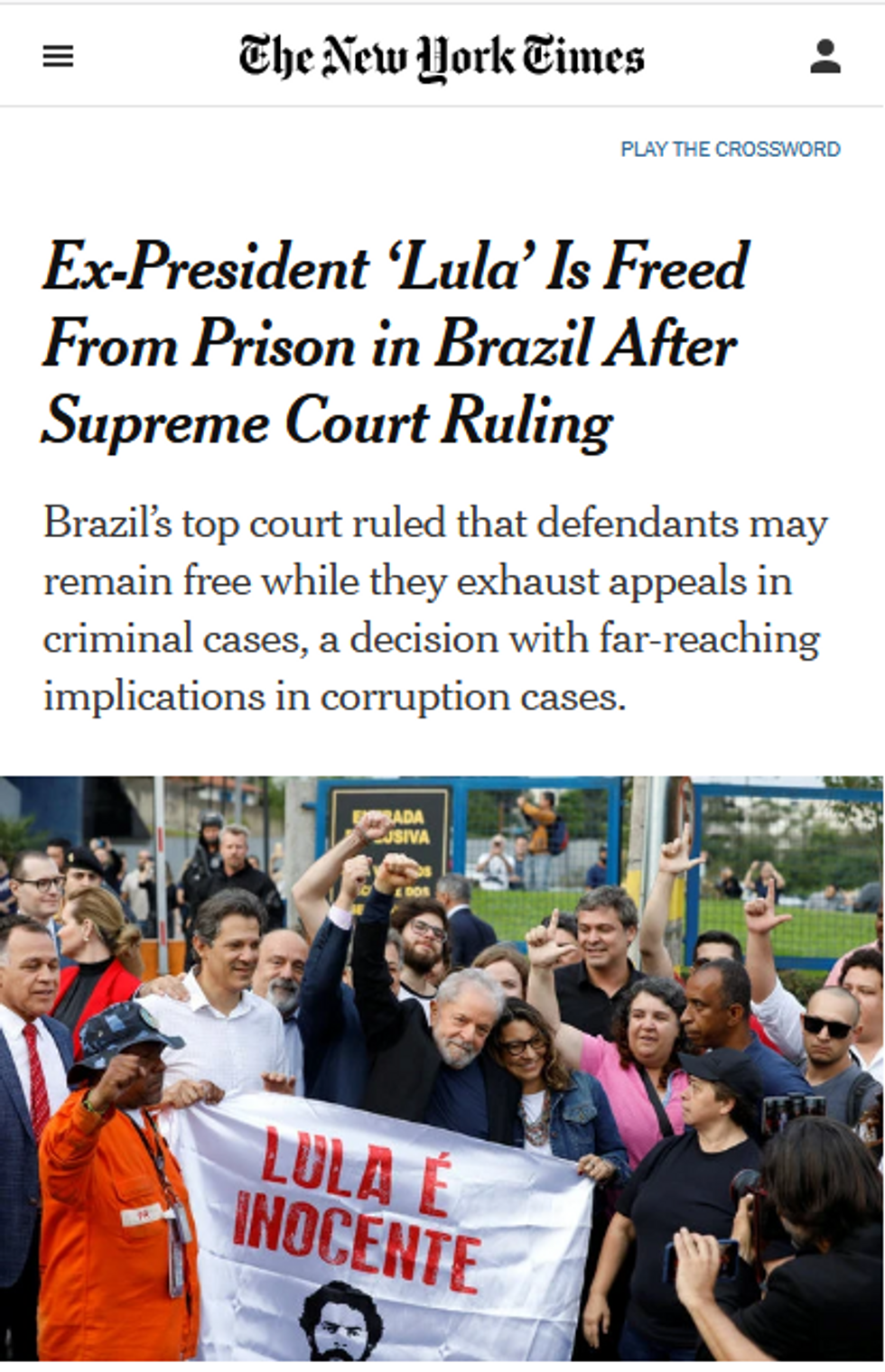
On the day Lula was released, the Guardian, whose Latin America editor Tom Phillips wrote 22 articles normalizing Bolsonaro in October 2018 in the leadup to the elections, made the editorial decision to rerun an AP article that makes no mention of the leaked social media conversations. One day later, the Washington Post's Dom Phillips (11/8/19), who was one of the biggest cheerleaders for Lula's political imprisonment in the international media, briefly mentioned the Intercept revelations and Moro's ethical problems in the context of an article that misrepresented Lula's conviction as being connected to "money laundering," and ended with an uncritical treatment of other frivolous charges against the former president.
The New York Times (11/8/19) mentioned the leaked audio messages, saying that they "made clear, for instance, that Mr. Moro had actively advised prosecutors on strategy in the case, conduct that legal analysts have called an ethical and legal transgression," then quoted Moro on the case and stated that he disputes the idea that he acted improperly.
Despite the evidence of Lula's innocence and illegal persecution, with the cooperation of the US DoJ, that removed him from the 2018 presidential elections, establishment media cling to a false narrative that, while weakened by the subsequent actions of current "Super Justice Minister" Moro, still attempts to damage the public image of the most popular president in Brazilian history.
As the smear campaign continues, it is important to remember that Lula represented a social democratic national development project, in the tradition of what Brazilians call desenvolvimentalismo, based on strategic control over natural resources and their use to fund public services like health and education, strong minimum wage policies and labor rights, increased access to free public universities, and strong investment in scientific research. This is the project that was dismantled after the 2016 coup, to the benefit of corporations like Monsanto, Chevron, ExxonMobil and Boeing. History shows that every Brazilian president who ever tried to implement desenvolvimentalista policies--from Getulio Vargas, Juscelino Kubitschek and Jango Goulart to Rousseff and Lula--has been subjected to a coup, political imprisonment or assassination, with perennial suspicion of US involvement. And as we see corporate media working to normalize the military coup in Bolivia (FAIR.org, 11/11/19), it is clear that this problem is not limited to Brazil.
Former Brazilian President Luiz Inacio Lula da Silva, known as Lula, was freed from prison Friday after a year-and-a-half behind bars due to a politically motivated prosecution from the country's right-wing government.
A large crowd, most decked in Workers' Party red, gathered to welcome Lula back to freedom.
"You don't know how much you represent me," the former Brazilian president told the throng of supporters.
"An extraordinary day in Brazil," The Intercept's Glenn Greenwald tweeted, "for the world, given Lula's stature."
"It's an emotional day," Greenwald added.
"Wow!" Greenwald's Intercept colleague, writer Naomi Klein, replied. "This is big."
For his part, Lula tweeted a video of himself working out, saying "Lula Livre."
Lula was imprisoned in April 2018 after a series of events that The Associated Press described as part of a plot by Brazil's right-wing to seize power:
Da Silva's hand-picked successor, Dilma Rousseff, was impeached and removed from office in 2016. Then Da Silva was jailed in April 2018 after a group of judges upheld his conviction for corruption and money laundering. That left his leftist Workers' Party rudderless, and it was further demoralized when routed in the 2018 general elections.
Sen. Bernie Sanders (I-Vt.), who is running for the 2020 Democratic nomination for president, called for Lula's release from prison in June and remains the only 2020 presidential candidate to do so. Sanders tweeted Friday that he was "delighted" Lula was free," calling the Brazilian leader's imprisonment "something that never should have happened in the first place."
In his remarks to the crowd, Lula repeatedly returned to a message of unity.
"They did not imprison a man," said Lula. "They wanted to kill an idea. And ideas are not killed."