SUBSCRIBE TO OUR FREE NEWSLETTER
Daily news & progressive opinion—funded by the people, not the corporations—delivered straight to your inbox.
5
#000000
#FFFFFF
To donate by check, phone, or other method, see our More Ways to Give page.
Daily news & progressive opinion—funded by the people, not the corporations—delivered straight to your inbox.
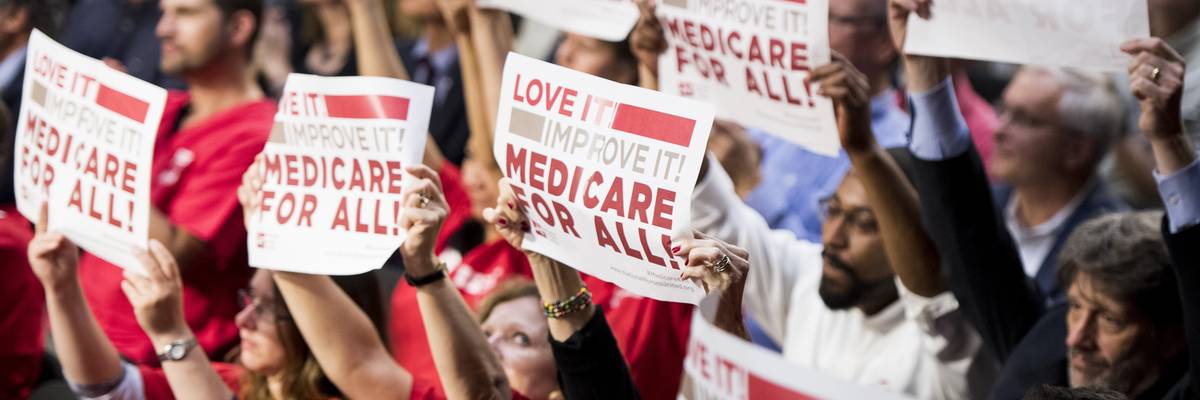
The audience waves signs as Sen. Bernie Sanders, I-Vt., speaks during his event to introduce the Medicare for All Act of 2017 on Wednesday, Sept. 13, 2017.
The urgency to “do something” can be worse than nothing. Let’s get it right the first time.
Dear Member of Congress:
Congratulations on your recent win to represent your constituents in Congress. The people have given you a mandate. Use this victory boldly to achieve National Improved Medicare for All, free from profit. There is no reason for any compromises to be made at this point. We need model legislation that sets the stage for the struggle that is to come. If a principle is not placed on the table at the beginning of the bargaining, it is conceded.
On October 22 (less than two weeks before the midterm elections), Representative Jayapal and others introduced H.R. 10875, the Improving Medicare Coverage Act, legislation that lowers the Medicare age to 50, while leaving private insurance in control of health care.
Our next step should not enrich our opposition further. Our next step should not be another detour away from Medicare for All.
On November 5 (2 days after the midterms), Senator Sanders, the most stalwart supporter of Medicare for All, released a statement where he listed many of the important agenda items that a Democratic majority in Congress must address, including Improved Medicare for All. However, he added, “As an immediate first step Democrats must lower the Medicare eligibility age from 65 down to 55, expand Medicare to cover dental, vision and hearing, and guarantee universal health care coverage for every child from birth to age 19.”
On November 10 (one week after the midterms), fellow Democratic Senator Tammy Baldwin led colleagues in introducing a bill to lower the age of Medicare to 50, touting it would lower health care costs.
Your proposals to “get us to Medicare for All” without actually getting us there are coming fast and furious.
The foremost goal of any national single payer organization is to build a movement that can successfully enact Improved Medicare for All, free from profit, in the shortest time possible. While lowering the Medicare age to 50, or to 55, or adding children, sounds appealing, and a great first step towards Medicare for All, the policy crumbles when it is examined closely and dispassionately.
H. R. 10875 places the financing burden for Medicare for those ages 50 to 64 on the federal government, relieving employers of those costs. The cost of covering those estimated 62 million new Medicare enrollees is unknown, but we can predict it will be massive because the savings of Improved Medicare for All are missing.
Unlike in H.R. 3069, the Improved Medicare for All Act in the House, and S 1506 in the Senate, there are zero cost savings in H. R. 10875, there are no benefit improvements, and there will be no relief from the costs of supplementary care and drug plans.
These “immediate first steps” do not guarantee funding for the 700 rural hospitals at risk of closing and other facilities serving our communities.
What else do these urgent missteps from Congressional leaders fail to do?
Mysteriously, the legislation will sunset after five years, leaving open the possibility of more disastrous consequences, reminiscent of the partisan fight in December 2025, when the enhanced subsidies in the Exchanges were allowed to expire.
The savings of H.R. 3069, Improved Medicare for All, come from the removal of the insurance industry with its high profits and administrative costs, redirecting the savings to be used to improve benefits and to expand those benefits to include everyone. Without those savings, adding millions to Medicare will massively increase federal funding, reinforcing the false conclusion that Medicare for All is too expensive. That will hurt rather than facilitate passing Improved Medicare for All.
Our next step should not enrich our opposition further. Our next step should not be another detour away from Medicare for All. How many times must we fall off the cliff before we force our elected officials to pass legislation necessary to guarantee every resident comprehensive medical benefits from cradle to end of life? The people gave you a mandate. Improve H.R. 3069. Introduce the bill early in 2027. Organize to get Democrats, Independents, and Republicans to cosponsor. Use your pulpit to rally the people into a mighty force. Then pass legislation.
Experienced negotiators know how to put everything on the table upfront. The people have spoken. Do not squander our trust by asking for a half loaf and settling for crumbs.
This country and this world are at a monumental crossroads. US voters have an opportunity to beat back the forces of fascism and confront the billionaires who are rigging the economy, our media system, and our democracy, making it increasingly impossible for ordinary people to get by. We’re not just talking about the election. We’re talking about what must be done once these fascist elements are vanquished from power. We need a bolder set of solutions than what either major party has so far been willing to offer and a working-class movement ready to fight like hell for it. Trump didn't emerge from nowhere. The conditions that fueled MAGA authoritarianism were created by decades of radical neoliberal economic policies and a corrupt political system dominated by corporate interests. They slashed taxes on the super-rich, promising that the benefits would trickle down. They said giveaways to the corporate titans would make life more affordable for the rest of us. It was all bullshit. And when a bitter, betrayed populace searches for someone to blame, right-wing demagogues have little trouble finding scapegoats. People know when they're being lied to, but you won't hear any of this from the corporate media. Only independent journalism—powered and funded by people who believe in building a better world—can deliver truly trustworthy daily news. If you share our vision, please contribute whatever you can to sustain our work. |
Dear Member of Congress:
Congratulations on your recent win to represent your constituents in Congress. The people have given you a mandate. Use this victory boldly to achieve National Improved Medicare for All, free from profit. There is no reason for any compromises to be made at this point. We need model legislation that sets the stage for the struggle that is to come. If a principle is not placed on the table at the beginning of the bargaining, it is conceded.
On October 22 (less than two weeks before the midterm elections), Representative Jayapal and others introduced H.R. 10875, the Improving Medicare Coverage Act, legislation that lowers the Medicare age to 50, while leaving private insurance in control of health care.
Our next step should not enrich our opposition further. Our next step should not be another detour away from Medicare for All.
On November 5 (2 days after the midterms), Senator Sanders, the most stalwart supporter of Medicare for All, released a statement where he listed many of the important agenda items that a Democratic majority in Congress must address, including Improved Medicare for All. However, he added, “As an immediate first step Democrats must lower the Medicare eligibility age from 65 down to 55, expand Medicare to cover dental, vision and hearing, and guarantee universal health care coverage for every child from birth to age 19.”
On November 10 (one week after the midterms), fellow Democratic Senator Tammy Baldwin led colleagues in introducing a bill to lower the age of Medicare to 50, touting it would lower health care costs.
Your proposals to “get us to Medicare for All” without actually getting us there are coming fast and furious.
The foremost goal of any national single payer organization is to build a movement that can successfully enact Improved Medicare for All, free from profit, in the shortest time possible. While lowering the Medicare age to 50, or to 55, or adding children, sounds appealing, and a great first step towards Medicare for All, the policy crumbles when it is examined closely and dispassionately.
H. R. 10875 places the financing burden for Medicare for those ages 50 to 64 on the federal government, relieving employers of those costs. The cost of covering those estimated 62 million new Medicare enrollees is unknown, but we can predict it will be massive because the savings of Improved Medicare for All are missing.
Unlike in H.R. 3069, the Improved Medicare for All Act in the House, and S 1506 in the Senate, there are zero cost savings in H. R. 10875, there are no benefit improvements, and there will be no relief from the costs of supplementary care and drug plans.
These “immediate first steps” do not guarantee funding for the 700 rural hospitals at risk of closing and other facilities serving our communities.
What else do these urgent missteps from Congressional leaders fail to do?
Mysteriously, the legislation will sunset after five years, leaving open the possibility of more disastrous consequences, reminiscent of the partisan fight in December 2025, when the enhanced subsidies in the Exchanges were allowed to expire.
The savings of H.R. 3069, Improved Medicare for All, come from the removal of the insurance industry with its high profits and administrative costs, redirecting the savings to be used to improve benefits and to expand those benefits to include everyone. Without those savings, adding millions to Medicare will massively increase federal funding, reinforcing the false conclusion that Medicare for All is too expensive. That will hurt rather than facilitate passing Improved Medicare for All.
Our next step should not enrich our opposition further. Our next step should not be another detour away from Medicare for All. How many times must we fall off the cliff before we force our elected officials to pass legislation necessary to guarantee every resident comprehensive medical benefits from cradle to end of life? The people gave you a mandate. Improve H.R. 3069. Introduce the bill early in 2027. Organize to get Democrats, Independents, and Republicans to cosponsor. Use your pulpit to rally the people into a mighty force. Then pass legislation.
Experienced negotiators know how to put everything on the table upfront. The people have spoken. Do not squander our trust by asking for a half loaf and settling for crumbs.