SUBSCRIBE TO OUR FREE NEWSLETTER
Daily news & progressive opinion—funded by the people, not the corporations—delivered straight to your inbox.
5
#000000
#FFFFFF
To donate by check, phone, or other method, see our More Ways to Give page.
Daily news & progressive opinion—funded by the people, not the corporations—delivered straight to your inbox.
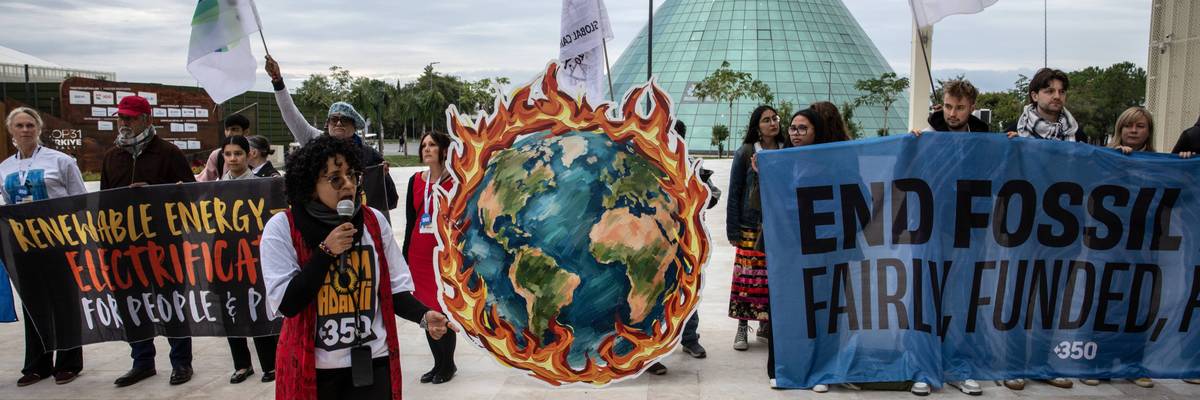
Activists participate in the End Fossil Fuels: Fair, Fast, Forever protest at the COP31 UNFCCC Climate Conference on November 10, 2026 in Antalya, Türikye.
Movements will need to put more pressure on governments—the history of these negotiations suggests that without that pressure the leaders simply won’t do more than the minimum.
Your correspondent is feeling a tad guilty for not being in Türikye this week for the 31st global climate talks—my only excuses are deep fatigue from the fall election, and the chance to address the big renewable energy trade show in Las Vegas. That’s currently in question as I’ve been swept up in the nationwide air traffic imbroglio, but if I make it, a full account next time. But of course I’ve been following events in Antalya, and talking with lots of people on the ground there.
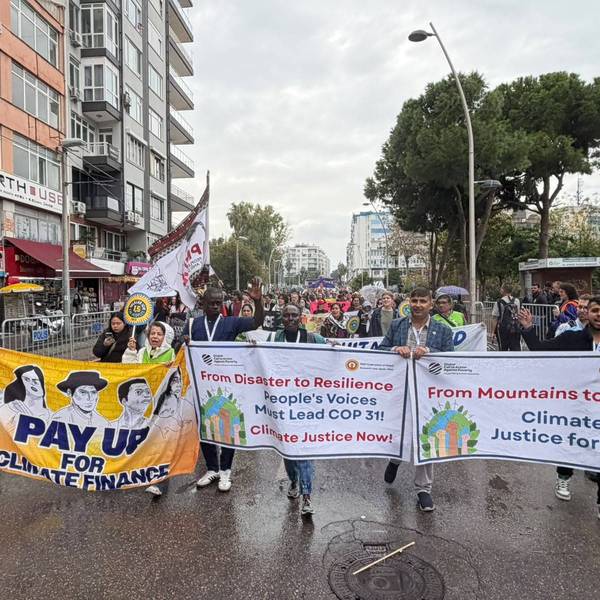
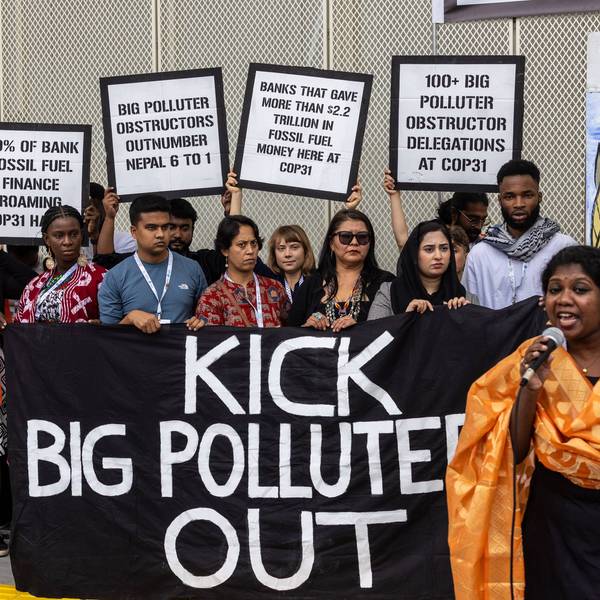
The first week—which is when the world leaders visit—is over. The weekend—when protesters take to the streets—is winding down. Now it’s the second week when the actual work of agreeing on a new text takes place.
The first week’s rhetoric was important and strong. Greta Thunberg returned to the talks for the first time in five years. (At Glasgow, in 2021, she’d pointed out that they were an exercise in “blah blah blah”). She kept up that theme this time around, telling reporters, “We’ve had 31 COPs now, and we’re still speeding in the wrong direction.” Since Thunberg doesn’t fly, she arrived via “trains, buses, and sleep deprivation,” and said the data center fight was part and parcel of the climate battle:
“They’re both the same issue,” Thunberg said, noting both the environmental toll of data centers as well as the way they overshadow more fundamental needs. “We’re detaching ourselves from our human values.”
Meanwhile, United Nations Secretary General Antonio Guterres gave what may be the last in a series of epic climate speeches, since he is stepping down at the end of December. Guterres’ tenure has been defined in no small part by climate concerns, and to his immense credit he has never pulled a punch, abandoning diplomatic language to focus on the bankers and fossil fuel execs who drive the crisis. It’s worth reading the transcript of his remarks to see how a world leader can address this crisis if he’s not worried about appeasing commercial interests. (Pope Francis, and now Leo, are the only comparable examples).
The case for fossil fuels is collapsing.
Three-quarters of humanity live in countries that import fossil fuels.
Hostage to price shocks they did not create and they cannot control.
Recent conflicts make clear that this is a recipe for chronic insecurity and a cost-of-living meltdown.
It’s time to accelerate a science-aligned, just, orderly, and equitable transition to renewables.
But let’s not underestimate the scale of the challenge.
Fossil fuels must go the way of the dinosaurs.
But that won’t happen on its own.
The dinosaurs did not have a lobby.
But fossil fuels do.
And their strategy is simple:
Distort the science. Delay the policy. Delay the action. Delay the accountability.
It’s time to kick the habit—and end the fossil-fuel addiction.
In many ways, it should be a year for the world to accelerate progress. The war in Iran has made it crystal clear that fossil fuel is a threat not only to the global climate but also to its economy and its security. In fact, it appears that the world’s carbon emissions will fall this year, simply because people couldn’t get the oil and gas to burn. As Brad Plumer explains:
Globally, emissions from oil consumption are expected to drop nearly 2% this year, while emissions from natural gas will decline roughly 0.3%. By contrast, carbon dioxide emissions from burning of coal are expected to rise roughly 0.6%, thanks to increased consumption in places like China and India. (Even though coal pollutes more than oil or gas, the uptick in coal consumption was smaller in comparison.)
“I would call it unexpected,” said Glen Peters, a senior researcher at the CICERO Center for International Climate Research in Oslo and one of the authors of the report. “It’s pretty rare to see a drop in oil demand this big.”
The Times cautions that the dip may be temporary: “if the war with Iran ends and the Strait of Hormuz reopens, oil and gas demand could easily bounce back.” But there’s increasing evidence that the decline is structural. As Justin Mikulka points out:
We were told natural gas was going to replace coal and this would drive big future demand. But believing that required not understanding basic economics. Gas demand destruction is happening in 2026 because renewables plus storage are replacing it in power generation.
Mikulka quotes one other expert who explains the base reality:
A billion dollars’-worth of solar farms will provide roughly 10 times as much electricity over their lifetimes as the same amount of money spent on liquefied natural gas.
Indeed, the emerging buzzword at the Türikye talks is “electrification,” with the host nation boosting a 35% by 2035 plan—which is not all that fast, but at least heads in the right direction. Electrifying everything is of course crucial to progress—as a new paper from Jan Rosenow and colleagues last week makes clear, EVs and heat pumps are so efficient that they could cut primary energy use in half on this planet, compared with the present world where combustion wastes wild amounts of heat:
We find that system-wide losses (rejected energy) fall by 61%, while the contribution of ambient environmental heat captured by heat pumps rises approximately 20-fold; under conventional energy-balance conventions this corresponds to a fall in primary energy inputs of nearly half.
But science is one thing and political power is another, and who knows what will happen this week—the fossil fuel industry is of course willing to electrify as long as its natural gas that gets to play a lead role in the process. Standing up to that is hard—as the EU climate chief Wopke Hoekstra told the Bloomberg team:
A “certain degree of pragmatism” was warranted to bring as many countries on board as possible, he told reporters. While curbs on methane are mentioned in the summary text, that’s no guarantee the issue will make it into a final text.
On boosting electrification, some debate has focused on whether the goal should include any reference to requirements for clean electricity. Hoekstra said the 27-member bloc isn’t seeking to add restrictions, and hopes the initiative can retain broad appeal.
By “broad appeal” he means, in part, “not getting vetoed by the Saudis,” who, now that the Americans boycott the proceedings, have emerged as the foremost defenders of overheating the Earth. (President Donald Trump’s puppet government in Caracas has joined in too). As Al Gore—as so often a tribune of common sense—said on the sidelines of the talks:
The idea that one individual country like Saudi Arabia can block anything the entire world wants to do is literally insane. We are facing the most serious threat to the future of humanity that we have ever faced.
China would of course be the obvious new leader in this global fight—they are producing the key technology, and now that the US has withdrawn they are, for climate negotiations, the sole superpower. But they seem reluctant to grab the reins—indeed, they declined even to host 2028’s talks, which are scheduled, in the continental rotation, to be held in Asia. As Fiona Harvey reports:
Gareth Redmond-King, the international lead at the Energy and Climate Intelligence Unit think tank, said China’s position as an industrial powerhouse would have made it a formidable contender to hold the summit.
“It would undoubtedly be significant for the world’s biggest emitter and second-biggest economy to host a climate COP,” he said.
“They’re leading the world on investment, manufacture, and deployment of clean energy tech, and their emissions have started to tick down. As a leadership story, China hosting COP33 would be a big deal.”
The time that we have to deal with this crisis grow short, and each year’s limp global talks means that the window has closed a little further. Events—the war in Iran, the falling cost of renewables—are conspiring to help, but without any of the global guidance that could speed the process. Movements will need to put more pressure on governments—the history of these negotiations suggests that without that pressure the leaders simply won’t do more than the minimum. So I’m glad we’re planning for things like Sun Day; right now the wheel isn’t squeaking enough, and as a result it’s getting way too much oil.
This country and this world are at a monumental crossroads. US voters have an opportunity to beat back the forces of fascism and confront the billionaires who are rigging the economy, our media system, and our democracy, making it increasingly impossible for ordinary people to get by. We’re not just talking about the election. We’re talking about what must be done once these fascist elements are vanquished from power. We need a bolder set of solutions than what either major party has so far been willing to offer and a working-class movement ready to fight like hell for it. Trump didn't emerge from nowhere. The conditions that fueled MAGA authoritarianism were created by decades of radical neoliberal economic policies and a corrupt political system dominated by corporate interests. They slashed taxes on the super-rich, promising that the benefits would trickle down. They said giveaways to the corporate titans would make life more affordable for the rest of us. It was all bullshit. And when a bitter, betrayed populace searches for someone to blame, right-wing demagogues have little trouble finding scapegoats. People know when they're being lied to, but you won't hear any of this from the corporate media. Only independent journalism—powered and funded by people who believe in building a better world—can deliver truly trustworthy daily news. If you share our vision, please contribute whatever you can to sustain our work. |
Your correspondent is feeling a tad guilty for not being in Türikye this week for the 31st global climate talks—my only excuses are deep fatigue from the fall election, and the chance to address the big renewable energy trade show in Las Vegas. That’s currently in question as I’ve been swept up in the nationwide air traffic imbroglio, but if I make it, a full account next time. But of course I’ve been following events in Antalya, and talking with lots of people on the ground there.
The first week—which is when the world leaders visit—is over. The weekend—when protesters take to the streets—is winding down. Now it’s the second week when the actual work of agreeing on a new text takes place.
The first week’s rhetoric was important and strong. Greta Thunberg returned to the talks for the first time in five years. (At Glasgow, in 2021, she’d pointed out that they were an exercise in “blah blah blah”). She kept up that theme this time around, telling reporters, “We’ve had 31 COPs now, and we’re still speeding in the wrong direction.” Since Thunberg doesn’t fly, she arrived via “trains, buses, and sleep deprivation,” and said the data center fight was part and parcel of the climate battle:
“They’re both the same issue,” Thunberg said, noting both the environmental toll of data centers as well as the way they overshadow more fundamental needs. “We’re detaching ourselves from our human values.”
Meanwhile, United Nations Secretary General Antonio Guterres gave what may be the last in a series of epic climate speeches, since he is stepping down at the end of December. Guterres’ tenure has been defined in no small part by climate concerns, and to his immense credit he has never pulled a punch, abandoning diplomatic language to focus on the bankers and fossil fuel execs who drive the crisis. It’s worth reading the transcript of his remarks to see how a world leader can address this crisis if he’s not worried about appeasing commercial interests. (Pope Francis, and now Leo, are the only comparable examples).
The case for fossil fuels is collapsing.
Three-quarters of humanity live in countries that import fossil fuels.
Hostage to price shocks they did not create and they cannot control.
Recent conflicts make clear that this is a recipe for chronic insecurity and a cost-of-living meltdown.
It’s time to accelerate a science-aligned, just, orderly, and equitable transition to renewables.
But let’s not underestimate the scale of the challenge.
Fossil fuels must go the way of the dinosaurs.
But that won’t happen on its own.
The dinosaurs did not have a lobby.
But fossil fuels do.
And their strategy is simple:
Distort the science. Delay the policy. Delay the action. Delay the accountability.
It’s time to kick the habit—and end the fossil-fuel addiction.
In many ways, it should be a year for the world to accelerate progress. The war in Iran has made it crystal clear that fossil fuel is a threat not only to the global climate but also to its economy and its security. In fact, it appears that the world’s carbon emissions will fall this year, simply because people couldn’t get the oil and gas to burn. As Brad Plumer explains:
Globally, emissions from oil consumption are expected to drop nearly 2% this year, while emissions from natural gas will decline roughly 0.3%. By contrast, carbon dioxide emissions from burning of coal are expected to rise roughly 0.6%, thanks to increased consumption in places like China and India. (Even though coal pollutes more than oil or gas, the uptick in coal consumption was smaller in comparison.)
“I would call it unexpected,” said Glen Peters, a senior researcher at the CICERO Center for International Climate Research in Oslo and one of the authors of the report. “It’s pretty rare to see a drop in oil demand this big.”
The Times cautions that the dip may be temporary: “if the war with Iran ends and the Strait of Hormuz reopens, oil and gas demand could easily bounce back.” But there’s increasing evidence that the decline is structural. As Justin Mikulka points out:
We were told natural gas was going to replace coal and this would drive big future demand. But believing that required not understanding basic economics. Gas demand destruction is happening in 2026 because renewables plus storage are replacing it in power generation.
Mikulka quotes one other expert who explains the base reality:
A billion dollars’-worth of solar farms will provide roughly 10 times as much electricity over their lifetimes as the same amount of money spent on liquefied natural gas.
Indeed, the emerging buzzword at the Türikye talks is “electrification,” with the host nation boosting a 35% by 2035 plan—which is not all that fast, but at least heads in the right direction. Electrifying everything is of course crucial to progress—as a new paper from Jan Rosenow and colleagues last week makes clear, EVs and heat pumps are so efficient that they could cut primary energy use in half on this planet, compared with the present world where combustion wastes wild amounts of heat:
We find that system-wide losses (rejected energy) fall by 61%, while the contribution of ambient environmental heat captured by heat pumps rises approximately 20-fold; under conventional energy-balance conventions this corresponds to a fall in primary energy inputs of nearly half.
But science is one thing and political power is another, and who knows what will happen this week—the fossil fuel industry is of course willing to electrify as long as its natural gas that gets to play a lead role in the process. Standing up to that is hard—as the EU climate chief Wopke Hoekstra told the Bloomberg team:
A “certain degree of pragmatism” was warranted to bring as many countries on board as possible, he told reporters. While curbs on methane are mentioned in the summary text, that’s no guarantee the issue will make it into a final text.
On boosting electrification, some debate has focused on whether the goal should include any reference to requirements for clean electricity. Hoekstra said the 27-member bloc isn’t seeking to add restrictions, and hopes the initiative can retain broad appeal.
By “broad appeal” he means, in part, “not getting vetoed by the Saudis,” who, now that the Americans boycott the proceedings, have emerged as the foremost defenders of overheating the Earth. (President Donald Trump’s puppet government in Caracas has joined in too). As Al Gore—as so often a tribune of common sense—said on the sidelines of the talks:
The idea that one individual country like Saudi Arabia can block anything the entire world wants to do is literally insane. We are facing the most serious threat to the future of humanity that we have ever faced.
China would of course be the obvious new leader in this global fight—they are producing the key technology, and now that the US has withdrawn they are, for climate negotiations, the sole superpower. But they seem reluctant to grab the reins—indeed, they declined even to host 2028’s talks, which are scheduled, in the continental rotation, to be held in Asia. As Fiona Harvey reports:
Gareth Redmond-King, the international lead at the Energy and Climate Intelligence Unit think tank, said China’s position as an industrial powerhouse would have made it a formidable contender to hold the summit.
“It would undoubtedly be significant for the world’s biggest emitter and second-biggest economy to host a climate COP,” he said.
“They’re leading the world on investment, manufacture, and deployment of clean energy tech, and their emissions have started to tick down. As a leadership story, China hosting COP33 would be a big deal.”
The time that we have to deal with this crisis grow short, and each year’s limp global talks means that the window has closed a little further. Events—the war in Iran, the falling cost of renewables—are conspiring to help, but without any of the global guidance that could speed the process. Movements will need to put more pressure on governments—the history of these negotiations suggests that without that pressure the leaders simply won’t do more than the minimum. So I’m glad we’re planning for things like Sun Day; right now the wheel isn’t squeaking enough, and as a result it’s getting way too much oil.