

SUBSCRIBE TO OUR FREE NEWSLETTER
Daily news & progressive opinion—funded by the people, not the corporations—delivered straight to your inbox.
5
#000000
#FFFFFF
To donate by check, phone, or other method, see our More Ways to Give page.
Daily news & progressive opinion—funded by the people, not the corporations—delivered straight to your inbox.

"Donald Trump wants Head Start teachers to get paid less and take away health insurance and paid leave to boot—how many of these teachers will just leave for a better paying job?" said one Democratic senator.
A Biden-era policy that would have raised salaries for Head Start preschool teachers by about $10,000 over the next five years was set to cost $2.1 billion annually—a tiny fraction of the $1.5 trillion Pentagon budget requested by Defense Secretary Pete Hegseth.
But months after President Donald Trump bluntly said the federal government "can’t take care of daycare" because "we're fighting wars," the administration is repealing the rule, claiming the money saved will allow the program, introduced more than six decades ago by President Lyndon Johnson, to enroll more students.
US Sen. Patty Murray (D-Wash.), former chair of the Senate Health, Education, Labor, and Pensions Committee and a former preschool teacher, noted Monday that the elimination of the pay hike is just Trump's latest attack on the program, which serves more than 750,000 children living below the poverty line at 17,000 centers across the country.
"Everyone knows that these educators are overworked and underpaid, creating retention challenges that limit options for families. This is a real problem that Donald Trump and RFK Jr. want to make worse," said Murray, referring to Health and Human Services (HHS) Secretary Robert F. Kennedy Jr., whose agency oversees Head Start.
Under the pay-raise mandate, teachers' health insurance and paid leave benefits also would have been expanded, and advocates said the salary boost would help solve a teacher turnover crisis in the program that has been especially acute in recent years since the pandemic—and could in turn increase enrollment capacity, contrary to the Trump administration's claims.
More than 20% of Head Start teachers left for higher-paying jobs in 2022, according to The Associated Press. President Joe Biden's 2024 policy was meant to achieve parity with public school teachers, who earn $75,000 per year on average. Head Start teachers with master's degrees earn an average of less than $60,000, while educators with bachelor's degrees earn less than $50,000 per year, the program reported this year.
Teacher turnover was still at 17% last year, HHS data shows, and the exodus of teachers has led some Head Start programs to close.
The National Association for the Education of Young Children (NAEYC) said the administration had framed the decision to roll back the pay raise as "a choice between paying educators and serving children, but a funded slot without a qualified teacher serves no one."
"The Department of Health and Human Services’ final rule asks Head Start educators to keep doing more for less," said the organization. "The rule says its estimate of 106,000 saved slots doesn’t predict how many children will actually be served, because that depends on whether programs can staff classrooms... The main barrier to supporting a stable, highly qualified workforce in Head Start is a lack of resources. In our public comment opposing the proposed rule, NAEYC urged HHS to work with Congress to fund these requirements. HHS chose to drop the standard instead."
With Democrats set to take control of the US Senate and House of Representatives in January, the group urged "Congress to make the investment Head Start needs so every eligible child has a qualified and consistent educator in the classroom."
The repeal of the pay-raise mandate was published in the Federal Register Monday, saying the new policy “restores flexibility to local Head Start programs and improves access for children and families by removing the costly requirements added in 2024.”
In actuality, said Murray, the Trump administration has gone out of its way to severely weaken the program that "moms and dads in every corner of the country count on," going as far as pushing for Head Start's elimination entirely in one leaked memo, "in keeping with Project 2025."
The senator pointed to the firing of up to 50% of the staff at the Office of Head Start and Office of Child Care at HHS, as well as the shuttering of half the offices' 10 regional locations. HHS has also proposed doing away with many of Head Start's regulations and standards, including federal student-to-teacher ratios, and deferring to looser state guidelines.
"President Trump also illegally impounded funding provided by Congress for Head Start programs across America, in violation of the Impoundment Control Act (ICA)," said a statement by Murray's office. "In response, Sen. Murray raised alarm bells and she led her colleagues in demanding that the funds get moving."
The senator said that when Democrats take control of Congress, she will "be fighting to stop this policy dead in its tracks every way I can—just like I’ll keep pushing back on Trump’s attempts to gut Head Start’s health and safety standards."
"Donald Trump wants Head Start teachers to get paid less and take away health insurance and paid leave to boot—how many of these teachers will just leave for a better-paying job? I’ve taught preschool and I’ll tell you what: You can’t help more kids with fewer teachers," said Murray. "You can bet I’ll be fighting to invest in Head Start and setting our kids up for success instead of Trump’s illegal wars overseas.”

Khanna took an apparent shot at a potential 2028 rival, Pete Buttigieg, calling his "Medicare for All Who Want It" proposal "pablum."
As he teases a 2028 presidential bid, US Rep. Ro Khanna is reigniting the healthcare debate that was front and center during the last open Democratic presidential primary and making the case for Medicare for All.
The California Democrat responded Monday to a common talking point from opponents of a single-payer healthcare program: that it would force those who want to keep their current insurance plans to give them up for a one-size-fits-all public plan.
"Medicare for All means healthcare for everyone, like public school is free for every kid," Khanna wrote on social media. "Private insurance can still exist on top of it, just like private school still exists."
The Medicare for All bills introduced in the House and Senate by Rep. Pramila Jayapal (D-Wash.) and Sen. Bernie Sanders (I-Vt.) would cover virtually all medically necessary healthcare, including doctor visits, hospital stays, prescription drugs, dental and vision care, and long-term care.
Both bills would prohibit private insurance that duplicates benefits covered by the public program, while allowing Americans to purchase supplemental coverage for benefits not covered by the government plan.
Khanna also took an apparent jab at a healthcare proposal from former Transportation Secretary and South Bend, Indiana Mayor Pete Buttigieg, one of his potential 2028 rivals.
During the 2020 Democratic presidential primary, Buttigieg campaigned on a policy he called “Medicare for All Who Want It,” which would have preserved private insurance while allowing Americans to enroll in a government-subsidized public plan, with marketplace premiums capped at 8.5% of household income.
“‘Medicare for All Who Want It’ is pablum,” wrote Khanna, who has argued that healthcare should be considered a human right. “It’s telling parents they have to pay for public school.”
Though Medicare for All would be funded through taxes, proponents argue that Americans would ultimately save money through the elimination of private insurance premiums, deductibles, and copays.
A recent analysis by researchers at Yale University, conducted at Khanna’s request, estimated that a single-payer system would reduce annual national healthcare expenditures by more than $1 trillion, or nearly 20%, by cutting administrative costs, lowering prescription drug prices, and reducing other inefficiencies. It also projected that approximately 114,000 deaths could be prevented every year through expanded healthcare coverage.

"We are going backwards toward the goal of controlling CO2 emissions," said the author of a new study accounting for the electricity use and emissions of over 400 US data centers.
Just over 400 artificial intelligence data centers emitted as much climate pollution as Denmark does in a year, according to Harvard research published in Nature Sustainability on Monday.
The study found that a total of 403 hyperscale data centers released 28.3 million tons of carbon dioxide between May 2024 and April 2025, up to triple earlier estimates. And that number is likely to increase further as the rapid build-out continues.
"We are going backwards toward the goal of controlling CO2 emissions," Francesca Dominici, the study's senior author and Clarence James Gamble professor of biostatistics, population, and data science and director of the Harvard Data Science Initiative, told The Associated Press.
"What we're seeing is already striking, but it's only a snapshot of a rapidly expanding industry."
The researchers also looked at the overall electricity use of the data centers and found it was between 68 and 99 terawatt-hours, with higher estimates rivaling the annual electricity use of Michigan. All told, the centers accounted for 1.8% of US electricity consumption.
“We’re talking about just 403 facilities consuming approximately 82 terawatt-hours of electricity in a single year—approaching the annual electricity consumption of an entire mid-sized American state, including its homes, businesses, and industries,” lead author Gianluca Guidi, a postdoctoral fellow in the Harvard Department of Biostatistics, told Gizmodo.
The numbers, while high, are "nowhere near" the true greenhouse gas emissions of the industry, as Emily Atkin noted in Heated. The study did not count every data center active during the study period, did not look at the contribution of off-grid power plants like those used by Elon Musk's controversial Colossus data center in Memphis, and did not consider the climate pollution of refrigerants used to cool the centers.
The researchers also acknowledge that the build-out has only increased since the study period ended.
"What we're seeing is already striking, but it's only a snapshot of a rapidly expanding industry," Guidi said in a statement. "The data center boom hasn't slowed down since our study period ended in April 2025. New facilities have been built, existing campuses have expanded, and demand for AI computing continues to grow. That means the electricity use and carbon footprint we're reporting could already be substantially larger now in 2026."
This makes their findings all the more urgent for policymakers to consider.
“We already have over a thousand hyperscale facilities operating and another 2,000 planned,” Guidi told Gizmodo. “So, the data starts to raise a red flag about where we’re going, and whether we’re building these AI data centers in the most responsible way we can.”
The authors are also concerned about the impact of the data centers' fossil fuel use on public health. The researchers found that 54% of the data centers they studied were powered by fossil fuels, with 38% of them powered by gas and 15% by coal, but they were not able to dive into what that means for US residents' health and well-being.
"Quantifying health impacts is an important next step," Dominici said in a statement. "First, carbon dioxide drives climate change, which affects health through heatwaves, wildfire smoke, flooding, and other pathways."
Dominic continued:
Second, the fossil fuel power plants in the regional electricity systems associated with this demand also release other pollutants, such as fine particulate matter, nitrogen oxides, and sulfur dioxide, that are directly linked to heart and lung disease and premature death. So when data centers draw heavily on fossil fuel power, the people living near and downwind of those power plants may bear health costs, even if they're far from the data center itself.
The study authors also noted a lack of transparency and reliable information about data centers.
"Perhaps what surprised me most throughout the research was how little independently verified information is publicly available about infrastructure that’s already consuming electricity on this scale," Guidi told Gizmodo.
Atkin noted that the lack of transparency had made the researchers' task more difficult, and provided an opening for the new democratically controlled Congress to take action in January:
It’s supremely messed up that scientists have to work this hard just to get a partial picture of how much an immensely powerful, fast-growing industry is heating the planet we all have to live on—especially when voters just made it clear they want the industry reined in.
The public deserves to know exactly how many of these facilities exist, and how much they are polluting, so they can decide whether it’s worth trading the planet’s health for toothbrushes that tell us if we’re doing it right.
Come January, Democrats can show voters they were listening by making tech companies publish the data scientists actually need to figure out how many hyperscale data centers are running and how much they pollute. My bet is that once scientists get the full numbers, we’ll need a bigger country than Denmark for the comparison.
The research comes amid a nationwide backlash against the proliferation of AI data centers, with voters approving 43 of 44 anti-data center measures on the ballot in the midterm elections.
It also builds on growing evidence that the data center build-out is a worrying new contribution to the climate crisis. A Sierra Club analysis warned that the use of fossil fuels to power data centers could increase power sector emissions by 42% by 2030. Another study concluded that artificial intelligence is boosting climate emissions in another way: by helping facilitate the extraction and production of fossil fuels.

"The DHS proposal was always a solution in search of a problem that appeared designed to crack down on independent journalism."
A federal judge on Monday struck down a rule from the US Department of Homeland Security that drastically shortened the length of visas for international students, researchers, teachers, and journalists.
In his ruling, US District Judge F. Dennis Saylor IV, an appointee of former President George W. Bush, found that DHS' visa rule change violated the Administrative Procedure Act's restrictions against federal agencies making "arbitrary and capricious" rule changes.
Saylor argued that, in shortening the length of visas, DHS failed to consider alternative methods for achieving its purported goals of cracking down on alleged fraud, such as enhanced utilization of the Student and Exchange Visitor Information System (SEVIS).
The judge also knocked DHS for trying to place restrictions on the types of degrees foreign students can pursue in the US, noting that the agency's rule changes "would prohibit foreign students from engaging in extended periods of study, such as those required for Ph.D. programs," among other restrictions.
"Put bluntly," wrote Saylor, "DHS is seeking to prevent or discourage the very activity—providing educational opportunities for foreign students in the United States—that Congress sought to permit and encourage. The statute simply does not grant DHS such broad and open-ended authority to undermine the F-1 visa program."
The judge concluded by vacating the entire rule "on the ground that it is arbitrary, capricious, an abuse of discretion, and otherwise not in accordance with law."
Saylor's decision earned applause from Reporters Without Borders (RSF), which hailed the ruling as "a victory for press freedom."
RSF pointed out that, in arguing for the visa restrictions, DHS "never articulated a justification for this arbitrary and overly restrictive change to visas for international journalists working in the United States" and "never even identified a single instance of the current visa rules being abused."
"The DHS proposal was always a solution in search of a problem that appeared designed to crack down on independent journalism," said RSF. "International journalists must be free to report from the United States without fear of arbitrary restrictions or political interference."

Members of the activist group, which boasts millions of supporters nationwide, described Van Hollen as “much more in tune with the average American” than Schumer and “not beholden” to donors.
Members of MoveOn, one of the most influential progressive organizations in the United States, are rallying behind Sen. Chris Van Hollen's leadership bid against Sen. Chuck Schumer.
A survey released Monday by the group shows that 75% of the more than 33,000 members surveyed prefer Van Hollen (D-Md.) to become the next majority leader when Democrats retake the chamber in January.
Surveys from earlier this month have shown a strong desire among Democrats more broadly to see Schumer (D-NY) replaced. In a YouGov survey commissioned by the activist group Indivisible earlier this month, 62% of Democratic partisans said they wanted a different Senate leader. Fifty-seven percent of all registered voters said they wanted someone else to lead the party, while just 10% wanted Schumer to remain.
“Americans gave Democrats a massive mandate for economic change, but they risk failing to deliver on affordability and accountability if they stick with the same leadership that’s failed us before,” said MoveOn executive director Joel Payne. “Sen. Van Hollen’s willingness to end the Iran War, part ways with the status quo, and take on the Trump administration shows he’s ready to meet the moment. MoveOn members are proud to support him in this leadership race so Washington can meaningfully deliver for working people.”
BREAKING: 75% of MoveOn members, out of more than 33,000 votes cast, voted to endorse Sen. @ChrisVanHollen for majority leader.
— MoveOn (@MoveOn) November 16, 2026
The overwhelming momentum behind Van Hollen among members of MoveOn—an activist group boasting around 10 million members nationwide—suggests that many of the party's most engaged supporters see this month's resounding midterm victory as a mandate for Democrats to deliver a transformative agenda and confront President Donald Trump more directly.
“Americans voted for bold new leadership from the Democratic Party, not the same old, tired corporate Democrats of recent years,” said one MoveOn member who voted to back Van Hollen—a senator who has built his profile over the past two years by increasingly breaking with Democratic Party leaders on issues including US military aid to Israel and the party's response to Trump.
Contrasting him with Schumer, another respondent said Van Hollen is “not beholden” to interests like the American Israel Public Affairs Committee (AIPAC), Wall Street, and other Democratic Party “donors” and that he “seems genuinely interested in listening to the mandate the voters just provided: Give us economic populism and fight the oligarchy.”
Another respondent said that Van Hollen made them “proud to be a Marylander” when he traveled to El Salvador to advocate for the release of Kilmar Ábrego García—a Maryland resident whom the administration had illegally deported and imprisoned in the notorious CECOT megaprison despite a court order explicitly prohibiting his removal to the country.
Van Hollen's trip was one of the first highly visible acts of resistance to Trump's mass deportation agenda by Democratic officials who'd until then been wary of the political consequences of opposing his immigration policy. One respondent said it showed the senator to be “a man of action, not just words.”
Van Hollen, who has publicly accused Israel of committing genocide in Gaza, endorsed Medicare for All, called to defund US Immigration and Customs Enforcement (ICE), and advocated for Democrats to hold up government funding to halt Trump's war with Iran, was described by another respondent as “much more in tune with the average American” than Schumer.
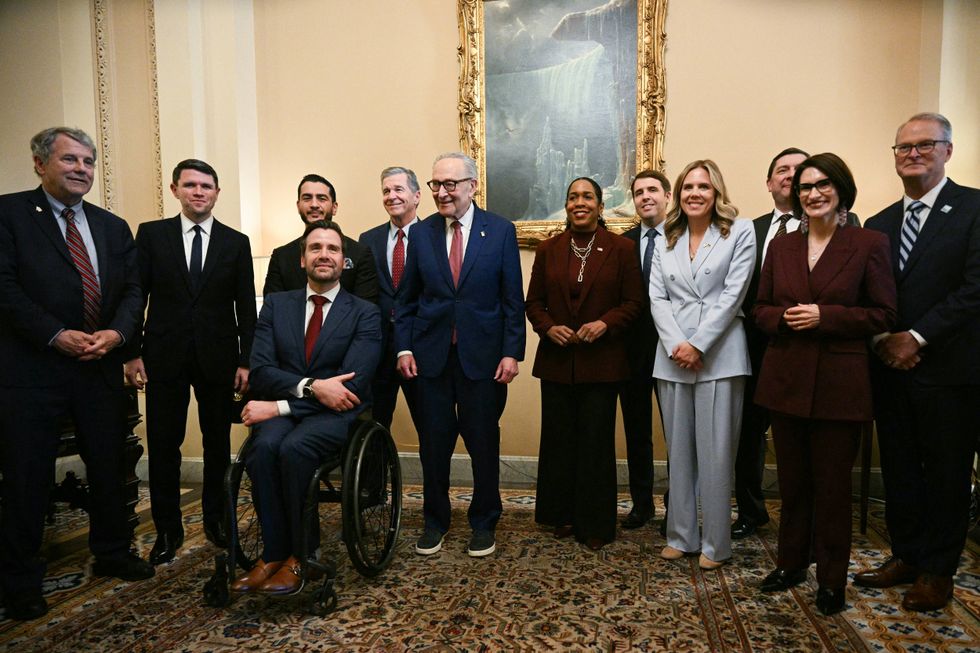 Senate Minority Leader Chuck Schumer (D-NY) and Sens.-elect (from left) Sherrod Brown (D-Ohio), James Talarico (D-Texas), Abdul El-Sayed (D-Mich.), Josh Turek (D-Iowa), Roy Cooper (D-NC), Juliana Stratton (D-Ill.), Chris Pappas (D-NH), Annie Andrews (D-SC), Troy Jackson (D-Maine), Peggy Flanagan (D-Minn.), and Adam Hamilton (D-Kan.) pose for a photo before a coffee discussion at the US Capitol in Washington, DC, on November 9, 2026. (Photo by Jim Watson/AFP via Getty Images)
Schumer has publicly projected confidence, declaring that he already has the votes to be elected party leader. But momentum has continued to build behind Van Hollen, who has gained the support of Sens. Bernie Sanders (I-Vt.), Jeff Merkley (D-Ore.), Tina Smith (D-Minn.), and several incoming senators elected this month.
Senate Democrats are scheduled to hold a closed-door vote to select their leader on December 1. But allies of Schumer are reportedly pushing to move the vote up to this week to capitalize on his lead, a move Van Hollen described Sunday as a “sign of weakness.”
Activist groups, including the Working Families Party, Our Revolution, and the Sunrise Movement, meanwhile, continue to line up behind Van Hollen.
Indivisible, one of the groups behind the "No Kings" movement that has brought millions of people into the streets to protest against Trump, endorsed Van Hollen on Monday, noting support for him among 97% of its chapter heads.
“Voters sent a clear message this November: They want leaders who will stand up to powerful interests, challenge a corrupt status quo, and deliver real results for working people,” said Leah Greenberg, Indivisible's co-executive director. “Chuck Schumer has become a symbol of the failed leadership and political status quo that voters are ready to move beyond.”

"Nurses and working people demand new Senate leadership that confronts the billionaire class, corporations, and governments to deliver transformative change for us," said National Nurses United.
The largest union of nurses in the United States on Monday endorsed Sen. Chris Van Hollen to lead the Senate Democratic caucus in the new Congress, arguing he is the only candidate "ready to advance real, systemic change" following the party's blowout midterm wins.
"The people have spoken," National Nurses United (NNU), which represents more than 225,000 registered nurses across the US, said in a statement. "Sen. Van Hollen is the clear leadership choice for nurses because he firmly stands on the side of working-class people."
Unlike Sen. Chuck Schumer, the current Democratic leader, Van Hollen cosponsored the Medicare for All Act of 2025—NNU's top legislative priority.
“Nurses witness every day, every shift how business-as-usual politics and policies have failed their patients, their communities and this country. Corporations have been allowed to steal from everyday working people,” Puneet Maharaj, NNU's executive director, said Monday. "The Democratic Party must not squander the chance midterm voters have given it to tackle our nation in crisis. Nurses and working people demand new Senate leadership that confronts the billionaire class, corporations, and governments to deliver transformative change for us."
"Sen. Van Hollen is the best person for the job," Maharaj continued. "We want guaranteed healthcare, not warfare. We want to abolish ICE. We want billionaires to pay their fair share. We want our tax dollars to meet working people’s needs, not fund genocide in Gaza and the war in Iran. And this is just the beginning."
The people have spoken. On Nov. 3, voters overwhelmingly rejected business-as-usual politics and demanded real, systemic change.That’s why nurses proudly endorse @ChrisVanHollen for Senate Majority Leader. He stands on the side of working-class people.https://t.co/qv27b9bjDQ
— National Nurses United (@NationalNurses) November 16, 2026
NNU is the third major labor union to endorse Van Hollen's bid for majority leader against Schumer, who has headed the Senate Democratic caucus for a decade. The 600,000-member International Association of Machinists and Aerospace Workers and the 90,000-member Office and Professional Employees International Union have also backed Van Hollen.
Growing union support for Van Hollen came as leaders and members of several major progressive advocacy organizations—including Indivisible, MoveOn, and the Working Families Party—threw their support behind the Maryland Democrat.
In the Senate Democratic caucus, Van Hollen has "around 15" supporters, the Maryland senator said on Sunday, calling his contest with Schumer "a wide open race."
Speaking to Politico for an interview released on Monday, Van Hollen suggested that some senators are hesitant to publicly break with Schumer because "there's a fear of retribution."
“Nobody should be afraid of a little democracy in the Democratic caucus," said the Maryland senator.
Van Hollen also said he has the votes to block any effort to fast-track the leadership election, which is currently scheduled for December 1.
"The more that time goes on, the more we have an open debate, the more we’ll see people voting for change," said Van Hollen.

Van Hollen "represents the kind of leadership we need," as he is "willing to match the urgency of this moment, make life more affordable, and take on powerful interests," said Indivisible co-executive director Leah Greenberg.
Indivisible, one of the organizations behind the "No Kings" movement that brought millions of people into the streets to protest against President Donald Trump, is throwing its support behind Sen. Chris Van Hollen's bid to be the next Senate majority leader.
In a Monday announcement, Indivisible said that 97% of its chapter leaders nationwide voted to endorse Van Hollen (D-Md.), who last week announced he was challenging current Senate Minority Leader Chuck Schumer (D-NY) to lead Democrats in the upper congressional chamber next year.
Indivisible said Van Hollen won its endorsement because he shared three key priorities with the group: "Ending the war in Iran and the economic pain Americans are feeling at the pump; clawing back funding for ICE and Border Patrol while stopping devastating Medicaid cuts; and using every procedural tool available, including breaking the corrupt Senate filibuster on day one."
The group also noted some of the high-profile fights Van Hollen has taken up with the Trump administration, such as his decision to meet with Maryland resident Kilmar Abrego after he was unlawfully deported to El Salvador in 2025.
Leah Greenberg, co-executive director of Indivisible, said Van Hollen "represents the kind of leadership we need," as he is "willing to match the urgency of this moment, make life more affordable, and take on powerful interests."
Schumer, in contrast, "has become a symbol of the failed leadership and political status quo that voters are ready to move beyond," Greenberg said.
Surveys of progressive activists released over the last two weeks by Our Revolution and MoveOn have shown an overwhelming desire for new Democratic congressional leadership, particularly in the Senate.
One poll conducted by MoveOn Civic Action found that 82% of MoveOn members who took part in the survey do not support Schumer becoming Senate majority leader.
A poll of over 4,300 progressive activists released by Our Revolution, meanwhile, found that 72% of respondents want a different leader than Schumer.

"Take action to prevent the use and spread of these merciless weapons," he declared. "We must never stop shielding civilians from the carnage and devastation of armed conflict, and preventing unnecessary suffering."
Echoing recent demands from advocacy groups around the world and the United Nations' human rights chief, outgoing UN Secretary-General António Guterres on Monday reiterated his call for governments from across the globe to agree to a legally binding instrument on lethal autonomous weapons systems, or "killer robots."
"For over 40 years, the Convention on Certain Conventional Weapons has reflected a fundamental principle: Even war has limits," Guterres said in his address to the Seventh Review Conference of the High Contracting Parties to the CCW in Geneva. "Across the decades, the convention has helped reduce human suffering caused by weapons such as mines, improvised explosive devices, incendiary weapons, and explosive remnants of war."
"But the nature of warfare is changing. New technologies—including autonomous weapon systems—present new humanitarian, legal, ethical, and security challenges," he continued. "We must ensure the convention remains fit for today's world. This review conference is an important opportunity: To strengthen and achieve universal participation in the convention and its existing protocols; to uphold and reinforce existing protections; and to update the convention to meet today's challenges."
In his explicit call "to seize this moment" and establish a legally binding instrument on killer robots that includes "clear prohibitions and restrictions," the UN chief highlighted that "the elements formulated by the group of governmental experts on this issue provide a strong foundation on which to build."
"Take action to prevent the use and spread of these merciless weapons," he declared at the start of the five-day conference, held every five years. "We must never stop shielding civilians from the carnage and devastation of armed conflict, and preventing unnecessary suffering. Together, let's put humanity and protection first."
Guterres' speech followed Volker Türk, the UN high commissioner for human rights, similarly saying Friday that "the international community has critical choices to make, right now, about the future of armed conflicts and the role of human beings in decisions over the use of force. I call on states to urgently agree on binding international rules to regulate autonomous weapons and protect human lives—before it is too late."
"A machine must never have the power to decide whether a human being survives or dies," argued Türk. "Human judgment and responsibility must remain at the center of decisions involving the use of force. Machines cannot understand the value of human life, assess context in the way humans can, or make the complex judgments required by international law. Nor can objects be held accountable when things go wrong."
"In order to protect the right to life of their populations, states must take measures to reduce the proliferation of potentially lethal weapons for unauthorized use," he continued. "Prohibiting the development or deployment of autonomous weapons designed or used to target human beings would be the most effective way to give effect to this obligation."
"The choice before states is clear,” Türk added. "They need to seize this moment to begin negotiations on a legally binding instrument containing clear prohibitions and restrictions. The longer the international community waits, the more difficult it will become to establish meaningful safeguards—and it may be too late."
UN News noted that "not all countries agree on controls, although UN General Assembly Resolution 78/241 from December 2023 confirming that lethal autonomous weapons systems must respect the laws of war received support from 152 countries, with four against and 11 abstentions."
Those who voted against were Belarus, India, Mali, and Russia—which, under Russian President Vladimir Putin, launched an ongoing full-scale invasion of Ukraine in February 2022. Ukraine voted for the resolution, as did the United States, while Iran and Israel were among the countries that abstained.
Nearly three years later, with over 74,000 Palestinians dead from US-backed Israel's genocidal assault on the Gaza Strip and thousands more recently killed across the Middle East due to US President Donald Trump and Israeli Prime Minister Benjamin Netanyahu's illegal war on Iran, their governments are working against what the UN leaders are urging.
As The Guardian reported in early November, "Russia, the US, and Israel, among others, are pushing against the review conference setting a timetable for a legally binding instrument," just months after Ukraine accused Russia of using an artificial intelligence-guided drone that "struck a propane tank at a fuel station in Zaporizhzhia."
EXCLUSIVE: The UK Government has declined to back a legally binding international treaty regulating so called 'killer-robots' ahead of crucial UN negotiations next week
[image or embed]
— The National (@scotnational.bsky.social) November 13, 2026 at 12:51 PM
Among those calling for action, as the newspaper pointed out, are organizations such as the International Committee of the Red Cross, US-born Pope Leo XIV, and "a coalition of 50 states including Ireland, Italy, Brazil, Mexico, France, and Germany."
Amnesty International, Human Rights Watch (HRW), and Stop Killer Robots jointly warned last week that "the failure of states to take decisive action on autonomous weapons" at the conference "would leave civilians dangerously exposed to rapidly advancing military technologies."
Verity Coyle, HRW's deputy crisis, conflict, and arms director, said that "after years of stalemate largely due to some states weaponizing the consensus-based decision-making under the CCW against meaningful progress, states parties finally have an opportunity to move from discussion to action."
"A time‑bound treaty negotiation process," Coyle asserted, "is the only credible way to ensure UN member states effectively respond to the existential dangers posed by autonomous weapons systems."

“Millions of Americans wait all year for Black Friday and Cyber Monday to score the biggest bargains... But it turns out that these major sales aren’t all they’re cracked up to be."
Families who have spent 2026 trying to keep up with soaring prices at the gas pump and grocery store, as well as the rising healthcare costs that have resulted from the Republican Party's Medicaid cuts and ripping away of Affordable Care Act subsidies, may be looking forward to the Black Friday and Cyber Monday deals that typically follow Thanksgiving, hoping to save money on holiday gifts and other purchases.
A new analysis by the think tank Groundwork Collaborative warns that they should look beyond Amazon for those savings.
The group examined more than 350 products included on Amazon's pages promoting what the $2.8 trillion e-commerce giant called its "best" deals in the 2024 and 2025 holiday seasons, and found that hundreds of the items were either just as expensive as they'd been weeks before the "deals" were announced—or even pricier than they'd previously been listed.
Nearly 30% of the products were priced the same or higher during the Black Friday and Cyber Monday events than they were in the month leading up to the "sales," and 60% were just as expensive as they'd been 90 days earlier.
Even worse for people who wait until Black Friday and Cyber Monday to make big purchases, 1 in 10 of the products listed on the pages were more expensive during the so-called sales than they had been in the months leading up to the holiday season—sometimes significantly so—even though Amazon advertised the two traditional holiday shopping days as ones when users would find “some of the lowest prices of the year."
An Apple Watch Series 10 was listed at $679.99 during Amazon's Black Friday 2025 sale—13% more than customers had paid for the same product nearly a month earlier, when it was priced at $602.
Those looking for women's rain boots from the brand Hunter paid $126.99 for the boots during the sale, but they would have been charged just $79.97 if they had bought them nine days earlier. Waiting for what Worldwide Amazon Stores CEO Doug Herrington called "incredible Black Friday Week and Cyber Monday deals” with “deep discounts" would cost a customer 59% more.
Similarly, shoppers hoping to take advantage of Cyber Monday in 2025 were told they were getting a low price when they paid $179.98 for a pair of men's UGG boots—but that was a whopping 83% more than they would have paid less than a month before the sale event, when it cost less than $99.
In addition to examining Amazon's deal pages from the past two years—which the company removed from its website after learning that Groundwork Collaborative's analysis was underway, but which the group accessed through archived versions—the organization analyzed how many days before the sales the product was selling at the sale price or cheaper, how much more so-called "deals" were than previous prices on average, and whether "same or worse deals" were more common in some product categories than others.
More than 40% of toys and games had "same or worse deals," as well as more than 38% of electronics and 37% of household goods.
Groundwork Collaborative, which has extensively studied how corporations use deceptive pricing tactics and other ploys to boost their profits at the expense of families who are already struggling to afford necessities under President Donald Trump's economic policies, emphasized that Amazon customers "aren’t shopping these marquee annual sale events for the excitement alone; they are increasingly looking to these events to offset rising prices."
"Over the past few years, consumers have faced steep price hikes on essential goods and services, including groceries, rent, electricity, and healthcare," reads the report. "Household savings diminished as prices climbed. These cost-of-living pressures have caused more consumers to plan around sale events, saving up and delaying purchases for weeks in anticipation of the sales. It is no surprise that more consumers planned to participate in sale events in recent holiday shopping seasons than in the past, strategically planning their spending to take advantage of discounts."
This year, according to polling, 70% of Americans are planning to take advantage of Black Friday and Cyber Monday sales, up from 64% last year.
“Millions of Americans wait all year for Black Friday and Cyber Monday to score the biggest bargains on stocking stuffers and household staples," said Lindsay Owens, president and CEO of Groundwork and a co-author of the report. "Shoppers trust that the deals advertised to them deliver real savings because Amazon promotes them that way. But it turns out that these major sales aren’t all they’re cracked up to be. Instead, our investigation reveals that shoppers who wait for these major sale events may be playing rip-off roulette."
In a statement, Amazon objected to Groundwork Collaborative's methodology and accused the group of ignoring "some deals" and incorrectly using "List Prices on Amazon to establish comparison prices from the prior 30 days—even though List Prices generally reflect the manufacturer's suggested retail price." It accused the group of using a "cherry-picked, unrepresentative sample," inaccurate prices in the research, and analyzing "products that were never deals."
The report notes that a number of states have laws to prevent companies from falsely advertising deals or discounts where none exist. In California, a former price must have been the prevailing market price within the three months before a sale is advertised, and in New Jersey, a former price "is treated as fictitious unless substantiated by a substantial number of actual sales within the prior 60 days, actively offered on at least 28 of the most recent 90 days, or a cost-plus-markup basis."
The group called on federal and state regulators to start cracking down on Amazon's deception "by enforcing the laws already on the books," to keep millions of Americans from overpaying on goods marketed as bargains.
Regulators "must also broaden their definition of deceptive discount advertising to cover a retailer’s failure to prominently disclose that consumers could have gotten a better price leading up to the sale," reads the report.
Owens said that "shoppers deserve to know they can trust every deal Amazon promises them. If Amazon can’t deliver that basic promise, lawmakers should hold them accountable.”
This article has been updated to include a statement from Amazon.

The document was released after a week of negotiations that Greenpeace’s delegate to the climate summit described as “heavy on rhetoric but painfully short on ambition.”
Climate advocates are frustrated as the second week of the 31st United Nations Climate Change Conference begins in Antalya, Türkiye.
They argue that a draft proposal released Monday by the Turkish and Australian presidencies overseeing COP31 is short on concrete commitments for world leaders to phase out fossil fuels as global temperatures rise.
Monday's draft calls for "accelerated action to phase out fossil fuels, including through the immediate transition away from fossil fuels in energy systems," acknowledging a roadmap promised at last year's COP30 in Belém, Brazil. But it provides few specific details, said Andreas Sieber, head of political strategy for the international climate advocacy group 350.org.
"Türkiye and Australia seem to want to keep the transition away from fossil fuels in the diplomatic waiting room but drop any reference to the work going forward in the current draft text," Sieber said Monday. "Countries have repeatedly called on them to take the roadmaps forward, yet the presidencies have barely lifted a finger."
The draft follows a first week that Jasper Inventor, Greenpeace’s delegate at COP31, described as “heavy on rhetoric but painfully short on ambition.”
"We are seeing familiar dynamics play out," Inventor said. "Governments are largely repeating entrenched positions rather than finding ways to bridge their differences. Discussions are getting bogged down in procedural disputes and disagreements over what should even be on the negotiating table, instead of focusing on the urgent decisions needed to confront the climate crisis."
In a news release Monday, 350.org criticized the draft for continuing to promote “distractions” such as carbon removal technology. While the draft sets an ambitious goal for 35% of energy consumption to come from electricity by 2035, it lacks any requirement for that power to come from renewable sources.
350.org also said the draft’s proposal to provide at least $120 billion annually by 2035 to help developing nations—which have contributed disproportionately little to the climate crisis—adapt to worsening extreme weather events and repair climate damage they’ve already sustained falls far short of what is needed.
The proposal builds on a commitment made at last year’s COP30 summit in Belém to at least triple adaptation finance by 2035. Still, adjusted for inflation, that amount would be less than a third of what the United Nations Environment Program estimates developing countries will need annually.
“Across Africa, people are dying from drought and drowning from floods. Communities badly need the resources to adapt to the reality of a crisis they did little to cause," said Rukiya Khamis, 350.org's East Africa program manager. "But with debt and stretched public budgets, African governments can’t provide this on their own. Climate finance isn’t an extra at these talks: It’s the condition for everything else.”
According to an analysis published last week by Carbon Brief, public funding pledged to help developing countries fight the climate crisis has fallen by more than 70% in 2026, with President Donald Trump withdrawing the US from international climate efforts and wealthy European nations such as France and Germany slashing their aid budgets.
The negotiations also come amid a global energy crisis fueled by the US-Israeli war with Iran, which climate advocates have said underscores the need to transition away from volatile fossil fuel markets.
While consumers have been saddled with higher costs, oil companies in the US have raked in over $130 billion in profits between April and September 2026—nearly three times what they earned during that period last year, according to a New York Times investigation published in October.
"We have an unprecedented opportunity to secure an outcome at COP31 that can help us hold rich countries accountable to their legal obligations to provide climate finance," said Laurie van der Burg, public finance lead at Oil Change International. "Rich countries keep gaslighting us, saying we should trust them to put the money on the table, but meanwhile they cut their climate finance as they increase their military spending."
"By ending fossil fuel subsidies, making polluters pay, and changing unfair financial rules, rich countries can mobilize trillions, and both meet the needs of their own people and their climate finance obligations," she added. "This way, they can fund a just transition away from fossil fuels toward a more secure and affordable energy future. The money is there. What we need is political will.”
The Climate Action Network said a final draft should aim to deliver $120 billion in adaptation funds well before the 2035 deadline and include long-term funding commitments. It called for this support to come through grants rather than loans that can drive impoverished countries deeper into debt. It also said accountability mechanisms must be put in place to require wealthy nations to fulfill their promises.
"We came to Antalya to turn promises into protection for people. Halfway through, governments are gutting those promises instead," said Tasneem Essop, executive director of Climate Action Network International. "Workers facing the end of their industries are being offered a website to share their experiences. Families losing their homes to floods and droughts are being offered another workshop. And the countries hit hardest by a crisis they did not cause are being offered declarations instead of the finance they are owed."
“Australia asked to lead these negotiations, yet it is fighting the very commitment vulnerable countries need most: at least tripling adaptation finance," she added. "You cannot claim to lead a COP while working against the people it exists to protect."
The conference is set to close on Friday, leaving four more days for negotiators to turn broad ambitions into a substantive agreement.
"After the biggest fossil fuel crisis in history," Sieber said, "we cannot afford false solutions."

"Well, if you take a look at the White House, it's flawless," said President Donald Trump.
President Donald Trump on Monday snapped at a reporter who asked about his fixation on building vanity projects in Washington, DC during a time when the US aviation system is under significant strain.
While speaking with journalists outside the White House, a reporter asked Trump about criticism that he is "too focused on DC construction projects, given the fact that our airlines are crumbling?"
Trump replied that his obsession with DC construction projects, including a planned luxury ballroom and a triumphal arch, was completely justified.
"Well, if you take a look at the White House, it's flawless," Trump said. "Listen to me. I know you don't see dirt, but if you take a look at the White House, you'd never noticed broken windows from where you come, I don't know. But we had 18 broken windows. The plaster, the exterior plaster was falling off the walls, and it was an embarrassment."
Q: What do you say to critics who say you were too focused on DC construction projects while our airline systems were crumbling?TRUMP: The White House is flawless. Listen to me. It takes me 10 minutes a day. Take a look at the helipad. Listen to me! You're so pathetic. You don't have talent.
— Aaron Rupar (@atrupar) November 16, 2026
"I have a responsibility to make sure that the symbol of our country is in decent shape," Trump continued. "And it takes me ten minutes a day, very little time, ten minutes a day."
The reporter then pressed Trump on whether the money spent on his vanity project would be better spent upgrading US aviation infrastructure.
"This doesn't cost money, this is peanuts, and I pay for it!" said Trump, whose assorted projects are projected as costing US taxpayers more than $1.8 billion. "This is called talent. You don't have talent."
The president also called the reporter "so pathetic."
The reporter's question came just three days after the Federal Aviation Administration ordered a nationwide ground stop of flights due to a communications failure affecting the entire National Airspace System.
US Transportation Secretary Sean Duffy over the weekend said he could not guarantee that similar failures would not occur in the future, and demanded Congress approve $50 billion in spending to overhaul the country's air traffic control infrastructure.