SUBSCRIBE TO OUR FREE NEWSLETTER
Daily news & progressive opinion—funded by the people, not the corporations—delivered straight to your inbox.
5
#000000
#FFFFFF
To donate by check, phone, or other method, see our More Ways to Give page.
Daily news & progressive opinion—funded by the people, not the corporations—delivered straight to your inbox.
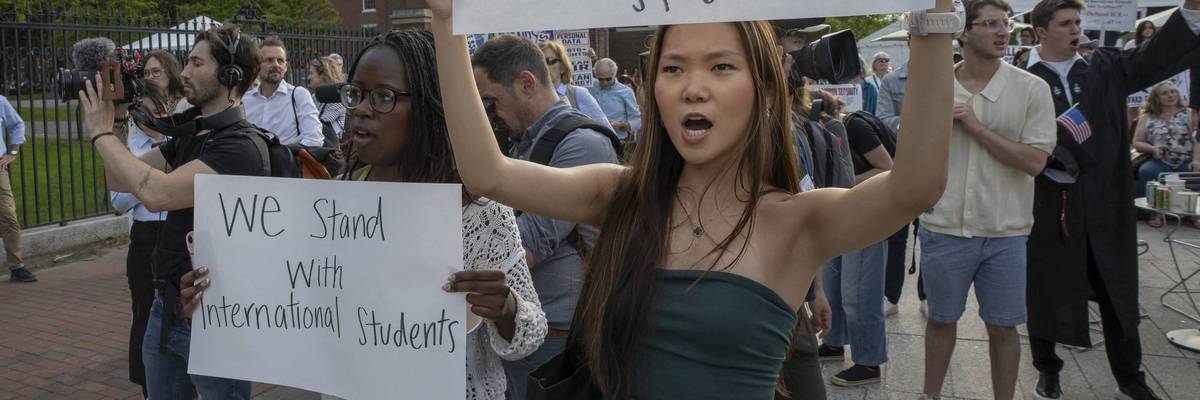
People hold up signs during the Harvard Students for Freedom rally in support of international students at the Harvard University campus in Cambridge on May 27, 2025.
One legal advocacy group said the rule change "will be costly, cause chaos, and cut legal immigration."
The Trump administration on Thursday finalized sweeping new visa restrictions that immigration advocates and higher education professionals say will make it significantly more difficult for international students and journalists to study and work in the United States.
The Department of Homeland Security (DHS) said it is replacing the long-standing "duration of status" system—which allowed students to remain in the country as long as they complied with the terms of their visas—with fixed admission periods that generally cap student and exchange visitor stays at four years.
Foreign journalists, meanwhile, will see their visas limited to 240 days, while Chinese journalists will face an even shorter 90-day limit. Visa holders will have to apply for extensions if they need more time.
NEW: The Trump admin finalized a regulation which makes the largest changes to the student visa process in 50 years, along with changes to rules for exchange visitors and international journalists. 🧵on some of the most consequential changes set to go into effect in September.
[image or embed]
— Aaron Reichlin-Melnick (@reichlinmelnick.bsky.social) July 16, 2026 at 12:09 PM
Homeland Security Secretary Markwayne Mullin claimed that “for nearly half a century, the outdated 'duration of status' system has compromised national security and created an environment ripe for immigration fraud."
"For decades, foreign students have been admitted into the US indefinitely, allowing thousands to abuse our immigration system by perpetually enrolling in courses to avoid having to leave the US," Mullin added. "By implementing clear, finite limits on these visas, the United States is reclaiming its ability to properly screen, vet, and monitor individuals within our borders."
However, Todd Schulte, president of the bipartisan political advocacy and lobbying group Fwd.US, warned that “these new restrictions will only make it harder for international students and researchers to complete their studies in the US and contribute their education to the US workforce after graduating."
"These changes will hurt America’s global competitiveness, hinder businesses’ ability to hire US-educated talent, impose significant and unnecessary costs on universities and students, and increase the workload for federal agencies already struggling with backlogs and delays," Schulte added. "This rule will create more bureaucratic backlogs and delays and help grind the legal immigration system to a halt.”
"Have these people no understanding of how life works?"
The American Immigration Lawyers Association said the rule change "will be costly, cause chaos, and cut legal immigration."
David Bier, the immigration studies director at the libertarian Cato Institute, told Reuters that "international students, many of whom will have spent years in the USA, will now have just 30 days to find an employer to sponsor them or immediately be turned into illegal immigrants. Have these people no understanding of how life works?"
Fanta Aw, executive director of NAFSA: Association of International Educators, said in an interview with The Washington Post that “DHS’ decision to end duration of status is a misguided and unnecessary policy shift that injects uncertainty, bureaucracy, and fear into a system that has long worked effectively."
Dear Common Dreams reader, It’s been nearly 30 years since I co-founded Common Dreams with my late wife, Lina Newhouser. We had the radical notion that journalism should serve the public good, not corporate profits. It was clear to us from the outset what it would take to build such a project. No paid advertisements. No corporate sponsors. No millionaire publisher telling us what to think or do. Many people said we wouldn't last a year, but we proved those doubters wrong. Together with a tremendous team of journalists and dedicated staff, we built an independent media outlet free from the constraints of profits and corporate control. Our mission has always been simple: To inform. To inspire. To ignite change for the common good. Building Common Dreams was not easy. Our survival was never guaranteed. When you take on the most powerful forces—Wall Street greed, fossil fuel industry destruction, Big Tech lobbyists, and uber-rich oligarchs who have spent billions upon billions rigging the economy and democracy in their favor—the only bulwark you have is supporters who believe in your work. But here’s the urgent message from me today. It's never been this bad out there. And it's never been this hard to keep us going. At the very moment Common Dreams is most needed, the threats we face are intensifying. We need your support now more than ever. We don't accept corporate advertising and never will. We don't have a paywall because we don't think people should be blocked from critical news based on their ability to pay. Everything we do is funded by the donations of readers like you. When everyone does the little they can afford, we are strong. But if that support retreats or dries up, so do we. Will you donate now to make sure Common Dreams not only survives but thrives? —Craig Brown, Co-founder |
The Trump administration on Thursday finalized sweeping new visa restrictions that immigration advocates and higher education professionals say will make it significantly more difficult for international students and journalists to study and work in the United States.
The Department of Homeland Security (DHS) said it is replacing the long-standing "duration of status" system—which allowed students to remain in the country as long as they complied with the terms of their visas—with fixed admission periods that generally cap student and exchange visitor stays at four years.
Foreign journalists, meanwhile, will see their visas limited to 240 days, while Chinese journalists will face an even shorter 90-day limit. Visa holders will have to apply for extensions if they need more time.
NEW: The Trump admin finalized a regulation which makes the largest changes to the student visa process in 50 years, along with changes to rules for exchange visitors and international journalists. 🧵on some of the most consequential changes set to go into effect in September.
[image or embed]
— Aaron Reichlin-Melnick (@reichlinmelnick.bsky.social) July 16, 2026 at 12:09 PM
Homeland Security Secretary Markwayne Mullin claimed that “for nearly half a century, the outdated 'duration of status' system has compromised national security and created an environment ripe for immigration fraud."
"For decades, foreign students have been admitted into the US indefinitely, allowing thousands to abuse our immigration system by perpetually enrolling in courses to avoid having to leave the US," Mullin added. "By implementing clear, finite limits on these visas, the United States is reclaiming its ability to properly screen, vet, and monitor individuals within our borders."
However, Todd Schulte, president of the bipartisan political advocacy and lobbying group Fwd.US, warned that “these new restrictions will only make it harder for international students and researchers to complete their studies in the US and contribute their education to the US workforce after graduating."
"These changes will hurt America’s global competitiveness, hinder businesses’ ability to hire US-educated talent, impose significant and unnecessary costs on universities and students, and increase the workload for federal agencies already struggling with backlogs and delays," Schulte added. "This rule will create more bureaucratic backlogs and delays and help grind the legal immigration system to a halt.”
"Have these people no understanding of how life works?"
The American Immigration Lawyers Association said the rule change "will be costly, cause chaos, and cut legal immigration."
David Bier, the immigration studies director at the libertarian Cato Institute, told Reuters that "international students, many of whom will have spent years in the USA, will now have just 30 days to find an employer to sponsor them or immediately be turned into illegal immigrants. Have these people no understanding of how life works?"
Fanta Aw, executive director of NAFSA: Association of International Educators, said in an interview with The Washington Post that “DHS’ decision to end duration of status is a misguided and unnecessary policy shift that injects uncertainty, bureaucracy, and fear into a system that has long worked effectively."
The Trump administration on Thursday finalized sweeping new visa restrictions that immigration advocates and higher education professionals say will make it significantly more difficult for international students and journalists to study and work in the United States.
The Department of Homeland Security (DHS) said it is replacing the long-standing "duration of status" system—which allowed students to remain in the country as long as they complied with the terms of their visas—with fixed admission periods that generally cap student and exchange visitor stays at four years.
Foreign journalists, meanwhile, will see their visas limited to 240 days, while Chinese journalists will face an even shorter 90-day limit. Visa holders will have to apply for extensions if they need more time.
NEW: The Trump admin finalized a regulation which makes the largest changes to the student visa process in 50 years, along with changes to rules for exchange visitors and international journalists. 🧵on some of the most consequential changes set to go into effect in September.
[image or embed]
— Aaron Reichlin-Melnick (@reichlinmelnick.bsky.social) July 16, 2026 at 12:09 PM
Homeland Security Secretary Markwayne Mullin claimed that “for nearly half a century, the outdated 'duration of status' system has compromised national security and created an environment ripe for immigration fraud."
"For decades, foreign students have been admitted into the US indefinitely, allowing thousands to abuse our immigration system by perpetually enrolling in courses to avoid having to leave the US," Mullin added. "By implementing clear, finite limits on these visas, the United States is reclaiming its ability to properly screen, vet, and monitor individuals within our borders."
However, Todd Schulte, president of the bipartisan political advocacy and lobbying group Fwd.US, warned that “these new restrictions will only make it harder for international students and researchers to complete their studies in the US and contribute their education to the US workforce after graduating."
"These changes will hurt America’s global competitiveness, hinder businesses’ ability to hire US-educated talent, impose significant and unnecessary costs on universities and students, and increase the workload for federal agencies already struggling with backlogs and delays," Schulte added. "This rule will create more bureaucratic backlogs and delays and help grind the legal immigration system to a halt.”
"Have these people no understanding of how life works?"
The American Immigration Lawyers Association said the rule change "will be costly, cause chaos, and cut legal immigration."
David Bier, the immigration studies director at the libertarian Cato Institute, told Reuters that "international students, many of whom will have spent years in the USA, will now have just 30 days to find an employer to sponsor them or immediately be turned into illegal immigrants. Have these people no understanding of how life works?"
Fanta Aw, executive director of NAFSA: Association of International Educators, said in an interview with The Washington Post that “DHS’ decision to end duration of status is a misguided and unnecessary policy shift that injects uncertainty, bureaucracy, and fear into a system that has long worked effectively."