SUBSCRIBE TO OUR FREE NEWSLETTER
Daily news & progressive opinion—funded by the people, not the corporations—delivered straight to your inbox.
5
#000000
#FFFFFF
To donate by check, phone, or other method, see our More Ways to Give page.
Daily news & progressive opinion—funded by the people, not the corporations—delivered straight to your inbox.
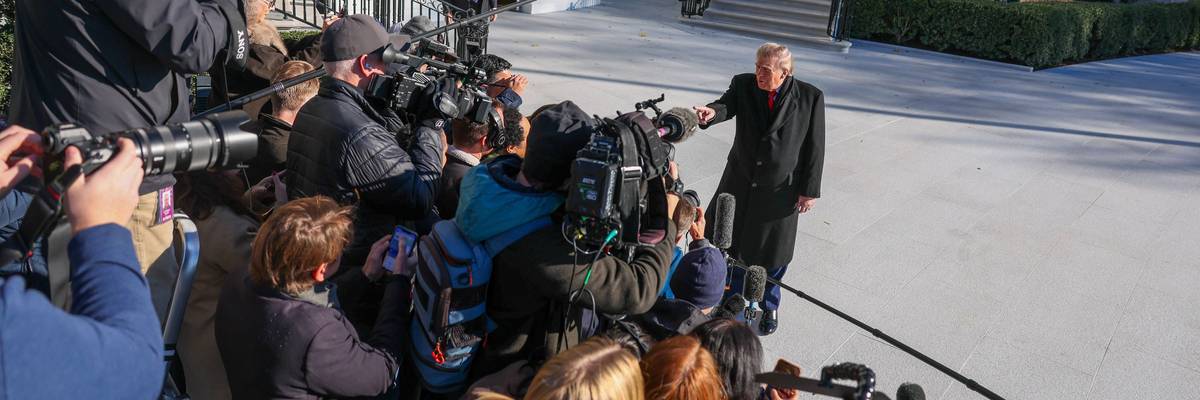
President Donald Trump talks to reporters while departing the White House on November 16, 2026 in Washington, DC.
"The DHS proposal was always a solution in search of a problem that appeared designed to crack down on independent journalism."
A federal judge on Monday struck down a rule from the US Department of Homeland Security that drastically shortened the length of visas for international students, researchers, teachers, and journalists.
In his ruling, US District Judge F. Dennis Saylor IV, an appointee of former President George W. Bush, found that DHS' visa rule change violated the Administrative Procedure Act's restrictions against federal agencies making "arbitrary and capricious" rule changes.
Saylor argued that, in shortening the length of visas, DHS failed to consider alternative methods for achieving its purported goals of cracking down on alleged fraud, such as enhanced utilization of the Student and Exchange Visitor Information System (SEVIS).
The judge also knocked DHS for trying to place restrictions on the types of degrees foreign students can pursue in the US, noting that the agency's rule changes "would prohibit foreign students from engaging in extended periods of study, such as those required for Ph.D. programs," among other restrictions.
"Put bluntly," wrote Saylor, "DHS is seeking to prevent or discourage the very activity—providing educational opportunities for foreign students in the United States—that Congress sought to permit and encourage. The statute simply does not grant DHS such broad and open-ended authority to undermine the F-1 visa program."
The judge concluded by vacating the entire rule "on the ground that it is arbitrary, capricious, an abuse of discretion, and otherwise not in accordance with law."
Saylor's decision earned applause from Reporters Without Borders (RSF), which hailed the ruling as "a victory for press freedom."
RSF pointed out that, in arguing for the visa restrictions, DHS "never articulated a justification for this arbitrary and overly restrictive change to visas for international journalists working in the United States" and "never even identified a single instance of the current visa rules being abused."
"The DHS proposal was always a solution in search of a problem that appeared designed to crack down on independent journalism," said RSF. "International journalists must be free to report from the United States without fear of arbitrary restrictions or political interference."
This country and this world are at a monumental crossroads. US voters have an opportunity to beat back the forces of fascism and confront the billionaires who are rigging the economy, our media system, and our democracy, making it increasingly impossible for ordinary people to get by. We’re not just talking about the election. We’re talking about what must be done once these fascist elements are vanquished from power. We need a bolder set of solutions than what either major party has so far been willing to offer and a working-class movement ready to fight like hell for it. Trump didn't emerge from nowhere. The conditions that fueled MAGA authoritarianism were created by decades of radical neoliberal economic policies and a corrupt political system dominated by corporate interests. They slashed taxes on the super-rich, promising that the benefits would trickle down. They said giveaways to the corporate titans would make life more affordable for the rest of us. It was all bullshit. And when a bitter, betrayed populace searches for someone to blame, right-wing demagogues have little trouble finding scapegoats. People know when they're being lied to, but you won't hear any of this from the corporate media. Only independent journalism—powered and funded by people who believe in building a better world—can deliver truly trustworthy daily news. If you share our vision, please contribute whatever you can to sustain our work. |
A federal judge on Monday struck down a rule from the US Department of Homeland Security that drastically shortened the length of visas for international students, researchers, teachers, and journalists.
In his ruling, US District Judge F. Dennis Saylor IV, an appointee of former President George W. Bush, found that DHS' visa rule change violated the Administrative Procedure Act's restrictions against federal agencies making "arbitrary and capricious" rule changes.
Saylor argued that, in shortening the length of visas, DHS failed to consider alternative methods for achieving its purported goals of cracking down on alleged fraud, such as enhanced utilization of the Student and Exchange Visitor Information System (SEVIS).
The judge also knocked DHS for trying to place restrictions on the types of degrees foreign students can pursue in the US, noting that the agency's rule changes "would prohibit foreign students from engaging in extended periods of study, such as those required for Ph.D. programs," among other restrictions.
"Put bluntly," wrote Saylor, "DHS is seeking to prevent or discourage the very activity—providing educational opportunities for foreign students in the United States—that Congress sought to permit and encourage. The statute simply does not grant DHS such broad and open-ended authority to undermine the F-1 visa program."
The judge concluded by vacating the entire rule "on the ground that it is arbitrary, capricious, an abuse of discretion, and otherwise not in accordance with law."
Saylor's decision earned applause from Reporters Without Borders (RSF), which hailed the ruling as "a victory for press freedom."
RSF pointed out that, in arguing for the visa restrictions, DHS "never articulated a justification for this arbitrary and overly restrictive change to visas for international journalists working in the United States" and "never even identified a single instance of the current visa rules being abused."
"The DHS proposal was always a solution in search of a problem that appeared designed to crack down on independent journalism," said RSF. "International journalists must be free to report from the United States without fear of arbitrary restrictions or political interference."