SUBSCRIBE TO OUR FREE NEWSLETTER
Daily news & progressive opinion—funded by the people, not the corporations—delivered straight to your inbox.
5
#000000
#FFFFFF
To donate by check, phone, or other method, see our More Ways to Give page.
Daily news & progressive opinion—funded by the people, not the corporations—delivered straight to your inbox.
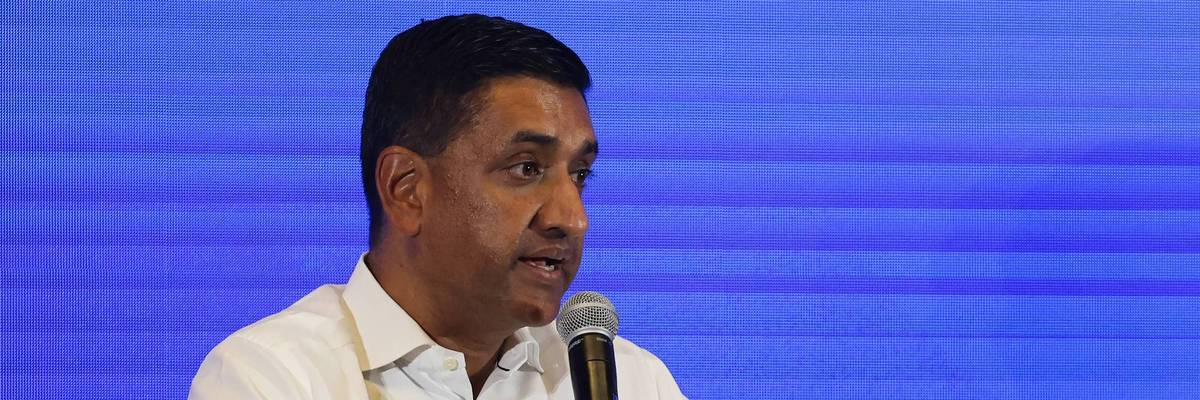
Tom Steyer and Rep. Ro Khanna (D-Calif.) sit in conversation with Excessive Wealth Executive Director Igor Volsky during the first-of-its-kind US vs. Billionaires convention held at The Hibernia in San Francisco, California, on Monday, October 5, 2026.
Khanna took an apparent shot at a potential 2028 rival, Pete Buttigieg, calling his "Medicare for All Who Want It" proposal "pablum."
As he teases a 2028 presidential bid, US Rep. Ro Khanna is reigniting the healthcare debate that was front and center during the last open Democratic presidential primary and making the case for Medicare for All.
The California Democrat responded Monday to a common talking point from opponents of a single-payer healthcare program: that it would force those who want to keep their current insurance plans to give them up for a one-size-fits-all public plan.
"Medicare for All means healthcare for everyone, like public school is free for every kid," Khanna wrote on social media. "Private insurance can still exist on top of it, just like private school still exists."
The Medicare for All bills introduced in the House and Senate by Rep. Pramila Jayapal (D-Wash.) and Sen. Bernie Sanders (I-Vt.) would cover virtually all medically necessary healthcare, including doctor visits, hospital stays, prescription drugs, dental and vision care, and long-term care.
Both bills would prohibit private insurance that duplicates benefits covered by the public program, while allowing Americans to purchase supplemental coverage for benefits not covered by the government plan.
Khanna also took an apparent jab at a healthcare proposal from former Transportation Secretary and South Bend, Indiana Mayor Pete Buttigieg, one of his potential 2028 rivals.
During the 2020 Democratic presidential primary, Buttigieg campaigned on a policy he called “Medicare for All Who Want It,” which would have preserved private insurance while allowing Americans to enroll in a government-subsidized public plan, with marketplace premiums capped at 8.5% of household income.
“‘Medicare for All Who Want It’ is pablum,” wrote Khanna, who has argued that healthcare should be considered a human right. “It’s telling parents they have to pay for public school.”
Though Medicare for All would be funded through taxes, proponents argue that Americans would ultimately save money through the elimination of private insurance premiums, deductibles, and copays.
A recent analysis by researchers at Yale University, conducted at Khanna’s request, estimated that a single-payer system would reduce annual national healthcare expenditures by more than $1 trillion, or nearly 20%, by cutting administrative costs, lowering prescription drug prices, and reducing other inefficiencies. It also projected that approximately 114,000 deaths could be prevented every year through expanded healthcare coverage.
This country and this world are at a monumental crossroads. US voters have an opportunity to beat back the forces of fascism and confront the billionaires who are rigging the economy, our media system, and our democracy, making it increasingly impossible for ordinary people to get by. We’re not just talking about the election. We’re talking about what must be done once these fascist elements are vanquished from power. We need a bolder set of solutions than what either major party has so far been willing to offer and a working-class movement ready to fight like hell for it. Trump didn't emerge from nowhere. The conditions that fueled MAGA authoritarianism were created by decades of radical neoliberal economic policies and a corrupt political system dominated by corporate interests. They slashed taxes on the super-rich, promising that the benefits would trickle down. They said giveaways to the corporate titans would make life more affordable for the rest of us. It was all bullshit. And when a bitter, betrayed populace searches for someone to blame, right-wing demagogues have little trouble finding scapegoats. People know when they're being lied to, but you won't hear any of this from the corporate media. Only independent journalism—powered and funded by people who believe in building a better world—can deliver truly trustworthy daily news. If you share our vision, please contribute whatever you can to sustain our work. |
As he teases a 2028 presidential bid, US Rep. Ro Khanna is reigniting the healthcare debate that was front and center during the last open Democratic presidential primary and making the case for Medicare for All.
The California Democrat responded Monday to a common talking point from opponents of a single-payer healthcare program: that it would force those who want to keep their current insurance plans to give them up for a one-size-fits-all public plan.
"Medicare for All means healthcare for everyone, like public school is free for every kid," Khanna wrote on social media. "Private insurance can still exist on top of it, just like private school still exists."
The Medicare for All bills introduced in the House and Senate by Rep. Pramila Jayapal (D-Wash.) and Sen. Bernie Sanders (I-Vt.) would cover virtually all medically necessary healthcare, including doctor visits, hospital stays, prescription drugs, dental and vision care, and long-term care.
Both bills would prohibit private insurance that duplicates benefits covered by the public program, while allowing Americans to purchase supplemental coverage for benefits not covered by the government plan.
Khanna also took an apparent jab at a healthcare proposal from former Transportation Secretary and South Bend, Indiana Mayor Pete Buttigieg, one of his potential 2028 rivals.
During the 2020 Democratic presidential primary, Buttigieg campaigned on a policy he called “Medicare for All Who Want It,” which would have preserved private insurance while allowing Americans to enroll in a government-subsidized public plan, with marketplace premiums capped at 8.5% of household income.
“‘Medicare for All Who Want It’ is pablum,” wrote Khanna, who has argued that healthcare should be considered a human right. “It’s telling parents they have to pay for public school.”
Though Medicare for All would be funded through taxes, proponents argue that Americans would ultimately save money through the elimination of private insurance premiums, deductibles, and copays.
A recent analysis by researchers at Yale University, conducted at Khanna’s request, estimated that a single-payer system would reduce annual national healthcare expenditures by more than $1 trillion, or nearly 20%, by cutting administrative costs, lowering prescription drug prices, and reducing other inefficiencies. It also projected that approximately 114,000 deaths could be prevented every year through expanded healthcare coverage.