SUBSCRIBE TO OUR FREE NEWSLETTER
Daily news & progressive opinion—funded by the people, not the corporations—delivered straight to your inbox.
5
#000000
#FFFFFF
To donate by check, phone, or other method, see our More Ways to Give page.
Daily news & progressive opinion—funded by the people, not the corporations—delivered straight to your inbox.
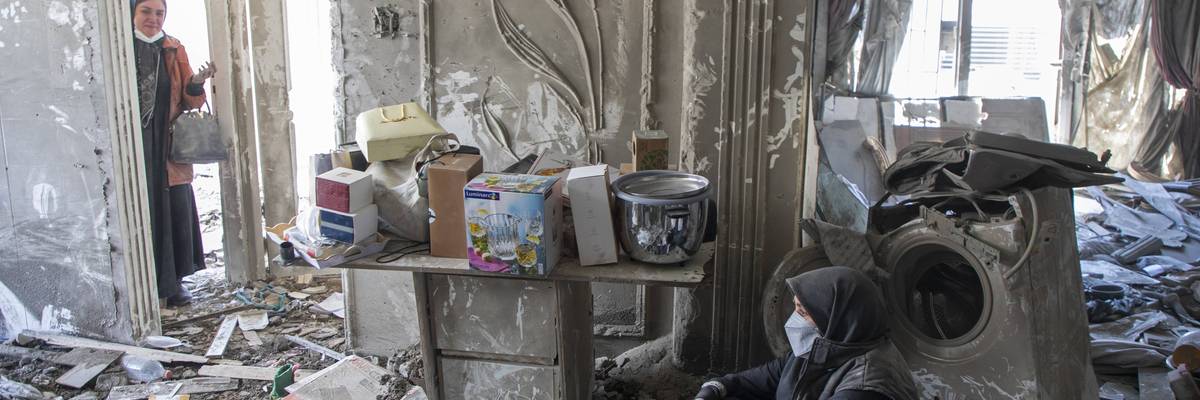
Residents sit amid debris in a residential building that was hit in an airstrike on March 30, 2026 in the west of Tehran, Iran. The United States and Israel have continued their joint attack on Iran that began on February 28.
Passing this proposed budget would be a recipe for endless war, while undermining the nation's ability to address the truly pressing problems at home that demand our urgent attention.
It has been reported that the Pentagon on Friday will release a proposed budget for Fiscal Year 2027 of almost $1.5 trillion, with approximately $1.15 trillion in discretionary spending contained in the department’s regular annual budget and an additional $350 billion dependent on Congress including it in a separate budget reconciliation bill.
Whatever vehicles the administration chooses to promote this huge increase, it will be doubling down on a failed budgetary and national security strategy. If passed as requested, $1.5 trillion in Pentagon spending—in a single year–will make America weaker by underwriting a misguided strategy, funding outmoded weapons programs, and crowding out other essential public investments.
The current war in the Middle East is a case study in the ineffectiveness of an overreliance on military force in seeking to make America or the world a safer place. In his first term, President Trump abandoned a multilateral agreement that was effectively blocking Iran’s path to a nuclear weapon. Six years later, in his second term, the president initially justified his disastrous intervention against Iran as being motivated by fears of that very same program.
The current war in the Middle East is a case study in the ineffectiveness of an overreliance on military force in seeking to make America or the world a safer place.
Diplomacy worked. Reckless resort to force does not, as evidenced by the devastating human, budgetary, and global economic consequences of the current Middle East war. Passing a $1.5 trillion Pentagon budget would be a recipe for endless war.
Meanwhile, other, non-military investments needed to protect the lives and livelihoods of Americans are being sharply reduced. By one account, the first week of the war on Iran cost $11.6 billion. That’s more than the Trump administration proposed for the annual budgets of the Centers for Disease Control and the Environmental Protection Agency combined for this year. Yet addressing the climate crisis and the need to prevent future outbreaks of disease are essential to the safety and security of Americans.
The administration has also reduced our available tools of influence on the foreign policy front by decimating the Agency for International Development, laying off trained diplomats at the State Department, and withdrawing from major international agreements. This leaves force and the threat of force as virtually the last tools standing for promoting U.S. security interests.
Diplomacy worked. Reckless resort to force does not.
The Pentagon doesn’t need more spending, it needs more spending discipline. Spending billions of dollars on a Golden Dome system that can never achieve the President’s dream of a leak proof missile defense system is sheer waste, as is continuing to lavish funds on overpriced, underperforming combat aircraft like the F-35, or multi-billion dollar aircraft carriers that are vulnerable to modern high speed missiles.
The truth is, there are not enough factories, or skilled workers, or materials to effectively spend such a huge increase. It will be a recipe for waste, fraud and abuse.
Dear Common Dreams reader, It’s been nearly 30 years since I co-founded Common Dreams with my late wife, Lina Newhouser. We had the radical notion that journalism should serve the public good, not corporate profits. It was clear to us from the outset what it would take to build such a project. No paid advertisements. No corporate sponsors. No millionaire publisher telling us what to think or do. Many people said we wouldn't last a year, but we proved those doubters wrong. Together with a tremendous team of journalists and dedicated staff, we built an independent media outlet free from the constraints of profits and corporate control. Our mission has always been simple: To inform. To inspire. To ignite change for the common good. Building Common Dreams was not easy. Our survival was never guaranteed. When you take on the most powerful forces—Wall Street greed, fossil fuel industry destruction, Big Tech lobbyists, and uber-rich oligarchs who have spent billions upon billions rigging the economy and democracy in their favor—the only bulwark you have is supporters who believe in your work. But here’s the urgent message from me today. It's never been this bad out there. And it's never been this hard to keep us going. At the very moment Common Dreams is most needed, the threats we face are intensifying. We need your support now more than ever. We don't accept corporate advertising and never will. We don't have a paywall because we don't think people should be blocked from critical news based on their ability to pay. Everything we do is funded by the donations of readers like you. When everyone does the little they can afford, we are strong. But if that support retreats or dries up, so do we. Will you donate now to make sure Common Dreams not only survives but thrives? —Craig Brown, Co-founder |
It has been reported that the Pentagon on Friday will release a proposed budget for Fiscal Year 2027 of almost $1.5 trillion, with approximately $1.15 trillion in discretionary spending contained in the department’s regular annual budget and an additional $350 billion dependent on Congress including it in a separate budget reconciliation bill.
Whatever vehicles the administration chooses to promote this huge increase, it will be doubling down on a failed budgetary and national security strategy. If passed as requested, $1.5 trillion in Pentagon spending—in a single year–will make America weaker by underwriting a misguided strategy, funding outmoded weapons programs, and crowding out other essential public investments.
The current war in the Middle East is a case study in the ineffectiveness of an overreliance on military force in seeking to make America or the world a safer place. In his first term, President Trump abandoned a multilateral agreement that was effectively blocking Iran’s path to a nuclear weapon. Six years later, in his second term, the president initially justified his disastrous intervention against Iran as being motivated by fears of that very same program.
The current war in the Middle East is a case study in the ineffectiveness of an overreliance on military force in seeking to make America or the world a safer place.
Diplomacy worked. Reckless resort to force does not, as evidenced by the devastating human, budgetary, and global economic consequences of the current Middle East war. Passing a $1.5 trillion Pentagon budget would be a recipe for endless war.
Meanwhile, other, non-military investments needed to protect the lives and livelihoods of Americans are being sharply reduced. By one account, the first week of the war on Iran cost $11.6 billion. That’s more than the Trump administration proposed for the annual budgets of the Centers for Disease Control and the Environmental Protection Agency combined for this year. Yet addressing the climate crisis and the need to prevent future outbreaks of disease are essential to the safety and security of Americans.
The administration has also reduced our available tools of influence on the foreign policy front by decimating the Agency for International Development, laying off trained diplomats at the State Department, and withdrawing from major international agreements. This leaves force and the threat of force as virtually the last tools standing for promoting U.S. security interests.
Diplomacy worked. Reckless resort to force does not.
The Pentagon doesn’t need more spending, it needs more spending discipline. Spending billions of dollars on a Golden Dome system that can never achieve the President’s dream of a leak proof missile defense system is sheer waste, as is continuing to lavish funds on overpriced, underperforming combat aircraft like the F-35, or multi-billion dollar aircraft carriers that are vulnerable to modern high speed missiles.
The truth is, there are not enough factories, or skilled workers, or materials to effectively spend such a huge increase. It will be a recipe for waste, fraud and abuse.
It has been reported that the Pentagon on Friday will release a proposed budget for Fiscal Year 2027 of almost $1.5 trillion, with approximately $1.15 trillion in discretionary spending contained in the department’s regular annual budget and an additional $350 billion dependent on Congress including it in a separate budget reconciliation bill.
Whatever vehicles the administration chooses to promote this huge increase, it will be doubling down on a failed budgetary and national security strategy. If passed as requested, $1.5 trillion in Pentagon spending—in a single year–will make America weaker by underwriting a misguided strategy, funding outmoded weapons programs, and crowding out other essential public investments.
The current war in the Middle East is a case study in the ineffectiveness of an overreliance on military force in seeking to make America or the world a safer place. In his first term, President Trump abandoned a multilateral agreement that was effectively blocking Iran’s path to a nuclear weapon. Six years later, in his second term, the president initially justified his disastrous intervention against Iran as being motivated by fears of that very same program.
The current war in the Middle East is a case study in the ineffectiveness of an overreliance on military force in seeking to make America or the world a safer place.
Diplomacy worked. Reckless resort to force does not, as evidenced by the devastating human, budgetary, and global economic consequences of the current Middle East war. Passing a $1.5 trillion Pentagon budget would be a recipe for endless war.
Meanwhile, other, non-military investments needed to protect the lives and livelihoods of Americans are being sharply reduced. By one account, the first week of the war on Iran cost $11.6 billion. That’s more than the Trump administration proposed for the annual budgets of the Centers for Disease Control and the Environmental Protection Agency combined for this year. Yet addressing the climate crisis and the need to prevent future outbreaks of disease are essential to the safety and security of Americans.
The administration has also reduced our available tools of influence on the foreign policy front by decimating the Agency for International Development, laying off trained diplomats at the State Department, and withdrawing from major international agreements. This leaves force and the threat of force as virtually the last tools standing for promoting U.S. security interests.
Diplomacy worked. Reckless resort to force does not.
The Pentagon doesn’t need more spending, it needs more spending discipline. Spending billions of dollars on a Golden Dome system that can never achieve the President’s dream of a leak proof missile defense system is sheer waste, as is continuing to lavish funds on overpriced, underperforming combat aircraft like the F-35, or multi-billion dollar aircraft carriers that are vulnerable to modern high speed missiles.
The truth is, there are not enough factories, or skilled workers, or materials to effectively spend such a huge increase. It will be a recipe for waste, fraud and abuse.