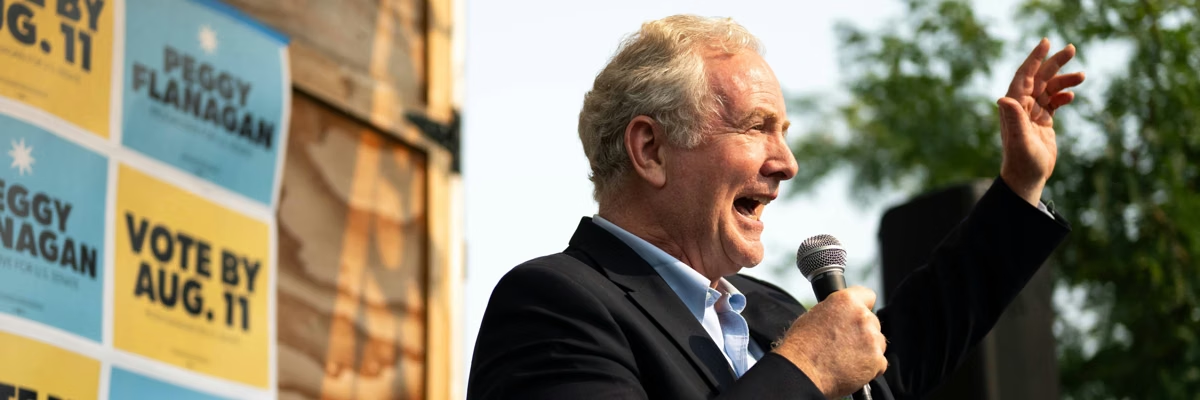
US Sen. Chris Van Hollen (D-Md.) introduces Minnesota Lt. Gov. Peggy Flanagan, a Democratic candidate for US Senate, during a volunteer appreciation event at Black Heart of Saint Paul on August 8, 2026, in St. Paul, Minnesota.
Van Hollen Says Medicare for All Is What's Needed If Democrats Take Back the Senate
“The reality is people are facing huge increases in premiums and copays… So we need a Medicare-for-All-type solution,” Van Hollen said. “This is the kind of debate we need to have.”
Another possible Democratic presidential contender says the party needs to pursue “Medicare for All” as a solution to America’s healthcare crisis should the US Senate flip blue in November.
“The reality is people are facing huge increases in premiums and copays. So we need a Medicare-for-All-type solution,” Sen. Chris Van Hollen (D-Md.) said in a Monday report from Politico. “This is the kind of debate we need to have.”
Van Hollen joins a list of potential 2028 hopefuls who have endorsed the idea of a single-payer healthcare system—including Reps. Alexandria Ocasio-Cortez (D-NY) and Ro Khanna (D-Calif.), who have championed the policy for years, following the lead of Sen. Bernie Sanders (I-Vt.).
Democratic California Gov. Gavin Newsom has also declared that he believes in “universal healthcare” and “Medicare for All” but has not yet released a concrete proposal for what his version of the policy would look like.
Van Hollen, who previously backed a public health insurance option to compete with private insurance, supported Sanders' Medicare for All bill in December as premiums were set to skyrocket after Republicans allowed enhanced Affordable Care Act insurance subsidies to expire.
He declared that Congress "must stop tinkering around the edges of a broken healthcare system," pointing to the massive administrative costs and poor health outcomes under the for-profit status quo.
Medicare for All could also face a more favorable climate in the Senate than it did during the Biden presidency.
If Democrats retake the chamber this November—buoyed by promises to tackle the high costs of everything from healthcare to energy to food—Sanders is expected to once again be appointed chair of the Senate Health, Education, Labor, and Pensions (HELP) Committee.
Sanders led the committee from 2023-25, a time when Medicare for All lacked any chance of passing out of a Republican-controlled House of Representatives.
While a new Medicare for All bill would likely be routed through the Senate Finance Committee, chairing HELP would give the Vermont socialist the power to frame the debate on healthcare by holding hearings that could address problems with private insurance and launching investigations into industry practices, while making the case for a single-payer system.
In an April 2026 letter, co-signed by Sen. Ron Wyden (D-Ore.), Sanders called for a series of high-profile Senate hearings grilling insurance CEOs over rising premiums, coverage denials, executive compensation, and industry consolidation.
“The American public deserves to know why the big insurance executives... continue to get richer and richer, while over one-third of people with health insurance have been forced to skip or delay getting the care they need because of the outrageous cost,” Sanders and Wyden wrote. “It is time for our committees to hold the chief executives of the major health insurance companies accountable for their greed and to address the healthcare crisis in America."
A strong showing for Democrats in November's midterms could bring a new crop of Medicare for All supporters to Congress, such as former Detroit public health official Abdul El-Sayed and labor leader Troy Jackson, who are leading their Senate races in Michigan and Maine.
As private insurance premiums spike and millions of Americans lose coverage after the Trump administration imposed the largest federal healthcare spending cut in the nation's history, Medicare for All also has more public support than it has had in years.
A September survey by KFF found that 66% of adults said they’d favor “a national health plan in which everyone gets insurance from a single government plan.” Support came from 84% of Democrats, who’ve long backed it, as well as nearly three-quarters of independents and even just over a third of Republicans.
“If I have anything to say about it… the agenda of the Democratic Party is going to be extremely bold. It is going to take on high costs,” Sanders told Politico. “The super [political action committees] are not going to run the agenda anymore. We’re going to do what the American people want.”
We are at a crossroads
This country and this world are at a monumental crossroads. In a few short weeks, US voters will have an opportunity to beat back the forces of fascism and confront the billionaires who are rigging the economy, our media system, and our democracy, making it increasingly impossible for ordinary people to get by. We’re not just talking about the election. We’re talking about what must be done once these fascist elements are vanquished from power. We need a bolder set of solutions than what either major party has so far been willing to offer and a working-class movement ready to fight like hell for it. Trump didn't emerge from nowhere. The conditions that fueled MAGA authoritarianism were created by decades of radical neoliberal economic policies and a corrupt political system dominated by corporate interests. They slashed taxes on the super-rich, promising that the benefits would trickle down. They said giveaways to the corporate titans would make life more affordable for the rest of us. It was all bullshit. And when a bitter, betrayed populace searches for someone to blame, right-wing demagogues have little trouble finding scapegoats. People know when they're being lied to, but you won't hear any of this from the corporate media. Only independent journalism—powered and funded by people who believe in building a better world—can deliver truly trustworthy daily news. Our Fall Campaign is underway, and we need your help. To power our newsroom through the rest of the year, we need to raise $125,000 by midnight on October 31. So if you share our vision, please contribute whatever you can to sustain our work. |
Another possible Democratic presidential contender says the party needs to pursue “Medicare for All” as a solution to America’s healthcare crisis should the US Senate flip blue in November.
“The reality is people are facing huge increases in premiums and copays. So we need a Medicare-for-All-type solution,” Sen. Chris Van Hollen (D-Md.) said in a Monday report from Politico. “This is the kind of debate we need to have.”
Van Hollen joins a list of potential 2028 hopefuls who have endorsed the idea of a single-payer healthcare system—including Reps. Alexandria Ocasio-Cortez (D-NY) and Ro Khanna (D-Calif.), who have championed the policy for years, following the lead of Sen. Bernie Sanders (I-Vt.).
Democratic California Gov. Gavin Newsom has also declared that he believes in “universal healthcare” and “Medicare for All” but has not yet released a concrete proposal for what his version of the policy would look like.
Van Hollen, who previously backed a public health insurance option to compete with private insurance, supported Sanders' Medicare for All bill in December as premiums were set to skyrocket after Republicans allowed enhanced Affordable Care Act insurance subsidies to expire.
He declared that Congress "must stop tinkering around the edges of a broken healthcare system," pointing to the massive administrative costs and poor health outcomes under the for-profit status quo.
Medicare for All could also face a more favorable climate in the Senate than it did during the Biden presidency.
If Democrats retake the chamber this November—buoyed by promises to tackle the high costs of everything from healthcare to energy to food—Sanders is expected to once again be appointed chair of the Senate Health, Education, Labor, and Pensions (HELP) Committee.
Sanders led the committee from 2023-25, a time when Medicare for All lacked any chance of passing out of a Republican-controlled House of Representatives.
While a new Medicare for All bill would likely be routed through the Senate Finance Committee, chairing HELP would give the Vermont socialist the power to frame the debate on healthcare by holding hearings that could address problems with private insurance and launching investigations into industry practices, while making the case for a single-payer system.
In an April 2026 letter, co-signed by Sen. Ron Wyden (D-Ore.), Sanders called for a series of high-profile Senate hearings grilling insurance CEOs over rising premiums, coverage denials, executive compensation, and industry consolidation.
“The American public deserves to know why the big insurance executives... continue to get richer and richer, while over one-third of people with health insurance have been forced to skip or delay getting the care they need because of the outrageous cost,” Sanders and Wyden wrote. “It is time for our committees to hold the chief executives of the major health insurance companies accountable for their greed and to address the healthcare crisis in America."
A strong showing for Democrats in November's midterms could bring a new crop of Medicare for All supporters to Congress, such as former Detroit public health official Abdul El-Sayed and labor leader Troy Jackson, who are leading their Senate races in Michigan and Maine.
As private insurance premiums spike and millions of Americans lose coverage after the Trump administration imposed the largest federal healthcare spending cut in the nation's history, Medicare for All also has more public support than it has had in years.
A September survey by KFF found that 66% of adults said they’d favor “a national health plan in which everyone gets insurance from a single government plan.” Support came from 84% of Democrats, who’ve long backed it, as well as nearly three-quarters of independents and even just over a third of Republicans.
“If I have anything to say about it… the agenda of the Democratic Party is going to be extremely bold. It is going to take on high costs,” Sanders told Politico. “The super [political action committees] are not going to run the agenda anymore. We’re going to do what the American people want.”