SUBSCRIBE TO OUR FREE NEWSLETTER
Daily news & progressive opinion—funded by the people, not the corporations—delivered straight to your inbox.
5
#000000
#FFFFFF
To donate by check, phone, or other method, see our More Ways to Give page.
Daily news & progressive opinion—funded by the people, not the corporations—delivered straight to your inbox.
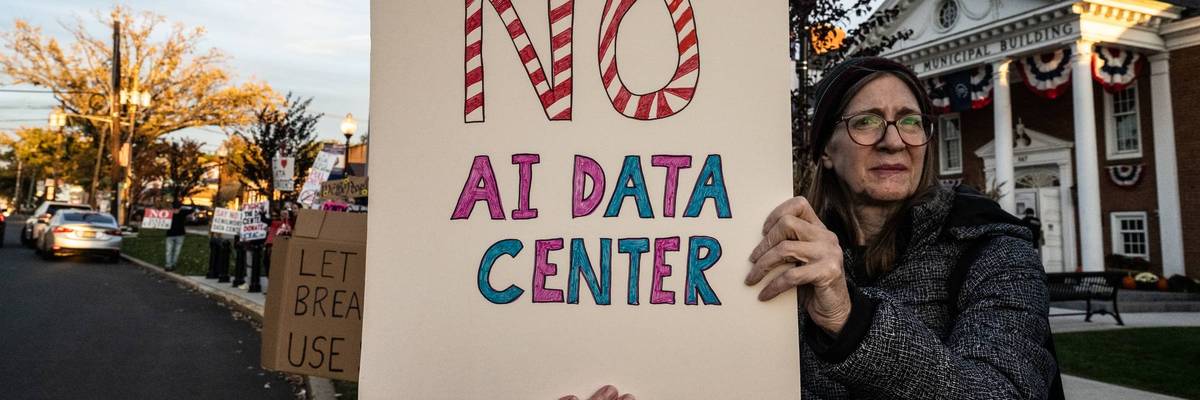
People participate in a protest of the CoreWeave AI data center outside the municipal building on October 21, 2026 in Kenilworth, New Jersey.
“In state after state and race after race, Big Tech has failed to deliver—and everyday Americans have won,” said Mitch Jones, deputy director of Food and Water Action.
The results of both ballot initiatives and legislative elections Tuesday night underscored what numerous polls have shown for months: Despite President Donald Trump's insistence to the contrary, Americans don't want data centers in their communities and are demanding that Big Tech, including artificial intelligence companies, be reined in.
Dozens of cities and towns across the country—including in Ohio, which has been pushed as a hub for the expansion of energy-sucking, water-guzzling data centers—resoundingly voting for moratoriums on their construction, blocking proposed projects like a $2 billion data center Amazon had planned for Sunbury, Ohio.
In all, communities across the US passed 43 out of 44 initiatives that proposed banning or pausing construction on data centers or infrastructure of a certain size.
Sunbury, a small city of less than 9,000 residents, mobilized to pass a ban on data centers larger than 25 megawatts, with more than 78% of voters supporting the moratorium.
The ban "gives us more of a say in the outcome of what happens in our community,” Trey Dockendorf, who helped organize the campaign, told WCMH. Amazon had planned to begin construction in 2028 and property tax breaks for the massive facility could have spanned more than 30 years.
"People do not want data centers where they can ruin neighborhoods, ruin communities, or put people at risk," Larry Thode, who lives near the proposed site for the Amazon project, told 10TV.
Wide margins were reported in elections across the country and in towns across Ohio, where 21 initiatives appeared on ballots.
More than 82% of voters in Granville approved a ban on all data center construction in the village, along with 76% of voters in Hubbard and 77% of people in Urbana.
Farm Action president Angela Huffman recounted how her community of Upper Sandusky also rallied around a proposed moratorium, which was backed by more than 76% of residents.
After Smartland Energy proposed a $900 million center in the town last year, residents "filled public meetings, challenged the proposed approval process, and pressed city officials for answers," wrote Huffman, eventually pushing Smartland to withdraw its zoning request.
She continued:
Local residents worked with attorneys at Conserve Ohio, who drafted the charter amendment that ultimately became Ordinance 85-14.
The amendment would prohibit construction of data centers with an electrical demand or peak load exceeding 25 megawatts.
To place it on the November ballot, we needed to collect signatures from registered city voters.
We were initially told that 155 valid signatures would be sufficient. We collected well beyond that number, knowing some signatures would be rejected during verification.
On August 3, we submitted petitions containing 301 signatures. Of those, 192 were accepted.
We then learned that the city’s charter required 212 valid signatures. That left us 20 valid signatures short.
With just hours remaining before the filing deadline, we headed back out to collect signatures, determined not to let months of work fall short.
On August 5, we submitted another 50 signatures. Election officials accepted 37. Our final total was 229 valid signatures, just 17 more than required.
We had qualified for the November ballot.
Ohioans also elected Democrat Amy Acton to be governor, after a campaign in which Acton supported a statewide moratorium on data centers, and unseated Republican Sen. Jon Husted, whom Democratic Sen.-elect Sherrod Brown derided as "the face of data centers," pointing to his support for tech giants' investment in Ohio when he served as lieutenant governor.
Maine was home to the second-highest number of data center-related ballot initiatives, and voters overwhelmingly supported measures banning construction for 180 days or, in the case of North Berwick, indefinitely for data centers larger than 25,000 square feet.
“Let’s not destroy our nice Maine environment to help produce this thing, and have water droughts and everybody surrounded by really loud noise," Kayley Buzzell of Sabattus told The Maine Monitor. The town voted 66-33% in favor of a moratorium on data centers of 10,000 sq ft or 20 megawatts or more, until May 2027.
Other victorious Democratic gubernatorial candidates who pledged to fight the unregulated growth of data centers, which Trump has aggressively pushed as AI giants poured tens of millions of dollars into the midterm elections, include Govs.-elect Keisha Lance Bottoms in Georgia and Gina Hinojosa in Texas. Hinojosa consistently called for an immediate moratorium on data center development, and Lance Bottoms advocated for a temporary statewide pause and accountability to stop companies from driving up residents' electricity costs.
And in South Carolina, Sen.-elect Annie Andrews (D) labeled her opponent, Republican Sen. Darline Graham, "Data Center Darline" as a super political action committee aligned with the industry spent $1.5 million on advertising for Graham.
The victories of citizen-led ballot initiatives and vocally anti-AI candidates against well-funded allies of Big Tech served as a "clear rebuke of the unchecked AI data center build-out," said Food and Water Action.
“Voters across the country have emphatically rejected the push for AI data centers. In state after state and race after race, Big Tech has failed to deliver—and everyday Americans have won,” said Mitch Jones, deputy director of the group. “Not only in Washington, but in state capitols and village halls across the country, newly elected leaders are poised to stand up to the unregulated, reckless build-out of hyperscale data centers wherever they are proposed."
“Congressional Democrats now have a mandate to stand up to Big Tech," said Jones. "They must start by rejecting the pro-polluter 'permitting reform' bill before them in the lame duck Congress. And a desperately needed moratorium on new data center construction must be enacted, so lawmakers and community leaders have the time to determine if—not how—this out-of-control industry can ever be safely regulated.”
This country and this world are at a monumental crossroads. US voters have an opportunity to beat back the forces of fascism and confront the billionaires who are rigging the economy, our media system, and our democracy, making it increasingly impossible for ordinary people to get by. We’re not just talking about the election. We’re talking about what must be done once these fascist elements are vanquished from power. We need a bolder set of solutions than what either major party has so far been willing to offer and a working-class movement ready to fight like hell for it. Trump didn't emerge from nowhere. The conditions that fueled MAGA authoritarianism were created by decades of radical neoliberal economic policies and a corrupt political system dominated by corporate interests. They slashed taxes on the super-rich, promising that the benefits would trickle down. They said giveaways to the corporate titans would make life more affordable for the rest of us. It was all bullshit. And when a bitter, betrayed populace searches for someone to blame, right-wing demagogues have little trouble finding scapegoats. People know when they're being lied to, but you won't hear any of this from the corporate media. Only independent journalism—powered and funded by people who believe in building a better world—can deliver truly trustworthy daily news. If you share our vision, please contribute whatever you can to sustain our work. |
The results of both ballot initiatives and legislative elections Tuesday night underscored what numerous polls have shown for months: Despite President Donald Trump's insistence to the contrary, Americans don't want data centers in their communities and are demanding that Big Tech, including artificial intelligence companies, be reined in.
Dozens of cities and towns across the country—including in Ohio, which has been pushed as a hub for the expansion of energy-sucking, water-guzzling data centers—resoundingly voting for moratoriums on their construction, blocking proposed projects like a $2 billion data center Amazon had planned for Sunbury, Ohio.
In all, communities across the US passed 43 out of 44 initiatives that proposed banning or pausing construction on data centers or infrastructure of a certain size.
Sunbury, a small city of less than 9,000 residents, mobilized to pass a ban on data centers larger than 25 megawatts, with more than 78% of voters supporting the moratorium.
The ban "gives us more of a say in the outcome of what happens in our community,” Trey Dockendorf, who helped organize the campaign, told WCMH. Amazon had planned to begin construction in 2028 and property tax breaks for the massive facility could have spanned more than 30 years.
"People do not want data centers where they can ruin neighborhoods, ruin communities, or put people at risk," Larry Thode, who lives near the proposed site for the Amazon project, told 10TV.
Wide margins were reported in elections across the country and in towns across Ohio, where 21 initiatives appeared on ballots.
More than 82% of voters in Granville approved a ban on all data center construction in the village, along with 76% of voters in Hubbard and 77% of people in Urbana.
Farm Action president Angela Huffman recounted how her community of Upper Sandusky also rallied around a proposed moratorium, which was backed by more than 76% of residents.
After Smartland Energy proposed a $900 million center in the town last year, residents "filled public meetings, challenged the proposed approval process, and pressed city officials for answers," wrote Huffman, eventually pushing Smartland to withdraw its zoning request.
She continued:
Local residents worked with attorneys at Conserve Ohio, who drafted the charter amendment that ultimately became Ordinance 85-14.
The amendment would prohibit construction of data centers with an electrical demand or peak load exceeding 25 megawatts.
To place it on the November ballot, we needed to collect signatures from registered city voters.
We were initially told that 155 valid signatures would be sufficient. We collected well beyond that number, knowing some signatures would be rejected during verification.
On August 3, we submitted petitions containing 301 signatures. Of those, 192 were accepted.
We then learned that the city’s charter required 212 valid signatures. That left us 20 valid signatures short.
With just hours remaining before the filing deadline, we headed back out to collect signatures, determined not to let months of work fall short.
On August 5, we submitted another 50 signatures. Election officials accepted 37. Our final total was 229 valid signatures, just 17 more than required.
We had qualified for the November ballot.
Ohioans also elected Democrat Amy Acton to be governor, after a campaign in which Acton supported a statewide moratorium on data centers, and unseated Republican Sen. Jon Husted, whom Democratic Sen.-elect Sherrod Brown derided as "the face of data centers," pointing to his support for tech giants' investment in Ohio when he served as lieutenant governor.
Maine was home to the second-highest number of data center-related ballot initiatives, and voters overwhelmingly supported measures banning construction for 180 days or, in the case of North Berwick, indefinitely for data centers larger than 25,000 square feet.
“Let’s not destroy our nice Maine environment to help produce this thing, and have water droughts and everybody surrounded by really loud noise," Kayley Buzzell of Sabattus told The Maine Monitor. The town voted 66-33% in favor of a moratorium on data centers of 10,000 sq ft or 20 megawatts or more, until May 2027.
Other victorious Democratic gubernatorial candidates who pledged to fight the unregulated growth of data centers, which Trump has aggressively pushed as AI giants poured tens of millions of dollars into the midterm elections, include Govs.-elect Keisha Lance Bottoms in Georgia and Gina Hinojosa in Texas. Hinojosa consistently called for an immediate moratorium on data center development, and Lance Bottoms advocated for a temporary statewide pause and accountability to stop companies from driving up residents' electricity costs.
And in South Carolina, Sen.-elect Annie Andrews (D) labeled her opponent, Republican Sen. Darline Graham, "Data Center Darline" as a super political action committee aligned with the industry spent $1.5 million on advertising for Graham.
The victories of citizen-led ballot initiatives and vocally anti-AI candidates against well-funded allies of Big Tech served as a "clear rebuke of the unchecked AI data center build-out," said Food and Water Action.
“Voters across the country have emphatically rejected the push for AI data centers. In state after state and race after race, Big Tech has failed to deliver—and everyday Americans have won,” said Mitch Jones, deputy director of the group. “Not only in Washington, but in state capitols and village halls across the country, newly elected leaders are poised to stand up to the unregulated, reckless build-out of hyperscale data centers wherever they are proposed."
“Congressional Democrats now have a mandate to stand up to Big Tech," said Jones. "They must start by rejecting the pro-polluter 'permitting reform' bill before them in the lame duck Congress. And a desperately needed moratorium on new data center construction must be enacted, so lawmakers and community leaders have the time to determine if—not how—this out-of-control industry can ever be safely regulated.”