SUBSCRIBE TO OUR FREE NEWSLETTER
Daily news & progressive opinion—funded by the people, not the corporations—delivered straight to your inbox.
5
#000000
#FFFFFF
To donate by check, phone, or other method, see our More Ways to Give page.
Daily news & progressive opinion—funded by the people, not the corporations—delivered straight to your inbox.
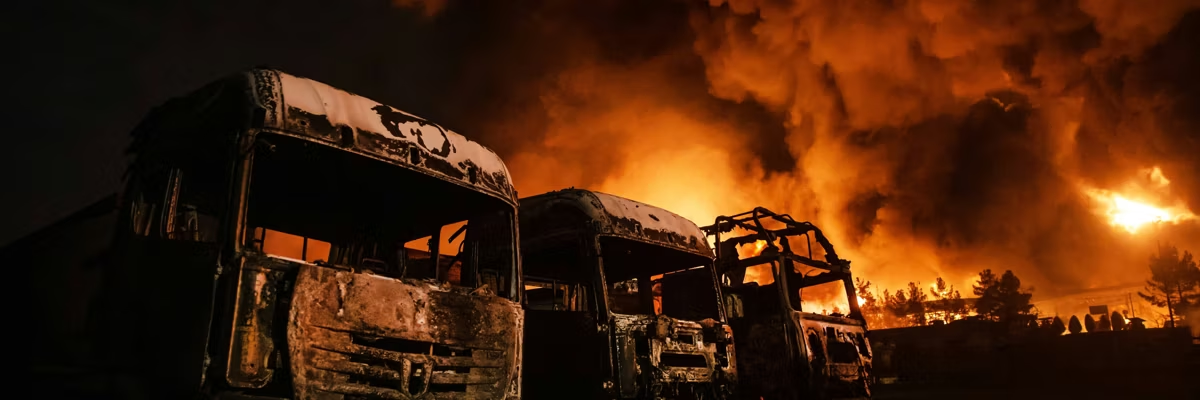
Fire breaks out at the Shahran oil depot after US and Israeli attacks, leaving numerous fuel tankers and vehicles in the area unusable in Tehran, Iran on March 8, 2026.
"The oil market challenges we are facing are unprecedented in scale," said the executive director of the International Energy Agency.
The International Energy Agency said Thursday that the US-Israeli war on Iran and its reverberating impacts across the region have sparked "the largest supply disruption in the history of the global oil market," with flows of crude and other fossil fuel products through the Strait of Hormuz plummeting and Gulf nations slashing production as they run out of storage space.
The agency noted in its monthly report on the state of the global oil market that "oil prices have gyrated wildly since the United States and Israel launched joint airstrikes on Iran on 28 February," pointing to "disruptions to Middle Eastern supplies due to attacks on the region’s oil infrastructure and the cessation of tanker traffic through the Strait of Hormuz," which have "sent Brent futures soaring, trading within a whisker of $120/bbl."
The IEA's report came a day after the agency's 32 member nations—including the US—agreed unanimously to release a total of 400 million barrels of oil from their emergency reserves to "address disruptions in oil markets stemming from the war in the Middle East."
"The oil market challenges we are facing are unprecedented in scale, therefore I am very glad that IEA member countries have responded with an emergency collective action of unprecedented size,” said the agency's executive director, Fatih Birol.
The IEA assessment on Thursday came as oil prices surged again as Mojtaba Khamenei, Iran's new supreme leader, vowed to keep the Strait of Hormuz closed. An estimated 20% of the world's oil passes through the route each year.
Earlier on Thursday, Iraq—which has among the largest confirmed reserves of crude oil in the world—suspended all of its oil terminal operations after two vessels were attacked off the nation's coast. NPR reported that Iran "took responsibility for attacking one of the tankers, which it said was owned by the US."
The US and Israel have also bombed Iran's oil infrastructure, choking Tehran with black smoke and spraying toxic rain that prompted warnings from the World Health Organization (WHO).
"The black rain and the acidic rain coming with it is indeed a danger for the population, respiratory mainly," WHO spokesperson Christian Lindmeier told reporters in Geneva earlier this week.
Heba Morayef, Amnesty International's regional director for the Middle East and North Africa, said Wednesay that "the potential for vast, predictable, and devastating civilian harm arising from strikes targeting energy infrastructure, including uncontrolled deadly fires, major disruptions to essential services, environmental damage, and severe long-term health risks for millions, means there is a substantial risk such attacks would violate international humanitarian law and in some cases could amount to war crimes."
“Regardless of whether a military objective is cited to justify targeting energy infrastructure, under international humanitarian law all parties have a clear obligation to take all feasible precautions to reduce civilian harm and refrain from attacks that cause disproportionate death or injury to civilians or damage to civilian objects," said Morayef. "This includes any foreseeable knock-on, indirect adverse effects on civilians’ life and health, such as exposure to toxic chemicals.”
Dear Common Dreams reader, It’s been nearly 30 years since I co-founded Common Dreams with my late wife, Lina Newhouser. We had the radical notion that journalism should serve the public good, not corporate profits. It was clear to us from the outset what it would take to build such a project. No paid advertisements. No corporate sponsors. No millionaire publisher telling us what to think or do. Many people said we wouldn't last a year, but we proved those doubters wrong. Together with a tremendous team of journalists and dedicated staff, we built an independent media outlet free from the constraints of profits and corporate control. Our mission has always been simple: To inform. To inspire. To ignite change for the common good. Building Common Dreams was not easy. Our survival was never guaranteed. When you take on the most powerful forces—Wall Street greed, fossil fuel industry destruction, Big Tech lobbyists, and uber-rich oligarchs who have spent billions upon billions rigging the economy and democracy in their favor—the only bulwark you have is supporters who believe in your work. But here’s the urgent message from me today. It's never been this bad out there. And it's never been this hard to keep us going. At the very moment Common Dreams is most needed, the threats we face are intensifying. We need your support now more than ever. We don't accept corporate advertising and never will. We don't have a paywall because we don't think people should be blocked from critical news based on their ability to pay. Everything we do is funded by the donations of readers like you. When everyone does the little they can afford, we are strong. But if that support retreats or dries up, so do we. Will you donate now to make sure Common Dreams not only survives but thrives? —Craig Brown, Co-founder |
The International Energy Agency said Thursday that the US-Israeli war on Iran and its reverberating impacts across the region have sparked "the largest supply disruption in the history of the global oil market," with flows of crude and other fossil fuel products through the Strait of Hormuz plummeting and Gulf nations slashing production as they run out of storage space.
The agency noted in its monthly report on the state of the global oil market that "oil prices have gyrated wildly since the United States and Israel launched joint airstrikes on Iran on 28 February," pointing to "disruptions to Middle Eastern supplies due to attacks on the region’s oil infrastructure and the cessation of tanker traffic through the Strait of Hormuz," which have "sent Brent futures soaring, trading within a whisker of $120/bbl."
The IEA's report came a day after the agency's 32 member nations—including the US—agreed unanimously to release a total of 400 million barrels of oil from their emergency reserves to "address disruptions in oil markets stemming from the war in the Middle East."
"The oil market challenges we are facing are unprecedented in scale, therefore I am very glad that IEA member countries have responded with an emergency collective action of unprecedented size,” said the agency's executive director, Fatih Birol.
The IEA assessment on Thursday came as oil prices surged again as Mojtaba Khamenei, Iran's new supreme leader, vowed to keep the Strait of Hormuz closed. An estimated 20% of the world's oil passes through the route each year.
Earlier on Thursday, Iraq—which has among the largest confirmed reserves of crude oil in the world—suspended all of its oil terminal operations after two vessels were attacked off the nation's coast. NPR reported that Iran "took responsibility for attacking one of the tankers, which it said was owned by the US."
The US and Israel have also bombed Iran's oil infrastructure, choking Tehran with black smoke and spraying toxic rain that prompted warnings from the World Health Organization (WHO).
"The black rain and the acidic rain coming with it is indeed a danger for the population, respiratory mainly," WHO spokesperson Christian Lindmeier told reporters in Geneva earlier this week.
Heba Morayef, Amnesty International's regional director for the Middle East and North Africa, said Wednesay that "the potential for vast, predictable, and devastating civilian harm arising from strikes targeting energy infrastructure, including uncontrolled deadly fires, major disruptions to essential services, environmental damage, and severe long-term health risks for millions, means there is a substantial risk such attacks would violate international humanitarian law and in some cases could amount to war crimes."
“Regardless of whether a military objective is cited to justify targeting energy infrastructure, under international humanitarian law all parties have a clear obligation to take all feasible precautions to reduce civilian harm and refrain from attacks that cause disproportionate death or injury to civilians or damage to civilian objects," said Morayef. "This includes any foreseeable knock-on, indirect adverse effects on civilians’ life and health, such as exposure to toxic chemicals.”
The International Energy Agency said Thursday that the US-Israeli war on Iran and its reverberating impacts across the region have sparked "the largest supply disruption in the history of the global oil market," with flows of crude and other fossil fuel products through the Strait of Hormuz plummeting and Gulf nations slashing production as they run out of storage space.
The agency noted in its monthly report on the state of the global oil market that "oil prices have gyrated wildly since the United States and Israel launched joint airstrikes on Iran on 28 February," pointing to "disruptions to Middle Eastern supplies due to attacks on the region’s oil infrastructure and the cessation of tanker traffic through the Strait of Hormuz," which have "sent Brent futures soaring, trading within a whisker of $120/bbl."
The IEA's report came a day after the agency's 32 member nations—including the US—agreed unanimously to release a total of 400 million barrels of oil from their emergency reserves to "address disruptions in oil markets stemming from the war in the Middle East."
"The oil market challenges we are facing are unprecedented in scale, therefore I am very glad that IEA member countries have responded with an emergency collective action of unprecedented size,” said the agency's executive director, Fatih Birol.
The IEA assessment on Thursday came as oil prices surged again as Mojtaba Khamenei, Iran's new supreme leader, vowed to keep the Strait of Hormuz closed. An estimated 20% of the world's oil passes through the route each year.
Earlier on Thursday, Iraq—which has among the largest confirmed reserves of crude oil in the world—suspended all of its oil terminal operations after two vessels were attacked off the nation's coast. NPR reported that Iran "took responsibility for attacking one of the tankers, which it said was owned by the US."
The US and Israel have also bombed Iran's oil infrastructure, choking Tehran with black smoke and spraying toxic rain that prompted warnings from the World Health Organization (WHO).
"The black rain and the acidic rain coming with it is indeed a danger for the population, respiratory mainly," WHO spokesperson Christian Lindmeier told reporters in Geneva earlier this week.
Heba Morayef, Amnesty International's regional director for the Middle East and North Africa, said Wednesay that "the potential for vast, predictable, and devastating civilian harm arising from strikes targeting energy infrastructure, including uncontrolled deadly fires, major disruptions to essential services, environmental damage, and severe long-term health risks for millions, means there is a substantial risk such attacks would violate international humanitarian law and in some cases could amount to war crimes."
“Regardless of whether a military objective is cited to justify targeting energy infrastructure, under international humanitarian law all parties have a clear obligation to take all feasible precautions to reduce civilian harm and refrain from attacks that cause disproportionate death or injury to civilians or damage to civilian objects," said Morayef. "This includes any foreseeable knock-on, indirect adverse effects on civilians’ life and health, such as exposure to toxic chemicals.”