

SUBSCRIBE TO OUR FREE NEWSLETTER
Daily news & progressive opinion—funded by the people, not the corporations—delivered straight to your inbox.
5
#000000
#FFFFFF
To donate by check, phone, or other method, see our More Ways to Give page.
Daily news & progressive opinion—funded by the people, not the corporations—delivered straight to your inbox.

"Susan Collins says she's 'Our Senator,'" said the former Maine state Senate president. "But there’s no one in my life who feels that way."
"Let's win this thing," said US Senate candidate Troy Jackson just before voters in Maine and across the country went to the polls on Tuesday, with Democrats vying to take control of Congress to rein in President Donald Trump.
The progressive former Maine state Senate president, who launched his campaign in July after former nominee Graham Platner dropped out of the race to unseat Republican Sen. Susan Collins, posted a video showing the packed campaign events where he has met voters from across the state and spoken out against Collins' support for Trump's mass deportation agenda, illegal war on Iran, and an economy that is "about taking pieces of our lives away from us."
"I am seeing something now that I've been waiting so damn long for," said Jackson at one event featured in the ad. "I've seen people who haven't been involved in politics before showing up now. We are the ones that built this country. We are the ones that's always put our blood, sweat, and tears on the line, and all those billionaires, we made them that money. Susan Collins needs to come out and hear that."
"Maine deserves a senator who works for Maine, not just those at the top," added Jackson in the video. "Because we're not from the left, we're not from the right, we're from the bottom, and we're rising!"
Tomorrow, Maine decides.I don't owe Washington, Donald Trump, or the billionaires a single thing. I owe the people of Maine everything.We’re not from the left. We’re not from the right. We’re from the bottom, and tomorrow, we’re rising.Polls are open tomorrow. Let's win this thing.
— Troy Jackson (@TroyJackson207) November 3, 2026
Countering Collins' perennial claims that she is a "moderate," independent-minded senator, Jackson has sought to tie New England's only remaining Republican member of the US Senate to Trump, whose approval rating is now in the low 30s as his war on Iran and tariff policies send gas and grocery prices soaring and as his mass deportation agenda continues to tear families and communities apart.
Last month he said Collins "paid for the bullets at Donald Trump’s command" when Colombian immigrant and Biddeford, Maine resident Johan Sebastián Durán Guerrero was shot to death by a US Immigration and Customs Enforcement (ICE) agent in July. He also took her to task during a debate over her vote for the One Big Beautiful Bill Act last year, which helped secure the largest Medicaid cuts in history, and over her attempt to mask the damage she did to Maine's healthcare system by touting a $50 billion rural hospital fund.
“Sen. Collins is like an arsonist who helped set the fire, and then she wants credit for bringing a cup of water to put it out,” said Jackson at the debate.
The fifth-generation logger, who has been endorsed by Sens. Bernie Sanders (I-Vt.) and Elizabeth Warren (D-Mass.) and Rep. Alexandria Ocasio-Cortez (D-NY), supports Medicare for All, a billionaire's tax, dismantling and abolishing ICE, overturning Citizens United to rein in unlimited election spending by corporations and special interest groups, passing a federal right to abortion, and ending US funding for Israel's military.
In recent weeks he has condemned Collins for voting to confirm two anti-abortion federal judges—something she has done dozens of times while claiming to support abortion rights—saying, "Enough is enough."
Jackson also accused her of "corruption of the highest order" after ProPublica reported on a "pay-to-play scheme" in which Collins sent millions of taxpayer dollars to a defense contractor whose CEO donated to her campaign.
"Susan Collins says she's 'Our Senator,'" said Jackson on Tuesday in reference to her campaign signs. "But there’s no one in my life who feels that way."
There's always money for bombs. There's always money for income tax cuts for the wealthiest Americans. But there's never any money for everyday people.Susan Collins says she's "Our Senator" — but there’s no one in my life who feels that way. It’s our time, Maine. Get to the polls to vote her out today.
— Troy Jackson (@TroyJackson207) November 3, 2026
The Maine race could be decisive in determining whether Republicans continue to control the Senate or Democrats have an opportunity to launch investigations into widespread allegations of Trump's corruption and connections to late convicted sex offender Jeffrey Epstein, block his nominees, and force the White House to negotiate over legislation.
A poll released by The New York Times/Siena College this week found Jackson six points ahead of Collins.
In his final get-out-the-vote push, Jackson reminded Mainers that polls are open until 8:00 pm and that they can register at their election sites on Election Day.
"There's always money for bombs. There's always money for income tax cuts for the wealthiest Americans. But there's never any money for everyday people," said Jackson, who also posted a photo of himself greeting Mainers at the polls. "It’s our time, Maine. Get to the polls to vote her out today."

"California, send these oligarchs a message: Democracy is not for sale," said US Sen. Bernie Sanders.
Foes of a California ballot initiative to establish a one-time 5% wealth tax on the state's billionaires have spent vastly more on advertising than proponents—and polls show that money may be having an impact.
A Monday report in The Washington Post estimated that opponents of California’s Proposition 40, led by Google co-founder Sergey Brin, have spent 250 times more than those in favor of the tax.
In total, the Post found, tax opponents have raised more than $379 million to fight the wealth tax, while proponents of the initiative have raised just $35 million.
The spending disparity in advertising is even greater, as tax opponents have spent $148 million on ads, while proponents have spent a mere $572,000.
Google co-founder Sergey Brin has been leading the charge against the measure, having donated more than $100 million to ensure its defeat.
Former Google CEO Eric Schmidt and Kleiner Perkins chairman John Doerr, meanwhile, have both chipped in $40 million each to help defeat the proposal.
The spending blitz comes as polling has shown a steady erosion of support for Proposition 40.
As noted by Gizmodo on Monday, two recent surveys—one from the Public Policy Institute of California and another from the University of California Berkeley Institute of Governmental Studies—show that opposition to the measure now outpaces support. For several months prior, polls showed a majority of California voters in favor of the wealth tax.
David McCuan, a political scientist at Sonoma State University, told the Post that opponents of the tax appear to have held their fire until late in the campaign, when most voters have traditionally started to really pay attention to ballot initiatives.
"The strategy has been to blanket the airwaves in weeks three and four," McCuan said, "and carpet-bomb the airwaves in the last two weeks."
McCuan also estimated that the battle over Proposition 40 "will be the most expensive ballot measure in the history of the world."
Sen. Bernie Sanders (I-Vt.) decried the billionaire campaign to defeat the tax in a Monday social media post.
"Oligarchs in California spent $379 million against Prop 40, a 5% billionaire wealth tax, outraising supporters 250-1," Sanders wrote. "They’d rather poor kids die than pay a little more in taxes. Obscene. California, send these oligarchs a message: Democracy is not for sale. Vote for Prop 40."
Economist Gabriel Zucman, a professor at the University of California, Berkeley, said in an interview with NPR published Monday that the wealth tax in California was part of a broader fight to take away power from the ultrarich, who have seen their wealth grow by leaps and bounds over the last several decades.
"If California says, 'We can tax billionaires. We can tax the wealthiest, most powerful people in the world,'" Zucman explained, "it will be the beginning of not only a broader US-wide movement, ultimately paving the way for a federal wealth tax—but I think it will be the beginning of an international movement."

"Elon Musk and other billionaires want to make sure that Trump and his Republican Congress works for them—not working families," said Sen. Bernie Sanders. "We can beat them."
People across the United States are heading to the polls on Tuesday to cast their ballots in the 2026 midterms, which are projected to rank as the most expensive congressional elections in the country's history thanks to massive spending by a few billionaires—with Tesla and SpaceX CEO Elon Musk leading the pack.
Musk, the richest man in the world, has spent nearly $446 million—a minuscule fraction of his net worth—on the 2026 elections to help Republicans cling to their narrow majorities in the House and Senate. Nearly half of Musk's election spending has flowed toward Texas Attorney General Ken Paxton's US Senate bid against Democratic candidate James Talarico, who is leading in recent polls.
While Musk is far and away the biggest spender this cycle, an OpenSecrets analysis published on Monday highlights the spending of 14 other billionaires and their spouses.
Richard and Elizabeth Uihlein, longtime Republican megadonors, have spent roughly $150 million this cycle to help the GOP. Jeff Yass, a billionaire financier who heavily backs school privatization schemes, has poured over $110 million into the 2026 midterms on the Republican side.
"Elon Musk and other billionaires want to make sure that Trump and his Republican Congress works for them—not working families," Sen. Bernie Sanders (I-Vt.) wrote this past weekend in response to massive billionaire spending. "We can beat them. Organize. Organize. Organize."
The only Democratic donor in the top five list of individual contributors this cycle is former New York City Mayor Michael Bloomberg, who has spent more than $83 million.
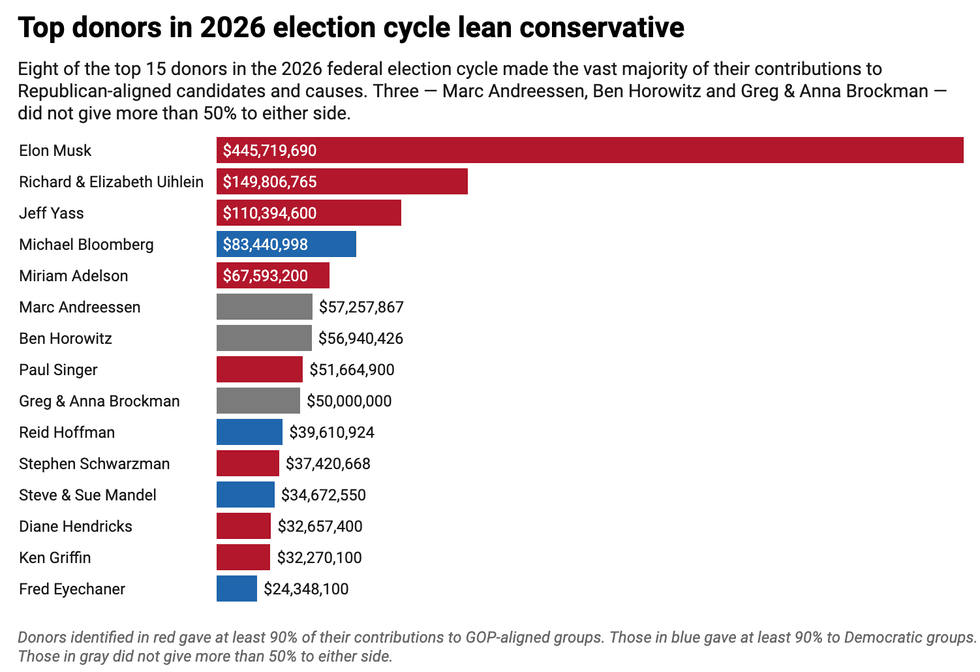
OpenSecrets observed that "as in past cycles, these megadonors took advantage of campaign finance rules allowing unlimited contributions to independent outside groups such as super PACs, which can spend without limit to support or attack candidates so long as they do not coordinate directly with campaign committees."
According to OpenSecrets, total spending on the 2026 midterms is expected to hit $11.9 billion—surpassing the 2024 elections as the most expensive congressional contest in US history.
While super PACs are required by federal law to disclose their donors, the entities often receive money from organizations that don't face the same disclosure mandates.
Judd Legum, author of the Popular Information newsletter, reported Tuesday that federal filings show $1.4 billion in midterm spending "has come from non-profit organizations that do not disclose their donors."
"This includes both donations from these non-profits to super PACs and money spent directly by the non-profits on electioneering," Legum wrote. "Dark money spending in 2026 dwarfs previous cycles. Spending from organizations with secret donors is more than six times higher this cycle compared to 2018."

"With a return to power," said Sanders, the Democratic Party "can no longer continue to ignore the major economic and political crises facing the majority of our people... or that return to power will be short-lived."
As a campaign season in which dozens of progressive candidates endorsed by US Sen. Bernie Sanders prevailed in primaries, the independent Vermont lawmaker urged his supporters across the country to "do all we can to bring out the vote to end Republican control of Congress," while urging voters to look beyond the goal of reining in President Donald Trump.
"If the pundits are correct and Democrats are able to take back the House and even the Senate, the Democratic Party must undergo fundamental and immediate reform," said Sanders in an email to supporters.
The senator's closing message of the campaign season came as the latest poll from The New York Times/Siena found Democrats, including progressives whose views have been deemed "too extreme" by the Democratic establishment and Republicans, with strong leads in Michigan, Texas, Maine, Ohio, and Kansas.
But he warned voters against allowing potential new majorities in the US House and Senate to become complacent, should the Democrats take control of one or both chambers.
"Status quo politics and status quo policies are no longer good enough," said Sanders. "With a return to power, [Democrats] can no longer continue to ignore the major economic and political crises facing the majority of our people... or that return to power will be short-lived."
Instead of accepting the ironclad grip on US politics held by wealthy corporations, billionaires like tech mogul Elon Musk, and powerful interest groups like the American Israel Public Affairs Committee, which poured more than $100 million into the 2026 elections, Sanders called on Democrats to prioritize "ending Citizens United" and getting super political action committees, which can spend unlimited money on behalf of candidates thanks to the 2010 Supreme Court ruling, "out of elections."
"We must no longer allow billionaires to buy elections," said Sanders, a day after it was reported that Musk had spent nearly $450 million to help elect GOP candidates tied to the deeply unpopular Trump, his illegal war on Iran, and the mass deportation policy that has torn apart families and angered people across the country.
Although some influential Democrats, like California Gov. Gavin Newsom, a likely 2028 presidential candidate, have pushed back against broadly popular efforts to tax the ultrarich, Sanders said the party must "create an economy that works for every man, woman, and child in our country and not just the 1%," and use tax revenue from billionaires to address many of the most persistent problems in the US economy.
With potential Democratic majorities at the federal level, "we must impose a wealth tax on billionaires and use that funding to build millions of units of affordable housing, establish universal and free childcare, and make public colleges and universities tuition-free," said Sanders, pushing back against Democrats like former Transportation Secretary Pete Buttigieg, another potential 2028 contender, who has opposed proposals for tuition-free public higher education.
The senator also spoke directly about California's proposed wealth tax, Proposition 40, urging voters to support the measure on the eve of the election.
Sanders suggested that if Democrats take control of the US House and Senate, leaders like Senate Minority Leader Chuck Schumer (D-NY) and House Minority Leader Hakeem Jeffries (D-NY) must take a hard look at the public's views on artificial intelligence and data centers, healthcare, and hundreds of billions of dollars in military spending.
"YES, we must make certain that the revolutionary technologies of artificial intelligence and robotics are used to improve life for all of us, not just make the Big Tech oligarchs even richer," said Sanders. "YES, we must join the rest of the industrialized world and guarantee health care to all people as a human right through Medicare for All. YES, instead of spending more than a trillion dollars a year on the military and endless wars, we must create the best public education system in the world with no teacher earning less than $60,000 a year."
Over the past two years, said Sanders, "we have changed political consciousness in our country. On major issue after major issue the positions that we have been fighting for over the years are now supported by a significant majority of Americans."
With progressives including US Senate candidates Abdul El-Sayed and Troy Jackson and US House candidates such as Melat Kiros, Donavan McKinney, Claire Valdez, and Adam Hamawy potentially changing the balance of power in Congress, Sanders suggested the Democratic Party will have no choice but to fight for fundamental changes to the US economy and political system, and for the interests of working people.
"The Democratic Party must respond to the urgent needs of the working people of this country," said Sanders, "not wealthy campaign contributors."

"There is still a chance to prevent another catastrophe, but that window may be closing. We cannot afford to let this war escalate further."
The Trump administration launched a new bombing attack on Iranian territory Monday night, striking Qeshm Island in the Strait of Hormuz on the eve of the US midterms amid mounting fears of a massive post-election assault.
The Wall Street Journal was first to report the strikes, which a US official characterized as a "defensive measure" in response to Iran's use of surface-to-air missiles against American forces that have been waging an illegal war of aggression against Iran since February. The Journal noted that "in one instance on Monday, Iran’s Islamic Revolutionary Guard Corps fired a surface-to-air missile at a US jet fighter, which fired back in self-defense."
The US military did not publicly announce the attack on Qeshm Island, which came hours before American voters were set to head to the polls to decide whether President Donald Trump's party should remain in control of Congress. The Journal reported that the Trump administration has "purposefully" been keeping its recent campaign of smaller-scale strikes on Iran quiet "so as not to signal any intention of resuming major combat operations."
Kazem Gharibabadi, Iran's deputy foreign minister, said Tuesday that "Iran is prepared for any scenario" and stressed that the country "retains its right to legitimate self-defense until the military aggression has been brought to a complete and permanent end."
Last month, Trump vowed—falsely, given Monday's strikes—that the US would "not be attacking Iran at any time prior" to the midterms and that the two sides were engaged in "productive discussions."
Vice President JD Vance asserted Monday that he and Trump "both feel really good about the prospect of potentially coming to a negotiated settlement" to end the massively unpopular and destructive war with Iran.
Jamal Abdi, president of the National Iranian American Council, said late Monday that "after eight months of an illegal war, there was finally some hope that a diplomatic agreement might be within reach and this war could end through negotiations rather than spiral into the violent scenarios being threatened after the midterm elections."
"But these deeply alarming revelations suggest we may be heading in precisely the opposite direction," Abdi said of the Qeshm Island strikes and other recent attacks on Iran. "Every day that Congress fails to intervene is another day this administration is allowed to wage an unauthorized war, conceal its military operations, and gamble with millions of lives. Congress must immediately demand answers, oppose further military action, and use its power to cut off funding for this unauthorized war. Americans must raise their voices and demand that their representatives act now. There is still a chance to prevent another catastrophe, but that window may be closing. We cannot afford to let this war escalate further.”
The latest US strikes came days after Sen. Chris Murphy (D-Conn.) warned that the Trump administration was considering an "insane" plan to resume major attacks on Iran following Tuesday's midterm elections.
If the plan is carried out, Murphy said, "it will lead to devastating escalation and the likely destruction of our commitment to the rule of law."
Murphy, whose remarks were based on information he and other lawmakers received during a classified briefing, did not specifically warn that Trump is considering the use of nuclear weapons against Iran. But concerns about such a grave escalation grew over the weekend after far-right commentator Tucker Carlson—who has vocally criticized the president's decision to wage war against Iran—claimed that the Trump administration "may be within days of launching a nuclear strike on Iran."
"Whether these allegations reflect serious military planning or reckless posturing, the very possibility of a US nuclear attack on Iran is an unconscionable horror," NIAC said in response.

The high court "declines to let Trump interfere in the election in California," one law professor said.
Although the US Supreme Court has a right-wing supermajority with multiple appointees of President Donald Trump, the nation's top tribunal rejected his administration's effort to set aside thousands of California ballots on the eve of the midterm elections.
The one-sentence order simply says that the application for an injunction pending appeal, presented to Justice Elena Kagan—one of the three liberals—and referred by her to the full court, is denied, with no noted dissents.
Trump has long claimed that voter fraud by immigrants is a rampant issue in the United States—despite evidence to the contrary—and his Department of Justice sued California last week after the state refused to set aside ballots from a list of voters the DOJ claimed could be noncitizens and thus ineligible to vote, based on databases known to be full of errors.
Democratic election attorney Marc Elias was among those celebrating the justices' denial of an emergency stay. He noted that "the court did not even ask for opposition briefs!"
The lawyer called it "a complete DEFEAT for Trump DOJ," and "another victory for Elias Law Group and our clients."
Joyce White Vance, a University of Alabama law professor and legal commentator on networks including MS NOW, similarly declared that "the Supreme Court declines to let Trump interfere in the election in California."
US House Minority Leader Hakeem Jeffries (D-NY)—who could lead the chamber if Democrats win a majority on Tuesday—also applauded that "the Supreme Court just denied the Trump Justice Department's corrupt request for an injunction in the California vote count," calling it "another complete and total defeat for the extremists."
As The Associated Press reported Monday:
A district court judge previously denied the Justice Department’s request and warned that the demand could disenfranchise citizens in Tuesday’s midterm elections to determine control of Congress.
Also on Monday in Washington, another federal judge ruled against the administration's efforts to make last-minute demands of California election officials, finding they violated the US Constitution.
California Attorney General Rob Bonta on Monday also pointed to recent rulings against the administration in a social media exchange with Bill Essayli, first assistant US attorney for the Central District of California.
While the Supreme Court has sometimes sided with Trump's agenda during his second term, it has rejected some of his recent attacks on democracy, including a September decision against his US Postal Service rules for mail-in ballots.
Despite the win at the high court on Monday, the president's efforts to interfere with the midterms are expected to continue. Given that, the Advancement Project, Legal Defense Fund, and NAACP are seeking an order to block federal law enforcement agents from serving as "election monitors."
The midterms come as Trump's public approval is at an all-time low, and Democrats highlight his illegal war on Iran and the related cost-of-living crisis in their efforts to secure majorities in the Senate and House of Representatives for the rest of his second term.

"Simply put, defendants' plans to deploy any federal law enforcement agent, investigator, or personnel for the November 3, 2026 general election constitute unlawful voter intimidation."
With midterm Election Day rapidly approaching, a coalition of rights groups on Sunday sought an eleventh-hour judicial intervention to stop the Trump administration from deploying federal law enforcement personnel to polling places across the country, warning that the Department of Justice's unprecedented election monitoring operation threatens to intimidate voters and interfere with the democratic process.
The NAACP, Advancement Project, and the Legal Defense Fund (LDF) asked Judge Reggie Walton—the senior judge at the US District Court for the District of Columbia and an appointee of former Republican President George W. Bush—to prohibit the DOJ from assigning federal officers as election monitors on Tuesday via an emergency temporary restraining order.
Alternatively, the groups asked the court to prohibit those personnel from carrying firearms, badges, or cameras, or from engaging in law enforcement activities while monitoring polling locations.
"In less than 36 hours, Americans will head to the polls to cast ballots for the 2026 general election, and for the first time ever, they face the risk of encountering federal law enforcement agents and criminal prosecutors at polling places," the groups' filing states.
The DOJ’s veiled attempt at fearmongering is voter intimidation. Advancement Project is working across the country to observe the polls and protect the right to vote. We’re not backing down from the fight for free and fair elections, and encourage communities to vote with confidence.
[image or embed]
— Advancement Project (@advancementproject.org) November 2, 2026 at 7:10 AM
"Simply put, defendants' plans to deploy any federal law enforcement agent, investigator, or personnel for the November 3, 2026 general election constitute unlawful voter intimidation," the document adds.
The filing follows the DOJ's initial affirmation that it would deploy personnel from several federal law enforcement agencies—including the Bureau of Prisons; Drug Enforcement Administration; and Bureau of Alcohol, Tobacco, Firearms and Explosives—to polling sites nationwide, and its subsequent about-face on the plan.
Historically, the DOJ has sent civil rights attorneys and professional support personnel to monitor elections—usually in coordination with state and local election officials and with advance public notice—in order to ensure compliance with federal voting rights laws and to spot any potential discrimination.
The Trump administration, however, has increasingly substituted criminal prosecutors and sworn law enforcement personnel for those traditional monitors.
Amid the administration's deadly US Immigration and Customs Enforcement crackdown, rights groups have also called for the establishment of “No ICE” zones around polling places, early voting locations, and ballot drop boxes, warning that the presence of federal agents could deter eligible Americans from exercising their right to vote.
The unprecedented interference has alarmed even Republican officials in deeply conservative states. Wyoming Gov. Mark Gordon, for example, decried what he called "aggressive" and "disruptive" conduct by DOJ monitors, including demands to interview voters and attempts to access voting machines.
Advancement Project executive director Carmen Daugherty said in a statement, "Let’s call the DOJ’s veiled attempt at fearmongering what it is, it’s voter intimidation, and we know that the Voting Rights Act clearly states that any attempts to intimidate voters from practicing their right to vote are illegal."
NAACP general counsel Kristen Clarke stressed that “the law is clear—law enforcement agents can have an intimidating effect on voters, especially Black voters, and they have no role and no right to be inside our polling places."
"We are taking action to ensure that the path to the ballot box remains free from harassment and intimidation for all voters on Election Day," Clarke added. "This Justice Department may want us to be afraid, but that’s only because they are afraid of us and the power of our votes. The NAACP urges every voter to cast a ballot if they have not already done so.”
LDF senior counsel Kathryn Sadasivan said that “the Justice Department must not be permitted to subvert its foundational responsibility of protecting voters’ right to elections free from fear."
“The continued threats of law enforcement deployment to the polls are clearly deliberate attempts to dissuade voter participation," she continued. "This is immoral, this is illegal, and this is absolutely shameful behavior from what’s supposed to be the nation’s highest legal authority."
"We will continue to fight to protect every eligible voters’ ability to cast a ballot without the threat of violence hanging over their head at the ballot box," Sadasivan added.

UNESCO reports setbacks in the fight against impunity as Reporters Without Borders names 33 governments, organizations, and powerful figures—including Donald Trump—as "press freedom predators."
The vast majority of journalist killings around the world go unpunished, according to a United Nations analysis published Monday, the same day that the advocacy group Reporters Without Borders released a report naming dozens of powerful actors—including US President Donald Trump—as "press freedom predators" who are repressing independent journalism.
In a report published on International Day to End Impunity for Crimes Against Journalists, the United Nations Educational, Scientific, and Cultural Organization (UNESCO) noted that 189 journalists were killed in 2024 and 2025, a 20% increase over the previous two-year period. In 6 out of every 7 of those killings, the perpetrators were not brought to justice.
"Journalists are increasingly paying with their lives for reporting from the frontlines of war, and far too often those responsible for their killings are not held accountable," UNESCO Director-General Khaled El-Enany said, calling on governments to respect a 2015 UN Security Council resolution affirming that journalists and other media workers must be protected as civilians during armed conflicts.
To mark the day, UN Secretary-General António Guterres acknowledged that "across the world, journalists continue to pay an outrageous price for telling the truth."
"Over the past year, at least 34 journalists paid the ultimate price," he continued, adding that in conflict zones, the impunity rate is "close to 100%."
"This is a heinous affront to the victims and their loved ones, as well as all of us who depend on journalists to remain informed and engaged," Guterres asserted. "This scandal must end."
As UNESCO noted:
Killings were recorded across all regions of the world during the 2024-25 biennium, representing “a global scourge," the report said.
The highest number of verified cases were in the Arab states (97), followed by Latin America and the Caribbean (37), Asia-Pacific (34), Central and Eastern Europe (14), Africa (6), and Western Europe and North America (1).
The state of Palestine had the highest number of killings in both years, at 30 and 32, respectively.
The journalists killed in Palestine were almost all slain by Israeli forces.
UNESCO's findings underscore concerns raised by the Committee to Protect Journalists (CPJ), which documented a record 129 journalists and media workers killed worldwide in 2025 alone. Israel was responsible for approximately two-thirds of those deaths, according to the organization, with the vast majority of those killed by Israeli forces being Palestinians in Gaza. Israel's genocidal assault on Gaza has become the deadliest conflict for journalists in CPJ's records.
Since 1992, more than 1 in 4 of all targeted killings with no justice were committed by a country’s government or military. That means no one was held accountable for these murders.cpj.org/issue/impuni... #EndImpunity #IDEI
[image or embed]
— Committee to Protect Journalists (@pressfreedom.bsky.social) November 2, 2026 at 11:04 AM
The Paris-based group Reporters Without Borders (RSF) observed International Day to End Impunity for Crimes Against Journalists by publishing its 2026 Press Freedom Predators List, an annual review of powerful actors it says are working to silence critical reporting.
RSF described methods ranging from assassination and imprisonment to employing internet trolls and bots, "to silence independent voices and trample on the right to information."
Trump made his first appearance on RSF's list after narrowly avoiding inclusion last year. The group cited what it called his "appalling record of attacks on the press" during his second term, accusing his administration of attempting to reduce journalism to political propaganda and physically restrict reporters.
The United States currently ranks 64th on RSF's World Press Freedom Index. It ranked 17th the first time the group published the index in 2002, but plummeted to 33rd the following year amid the George W. Bush administration's War on Terror crackdown, and 53rd in 2006. The country climbed to 20th during the early years of the Obama administration but fell back down to 49th in 2015 amid then-President Barack Obama's war on whistleblowers.
The US never ranked as poorly as it did under Obama during Trump's first term, and fell as low as 55th during the Biden administration's attempts to quash reporting on the Gaza genocide. But the country has never sunk as low in the rankings as it has during Trump's second tenure.
Other prominent press freedom predators, according to RSF, include Russian President Vladimir Putin, Saudi Crown Prince Mohammed bin Salman, Egyptian President Abdel Fattah el-Sisi, Turkish President Recep Tayyip Erdoğan, tech giants Alphabet and Meta, tech titan Elon Musk, the Israel Defense Forces, Chinese Communist Party, and Mexican drug cartels.
"The Press Freedom Predators List builds on RSF’s World Press Freedom Index—which highlights how press freedom has evolved in every country each year—and turns the spotlight around to identify the actors responsible for declining press freedom," RSF director-general Thibaut Bruttin said in a statement.
"Behind the statistics, the setbacks, and the obstacles lie clear lines of responsibility. Whether they resort to physical or verbal violence, legal abuses, intimidation, digital manipulation of the facts, or economic pressure, these predators share the same goal: to prevent journalists from doing their jobs and deprive citizens of information from independent sources," he continued.
"RSF makes nothing up—each predator has their own profile, presented as a sort of hall of shame, that shows their background, rhetoric, and weapon of choice," Bruttin added. "Identifying press freedom predators, exposing their methods, and documenting their abuses means refusing to let their attacks become normalized. In the face of those who seek to impose silence, RSF will continue to name those who kill journalism."

"Congress must urgently intervene to prevent further escalation and bring an end to this devastating war before an already horrific conflict becomes an irreversible catastrophe."
US President Donald Trump, who has long sought the Nobel Peace Prize while bombing various countries, is under pressure to rule out launching a nuclear attack on Iran after former Fox News host Tucker Carlson reported Sunday night that Israeli Prime Minister Benjamin Netanyahu is pushing for one.
"The target would be Pickaxe Mountain in central Iran, where Israeli intelligence claims the Iranian government has restarted its nuclear enrichment program," Carlson wrote on social media. "No conventional weapon in the American arsenal can penetrate 300 feet of solid granite to destroy the tunnels where enrichment is supposedly taking place. The only military option is a nuclear strike."
The US midterm election is on Tuesday, and according to Carlson, "close observers say Trump is likely to decide by next weekend whether or not to use nuclear weapons. That would be November 7... To his credit, he's hesitating. At the moment, Trump is listening to his vice president, JD Vance, and to his envoy and friend Steve Witkoff, both of whom argue a deal with Iran can be made."
However, Netanyahu "is cornered and desperate," Carlson noted. "After last week's election results, he can't form a government unless Trump intervenes directly in Israeli politics and brokers a deal with other parties that gives Netanyahu 61 seats in the Knesset. Otherwise, he is out as prime minister and on his way to ignominy, investigations, and possibly jail. Netanyahu must stay close to Trump. He needs this war."
Responding to Carlson's post, the National Iranian American Council (NIAC) said that "whether these allegations reflect serious military planning or reckless posturing, the very possibility of a US nuclear attack on Iran is an unconscionable horror. After eight months of devastating war, Iranian Americans are once again being forced to wait in terror as the Trump administration reportedly weighs another catastrophic escalation at the urging of Benjamin Netanyahu."
"NIAC demands that President Trump immediately and unequivocally rule out any use of nuclear weapons against Iran," the group asserted. "Congress must urgently intervene to prevent further escalation and bring an end to this devastating war before an already horrific conflict becomes an irreversible catastrophe."
The group's policy director, Ryan Costello, stressed that such an attack "would be an unimaginable catastrophe in its own right, and the radioactive plume of a blast could extend hundreds of miles and reach major population centers, depending on yield and wind direction. Isfahan province alone, where Pickaxe is, is home to more than 5 million Iranians."
"The Trump administration would also have to consider the ramifications of breaking the nuclear taboo in a war of aggression," he continued, suggesting that the US and Israel using such weapons could spur similar action by the other nuclear-armed nations: China, France, India, North Korea, Pakistan, Russia and the United Kingdom.
Would Russian President Vladimir "abstain from using nuclear weapons in Ukraine if Trump had dropped a nuclear weapon in Iran?" Costello wondered. "It would be a new, far more dangerous world."
While people across the ideological spectrum expressed alarm, some dismissed Carlson's lengthy post.
However, Drop Site News co-founder Ryan Grim highlighted that "Tucker is extremely well sourced in the Trump administration and shouldn't be ignored if this is what he's being told," and fellow journalist Pablo Manríquez agreed.
Pushing back against one skeptic, Andrew Day, senior editor at The American Conservative, pointed out that recently "Trump threatened to 'annihilate' Iranian civilization and unleash 'military terror' not seen since World War II. Those statements are plausibly implicit nuclear threats. Now Trump is finding that conventional weapons don't force Iran's capitulation. Concern is warranted."
Iran's government was already preparing its people for a possible US nuclear attack, and last Friday, more than 200 global civil society groups implored Congress to stop Trump from using such weapons in a bid to end the illegal war that he and Netanyahu launched at the end of February.
"In recent weeks, President Trump has threatened to ‘hit Iran hard’ after the US midterm elections next week," wrote members of the Back From the Brink Coalition. "On October 15, President Trump stated that he would not use nuclear weapons against Iran. But frequent, abrupt changes of policy have become a staple feature of his presidency, and the single statement that he will not use nuclear weapons stands against a string of threats to do just that."
Even if Trump opts not to use nuclear weapons, there are mounting global concerns about his next steps. After being briefed on the administration's military schemes behind closed doors, US Sen. Chris Murphy (D-Conn.) declared last week that "their plan is insane."
The Wall Street Journal reported Monday that "America's Gulf allies are steeling themselves for a heavy US bombardment of Iran that they expect to trigger a vicious cycle of retaliation against their own economic and civilian infrastructure as early as this week."

One progressive organizer said that with a strong showing on Tuesday, “we’re going to be the center of gravity."
New polling data out Monday suggests a "blue tsunami" could be coming in this week's midterms, with Democrats holding leads in seven competitive US Senate races.
The polling, from The New York Times/Siena, showed Democratic candidates with solid leads in marquee races in Michigan, Maine, and Texas, ahead in states once thought to be unreachably red, including Ohio and Kansas, and narrowly ahead in Alaska and Iowa, with those advantages falling within the margin of error.
Astonishingly, this data may actually understate Democratic support—as the Times' chief political analyst, Nate Cohn, explained Monday, the paper changed its methodology to correct for undercounting Trump voters in presidential elections, potentially overcorrecting in a midterm when those voters are less likely to turn out.
If that’s the case, it may point to a clobbering of epic proportions, with states like Florida and Nebraska, and potentially even Louisiana and Mississippi, within reach, and the Democrats potentially coming away with large majorities in both chambers of Congress.
The sky may be the limit for Democrats on Tuesday. But the candidates, organizers, and leaders from the nation's progressive movement are taking nothing for granted.
"I was elected mayor of [Burlington, Vermont] after a recount by 10 votes," Sen. Bernie Sanders (I-Vt.) said in a video message Monday. "My point: Every vote counts."
"We can win this election," said Sanders, who has appeared at events alongside Democratic nominees Abdul El-Sayed in Michigan, Angie Nixon in Florida, and Troy Jackson in Maine, among others, over the final weeks of the campaign. "But the only way we win it is if millions of people come out and vote; we bring our friends, our uncles, our aunts, our neighbors."
The progressive advocacy group Our Revolution, initially formed following Sanders’ 2016 presidential run, says it has sought to reach 5 million voters in battleground states as it works to counter unprecedented spending by superrich donors.
“Big money can buy ads, but it can’t knock on a door, make a call, or have a conversation,” the group said in an email to volunteers last week.
The AFL-CIO said it had reached more than 16 million union voters as of October 30 and had tens of thousands of volunteers conducting doorstep, phone, and workplace conversations with voters as part of its largest ever midterm operation. The labor federation cited internal polling showing 83% of union members are “extremely motivated” about voting in the election—10 percentage points higher than in 2022.
“For months, workers have been talking to their fellow workers and families. And in every community, we hear the same thing: Shit is too expensive, and working people are sick and tired of the failed economic status quo that prioritizes billionaires over the people who make this country run,” AFL-CIO president Liz Shuler said.
This weekend, nearly 100 union members took part in a Halloween canvass in Des Moines, Iowa, where they said they exceeded their door-knocking goal for the election cycle.
“Every door we knock between now and Tuesday counts and will make the difference,” said Iowa Federation of Labor president Charlie Wishman.
With President Donald Trump now at new lows in public approval, Democratic candidates have focused their closing message on accountability and blocking his agenda.
"This is for... control of the United States Senate, to put a check on Trump and this ridiculous war, whether it's a war with Canada over tariffs, or a war in Iran that's raising our gas prices and our groceries," El-Sayed said in a get-out-the-vote video Monday. "But it's also for the Supreme Court, because if we don't win this race, Donald Trump is going to have another two Supreme Court nominations."
El-Sayed also looked toward a future in which Democrats are back in power and can use their sizable majority to advance a progressive agenda.
“This movement,” he said, “is about getting money out of politics, putting money in your pocket, passing ‘Medicare for All,’ standing up for union rights, standing up for the right to choose, standing up for healthcare for everybody.”
Joseph Geevarghese, the executive director of Our Revolution, said Tuesday could be a make-or-break moment for a progressive movement that has won the hearts of the Democratic base but faced pushback from the party establishment.
“There are centrists who don’t want to see us win, and who will lay any setbacks on Election Day at the feet of progressives,” Geevarghese told The Wall Street Journal on Monday.
He said a strong showing on the left could set the tone for the direction of the party entering 2028: “We’re going to be the center of gravity.”

"We cannot let the billionaire class take these kinds of risks with our future."
Progressive author Naomi Klein and comedian Ilana Glazer on Monday warned that America's billionaire class is taking "unprecedented risks with our future," and said US policymakers must block further Big Tech initial public offerings and mergers to prevent even more damage from occurring.
In an op-ed published by The Guardian, Klein and Glazer outlined how US billionaires have used tax loopholes, corporate mergers, and IPOs to enrich themselves at an unprecedented scale, as their wealth has grown by an estimated 40% over just the last two years.
Klein and Glazer argued that the upcoming IPOs of artificial intelligence giants OpenAI and Anthropic could be particularly risky to the economy given questions about their ability to be consistently profitable.
"It’s no secret that the AI companies Anthropic and OpenAI are intending to go public in the near future," they wrote. "Both of these players also had major security flaws exposed recently, and openly acknowledge mind-bogglingly huge amounts of debt."
The risk will only grow, they added, if Nasdaq grants OpenAI and Anthropic the same exception it granted to Elon Musk's SpaceX earlier this year by allowing their shares to be immediately included in index funds without having to wait through the one-year "seasoning" period.
"June’s highly contentious SpaceX IPO already carries great risk for regular investors," they explained. "If more speculative tech companies with staggering risk profiles are allowed to follow suit, the results will become too much for the market to bear."
Klein and Glazer said that policymakers need to intervene to put a halt to new Big Tech IPOs, and also pass a wealth tax to take away billionaires' power to spend cavalierly even as they leave working people potentially holding the bag for their failed investments.
"We cannot let the billionaire class take these kinds of risks with our future," they emphasized. "To stop these reckless IPOs we must stand together, take collective action, and push for real change."
Economist Jeffrey D. Sachs last month similarly called for AI IPOs to be halted until Congress "has enacted a public system of licensing, independent safety evaluation, liability, and financial backstops for frontier AI."
Sachs noted that Anthropic executives and employees, including CEO Dario Amodei, have warned that AI could pose a threat to all human life, and he questioned why the creators of such technology should become unfathomably wealthy before such risks are understood and eliminated.
"A company should not disclose a risk of catastrophe to humanity and then sell its shares to the public before any public authority has the power to evaluate that risk or to stop deployment," argued Sachs. "In fact, to proceed rapidly in the face of such dire warnings is beyond folly."