SUBSCRIBE TO OUR FREE NEWSLETTER
Daily news & progressive opinion—funded by the people, not the corporations—delivered straight to your inbox.
5
#000000
#FFFFFF
To donate by check, phone, or other method, see our More Ways to Give page.
Daily news & progressive opinion—funded by the people, not the corporations—delivered straight to your inbox.
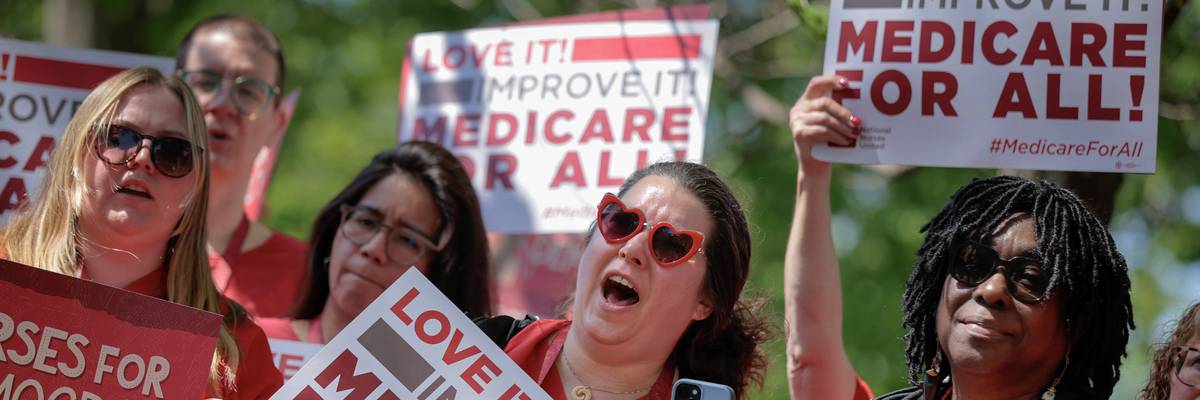
Members of National Nurses United rally with lawmakers to show their support for the Medicare For All Act in Upper Senate Park on Capitol Hill on April 29, 2025 in Washington, DC.
"Voters see this election not just as a referendum on Trump... but as a repudiation of the entire political system."
A poll released by the Cook Political Report on Thursday shows US voters in key swing districts overwhelmingly dislike artificial intelligence companies—but are feeling warm about Medicare for All.
In total, the poll finds that voters in 37 swing districts across the US view AI companies unfavorably by a two-to-one margin, with 64% of voters saying they're more concerned than excited about the technology, compared to just 31% who say they're more excited than concerned.
Opposition to AI data centers is even stronger, as 63% of voters say they would oppose building one in their communities, compared to just 28% in favor. Additionally, 44% express strong opposition to local data center construction, making strong opposition higher than overall support.
At the same time, the poll finds much stronger support for Medicare for All, with 62% of swing-district voters having a favorable view of the policy, compared to 34% who said they were opposed. The intensity gap is also notable, as 41% of voters sat they have a strongly favorable view of Medicare for All, while just 25% have a strongly unfavorable view.
This does not mean that these voters are socialists, however, as the poll shows just 32% expressing a positive view of socialism, compared to 58% expressing a negative view. When it comes to Democratic Socialists of America (DSA), 37% of voters say they have a favorable view of the group, compared to 56% who say they have an unfavorable view.
Regardless of specifics about policy and ideology, the poll shows a deep dissatisfaction with the American political system and an openness to major changes.
Amy Walter, editor-in-chief of the Cook Political Report, commented in a social media post that "the most interesting finding was that these voters see this election not just as a referendum on Trump (who’s underwater by 16 points), but as a repudiation of the entire political system."
Walter pointed to a striking finding among independent voters in the survey, who vastly preferred a candidate promising to change the whole political system compared to a candidate who would just be a check on Trump.
"This also suggests," Walter added, "that these voters would want a Dem-led Congress that focuses more on an agenda that tackles corruption and institutional rot than one that focuses solely on Trump and his overreach."
Yasmin Radjy, executive director of Swing Left, said that the Cook Political poll "tracks with everything we're hearing" in conversations with voters.
The idea that the "system is broken," wrote Radjy, "is overwhelmingly the top issue/theme we hear from voters across the ideological and partisan spectrum—even more than affordability!”
Dear Common Dreams reader, It’s been nearly 30 years since I co-founded Common Dreams with my late wife, Lina Newhouser. We had the radical notion that journalism should serve the public good, not corporate profits. It was clear to us from the outset what it would take to build such a project. No paid advertisements. No corporate sponsors. No millionaire publisher telling us what to think or do. Many people said we wouldn't last a year, but we proved those doubters wrong. Together with a tremendous team of journalists and dedicated staff, we built an independent media outlet free from the constraints of profits and corporate control. Our mission has always been simple: To inform. To inspire. To ignite change for the common good. Building Common Dreams was not easy. Our survival was never guaranteed. When you take on the most powerful forces—Wall Street greed, fossil fuel industry destruction, Big Tech lobbyists, and uber-rich oligarchs who have spent billions upon billions rigging the economy and democracy in their favor—the only bulwark you have is supporters who believe in your work. But here’s the urgent message from me today. It's never been this bad out there. And it's never been this hard to keep us going. At the very moment Common Dreams is most needed, the threats we face are intensifying. We need your support now more than ever. We don't accept corporate advertising and never will. We don't have a paywall because we don't think people should be blocked from critical news based on their ability to pay. Everything we do is funded by the donations of readers like you. When everyone does the little they can afford, we are strong. But if that support retreats or dries up, so do we. Will you donate now to make sure Common Dreams not only survives but thrives? —Craig Brown, Co-founder |
A poll released by the Cook Political Report on Thursday shows US voters in key swing districts overwhelmingly dislike artificial intelligence companies—but are feeling warm about Medicare for All.
In total, the poll finds that voters in 37 swing districts across the US view AI companies unfavorably by a two-to-one margin, with 64% of voters saying they're more concerned than excited about the technology, compared to just 31% who say they're more excited than concerned.
Opposition to AI data centers is even stronger, as 63% of voters say they would oppose building one in their communities, compared to just 28% in favor. Additionally, 44% express strong opposition to local data center construction, making strong opposition higher than overall support.
At the same time, the poll finds much stronger support for Medicare for All, with 62% of swing-district voters having a favorable view of the policy, compared to 34% who said they were opposed. The intensity gap is also notable, as 41% of voters sat they have a strongly favorable view of Medicare for All, while just 25% have a strongly unfavorable view.
This does not mean that these voters are socialists, however, as the poll shows just 32% expressing a positive view of socialism, compared to 58% expressing a negative view. When it comes to Democratic Socialists of America (DSA), 37% of voters say they have a favorable view of the group, compared to 56% who say they have an unfavorable view.
Regardless of specifics about policy and ideology, the poll shows a deep dissatisfaction with the American political system and an openness to major changes.
Amy Walter, editor-in-chief of the Cook Political Report, commented in a social media post that "the most interesting finding was that these voters see this election not just as a referendum on Trump (who’s underwater by 16 points), but as a repudiation of the entire political system."
Walter pointed to a striking finding among independent voters in the survey, who vastly preferred a candidate promising to change the whole political system compared to a candidate who would just be a check on Trump.
"This also suggests," Walter added, "that these voters would want a Dem-led Congress that focuses more on an agenda that tackles corruption and institutional rot than one that focuses solely on Trump and his overreach."
Yasmin Radjy, executive director of Swing Left, said that the Cook Political poll "tracks with everything we're hearing" in conversations with voters.
The idea that the "system is broken," wrote Radjy, "is overwhelmingly the top issue/theme we hear from voters across the ideological and partisan spectrum—even more than affordability!”
A poll released by the Cook Political Report on Thursday shows US voters in key swing districts overwhelmingly dislike artificial intelligence companies—but are feeling warm about Medicare for All.
In total, the poll finds that voters in 37 swing districts across the US view AI companies unfavorably by a two-to-one margin, with 64% of voters saying they're more concerned than excited about the technology, compared to just 31% who say they're more excited than concerned.
Opposition to AI data centers is even stronger, as 63% of voters say they would oppose building one in their communities, compared to just 28% in favor. Additionally, 44% express strong opposition to local data center construction, making strong opposition higher than overall support.
At the same time, the poll finds much stronger support for Medicare for All, with 62% of swing-district voters having a favorable view of the policy, compared to 34% who said they were opposed. The intensity gap is also notable, as 41% of voters sat they have a strongly favorable view of Medicare for All, while just 25% have a strongly unfavorable view.
This does not mean that these voters are socialists, however, as the poll shows just 32% expressing a positive view of socialism, compared to 58% expressing a negative view. When it comes to Democratic Socialists of America (DSA), 37% of voters say they have a favorable view of the group, compared to 56% who say they have an unfavorable view.
Regardless of specifics about policy and ideology, the poll shows a deep dissatisfaction with the American political system and an openness to major changes.
Amy Walter, editor-in-chief of the Cook Political Report, commented in a social media post that "the most interesting finding was that these voters see this election not just as a referendum on Trump (who’s underwater by 16 points), but as a repudiation of the entire political system."
Walter pointed to a striking finding among independent voters in the survey, who vastly preferred a candidate promising to change the whole political system compared to a candidate who would just be a check on Trump.
"This also suggests," Walter added, "that these voters would want a Dem-led Congress that focuses more on an agenda that tackles corruption and institutional rot than one that focuses solely on Trump and his overreach."
Yasmin Radjy, executive director of Swing Left, said that the Cook Political poll "tracks with everything we're hearing" in conversations with voters.
The idea that the "system is broken," wrote Radjy, "is overwhelmingly the top issue/theme we hear from voters across the ideological and partisan spectrum—even more than affordability!”