SUBSCRIBE TO OUR FREE NEWSLETTER
Daily news & progressive opinion—funded by the people, not the corporations—delivered straight to your inbox.
5
#000000
#FFFFFF
To donate by check, phone, or other method, see our More Ways to Give page.
Daily news & progressive opinion—funded by the people, not the corporations—delivered straight to your inbox.
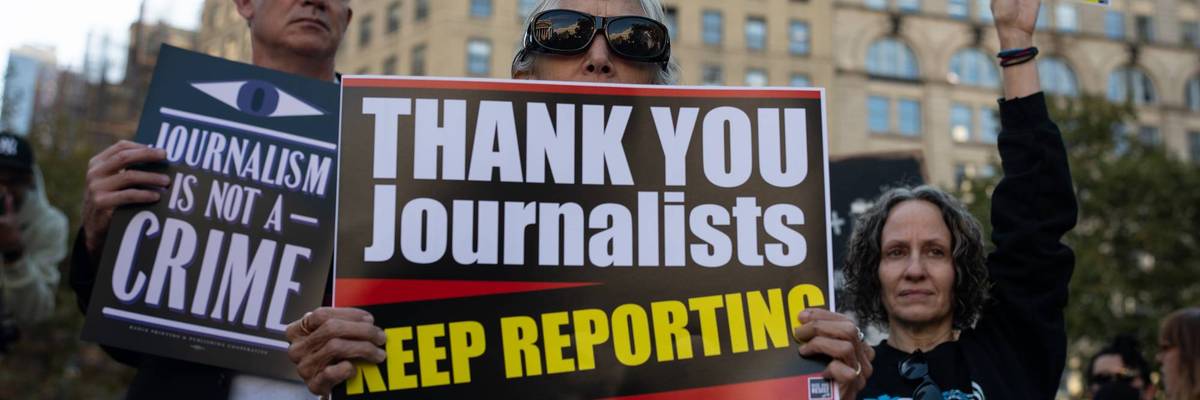
People take part in a rally for First Aamendment protections in New York City on October 1, 2025.
"Trump and his administration have carried out a coordinated war on press freedom since the day he took office, and we will live with the consequences for years to come."
Reporters Without Borders warned Thursday that the United States is facing a "press freedom crisis" as President Donald Trump and his subordinates wage an aggressive assault on the media that has included threats of treason charges and imprisonment against journalists.
The Trump administration's active disdain for press freedom has pushed the US to its lowest-ever rank on Reporters Without Borders' (RSF) World Press Freedom Index, which ranks countries based on numerous indicators including legal protections for journalists, reporter safety, and overall political hostility toward the press. The US landed at 64th out of 180 countries on the latest version of the index, falling seven spots compared to last year.
"The US has experienced a steady decline in the RSF Index over the past decade, but President Trump is pouring gasoline on the fire," said Clayton Weimers, executive director of RSF's North America section. "Trump and his administration have carried out a coordinated war on press freedom since the day he took office, and we will live with the consequences for years to come."
"The index shows that this decline is measurable and ongoing, but preventable," Weimers added. "Our message is clear: Protect legal rights, ensure accountability for attacks on media professionals, and support independent media to restore American press freedom."
RSF specifically cites Trump's efforts to dismantle public broadcasters, weaponization of government agencies to punish media outlets and figures critical of his administration, and lawsuits against "disfavored outlets" as factors contributing to the erosion of press freedom in the US.
The index also points to rising violence against journalists during Trump's second term in the White House. "According to the US Press Freedom Tracker," RSF notes, "there were more than 170 attacks on journalists in 2025, nearly double the previous year, driven by an increase in violence against journalists while covering protests and law enforcement activity."
The precipitous decline of press freedoms in the US comes in the context of growing attacks on and criminalization of journalism worldwide. For the first time in the 25-year history of RSF's index, more than half of the world's countries currently fall in the "difficult" or "very serious" categories for press freedoms.
The country that ranked last on the index for 2026 was Eritrea, a nation that is "sadly notorious for detaining journalists longer than any other country in the world," said RSF.
Norway ranked first on this year's index, with RSF praising the country's "robust" legal safeguards for press freedom, "vibrant" media market, and "extensive editorial independence" for publishing companies.
Anne Bocandé, RSF's editorial director, said that "current protection mechanisms" for journalism worldwide "are not strong enough" to withstand escalating attacks by "authoritarian states, complicit or incompetent political powers, predatory economic actors, and underregulated online platforms."
"How much longer will we tolerate the suffocation of journalism, the systematic obstruction of reporters and the continued erosion of press freedom?" Bocandé asked. "The ball is in the court of democracies and their citizens. It is up to them to stand in the way of those who seek to silence the press. The spread of authoritarianism isn’t inevitable."
Dear Common Dreams reader, It’s been nearly 30 years since I co-founded Common Dreams with my late wife, Lina Newhouser. We had the radical notion that journalism should serve the public good, not corporate profits. It was clear to us from the outset what it would take to build such a project. No paid advertisements. No corporate sponsors. No millionaire publisher telling us what to think or do. Many people said we wouldn't last a year, but we proved those doubters wrong. Together with a tremendous team of journalists and dedicated staff, we built an independent media outlet free from the constraints of profits and corporate control. Our mission has always been simple: To inform. To inspire. To ignite change for the common good. Building Common Dreams was not easy. Our survival was never guaranteed. When you take on the most powerful forces—Wall Street greed, fossil fuel industry destruction, Big Tech lobbyists, and uber-rich oligarchs who have spent billions upon billions rigging the economy and democracy in their favor—the only bulwark you have is supporters who believe in your work. But here’s the urgent message from me today. It's never been this bad out there. And it's never been this hard to keep us going. At the very moment Common Dreams is most needed, the threats we face are intensifying. We need your support now more than ever. We don't accept corporate advertising and never will. We don't have a paywall because we don't think people should be blocked from critical news based on their ability to pay. Everything we do is funded by the donations of readers like you. When everyone does the little they can afford, we are strong. But if that support retreats or dries up, so do we. Will you donate now to make sure Common Dreams not only survives but thrives? —Craig Brown, Co-founder |
Reporters Without Borders warned Thursday that the United States is facing a "press freedom crisis" as President Donald Trump and his subordinates wage an aggressive assault on the media that has included threats of treason charges and imprisonment against journalists.
The Trump administration's active disdain for press freedom has pushed the US to its lowest-ever rank on Reporters Without Borders' (RSF) World Press Freedom Index, which ranks countries based on numerous indicators including legal protections for journalists, reporter safety, and overall political hostility toward the press. The US landed at 64th out of 180 countries on the latest version of the index, falling seven spots compared to last year.
"The US has experienced a steady decline in the RSF Index over the past decade, but President Trump is pouring gasoline on the fire," said Clayton Weimers, executive director of RSF's North America section. "Trump and his administration have carried out a coordinated war on press freedom since the day he took office, and we will live with the consequences for years to come."
"The index shows that this decline is measurable and ongoing, but preventable," Weimers added. "Our message is clear: Protect legal rights, ensure accountability for attacks on media professionals, and support independent media to restore American press freedom."
RSF specifically cites Trump's efforts to dismantle public broadcasters, weaponization of government agencies to punish media outlets and figures critical of his administration, and lawsuits against "disfavored outlets" as factors contributing to the erosion of press freedom in the US.
The index also points to rising violence against journalists during Trump's second term in the White House. "According to the US Press Freedom Tracker," RSF notes, "there were more than 170 attacks on journalists in 2025, nearly double the previous year, driven by an increase in violence against journalists while covering protests and law enforcement activity."
The precipitous decline of press freedoms in the US comes in the context of growing attacks on and criminalization of journalism worldwide. For the first time in the 25-year history of RSF's index, more than half of the world's countries currently fall in the "difficult" or "very serious" categories for press freedoms.
The country that ranked last on the index for 2026 was Eritrea, a nation that is "sadly notorious for detaining journalists longer than any other country in the world," said RSF.
Norway ranked first on this year's index, with RSF praising the country's "robust" legal safeguards for press freedom, "vibrant" media market, and "extensive editorial independence" for publishing companies.
Anne Bocandé, RSF's editorial director, said that "current protection mechanisms" for journalism worldwide "are not strong enough" to withstand escalating attacks by "authoritarian states, complicit or incompetent political powers, predatory economic actors, and underregulated online platforms."
"How much longer will we tolerate the suffocation of journalism, the systematic obstruction of reporters and the continued erosion of press freedom?" Bocandé asked. "The ball is in the court of democracies and their citizens. It is up to them to stand in the way of those who seek to silence the press. The spread of authoritarianism isn’t inevitable."
Reporters Without Borders warned Thursday that the United States is facing a "press freedom crisis" as President Donald Trump and his subordinates wage an aggressive assault on the media that has included threats of treason charges and imprisonment against journalists.
The Trump administration's active disdain for press freedom has pushed the US to its lowest-ever rank on Reporters Without Borders' (RSF) World Press Freedom Index, which ranks countries based on numerous indicators including legal protections for journalists, reporter safety, and overall political hostility toward the press. The US landed at 64th out of 180 countries on the latest version of the index, falling seven spots compared to last year.
"The US has experienced a steady decline in the RSF Index over the past decade, but President Trump is pouring gasoline on the fire," said Clayton Weimers, executive director of RSF's North America section. "Trump and his administration have carried out a coordinated war on press freedom since the day he took office, and we will live with the consequences for years to come."
"The index shows that this decline is measurable and ongoing, but preventable," Weimers added. "Our message is clear: Protect legal rights, ensure accountability for attacks on media professionals, and support independent media to restore American press freedom."
RSF specifically cites Trump's efforts to dismantle public broadcasters, weaponization of government agencies to punish media outlets and figures critical of his administration, and lawsuits against "disfavored outlets" as factors contributing to the erosion of press freedom in the US.
The index also points to rising violence against journalists during Trump's second term in the White House. "According to the US Press Freedom Tracker," RSF notes, "there were more than 170 attacks on journalists in 2025, nearly double the previous year, driven by an increase in violence against journalists while covering protests and law enforcement activity."
The precipitous decline of press freedoms in the US comes in the context of growing attacks on and criminalization of journalism worldwide. For the first time in the 25-year history of RSF's index, more than half of the world's countries currently fall in the "difficult" or "very serious" categories for press freedoms.
The country that ranked last on the index for 2026 was Eritrea, a nation that is "sadly notorious for detaining journalists longer than any other country in the world," said RSF.
Norway ranked first on this year's index, with RSF praising the country's "robust" legal safeguards for press freedom, "vibrant" media market, and "extensive editorial independence" for publishing companies.
Anne Bocandé, RSF's editorial director, said that "current protection mechanisms" for journalism worldwide "are not strong enough" to withstand escalating attacks by "authoritarian states, complicit or incompetent political powers, predatory economic actors, and underregulated online platforms."
"How much longer will we tolerate the suffocation of journalism, the systematic obstruction of reporters and the continued erosion of press freedom?" Bocandé asked. "The ball is in the court of democracies and their citizens. It is up to them to stand in the way of those who seek to silence the press. The spread of authoritarianism isn’t inevitable."