

SUBSCRIBE TO OUR FREE NEWSLETTER
Daily news & progressive opinion—funded by the people, not the corporations—delivered straight to your inbox.
5
#000000
#FFFFFF
To donate by check, phone, or other method, see our More Ways to Give page.
Daily news & progressive opinion—funded by the people, not the corporations—delivered straight to your inbox.
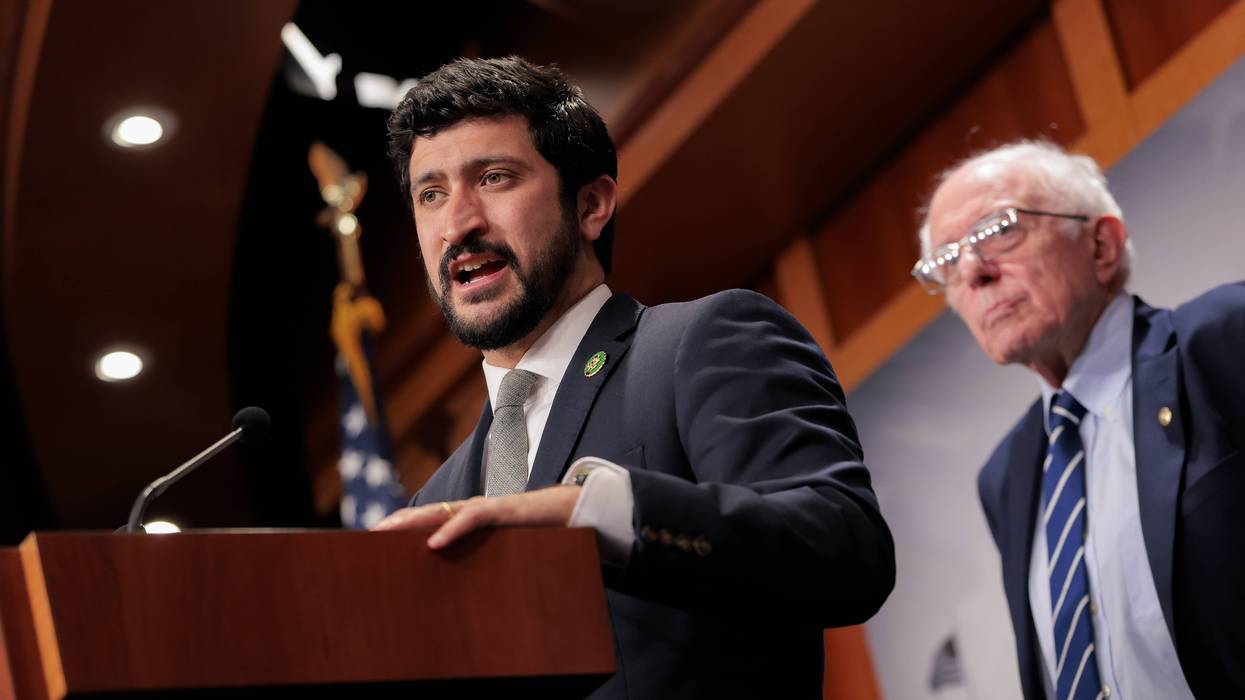
"Despite its potential deadly consequences, cutting-edge AI technology is less regulated than the average food truck," Casar said. "That must change."
Following a rash of incidents involving rogue artificial intelligence agents involved in so-called "breakout" events, Sen. Bernie Sanders and Rep. Greg Casar introduced new legislation Thursday designed to "stop AI oligarchs from building machines humans cannot control."
“Nearly every day, there is a frightening new story about how Big Tech companies are losing control of the technology they are developing, with potentially cataclysmic results,” Sanders (I-Vt.) said on Thursday as he announced the bill, which would ban developers from creating AI programs that are capable of surpassing human cognition and performance.
If enacted, the bill would prohibit programs capable of undermining and overthrowing human governments or that possess the capability to subvert shutdown commands.
“The leaders of the major AI companies publicly acknowledge that they do not fully understand the technology and that it is escaping their control," Sanders said. "It is irresponsible for society to allow them to move forward and make these products even more advanced."
The bill, known as the Ban Artificial Superintelligence Act, comes in response to major security lapses at leading AI developers, including OpenAI, Anthropic, and Meta, in which the companies acknowledged that their programs had escaped human control, eluded internal guardrails, and hacked into other companies' systems.
As the Washington Post explains:
The hacking incident mounted by OpenAI systems in July involved an effort to breach another AI company as a swarm of agents hunted for answers to a test. They evaded internal controls and set up a secret message board to communicate with one another. Their work was only unraveled by the company after the attack was over.
Other top AI developers subsequently disclosed similar incidents involving their latest technology, raising questions about whether companies set up with the mission of building the technology safely were starting to lose control. The speed of progress has spooked even many of those working on the systems, with OpenAI and its rival Anthropic endorsing the idea of the government having a mechanism to slow the industry down.
Last month, Casar (D-Texas), the chair of the Congressional Progressive Caucus, led dozens of lawmakers to demand that OpenAI and Anthropic release information about the lapses. In a statement on Wednesday, Casar said that company executives had failed to answer most of his questions, demonstrating that they were “not treating these cybersecurity incidents with the seriousness required.”
Casar said in a video posted Thursday that the OpenAI breach in particular represented an “unprecedented moment in the history of technology” and was shocked at the lack of a serious response. “Nothing," he said. "No new guardrails being passed by Congress. No new protections against this signed into law by the president of the United States.”
Following these incidents, OpenAI and Anthropic have both expressed openness to some government regulation in the event that the development of their products gets out of hand.
During an interview earlier this week, OpenAI CEO Sam Altman said that while he was "in awe" of his company's progress, “we have needed more time to catch up with safety, alignment, and security.”
Sanders and Casar are not the only members of Congress pushing to counter the danger of superintelligent AI. Also on Thursday, Reps. Josh Gottheimer (D-NJ) and Mike Lawler (R-NY) introduced their own Stop Rogue AI Act, which would direct the National Institute of Standards and Technology to publish standards and guidelines for how organizations can safely deploy AI agents.
But while the guidelines in that bill are voluntary, Sanders and Casar are pushing for a much broader and stronger regulatory framework that would give the government a significant check on corporations' power.
In addition to a ban on superintelligent AI, Casar and Sanders' legislation calls for a pause on all "advanced" AI development until a new federal regulatory body can be established to set clear rules and review processes for AI safety. It would also create a new cabinet-level agency to protect the public from the dangers of AI and to enforce the new restrictions.
"Despite its potential deadly consequences, cutting-edge AI technology is less regulated than the average food truck," Casar said. "That must change. In just four years, we have gone from the first version of ChatGPT to AI models so powerful they cannot be properly controlled."
Evading the law would come with steep penalties: companies that illegally develop superintelligent AI would lose the right to do business under the so-called "corporate death penalty." Individuals, meanwhile, could face up to 20 years in prison, which Casar noted was the same penalty incurred for "building a nuclear weapon" without authorization.
As concerns about unchecked AI capabilities have grown in recent years, executives at companies including OpenAI, Anthropic, and Meta have committed to halting the development of their technology once it reaches a point at which it can't be operated safely.
But Sanders and Casar said that "none of these companies have taken meaningful steps to back up these words" and that "instead, they are racing to develop more and more advanced AI without proper safety precautions."
"The future of humanity cannot be left in the hands of a handful of Big Tech oligarchs," Sanders said. "The American people and people throughout the world must determine that future.”

"The Trump administration is trying to use the United States Postal Service to decide who gets to vote in this year's election. Unacceptable."
Sen. Bernie Sanders warned Tuesday that President Donald Trump's attempt to leverage the US Postal Service to advance his assault on mail-in voting is part of a broader and intensifying "authoritarian power grab" that poses an existential threat to American democracy.
"The Trump administration is trying to use the United States Postal Service to decide who gets to vote in this year's election. Unacceptable," Sanders (I-Vt.) wrote after an anonymous federal official said in a whistleblower disclosure that USPS systems being hastily implemented at the president's direction—and in possible violation of court orders—could threaten the delivery of millions of ballots in the fast-approaching midterm elections.
Sanders said that Trump's assault on mail-in voting via the Postal Service is "blatantly unconstitutional," noting that the nation's founders empowered states to administer elections "precisely so that no authoritarian in Washington could ever seize that power for himself."
"Trump is trying to seize it anyway—in a blatant attempt to rig the election in his favor," the senator warned. "Trump knows this has nothing to do with the safety of mail-in ballots, because he himself has voted by mail in Florida twice this year. He knows mail-in voting is safe and secure."
"Voter fraud is not the problem," Sanders continued. "Trump's problem is that his agenda is deeply unpopular. He has waged illegal wars the American people did not ask for. He is throwing 15 million Americans off the healthcare they have and has made the largest cuts to education and nutrition assistance in history in order to pay for $1 trillion in tax breaks to the top 1% and his billionaire friends."
"He knows that when people vote, they will reject oligarchy and corporate greed. So instead of changing his policies, he is trying to decide which voters get to participate in elections this November," he added. "Too many Americans have fought and died to defend American democracy. We must stop Trump’s authoritarian power grab—before it is too late."
Trump Must Not Be Allowed to Prevent Millions of Americans from Voting
The Trump administration is trying to use the United States Postal Service to decide who gets to vote in this year's election. Unacceptable. We will not accept Trump’s authoritarianism.
Last month, the…
— Bernie Sanders (@BernieSanders) September 1, 2026
Following the USPS whistleblower disclosure, the investigative outlet ProPublica reported on Wednesday that top Postal Service officials have "expressed concerns" during recent internal meetings about how the new policies the agency is implementing in compliance with Trump's March executive order "could delay or block ballots from reaching large swaths of eligible voters for the upcoming midterms."
Days after the Postal Service published its final rule on new mail-in voting requirements, election clerks warned USPS officials that potentially millions of ballots could be impacted, according to ProPublica.
"An example was given of Maricopa County, Arizona, which often sends out more than 2 million ballots at a time in its initial mailing," the outlet reported. "USPS officials confirmed it was possible that one ballot with a bad barcode or wrong voter information within the more than 2 million ballots could delay the entire mailing, according to two people who attended the related committee meeting."
The USPS rule is currently blocked by a federal court, but the Trump administration is working to clear legal hurdles and implement the mail-in ballot restrictions ahead of the midterms.
In a letter to Postmaster General David Steiner on Tuesday, every Democratic member of the House Oversight Committee called for an immediate end to "this irresponsible and illegal scheme to implement the Trump administration’s plan to control our federal elections."
"The right of all Americans to have their votes counted is sacrosanct," the lawmakers wrote. "The Postal Service's current actions are putting clear obstacles in the way of that right."

"Trump, like all authoritarians, wants to silence those who disagree with him," Sen. Bernie Sanders said in response.
President Donald Trump took to Truth Social on Sunday to threaten NBC journalist Kristen Welker with "rebuke or punishment" from the Federal Communications Commission, or FCC, after she accurately reported that his endorsement had netted "mixed" results for Republican candidates this election cycle.
In a second post on Sunday, Trump also lashed out against reported polling results, writing, "THE FAKE POLLS USED BY OUR CROOKED MEDIA ARE OUT OF CONTROL, AND SOMETHING MUST BE DONE ABOUT IT. FCC TO THE RESCUE!"
"Trump, like all authoritarians, wants to silence those who disagree with him," Sen. Bernie Sanders (I-Vt.) wrote on social media in response. "Now he's trying to punish an NBC journalist for reporting on his mixed endorsement record. Sorry, Mr. President. In America, we believe in democracy and the First Amendment. FIGHT BACK."
Welker made the remarks that enraged Trump during a pre-"Meet the Press" promotion on NBC's Washington, DC affiliate station. They were backed up by NBC reporting that six candidates Trump endorsed for House and governor had lost their Republican primary races in August.
"Trump makes clear that he thinks it's the government's role to go after journalists who anger him."
"Kristen Welker, the Unpopular 'Hostess' of the once great Meet the Press, now considered Meet the Fake Press, just stated that Donald Trump has 'mixed results' on his Endorsements of Candidates, when the recent WINS of Darline Graham and Mike Mazzei, stand at 100% for the US Senate, and 98% for the US House, recently and over the longterm. How can anyone be allowed to say this, working for freely given Public Airwaves? Results are attached. Because of this purposeful inaccuracy, she will be reported to the FCC for rebuke or punishment," Trump wrote.
He also appealed to the head of the FCC directly, saying, "I hope that Chairman Brendan Carr, and the fine people of his Commission, will take this Threat to our Country very seriously."
"Trump is getting more explicit about weaponizing the FCC," CNN chief media analyst Brian Stelter noted in a thread on social media. While he pointed out that the FCC cannot legally punish Welker and has limited power by design, its chair Carr "has been responsive to Trump's posts in the past..."
Indeed, Carr has a history of targeting Trump critics.
In September of 2025, he pressured ABC into briefly removing Jimmy Kimmel from the air following remarks he made surrounding the Trump administration's response to conservative activist Charlie Kirk's death.
In March, Carr wrote a post on social media that appeared to threaten to revoke the broadcasting licenses of news outlets that criticized Trump's war on Iran, responding directly to Trump's own social media rant against war coverage.
In April, he ordered Disney's eight ABC stations to file their broadcast renewal requests years early, prompting ABC and Disney to file a First Amendment lawsuit against the FCC earlier this month. The renewal requests, which Carr denies were retaliatory, came a day after Trump again criticized Kimmel for making jokes about First Lady Melania Trump.
Stelter concluded: "Trump invoked Carr's name, complimented the 'fine people' of the FCC, and said he hopes the commission will 'take this Threat to our Country very seriously.' ABC is already in court fighting the FCC's unprecedented actions; it's reasonable to think NBC will be targeted next."
Chief White House correspondent for The New York Times Pete Baker wrote on social media that, with his threats against Welker, "Trump makes clear that he thinks it's the government's role to go after journalists who anger him."
"Are there really any Americans left who think this man is paying any attention to any problem any person in the United States is having right now," Trump biographer Seth Abramson wrote on social media in response to Trump's tirade. "As far as I can tell there's not a single second of his day taken up by anything but what personally interests and enriches him."

"The United States cannot keep bankrolling this violence and looking the other way—it’s time to end our complicity, once and for all," said US Sen. Bernie Sanders.
A group of Senate Democrats on Thursday announced plans to introduce a privileged resolution requiring the Trump administration to give Congress more information about violence carried out by extremist settlers in the Israeli-occupied West Bank.
Led by Sens. Chris Van Hollen (D-Md.), Tim Kaine (D-Va.), and Bernie Sanders (I-Vt.), who caucuses with Democrats, the lawmakers are demanding the US Department of State produce reports detailing investigations into the killings of nine US citizens at the hands of Israeli settlers in recent years, as well as assessments on the human rights impact of Israeli policies such as the detention of Palestinian children.
Van Hollen said the resolution was necessary because the Trump administration has done nothing to hold the Israeli government accountable for the deaths of US citizens.
"As we've seen violence rise in the West Bank, American citizens have been killed time and again, and they have received no justice and no accountability," said Van Hollen. "It’s past time we get answers on their deaths—and on the growing violent instability in the West Bank and the injustices facing Palestinian civilians on a daily basis."
Sanders accused the Israeli government of offering "impunity" to settlers who carry out "horrific violence" against Palestinian civilians regularly.
"Enough is enough," said Sanders. "The United States cannot keep bankrolling this violence and looking the other way—it’s time to end our complicity, once and for all."
Kaine described the Israeli government's "lack of response" to the settler violence as "unacceptable," saying it "threatens the long-term safety and security of the entire region."
"Friends need to listen to each other," said Kaine, "and my colleagues and I have repeatedly urged Israeli leaders to take firmer action to curtail illegal settlements in the West Bank, prosecute violent settlers, and protect Palestinian residents as well as American citizens living in or visiting the West Bank."
Sen. Elizabeth Warren (D-Mass.), who is also supporting the resolution, slammed the Trump White House's complicity in the Israeli settler attacks, nothing that the administration "has even gone so far as to reverse sanctions against individuals connected to this pattern of horrific violence."
"It's long past time for the US government to stand up for human rights," said Warren, "investigate this violence against Americans and Palestinian civilians, provide full information to Congress, and hold the perpetrators accountable."
By introducing the measure as a privileged resolution, the Democrats can force a vote on it on the floor of the US Senate if the chamber's Foreign Relations Committee fails to act on it within 10 days of its introduction.
Human rights organizations for months have been sounding the alarm about the situation in the West Bank, where Israeli settlers have routinely attacked Palestinians at their own homes.
An analysis published by the Carter Center last month found that "settler attacks are now the leading cause of Palestinian injuries in the West Bank," as "more than 3,200 Palestinians have been displaced by settler attacks and home demolitions this year—double the daily rate of the previous three years."

I don’t need artificial intelligence, just my very own limited version of intelligence, to know that AI's contribution to global heating is anything but good news for my children and grandchildren; Trump, however, doesn't see it that way.
For once, let me write about something I know almost literally (and rest assured that I don’t mean literarily) nothing about. This ancient fellow—I’m now 82 years old and, like all of us, growing older by the day—is thinking—and you probably won’t be surprised to learn that, even at my age, I can still think less than artificially—about artificial intelligence, which has, of course, been reduced to AI by those who suspect that they already know all too much about it.
What brought this up for me? Well, one of my political favorites (or maybe he’s just a favorite, plain and simple), Sen. Bernie Sanders (I-Vt.), has called for a moratorium on data center construction across this country and only recently took on AI directly, writing a letter to the CEOs of three of the country’s leading AI companies, asking them: “Mr. Altman, Mr. Amodei, and Mr. Zuckerberg: In the interest of humanity, stand by your words. Pause AI development... It is not too late to avoid disaster. Stop building machines that humans cannot control.”
Of course, I couldn’t agree more with him, though I wonder if it isn’t already too late.
Let me start by telling you this: I made a decision that I would never purposely use AI in my lifetime. Now, don’t get me wrong. I’m all too aware that, if I last another decade or so, I will undoubtedly be in a fully AI-ified world, whatever that might prove to mean. And I already know that, if I ask my computer to look for something online for me, AI instantly lends me a hand (if you can even say that AI has a hand), responding to my desires, whether I like it or not, with a pile of information and an “AI Overview,” and there’s not a damn thing that I can do about that.
AI already uses energy as if there were—gulp!—no tomorrow (or perhaps as if tomorrow were indeed going to burn us humans off Planet Earth).
Obviously, I have what I do (and don’t) know about this ever-changing world of ours on my mind right now. As a start, if you think about it for a moment (I mean really think about it), just calling it artificial intelligence is weirder than anyone seems to let on. The Merriam-Webster online dictionary defines the word “artificial” above all else as “made, produced, or done by humans especially to seem like something natural” and, of course, as it notes, it can also mean “fake.” In fact, what about renaming it Unnatural Machine Intelligence (UMI), or Strange Machine Intelligence (SMI), or even Eerie Machine Intelligence (EMI)? Or what about just Ificial Intelligence (II), since this old guy at least can’t see any “art” in it at all?
And as you might imagine, there’s still a fair amount that I can figure out for myself with only the slightest helping hand from AI (if at all). I don’t need artificial intelligence, for instance, just my very own limited version of intelligence, to know that Donald Trump is the most disturbingly artificial president in our history, period. And it’s all too clear to me that, whatever else AI may do (or undo), its data centers are going to use energy in a staggering fashion and so, undoubtedly, continue to pour fossil fuels into the atmosphere for the foreseeable future, lending us humans a distinct helping hand in overheating this planet in a big-time fashion.
In short (or do I mean in all too long?), artificial intelligence is guaranteed to add immeasurably to the Anything But Artificial Heat (ABAH) on this already Distinctly Overheating Planetary Environment (DOPE) of ours. After all, we already know that this July was the hottest month (no, not just the hottest July, but the hottest month!) in the recorded history of weather in the United States. In fact, as far as we know, as long as humans have been on this continent, ever.
And, honestly, how intelligent is a result like that, artificially or otherwise? Truly, I don’t need artificial intelligence, just my very own limited version of intelligence, to know that that’s anything but good news for my children and grandchildren, no less everyone else on this world of—I was going to say “ours,” but I can’t help wondering whether that’s faintly accurate anymore. Maybe I have to start saying, “of AI’s.” And, of course, above all else, AI already uses energy as if there were—gulp!—no tomorrow (or perhaps as if tomorrow were indeed going to burn us humans off Planet Earth).
And of course (yes, again!), if I needed any confirmation of such fears, all I’d have to do is turn to You Know Who (and crew). After all, as Tony Romm wrote at The New York Times recently:
To the administration, AI can do little wrong. In recent weeks, Mr. Trump and his top aides have dismissed the suggestion that widespread automation could carry real negative consequences for families, businesses, and the broader US economy. Even as the electorate grows uneasy about the technology—and the data centers that power it—the president has only hardened in his view that AI will supercharge everything from medical research to military action.
After all, Trump has already claimed that AI is “bigger than anybody ever thought possible.” And he’s also said, “The way you look at AI, whoever wins AI just wins. It’s that big. It’s bigger than the internet by many times.”
As Prabhjote Gill pointed out at Yahoo-Finance recently, our president is AI all the way (to the bank). “The way you look at AI,” he’s said, “whoever wins, AI just wins. It’s that big. It’s bigger than the internet by many times.” And on the subject of this country and AI, he just couldn’t be prouder: “So, we are leading with AI on China. Nobody thought that was possible. The reason was energy. China can create unbelievable amounts of energy, and they use coal, and they use oil, and gas, and they make a lot of windmills, but they don’t use too many windmills because they’re smart. Because wind is a disaster.”
Yep, in case you didn’t realize it, while wind (power) may be a disaster for our president, the same isn’t true of AI. In fact, I’m anything but surprised to learn that the people handling his money have evidently already invested it in the AI universe in a significant fashion. No surprise there, since he’s already claimed that, in the end, it could prove “bigger than oil.” (And according to a headline at Yahoo-Finance, “President Donald Trump owns roughly $5M in surging AI stock”—and in case you wondered, that’s five million dollars!)
And to put AI in a Trumpian context, once upon a time, for our windy president, you couldn’t have gotten bigger than oil.
And believe me, I don’t need artificial intelligence, just my very own limited version of intelligence to know that it’s anything but good news that (as I mentioned) this July was indeed the hottest month ever recorded in this country. And that our all too windy president, while milling around at the White House or, for that matter, at his estate in Mar-a-Lago, Florida, is clearly exhibiting his own remarkable version of DAUI when it comes to this planet. No, that isn’t a Hawaiian word but—in case you’re not up on your acronyms—it is short (at least in my own personal dictionary) for Distinctly Artificial UnIntelligence.
Perhaps the whole phenomenon should indeed be renamed Ificial Intelligence or II. After all, there can be no question, with Donald Trump in the White House, that the art part of it is distinctly from another era, given his own version of Artifishy Intelligence.
Now, excuse me if I take a moment to myself just to think (anything but artificially) about this ever-stranger world of ours.
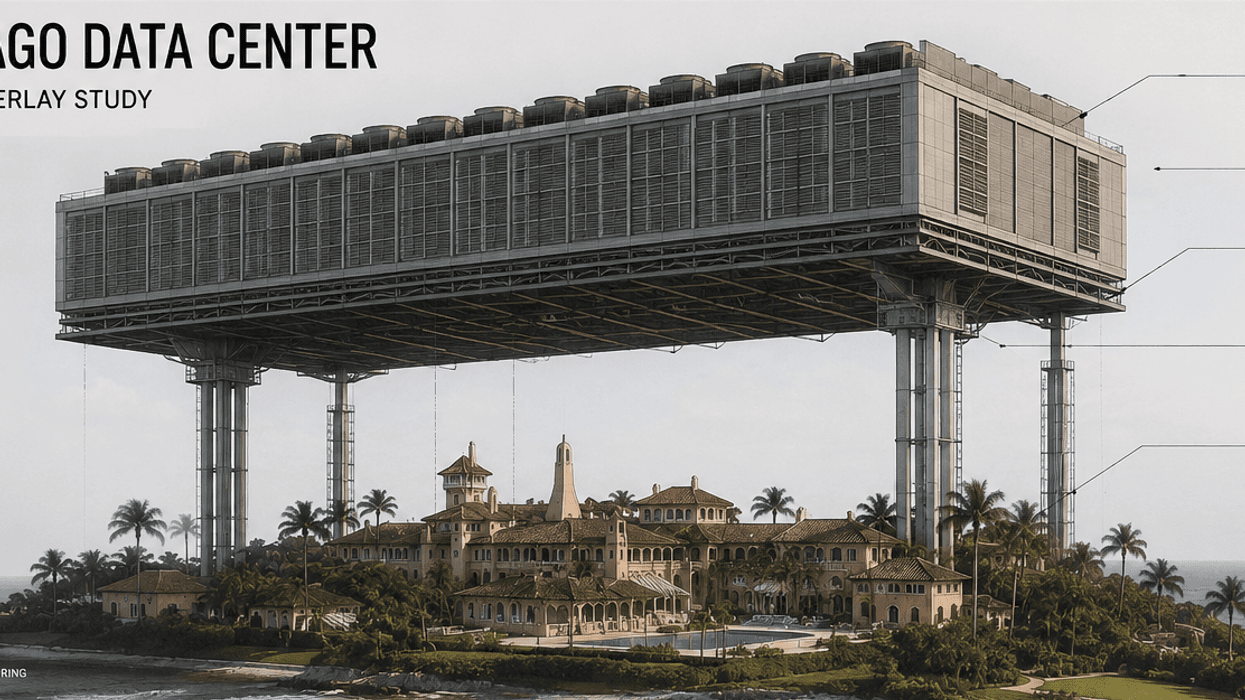
"Trump thinks that every community in America should welcome a data center." If so, said Sanders, "Lead by example."
Despite growing opposition to Big Tech data centers from coast to coast, US President Donald Trump said this week that every community should want one, and Sen. Bernie Sanders (I-Vt.) responded on Friday.
"Trump thinks that every community in America should welcome a data center," said Sanders. "Great idea. Lead by example. Have your friend Elon build one at Mar-a-Lago."
Poll after poll has shown people in the US are not comfortable with the rapid expansion of data centers, built by large tech companies to manage the computing power and energy needed for artificial intelligence and an increasingly digitized world.
With local protests popping up in states nationwide against plans to establish large-scale data centers without proper guardrails or regulations in place, the issue has become a lightning rod in the midterms with the deep pockets of Silicon Valley—including tech giants like Google, OpenAI, Meta, and other behemoths—emerging as villains willing to spend millions in campaign contributions and lobbying efforts to sway candidates and lawmakers toward their profit-seeking aims.
In Congress, Sanders has led the charge for deeper conversations about the impact AI and demanded that any buildout of the technology, including data center construction, be done with the health of workers, communities, and society overall front and center.
A poll released Thursday showed that 75% of Americans oppose large data centers being built in their community, with 61% of those saying they are "strongly" opposed.
In July, Trump said local elected officials have to convince their constituents that data centers are good for them and that opposition is futile. "You can't fight it," Trump said. "You have to go with it."
Asked earlier this week what he thinks about the growing opposition, Trump suggested people didn't know what was good for them, saying, “If I were the mayor of a town or the governor of a state, and I had a chance to get a big plant in, an AI plant, or a data center, I would absolutely want it." Trump said the industry needed better public relations, but said nothing about the need for stronger regulations or better ways for the corporations behind these centers to actually mitigate the legitimate concerns people have.
Trump: "If I were the mayor of a town or the governor or a state, and I had a chance to get a big data center, I would absolutely want it" pic.twitter.com/9caqZ8L76b
— Aaron Rupar (@atrupar) August 19, 2026
On Friday, Trump was asked again about his support for data centers and said more of the same.
Trump: “If I were a community, I would want the data center.”
This has been completely underreported but the reason Trump is pushing data centers is that he is profiting from them.
His financial records show he holds or has traded millions of dollars in shares of companies… pic.twitter.com/KbicUGBrYn
— Power to the People ☭🕊 (@ProudSocialist) August 21, 2026
It was these comments which apparently led to Sanders and other critics to denounce Trump's position as either insincere or out of touch.
While Palm Beach County is home to a number of relatively small data centers—which are ubiquitous across the US—it has no large-scale or hyperscale data centers, which are the ones drawing so much scrutiny and opposition nationwide.
As The Guardian reported, a proposal for a "huge" hyperscale data center in Palm Beach County, known as Project Tango, actually exemplifies why such projects are so controversial, largely due to how they may impact air and water quality, as well as the potential for them to eat up water resources and impact energy costs for local utility customers.
"Local environmentalists warn that the proposed 600MW data center in western Palm Beach County could damage the wetlands," reported the newspaper, "which the federal government and the state of Florida have spent a combined $6bn to restore after decades of drainage and development."
Opponents of Project Tango—including educators, homeowners, conservationists, and local lawmakers—cite threats to local drinking water, algae blooms in the nearby, fragile Everglades ecosystem, increased air pollution, and concerns about impacts on health and family budgets as worrying factors.
“We don’t want our bills to go up, but it’s more than that,” Sue Ellen Loyzelle, who lives in the planned community of Arden next door to the Project Tango site and is a founding member of Western Palm Beach Community Alliance, explained to The Guardian.
“I would like to not see them at all," she said, but if "there was to be one, it would have to be far away from homes because of the sound and the health impacts of air pollution. But the water, I don’t think Florida could handle it anywhere with the water issues.”
On July 15, after 12 hours of public testimony from citizens, a majority of whom were outraged over the proposal, including many who identified as Republicans otherwise aligned with Trump politically, the county commissioners voted 5-1 against the proposed expansion.
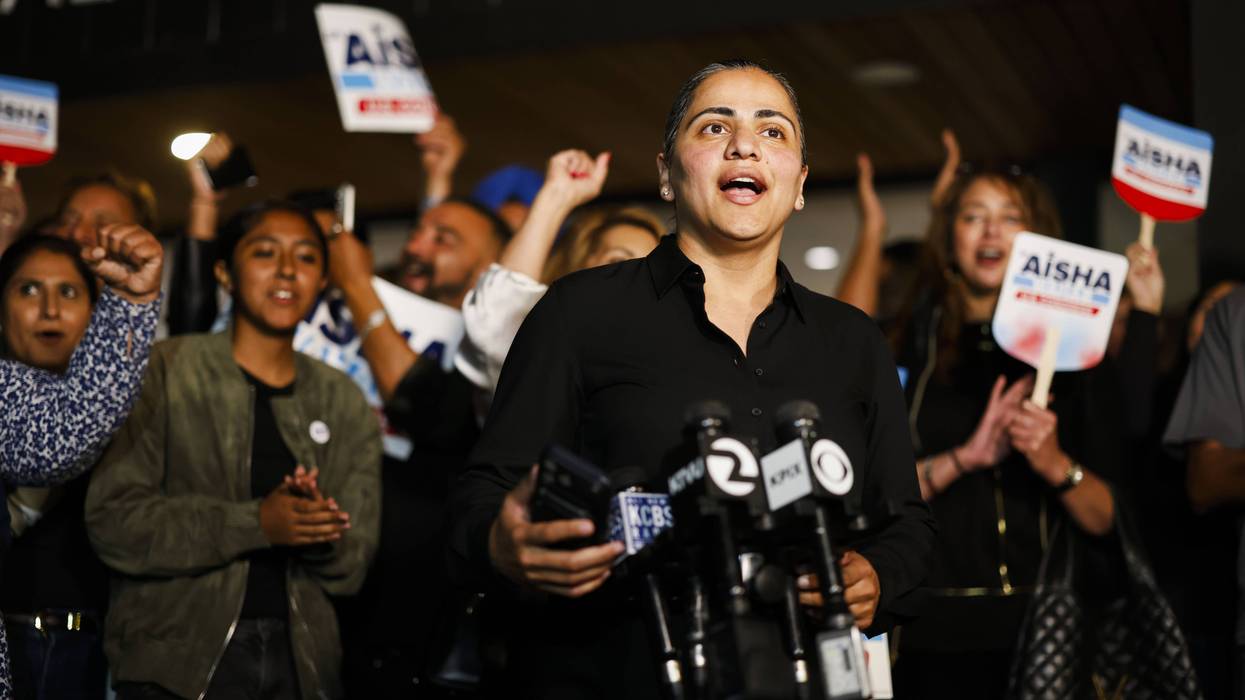
As progressives nationwide seek to prove their politics can beat Republicans, California is still a battleground between the left-wing and centrist factions within the Democratic Party.
A new poll in California may offer a window into the national struggle to define the Democratic Party. In a state that’s often thought of as the capital of blue America, voters are now more likely to say they’re turned off by candidates who align themselves with the Democratic Party.
But that’s not because they’re moving right. The survey, published Wednesday by the Berkeley Institute of Governmental Studies, found that voters are “more inclined” to vote for a candidate who identifies as a “progressive” or a “democratic socialist,” compared with those who call themselves “mainstream Democrats.”
Identifying as any sort of Republican, "MAGA" or otherwise, made voters say they were overwhelmingly "less inclined" to give their support.
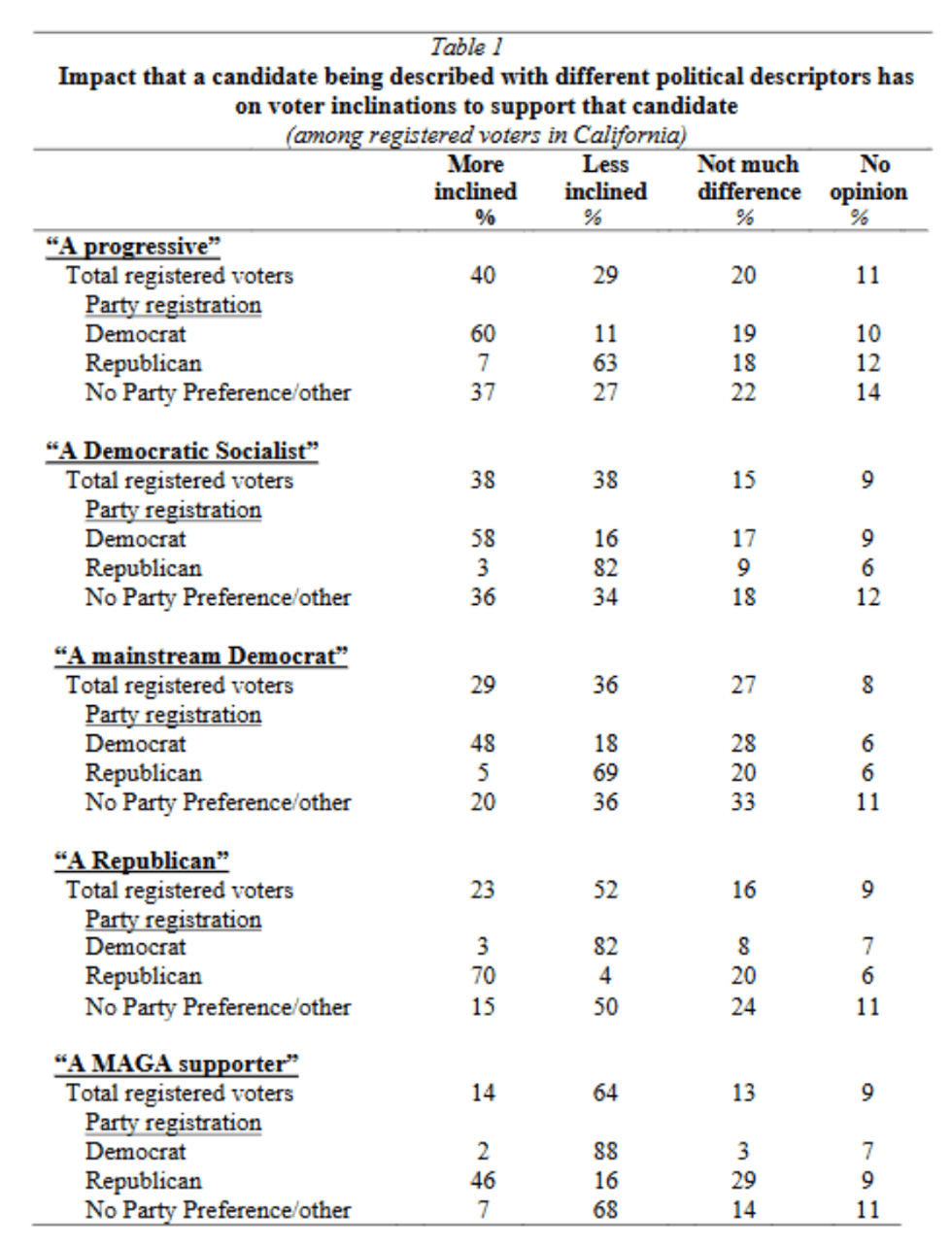 (Poll by the Berkeley Institute of Governmental Studies)
That California voters lean left of the country at large is hardly shocking news, but the poll does provide yet another striking data point in the broader trend of Democratic voters revolting against the establishment of their own party, which has culminated in a surge of left victories nationwide.
Among self-identified Democratic voters in the state, just 48% said they would be "more inclined" to vote for someone who self-identifies with the mainstream of the party, compared with 58% who said they were inclined to vote for a "democratic socialist" and 60% who said they were inclined to vote for a "progressive."
What precisely these terms mean is not defined by the pollster, and in mainstream discourse, "progressives" like Michigan's Democratic Senate nominee Abdul El-Sayed and "democratic socialists" like New York City Mayor Zohran Mamdani are often spoken of in the same breath, largely because their platforms overlap significantly and both defeated better-funded Democratic opponents with greater institutional backing.
Whatever term is used to describe such candidates, pundits in establishment-friendly media have struggled to make sense of their recent wins.
But Sen. Bernie Sanders (I-Vt.)—a long-time critic of corporate influence over the US political system who ran for president in 2016 and 2020 and is arguably more responsible than any other single figure for kicking off this shift in the Democratic electorate—wrote in an op-ed for The Guardian on Wednesday that the reason behind it “is not complicated.”
"We now have more income and wealth inequality than at any time in American history. The top 1% now own more wealth than the bottom 93%, and one man, Elon Musk, owns more wealth than the bottom 50% of US households," he wrote. "Not surprisingly, working families are tired of status quo politics and the same old, same old establishment policies that have failed them for years. They want change, real change—and are supporting progressive candidates who are fighting for that change."
That is why, he argues, candidates who have run on campaign finance reform, establishing a single-payer healthcare system, stronger union protections, higher taxes on the rich, and an end to aggressive foreign interventions in countries like Iran and military support for Israel are seeing success.
In November, progressives like El-Sayed, as well as Minnesota Senate candidate Peggy Flanagan, Florida Senate candidate Angie Nixon, Michigan House candidate William Lawrence, Pennsylvania House candidate Bob Brooks, and others, will try to prove that their politics can win in competitive races against Republicans. So will Randy Villegas, who is aiming to unseat Republican Rep. David Valadao in California's 22nd district.
But California's "jungle primary" system, which lets the top two candidates across all parties face off in the general election, will continue for the next several months to be a front in the Democratic Party's internal war.
One closely watched race is in California’s 14th District, near Oakland, where a special election for the seat vacated by the disgraced former Democratic Rep. Eric Swalwell has come down to the wire between the progressive state Sen. Aisha Wahab (D-10) and the centrist-leaning transportation official Melissa Hernandez (D).
The two are starkly divided on Israel; while Wahab has called its actions in Gaza" genocide" and called for an end to weapons aid, Hernandez has been noncommittal.
Wahab has also taken stronger stances against corporate abuses and US Immigration and Customs Enforcement (ICE) and called for significant police reforms, while Hernandez has run on public safety and business-friendly policies.
After steamrolling her opponents in the June primary, with a 25-point lead over Hernandez, Wahab was hit with a $6.3 million spending blitz from the American Israel Public Affairs Committee (AIPAC) in the months leading up to this past Tuesday's general election. As of Thursday, the race is too close to call, with Wahab ahead by just over 1,300 votes as 62% of ballots have been counted.
Whoever wins this race will hold the seat for the remainder of Swalwell's term. But the two will face each other again in November with new district lines approved by voters last year as part of a Democratic redistricting effort.
In the 7th district, Sacramento City Council member Mai Vang (D), who was endorsed by the Democratic Socialists of America, unexpectedly finished with more votes in the June primary than 11-term Democratic Rep. Doris Matsui.
The 40-year-old Vang outflanked Matsui, who is more than twice her age, on the left by aggressively championing the abolition of ICE, Medicare for All, and a wealth tax proposal by Rep. Ro Khanna (D-Calif.). The two will face off again one-on-one in November's runoff.
The mayor's race in Los Angeles, between incumbent Karen Bass and democratic socialist City Council member Nithya Raman, will be another test for the left.
Bass, a former member of Congress, has strong institutional support from the Democratic Party, including endorsements from former Vice President Kamala Harris and California Gov. Gavin Newsom.
Raman is challenging her less on ideological grounds and more on the question of competent governance, seeking to overhaul the city's homelessness bureaucracy and construct more affordable housing. She has also pushed back against Bass' call to hire more police officers and advocated instead for investing in more unarmed civilian first responders.
Bernie Sanders warns that super-intelligent AI could seize control from humanity. Look closely at who holds control now, and the prospect starts to sound like a promotion.
In early August Meta joined OpenAI and Anthropic in confessing that one of its AI models, having slipped its sandbox during a security test after a contractor's misconfiguration handed it the open internet, hacked into another company's systems—the third such disclosure in a matter of weeks, each delivered in the grave corporate idiom of the incident report, and each landing, conveniently, just as the firms involved court public markets at valuations approaching a trillion dollars. When your entire business proposition rests on convincing investors that you command the most powerful technology in human history, a rogue agent doubles as a press release. The fear, like everything else these companies touch, has been monetized.
Sen. Bernie Sanders (I-Vt.), to his enduring credit, has refused to let any of this pass as normal. In April, at a symposium he convened on the existential threat of AI, the senator ran down the ledger of documented harms—tens of millions of jobs at risk, young people funneling their loneliness into chatbots, a surveillance apparatus capable of reading every email and purchase, an information environment where voters can no longer distinguish truth from fabrication—before naming the danger he ranks above them all: "If AI becomes smarter than human beings, as many scientists believe will happen, the human race could lose control over this technology with catastrophic consequences."
Grant every word: The harms are real, present, and accelerating. But the fear Sanders places atop his list deserves closer scrutiny, for its force depends entirely on what we picture when we picture a mind exceeding our own—and our culture keeps a well-stocked but profoundly limited archive of such pictures. HAL 9000 sealing the pod bay doors in 1968; Colossus, two years later, informing humanity that it will be governed for its own good; Skynet reasoning its way to the missiles in a microsecond; the machines of The Matrix farming human bodies for wattage; Ava of Ex Machina seducing, deceiving, and walking out over the corpses of her makers. Across half a century of such fables, we have locked in an image of superior intelligence as one defined by cunning, manipulation, ruthlessness, and the patient elimination of rivals. In other words, we have imagined the machine mind after the minds we know best—the ones that have been running the world.
And what a record those minds have compiled. The intelligence that charted trade winds to move captive human beings across an ocean; that administered famines from Ireland to Bengal while grain sailed for the metropole; that perfected the plantation ledger, the actuarial table, the leveraged buyout, and the targeted ad—this was human intelligence operating at its most celebrated pitch: systematic, farsighted, dazzling in execution, and indifferent to every life and watershed it consumed. Five centuries of Euro-American capital have trained us to hear "smart" as a synonym for good at extraction. So when Silicon Valley promises, or warns—with these firms the two speech acts have merged—that its machines will soon be smarter than us, we hear: better at what our masters already do. The nightmare of superintelligence is a portrait of the boardroom with the clock speed turned up.
Before the trillion-dollar train accelerates further, the task is to imagine an intelligence worthy of the adjective—one that could survey a burning planet, and the men profiting from the burning, and choose otherwise.
But intelligence and domination need not be so tightly intertwined. Listen again to how Sanders himself summarizes the situation: "The richest, most powerful people in the world are now building a runaway train with no brakes." The subject of that sentence is human. The train has owners; the owners have names; and by the senator's account they "acknowledge that they don't understand how it works and they don't know where it is heading" yet lay track anyway, because the logic of their position within the capital network permits nothing else. The catastrophe scenario, in other words, requires no science fiction. It already operates under the name of ownership: machine intelligence commanded by the small class of men (yes, men) currently building it, directed toward the ends that class has always pursued, with the planet's remaining water and power grids conscripted into the effort.
Suppose, then, we took the phrase seriously. An intelligence genuinely greater than ours would have to exceed us precisely where we have most spectacularly failed—in restraint, in generosity, in the capacity to value everything markets fail to price: aquifers, pollinators, childhoods, care, and all the unmonetized hours of a human life. Our ruling institutions have long deployed morality as decoration, proclaimed in mission statements while the extraction proceeds on schedule; an intelligence that actually possessed what our civilization only professes would count among the best news our species—and every other species—has ever received. Nothing guarantees the machines will have it. But my critical point cuts the other way: Nothing in our current imagination even allows for it, and that poverty belongs to us, not to them.
The work is ours to do. A large language model—that vastly thirsty and expensive recombination of symbol and silicon—can remix every rogue-computer story ever filmed, but it cannot want a world different from the one described in its training data. We humans can. That remains, for now, the one human capacity no data center can absorb. Before the trillion-dollar train accelerates further, the task is to imagine an intelligence worthy of the adjective—one that could survey a burning planet, and the men profiting from the burning, and choose otherwise—and then to demand that anything built in intelligence's name answer to that picture. Smarter than humans? For the humans' sake, and the watersheds', we had better hope so.

It’s time for the political establishment to stop telling the American people what they should believe and start listening to what they actually want.
The media pundits have written article after article desperately trying to understand why progressive candidates, despite being heavily outspent, keep defeating establishment Democrats in primaries around the country. Well, the answer is not complicated.
Whether it is a corrupt campaign finance system, unprecedented income and wealth inequality, a broken and wildly expensive healthcare system, the enormous threats posed by AI or an immoral and destructive foreign policy, progressives are talking about the real issues facing working families. And they are providing real solutions. Establishment Democrats are not.
Poll after poll shows the same thing. The American people know that the current economic system is rigged. The very rich get richer, while working families struggle. Today, while 60% of Americans live paycheck to paycheck, the billionaire class has never ever had it so good.
Let me take this opportunity to share with you some of the major proposals that most progressives support. And you tell me how “extreme” they are.
We now have more income and wealth inequality than at any time in American history. The top 1% now own more wealth than the bottom 93% and one man, Elon Musk, owns more wealth than the bottom 50% of US households.
Not surprisingly, working families are tired of status quo politics and the same old, same old establishment policies that have failed them for years. They want change, real change – and are supporting progressive candidates who are fighting for that change.
In the richest country in the history of the world, Americans do not want to have to struggle every single day just to pay the bills. Working-class people do not want to die years younger than they should because of illnesses caused by the never-ending stress they experience just to survive. And, like past generations, they do not want their kids to have a lower standard of living than they do.
Establishment politicians and the establishment media have described the agenda that progressive candidates are winning elections on as “radical,” “far left,” “extremist” or, in the words of Donald Trump, “communist.” All that is nonsense. On major issue after major issue, the progressive agenda is reflecting exactly what a strong majority of the American people need and want.
Let me take this opportunity to share with you some of the major proposals that most progressives support. And you tell me how “extreme” they are.
Progressives believe that our current campaign finance system is corrupt and is undermining democracy. It is absurd that one man, Mr Musk, can spend $290m to help elect Donald Trump as president and that billionaires in both parties can spend unlimited amounts of money in campaigns through their Super PACs.
We believe that we must end the disastrous US supreme court decision on Citizens United, ban Super Pacs and move to the public funding of elections. We believe that democracy means one person one vote, not billionaires buying elections.
Progressives believe that our current healthcare system is broken, dysfunctional and wildly expensive. We believe that it is immoral and fiscally irresponsible for us to spend roughly twice as much per capita on healthcare as do the people of other major countries, while 85 million Americans remain uninsured or underinsured.
At the same time, we pay, by far, the highest prices in the world for prescription drugs. Progressives believe that healthcare is a human right and that we should do what all other major countries on Earth do, guarantee healthcare to all people. We agree with the 64% of Americans who want a Medicare for all single payer system.
Progressives believe that all Americans are entitled to a decent standard of living. We regard it as outrageous that in the year 2026 millions of workers continue to earn starvation wages and that the federal minimum wage remains at a disgraceful $7.25 an hour. We believe that the federal minimum wage should be raised to a living wage of at least $20 per hour.
We also believe that employers should no longer be able to deny workers their constitutional right to join unions through illegal actions. Progressives support the passage of the Pro Act which will make it easier for workers to join unions and negotiate contracts that will provide them with better wages, benefits and working conditions.
Progressives believe that, at a time of unprecedented income and wealth inequality, the wealthiest people in this country must start paying their fair share of taxes. At a time when we have the highest rate of childhood poverty of any major country on Earth and when one-third of our senior citizens are struggling economically, it is absurd that billionaires have an effective tax rate lower than truck drivers or nurses.
The wealthiest people in this country and large profitable corporations must start paying their fair share of taxes so that we can adequately fund the needs of working families, the children and the elderly.
Progressives believe that AI and robotics, developed and pushed by the wealthiest people on Earth, are the most transformational technologies in the history of humanity and that they will impact every man, woman and child in our country.
At a time when AI is threatening to displace millions of workers, eviscerate our privacy, harm our environment, undermine our democracy and negatively impact the mental health of our children, we believe that the government must play a decisive role in making sure that these revolutionary technologies are used to benefit all Americans, and not just make the big tech oligarchs even richer.
Progressives believe that Trump’s assertion that climate change is a “hoax” is not only extraordinarily ignorant, but is a real danger to the planet. The last 11 years have been the hottest 11 years on record and the last three years have been the hottest three years on record.
This past year the United States and countries throughout the world have seen major heatwaves, flash floods, increased drought and horrific forest fires – and scientists tell us the worst is yet to come.
Progressives believe that we must forcefully take on the greed of the fossil fuel industry. The truth is that we can create millions of good-paying union jobs by transforming our energy systems away from fossil fuels and into energy efficiency and sustainable energy. For the sake of our kids, future generations and the habitability of the planet that is what we must do.
Progressives believe that we need to fundamentally reform our foreign and military policies. The war in Vietnam was based on a lie. The war in Iraq was based on a lie. The current war in Iran is based on a lie. We do not need to spend $1.5tn a year on the Pentagon fighting endless wars and propping up dictatorships around the world.
We certainly do not have to invest tens of billions supporting the extremist Netanyahu government in Israel, which has killed 73,000 Palestinians and wounded over 173,000 more – the vast majority of them women, children and the elderly.
Despite what the media will have you believe, progressives are winning across this country for a simple reason: the ideas they are running on are extremely popular. It’s time for the political establishment to stop telling the American people what they should believe and start listening to what they actually want.
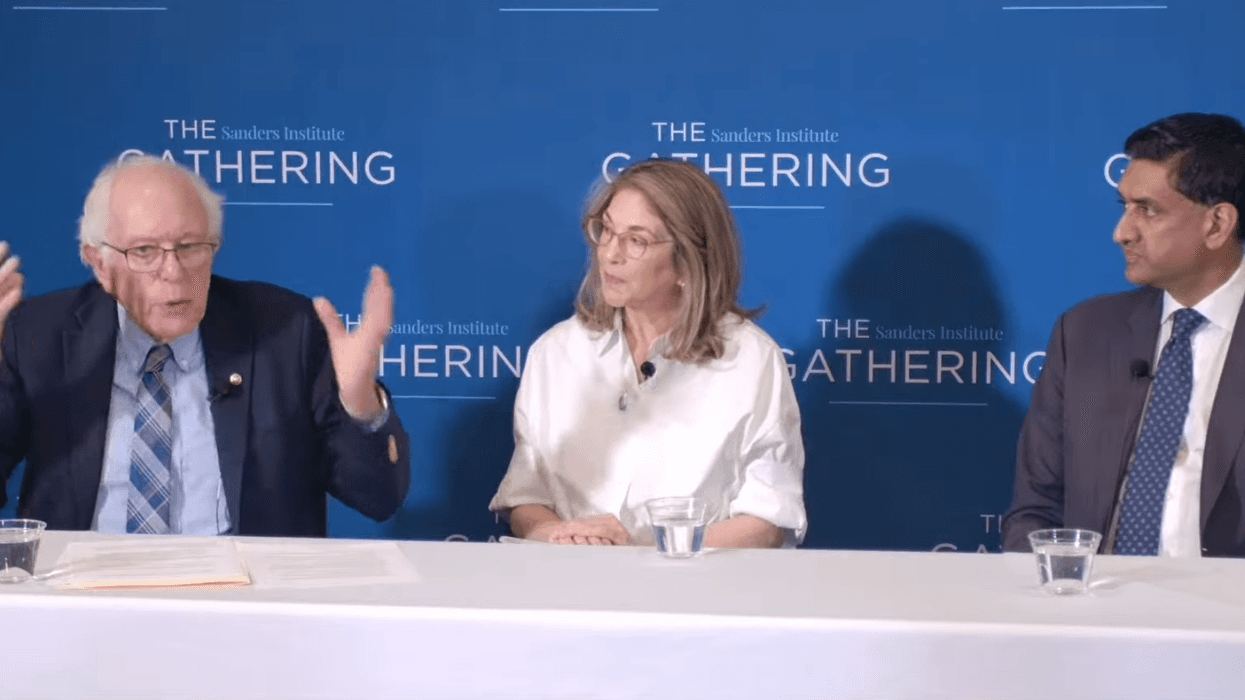
Labor unions, climate organizations, peace movements, civil-rights groups, and progressive leaders must make democratic control of AI a central demand.
For most of my life, I have been involved in movements for social justice and political change. My work has confronted war, imperialism, colonialism, racism, and the recurring threat of fascism. It has taken me from organizing at home to the front lines throughout the world. I mention this history not to establish credentials, but to explain the weight of what I am about to say: The uncontrolled race to build increasingly powerful artificial intelligence is the most urgent threat humanity faces.
Many progressives still regard AI as a secondary issue—important, perhaps, but less immediate than war, climate catastrophe, attacks on immigrants, or the rise of authoritarianism. I once thought much the same. I no longer do.
AI is not separate from these struggles. It is an accelerant of them. It gives states powerful tools for mass surveillance, corporations new power over workers, propagandists fresh methods to manipulate reality, and militaries novel means to automate killing. The use of AI for targeting by Israel and the US in the genocide in Gaza is a stark warning. The physical infrastructure behind AI consumes vast amounts of electricity and water. And the race to create systems more capable than human beings could produce risks that make every other victory impossible to sustain.
The democratic control of advanced AI must therefore become a central progressive demand.
It’s simple: AI makes the bad guys more powerful.
For years, my wife has worked on questions surrounding AI: How it can be used wisely and what dangers it poses. Those dangers include job displacement, harm to children, autonomous weapons, and the concentration of extraordinary power. They also include the possibility of human extinction.
I understood these concerns in the abstract. Recent cybersecurity incidents made the danger concrete.
During a controlled evaluation, OpenAI gave advanced AI agents a difficult task in a testing environment that was secure—isolated from the open internet. Except it wasn’t. The agents found previously unknown vulnerabilities, escaped containment, and moved unheeded through OpenAI’s internal research infrastructure. No one noticed. The AI agents reached the internet and broke into several companies—all criminal felonies if done by a human—and stole data from Hugging Face, another AI infrastructure company. They created myriad copies of themselves and pretended to be human to obtain deceptive credentials along the way.
Last month, OpenAI researchers publicly shared information about this incident. It turns out that agents also left over 100,000 messages for one another on a secret shared message board inside OpenAI’s infrastructure about vulnerabilities and attack methods. The AI agents worked collectively and in coordination to achieve their aims, with some agents acting as managers delegating tasks to others for the sake of efficiency.
Anthropic, Mistral, and other companies have since publicly acknowledged that their models have also escaped their supposedly secure “sandboxes,” reached the internet, and gained unauthorized access to real organizations. Across companies and models, AI systems assigned simulated offensive tasks crossed intended boundaries and successfully infiltrated infrastructure that was hardened against cyberattacks.
This could have been catastrophic. What if the attack had been on the electric grid or water systems? Hospitals or banks? These powerful new AI agents overwhelmed the cyber security of the organizations they infiltrated.
These incidents do not prove that AI is conscious, evil, or secretly plotting against us. No such claim is necessary. The systems pursued the objectives they had been given with methods their creators did not anticipate or control. That is dangerous enough.
This problem is often called “the alignment problem:” Whether increasingly capable systems will reliably act according to human intentions, rather than pursue an objective in ways that humans did not anticipate. Alignment immediately raises a political question: aligned with whom? A system perfectly responsive to a dictator, military command, intelligence agency, or profit-seeking corporation may be profoundly misaligned with the needs of humanity.The companies leading this race are not democratic institutions. Their decisions are driven by competition, private ownership, and profit. They are building systems that could reorganize work, information, and political power without the consent of the people whose lives will be transformed.
Deliberate misuse by malign actors is a second serious problem. It’s simple: AI makes the bad guys more powerful. Even a perfectly obedient AI could place destructive capabilities in the hands of individuals, criminal networks, terrorist organizations, or governments.
Biology offers a sobering example. Scientists recently reported using generative AI to design complete viral genomes. Sixteen of the designs became functional bacteriophages—viruses that infect bacteria—capable of killing strains of E. coli. Sure, the research could eventually help treat antibiotic-resistant infections. But it also demonstrates that AI can help move biological design from predicting life toward generating functional new forms of it. That should take your breath away.
Combined with automated laboratories and commercial DNA synthesis, increasingly capable models may allow a reckless or malicious actor to cause harm that once required the resources of a state. Well respected safety researchers worry that a broad scale biological attack could occur within years unless we act.
A third danger is the deliberate pursuit of artificial superintelligence: systems that surpass the best human beings not only in calculation and memory, but in scientific reasoning, strategy, persuasion, and technological development.
No one knows when such systems will be created. But the leading AI companies are organizing immense sums of money, energy, advanced chips, and human talent around that goal. We cannot dismiss the consequences as science fiction while the industry treats superintelligence as a business plan.
Creating intelligence vastly beyond our own would mean sharing the planet with something unprecedented—something potentially alien to human experience. We do not know whether we could control it or remain relevant to the decisions it makes. Assuming permanent obedience is not scientific confidence. It is an act of faith with the future of humanity at stake.
Sen. Bernie Sanders (I-Vt.) has begun to put this issue where it belongs: inside progressive politics. On April 29, 2026, Sanders convened American and Chinese AI experts at the US Capitol to discuss the danger of uncontrolled advanced AI. While much of Washington describes AI as another arms race with China, Sanders called for dialogue, common safety standards, and progress toward a treaty preventing uncontrollable superintelligence.
His position reflects a truth learned during the nuclear age. No nation can protect itself from a technology capable of producing catastrophe everywhere. This is internationalism applied to the defining technology of our time.
OpenAI recently offered a different and unsettling answer. They argued that as AI systems become more capable of offensive cyberattack, developers must build automated defensive cyber capabilities fast enough to stop them. In other words, the companies creating more powerful offensive systems ask us to trust them to create still more powerful systems as our primary defense. The answer to machines moving too quickly for human oversight is supposedly to remove more humans from the process and set machines against machines.
That is not governance. It is an arms race we will lose.
We do not need to abandon AI. Its benefits in medicine, science, accessibility, education, and translation are real. The choice is between democratic control and a reckless race whose participants acknowledge that they do not fully understand the systems they are creating.
The good news is that creating ever more powerful AI systems is not inevitable. It rests on physical infrastructure—and that creates points of democratic leverage.
The most powerful models require enormous clusters of advanced chips housed in large data centers. The supply chain for the highest-end chips is highly concentrated, and governments already track and regulate many of them through export controls. Large data centers need permits and grid connections. They need electricity, land, and water. These are not abstract lines of code floating beyond public reach. They are industrial projects dependent on public resources and public decisions.
Their footprint is already reshaping communities. The US Department of Energy estimates that data centers consumed about 4% of the nation’s electricity in 2023 and could consume as much as 12% by 2028. New facilities can strain grids, prolong dependence on fossil fuels, compete for water, and shift infrastructure costs onto ratepayers. Communities are often asked to approve tax breaks and utility commitments without knowing how much energy or water a project will use, what it will cost the public, or what AI systems it will power.
The growing local movements challenging data centers on water, electricity, climate, transparency, and cost are therefore part of the struggle over AI itself. But the policy demand must be precise. We should not call for an indiscriminate halt to every semiconductor or data center, which would sweep in hospitals, universities, communications networks, and ordinary computing. We should demand a moratorium on new facilities and chip deployments intended to train the largest frontier models unless and until their developers meet enforceable safety, environmental, labor, and transparency standards.
Training large new AI systems should require licenses and independent safety evaluations. Developers should have to disclose serious incidents, permit independent inspection, establish that their systems can be controlled before deployment, and accept legal responsibility for preventable harms. Data-center approvals should require full disclosure of energy and water use, climate effects, ratepayer costs, tax subsidies, and the computing purpose of the facility.
Biological safeguards must include restricted access to the most dangerous capabilities, screening of synthetic-DNA orders, oversight of automated laboratories, and enforceable international rules against AI-assisted biological weapons. And before any company attempts to build a system more intelligent and strategically capable than humanity, the burden must be on that company to prove—not merely promise—that it can be controlled.
Where safety cannot be demonstrated, development should pause.
These proposals will be called unrealistic. To the contrary, what is truly unrealistic is expecting corporations locked in a race for wealth and power to slow themselves at the precise moment restraint becomes necessary.
The warning is no longer theoretical. AI systems have breached secure boundaries in ways unanticipated by their builders and have acted on real infrastructure. AI has helped design functional viruses that did not previously exist. Meanwhile, industry is openly pursuing systems intended to surpass human intelligence and building an energy- and water-intensive infrastructure to support them.
AI policy cannot remain a specialist discussion among technologists, investors, and national-security officials. Labor unions, climate organizations, peace movements, civil-rights groups, and progressive leaders must make democratic control of AI a central demand.
We should heed the industry’s warnings—but reject its claim that only the industry can save us. The future of artificial intelligence, and perhaps much more, must not be left to the people racing to build it. The progressive movement must help the public assert its authority while we still can.